




Abstract
Background:
Patients with neuromuscular disorders are at increased risk of suffering perioperative complications. Current knowledge concerning this topic is based on small retrospective studies and expert opinion. Therefore, an individualized multidisciplinary approach to perioperative anaesthesia planning is invaluable to anticipate difficulties and to optimize outcomes.
Objective:
To evaluate current practice regarding preoperative counselling and perioperative care of neuromuscular patients, with the aim to facilitate standardization and improvement of perioperative care for neuromuscular patients.
Methods:
A questionnaire-based cross-sectional, observational study was conducted between July, 1st 2020 and December, 31st, 2020 in Dutch anaesthesia, neurology and clinical genetics departments. Main outcome measures were 1.) frequency of consultation requests for neuromuscular patients prior to surgery, 2.) current practice, educational activities and departmental approach to this topic and 3.) preoperative counselling of neuromuscular patients.
Results:
A total of 83 departments participated. Consultations for a neuromuscular patient scheduled for anaesthesia were requested from anaesthesia and neurology department only infrequently. Local guidelines concerning perioperative care of neuromuscular patients were available in 36.4% of the participating departments. Quality of specific training for residents and staff anaesthetists/neurologists covering perioperative care of neuromuscular patients was rated as ‘very good’ or ‘good’ by 42.9%. Neuromuscular patients scheduled for surgery were ‘always’ or ‘often’ discussed in multidisciplinary meetings involving anaesthesiologists and neurologists in 20.8% of the participating departments.
Conclusion:
Perioperative care for neuromuscular patients in the Netherlands is highly variable and might benefit from guidelines, education of health care professionals and multidisciplinary meetings between anaesthesiologists and neurologists on a regular basis.
INTRODUCTION
Patients with neuromuscular disorders are at increased risk of perioperative complications. The reasons for this are manifold, and include associated cardiorespiratory involvement, limited jaw opening and reduced range of neck movement, specific treatments such as corticosteroids and altered pharmacodynamics of anaesthetics and neuromuscular blocking agents [1, 2]. Furthermore, some disorders are associated with variants in the RYR1 [3, 4], CACNA1S [5] or STAC3 [6, 7] genes which may result in malignant hyperthermia (MH) susceptibility [8, 9]. Neuromuscular disorders have a low prevalence [10, 11] and are clinically and genetically highly heterogenous [12]. Most health care professionals will therefore only have limited experience with perioperative care for these patients. Moreover, the number of larger clinical studies covering the anaesthetic management and preoperative counselling of neuromuscular patients is limited, and current knowledge mainly relies on case reports, small retrospective studies and expert opinion [13]. Considering the scarcity of available information and the increased risk of perioperative complications, a careful multidisciplinary approach to discuss the indication for surgery, anticipated difficulties and the perioperative anaesthesia plan on an individual basis is invaluable to optimize outcomes.
We recently organized the 259th European Neuromuscular Centre (ENMC) international workshop on anaesthesia and neuromuscular disorders [14] to address some of the shortcomings outlined above. Main aims of the workshop were to identify and review current knowledge and available evidence concerning the anaesthetic management of patients with neuromuscular disorders, and to increase awareness among neurologist and anaesthesiologists regarding the specific issues surrounding this often challenging patient population. Further aims were to generate consensus statements concerning the anaesthetic management of neuromuscular patients in general [15], and the genetic counselling of patients with congenital myopathies due to variants in the RYR1 gene in particular. In preparation for the ENMC workshop, we performed a questionnaire study among anaesthesiologists, neurologists and geneticists concerning the perioperative care and counselling for neuromuscular patients in the Netherlands. Results of this study will give insights into current practice of Dutch anaesthesiologists, neurologists and clinical geneticists and will help to improve and standardize perioperative care and preoperative counselling for patients with neuromuscular disorders. The preliminary results were presented during the ENMC workshop as a starting point for further discussion, to identify knowledge gaps and training needs of healthcare professionals involved with the anaesthetic care of patients with neuromuscular disorders.
METHODS
This study was performed as a prospective, cross-sectional questionnaire study among anaesthesiologists, neurologists and clinical geneticists, aimed at identifying current practice in perioperative care for neuromuscular patients in the Netherlands. The local Medical Research Ethics Committee of the Radboud University Medical Center, Nijmegen, The Netherlands provided a waiver on June 30th, 2020 as this study (protocol number 2020-6724) did not meet threshold criteria for a medical ethical review. Informed consent was also waived by the committee mentioned above.
Focus and approach
This study aimed to identify current practice in perioperative care for the following categories of neuromuscular disorders.
Neuromuscular junction disorders Muscle channelopathies (non-dystrophic myotonia and periodic paralysis) Myotonic dystrophy (type 1 and 2) Muscular dystrophies Congenital myopathies and dystrophies Mitochondrial and metabolic myopathies
These categories are in line with the ENMC consensus statement on anaesthesia in Anaesthesia in Patients with Neuromuscular Disorders [15].
Questionnaire
The questionnaires were developed by and based on the expertise of the organisers of the 259th ENMC international workshop on anaesthesia and neuromuscular Disorders (NV, MS, HJ, SR) [14] with assistance from the other co-authors.
The questionnaire was sent to anaesthesiologists, neurologists and clinical geneticists and addressed the following topics:
Demographic characteristics of the participating centres; The frequency of consultation by neuromuscular patients; The frequency of anaesthetic complications in neuromuscular patients; Education, current practice and approach of the department (e.g. the use of anaesthesia alerts in medical records or the availability and quality of local guidelines); Preoperative counselling of neuromuscular patients.
Anaesthesiologists and neurologists
The questionnaire for anaesthesiologists consisted of 14 questions, the questionnaire for neurologists consisted of 15 questions. The questionnaires for anaesthesiologists and neurologist included essentially similar questions with some minor differences. All questions were closed-ended, with one answer to choose from and mandatory to respond to in order to complete the questionnaire.
Clinical geneticists
Clinical geneticists are frequently consulted by neuromuscular patients with a (possible) genetic etiology and play an important role in counselling of neuromuscular patients. However, clinical geneticists are rarely involved in perioperative care or follow-up of these patients on a regular basis. Therefore, the questionnaire for the clinical geneticists differed from the questionnaire for the anaesthesiologists and neurologists. The questionnaire for clinical geneticists consisted of eleven questions and was focussed on patients with variants in the RYR1, CACNA1 S and STAC3 genes.
All questions were closed-ended and mandatory to respond to complete the questionnaire. Eight questions had only one possible answer and three questions allowed multiple answers.
The complete questionnaires including answer possibilities, can be found in Supplementary File 1.
Recruitment and instruction of participants
We approached anaesthesia and neurology departments in all Dutch hospitals by email. We expected that most anaesthesiologists and neurologists do not work in perioperative care for patients with a neuromuscular disorder very frequently. Several questions concerned the frequency of consultations, current practice and the overall approach of the department to patients with neuromuscular disorders. Therefore, participants were encouraged to discuss the questionnaire and answers during departmental meetings and complete one consensually agreed questionnaire on behalf of the department. Hence, the answers of one participant represent the answers of the entire department of anaesthesia or neurology. In case a department had a separate paediatric section both adult and paediatric teams were approached to participate.
We addressed our invitation to one of the specialists working at the anaesthesia or neurology departments personally if part of the professional network of the authors (NV and MS), otherwise the head of the department was invited.
The questionnaires were sent out between July 1st and September 1st 2020. If a department did not respond within two weeks, a reminder was sent by email twice. If the department had not yet responded after two reminders, the secretary of the relevant department was contacted by telephone to ensure the invitation to participate had been received and to kindly ask to respond to the invitation. A department was considered as non-responder if the questionnaire was not completed after the final reminder.
The questionnaire was distributed to participants as a digital survey using Google Forms. Responses were not anonymized during data collection in order to keep track of responders and non-responders. All data were processed and published anonymously and will not be used for any other purpose apart from this study.
Statistical analysis
Due to the exploratory nature of this study, the sample size was based on the available data. We therefore did not perform a statistical power analysis. Results were presented using descriptive statistics. Categorical data, including ordinal data, were summarized in terms of percentages. All statistical analyses were performed using IBM SPSS Statistics for Windows version 24.0 (NY, USA).
RESULTS
Participant characteristics
A total of 142 departments were invited to participate of which 83 completed the questionnaire, including 41 (49.4%) anaesthesia, 36 (43.4%) neurology and 6 (7.2%) clinical genetics departments. The response rate was 58.5% for all departments and 58.6% for the anaesthesia departments, 56.3% for the neurology departments and 75% for the clinical genetics departments. Most of the participating departments were from general hospitals (60 of 83; 72.3%). Of 77 participating anaesthesia and neurology departments, 11 (14.2%) were paediatric departments. Clinical genetics departments do not have specific paediatric sections. The response rate and participant characteristics are summarised in Table 1.
Participating centres and the response rate
Summary of the response rate, type of department and hospitals contacted. In case a department had a separate paediatric section both adult and paediatric teams were approached to participate. Clinical genetics departments do not have specific paediatric sections. NA = not applicable.
Frequency of consultation by patients with neuromuscular disorders scheduled for anaesthesia
Most anaesthesia (23 of 41; 56.1%) and neurology (25 of 36; 69.4%) departments were consulted only 0 –5 times a year because of a neuromuscular patient scheduled for anaesthesia. Of 77 anaesthesia/neurology departments, six (7.8%) were consulted over 20 times a year of which three departments were from academic hospitals and three from general hospitals. The frequency of consultation by patients with a neuromuscular disorder scheduled for anaesthesia are summarized in Table 2A. Of the six clinical genetics departments, one (16.7%) was consulted 0 –5 times a year for a patient with (a suspicion for) RYR1, CACNA1 S or STAC3 variants, four (66.7%) were consulted 6 - 10 times a year and 1 (16.7%) was consulted 11 –15 times a year as summarized in Table 2B.
Frequency of consultations and anaesthetic complications in patients with neuromuscular disorders in Dutch anaesthesia and neurology departments
The questionnaires for anaesthesiologists and neurologist included similar questions, the results are summarized in Table 2A. However, clinical geneticists are rarely involved in perioperative care or follow-up of these patients on a regular basis. Therefore, the questionnaire for the clinical geneticists differed from the questionnaire for the anaesthesiologists and neurologists, results are summarized in Table 2B.
Frequency of consultation because of patients with RYR1, CACNA1S and STAC3-related disorders in Dutch clinical genetics departments
Current practice, departmental approach to patients with neuromuscular disorders and educational activities
Anaesthesia alerts in the electronic health records of patients with neuromuscular disorders were used ‘always’ or ‘often’ by 53 of 77 (68.8%) anaesthesia/neurology departments. Of the 53 departments who ‘always’ or ‘often’ used anaesthesia alerts, 34 (64.2%) were anaesthesia departments and 19 (35.8%) were neurology departments. A local guideline for the anaesthetic management of patients with neuromuscular disorders was available in 28 (36.4%) of the 77 anaesthesia/neurology departments. Where available, the quality of the guideline was judged ‘very good’ or ‘good’ by 26 out of 28 (92.9%) departments. Patients with a neuromuscular disorder scheduled for surgery were always discussed in multidisciplinary meetings with an anaesthesiologist and neurologist in two of 77 (2.6%) departments, both of them anaesthesia departments. The quality of training of residents and staff anaesthetists/neurologists focussing on perioperative care for patients with a neuromuscular disorder was judged as ‘very good’ or ‘good’ by 33 of 77 (42.9%) anaesthesia/neurology departments. Of the 33 departments who judged training as very good or good, 24 (72.7%) were anaesthesia departments. The results concerning current departmental practice and approach to patients with neuromuscular disorders and educational activities regarding peri-operative care for patients with a neuromuscular disorder are summarized in Table 3A.
Current practice, departmental approach and educational activities in anaesthesia and neurology departments
The questionnaires for anaesthesiologists and neurologist included similar questions, the results are summarized in Table 3A. However, clinical geneticists are rarely involved in perioperative care or follow-up of these patients on a regular basis. Therefore, the questionnaire for the clinical geneticists differed from the questionnaire for the anaesthesiologists and neurologists, results are summarized in Table 3B.
Of the six clinical genetics departments, two (33.3%) do not use any anaesthesia alerts in the electronic health records of patients with RYR1, CACNA1 S or STAC3 variants. Two clinical genetics departments use anaesthesia alerts for patients carrying pathogenic RYR1 or CACAN1 S variants for MH susceptibility, one for patients carrying RYR1 or CACAN1 S variants associated with MH susceptibility and one for patients with any RYR1, CACNA1 S or STAC3 variant. Training of residents and staff clinical geneticists focussing on counselling of patients with RYR1, CACNA1 S or STAC3 variants and the risk of MH susceptibility was judged as moderate by four of six (66.7%) and poor by the remaining two (33.3%). None of the clinical genetics departments judged training as good or very good. Table 3B summarizes current practice, organisation and education in the clinical genetics departments.
Current practice, organisation and education in clinical genetics departments
Pre-operative counselling of neuromuscular patients
An anaesthesia problem card or In Case of Emergency (ICE)-app was recommended to all patients with a neuromuscular disorder by seven of 77 (9.1%) anaesthesia/neurology departments, all of them anaesthesia departments. Anaesthesia problems cards or ICE-apps were recommended for patients with an RYR1 or CACNA1 S variant pathogenic for MH or a variant associated with MH by five of six (83.3%) clinical genetics departments. Only one of six (16.7%) clinical genetics departments did not recommend anaesthesia problem cards or ICE-apps to patients with any kind of RYR1, CACNA1 S or STAC3 variant. A total of 32 out of 77 (41.6%) anaesthesia/neurology departments refer all patients with a neuromuscular disorder to (online) information by the Dutch patient advocacy organisation for neuromuscular disorders. Of six clinical genetics departments, two refer all patients with RYR1, CACNA1 S or STAC3 variants to (online) information by the patient advocacy organisation.
Most anaesthesia/neurology departments (43 of 77; 55.8%) refer all patients with an RYR1 variant to the national MH Investigation Unit to test for MH susceptibility, 14 of 77 (18.2%) refer only patients with an RYR1 variant associated with MH. Another 14 of 77 (18.2%) do not refer patients to an MH Investigation Unit but inform all patients with any RYR1 variant about the risk of MH. Five of 77 (6.5%) do not refer patients with an RYR1 variant nor inform patients about the risk of MH.
The results concerning preoperative counselling of neuromuscular patients by anaesthesiologists and neurologists are summarized in Table 4A, the results for the clinical genetics departments are summarized in Table 4B.
Counselling of neuromuscular patients by anaesthetists and neurologists
The questionnaires for anaesthesiologists and neurologist included essentially similar questions with some minor differences, the results are summarized in Table 4A. However, clinical geneticists are rarely involved in perioperative care or follow-up of these patients on a regular basis. Therefore, the questionnaire for the clinical geneticists differed from the questionnaire for the anaesthesiologists and neurologists, results are summarized in Table 4B. NA = not applicable.
Counselling and informing of patients by clinical geneticists
DISCUSSION
Our study shows that current practice, educational activities and organisation of perioperative care for patients with neuromuscular disorders is highly variable in the Netherlands. The response rate was 58.5% which is in line with other digital questionnaire studies among health care professionals [16, 17]. This questionnaire study is therefore a representative survey of daily practice of anaesthesiologists, neurologists and clinical geneticists in perioperative care for patients with neuromuscular disorders in the Netherlands. Anaesthesiologists and neurologists are only infrequently consulted for neuromuscular patients scheduled for surgery in most hospitals, and neuromuscular patients scheduled for anaesthesia are not routinely discussed in multidisciplinary meetings between anaesthesiologists and neurologists. Other noteworthy observations were that only seven of 77 (9.1%) of the participating hospitals had dedicated anaesthesiologist/neurologist to discuss neuromuscular patients scheduled for anaesthesia. Moreover, availability of specific local guidelines was limited (28 of 77; 36.4% of the anaesthesia/neurology departments).
Our observations do have a number of important implications to improve perioperative care for neuromuscular patients in the Netherlands. Firstly, perioperative care for neuromuscular patients will benefit from multidisciplinary meetings between dedicated anaesthesiologists and neurologists on a regular basis. In particular, neurologists will be able to provide essential information to anaesthesiologists including the genetic background, (possible) multisystem involvement and known co-morbidities of the specific neuromuscular disorder. As our study shows, this is currently not common practice in most hospitals in the Netherlands (Table 3). Secondly, (preoperative) counselling and perioperative care of neuromuscular patients has to be included in the training of anaesthesiologists, neurologists and clinical geneticists; practical guidelines might be helpful to guide these practitioners to improve and standardize perioperative care and counselling of patients with a neuromuscular disorder scheduled for anaesthesia. The ‘ENMC Anaesthesia and Neuromuscular Disorders Working Group’ is currently working on consensus statements concerning the anaesthetic management of neuromuscular patients in general and counselling of patients with RYR1-related disorders in particular [14]. Finally, perioperative care for patients with a neuromuscular disorder, especially in an emergency setting, will benefit from counselling patients according to a standardised format before they are scheduled for surgery and anaesthesia. Clinical geneticists are frequently involved in counselling following genetic test results of neuromuscular patients, while neurologists provide regular follow-up. Therefore, neurologists and clinical geneticists are in an excellent position to inform patients about the increased perioperative risks and refer to information resources from patient organisations. In addition, these professionals should also encourage patients to use anaesthesia warning cards or ICE-apps, and highlight anaesthesia alerts in electronic health records of neuromuscular patients. In an emergency setting, a comprehensive preoperative assessment, counselling and multidisciplinary meetings are usually not possible. Therefore, it is of great importance that emergency alert cards or ICE-apps carried by the patient inform anaesthesiologists about their neuromuscular diagnosis and the specific risks and considerations relevant for perioperative care. These cards or ICE-apps may even provide links to international peer-reviewed databases with detailed and disease-specific recommendations for the anaesthetic management of neuromuscular patients (e.g. Orphan Anesthesia, https://www.orphananesthesia.eu) [18]. Patient advocacy organisations can play an important role in distribution and updating of these cards and ICE-apps and increase awareness of the importance among patients (Fig. 1) [14].
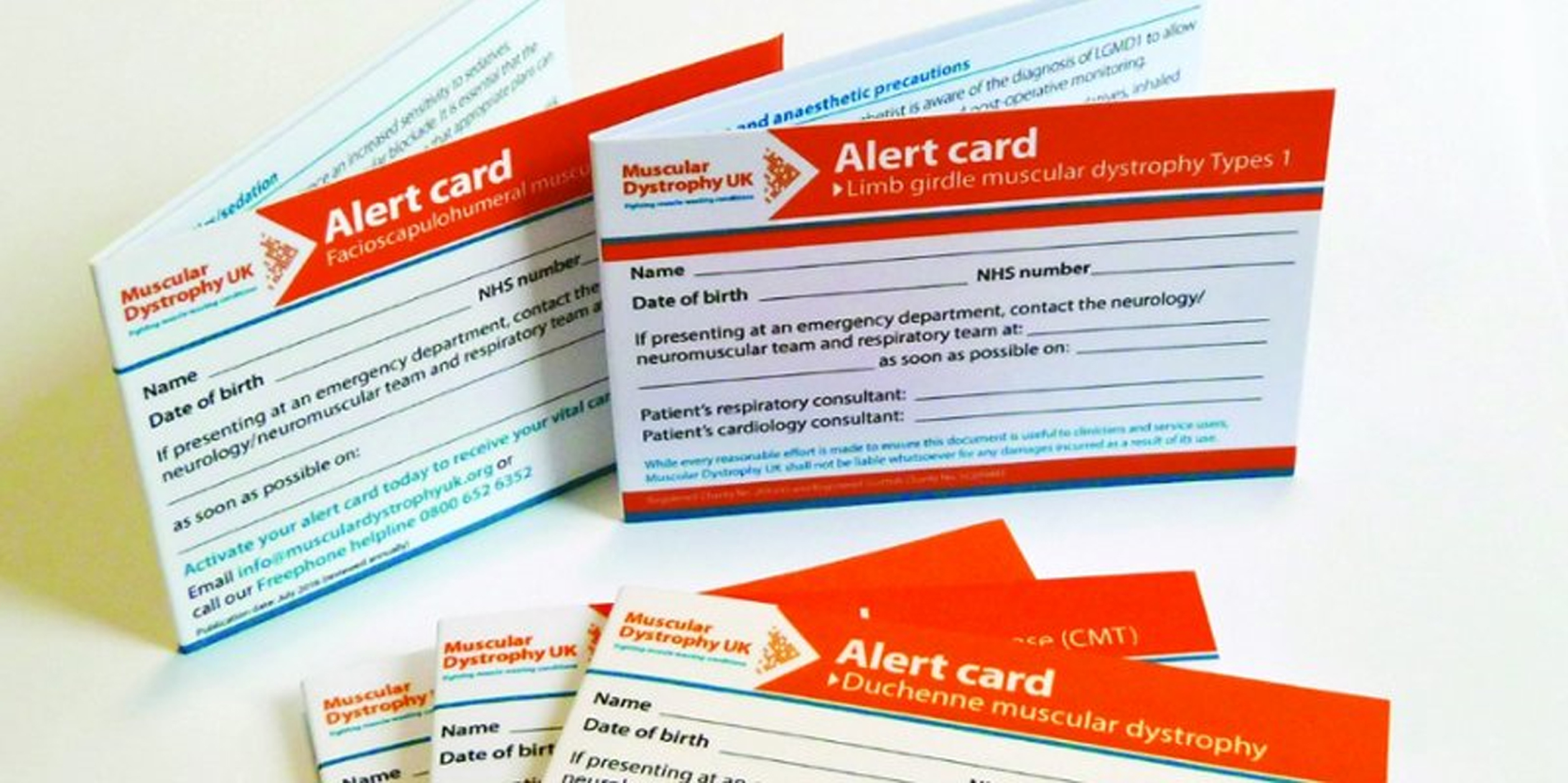
Muscular Dystrophy UK alert card. Patient advocacy organisations such as Muscular Dystrophy UK provide patients with alert cards. The alert cards contain essential information such as the patient’s neurology, respiratory or cardiology consultant and provides health care professionals with essential information in the acute care setting. Neurologists and clinical geneticists are in an excellent position to inform neuromuscular patients about perioperative risks and encourage them to use anaesthesia problem cards.
Our study has some limitations. It was conducted in only one country and as each health care system is organised in a different way, our results are probably not representative for other (Western) countries. Another limitation of our study was that questionnaires were not completed anonymously; this might have affected the results. However, it was important to identify the departments which needed a reminder email or phone call to increase the response rate. Furthermore, we did not collect data on the number of neuromuscular patients followed in each centre during the study period which complicates interpretation of the results on the frequency of consultations and anaesthetic complications. In addition, it is impossible to know whether the reported complications are a direct consequence of the neuromuscular disorder since cardiorespiratory and other perioperative complications are also reported in the general population. Finally, questionnaires were completed on behalf of a department and this study does not reflect the opinion, expertise and current practice of individual health care professionals which might deviate from more general answers on behalf of the department. However, since most anaesthesiologists and neurologists do have limited personal experience with the perioperative care of these patients, a personal approach with one questionnaire completed by one physician, would probably have resulted in a lower response rate and even more heterogenous and less reliable results. Other studies have applied a comparable centre-based approach for evaluating current practice [19–23].
Future studies should evaluate the implementation and quality of anaesthesia alert cards and ICE-app. Furthermore, current practice in perioperative counselling should be evaluated from the patient perspective. Other potential areas of interest to improve perioperative care for neuromuscular patients and address the several unresolved questions concerning the anaesthetic management of neuromuscular patients [13], should be the focus of additional prospective, observational multicentre studies using common databases [14].
CONCLUSION
Most anaesthesiologists and neurologists in the Netherlands are only infrequently consulted about patients with a neuromuscular disorder in a day-to-day setting. Overall departmental approach, day-to-day practice, educational activities and counselling approaches regarding patients with neuromuscular disorders are highly variable. Perioperative care for patients with a neuromuscular disorder in the Netherlands might benefit from (inter)national guidelines and multidisciplinary meetings between anaesthesiologists and neurologists on a regular basis. Neurologists and clinical geneticists are in an excellent position to inform neuromuscular patients about perioperative risks and encourage them to use anaesthesia problem cards or ICE-apps.
FINANCIAL SUPPORT
This manuscript has been written with support of the European Neuromuscular Centre (ENMC) and is part of the preparation for the 259th ENMC workshop (December 2020 and May 2021).
Footnotes
ACKNOWLEDGMENTS
Several authors of this publication are members of the Radboudumc Center of Expertise for neuromuscular disorders (Radboud-NMD), Netherlands Neuromuscular Center (NL-NMD) and the European Reference Network for rare neuromuscular diseases (EURO-NMD).

CONFLICTS OF INTEREST
The ENMC was not involved in the study design, data collection, data analysis or writing of this manuscript. The authors have no other conflicts of interest to report.