




Abstract
Process capability analysis (PCA) is an important stage to check variability of process by using process capability indices (PCIs) that are very effective statistics to summarize process’ performance. Traditional PCIs can produce some incorrect results and declare misinterpretation about process’ quality if the process includes uncertainties. Additionally, definitions of process’ parameters with exact values is not possible when there are uncertainty caused by measurement errors, sensitivities of measuring instruments or quality engineers’ hesitancies. Although the fuzzy set theory (FST) has been successfully used in PCA, it is the first time to use of Pythagorean fuzzy sets (PFSs) to model uncertainties of process more than traditional fuzzy sets in PCA. Since the PFSs has two-dimensional configurations by defining membership and non-membership values, they also have a huge ability to model uncertainty that arises from the human’s thinking and hesitancies, and has brought flexibility, sensitivity and reality for PCA. In this paper, specification limits (SLs), mean (μ
p
), standard deviation (σ) and target value (T) main parameters of PCIs have been analyzed by using PFSs and Pythagorean fuzzy process capability indices (PFPCIs) for two well-known PCIs such as
Keywords
Introduction
Process capability analysis (PCA) is a statistical measurement for the ability of a process to meet predetermined SLs. Companies should regularly analyze the capability of the process and interpret results obtained correctly to produce output with desired quality. The need to regularly measure process performance has led to the widespread use of process capability indices (PCIs). PCIs are one of the techniques that enable to improve the quality of the process. The results may be incorrect if the PCIs are not defined properly. Statistical process control techniques play a significant role in achieving the necessary process control and reducing the variability about the desired target value (T) [1]. It is also clear that each process has its own different conditions and requirements. Since these requirements and conditions cannot be calculated with a single index, various PCIs have been developed in the literature. Two of well known PCIs named C p and C pk do not take into account the cost of not meeting customers’ requirements and they analyze the process without considering the target value (T) that expresses customer expectations. Taguchi focused on the loss of product value when one of the characteristics of a product deviates from the customers’ ideal value (T). For this purpose, the index C pm that analyzes process performance based on deviations from customer expectations, has developed by Hsiang and Taguchi [2]. The index C pmk that provides a warning when the process average deviates from the target value and/or increases the process variability and also known as the third-generation PCI is also introduced in the literature [3]. They are highly useful tools for evaluating process performance and identifying areas for improvement with respect to not only process mean and deviation but also take care of customer expectations. For this reason, the indices C pm and C pmk are analyzed in this study.
Defining of main parameters of PCIs such as SLs, mean (μ) and variance (σ2) by using the flexiblility of fuzzy set extensions rather than precise values due to uncertainty, time, cost, inspector’s hesitancy and sampling difficulty is valuable for PCIs to contain more sensitive and more information. In the majority of real-case problems, uncertainty is present, and traditional approaches may not be successful in addressing this situation. For instance, the subjective thinking of the quality inspectors who play a role in determining the SLs of a product, or the quality control of the samples obtained from each process in production, the process cannot be analyzed and followed up effectively due to some measurement errors arising from the uncertainty in the measurement values or the controller factor. Traditional fuzzy sets (or type-1 fuzzy sets), especially when in the deficiency of information, may cause the opinions of quality inspectors to not be fully conveyed or to not have sufficient information about the process. Although these sets are very effective tools for modeling uncertainty, in some cases they may be insufficient and/or require more effective tools for modeling. To manage the uncertainty in the process, some fuzzy set extensions have been developed and successfully applied in especially for real case problems. These extensions have been used in some studies because of their advantages in defining uncertainty. They also analyzed and adapted on PCA. Kaya and Çolak [4] examined the studies on PCA that used the fuzzy set theory (FST). They concluded that the majority of these studies about fuzzy PCA (FPCA) are on traditional fuzzy sets. It has been observed that studies using fuzzy set extensions are quite limited in the literature. Yalçın and Kaya [5] defined the SLs with neutrosophic sets (NSs) and introduced the neutrosophic indices
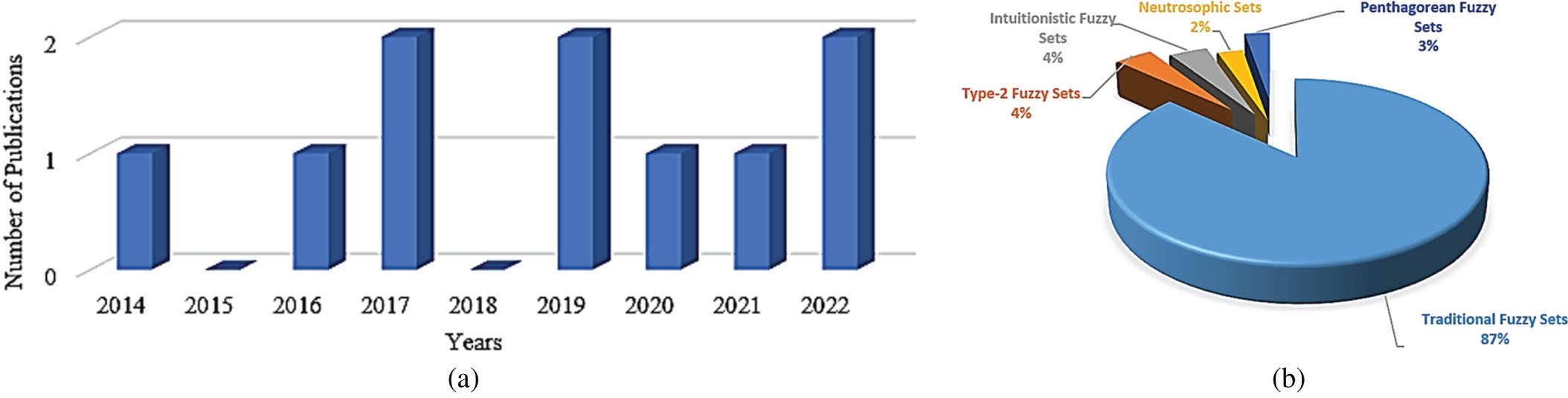
Distribution of the PCA publications that use fuzzy set extensions
As can be seen in Fig. 1.1, the studies are mainly carried out with traditional fuzzy sets. In the studies on PCA, it is seen that traditional fuzzy sets are used the most with 87%. It has been concluded that no study has been done on the Pythagorean fuzzy sets (PFSs) used in this study. It is seen that other fuzzy set extensions have been studied in a limited number of 13% in total.
PFSs offer many advantages over traditional fuzzy sets as they are more flexible and have higher expressive power. PFSs provide a more detailed representation of uncertainty as they can model membership degrees and non-membership degrees separately. This allows for a more accurate representation of complex real-case problems with different degrees of uncertainty in different aspects. In addition, it is possible to make more accurate choices in decision-making problems under uncertainty. Especially in quality control processes, the hesitancy of inspectors can be expressed very well with PFSs whose membership and non-membership infrastructure will allow this instability to be represented in the best way. In addition, the possibility of making a more flexible definition instead of making a precise definition will provide significant advantages in terms of time and cost. Defining exact values can be challenging and can make process uncertainty even more difficult in terms of time and cost. In this study, PFSs, which have not been examined on PCA in the literature yet, have been used in order to determine the gaps in the literature and to ensure that the results obtained with the PCA are more sensitive, more flexible, and contain more information. PFSs provide flexible definition and contain more information than traditional fuzzy sets, making them better to represent uncertainty. For this reason, it is thought that the two-stage representation of PFSs in defining uncertainty can yield more effective and detailed results. Defining process parameters by using PFSs, which are more successful in modeling uncertainty than other sets, enables us to make more realistic and more accurate decisions about the process of a manufactured product.
This study’s motivations can be described as follows: (i) PFSs have been used to design the indices C
pm
and C
pmk
for obtaining more sensitive, flexible, and informative indices. (ii) By eliminating subjective thinking structure when defining the SLs of the quality inspectors, a framework has been suggested to provide a more realistic and accurate interpretation of the process. In summary, this study’s contribution and originality can be also described as follows: (i) A novel approach is introduced to determine the SLs using the flexibility of PFSs, and subsequently derived the Pythagorean
The rest of this paper is organized as follows: The indices C pm and C pmk are briefly explained into Section 2. PFSs are introduced into Section 3. The Pythagorean fuzzy process capability indices (PFPCIs) are produced by using PFSs are given into Section 4. The application of the proposed approach based on a manufacturing process is shown in Section 5. Finally, the obtained results and future research directions are discussed in Section 6.
Process’ performance can be analyzed by using some statistical PCIs that are summarized statistics to measure the actual or the potential performance of the process characteristics relative to the target and SLs by considering process location and dispersion [18]. PCIs have been widely applied for evaluating process’ performance. Several PCIs such as C
p
, C
pk
, C
pm
and C
pmk
are used to estimate the capability of a process [19–21]. Since the designs of C
p
and C
pk
are independent of the target value (T), they can fail to account for process loss incurred by the departure from the target. A well-known pioneer in the quality control, G. Taguchi, pays special attention on the loss in product’s worth when one of product’s characteristics deviates from the customers’ ideal value T. To take this factor into account, Hsiang and Taguchi introduced the index C
pm
[2]. Chan et al. developed the index C
pm
, which provides indicators of both process variability and deviation of process mean from T, and also provides a quadratic loss interpretation, taking into account the process departure [22]. As a result, the index C
pm
incorporates with the variation of production items with respect to T and SLs, and emphasizes on measuring the ability of the process to cluster around the target. The index C
pm
is defined as follow [23]:
Pearn et al. [3] proposed the process capability index C
pmk
, which combines the features of the three earlier indices C
p
, C
pk
, and C
pm
. The index C
pmk
alerts the user whenever the process variance increases and/or the process mean deviates from its T. The index C
pmk
is defined as follow [23]:
If the process mean departs from the T, the reduced value of C pmk is more significant than the three indices C p , C pk and C pm . Hence, the index C pmk responds to the departure of the process mean from the T faster than the other three basic indices C p , C pk and C pm , while it remains sensitive to the changes of process variation [24].
After Zadeh [25] introduced fuzzy sets to the literature, many different fuzzy set extensions have been developed to deal with uncertainty. Fuzzy sets are insufficient in solving problems in some cases where there is uncertainty. This has led to the development of various fuzzy set extensions. As an extension of fuzzy sets, Atanassov [26] developed the intuitionistic fuzzy set theory that deals with fuzziness with both membership and non-membership functions. However, the sum of the membership degrees of these functions must be less than 1. Atanassov [27] first proposed PFSs as Type-2 intuitionistic fuzzy sets (Type-2 IFSs). Yager [28] developed Type-2 IFSs defined by membership and non-membership functions and named them as PFSs [29]. PFSs allow definitions in such a way that the sum of membership and non-membership degrees is greater than 1. This makes PFSs more advantageous than IFSs in modeling uncertainty [30].
Type-2 fuzzy sets (T2FSs), hesitant fuzzy sets (HFSs), intuitionistic fuzzy sets (IFSs), Pythagorean fuzzy sets (PFSs), spherical fuzzy sets (SFSs) and neutrosophic sets (NSs) are frequently used in the literature. Figure 3.1 shows the chronological order of the fuzzy set and its extensions.
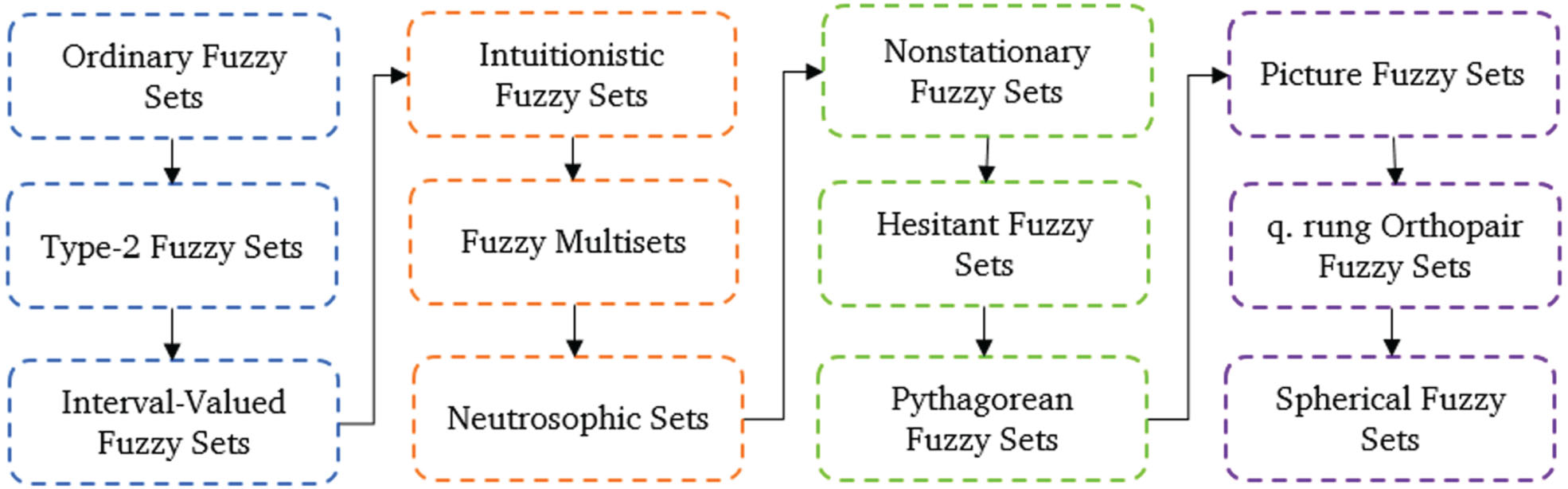
Fuzzy set extensions [31].
PFSs have been successfully used in various areas, such as programming [32, 36], decision-making [33–35, 37], aggregation operators [32, 35], and transportation problems [38]. PFSs represent uncertainty better because they provide flexible definition to quality inspectors and contain more information because they are expressed in two dimensions compared to fuzzy sets. Score functions developed using the advantages of fuzzy set extensions [39–41] also play an important role in the PCA. In the study, the deficiencies in PCA have been tried to be eliminated by utilizing the advantages of PFSs. Some basic definitions of PFSs s are summarized as following [30, 42–45]:
The degree of hesitancy is calculated as follows:
Pythagorean trapezoidal fuzzy numbers (PTFNs) are defined by inspiration of similar concepts in the interval-valued PTFNs [35].
if
if
If If If If If If
In this paper, the PFPCIs such as
Pythagorean
and
indices
In this paper, a novel approach is introduced to increase the ability of the process to express the vagueness. For this aim, the indices C
pm
and C
pmk
are improved by using PFNs. The proposed Pythagorean
Likewise, the process parameters can be defined as PTFNs as follows:
The Pythagorean
Then, Equation (4.2) is re-constructed using the arithmetical operations of PFNs as by Equation (4.3):
Now, let we present the Pythagorean
Equation (4.4) can be written using the arithmetical operations of PTFNs by Equation (4.5):
Then, the MFs of the Pythagorean
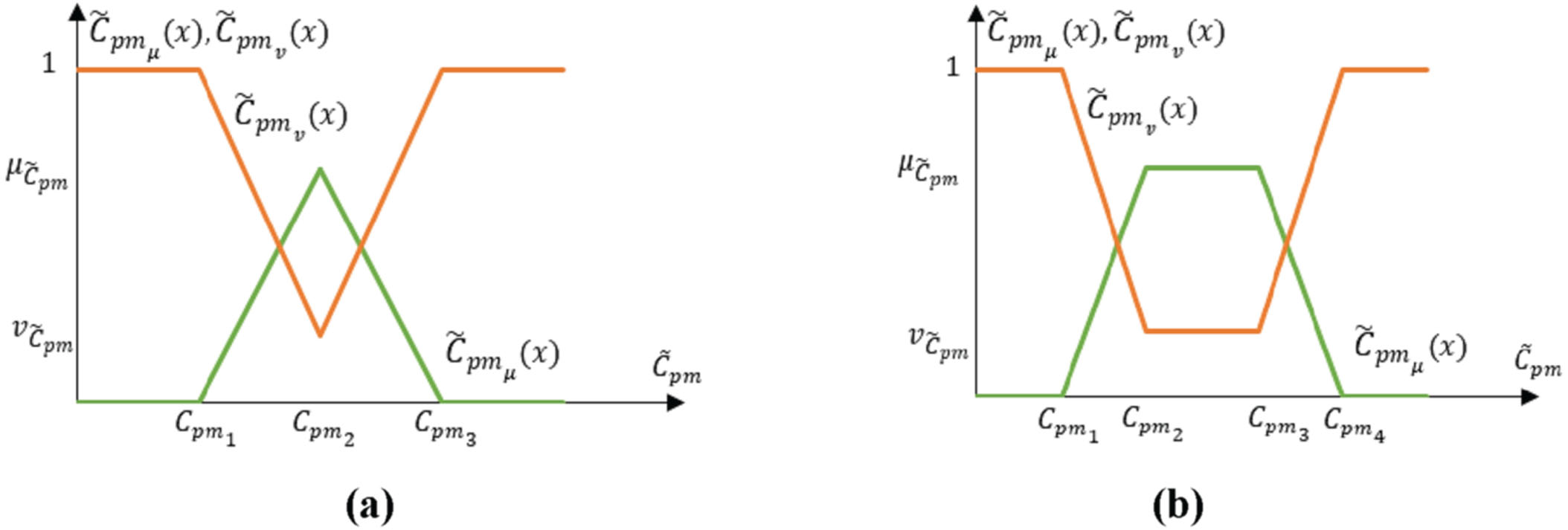
PFSs have an important role in modelling the case that include uncertainty, incomplete and inconsistent information. Therefore, the MFs of index
The index
The Pythagorean
The Pythagorean one-sided indices
Based on the arithmetical operations of PTFNs, the Pythagorean
The Pythagorean one-sided capability indices
The MFs of the Pythagorean
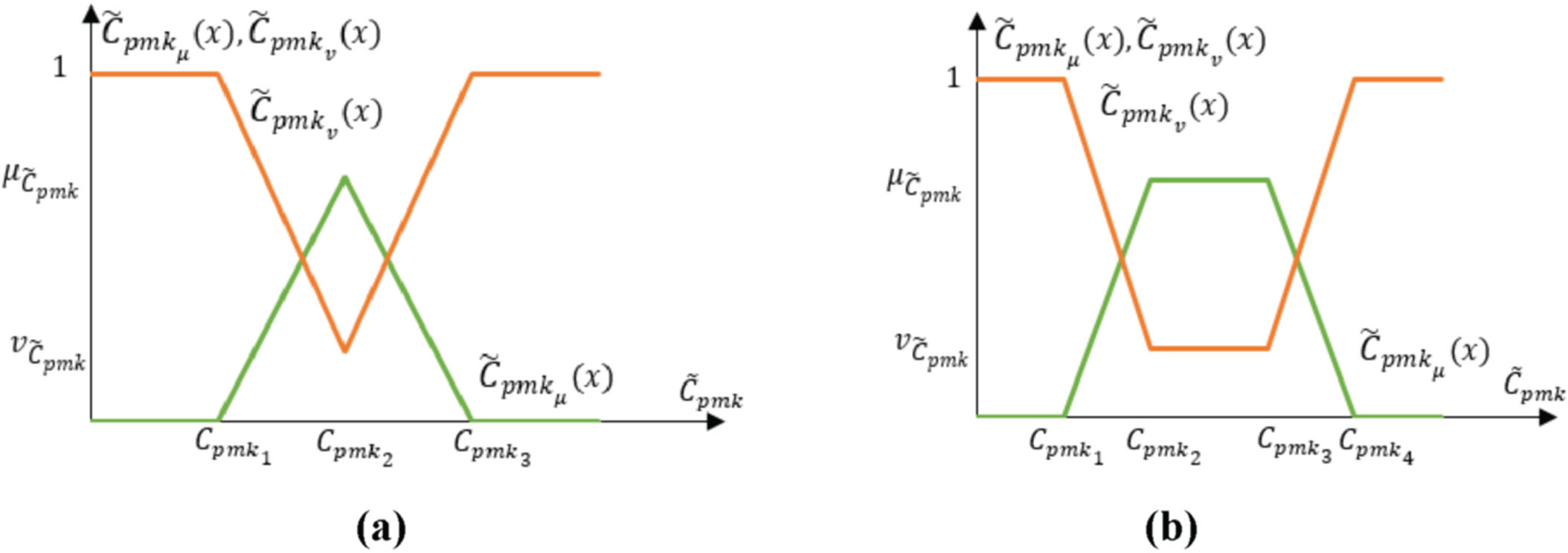
The MFs of
The fact hat the PCIs developed with PFSs are more flexible than the traditional PCIs and provide ease of application in real-case problems. They contain more information about the process capability allows realistic analyzes to be made, and the better modeling of the uncertainty that may occur due to the subjective thinking of quality inspectors while defining the process parameters ensures the elimination of uncertainty. Therefore, unlike the classical methods in the literature, it has been developed together with the membership
Then, the specification limits (
The index Pythagorean
The flexible structure of the index
The MFs of the index Pythagorean
The MFs of indices
Based on PTrFNs, the index Pythagorean
The index Pythagorean
The one-sided indices C
pml
and C
pmu
are re-formulated and the indices Pythagorean
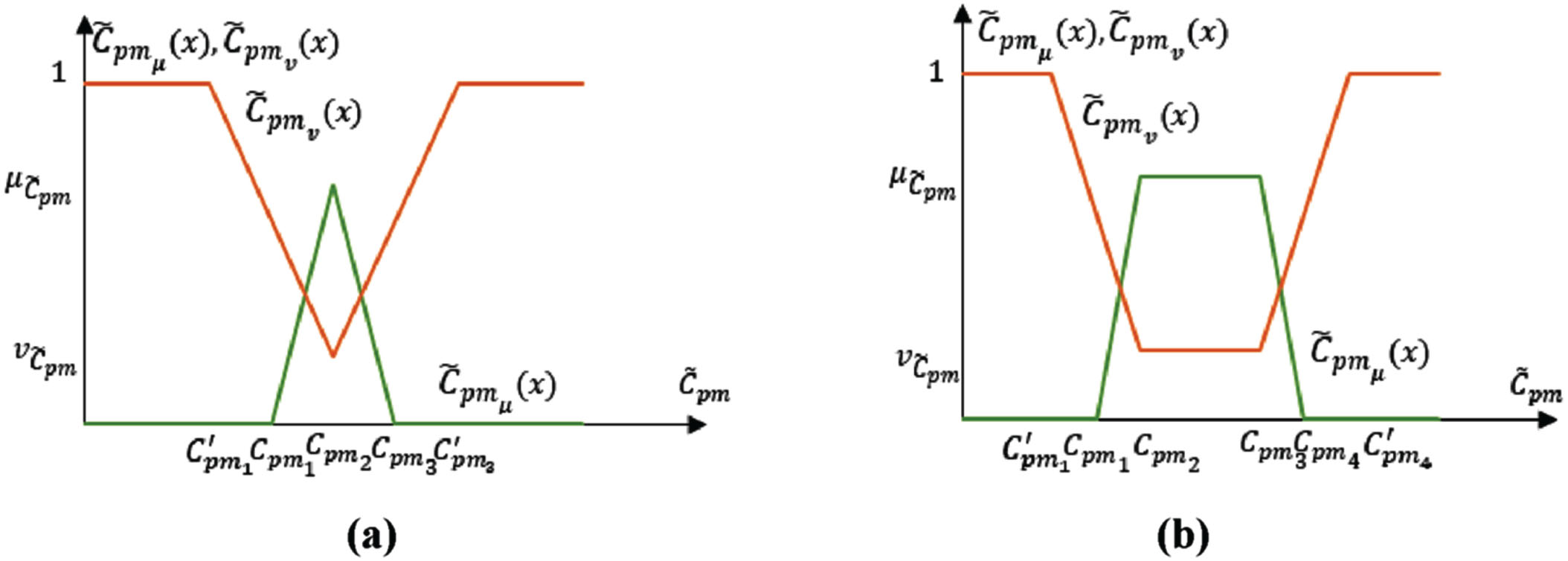
and
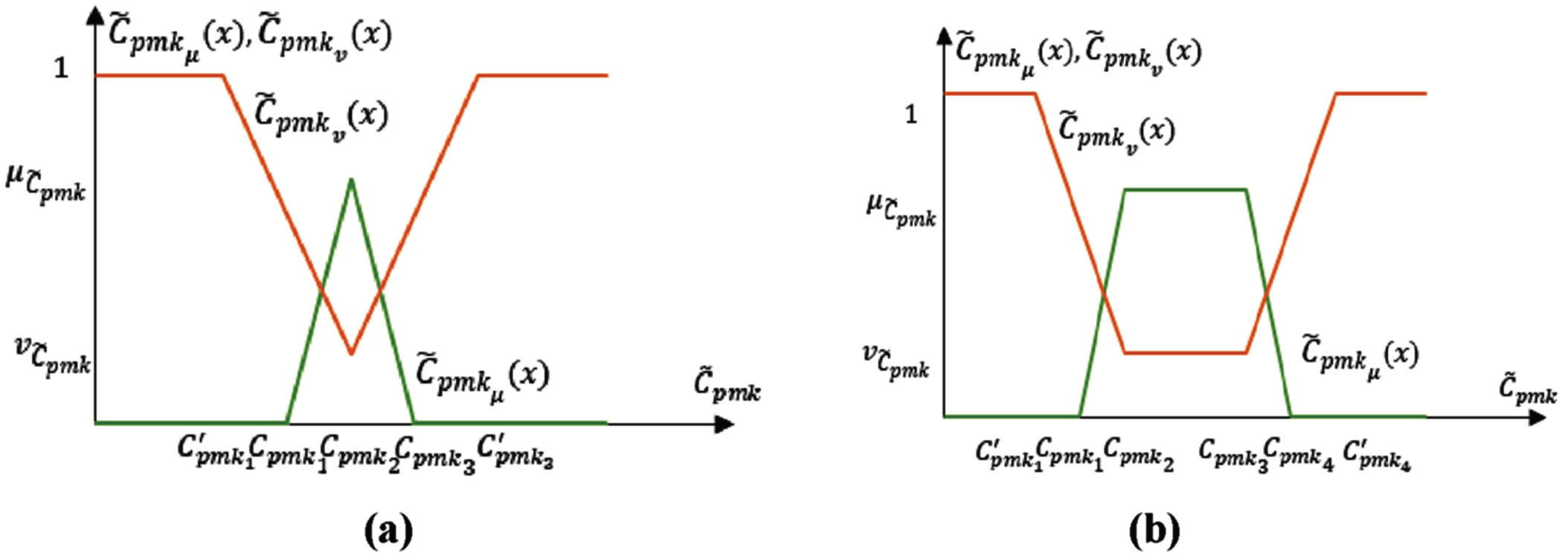
The MFs of the index Pythagorean
The MFs of the index
Since PFSs have two-dimensional definitions based on membership and non-membership functions, they are more capable to model uncertainty because it contains more information than traditional fuzzy sets. When the values of process parameters are defining, the quality inspectors may not be completely sure to evaluate their judgments or to clarify their hesitancy. This causes that the reality not to be reflected in real-case problems. In order to eliminate this problem, PCIs have been re-designed by using PFSs that are including membership and non-membership functions to analyze the capability of the process, especially in real case problems that contain higher level of uncertainty. In this section, an application from the manufacturing industry is carried out in order to evaluate the performance of the proposed PFPCIs. For this aim, an evaluation of the process by considering the measurement values of the inside diameter of the gear shown in Fig. 5.1 has been analyzed.
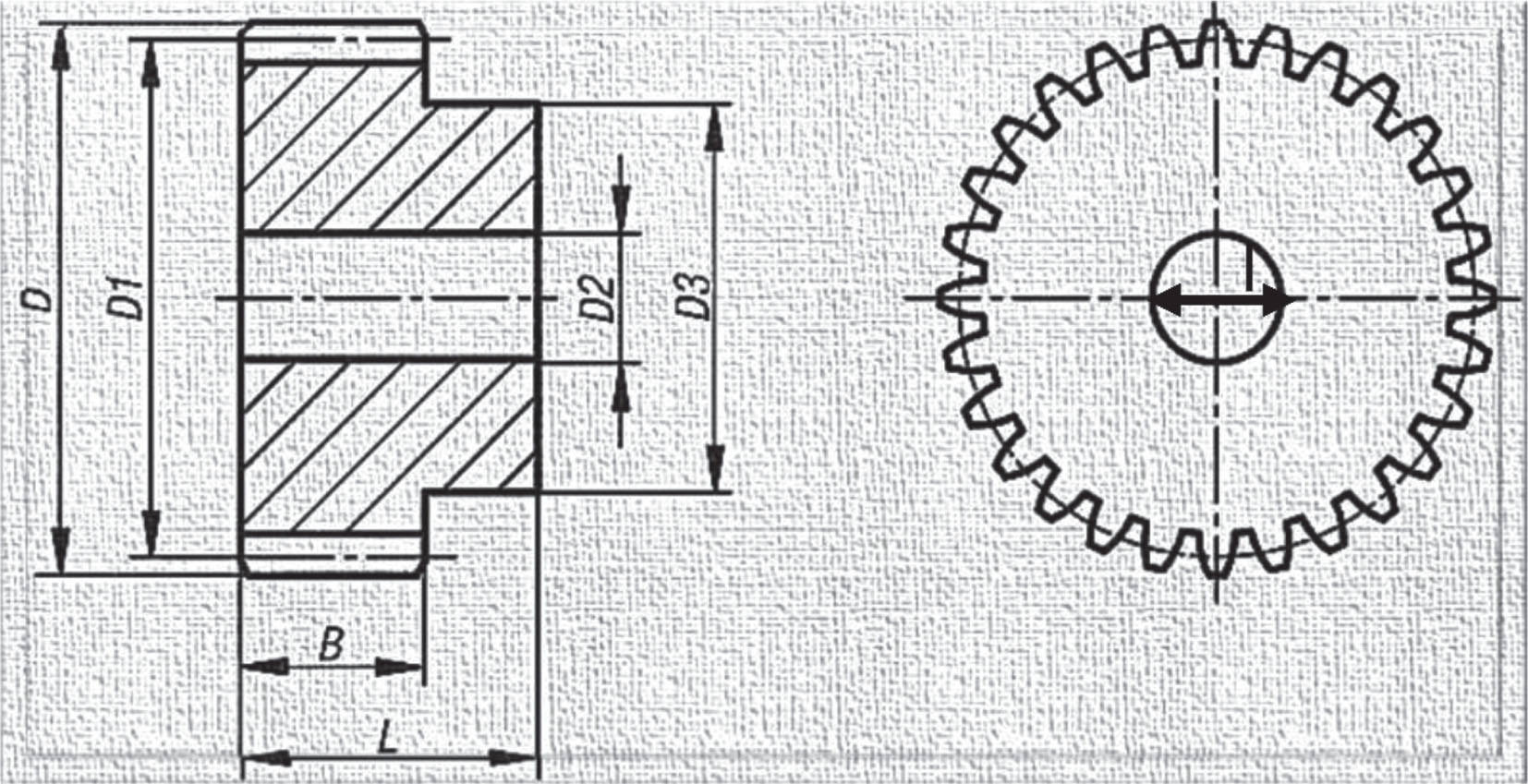
Dimensions of the gear.
The definitions for the main parameters of PCIs have been realized by using PFS. For this aim, SLs,
PCIs are one of the most used the techniques that enable to improve the quality of the process. The results may be incorrect if the PCIs are not defined properly. Defining of main parameters of PCIs such as SLs, μ and σ2 by using the flexible of fuzzy set extensions rather than crisp values due to uncertainty, time, cost, inspector’s hesitancy and sampling difficulty is valuable for PCIs to contain more sensitive and more information. Therefore, the indices C
pm
and C
pmk
have been defined more flexibly together with the membership
The SLs,
Then, the indices Pythagorean
The index Pythagorean
and
The score values of
The Pythagorean
Similar comments are also valid for the index Pythagorean
The score values of
The obtained results are summarized into Table 5.1. As seen Table 5.1, when the parameters are defined by using PFSs, the PCIs include more information about the process by indicating all of the possible values for PCIs. The novel methodology that constructed on the fuzzy based definition has been confirmed by showing that the fuzzy values also include the crisp value.
The obtained results for PCA of gear based on PFNs and crisp values
The obtained results for PCA of gear based on PFNs and crisp values
In this subsection, the parameters of PCIs as flexible structure have been determined by using PFNs. The performance of the proposed PFPCIs as flexible structure have been also evaluated on the similar application. The main parameters are defined in a widely perspective to reflect inspectors’ hesitancy. The process parameters are defined under the flexible Pythagorean fuzzy information as follows:
The process parameters are defined in a flexible structure based on PTFNs for this gear as follows:
The indices Pythagorean
When the index Pythagorean
The one-sided Pythagorean
and
The minimum value of index
The indices Pythagorean
Similar comments are also valid for the index Pythagorean
The one-sided Pythagorean
and
The score values of indices
The obtained results are summarized into Table 5.2. As seen Table 5.2, when the parameters are defined by using PFSs with in flexible way, the PCIs include more information about the process by indicating all of the possible values for PCIs.
The obtained results for PCA of gear based on flexible PFNs and crisp values
The obtained results for PCA of gear based on flexible PFNs and crisp values
The flexible PFPCIs values that are generated when flexible PFNs are used as process parameters are listed in Table 5.2. In Table 5.1, it is clearly seen that the PCIs produced by using PFSs contain more information than the crisp values. More realistic results are obtained because it also addresses the uncertainty to reflect the hesitancy of the quality inspector. The flexible PCIs attained with PFSs in Table 5.2 contain more information about the process than the classical method in Table 5.1, as well as the interval value of the results obtained from the PCA. For example,
According to crisp definitions, it is seen that the process is incapable. It has been determined that the process is also incapable when analyzed by using IFSs. The application also shows that parameter definition of PCIs using PFNs that provides more flexible definitions than crisp and traditional definitions, gives more effective results in analyzing the process. The degrees of membership and non-membership in PFPCIs enable knowledge about which probability and in which interval the process will be capable or incapable. Eliminating the subjective thinking that may occur when defining the main parameters of the PCIs of quality inspectors leads to the interpretation of the process based on realistic information. This shows that PFPCIs provide more accurate results in real-case problems.
In terms of managerial implications, the proposed approach has some advantages such as firstly to eliminate incorrect evaluations that may arise due to uncertainty in analyzing process capability and to provide a more flexible evaluation and definition for PCA. PFPCIs enable quality inspectors to make sensitive definitions, leading to a more accurate evaluation of process capability. The use of membership and non-membership functions in defining PFPCIs offers a deeper understanding of the process, allowing for more detailed insights. Moreover, their flexibility enables a more precise representation of quality inspectors’ subjective judgments, modeling uncertainty in the process. In essence, the limitations of previous studies have been overcome thanks to this flexibility. This enables more accurate and flexible definition of process capability values. This will allow managers to have more information about process quality and make more accurate cost and quality estimates. Incorrect analyses can result in higher operational costs and wasted time, making accurate process capability evaluation essential. In this regard, PFPCIs prove to be a highly effective tool for analyzing process capability when compared to traditional PCIs based on managerial decisions.
Conclusion
In the literature, it has been concluded that PCA is frequently examined with the help of traditional fuzzy sets, but studies with fuzzy set extensions are very limited. In this study, the PCA has been examined using PFSs in order to fill the gap in the literature. Using the flexibility provided by the PFSs to be defined in different forms, the process parameters as PFSs are discussed. The flexibility of the process parameters facilitates the applicability to real-case problems. PFPCIs based on PFNs have been developed. To examine the performance of the developed PFPCIs, the process capability has been analyzed using measurement values of the inside diameter of a gear. The SLs,
Although this study has made valuable contributions, it’s essential to acknowledge certain limitations. Firstly, these PCIs based on PFSs contain many advantages, they also include some difficulties, especially at the point of linguistic definition. It is not easy for inspectors to express their hesitancy depending on the limit values. At the same time, differences in linguistic descriptions between inspectors and the aggregation of these opinions can lead to some difficulties in practice. For this reason, it can be examined that the definition of linguistic variables for the PCIs discussed in future studies and the PFSs for these definitions can be examined. Secondly, due to the difficulty in calculating PFPCIs, some problems may arise. Overcoming this situation could contribute significantly to future research. Thirdly, the limited number of score functions developed for PFNs in the literature significantly restricts the comparability of the obtained results. Therefore, the novel defuzzification operators can be improved for linguistic identification and PFSs integrated PCIs. It is important for the performance of defuzzification approaches to be analyzed in future studies as well.