

This paper explores the relationship between fuzzy logic algebra and non associative groupoid. As a groupoid which can satisfy type-2 cyclic associative (T2CA) law, T2CA-groupoid is characterized by generalized symmetry. Fuzzy logic algebra is a major direction in the study of fuzzy logic. Residuated lattices are a class of fuzzy logic algebras with widespread applications. The inflationary pseudo general residuated lattice (IPGRL), a generalization of the residuated lattice, does not need to satisfy the associative law and commutative law. Moreover, the greatest element of IPGRL is no longer the identity element. In this paper, the notion of T2CA-IPGRL (IPGRL in T2CA-groupoid) is proposed and its properties are investigated in combination with the study of IPGRL and T2CA-groupoid. In addition, the generalized symmetry and regularity of T2CA-groupoid are investigated based on the characteristics of commutative elements. Meanwhile, the decomposition of T2CA-root of band with T2CA-unipotent radical is studied as well. The result shows that every T2CA-root of band is the disjoint union of T2CA-unipotent radicals.
A groupoid will be called a type-2 cyclic associative groupoid (T2CA-groupoid) if it holds the type-2 cyclic associative (T2CA) law [x * (y * z) = (z * x) * y] [1]. In the early literature, there was no distinction between T2CA law and cyclic associative (CA) law [x * (y * z) = z * (x * y)] so both of them were called CA law.
In 1954, Hosszú [2] discussed the function equations that satisfy two types of CA laws. The continuous and strictly monotonic solutions of these two types of equations are given in [3], and the power series solutions in the complex domain are given in [4]. Until 2020, the two different forms of CA laws had not been distinguished in [1]. As a follow-up study of [1], we extend the quasi identity element and study the generalized symmetry of T2CA-groupoid from operational laws perspective.
In 1936, von Neumann put forward the concept of regularity when studying ring theory [5]. As an effective research method, regularity is widely used in semigroups [6–11]. There are also many interesting conclusions about regularity in non associative groupoids (see [12–14]). In order to reveal the regularity of T2CA-groupoid, we study regular T2CA-groupoid, generalized regular T2CA-groupoid, transposition regular T2CA-groupoid and their relationships. In [15], Xiaogang An et al. studied T2CA-band and T2CA-3-band. As a special type of T2CA-groupoid, the squares of all elements of the T2CA-root of band are idempotent, and we study its structural characteristics.
In 2021, Rui Paiva et al. proposed an inflationary general residuated lattice (IGRL) [16] when studying inflationary general overlap function. Rong Liang and Xiaohong Zhang extended the IGRL to the inflationary pseudo general residuated lattice (IPGRL) [17]. The filters of IGRL and IPGRL was studied in [18]. Based on the research in [17], we have studied a special IPGRL which called T2CA-IPGRL because its elements satisfy the T2CA law.
In [17], Rong Liang and Xiaohong Zhang proposed inflationary pseudo general overlap function (PGOF) which proves that an inflationary PGOF is a fuzzy conjunction (see [17] lemma 2). Due to the non commutative and non associative properties of T2CA-groupoid, the inflationary PGOF that satisfies the T2CA law will be a non commutative and non associative fuzzy conjunction. A T2CA-IPGRL can be induced by an inflationary PGOF that satisfies the T2CA law. Therefore, studying the properties of T2CA-groupoid and T2CA-IPGRL is helpful for further research on non commutative and non associative fuzzy logic formal system.
The rest of this paper is organized as follows. In Section 2, we extend the concept of quasi identity element and study the generalized symmetry of T2CA-groupoid from the perspective of operational laws. In Section 3, we study various types of T2CA-groupoid with regularity and their relationships. T2CA-root of band is analyzed in Section 4. The notion of inflationary pseudo general residuated lattice in T2CA-groupoid is proposed, and its properties are studied in Section 5. The final section provides conclusions and future research directions.
Generalized Symmetry of T2CA-Groupoids
In this section, we will discuss the generalized symmetry of T2CA-groupoids, which is the basis of studying regular T2CA-groupoids.
First, we will introduce several basic concepts of groupoid and the research results related to this paper in T2CA-groupoid. For a groupoid (D, *), if for any x, y ∈ D, x * y = y * x, it has commutative property, and if for any x ∈ D, (x * x) * x = x * (x * x), it has monoassociative property. It is obvious that a T2CA-groupoid has monoassociative property.
Proposition 2.1. [1] If (D, *) is a T2CA-groupoid, then for any x1, x2, x3, x4 ∈ D, (x1 * x2) * (x3 * x4) = (x2 * x1) * (x4 * x3).
Proposition 2.2.The idempotent elements in a T2CA-groupoid have commutativity.
Proof. Let e be an idempotent element in a T2CA-groupoid (D, *) and for any a ∈ D. Then
□
In [1], Xiaohong Zhang et al. proposed the quasi identity element and gave the relationship between quasi identity element and commutativity in T2CA-groupoids (see Definition 2.1 and Theorem 2.1).
Definition 2.1. [1] In a T2CA-groupoid (D, *), an element c ∈ D is called the quasi identity element if for any a ∈ D (a ≠ c), c * a = a * c = a.
Theorem 2.1. [1] The T2CA-groupoid with quasi identity element has commutativity.
Proposition 2.3.The square of quasi identity element in a T2CA-groupoid is idempotent.
Proof. Let c be a quasi identity element in a T2CA-groupoid (D, *). By Definition 2.1, c2 ≠ c, c * c2 = c2 * c = c2. Since D is monoassociative, we have c2 * c2 = c * (c * c2) = c * c2 = c2. That is, c2 is an idempotent element. □
Example 2.1 is from [1], which clearly illustrates Theorem 2.1 and Proposition 2.3.
Example 2.1. In Table 1, the T2CA-groupoid (D, *) with quasi identity element of order 5 is given, where D = {1, 2, 3, 4, 5}. D is a commutative T2CA-groupoid. Element 1 is a quasi identity element, element 2 = 12 is an idempotent element.
A T2CA-groupoid with quasi identity element of order 5
*
1
2
3
4
5
1
2
2
3
4
5
2
2
2
3
4
5
3
3
3
2
4
5
4
4
4
4
4
4
5
5
5
5
4
5
Theorem 2.1 gives a sufficient condition for the T2CA-groupoid to have commutative properties. In fact, we divide a T2CA-groupoid into idempotent sets and non idempotent sets. By Proposition 2.2, every idempotent element in T2CA-groupoid has commutativity. As long as the non idempotent elements are commutative, the T2CA-groupoid is commutative. The following Theorem 2.3 is an extension of Theorem 2.1. In Theorem 2.3, the condition for quasi identity element can be relaxed. For a T2CA-groupoid (D, *), all its idempotent set can be represented by E (D), and all non idempotent elements, that is, the complementary set of E (D), can be represented by . In order to extend Theorem 2.1, we need to extend Definition 2.1 first. Definition 2.2 does this extension work.
Definition 2.2. In a T2CA-groupoid (D, *), an element is called the left (resp. right) pre-quasi identity element if for any , c * a = a (resp. a * c = a).
In a T2CA-groupoid (D, *), an element is called the pre-quasi identity element if it is both a left and right pre-quasi identity element.
Proposition 2.4.The square of left pre-quasi identity element in a T2CA-groupoid is idempotent.
Proof. Let c be a left pre-quasi identity element in a T2CA-groupoid (D, *). By Definition 2.2, , c2 ≠ c. If , we have c * c2 = c2. Since D is monoassociative, we have c2 * c2 = c * (c * c2) = c * c2 = c2, that is c2 ∈ E (D). This will lead to contradictions. Thus, c2 is an idempotent element. □
Proposition 2.5.The square of right pre-quasi identity element in a T2CA-groupoid is idempotent.
Proof. The proof process of this proposition is similar to Proposition 2.4. □
Theorem 2.2.In T2CA-groupoid, a left pre-quasi identity element, a right pre-quasi identity element and a pre-quasi identity element are equivalent.Proof. It is only necessary to prove that the left and right pre-quasi identity elements are equivalent.
First, we will prove that a left pre-quasi identity element is a right pre-quasi identity element. Let c be a left pre-quasi identity element in a T2CA-groupoid (D, *). By Definition 2.2, for any , c * a = a. By Propositon 2.4 and Proposition 2.2, element c2 has the commutative property.
Thus, element c is a right pre-quasi identity element.
Next, we prove that a right pre-quasi identity element is a left pre-quasi identity element. Let c be a right pre-quasi identity element in a T2CA-groupoid (D, *). For any , a * c = a. By Propositon 2.5 and Proposition 2.2, element c2 has the commutative property.
By Definition 2.2, element c is a left pre-quasi identity element. Thus, the left and right pre-quasi identity elements are equivalent, ending the proof. □
Corollary 2.1.The square of pre-quasi identity element in a T2CA-groupoid has commutativity.
Proof. It can be derived from Theorem 2.2, Propositon 2.4 and Proposition 2.2. □
Theorem 2.3.The T2CA-groupoid with pre-quasi identity element is commutative.
Proof. Let c be a pre-quasi identity element in T2CA-groupoid (D, *). Then such that for any . By Corollary 2.1, element c2 has the commutative property. For any f, g ∈ D, according to whether f and g belong to E (D), we discuss them in three cases.
Case 1: f ∈ E (D) or g ∈ E (D), by Proposition 2.2, f * g = g * f;
Case 2: and , if f = c or g = c, it is obvious that f * g = g * f;
Case 3: and , if f ≠ c and g ≠ c, we have c * f = f * c = f, c * g = g * c = g. Then,
Thus, D is a commutative T2CA-groupoid. □
Theorem 2.3 can be seen as a generalization of Theorem 2.1.
Example 2.2. In Table 2, the T2CA-groupoid (D, *) with pre-quasi identity element of order 6 is given. Here, E (D) = {x2, x3, x4},. Element x1 is not the quasi identity element because x1 * x3 = x4 ≠ x3. However, it is the pre-quasi identity element. From Theorem 2.3, it can be seen that this T2CA-groupoid has commutativity.
A T2CA-groupoid of order 6 with pre-quasi identity element
*
x1
x2
x3
x4
x5
x6
x1
x2
x1
x4
x4
x5
x6
x2
x1
x2
x4
x4
x5
x6
x3
x4
x4
x3
x4
x5
x6
x4
x4
x4
x4
x4
x5
x6
x5
x5
x5
x5
x5
x6
x4
x6
x6
x6
x6
x6
x4
x5
The commutative law of binary operations defined on a groupoid reflects its symmetry. As a generalized commutative law, the arbitrary three elements in a groupoid perform binary operations in order. Changing the order of the first two elements does not affect the final result, which is (x * y) * z = (y * x) * z. This is called left commutative law. Correspondingly, there is the right commutative law, where x * (y * z) = x * (z * y). A groupoid is called a left (right) commutative groupoid if it holds the left (right) commutative law. In [19], left (right) commutative groupoid was introduced. Rashad Muhammad et al. extended these concepts and studied left (right) commutative groupoid in Abel-Grassmann’s groupoids (AG-groupoids) [20]. When the left (right) commutative groupoid satisfies the T2CA law, we call it the left (right) commutative T2CA-groupoid, abbreviated as LC-T2CA-groupoid (RC-T2CA-groupoid). A T2CA-groupoid is called a bi-commutative T2CA-groupoid (BC-T2CA-groupoid) if it holds both the left and right commutative laws. The LC-T2CA-groupoid, RC-T2CA-groupoid, and BC-T2CA-groupoid can characterize the generalized symmetry of T2CA-groupoid from a macro perspective.
Example 2.3 and 2.4 illustrate that there is no necessary connection between LC-T2CA-groupoid and RC-T2CA-groupoid.
Example 2.3. The LC-T2CA-groupoid given in Table 3, is not a RC-T2CA-groupoid because 5 * (5 * 6) =4 ≠ 1 =5 * (6 * 5).
A LC-T2CA-groupoid that is not a RC-T2CA-groupoid
*
1
2
3
4
5
6
1
1
1
1
1
1
1
2
1
1
1
1
4
1
3
1
1
1
1
4
1
4
1
1
1
1
1
1
5
1
4
1
1
2
2
6
1
4
1
1
3
3
Example 2.4. The RC-T2CA-groupoid given in Table 4, is not a LC-T2CA-groupoid because (f * c) * f = e ≠ a = (c * f) * f.
A RC-T2CA-groupoid that is not a LC-T2CA-groupoid
*
a
b
c
d
e
f
a
a
a
a
a
a
a
b
a
a
a
a
a
e
c
a
e
a
a
a
e
d
a
a
a
a
a
e
e
a
a
a
a
a
a
f
a
e
d
a
a
b
From Example 2.5, we can see that a BC-T2CA-groupoid may not be a commutative T2CA-groupoid.
Example 2.5. The BC-T2CA-groupoid given in Table 5, is not a commutative T2CA-groupoid because x5 * x6 = x3 ≠ x4 = x6 * x5.
A non commutative BC-T2CA-groupoid
*
x1
x2
x3
x4
x5
x6
x1
x1
x2
x3
x3
x2
x2
x2
x2
x3
x1
x1
x3
x3
x3
x3
x1
x2
x2
x1
x1
x4
x3
x1
x2
x2
x1
x1
x5
x2
x3
x1
x1
x4
x3
x6
x2
x3
x1
x1
x4
x4
In [1], Xiaohong Zhang et al. proved that every commutative T2CA-groupoid is a semigroup. Commutativity is a sufficient condition for a T2CA-groupoid to become a semigroup. We can weaken this condition. See the following Proposition 2.6.
Proposition 2.6.A BC-T2CA-groupoid is a semigroup.
Proof. Let a, b and c be any three elements in the BC-T2CA-groupoid (D, *). Then
Thus, D is a semigroup. □
By Proposition 2.2, every idempotent element in T2CA-groupoid has commutativity. According to the latest research, an element in T2CA-groupoid also has commutativity if its third power is equal to itself. With the deepening of research, there are two research directions on the generalized symmetry of T2CA-groupoid. The first is to study from the perspective of operational laws, which characterizes the generalized symmetry of T2CA-groupoid from a macro perspective (see Example 2.3, 2.4, 2.5, and Proposition 2.6). The second is to study the commutativity of individual elements, which characterizes the local symmetry of T2CA-groupoid from a microscopic perspective. We know that when all elements have commutativity, local symmetry becomes global symmetry. This also prompts us to find ways to identify the characteristics of elements with commutative properties in future research.
Regular T2CA-Groupoids and Generalized Regular T2CA-Groupoids
In this section, we study various types of T2CA-groupoid with regularity and their relationships.
Definition 3.1. Let a be an element in the T2CA-groupoid (D, *). Then a is a regular element of D if there exists c ∈ D such that (a * c) * a = a. The T2CA-groupoid has the regularity if all its elements are regular.
Through Example 3.1, the existance of regular T2CA-groupoid can be demonstrated.
Example 3.1.Table 6 shows a T2CA-groupoid (D, *) of order 6. Element 3 is a regular element because 3 = (3 * 5) *3. We can easily verify that other elements also have regularity.
A regular T2CA-groupoid
*
1
2
3
4
5
6
1
1
1
3
4
5
6
2
1
2
3
4
5
6
3
3
3
4
6
1
5
4
4
4
6
5
3
1
5
5
5
1
3
6
4
6
6
6
5
1
4
3
Proposition 3.1. Let a be an arbitrary element in a regular T2CA-groupoid (D, *). Then, there exists c ∈ D such that (a * c) * a = a. We have
c * a is an idempotent element;
a * c = c * a;
a = (c * a) * a = a * (a * c) = (a * c) * a = a * (c * a).
Proof. (1) Suppose that a is an arbitrary element in a regular T2CA-groupoid (D, *). There exists c ∈ D such that (a * c) * a = a. Then,
Thus, c * a is an idempotent element.
(2)
Thus, a * c is also an idempotent element. Since a * c and c * a are idempotent elements, and the square of a * c is equal to the square of c * a, then naturally a * c = c * a.
(3) It is easy to deduce from (2). □
In [11], the left (right) transposition regular semigroups were introduced. In 2022, Yudan Du et al. studied the left (right) transposition regular AG-groupoids [13] and Xiaogang An discussed the left (right) transposition regular TA-groupoids [14]. Similarly, we will introduce the left (right) transposition regular T2CA-groupoid and investigate the relationship between regularity and left (right) transposition regularity in T2CA-groupoid.
Definition 3.2. A T2CA-groupoid (D, *) is called a left (resp. right) transposition regular T2CA-groupoid if for any a ∈ D there exists c ∈ D satisfying (c * a) * a = a (resp. a * (a * c) = a), abbreviated as LTR-T2CA-groupoid (resp. RTR-T2CA-groupoid).
Theorem 3.1.A LTR-T2CA-groupoid, a RTR-T2CA-groupoid and a regular T2CA-groupoid are equivalent.
Proof. By the T2CA law, we can easily conclude that the LTR-T2CA-groupoid is equivalent to the RTR-T2CA-groupoid. Therefore, it is only necessary to prove that the LTR-T2CA-groupoid is equivalent to the regular T2CA-groupoid.
First, we will prove that a LTR-T2CA-groupoid is a regular T2CA-groupoid. Suppose that a is an arbitrary element in a LTR-T2CA-groupoid (D, *). There exists c ∈ D such that (c * a) * a = a. We have
By Definition 3.1, (D, *) is a regular T2CA-groupoid.
Next, we will prove that a regular T2CA-groupoid is a LTR-T2CA-groupoid. It is easily obtained by Proposition 3.1 (3), ending the proof. □
Definition 3.3. Let a be an arbitrary element in the T2CA-groupoid (D, *). Then D is called a generalized regular T2CA-groupoid if there exists at least n ∈ Z+, such that an has regularity.
Example 3.2 illustrates the existance of generalized regular T2CA-groupoid.
Example 3.2. The T2CA-groupoid (D, *) given in Table 7, has no regularity because only element a is a regular element. For element b, c and d, b2 = c2 = d2 = a. For element e and f, e3 = f3 = a. By Definition 3.3, D is a generalized regular T2CA-groupoid. What’s more, D is not a semigroup because (f * e) * e = b ≠ a = f * (e * e).
A generalized regular T2CA-groupoid of order 6
*
a
b
c
d
e
f
a
a
a
a
a
a
a
b
a
a
a
a
a
a
c
a
a
a
a
a
a
d
a
a
a
a
b
b
e
a
a
b
a
b
c
f
a
a
a
a
d
c
Theorem 3.2.A finite T2CA-groupoid is a generalized regular T2CA-groupoid.
Proof. Assume that (D, *) is a finite T2CA-groupoid and a ∈ D, n ∈ Z+. By Definition 3.3, if there exists an ∈ G such that an is a regular element, then D is a generalized regular T2CA-groupoid. In a T2CA-groupoid, it is obvious that an idempotent element is a regular element. If we can find element an is an idempotent, the conclusion can be proven. Since D is finite and monoassociative, there exist i, j ∈ Z+ such that ai = ai+j. Based on the different values i and j, we will discuss three cases.
Case 1: if j = i, then ai = a2i, that is, ai = ai * ai, ai is the idempotent element in D.
Case 2: if j > i, then from ai = ai+j we have
aj = ai * aj-i = ai+j * aj-i = a2j = aj * aj.
This means that aj is the idempotent element.
Case 3: if j < i, then from ai = ai+j we have
ai = ai+j = ai * aj = ai+j * aj = ai+2j;
ai = ai+2j = ai * a2j = ai+j * a2j = ai+3j;
……
ai = ai+ij.
Since i, j ∈ Z+, then ij ≥ i. For ai = ai+ij, Case 3 becomes Case 1 when ij = i, and Case 3 becomes Case 2 when ij > i. Therefore, for any element a ∈ D, we can find that an is a regular element. □
Figure 1 shows the relationships between the generalized regular T2CA-groupoid and regular T2CA-groupoid. Here, A, the upper right sector, represents the finite regular T2CA-groupoid given in Example 3.1; B, the upper left sector, represents the infinite regular T2CA-groupoid; C, the lower right sector, represents the finite generalized regular T2CA-groupoid given in Example 3.2 rather than regular T2CA-groupoid; and D, the lower left sector, represents the infinite generalized regular T2CA-groupoid rather than regular T2CA-groupoid. A+B represents the regular T2CA-groupoid. A+C represents the finite generalized regular T2CA-groupoid. At the same time, A+C also represents the finite T2CA-groupoid, which shows that all finite T2CA-groupoids are generalized regular T2CA-groupoids (see Theorem 3.2). A+B+C+D represents the generalized regular T2CA-groupoid.
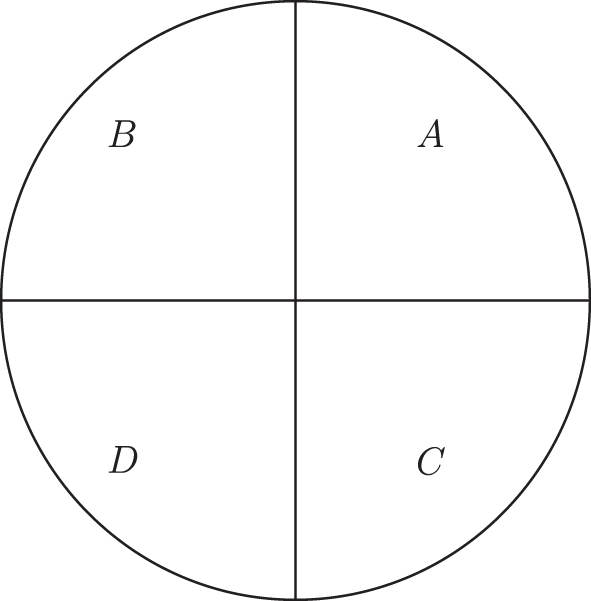
The relationships between the generalized regular T2CA-groupoid and regular T2CA-groupoid.
Commutativity is a global symmetric property in a groupoid, while Proposition 3.1 represents a local symmetric property in a regular T2CA-groupoid. When we were looking for examples of regular T2CA-groupoid, we found an interesting phenomenon. In T2CA-groupoid of order 3, 4, 5 and 6, there is no non-commutative regular T2CA-groupoid. Therefore, in the rest of this section, we will study the relationship between commutativity and regular T2CA-groupoid.
Proposition 3.2.A regular T2CA-groupoid is a LC-T2CA-groupoid.
Proof. Suppose that a, b and d are three arbitrary elements in a regular T2CA-groupoid (D, *). Then by Definition 3.1, there exists c ∈ D such that (a * c) * a = a. By Proposition 3.1, a = (a * c) * a = (c * a) * a = a * (c * a). We have
Thus, D is a LC-T2CA-groupoid. □
Proposition 3.3.Each regular T2CA-groupoid is a RC-T2CA-groupoid.
Proof. The proof process is similar to Proposition 3.2. □
Corollary 3.1.Each regular T2CA-groupoid is a semigroup.
Proof. This is the corollary of Proposition 3.2, 3.3 and 2.6. □
Theorem 3.3.A regular T2CA-groupoid is a commutative semigroup.
Proof. Suppose that a and b are two arbitrary elements in a regular T2CA-groupoid (D, *). Then there exists c ∈ D such that a = (a * c) * a. By Corollary 3.1, D is a semigroup. We have
That is, (D, *) is a commutative semigroup. □
T2CA-Root of Band
Bands and band decompositions [21–29] are one of the most effective methods to study nonassociative algebra. In [15], Xiaogang An et al. studied T2CA-band and T2CA-3-band. However, these two special T2CA-groupoids are commutative, so the study of their decomposition theorems is of little value. In T2CA-groupoid, we study a special band structure (see Definiton 4.1), which is not all commutative, so its decomposition theorem is more valuable (see Theorem 4.1). In a T2CA-groupoid (D, *), there is a class of elements whose square is idempotent, which we denote the set as
Definition 4.1. A T2CA-groupoid D is called a T2CA-root of band if
Example 4.1 illustrates the existance of T2CA-root of band.
Example 4.1. Consider the T2CA-root of band (D, *) of order 7 in Table 8. D has two idempotent elements x1 and x7, and the square of other elements is element x1. By Definition 4.1, D is a T2CA-root of band. What’s more, It is neither a semigroup nor an AG-groupoid, because (x5 * x6) * x6 = x2 ≠ x1 = x5 * (x6 * x6) , (x5 * x6) * x6 = x2 ≠ x1 = (x6 * x6) * x5.
A T2CA-root of band of order 7
*
x1
x2
x3
x4
x5
x6
x7
x1
x1
x1
x1
x1
x1
x1
x7
x2
x1
x1
x1
x1
x1
x1
x7
x3
x1
x1
x1
x1
x1
x2
x7
x4
x1
x1
x1
x1
x1
x1
x7
x5
x1
x1
x1
x1
x1
x3
x7
x6
x1
x1
x1
x2
x4
x1
x7
x7
x7
x7
x7
x7
x7
x7
x7
Definition 4.2. Let (D, *) be a T2CA-groupoid and e be the unique idempotent element in D, then if for any a ∈ D, a2 = e, we say that D is a T2CA-unipotent radical.
Theorem 4.1. Let (D, *) be a T2CA-root of band. E (D) = {x ∈ D | x2 = x} and for any e ∈ E (D), Se = {a ∈ D | a2 = e}. Then:
Se is a T2CA-unipotent radical;
D = ⋃ e∈E(D)Se, that is, every T2CA-root of band is the disjoint union of T2CA-unipotent radicals.
Proof. (1) Suppose that e is an idempotent element in a T2CA-root of band (D, *). Se = {a ∈ D | a2 = e}. For any a, b ∈ Se, we have a2 = b2 = e. Element e has the commutative property by Proposition 2.2. Then
Thus, a * b ∈ Se and Se is closed. By Definition 4.2, Se is a T2CA-unipotent radical.
(2) By Definition 4.1, the square of each element in the T2CA-root of band is an idempotent. Suppose that α and β are two different idempotent elements. It is easy to prove that S
α∩ S
β = ∅. Thus, every T2CA-root of band is the disjoint union of T2CA-unipotent radicals. □
Example 4.2. Consider the T2CA-root of band (D, *) of order 12 in Table 9. D has two idempotent elements 1 and 7. S1 = {1, 2, 3, 4, 5, 6} and S7 = {7, 8, 9, 10, 11, 12}. Both S1 and S7 are two T2CA-unipotent radicals. What’s more, S1 is neither a semigroup nor an AG-groupoid, because (6 *5) *5 = 2 ≠1 = 6 * (5 * 5), (6 *5) *5 = 2 ≠1 = (5 * 5) *6, and S7 is neither a semigroup nor an AG-groupoid, because (11 * 12) *12 = 8 ≠7 = 11 * (12 * 12),(11 * 12) *12 = 8 ≠7 = (12 * 12) *11. It is easy to verify that D = S1 ⋃ S7.
A T2CA-root of band of Example 4.2
*
1
2
3
4
5
6
7
8
9
10
11
12
1
1
1
1
1
1
1
7
7
7
7
7
7
2
1
1
1
1
1
1
7
7
7
7
7
7
3
1
1
1
1
2
1
7
7
7
7
7
7
4
1
1
1
1
1
2
7
7
7
7
7
8
5
1
1
1
2
1
4
7
7
7
7
8
9
6
1
1
2
1
3
1
7
7
7
8
10
8
7
7
7
7
7
7
7
7
7
7
7
7
7
8
7
7
7
7
7
7
7
7
7
7
7
7
9
7
7
7
7
7
8
7
7
7
7
7
8
10
7
7
7
7
7
7
7
7
7
7
7
7
11
7
7
7
7
8
9
7
7
7
7
7
9
12
7
7
8
7
10
8
7
7
7
8
10
7
Type-2 Cyclic Associative Inflationary Pseudo General Residuated Lattices
In [17], Rong Liang and Xiaohong Zhang studied inflationary pseudo general residuated lattices. As a continuation of [17], we study a special inflationary pseudo general residuated lattice whose star operation satisfies the T2CA law (see Definiton 5.3).
Definition 5.1. A residuated lattice is a structure (L, ∧ , ∨ , * , → , 0, 1) such that
(L, ∧ , ∨ , 0, 1) is a lattice, where element 0 is its lower bound and element 1 is its upper bound;
(L, * , 1) is a commutative monoid;
x * y ≤ z iff x ≤ y → z, for any x, y, z ∈ L.
Definition 5.2. [17] Consider an algebra , where the * operation satisfies 1 * x ≥ x and x * 1 ≥ x, which is a non commutative inflation binary operator. If the following three conditions are met, then A is the inflationary pseudo general residuated lattice (IPGRL):
is a lattice, where element 0 is its lower bound and element 1 is its upper bound;
is a groupoid;
x * z ≤ y iff z ≤ x → y, z * x ≤ y iff z ≤ x ⇝ y, for any x, y, z ∈ L.
By Definition 5.1 and 5.2, an IPGRL is a generalization of the residuated lattice. It does not need to satisfy the associative law and commutative law. Moreover, the greatest element of IPGRL is no longer the identity element.
Proposition 5.1. [17] Let be an IPGRL. For any a, b, c ∈ L, then:
a * (a → b) ≤ b, (a ⇝ b) * a ≤ b;
a * b ≤ a * c and b * a ≤ c * a when b ≤ c;
a → b ≤ a → c and a ⇝ b ≤ a ⇝ c when b ≤ c;
c → a ≤ b → a and c ⇝ a ≤ b ⇝ a when b ≤ c;
a * 0 =0 * a = 0;
c * (a ∨ b) = (c * a) ∨ (c * b).
Definition 5.3. An IPGRL is called a T2CA-IPGRL if is a T2CA-groupoid.
Through Example 5.1, the existance of T2CA-IPGRL can be demonstrated.

Example 5.1.Figure 2 shows a lattice where the operators *, →, and ⇝ are defined in Tables 10, 11 and 12 respectively. (L, *) is a T2CA-groupoid, however, it is not a semigroup because (b * a) * a = e ≠ 1 = b * (a * a).
Lattice structure of Example 5.1.
The * operation table of Example 5.1
*
0
a
b
c
d
e
1
0
0
0
0
0
0
0
0
a
0
c
d
e
e
1
1
b
0
c
d
1
1
1
1
c
0
e
e
1
1
1
1
d
0
1
1
1
1
1
1
e
0
1
1
1
1
1
1
1
0
1
1
1
1
1
1
The → operation table of Example 5.1
→
0
a
b
c
d
e
1
0
1
1
1
1
1
1
1
a
0
0
0
a
b
d
1
b
0
0
0
a
b
b
1
c
0
0
0
0
0
b
1
d
0
0
0
0
0
0
1
e
0
0
0
0
0
0
1
1
0
0
0
0
0
0
1
The ⇝ operation table of Example 5.1
⇝
0
a
b
c
d
e
1
0
1
1
1
1
1
1
1
a
0
0
0
b
b
c
1
b
0
0
0
0
b
c
1
c
0
0
0
0
0
a
1
d
0
0
0
0
0
a
1
e
0
0
0
0
0
0
1
1
0
0
0
0
0
0
1
Theorem 5.1. Let be a T2CA-IPGRL. For any a, b, c ∈ L, then:
(b → c) * a ≤ (a → b) → c;
a * (b ⇝ c) ≤ (a ⇝ b) ⇝ c;
a ⇝ b ≤ (b → c) → (a → c);
a → b ≤ (b ⇝ c) ⇝ (a ⇝ c);
a * b → c = a ⇝ (b → c);
a * b ⇝ c = b → (a ⇝ c).
Proof. (1) For any a, b, c ∈ L, by Proposition 5.1 (1), we have a * (a → b) ≤ b and b * (b → c) ≤ c. By Proposition 5.1 (2), (a * (a → b)) * (b → c) ≤ b * (b → c) ≤ c. Because L satisfies the T2CA law, we have (a * (a → b)) * (b → c) = (a → b) * ((b → c) * a) ≤ c. By Definition 5.2 (3), (b → c) * a ≤ (a → b) → c.
(2) For any a, b, c ∈ L, by Proposition 5.1 (1), we have (a ⇝ b) * a ≤ b and (b ⇝ c) * b ≤ c. From Proposition 5.1 (2), (b ⇝ c) * ((a ⇝ b) * a) ≤ (b ⇝ c) * b ≤ c. Because L satisfies the T2CA law, we have (b ⇝ c) * ((a ⇝ b) * a) = (a * (b ⇝ c)) * (a ⇝ b) ≤ c. By Definition 5.2 (3), a * (b ⇝ c) ≤ (a ⇝ b) ⇝ c.
(3) For any a, b, c ∈ L, by (1), we have (b → c) * (a ⇝ b) ≤ ((a ⇝ b) → b) → c. From Proposition 5.1 (1), Definition 5.2 (3) and Proposition 5.1 (4), we have
Thus, we can get (b → c) * (a ⇝ b) ≤ a → c. By Definition 5.2 (3), a ⇝ b ≤ (b → c) → (a → c).
(4) For any a, b, c ∈ L, by (2), we have (a → b) * (b ⇝ c) ≤ ((a → b) ⇝ b) ⇝ c. By Proposition 5.1 (1), Definition 5.2 (3) and Proposition 5.1 (4) we have
Thus, we can get (a → b) * (b ⇝ c) ≤ a ⇝ c. By Definition 5.2 (3), a → b ≤ (b ⇝ c) ⇝ (a ⇝ c).
(5) For any a, b, c, x ∈ L, we have
Because of the arbitrariness of x, taking x as a * b → c and a ⇝ (b → c) can get a * b → c ≤ a ⇝ (b → c), a ⇝ (b → c) ≤ a * b → c respectively. Thus, a * b → c = a ⇝ (b → c).
(6) For any a, b, c, x ∈ L, we have
Because of the arbitrariness of x, taking x as a * b ⇝ c and b → (a ⇝ c) can get a * b ⇝ c ≤ b → (a ⇝ c), b → (a ⇝ c) ≤ a * b ⇝ c respectively. Thus, a * b ⇝ c = b → (a ⇝ c). □
Proposition 5.2. Let be a T2CA-IPGRL. For any a ∈ L, then:
1 is an idempotent element, and 1 * a = a * 1;
if there exists c ∈ L such that 1 * c = a then 1 * a = a.
Proof. (1) By Definition 5.2, 1 * 1 ≥1; 1 * 1 ≤1 because 1 is the upper bound in L. Thus, 1 * 1 =1. By Proposition 2.2, 1 * a = a * 1.
(2) If there exists c ∈ L such that 1 * c = a, we have
□
Theorem 5.2.Let be a T2CA-IPGRL. T (L) = {t ∈ L | ∃ a ∈ Ls . t . t = 1 * a}, (T (L) , *) is a commutative monoid.
Proof. Suppose that is a T2CA-IPGRL and T (L) = {t ∈ L | ∃ a ∈ Ls . t . t = 1 * a}. First, we prove that T (L) is a non-empty subset of L. By Proposition 5.1 (5), 1 * 0 =0, 0 ∈ T (L). By Proposition 5.2, 1 * 1 =1, 1 ∈ T (L).
Second, we prove that the * operation is closed in T (L). For any s, t ∈ T (L), there exist a, b ∈ L such that s = 1 * a, t = 1 * b. Then
Third, we prove that the * operation has commutativity and associativity in T (L).
By Proposition 2.6, (T (L) , *) is a semigroup. By Proposition 5.2, 1 is the identity element in (T (L) , *). Thus, (T (L) , *) is a commutative monoid. □
Theorem 5.3. Let be a T2CA-IPGRL. T (L) = {t ∈ L | ∃ a ∈ Ls . t . t = 1 * a}, is a residuated lattice.
Proof. Suppose that is a T2CA-IPGRL and T (L) = {t ∈ L | ∃ a ∈ Ls . t . t = 1 * a}. By Theorem 5.2, both 0 and 1 are in T (L), and (T (L) , * , 1) is a commutative monoid. For any s, t ∈ T (L), we have 1 * s = s, 1 * t = t.
Similarly, 1 * (s ∧ t) ≤ t. We can get 1 * (s ∧ t) ≤ s ∧ t. By Definition 5.2, 1 * (s ∧ t) ≥ s ∧ t. Thus, 1 * (s ∧ t) = s ∧ t. The ∧ operation is closed in T (L).
The ∨ operation is closed in T (L).
Since 1 is the identity element in (T (L) , *), 1 * s = s ≤ s. By Definition 5.2 (3), s ≤ 1 → s. By Proposition 5.1 (4), we have (1 → s) → t ≤ s → t. From Theorem 5.1 (1), 1 * (s → t) = (s → t) *1 ≤ (1 → s) → t ≤ s → t. By Definition 5.2, 1 * (s → t) ≥ s → t. Thus, 1 * (s → t) = s → t. The → operation is closed in T (L). Thus, is a residuated lattice. □

Example 5.2.Figure 3 shows a lattice L where the operators *, →, and ⇝ are defined in Tables 13, 14 and 15 respectively. (L, *) is not a semigroup because (b * a) * a = e ≠ f = b * (a * a). In L, f = 1 * a and by Proposition 5.2 (2), we can get f = 1 * f. T (L) = {0, f, 1}. is a residuated lattice by Theorem 5.3.
Lattice structure of Example 5.2.
The * operation table of Example 5.2
*
0
a
b
c
d
e
f
1
0
0
0
0
0
0
0
0
0
a
0
c
d
e
e
f
f
f
b
0
c
d
f
f
f
f
f
c
0
e
e
f
f
f
f
f
d
0
f
f
f
f
f
f
f
e
0
f
f
f
f
f
f
f
f
0
f
f
f
f
f
f
f
1
0
f
f
f
f
f
f
1
The → operation table of Example 5.2
→
0
a
b
c
d
e
f
1
0
1
1
1
1
1
1
1
1
a
0
0
0
a
b
d
1
1
b
0
0
0
a
b
b
1
1
c
0
0
0
0
0
b
1
1
d
0
0
0
0
0
0
1
1
e
0
0
0
0
0
0
1
1
f
0
0
0
0
0
0
1
1
1
0
0
0
0
0
0
f
1
The ⇝ operation table of Example 5.2
⇝
0
a
b
c
d
e
f
1
0
1
1
1
1
1
1
1
1
a
0
0
0
b
b
c
1
1
b
0
0
0
0
b
c
1
1
c
0
0
0
0
0
a
1
1
d
0
0
0
0
0
a
1
1
e
0
0
0
0
0
0
1
1
f
0
0
0
0
0
0
1
1
1
0
0
0
0
0
0
f
1
Conclusions
In this paper, we investigate the generalized symmetry and regularity of T2CA-groupoid. A sufficient condition for the commutativity of T2CA-groupoids is given (see Theorem 2.3). In T2CA-groupoid, regularity and left (right) transposition regularity are equivalent (see Theorem 3.1) and each regular T2CA-groupoid is a commutative semigroup (see Theorem 3.3). Moreover, the decomposition of T2CA-root of band is studied with T2CA-unipotent radical. The result shows that every T2CA-root of band is the disjoint union of T2CA-unipotent radicals (see Theorem 4.1). Finally, the properties of T2CA-IPGRL are studied. The results are shown in Theorem 5.1 and 5.3. The main results obtained in this paper on the T2CA-groupoids are shown in Fig. 4.
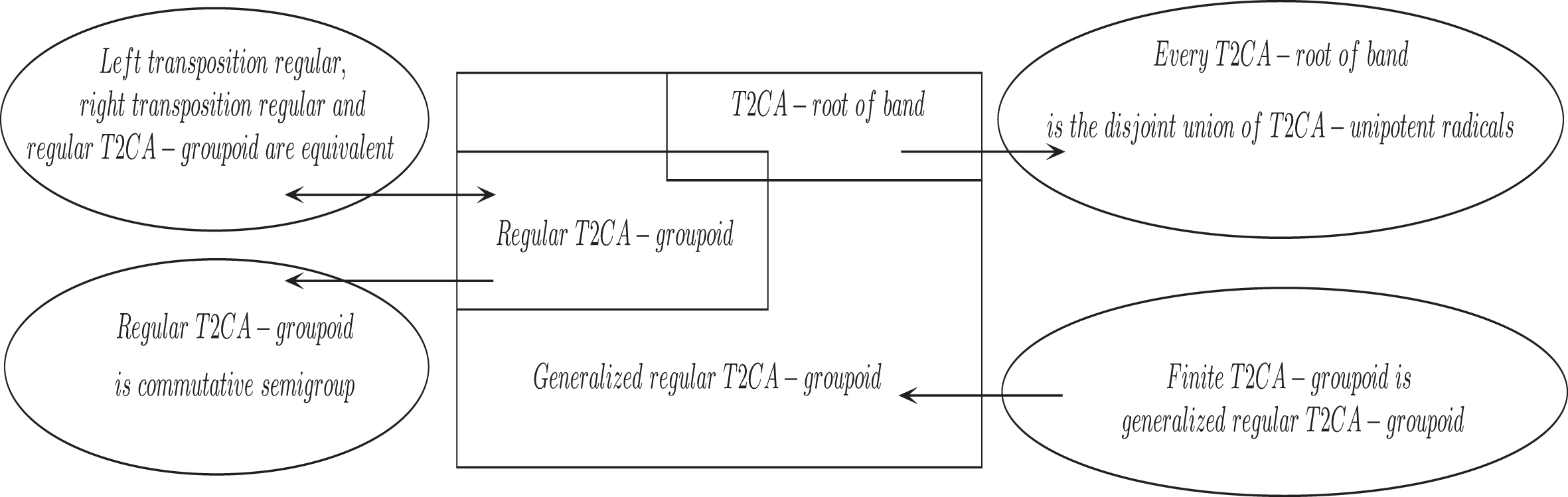
The main results on the T2CA-groupoids.
We have two research directions for future research. One is to find the characteristics of elements with commutative properties (as described at the end of Section 2), and the other is to study the relationships among T2CA-IPGRL, pseudo overlap functions and some related algebra systems (see [18, 31–34]).
Footnotes
Acknowledgments
This research was supported by the National Natural Science Foundation of China (Grant No. 12271319).
References
1.
ZhangX., YuanW. and ChenM., A kind of non-associative groupoids and quasi neutrosophic extended triplet groupoids (QNET-groupoids), Neutrosophic Sets Syst.36 (2020), 144–163.
2.
HosszúM., Some functional equations related with the associative law, Publ. Math. Debrecen3 (1954), 205–214.
3.
MaksaG., CM solutions of some functional equations of associative type, Annales Univ. Sci. Budapest. Sect. Comp.24 (2004), 125–132.
4.
SchölzelK. and TomaschekJ., Power series solutions of Tarski’s associativity law and of the cyclic associativity law, Aequationes Math.90 (2016), 411–425.
5.
vonJ., Neumann, On regular rings, Proc. Natl. Acad. Sci. USA22 (1936), 707–713.
6.
MunnW.D. and PenroseR., A note on inverse semigroups, Math. Proc. Camb. Philos. Soc.51 (1955), 396–399.
7.
HallT.E., On regular semigroups, J. Algebra24 (1973), 1–24.
8.
GrilletP.A., The structure of regular semigroups, I: A representation, Semigroup Forum8 (1974), 177–183.
9.
GrilletP.A., The structure of regular semigroups, II: Cross-connections, Semigroup Forum8 (1974), 254–259.
10.
GrilletP.A., The structure of regular semigroups, III: The reduced case, Semigroup Forum8 (1974), 260–265.
11.
ZhangX. and DuY., Left (right) regular and transposition regular semigroups and their structures, Mathematics10 (2022), 1021.
12.
YuanW. and ZhangX., Regular CA-groupoids and cyclic associative neutrosophic extended triplet groupoids (CA-NET-groupoids) with green relations, Mathematics8 (2020), 204.
13.
DuY., ZhangX. and AnX., Transposition regular AG-groupoids and their decomposition theorems, Mathematics10 (2022), 1396.
14.
AnX. and ZhangX., Transposition regular TA-groupoids and their structures, Axioms11 (2022), 378.
15.
AnX., ZhangX. and MaZ., Two open problems on CA-groupoids and cancellativities of T2CA-groupoids, Axioms11 (2022), 169.
16.
PaivaR., SantiagoR., BedregalB. and RivieccioU., Inflationary BL-algebras obtained from 2-dimensional general overlap functions, Fuzzy Sets Syst.418 (2021), 64–83.
17.
LiangR. and ZhangX., Pseudo general overlap functions and weak inflationary pseudo BL-algebras, Mathematics10 (2022), 3007.
18.
ZhangX., LiangR. and BedregalB., Weak inflationary BL-algebras and filters of inflationary (pseudo) general residuated lattices, Mathematics10 (2022), 3394.
19.
Celakoska-JordanovaV. and JanevaB., Free left commutative groupoids,pp, Annual Review of the European University, Skopje, Republic of Macedonia2009, 687–694.
20.
RashadM., AhmadI., ShahM. and SaeidA.B., Enumeration of bi-commutative–AG-groupoids, Journal of Siberian Federal University Mathematics & Physics13 (2020), 314–330.
21.
ProtićP.V. and StevanovićN., Abel-Grassmann’s bands, Quasigroups Relat. Syst.11 (2004), 95–101.
22.
StevanovićN. and ProtićP.V., Composition of Abel-Grassmann’s 3-bands, Novi Sad J. Math.34 (2004), 175–182.
23.
MushtaqQ. and KhanM., Ideals in AG-band and AG*-groupoid, Quasigroups Relat. Syst.14 (2006), 207–215.
24.
MushtaqQ. and KhanM., A note on an Abel-Grassmann’s 3-band, Quasigroups Relat. Syst.15 (2007), 295–301.
25.
StevanovićN. and ProtićP.V., Band decompositions of Abel-Grassmann’s groupoids, Pure Math. Appl.12 (2001), 431–436.
26.
StevanovićN. and ProtićP.V., Some relations of Abel-Grassmann’s 3-bands, Pure Math. Appl.14 (2003), 145–150.
27.
StevanovićN., ProtićP.V. Roots of AG-bands, in: Approximation and Computation: In Honor of Gradimir V. Milovanovic, Springer Optimization and Its Applications, W. Gautschi, G. Mastroianni, T. Rassias, Eds., Springer, New York, NY, USA, 2010, Vol. 42, pp. 439–445.
28.
IqbalM. and AhmadI., On quasi-cancellative AG-groupoids, Quasigroups Relat. Syst.29 (2021), 209–212.
29.
ProtićP.V., Some remarks of medial groupoids, Facta Univ. Ser. Math. Inform.26 (2011), 65–73.
30.
HájekP. Metamathematics of Fuzzy Logic, Dordrecht, Boston and London: Kluwer Academic Publishers, 1998.
31.
ShengN. and ZhangX., Regular partial residuated lattices and their filters, Mathematics10 (2022), 2429.
32.
ZhangX., LiangR., BustinceH., BedregalB., FernandezJ., LiM. and OuQ., Pseudo overlap functions, fuzzy implications and pseudo grouping functions with applications, Axioms11 (2022), 593.
33.
JingM. and ZhangX., Pseudo-quasi overlap functions and related fuzzy inference methods, Axioms12 (2023), 217.
34.
ZhangX., ShengN. and BorzooeiR.A., Partial residuated implications induced by partial triangular norms and partial residuated lattices, Axioms12 (2023), 63.