Prioritization of types of wireless sensor networks by applying decision-making technique based on bipolar complex fuzzy linguistic heronian mean operators
Free accessResearch articleFirst published online January 10, 2024
Prioritization of types of wireless sensor networks by applying decision-making technique based on bipolar complex fuzzy linguistic heronian mean operators
Wireless sensor networks are flexible monitoring systems that save track of, data, and communicate multipoint digital information interpretations to other devices. Wireless sensor networks meaningly enhance the accuracy, breadth, and extent of local data collection, commonly doing away with the requirement for expensive data wiring and recurring manual checks at risky, remote, or inaccessible locations. As a result, it is utilized to keep an eye on systems and environmental or physical parameters. In this manuscript, we expand the Heronian mean operators in the model of bipolar complex fuzzy linguistic set to concoct bipolar complex fuzzy linguistic arithmetic Heronian mean, bipolar complex fuzzy linguistic weighted arithmetic Heronian mean, bipolar complex fuzzy linguistic geometric Heronian mean and bipolar complex fuzzy linguistic weighted geometric Heronian mean operators. We also inspect the special cases of the invented bipolar complex fuzzy linguistic arithmetic Heronian mean and bipolar complex fuzzy linguistic geometric Heronian mean operators. Moreover, in this manuscript, we concoct a technique of decision-making in the model of a bipolar complex fuzzy linguistic set with the assistance of the invented operators. As the selection and prioritization of the various types of Wireless sensor networks is the decision-making dilemma, we prioritize various types of Wireless sensor networks by employing the concocted technique of decision-making and by taking artificial data in the model of the bipolar complex fuzzy linguistic set. To reveal the influence and excellence of the concocted work, a comparative study is given in this manuscript.
Wireless Sensor Networks (WSNs) are networks of small, low-cost, low-power, and wireless sensor nodes that can be deployed in a variety of environments, such as indoor and outdoor settings, to monitor and collect data on physical or environmental conditions. Each node in a WSN typically consists of a sensor, a microcontroller, and a wireless communication interface, which allows the node to collect data and transmit it wirelessly to other nodes or a central data processing system. WSNs are widely used in a variety of applications, such as environmental monitoring, health monitoring, smart homes and buildings, precision agriculture, and industrial automation. The data collected by WSNs can be used to provide valuable insights and inform decision-making in various fields. One of the key challenges in WSNs is power management, as sensor nodes are typically powered by batteries and have limited energy resources. Researchers have developed various techniques to reduce the energy consumption of sensor nodes, such as duty cycling, data aggregation, and localization. Another challenge is ensuring the security and privacy of data transmitted by WSNs, as the wireless communication between nodes can be vulnerable to attacks. Overall, WSNs offer a powerful and versatile tool for monitoring and collecting data in a wide range of settings, and continued research and development in this area will likely lead to new applications and innovations.
In the technique of decision-making (DM), crisp arguments are usually utilized but the crisp arguments are not constantly accessible and incompetent of tackling genuine world dilemmas. Because of this, the notion of the fuzzy set (FS) was concocted by Zadeh [1] in 1965 to tackle ambiguities and imprecision in the DM dilemmas. In the human’s opinion, there is bipolarity i.e., both positive and negative poles and so there is a possibility of a situation where the decision analyst requires both poles in the DM dilemma. For such possibilities, Zhang [2] concocted a bipolar fuzzy set (BFS) to tackle the information consisting the bipolarity. The model of the complex fuzzy set (CFS) was initially concocted by Ramot et al. [3] by expanding the model of FS. The primary variation between FS and CFS is that the range of FS is [0, 1], but the range of CFS is a unit circle in a complex plane and not a [0, 1]. Another form of CFS was interpreted by Tamir et al. [4]. One of the latest modifications of FS is the bipolar complex fuzzy set (BCFS) devised by Mahmood and Ur Rehman [5] to tackle the information consisting of the bipolarity and extra fuzzy information concurrently. A positive grade of membership and a negative grade of membership would interpret the model of BCFS and would be placed in the unit square of a complex plane. Because of the socioeconomic situation’s growing complexity and the inherent subjectivity of human thoughts, numerical data may not always be sufficient to address ambiguous and vague data in genuine-life DM situations, particularly when it comes to qualitative factors. However, it is simple to interpret the evaluation arguments in the model of linguistic variables (LVs). Thus, Zadeh [6] devised the notion of LVs. The theory of bipolar complex fuzzy linguistic set (BCFLS) was interpreted by Mahmood et al. [7] by modifying the notion of BCFS and linguistic term set.
Literature review
Arampatzis et al. [8] investigated the application of WSNs. Ortiz et al. [9] studied reactive routing protocols in WSN. Ko et al. [10] investigated WSNs in the field of healthcare. Eldrandaly et al. [11] discussed mobile WSNs employing a nature-inspired firefly algorithm. The security in WSNs is investigated by Perrig et al. [12]. Abbasi et al. [13] reviewed the WSNs and discussed their application to agriculture. Kumar and Amgoth [14] studied connectivity restoration in WSNs. Sharma et al. [15] studied the dilemmas and challenges in WSNs. Joshi et al. [16] interpreted the technique for heterogeneous WSNs. Chen and Zhao [17] investigated the lifetime of WSNs. Youssef and Younis [18] discussed gateway protection in WSNs. Fan and Gou [19] studied the whale optimization algorithm in the model of fuzzy information. Ran et al. [20] employed fuzzy logic the enlighten the LEACH protocol of WSNs. Alshwai et al. [21] discussed the growth of the lifetime of WSNs by employing the fuzzy method. Gao et al. [22] utilized fuzzy control for the interpretation of an irrigation system relying on WSNs. Employing fuzzy logic for the study of forest fire detection based on WSNs was investigated by Bolourchi and Uysal [23]. Haider and Yusuf [24] studied energy-optimized routing for WSNs by employing the fuzzy technique. Azad and Sharma [25] interpreted the choice of cluster head in WSNs in the setting of FS. Arjunan and Sujatha [26] discussed WSN by utilizing fuzzy-based unequal clustering. Arunachalam and Perumal [27] discussed WSNs in the setting of BFS. Jana et al. [28, 29] invented Dombi aggregation operators (AOs) and Dombi prioritized AOs for coping with bipolar fuzzy (BF) information. Wei et al. [30] and Raiz et al. [31] invented Hamacher and Sin trigonometric AOs for BFS respectively. Alghamdi et al. [32] and Akram et al. [33] devised techniques of DM for tackling BF information.
The AOs for tackling CFS information have been invented by various researchers, for instance, Bi et al. [34, 35] and Hu et al. [36]. Mahmood et al. [37] invented Aczel-Alsina, Mahmood, and Ur Rehman [38] devised Dombi, Mahmood, et al. [39] invented Hamacher AOs for managing bipolar complex fuzzy (BCF) information. MADM (multi-attribute DM) approaches for BCF information were investigated by Mahmood and Ur Rehman [40] and Mahmood et al. [41]. Further, Mahmood et al. [42] devised a decision support system, and Ur Rehman et al. [43] concocted the AHP approach in the setting of BCFS. Ur Rehman [44] invented BCF semigroups. Gou et al. [45] devised an improved VIKOR approach in a linguistic term set. Arfi [46] studied politics by employing the linguistic FS method. Cao et al. [47] interpreted linguistic fuzzy rules. Wang and Li [48] invented an intuitionistic fuzzy linguistic set (FLS). Liu et al. [49] invented Pythagorean FLS and Du et al. [50] studied interval-valued Pythagorean FLS. Wang et al. [51] devised q-rung orthopair FLS and Lin et al. [52] investigated hesitant FLS. Gou et al. [53] devised entropy and cross-entropy measures within hesitant FLS and Zhang et al. [54] devised an approach of ELECTRE II under the setting of Hesitant FLS. Moreover, Liu et al. [55] studied bipolar LT set and DM. Tehrim and Riaz [56] investigated interval-valued bipolar FLS.
Motivation
In situations involving DM, the AOs are frequently utilized. Usually, the AOs may be split into two categories i.e., geometric and arithmetic AOs. Most of the AOs can stress the significance of every datum or their ordered position but are unable to capture the interrelation among the attributes. HM operator is a crucial operator that may take into account the interrelation among the attributes. It did, though, receive a lot of study interest in the past and utilized various notions and applications of inequality. HM operator was proved by Beliakov [57] as an AO, however, he didn’t conduct a thorough investigation. Yu [58] invented intuitionistic fuzzy (IF) geometric HM, and Yu and Wu [59] devised interval-valued IF HM operators. Wei et al. [60] invented HM operators for picture fuzzy information. Fan et al. [61] studied HM operators for the bipolar neutrosophic set. Naz et al. [62] investigated HM operators in the model of 2-tuple linguistic BFS. Yu [63] and Ju et al. [64] invented HM operators for hesitant FS and hesitant FLS respectively. Mahmood et al. [65] invented the HM operator in the model of BCF information. In short, interactions among the DM attributes are a regular occurrence in real-world DM dilemmas. As the HM operator can easily capture the interrelation among the attributes and the BCFL variables is a significant tool for describing the fuzzy data, and the research on DM dilemmas with BCFL information is currently in its early stages. Thus, the HM operator should be extended in order to handle BCFL information. Consequently, in this manuscript, we devise a technique for DM dilemmas to tackle the BCFL information. Further, we concoct the HM operators with BCFL information like BCFL arithmetic Heronian mean (BCFLAHM), BCFL weighted arithmetic Heronian mean (BCFLWAHM), BCFL geometric Heronian mean (BCFLGHM) and BCFL weighted geometric Heronian mean (BCFLWGHM) operators. After that, we prioritize the various types of WSNs by taking artificial data and utilizing the invented technique of DM.
The below part of the manuscript is constructed as: In Section 2, the theory of BCFLS, and HM operator is reviewed. In Section 3, we concoct the HM operators with BCFL information like BCFLAHM, BCFLWAHM, BCFLGHM, and BCFLWGHM operators and investigate special cases. In Section 4, we establish a technique of DM by employing the invented HM operators for coping with BCFL information and then discuss a descriptive example related to WSNs. In Section 5, the comparative study is diagnosed for revealing the significant and critical role of the interpreted work. In Section 6, we conclude this manuscript.
Preliminaries
In this section, the theory of BCFLS and HM operators is reviewed.
Definition 1: [7] Let be the universal set. Then the BCFLS over is depicted as
where, , is a positive grade of membership and is a negative grade of membership with and , of an element to the linguistic term 𝓉ψ(ringu). The BCFLN is depicted by .
Definition 2: [7] The SV of a BCFLN is depicted as
and the AV of a BCFLN is depicted as
By employing Def (2) we have
if , then ;
if , then ;
if , then
if , then ;
if , then ;
if , then .
Definition 3: [57] Consider a gathering of crisp numbers and 𝔛, y > 0, then the HM operator is
Definition 4: [58] Consider a gathering of crisp numbers and 𝔛, y > 0, then the geometric HM operator is
The BCF linguistic HM operators
AOs are typically categorized into two sorts, i.e. arithmetic AOs (AAOs) and geometric AOs (GAOs). The AAOs feature the usefulness of the framework, i.e. accentuation on the effect of all data and permit the solid complementarity among the different information, while the GAOs feature the equilibrium of the framework i.e. accentuation on the coordination among the different information and feature the job of the singular information and don’t permit a short board peculiarity. In the following section, we are going to establish both AAOs and GAOs by employing HM operators in the setting of BCFLS.
Definition 5: For two BCFLNs and with λ > 0, we have
BCF arithmetic AOs
The HM operator is a significant AO, nonetheless, it has typically been employed in circumstances, where the crisp numbers are employed as the input values. Here, we will expand the HM operator to the circumstances, where the BCFL data are employed as the input values and establish BCFLAHM and BCFLWAHM operators. Further, we investigate a few basic properties of this operator like idempotency, monotonicity, and boundedness, and also deliberate a few particular cases by considering various parameter values (PVs).
BCFLAHM operator
Following, we establish the BCFLAHM operator
Definition 6: Suppose
(ξ = 1, 2, … , ϑ) is a class of BCFLNs and , if
then BCFLAHM𝔛,y operator is termed as BCFLAHM operator.
Theorem 1:Suppose (ξ = 1, 2, … , ϑ) is a class of BCFLNs, then the outcome achieved by Equation (6) is a BCFLN and
Next, we investigate the specific cases of the discovered BCFLAHM operator by considering various values of the parameter 𝔛, y.
1. By y → 0, the Equation (7) decreases to BCFL generalized linear (GL) descending weighted mean operator (WMO) as below
Cleary, it is equal to the weight of the data with weight values (WVs) (ϑ, ϑ - 1, . . , 1).
2. By 𝔛 → 0, the Equation (7) decreases to BCFL GL ascending WMO as below
Cleary, it is equal to the weight of the data with WVs (1, 2, . . , ϑ).
3. By letting , then the Equation (7) transform to BCFL basic HM operator as below
4. By letting 𝔛 = y = 1, then the Equation (7) transform to BCFL line HM operator as below
The BCFLWAHM operator
In the BCFLAHM operator, we just think about the information parameter and their interrelatedness and don’t think about the significance of every info parameter itself. Be that as it may, in numerous real-life circumstances, the weight of given information is likewise a significant parameter. Thus, we can characterize a BCFLWAHM operator below
Definition 7: Suppose (ξ = 1, 2, … , ϑ) is a class of BCFLNs and , if
then BCFLWAHM𝔛,y operator is said to be BCFLWAHM operator, where, ϑ is the balance parameter (BP) and is a weight vector with and .
Theorem 2: Suppose (ξ = 1, 2, … , ϑ) is a class of BCFLNs, then the outcome achieved by Equation (8) is a BCFLN and
Next, we investigate the specific cases of the discovered BCFLGHM operator by considering various values of the parameter 𝔛, y.
1 By y → 0, the Equation (11) decreases to BCFL generalized geometric linear descending WMO as below
2 By 𝔛 → 0, the Equation (11) decreases to BCFL generalized geometric linear ascending WMO as below
3. By letting , then the Equation (11) transform to BCFL basic geometric HM operator as below
4. By letting 𝔛 = y = 1, then the Equation (11) transform to BCFL geometric line HM operator as below
The BCFLWGHM operator
Following is the interpretation of the BCFLWGHM operator
Definition 9: Suppose (ξ = 1, 2, … , ϑ) is a class of BCFLNs and , if
then BCFLWGHM𝔛,y operators is said to be BCFLWGHM operator, where, ϑ is BP and is a weight vector with and .
Theorem 4:Suppose(ξ = 1, 2, … , ϑ) is a class of BCFLNs, then the outcome achieved by Equation (12) is a BCFLN and
Following are the axioms of the BCFLWGHM operator.
For any two classes of BCFLNs and .we have
1. Idempotency: If , then
2. Monotonicity: If , then
3. Boundedness: Suppose and , then
Application
Depending on the setting, there are five different types of sensor networks. Different WSN types include:
1. Terrestrial WSNs: Terrestrial WSNs, which are made up of thousands of nodes of wireless sensors placed either in an unorganized (ad hoc) or organized (pre-planned) manner, are used to effectively communicate base stations. The nodes of the sensor are placed around the target region that is dropped from a predetermined plane in an unorganized mode (ad hoc). The battery power in WSNs is constrained, but the battery is equipped with photovoltaic cells as a backup power source. Low-duty cycle processes, optimum routing, avoiding delays, and other techniques help WSNs conserve energy.
2. Underground WSNs: Underground WSNs cost more than terrestrial WSNs to deploy, maintain, buy the necessary equipment, and plan carefully. The underground sensor networks UWSNs are made up of several sensor nodes that are buried to monitor conditions underground. These underground WSNs installed into the ground are challenging to recharge. Extended sink nodes are placed beyond the bottom to carry information from sensors to the base station. It is also challenging to replenish the sensor power nodes because they have limited battery power. The significant attenuation and level of signal loss in the subsurface environment further complicate wireless communication.
3. Mobile WSNs: A collection of sensor networks that may move independently and communicate with the physical living environment make up mobile WSN networks. These network nodes can also compute, perceive, and communicate. In comparison to static sensor networks, mobile WSNs are far more flexible. Better and more enhanced range, superior channel conditions, higher energy efficiency, and other advantages make mobile WSNs superior to static WSNs.
4. Multimedia WSNs: It is suggested that multimedia WSNs be used to enable the observation and tracking of multimedia events like audio, video, and imaging. Low-cost sensor nodes with microphones and cameras are present in these networks. For retrieving data, data reduction, and data linkage, these multimedia WSN sensory nodes are interconnected via a wireless network. Increased bandwidth needs, high power consumption, processing, and compression methods are some of the difficulties with multimedia WSNs. For multimedia content to be sent correctly and easily, a large amount of bandwidth is also required.
5. Underwater WSNs: Water covers 70 percent of the total surface of the globe. These networks include numerous underwater vehicles and sensor nodes. Data collection from these sensors is carried out by autonomous underwater machines and vehicles. Communication underwater may be difficult due to network latency, limited bandwidth, and sensor malfunctions. WSNs have a restricted battery that cannot be replaced or recharged underwater. The invention of underwater networking and communication methods is necessary to address the challenge of conserving energy for underwater WSNs.
Decision-making technique
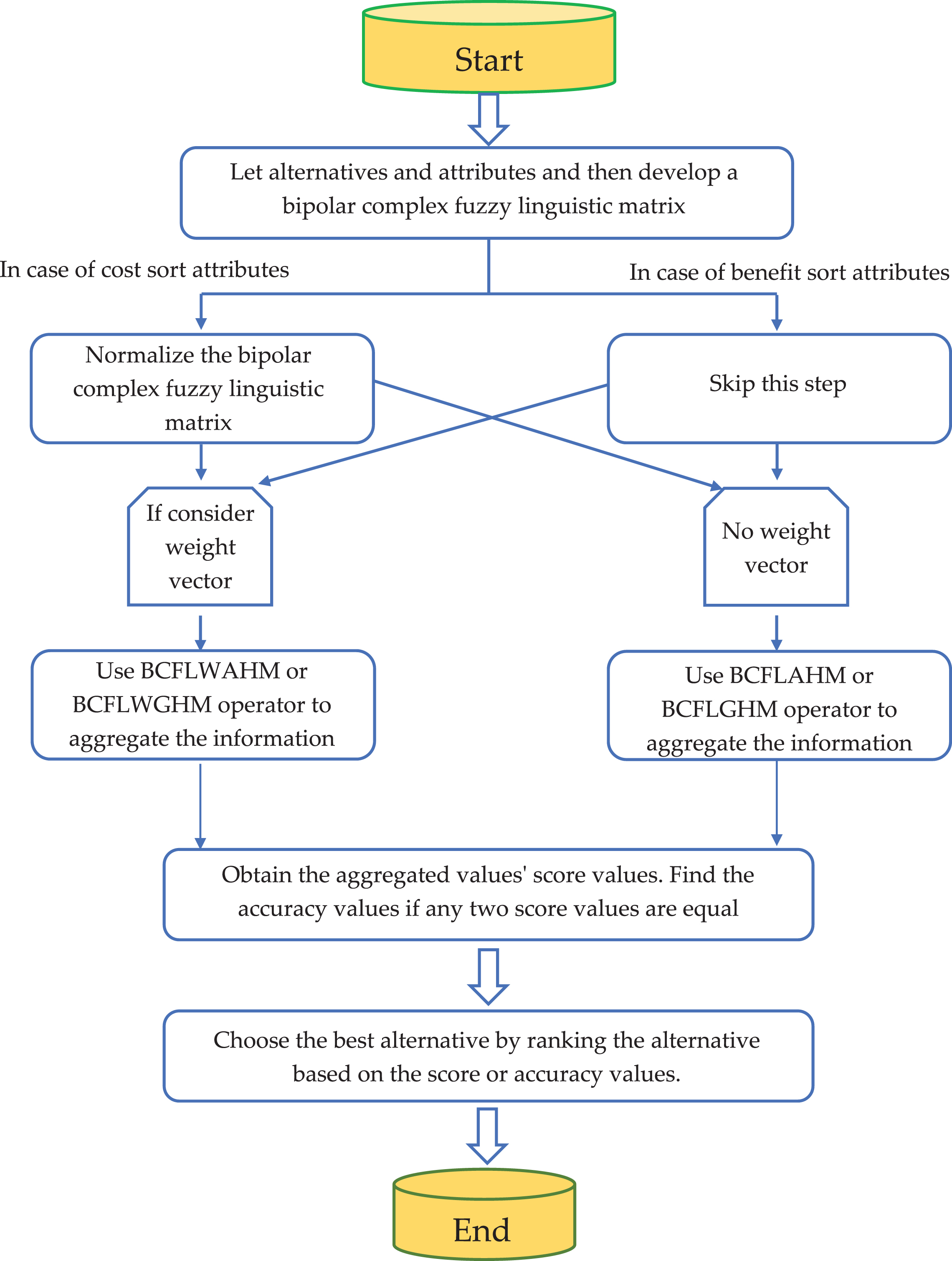
Consider a gathering of alternatives and gathering attributes with weight vector Zω𝓋 = (Zω𝓋-1, Zω𝓋-2, … , Zω𝓋-γ) such that 0 ≤ Zω𝓋-ς ≤ 1 ∀ ς and . The expert or decision analyst would assess the alternative and interpret the values of each alternative by examining the attributes. The assessment values would be in the model of BCFLS and would form a BCFL decision matrix. To handle this matrix we have the following steps
Step 1: Here, we have to see the attributes whether they are cost types or benefit types. If they are benefit sort then we can skip this step. If any attribute is cost type then we would normalize the matrix by taking the complement of BCFLNs of the cost attribute.
Step 2: Any of the invented operators (BCFLAHM, BCFLWAHM, BCFLGHM, BCFLWGHM) would be utilized to aggregate the information.
Step 3: The score values of the aggregated values will be determined.
Step 4: The ranking of the alternatives would be interpreted relying on the score values.
Step 5: Finished.
The flow chart of DM approach is revealed in Fig. 1.
The flow chart of the invented DM approach.
Descriptive example
To increase production efficiency and become more environmentally friendly, industrial organizations are adopting technologies like wireless sensing and control. This is due to the competitive nature of the global market, rising energy prices, and continuous environmental concerns. Here, we suppose that an industrial organization wants to adopt the WSN to increase production efficiency and becoming more environmentally friendly. The IT expert of the industrial organization analyzed various types of WSN which is , , , under , , , and , attributes and established the assessment values in the model of BCFLS exhibited in Table 1.
The BCFL information was assessed by the expert
For obtaining the finest WSN any decision analyst can utilize the interpreted procedure of DM.
Step 1: Attributes are benefits sorts so the decision analyst skips this step.
Step 2: The invented operators BCFLAHM, BCFLWAHM, BCFLGHM, and BCFLWGHM are utilized and the aggregate result is exhibited in Table 2.
The expected aggregated values of the data are in Table 1 after using invented operators
BCFLAHM
BCFLWAHM
BCFLGHM
BCFLWGHM
Step 3: The score values of the aggregated values are exhibited in Table 3.
The score values of the aggregated values
BCFLAHM
BCFLWAHM
BCFLGHM
BCFLWGHM
2.61
3.8
6.13
5.72
4.55
5.83
23.7
20.2
2.92
3.99
9.6
6.97
3.09
4.49
6.18
6.17
1.64
2.33
3.36
1.69
Step 4: The ranking of the alternatives is interpreted in Table 4.
The expected ranking
Operators
Ranking
BCFLAHM
BCFLWAHM
BCFLGHM
BCFLWGHM
This implies that (Mobile WSN) is the finest one.
Step 5: Finished.
Comparative study
To explain the dominance and excellence of the devised work, in this section, we compare the devised work with numerous existing work.
Let us consider numerous prevailing notions that are briefly discussed below
Dombi AOs within BFS were invented by Jana et al. [28].
Hamacher AOs within BFS, interpreted by Wei et al. [30].
Sine trigonometric AOs for BFS devised by Riaz et al. [31],
Arithmetic AOs under the environment of CFS invented by Bi et al. [34]
Geometric AOs under the environment of CFS, interpreted by Bi et al. [35]
Probability complex fuzzy AOs devised by Rehman [66].
Aczel-Alsina AOs under the environment of BCFS devised by Mahmood et al. [37]
Dombi AOs for BCFS were devised by Mahmood and Rehman [38].
HM operators under the setting of the BCFS were investigated by Mahmood et al. [65].
Next, we are going to take the information in the setting of BCFLS which is demonstrated in Table 1 and would try to solve this information by the invented work as well as the mentioned current notions. The expected results are displayed in Table 5 and the ranking order is exhibited in Table 6.
The expected results after applying current notions and invented work
With the assistance of the above outcomes one can note that the prevailing notions didn’t interpret any solution of the information described in Table 1 because Jana et al. [28], Hamacher et al. [30], and Riaz et al. [31] just cope with bipolar fuzzy information and can’t overcome with linguistic terms and extra fuzzy information, Bi et al. [34], Bi et al. [35] and Rehman [66] just cope with complex fuzzy information and can’t overcome with linguistic terms as well as the counter property of the objects. Moreover, the theory invented by Mahmood et al. [37], Mahmood and Rehman [38], and Mahmood et al. [65] just cope with bipolar complex fuzzy information and can’t overcome with linguistic terms. The concocted operators and technique of DM established a result that interpreted that (Mobile WSNs) is the finest one. Furthermore, the concocted operators are also overcome with fuzzy, bipolar fuzzy, bipolar fuzzy linguistic, complex fuzzy, complex fuzzy linguistic, and bipolar complex fuzzy information because the devised operator can degenerate into these models. This implies that the invented work is more generalized and superior than the mentioned current notions. The invented theories can be reduced to the notion of FS, CFS, BFS, and BCFS as underneath
By ignoring linguistic term, we get the invented theories in the structure of BCFS.
By ignoring linguistic term and unreal parts, we get the invented theories in the structure of BFS.
By ignoring linguistic term and negative grade of membership, we get the invented theories in the structure of CFS.
By ignoring linguistic term, negative grade of membership and unreal parts in positive grade of membership, we get the interpreted theories in the structure of FS.
Conclusion
In this manuscript, we studied WSNs (Networks of tiny, battery-powered sensors with wireless communication capabilities are known as WSNs. These sensors gather and provide information to a central control point about their surroundings, such as temperature, humidity, or environmental variables. WSNs provide real-time data collecting and analysis in a variety of industries, including healthcare, industrial automation, and environmental monitoring. For remote sensing and control activities, they provide scalable, affordable solutions) and prioritize the types of WSNs. Thus, we developed AOs for prioritizing different types of WSNs by combining the HM operator with the idea of BCFLS. BCFLAHM, BCFLWAHM, BCFLGHM, and BCFLWGHM were these AOs. We also studied their primary properties and special cases of BCFLAHM and BCFLGHM operators. In addition, we identified a DM method to address DM problems using the newly developed operators in a BCFLS environment. We prioritized the various types of WSNs with the help of the DM technique that was developed and by taking into account the artificial data in the BCFLS structure because the selection and prioritization of the various types of WSNs is the DM dilemma. We concluded from that numerical example that, , which is Mobile WSNs, is the finest one in all. To reveal the influence and excellence of the concocted work, we did a comparative study in this manuscript.
In the future, our wish is to diagnose a few novel notions linked with the measures, AOs, and techniques and would like to employ them in various fields such as pattern recognition, medical diagnosis, DM, etc. Further, we would expand the devised work in the bipolar complex fuzzy soft sets [67], bipolar complex fuzzy subgroups [68], complex bipolar picture fuzzy set [69], bipolar complex spherical fuzzy set [70], and Hamacher prioritized and power interaction aggregation operators [71, 72] etc.
Completing interest
The authors declare that they have no completing interest.
Authors contribution statement
The authors contribute equally.
Ethical and informed consent for data used
The data of this article is artificial.
Data availability
The data employed in this script are artificial and hypothetical and one can use these data before prior permission by just citing this script.
Footnotes
The appendices are available in the electronic version of this article: .
References
1.
ZadehL.A., Fuzzy sets, Information and Control8(3) (1965), 338–353.
2.
ZhangW.R. Bipolar fuzzy sets and relations: a computational framework for cognitive modeling and multiagent decision analysis. In NAFIPS/IFIS/NASA’94. Proceedings of the First International Joint Conference of The North American Fuzzy Information Processing Society Biannual Conference. The Industrial Fuzzy Control and Intellige (pp. 305–309). IEEE.
3.
RamotD., MiloR., FriedmanM. and KandelA., Complex fuzzy sets, IEEE Transactions on Fuzzy Systems10(2) (2002), 171–186.
4.
TamirD.E., JinL. and KandelA., A new interpretation of complex membership grade, International Journal of Intelligent Systems26(4) (2011), 285–312.
5.
MahmoodT. and UrU., Rehman, A novel approach towards bipolar complex fuzzy sets and their applications in generalized similarity measures, International Journal of Intelligent Systems37(1) (2022), 535–567.
6.
ZadehL.A., The concept of a linguistic variable and its application to approximate reasoning—I, Information Sciences8(3) (1975), 199–249.
7.
MahmoodT., ur RehmanU., NaeemM. Prioritization of strategies of digital transformation of supply chain employing bipolar complex fuzzy linguistic aggregation operators, IEEE Access (2023).
8.
ArampatzisT., LygerosJ., ManesisS. Asurvey of applications of wireless sensors and wireless sensor networks. In Proceedings of the 2005 IEEE International Symposium on, Mediterrean Conference on Control and Automation Intelligent Control, 2005. (pp. 719–24). IEEE (2005).
9.
OrtizA.M., RoyoF., OlivaresT., CastilloJ.C. and Orozco-BarbosaL., On reactive routing protocols in ZigBee wireless sensor networks, Expert Systems31(2) (2014), 154–162.
10.
KoJ., LuC., SrivastavaM.B., StankovicJ.A., TerzisA. and WelshM., Wireless sensor networks for healthcare, Proceedings of the IEEE98(11) (2010), 1947–1960.
11.
EldrandalyK., Abdel-BassetM. and Abdel-FatahL., Grid quorum-based spatial coverage in mobile wireless sensor networks using nature-inspired firefly algorithme, Expert Systems36(4) (2019), e12421.
12.
PerrigA., StankovicJ. and WagnerD., Security in wireless sensor networks, Communications of the ACM47(6) (2004), 53–57.
13.
AbbasiA.Z., IslamN. and ShaikhZ.A., A review of wireless sensorsand networks’ applications in agriculture, Computer Standards& Interfaces36(2) (2014), 263–270.
14.
KumarR. and AmgothT., Reinforcement learning based connectivity restoration in wireless sensor networks, Applied Intelligence52(11) (2022), 13214–13231.
15.
SharmaS., BansalR.K., BansalS. Issues and challenges in wireless sensor networks. In 2013 international conference on machine intelligence and research advancement (pp. 58–62). IEEE (2013).
16.
JoshiP., KumarS., RaghuvanshiA.S. A performance efficient joint clustering and routing approach for heterogeneous wireless sensor networks, Expert Systems (2022).
17.
ChenY. and ZhaoQ., On the lifetime of wireless sensor networks, IEEE Communications Letters9(11) (2005), 976–978.
18.
YoussefW. and YounisM., A cognitive scheme for gateway protection in wireless sensor network, Applied Intelligence29 (2008), 216–227.
19.
FanZ. and GouJ., Predicting body fat using a novel fuzzy-weighted approach optimized by the whale optimization algorithm, Expert Systems with Applications217 (2023), 119558.
20.
RanG., ZhangH. and GongS., Improving on LEACH protocol of wireless sensor networks using fuzzy logic, Journal of Information & Computational Science7(3) (2010), 767–775.
21.
AlShawiI.S., YanL., PanW. and LuoB., Lifetime enhancement in wireless sensor networks using fuzzy approach and A-star algorithm, IEEE Sensors Journal12(10) (2012), 3010–3018.
22.
GaoL., ZhangM. and ChenG., An intelligent irrigation system based on wireless sensor network and fuzzy control, Journal of Networks8(5) (2013), 1080.
23.
BolourchiP., UysalS. Forest fire detection in wireless sensor network using fuzzy logic. In 2013 Fifth International Conference on Computational Intelligence, Communication Systems and Networks (pp. 83–87). IEEE (2013).
24.
HaiderT. and YusufM., A fuzzy approach to energy optimized routing for wireless sensor networks, Int. Arab J. Inf. Technol.6(2) (2009), 179–185.
25.
AzadP. and SharmaV., Cluster head selection in wireless sensor networks under fuzzy environment, International Scholarly Research Notices2013 (2013).
26.
ArjunanS. and SujathaP., Lifetime maximization of wireless sensor network using fuzzy based unequal clustering and ACO based routing hybrid protocol, Applied Intelligence48 (2018), 2229–2246.
27.
ArunachalamR. and PerumalE.R., Bipolar fuzzy information-based PROMETHEE-based outranking scheme for mitigating vampire attack in wireless sensor networks, Transactions on Emerging Telecommunications Technologies33(9) (2022), e4564.
28.
JanaC., PalM. and WangJ.Q., Bipolar fuzzy Dombi aggregation operators and its application in multiple-attribute decision-making process, Journal of Ambient Intelligence and Humanized Computing10 (2019), 3533–3549.
29.
JanaC., PalM. and WangJ.Q., Bipolar fuzzy Dombi prioritized aggregation operators in multiple attribute decision making, Soft Computing24 (2020), 3631–3646.
30.
WeiG., AlsaadiF.E., HayatT. and AlsaediA., Bipolar fuzzy Hamacher aggregation operators in multiple attribute decision making, International Journal of Fuzzy Systems20 (2018), 1–12.
31.
RiazM., PamucarD., HabibA. and JamilN., Innovative bipolar fuzzy sine trigonometric aggregation operators and SIR method for medical tourism supply chain, Mathematical Problems in Engineering2022(2022).
32.
AlghamdiM.A., AlshehriN.O. and AkramM., Multi-criteria decision-making methods in bipolar fuzzy environment, International Journal of Fuzzy Systems20 (2018), 2057–2064.
33.
AkramM. and Al-KenaniA.N., Multiple-attribute decision making ELECTRE II method under bipolar fuzzy model, Algorithms12(11) (2019), 226.
34.
BiL., DaiS., HuB. and Li.S., Complex fuzzy arithmeticaggregation operators, Journal of Intelligent & FuzzySystems36(3) (2019), 2765–2771.
HuB., BiL. and DaiS., Complex fuzzy power aggregation operators, Mathematical problems in Engineering2019 (2019), 1–7.
37.
MahmoodT., ur RehmanU., AliZ.Analysis and application of Aczel-Alsina aggregation operators based on bipolar complex fuzzy information in multiple attribute decision making, Information Sciences619 (2023), 817–833.
38.
MahmoodT. and RehmanU.U., A method to multi-attribute decision making technique based on Dombi aggregation operators under bipolar complex fuzzy information, Computational and Applied Mathematics41 (2022), 47. https://doi.org/10.1007/s40314-021-01735-9.
39.
MahmoodT., RehmanU.U., AhmmadJ. and Santos-GarcíaG., Bipolar complex fuzzy Hamacher aggregation operators and their applications in multi-attribute decision making, Mathematics10(1) (2021), 23.
40.
MahmoodT. and ur RehmanU., Multi-attribute decision-making method based on bipolar complex fuzzy Maclaurin symmetric mean operators, Computational and Applied Mathematics41(7) (2022), 331.
41.
MahmoodT., ur RehmanU., AliZ. and AslamM., Bonferroni mean operators based on bipolar complex fuzzy setting and their applications in multi-attribute decision making, AIMS Mathematics7(9) (2022), 17166–17197.
42.
MahmoodT., RehmanU.U., AliZ., AslamM. and ChinramR., Identification and classification of aggregation operators using bipolar complex fuzzy settings and their application in decision support systems, Mathematics10(10) (2022), 1726.
43.
RehmanU.U., MahmoodT., AlbaityM., HayatK. and AliZ., Identification and prioritization of devops success factors using bipolar complex fuzzy setting with frank aggregation operators and analytical hierarchy process, IEEE Access10 (2022), 74702–74721.
GouX., XuZ., LiaoH. and HerreraF., Probabilistic double hierarchy linguistic term set and its use in designing an improved VIKOR method: The application in smart healthcare, Journal of the Operational Research Society72(12) (2021), 2611–2630.
46.
ArfiB., Fuzzy decision making in politics: A linguistic fuzzy-set approach (LFSA), Political Analysis13(1) (2005), 23–56.
47.
CaoN., DvorákA., ŠtěpničkaM. and ValášekR., Redundancy criteria for linguistic fuzzy rules, Expert Systems with Applications214 (2023), 119112.
48.
WangJ.Q. and LiJ.J., The multi-criteria group decision makingmethod based on multi-granularity intuitionistic two semantics, Science & Technology Information33(1) (2009), 8–9.
49.
LiuY., LiuJ. and QinY., Pythagorean fuzzy linguistic Muirhead mean operators and their applications to multiattribute decision-making, International Journal of Intelligent Systems35(2) (2020), 300–332.
50.
DuY., HouF., ZafarW., YuQ. and ZhaiY., A novel method for multiattribute decision making with interval-valued Pythagorean fuzzy linguistic information, International Journal of Intelligent Systems32(10) (2017), 1085–1112.
51.
WangH., JuY. and LiuP., Multi-attribute group decision-making methods based on q-rung orthopair fuzzy linguistic sets, International Journal of Intelligent Systems34(6) (2019), 1129–1157.
52.
LinR., ZhaoX. and WeiG., Models for selecting an ERP system with hesitant fuzzy linguistic information, Journal of Intelligent & Fuzzy Systems26(5) (2014), 2155–2165.
53.
GouX., XuZ. and LiaoH., Hesitant fuzzy linguistic entropy and cross-entropy measures and alternative queuing method for multiple criteria decision making, Information Sciences388 (2017), 225–246.
54.
ZhangR., XuZ. and GouX., ELECTRE II method based on the cosine similarity to evaluate the performance of financial logistics enterprises under double hierarchy hesitant fuzzy linguistic environment, Fuzzy Optimization and Decision Making22(1) (2023), 23–49.
55.
LiuH., JiangL. and MartínezL., A dynamic multi-criteria decision making model with bipolar linguistic term sets, Expert Systems with Applications95 (2018), 104–112.
56.
TehrimS.T. and RiazM., An interval-valued bipolar fuzzy linguistic VIKOR method using connection numbers of SPA theory and its application to decision support system, (3), Journal of Intelligent & Fuzzy Systems39 (2020), 3931–3948.
57.
BeliakovG., PraderaA., CalvoT. Aggregation functions: A guide for practitioners (Vol. 221). Heidelberg: Springer (2007).
YuD. and WuY., Interval-valued intuitionistic fuzzy Heronian mean operators and their application in multi-criteria decision making, African Journal of Business Management6(11) (2012), 4158.
60.
WeiG., LuM. and GaoH., Picture fuzzy heronian mean aggregation operators in multiple attribute decision making, International Journal of Knowledge-Based and Intelligent Engineering Systems22(3) (2018), 167–175.
61.
FanC., YeJ., FengS., FanE. and HuK., Multi-criteria decision-making method using heronian mean operators under a bipolar neutrosophic environment, Mathematics7(1) (2019), 97.
62.
NazS., AkramM., Al-ShamiriM.M.A., KhalafM.M. and YousafG., A new MAGDM method with 2-tuple linguistic bipolar fuzzy Heronian mean operators, Mathematics Biosciences and Engineering19(4) (2022), 3843–3878.
63.
YuD., Hesitant fuzzy multi-criteria decision making methods based on Heronian mean, Technological and Economic Development of Economy23(2) (2017), 296–315.
64.
JuD., JuY. and WangA., Multi-attribute group decision making based on power generalized Heronian mean operator under hesitant fuzzy linguistic environment,, Soft Computing23 (2023), 3823–3842.
65.
MahmoodT., RehmanU.U. and NaeemM., A novel approach towards Heronian mean operators in multiple attribute decision making under the environment of bipolar complex fuzzy information, AIMS Mathematics8(1) (2023), 1848–1870.
66.
ur RehmanU., Selection of database management system by using multi-attribute decision-making approach based on probability complex fuzzy aggregation operators, Journal of Innovative Research in Mathematical and Computational Sciences2(1) (2023), 1–16.
67.
MahmoodT., RehmanU.U., JaleelA., AhmmadJ. and ChinramR., Bipolar complex fuzzy soft sets and their applications in decision-making, Mathematics10(7) (2022), 1048.
68.
YangX., MahmoodT. and ur RehmanU., Bipolar complex fuzzy subgroups, Mathematics10(16) (2022), 2882.
69.
JanN., AkramB., NasirA., AlhilalM.S., AlabrahA. and Al-AidroosN., An innovative approach to investigate the effects of artificial intelligence based on complex bipolar picture fuzzy information, Scientific Programming2022 (2022).
70.
GwakJ., GargH., JanN., AkramB. A new approach to investigate the effects of artificial neural networks based on bipolar complex spherical fuzzy information, Complex & Intelligent Systems (2023), 1–24.
71.
OzerO., Hamacher Prioritized Aggregation Operators Based on Complex Picture Fuzzy Sets and Their Applications in Decision-Making Problems, Journal of Innovative Research in Mathematical and Computational Sciences1(1) (2022), 33–54.
72.
AliZ., Decision-Making Techniques Based on Complex Intuitionistic Fuzzy Power Interaction Aggregation Operators and Their Applications, {Journal of Innovative Research in Mathematical and Computational Sciences1(1) (2022), 107–125.