




Abstract
The Covid-19 infections outbreak is increasing day by day and the mortality rate is increasing exponentially both in underdeveloped and developed countries. It becomes inevitable for mathematicians to develop some models that could define the rate of infections and deaths in a population. Although there exist a lot of probability models but they fail to model different structures (non-monotonic) of the hazard rate functions and also do not provide an adequate fit to lifetime data. In this paper, a new probability model (FEW) is suggested which is designed to evaluate the death rates in a Population. Various statistical properties of FEW have been screened out in addition to the parameter estimation by using the maximum likelihood method (MLE). Furthermore, to delineate the significance of the parameters, a simulation study is conducted. Using death data from Pakistan due to Covid-19 outbreak, the proposed model applications is studied and compared to that of other existing probability models such as Ex-W, W, Ex, AIFW, and GAPW. The results show that the proposed model FEW provides a much better fit while modeling these data sets rather than Ex-W, W, Ex, AIFW, and GAPW.
Introduction
These days, the deaths due to the Covid-19 are at the peak and the rate is still increasing day by day. So, it becomes necessary to predict and forecasts the deaths due to this virus so that to adopt some prevention measures. The first case of Covid-19 was discovered in Pakistan on February 26, 2020, in Karachi, by a man who had recently returned from Iran. Since then, the spread of infections has accelerated, and on March 18, 2020, it was confirmed that the virus had spread to four provinces of Pakistan. Currently, in South Asia, Pakistan is the second highest number of confirmed cases, 19th number of confirmed cases in Asia, and 31st number with the highest confirmed cases in the world. The first death due to Covid-19 was reported in Sindh on 20 March, the third death was confirmed in KPK on 22 March. Since then the number of deaths is increasing and it’s reached the highest figures than some other countries. In the last weeks of June, the cases were decreasing and showing some downward trends. In Fig. 1, the left and right handed graphs show the average increase decrease in the number of infections and deaths respectively.
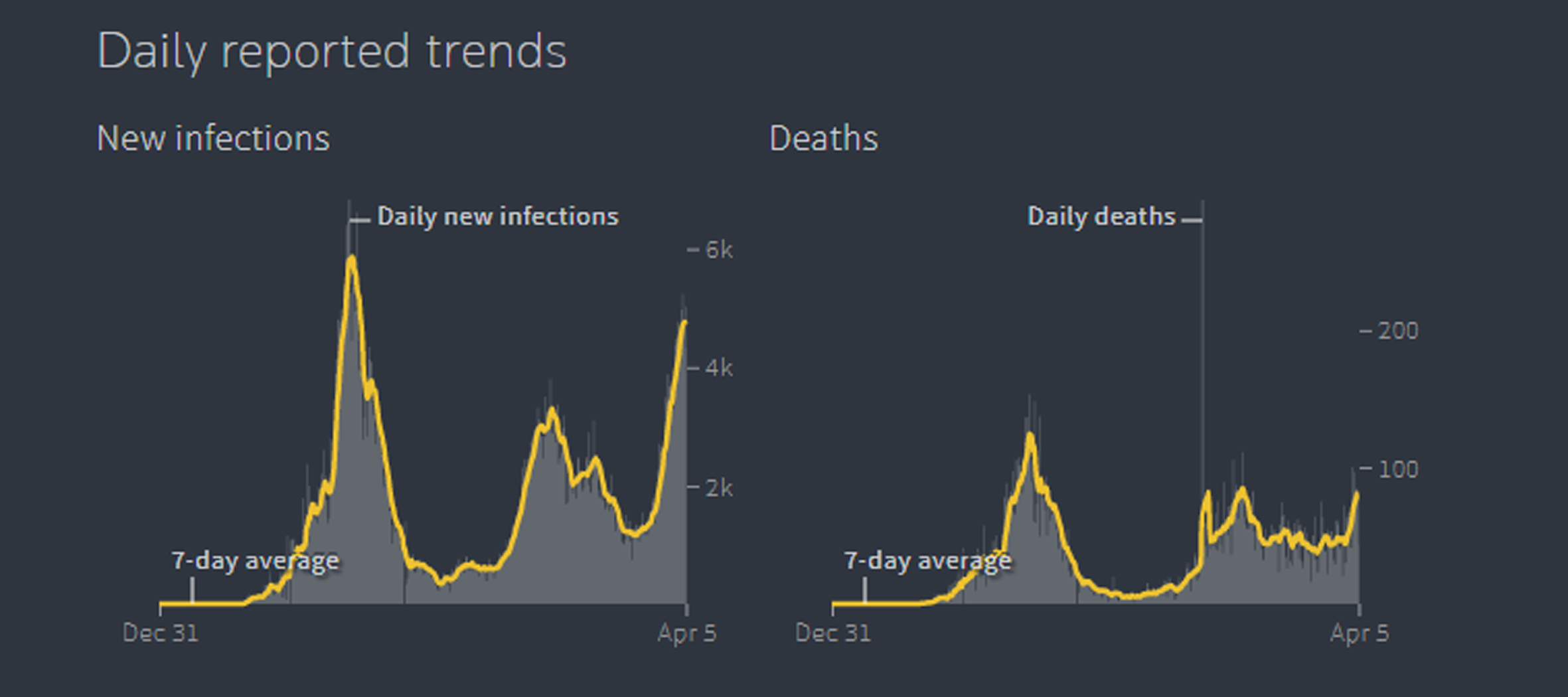
Daily New Infections and Deaths of Covid-19.
Many research studies have been conducting on Covid-19, for example, Yousaf et al. [1] studies the forecasting of the infections, deaths, and recoveries using Auto-Regressive Integrated Moving Average Model (ARIMA), Fong et al. [2] discussed the accurate early forecasting model using small data, Petropoulos and Makridakis [3] also discussed the forecasting model, Chen et al. [4] worked on the reconstruction and prediction algorithm for Covid-19, Nayak et al. [5] presented the statistical analysis of Covid-19 using the probabilistic model, Wolkewitz [6] discussed the statistical analysis of the clinical Covid-19 data, Yue et al. [7] worked out the Size of a COVID-19 Epidemic from Surveillance Systems, Syed and Sibgatullah [8] discussed the estimation of the final size of the COVID-19 epidemic in Pakistan using the SIR model, Mizumot et al. [9] estimates the asymptomatic proportion of COVID-19. Many other research studies have been conducted where the investigator applied various statistical tools for data analysis, For example, zeri et al. [10] discussed the comparison of the climate indices using GEE model, Mahmoudi et al. [11] worked on the estimation of the simple harmonizable processes, Maleki and Mahmoudi [12] studied the Two-piece location-scale distribution, Mahmoudi et al. [13] explored the large sample inference in two independent populations, and Pan et al. [14] worked on classifying and comparing several linear and non-linear regression models with a symmetric error.
For modeling and predictions of the lifetime data like Covid-19, there exist, various statistical models to estimate the parameter and predict the pattern of infections and deaths from a particular virus. For example, the Weibull distribution (W) introduced by Wallodi [15], and Exponential distribution (Ex) by Epstein [16] are among others. These models fail to model the data having a non-monotonic hazard rate function. In practice, the data is not all the time following a monotonic failure function, for example, the accidents rate, and the lifetime of a machine to work follow a non-monotonic failure function. To overcome this flaw, researchers are trying to develop new probability models so that to capture a non-monotonic hazard rate function. For example, Cordeiro [17] developed exponential-Weibull distribution (EX-W) while El-Gohary [18] introduced Inverse flexible Weibull extension distribution (EIFW) for capturing flexibility in the data by using the real data of a lifetime of 50 devices and remission times of 128 bladder cancer patients. To overcome the problem of non-monotonicity, Ijaz et al. [19] presented the Gull Alpha Power Weibull distribution (GAPW) has better performances as compared to others existing distributions by using the real data set of bank customers and bladder cancer patients data. For more recent research studies, we refer to see, ijaz et al. [20, 21], and Ali et al. [22].
In this paper, a new model specifically for modeling Covid-19 deaths in Pakistan is designed. In comparison to the existing distributions, the proposed model not only captures a non-monotonic hazard shape but also leads to an adequate fit.
In this section, we produced a new family of distributions which is defined as under,
A random variable x is said to be FEF variable if it holds the following cumulative distribution function and Probability density function or in short CDF and PDF respectively
For producing new probability models one can choose an appropriate CDF and PDF of the existing functions. In this paper, we have incorporated the CDF and PDF of the Weibull distribution presented by Wallodi Weibull in the above two equations so that to produce a new probability model. The new probability model is then called Flexible Exponential Weibull (FEW) distributions having the following CDF and PDF
Figure 2 describes various shapes of the CDF and PDF given in Equations (3) and (4) with various parameter values.
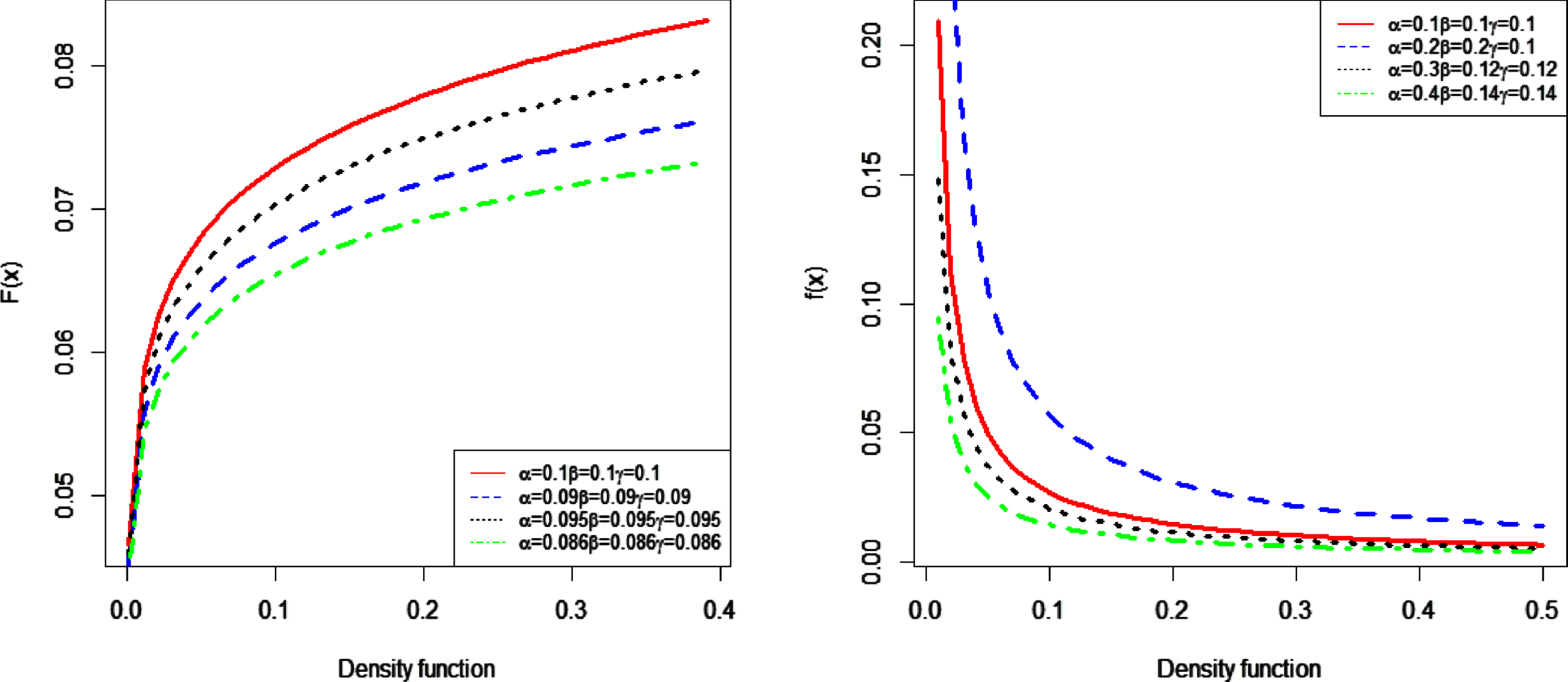
Plots of the CDF and PDF of FEW.
This section describes some important statistical properties of FEW distribution including they are the survival and hazard rate function, Quantile function, moments, order Statistics, Renyi entropy, and Skewness and Kurtosis.
Survival and Hazard rate Function
The survival function can be defined by
Using the (3) in (5), we get
By incorporating the result of Equation (4) and (6) in Equation (7), we obtained
Figure 3 reflects various plots of the hazard rate function by using different values of parameters.
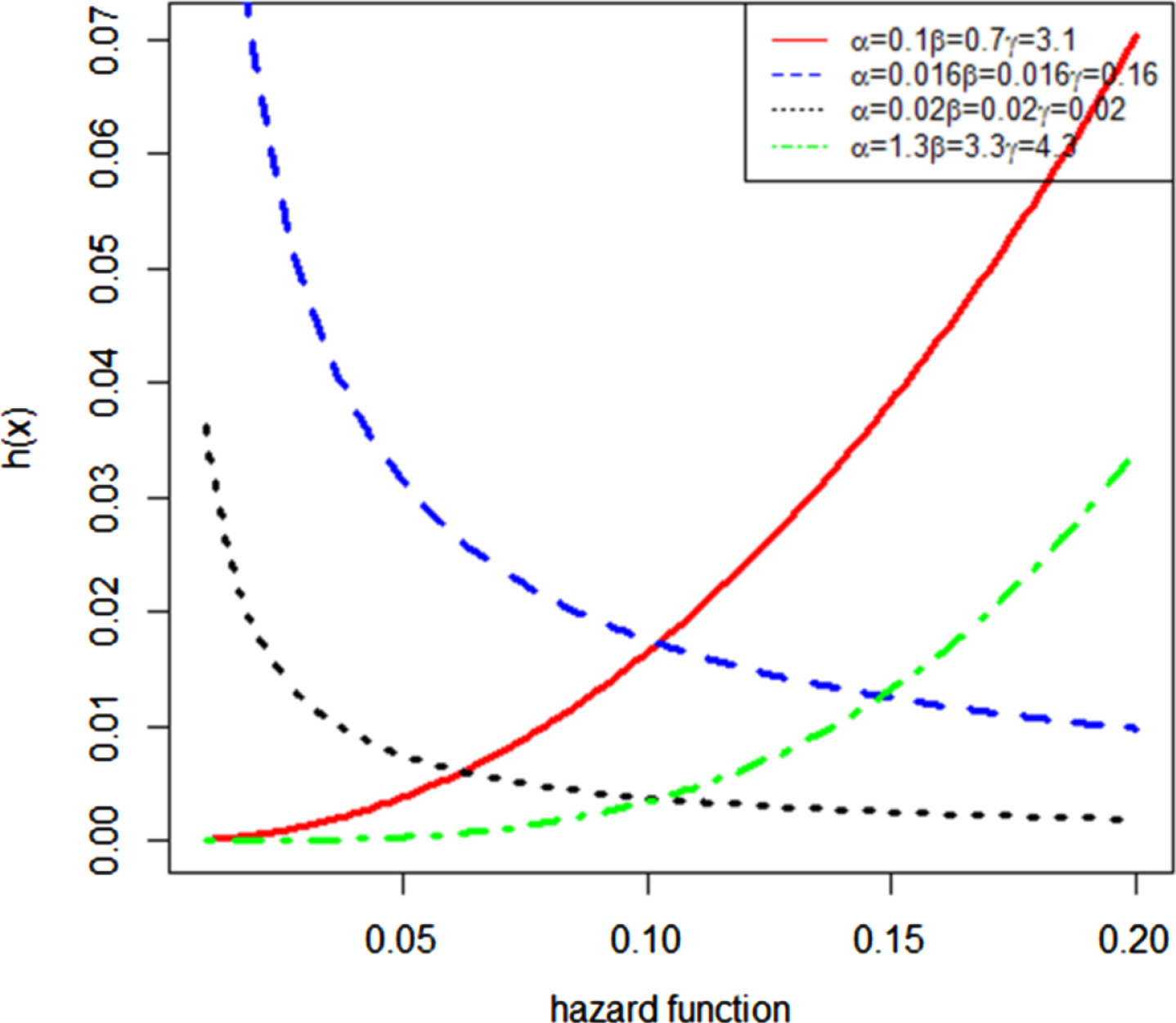
Plots of the hazard rate function of FEW.
The quantile of FEW can be defined by
Using Equation (3) and then solve for x, we get
To study the shape of the distribution, we need to study its four moments. This can be done by finding the Rth moments which is defined by
By putting Equation (4) in Equation (10), we obtained
The more simplified form of the above expression is
Using the above supposition in (11), we get the following integral form
Finally, we obtained the result
Let X1, X2, X3, ... Xn be ordered random variables from FEW, then the PDF of the i t h order statistic is given by
Using Equation (3) and (4), the smallest and largest order statistics of FEW can be obtained respectively by using i = 1 and i = n as
The Renyi entropy of the random variable X belong to FEW is defined by
Recalling Equation (4), we get the following result
The simplified form of the above expression is
Finally, we obtained
where
The mathematical expression of the Galton Skewness and Moors kurtosis are as follows
Table 1 illustrates the numerical description of the Skewness and Kurtosis for different values of parameters.
Numerical values of skewness and Kurtosis
Then special forms of Equation (3) and (4) can be derived by choosing appropriate values of the parameters. Table 2 presents the special forms of FEW with their corresponding CDF and PDF
Special forms of FEW
Special forms of FEW
In this section, the unknown parameters of FEW are estimated by using the maximum likelihood method. The likelihood function of Equation (4) is defined by
The log likelihood function is given by
To obtain the parameter values of a, b, and c, we have to take the partial derivatives of Equation (23) with respect to each parameter
Since the above equations are not in closed form but still one can solve these equations numerically by using Mathematical Techniques.
This section provides the significance of the novel probability model by using the deaths of Covid-19. The data set is taken from Coronavirus Pandemic (Covid-19) statistics and research [23] consisting of daily deaths per million in Pakistan from 02/05/2020 to 04/07/2021. The performance of the proposed model with others is compared by using the Cramer-von mises (W), Anderson darling (A), Akaike information criteria (AIC), Consistent Akaike information criteria (CAIC), Hannan and quin information criteria (HQIC), and Bayesian information criteria (BIC). The mathematical form of these criteria are defined by
It is to be noted that the probability model with the smaller values of these criteria leads to a better fit using this data.
Data set: Covid-19 data for Pakistan (Total deaths in Millions)
The data set values are
0.009, 0.014, 0.014, 0.023, 0.027, 0.032, 0.036, 0.041, 0.05, 0.054, 0.063, 0.095, 0.118, 0.122, 0.154, 0.181, 0.186, 0.213, 0.24, 0.258, 0.276, 0.294, 0.299, 0.389, 0.412, 0.421, 0.435, 0.503, 0.579, 0.611, 0.647, 0.761, 0.797, 0.91, 0.96, 1.073, 1.145, 1.218, 1.272, 1.322, 1.412, 1.553, 1.743, 1.888, 1.992, 2.069, 2.155, 2.327, 2.553, 2.648, 2.712, 2.879, 2.983, 3.196, 3.336, 3.445, 3.486, 3.776, 3.776, 3.952, 4.088, 4.251, 4.459, 4.604, 4.83, 4.984, 5.129, 5.283, 5.419, 5.546, 5.704, 5.962, 6.315, 6.714, 6.985, 7.338, 7.642, 8.013, 8.321, 8.76, 9.063, 9.358, 9.833, 10.209, 10.666, 11.15, 11.15, 11.549, 12.354, 12.852, 13.468, 14.002, 14.618, 15.311, 15.849, 16.252, 16.728, 16.999, 17.669, 17.936, 18.267, 18.643, 18.864, 19.485, 19.897, 20.25, 20.603, 20.603, 20.911, 21.558, 21.907, 22.282, 22.559, 22.898, 23.192, 23.527, 23.84, 24.084, 24.383, 24.564, 24.564, 24.999, 25.207, 25.347, 25.528, 25.7, 25.845, 26.09, 26.198, 26.357, 26.357, 26.447, 26.551, 26.674, 26.818, 26.941, 26.941, 27.054, 27.158, 27.158, 27.226, 27.321, 27.398, 27.47, 27.534, 27.602, 27.67, 27.747, 27.792, 27.855, 27.896, 27.955, 27.955, 28.023, 28.073, 28.109, 28.154, 28.208, 28.267, 28.267, 28.317, 28.371, 28.403, 28.444, 28.448, 28.466, 28.494, 28.512, 28.647, 28.679, 28.702, 28.702, 28.724, 28.747, 28.788, 28.815, 28.838, 28.851, 28.878, 28.896, 28.924, 28.942, 28.969, 29.01, 29.041, 29.046, 29.064, 29.082, 29.118, 29.141, 29.173, 29.204, 29.231, 29.272, 29.308, 29.331, 29.354, 29.422, 29.458, 29.485, 29.485, 29.53, 29.585, 29.625, 29.662, 29.689, 29.743, 29.788, 29.824, 29.883, 29.942, 29.974, 30.051, 30.123, 30.146, 30.209, 30.295, 30.341, 30.399, 30.454, 30.494, 30.508, 30.535, 30.599, 30.671, 30.762, 30.811, 30.888, 30.943, 31.006, 31.088, 31.205, 31.341, 31.432, 31.545, 31.586, 31.69, 31.785, 31.939, 32.106, 32.183, 32.328, 32.414, 32.563, 32.731, 32.812, 34.229, 34.419, 34.687, 34.841, 35.058, 35.325, 35.506, 35.75, 35.954, 36.149, 36.33, 36.629, 36.968, 37.145, 37.394, 37.588, 37.851, 38.019, 38.421, 38.693, 38.947, 39.173, 39.494, 39.82, 39.983, 40.314, 40.789, 41.106, 41.486, 41.876, 42.238, 42.518, 42.89, 43.265, 43.768, 44.153, 44.438, 44.701, 44.95, 45.235, 45.484, 45.746, 46.068, 46.439, 46.679, 46.855, 47.123, 47.358
Figure 4 describes the theoretical and empirical PDF, CDF, and TTT plot of the data. The TTT plot clearly defines that this data follows a non-monotonic hazard rate function. Figure 5 defines the Q-Q and P-P plots of FEW.
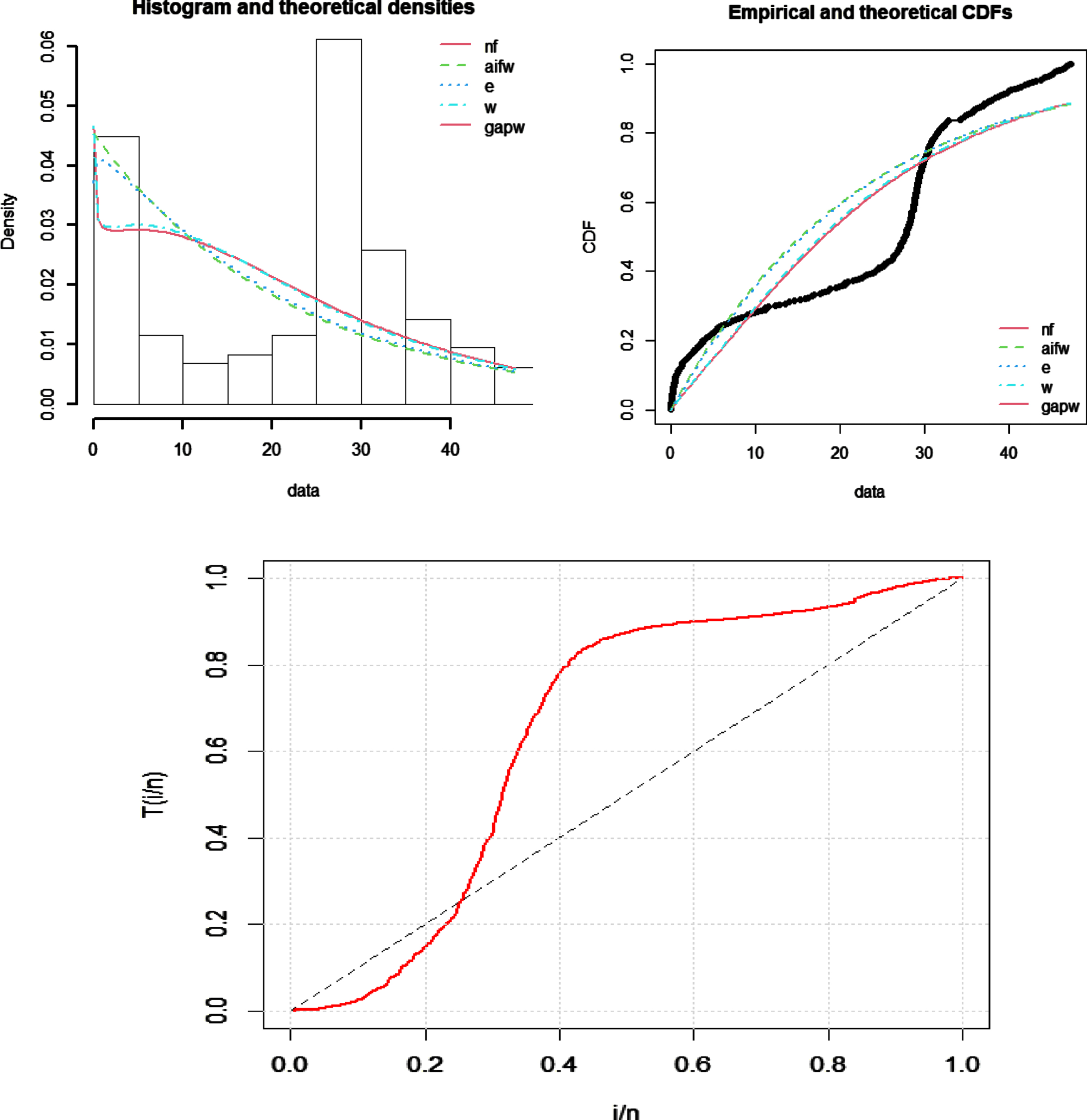
Theoretical and empirical PDF and CDF, and TTT plot of FEW.
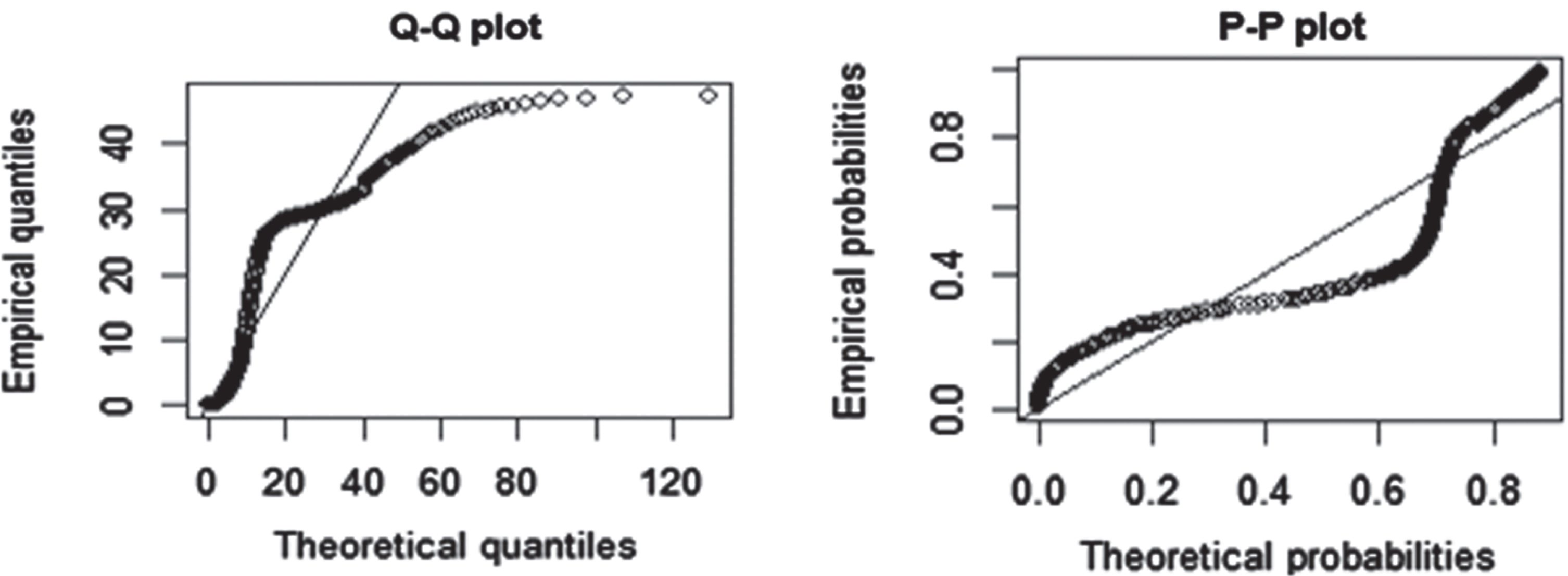
Q-Q plot and P-P plot of FEW.
The Cramer-von mises (W), Anderson darling (A), maximum likelihood estimates, standard errors, and the log-likelihood values are given in Table 3. Table 4 reflects the values of AIC, CAIC, BIC, and HQIC. The results declared that the smaller values are obtained for FEW among others using these criteria and hence FEW provides a flexible fit over Exponential (E), Weibull (W), Exponential-Weibull (Ex-W), Algoharai Inverse Flexible Weibull (AIFW), and Gull Alpha Power Weibull distribution (GAPW).
Maximum likelihood estimates and their standard errors of FEW for Covid-19 data of Pakistan
Goodness of fit measures of FEW for Covid-19 data of Pakistan
The simulation study is performed by using the expression given in Equation (9). The experiment is repeated 1000 times with a sample of size n by choosing different values of parameters. The MSE and bias of each parameter are given in Table 5. The result shows that the bias and MSE of each estimator are decreasing when the sample size increases.
Bias and Mean Square Errors (MSE)
Bias and Mean Square Errors (MSE)
This paper proposes a novel probability model for modeling the Covid-19 data. The proposed model is called FEW, various statistical properties are derived including the estimation of parameters. In order to evaluate the significance of the parameter estimates, a simulation study is conducted. Moreover, the proposed model is compared with already existing probability models by using the death data of Covid-19 in Pakistan. It has been observed that the novel probability model is a better choice and is supposed to increase the model flexibility regarding Covid-19 data. Hence, the proposed probability distribution can be used to predict efficiently the pattern of deaths due to Covid-19 or some other pandemic like the Dengue virus, etc. In order to minimize the rate of mortality, this model will help the health practitioners to determine the estimated figures with certain preventive measures.