Intensive continuing research has been noticed among scholars in the literature with a particular appreciable interest in developing new enhanced variants for the long-standing Random Early Detection (RED) algorithm. Contemporary trends shows that researchers continue to follow a research line thereby exchanging the linear curve needed in RED with nonlinear curves. Several reports have shown that RED’s sole linear function is insufficiently powered for managing rising degrees of traffic congestion in the network. In this paper, Amended Dropping – Random Early Detection (AD-RED), a revised version of RED is presented. AD-RED algorithm consists in combining two nonlinear packet dropping functions: quadratic plus exponential. What’s more, results from ns-3 simulator shows that AD-RED reasonably stabilized and minified the (average) queue size; and obtained a whittled down end-to-end delay when compared with RED itself and another variant of RED. Hence, AD-RED is offered as a fully sufficient replacement for RED’s algorithm implementation in routers.
Network traffic congestion control remains a persistent and inescapable problem on the Internet due to: (i) increasing magnitude in the number of users deploying several impressive applications and (ii) advancements in communication systems [1–5]. Exclusively, from a technical standpoint, congestion occurs in a network when the proportion of data traffic transmitted increases above the sustainable capacity of the supporting network infrastructure [3,6,7]. Congestion calamitously impacts network performance with regards to problem of large average queue size, increased delay, increased packet loss rate, reduced throughput [3,8–12]. On a more extreme scale, a problem often referred to as congestion collapse can occur when entire communication ceases in the network [13,14].
Two forms of congestion control methods exist: router-based and source-based. The latter method usually implements the Transport Control Protocol (TCP), transport layer protocol. As it turns out, the former method which is implemented in routers effectively enhances network performance and is known to exist in two forms [4,15]: passive queuing and active queuing. Active queue management (AQM) expresses potential to detect incipient congestion and transmits a notification signal to sending devices to whittle down their rates [16–19]. Contrastingly, the use of passive queue management (e.g. DropTail queuing) which inherently relies on First In First Out (FIFO) principle leads to poor network performance as all arriving packets are compulsorily dropped in the event that the buffer is wholly saturated [16,20,21].
One of the novel and earliest AQM algorithm which has been widely investigated in literature is random early detection (RED, as it is called) profoundly initiated by scientists in [22]. RED has been instrumental in providing inspiration to scholars in pursuit of a more effective and robust congestion control algorithms for implementation in routers. RED make do with two thresholds: (i) minimum threshold (denoted ) and (ii) maximum threshold (denoted ). Usually, when a packet arrives the buffer, RED computes the average queue size (denoted ) for congestion indication according to an exponential weighted moving average (EWMA) function Eq. (1):
where refers to computed previously, refers to the averaging weight, q denotes the current queue size.
Afterwards, is compared to the two thresholds. RED accepts an incoming packets when is below , probabilistically drops an incoming packet using a linear approach when , and dismisses (or drop) an arriving packet when towers above . The piecewise function to describe RED’s drop policy is given as follows:
Based on Eq. (2), the final drop probability function (denoted ) is computed as follows:
where and refers to the initial; parameter denotes the maximum packet dropping probability, and represents the number of arrived packets since last packet drop.
More interestingly, since 1993 (referring to the year that RED was introduced), the smooth increasing property of linear dropping function implemented in RED has certainly become an obvious symbol for research, in that, it has been arousing the interest of scholars even on a global scale. One good reason for this is because, in part, it often leads to large delay when congestion in the network becomes severe. Therefore, in recent times, a paradigm shift has been observed in some works with respect to newer AQM algorithm designs. Precisely, new RED-based algorithms that exerts nonlinear drop functions are being initiated as an alternative to the characteristic linear drop function operated in RED, yielding higher network performance.
As rightly pointed out by Kato and colleagues in paper [23], among the class of nonlinear functions, the exponential function is fast gaining recognition as a more powerful dropping function for designing newer RED-based algorithms. In tandem with this line of thought, therefore, the two-fold contribution of this study is as follows: (1) an updated version of RED is proposed named Amended Dropping – Random Early Detection (AD-RED) algorithm. The idea of AD-RED consists in bringing into service the slowly increasing advantage of a quadratic drop function as well as the fast rising benefit of an exponential packet drop function in order to effectively address network congestion, and (2) an investigation of AD-RED’s performance strength in comparison with two (existing) AQM algorithms was done via simulation experiments.
The rest of the paper is outlined along these lines. Section 2 looks at the related works. In Section 3, the principle for the proposed AD-RED algorithm is given. Section 4 offers the simulation configurations, simulation experiments and discussion on results. In closing, the conclusion is offered in Section 5.
Related works
In [24], Jafri et al. initiated the Aggressive-RED (AgRED) model. AgRED operates similar but rather chooses to implement sigmoid drop function (with an S-shape) as opposed to the sole linear function exerted in RED. AgRED showcases strength in delay whittling down than RED. In [9], Abdel-Jaber invented the RED-Exponential (RED−E) model designed to effectively do away with ’s parameter overload in RED. RED−E employs same thresholds: and as done by RED, however, an exponential drop function was used in preference to the linear drop function, obtaining a delay performance gain. RED−E’s dropping function is expressed as follows:
In [25], a nonlinear RED (NLRED) algorithm was suggested by Zhou et al. NLRED, as done by RED uses same queue threshold parameters, and . However, the linear drop function was substituted with a quadratic drop function, achieving an increased throughput. NLRED’s packet drop function is expressed as follows:
in which
The research in [26] introduced the Gentle RED (GRED) model, another update on RED which utilized three queue threshold parameters: , , and . In GRED, two linear packet drop functions were used. This was done in order to keep at minimum the aggressive feature of the linear packet drop function of RED and is therefore expressed as follows:
Scholars in [27] invented MRED model which resembles GRED model in that it utilizes three threshold parameters namely, , , and . But unlike GRED, the MRED model obtained a higher throughput performance due to its usage of the conjunction of two different dropping functions- quadratic as well as linear, expressed as follows:
The study in [28] explicitly applies one (linear) as well as another (exponential) dropping functions for extending RED algorithm in order that a lower average queue size would be achieved. The improved algorithm was named modified dropping-RED (abbreviated MD-RED). The model operates within the boundary set by RED (i.e., between and ). In [23], Kato et al. initiated RED with nonlinearity which resembles NLRED model, but unlike NLRED, the modified model simply substituted the squaring function in NLRED with an exponential function (Eq. (8)) in order to achieve a higher throughput benefit.
in which the parameter gamma (γ) is varied in order to achieve a suitable bending degree for the exponential curve.
Based on RED mechanism, the authors in [29] proposed RED-Exponential and RED-Linear analytical models which uses instantaneous queue length for congestion detector. Authors in [30] suggested Quadratic RED (QRED) algorithm as an amendment for NLRED. QRED utilized the and queue thresholds while bringing to play a quadratic packet drop function given as follows:
or
in which K denotes the size of buffer size.
In [4], a Beta distribution function for computing the packet drop probability was called into play when is bounded between and threshold values in order to stabilize the queue. In [31], the Congestion Control RED (CoCo-RED) model which aimed at keeping to a minimum the number of dropped packets was initiated. Using CoCo-RED, a conjunction of two drop actions were deployed. Firstly, a linear packet drop function is exerted between the bounds of and threshold parameters. Secondly, an exponential packet drop function is utilized between the bounds of and the buffer size (represented by K). The modified packet dropping probability function is expressed as:
in which
and
In Double Slope (DS)-RED [32], the bounds between and thresholds is divided equally (involving a mid-point set as (), each part utilizing a linear function, however, with different slopes. By so doing, DSRED cut back on the aggressive characteristics of RED and increases its throughput. Domańska et al. in [33], also utilized the and threshold positions of RED. However, a cubic packet dropping probability function was brought into action between the two positions. In [34], Smart RED (SmRED) model employs three threshold parameters: , (set as ), and . A quadratic function is used in conjunction with a square root packet drop function. Dropping function in SmRED can be expressed as follows:
The authors in [35] perceived the distinctive linear dropping function in RED as low-powered for effective congestion control. Therefore, they suggested an extension to RED, named RED-Quadratic linear (RED-QL) which utilizes both quadratic and linear functions. RED-QL exhibited gain in delay whittling down. In [15], the authors initiates an improved RED algorithm that modifies the drop probability used between and threshold parameters. Dropping function used can be expressed as follows:
in which
Based on CoCo-RED algorithm, the authors in [36] chose to dynamically adjust the and thresholds. The improved scheme was called Enhanced CoCo-RED (EnCoCo-RED). An enhanced SmRED algorithm named SmRED-i was initiated by authors in [37]. SmRED-i utilizes the three queue thresholds of SmRED. However, a parameter was brought to bear. SmRED-i’s packet drop function is given as follows:
The paper in [38] shares the opinion that a typical linear function used by RED is underpowered. The authors suggested a model which uses two linear functions, it was named Double Linear-RED (DL-RED). It displays considerable strength in delay reduction. In [39], the Adaptive GRED (AGRED) was initiated similar to GRED. However, the modification lies where falls in between and parameters. AGRED’s packet drop function is given as follows:
The author in [40] initiated another improved version of RED named RED-Linear Exponential (RED-LE). This algorithm cut in half the portion bounded by and thresholds of RED utilizing linear as well as exponential drop functions. RED-LE succeeded in keeping at minimum the average queue size.
in which
In Three-Section RED (TRED) [41] model, three queue thresholds parameters are utilized: , Δ (set as ), and . TRED make do with a nonlinear (i.e., cubic), linear, plus an extra nonlinear (i.e., cubic) packet drop functions in the first, second, and third segments respectively. This was done in order to attain a trade-off between delay as well as throughput under varying traffic loads. TRED’s packet drop function is given as follows:
To further increase the throughput performance of RED, [42] suggested an improved adaptive RED. Based on RED, the new variant utilizes a cubic drop function when increases above but lesser than . Mathematically, the piecewise function to describe improved adaptive RED drop policy is given as follows:
In light of the review made thus far, it is observed that newer AQM algorithms continue to share the believe that utilizing a nonlinear function in the piecewise function for describing the packet drop probability function of RED will go a long way in increasing its performance rather than adopting just one linear function. This claim is also supported by [4,30,34]. Moreover, obtaining average queue size lowering is an important goal of AQM in which existing algorithms could not meet. The substantial innovation of this study is two-fold. Firstly, a new proposal is presented called Amended Dropping – Random Early Detection (AD-RED) with reference to RED algorithm. Concretely, AD-RED aimed at maintaining a network’s average queue size lowering as a means for ensuring a minified delay network performance. AD-RED achieves this by dividing the queue into four sections and put to use the composition of double nonlinear drop functions.
Amended Dropping - Random Early Detection (AD-RED) algorithm
The proposed Amended Dropping – Random Early Detection (AD-RED) AQM algorithm is designed based on RED. Essentially, in AD-RED, the dropping function of RED is revised consisting of two nonlinear dropping functions as against the sole linear dropping function. Concretely, the mathematical model (describing the working procedure) for AD-RED is expressed using a piecewise function as follows:
As could be observed from Eq. (23), AD-RED utilizes an extra queue threshold, for the sake of cutting the queue part of RED bounded by and positions into two unequal portions. The value for (is set based on Eq. (24)). This way, two sub-intervals of unequal lengths is achieved. One (i.e., the shorter) exists between and Target (account for light and moderate traffic loads), while the other exist between Target and (account for heavy traffic load).
At light as well as moderate traffic load scenarios whereby congestion is rated as not severe yet, AD-RED model cut back on the aggressiveness of RED model. Such that, packets are dropped by bringing into action a quadratic function – Eq. (25). This account for cases when as well as
At heavy network traffic load scenarios whereby congestion is seems severe, AD-RED quickly increases the aggressiveness of RED model. This way, packets dropping is achieved by calling into play an exponential function – Eq. (26). This account for cases when as well as
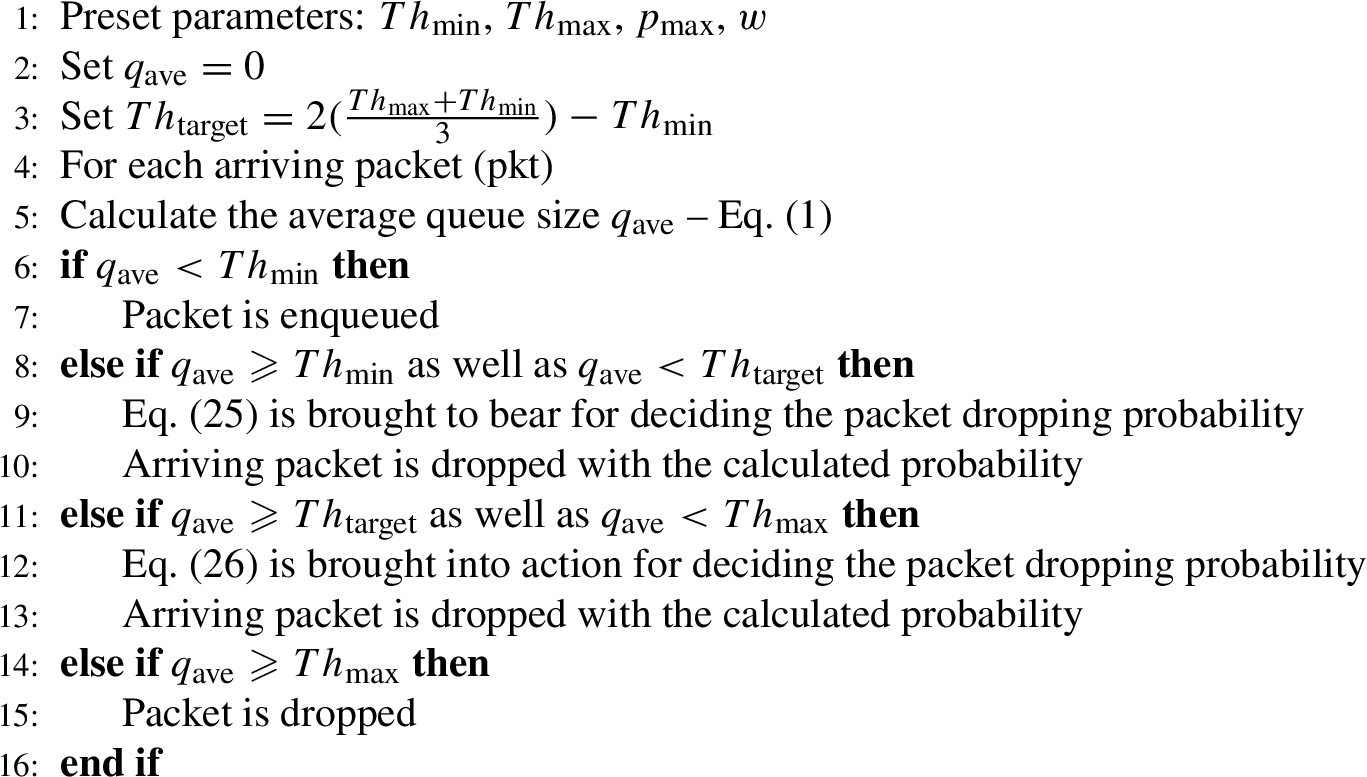
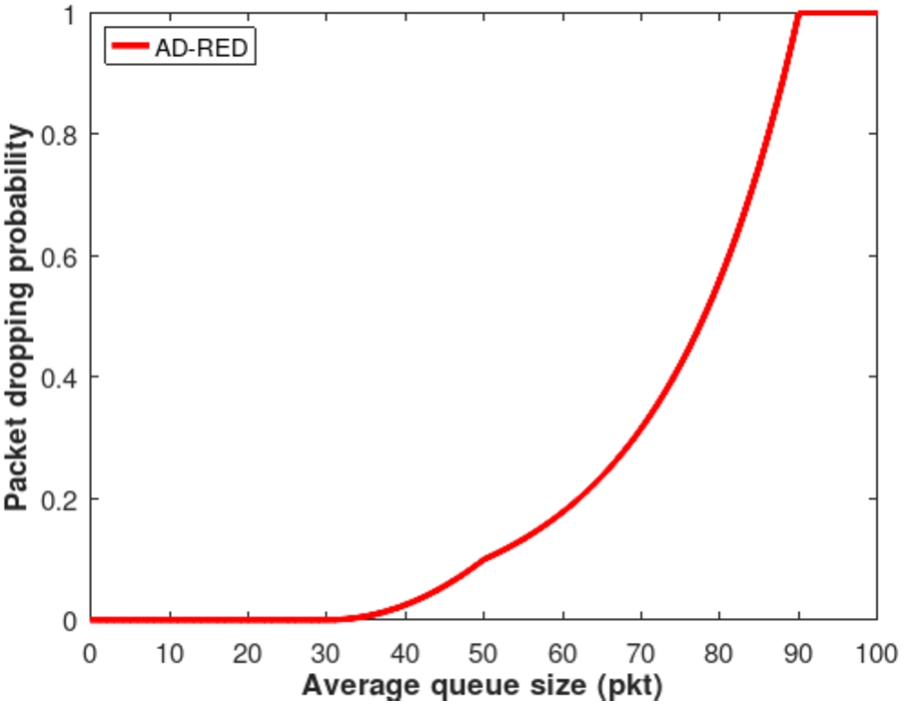
Furthermore, when , incoming packets are admitted (that is, ) while all incoming packets are discarded when (that is, ), as done by RED. Therefore, in Algorithm 1, the pseudocode illustrating the major steps involved in AD-RED is presented. Thence, commensurate with the above-mentioned idea, by configuring to 30 packets, to 0.1 (as suggested by scholars in [22]), and to packets (also as recommended by scientists in [22]), the proposed AD-RED dropping function is visualized in Fig. 1.
Pseudocode for AD-RED
AD-RED’s dropping function.
Simulation experiment and results
In this section, the proposed AD-RED algorithm is implemented in ns-3 [43]. Furthermore, its performance is assessed against two AQM algorithms: TRED as well as RED.
Simulation configuration
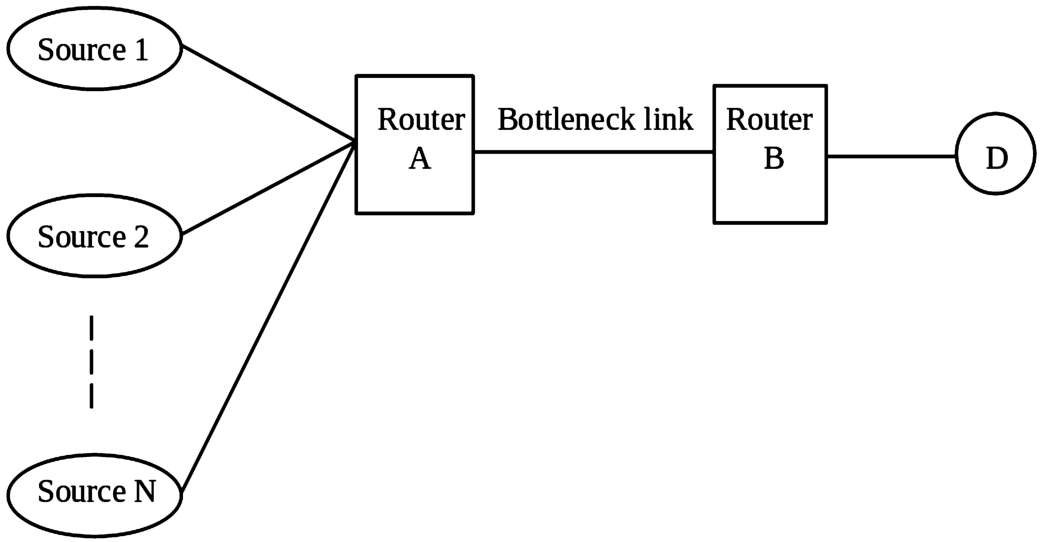
The network topology considered for simulation is shown in Fig. 2. The topology has N number of sources (which is varied), two routers: A and B, and one sink (i.e., destination end-system). The three AQM algorithms being evaluated were deployed at router A (in a sequential arrangement). Each source end-system is connected to router A using a point-to-point link of 100- with 10- propagation delay time. Router A is then connected to router B using a bottleneck point-to-point link of 10- with 100- propagation delay time. Similarly, router B is connected to the sink using a point-to-point link of 100- with 10- propagation delay time. TCP New-Reno was implemented. The default packet size is 1000 long. Buffer size is set to 250 packets. Simulation duration is set to 100 while (as recommended by scientists in [22]). The number of sender nodes is varied as a way of offer varying levels of congestion on the network which is in tandem with the suggestions made in RFC 7928 [44].
Network topology simulated.
Experiment 1: Light load
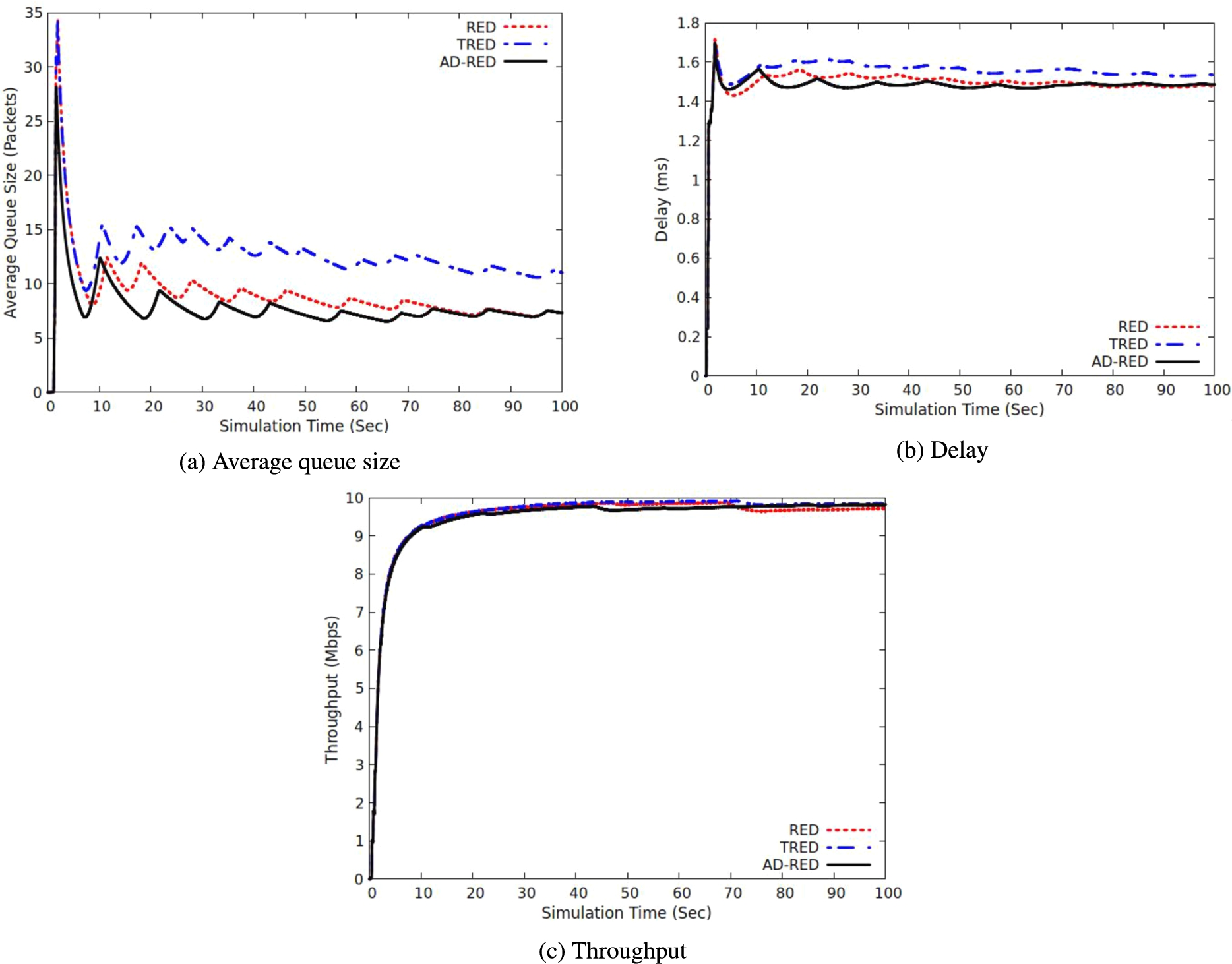
In this simulation experiment, 5 TCP sources are considered which account for light load scenario. In Fig. 3(a), the average queue size is depicted. It can be observed that AD-RED keeps down the average queue size better than RED and even much smaller relative to both TRED and RED. This result is also confirmed in Table 1. Figure 3(b) shows the delay performance of the trio algorithms. It can be observed that AD-RED algorithm exhibits a significant improvement over RED and TRED. The results depicted in Fig. 3(c) shows the throughput performance for the three algorithms. Statistical result supporting this claim is provided in Table 2. TRED obtained the highest throughput value while AD-RED got the least value even as presented in Table 3.
Performance comparison for AD-RED, TRED, and RED under light traffic condition.
Average queue size comparison – light load
Statistical analysis
Average queue size, Packets
AD-RED
TRED
RED
Mean
7.7802
12.6164
8.9880
Standard deviation
2.2932
2.8189
3.1508
Maximum
28.1297
34.1103
31.3134
Delay comparison – light load
Statistical analysis
Delay, ms
AD-RED
TRED
RED
Mean
1.4769
1.5507
1.4924
Standard deviation
0.1014
0.1098
0.1051
Maximum
1.6970
1.7162
1.7161
Throughput comparison – light load
Statistical analysis
Throughput, Mbps
AD-RED
TRED
RED
Mean
9.4392
9.5590
9.4764
Standard deviation
1.1330
1.1476
1.1329
Maximum
9.8199
9.9225
9.8772
Experiment 2: Moderate load
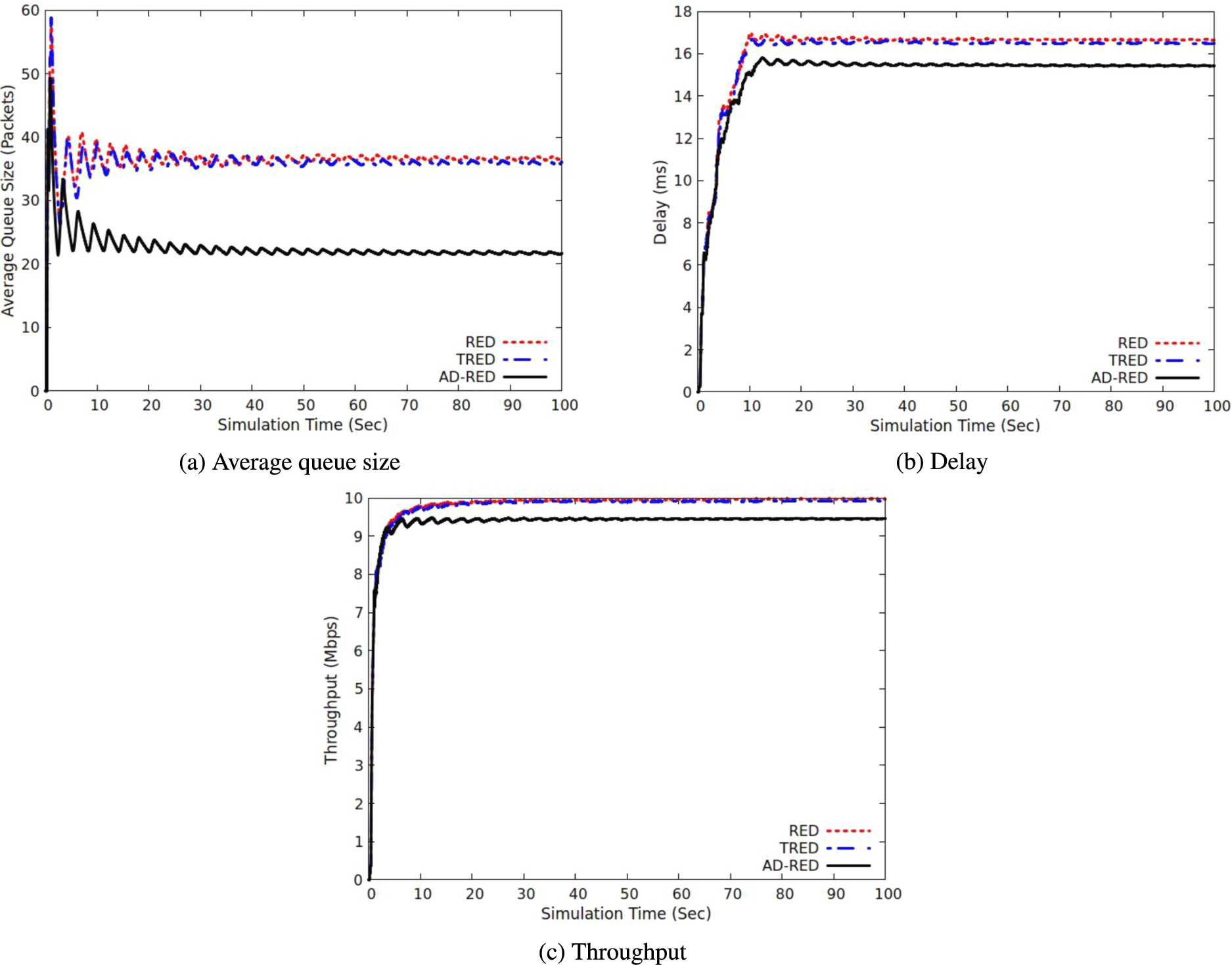
In this simulation experiment, 50 TCP sources are considered which account for moderate load scenario. In Fig. 4(a), AD-RED again succeeded over both TRED as well as RED with regards to achieving a good cut back on the average queue size. Results depicted in Fig. 4(b) confirms that AD-RED is more effective when compared with TRED as well as RED algorithms in obtaining a reduced delay even when the traffic load is moderate. Figure 4(c) demonstrates the throughput performance for the three algorithms. RED performed better in contrast to TRED and AD-RED algorithms. However, TRED outperformed AD-RED. Tables 4–6 presents the statistical results for average queue size, delay, as well as throughput respectively.
Performance comparison for AD-RED, TRED, and RED under moderate traffic condition.
Average queue size comparison – moderate load
Statistical analysis
Average queue size, Packets
AD-RED
TRED
RED
Mean
22.5339
35.8891
36.4716
Standard deviation
2.8146
2.9878
2.9733
Maximum
49.3588
58.7594
58.7507
Delay comparison – moderate load
Statistical analysis
Delay, ms
AD-RED
TRED
RED
Mean
14.9898
15.9879
16.1475
Standard deviation
1.9288
2.1070
2.1283
Maximum
15.7995
16.7475
16.9302
Throughput comparison – moderate load
Statistical analysis
Throughput, Mbps
AD-RED
TRED
RED
Mean
9.3360
9.7542
9.8081
Standard deviation
0.7685
0.8299
0.8326
Maximum
9.4798
9.9261
9.9707
Experiment 3: Heavy load
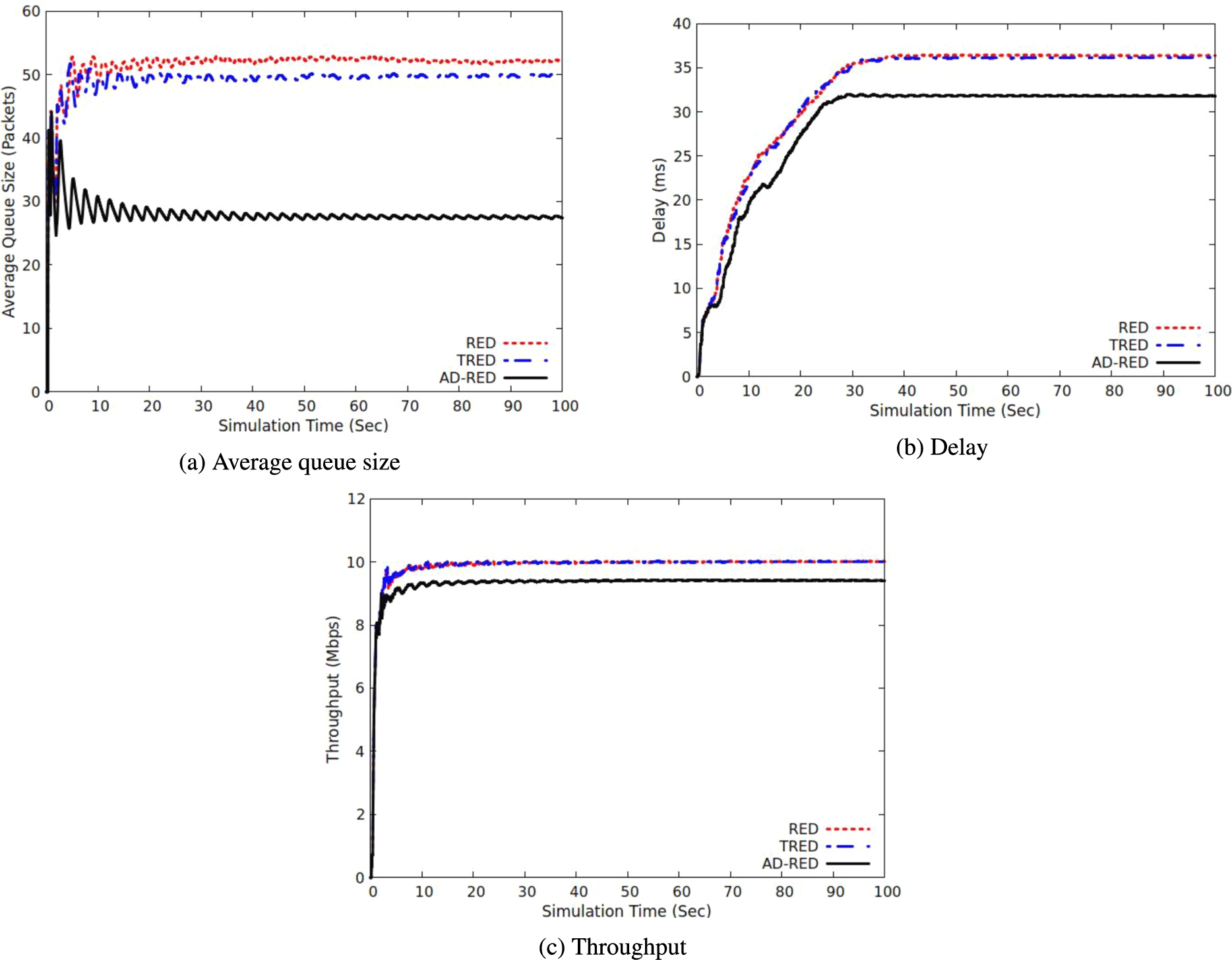
In this simulation experiment, 100 TCP sources which account for heavy load scenario are considered. In Fig. 5(a), the average queue size for AD-RED, TRED, as well as RED is compared. It can be clearly seen that the proposed AD-RED model exhibit superior advantage over TRED and RED with respect to keeping at minimum the average queue size. Although, TRED achieved a smaller average queue size compared with RED. As Fig. 5(c) illustrates, it is evident that the performance of AD-RED algorithm is superior to both TRED and RED with respect to cutting back on delay even at a heavy traffic load. The throughput performance of AD-RED, TRED, as well as RED is depicted in Fig. 5(b). RED obtained the highest value while TRED outperfromed AD-RED. Tables 7–9 provides further statistical results regarding the performance metrics.
Performance comparison for AD-RED, TRED, and RED under heavy traffic condition.
Average queue size comparison – heavy load
Statistical analysis
Average queue size, Pkt
AD-RED
TRED
RED
Mean
27.8964
49.0254
51.3717
Standard deviation
2.3291
3.6993
4.0873
Maximum
44.0389
51.6655
52.9229
Delay comparison – heavy load
Statistical analysis
Delay, ms
AD-RED
TRED
RED
Mean
28.7142
32.5021
32.7001
Standard deviation
6.6832
7.4041
7.4285
Maximum
31.9644
36.1611
34.4336
Throughput comparison – heavy load
Statistical analysis
Throughput, Mbps
AD-RED
TRED
RED
Mean
9.2816
9.8558
9.8509
Standard deviation
0.7415
0.8090
0.8096
Maximum
9.4248
10.0248
10.0214
Conclusions
In recent past years, congestion control at the router has been an important subject for discussion among researchers and scientists in computer networking field. Developing an active queue management (AQM) algorithm that reasonably modifies the dropping function of Random Early Detection (RED) has consistently remained a major research hotspot, catching the attention of researchers all around the world. Therefore, this paper has presented a revised AQM algorithm named Amended Dropping – RED (AD-RED). Simulation evaluations in ns3 simulator asserts that the dropping functions used in AD-RED are indeed a promising combination for improving RED’s performance. AD-RED exhibits good advantage in improving delay performance when compared with RED as well as one other RED-based AQM algorithms. In near future work, AD-RED will be implemented in cellular networks.
Conflict of interest
The author has no conflict of interest to report.
References
1.
A.Adamu, Y.Surajo and M.T.Jafar, SARED: Self-adaptive active queue management scheme for improving quality of service in network systems, Journal of Computer Science22(2) (2021), 253–267. doi:10.7494/csci.2021.22.2.4020.
2.
A.Adamu, V.Shorgin, S.Melnikov and Y.Gaidamaka, Flexible random early detection algorithm for queue management in routers, in: International Conference on Distributed Computer and Communication Networks, Springer, Cham, 2020, pp. 196–208. doi:10.1007/978-981-10-3773-3_62.
3.
L.Pei, F.Wu and S.Wang, Periodic, quasi-periodic and chaotic oscillations in two heterogeneous AIMD/RED network congestion models with state-dependent round-trip delays, International Journal of Bifurcation and Chaos31(6) (2021), 2150124. doi:10.1142/S0218127421501248.
4.
A.Giménez, M.A.Murcia, J.M.Amigó, O.Martínez-Bonastre and J.Valero, New RED-type TCP-AQM algorithms based on beta distribution drop functions, 2022, arXiv:2201.01105v1 [cs.NI]. doi:10.48550/arXiv.2201.01105.
5.
S.Sunassee, A.Mungur, S.Armoogum and S.Pudaruth, A comprehensive review on congestion control techniques in networking, in: Proceedings of the 5th International Conference on Computing Methodologies and Communication (ICCMC), 2021, pp. 305–312. doi:10.1109/ICCMC51019.2021.9418329.
6.
N.Kaur and R.Singhai, Congestion control scheme using network coding with local route assistance in mobile adhoc network, International Journal of Computer Applications in Technology60(3) (2019), 242–253. doi:10.1504/IJCAT.2019.100298.
7.
G.Thiruchelvi and J.Raja, A survey on active queue management mechanisms, International Journal of Computer Science and Network Security8(12) (2008), 130–145.
8.
H.Abdel-Jaber, A.Shehab, M.Barakat and M.Rashad, Igred: An improved gentle random early detection method for management of congested networks, Journal of Interconnection Networks19(2) (2019), 1950004. doi:10.1142/S021926591950004X.
9.
H.Abdel-Jaber, An exponential active queue management method based on random early detection, Journal of Computer Networks and Communications2020 (2020), 1–11. doi:10.1155/2020/8090468.
10.
A.A.Abu-Shareha, Controlling delay at the router buffer using modified random early detection, International Journal of Computer Networks and Communications (IJCNC)11(6) (2019), 63–75. doi:10.5121/ijcnc.2019.11604.
11.
X.Dang, L.Ma and X.Liu, CCAIB: Congestion control based on adaptive integral backstepping for wireless multi-router network, Sensors2022(22) (2022), 1–15. doi:10.3399/s22051818.
12.
A.Ahmed and N.Nasrelden, New congestion control algorithm to improve computer networks performance, in: Proceedings of the 2018 International Conference on Innovative Trends in Computer Engineering, 2018, pp. 87–93. doi:10.1109/ITCE.2018.8316605.
13.
L.Chen, X.Wang and Z.Han, Controlling chaos in Internet congestion control model, Chaos, Solitons and Fractals21(1) (2004), 81–91. doi:10.1016/j.chaos.2003.09.037.
14.
S.Ryu, C.Rump and C.Qiao, Advances in Internet Congestion Control, IEEE Communications Surveys and Tutorials5(1) (2003), 28–39. doi:10.1109/COMST.2003.5342228.
15.
S.Patel and Karmeshu, A new modified dropping for congested networks, Wireless Personal Communications104(1) (2019), 37–55. doi:10.1007/s11277-018-6007-8.
16.
B.Braden, D.Clark, J.Crowcroft, B.Davie, S.Deering, D.Estrin, S.Floyd, V.Jacobson, G.Minshall, C.Patridge, L.Peterson, K.Ramakrishnan, S.Shenker, J.Wroclawski and L.Zhang, Recommendations on Queue Management and Congestion Avoidance in the Internet, RFC 2309, 1998. doi:10.1109/ISCC.2001.935364.
17.
M.Barczyk and A.Chydzinski, AQM based on the queue: A real-network study, PLos ONE17(2) (2022), 1–22. doi:10.1371/journal.pone.0263407.
18.
S.Kar, B.Alt, H.Koeppl and A.Rizk, PAQMAN: A principled approach to active queue management, 2022, arXiv:2202.10352v1 [cs.PF]. doi:10.48550/arxiv.2202.10352.
19.
M.Q.Sulttan, M.H.Jaber and S.W.Shneen, Proportional-integral genetic algorithm controller for stability of TCP network, International Journal of Electrical and Computer Engineering10(6) (2020), 6225–6232. doi:10.11591/ijece.v10i6.pp6225-6232.
20.
F.Baker and G.Fairhurst, IETF recommendations regarding active queue management, RFC 7567 (2015). doi:10.17487/RFC7567.
21.
C.Brandauer, G.Iannaccone, C.Diot, T.Ziegler, S.Fdida and M.May, Comparison of tail drop and active queue management performance for bulk-data and web-like Internet traffic, in: Proceedings of the Sixth IEEE Symposium on Computers and Communications, 2001, pp. 122–129. doi:10.1109/ISCC.2001.935364.
22.
S.Floyd and V.Jacobson, Random early gateway for congestion avoidance, IEEE/ACM Transactions on Networking1(4) (1993), 397–413. doi:10.1109/90.251892.
23.
K.Kato, H.Kato, H.Asahara, D.Ito and T.Kousaka, Effects on random early detection of the packet drop probability function with an adjustable nonlinearity, Nonlinear Theory and Its Applications (NOLTA)14(2) (2023), 193–206. doi:10.1587/nolta.14.193.
24.
S.T.A.Jafri, I.Ahmed and S.Ali, Queue-buffer optimization based on aggressive random early detection in massive NB-IoT MANET for 5G applications, Electronics11(18) (2022), 1–18. doi:10.3390/electronics11182955.
25.
K.Zhou, K.L.Yeung and V.O.K.Li, Nonlinear RED: A simple yet efficient active queue management scheme, Journal of Computer Networks50(18) (2006), 3784–3794. doi:10.1016/j.comnet.2006.04.007.
26.
S.Floyd, Recommendation on using the “gentle” variant of RED, 2000, Available online at https://icir.org/floyd/red/gentle.html.
27.
Y.Zhang, J.Ma, Y.Wang and C.Xu, MRED: An improved nonlinear RED algorithm, in: Proceedings of the 2011 International Conference on Computer and Automation Engineering (ICCAE 2011), Vol. 44, 2012, pp. 6–11. doi:10.7763/IPCSIT.2012.V44.2.
28.
S.O.Hassan and A.Rufai, Modified Dropping – Random Early Detection (MD-RED): A modified algorithm for controlling network congestion, International Journal of Information Technology15(3) (2023), 1499–1508. doi:10.1007/s41870-023-01201-1.
29.
H.Abdel-Jaber, F.Thabtah and M.Woodward, Modeling discrete-time analytical models based on random early detection: Exponential and linear, International Journal of Modeling, Simulation, and Scientific Computing6(3) (2015), 155028. doi:10.1142/S1793962315500282.
30.
D.Kumhar, A.Kumar and A.Kewat, QRED: An enhancement approach for congestion control in network communications, International Journal of Technology13 (2021), 221–227. doi:10.1007/s41870-020-00538-1.
31.
C.Suwannapong and C.Khunboa, Congestion control in CoAP observe group communication, Sensors19(3433) (2019), 1–14. doi:10.3390/s19153433.
32.
B.Zheng and M.Atiquzzaman, DSRED: A new queue management scheme for the next generation Internet, IEICE Trans. Commun. EE89 (2006), 764–774. doi:10.1093/ietcom/e89-b.3.764.
33.
J.Domańska, D.R.Augustyn and A.Domański, The choice of optimal 3-rd order polynomial packet dropping function for NLRED in the presence of self-similar traffic, Bulletin of the Polish Academy of Sciences Technical Sciences60(4) (2012), 779–786. doi:10.2478/v10175-012-0090-x.
34.
A.K.Paul, H.Kawakami, A.Tachibana and T.Hasegawa, An aqm based congestion control for enb rlc in 4g/lte network, in: Proceedings of the 2016 IEEE Canandian Conference on Electrical and Computer Engineering (CCECE), 2016, pp. 1–5. doi:10.1109/CCECE.2016.7726792.
35.
S.O.Hassan, V.O.Nwaocha, A.U.Rufai, T.J.Odule, T.A.Enem, L.A.Ogundele and S.A.Usman, Random early detection-quadratic linear: An enhanced active queue management algorithm, Bulletin of Electrical Engineering and Informatics11(4) (2022), 2262–2272. doi:10.11591/eei.v11i4.3875.
36.
C.Suwannapong and C.Khunboa, EnCoCo-RED: Enhanced congestion control mechanism for CoAP observe group communication, Journal of Ad Hoc Networks112 (2021), 1–10. doi:10.1016/j.adhoc.2020.102377.
37.
A.K.Paul, H.Kawakami, A.Tachibana and T.Hasegawa, Effect of AQM-based RLC buffer management on the eNB scheduling algorithm in LTE network, Technology5(59) (2017), 1–7. doi:10.3390/technologies5030059.
38.
S.O.Hassan, A.U.Rufai, C.Ajaegbu and F.Ayankoya, DL-RED: A RED-based algorithm for routers, International Journal of Computer Applications in Technology70(3/4) (2022), 244–253. doi:10.1504/IJCAT.2022.10053495.
39.
M.Baklizi, H.Abdel-Jaber, S.Ramadass, N.Abdullah and M.Anbar, Performance assessment of AGRED, RED and GRED congestion control algorithms, Information Technology Journal11(2) (2012), 255–261. doi:10.3923/itj.2012.255.261.
40.
S.O.Hassan, RED-LE: A revised algorithm for active queue management, Journal of Telecommunications and Information Technology2 (2022), 91–97. doi:10.26636/jtit.2022.160022.
41.
C.-W.Feng, L.-F.Huang, C.Xu and Y.-C.Chang, Congestion control scheme performance analysis based on nonlinear RED, IEEE Systems Journal11(4) (2017), 2247–2254. doi:10.1109/JSYST.2014.2375314.
42.
Y.Bie, Z.Li, Z.Hu and J.Chen, Queue management algorithm for satellite network based on traffic prediction, IEEE Access10 (2022), 54313–54324. doi:10.1109/ACCESS.2022.3163519.
43.
N. S. Foundation, The network simulator – ns3, 2006, https://www.nsnam.org, accessed: 2021-08-10.
44.
N.Kuhn, P.Natarajan, N.Khademi and D.Ros, Characterization guidelines for Active Queue Management (AQM), RFC 7928 (2016). doi:10.17487/RFC7928.