




Abstract
OBJECTIVE:
To study the personality changes of Chinese airline transport pilots in the training process from cadets to captains.
METHODS:
In This paper, we used the Cattell 16 Personality Factor Questionnaire (16PF) to track and record the personality traits of 200 students majoring in flight technology and 200 “college graduates to pilot” in five different periods from the beginning of aviation theory training to becoming captains.
RESULTS:
Before the aviation theory training, for the 16 factors of 16PF, there was a significant difference in 11 factors (including Warmth (A), Reasoning (B), etc.) between the students majoring in flight technology and “college graduates to pilot” (
CONCLUSION:
During the process of a pilot growing from a cadet to a captain, his or her personality is constantly developing and changing, and on the whole, develops towards a personality direction conducive to flight safety. In particular, when a copilot grows into a captain, the personality traits of a qualified airline pilot, including Emotional Stablity (C), Rule-Consciousness (G), Social Boldness (H), Privateness (N), Self-Reliance (Q2), etc., have been greatly strengthened at this stage.
Introduction
Due to the big difference between the aviation environment and the ground environment, pilots will be affected by vibration, noise, acceleration and other problems during flight, which will directly affect their physiological and psychological status, thus affecting the flight performance. During the First World War, in order to improve the operational efficiency of pilots, some countries began to use some simple psychological tests to test and select pilots, which marked the birth of psychological selection of pilots. The flight practice at home and abroad shows that the psychological state of pilots is directly related to flight safety, so the psychological selection of pilots has been highly valued by military and civil aviation departments of various countries, and has become a hot topic in the field of aviation psychology.
At present, the research and practice of psychological selection of pilots mainly focus on three aspects: intelligence and cognition, psychomotor ability and personality. Among them, personality is a very important research field. Personality, originates from Greek “Persona”, which originally means the mask worn by actors on the stage. Personality is defined in psychology as the sum total of individual’s tendentious, essential and relatively stable psychological characteristics including interests, hobbies, abilities, temperament, characters, etc.
Since the 1970s, personality has been considered as a factor which can affect pilot performance and training effect [1]. Compared with the general population, the overall characteristics of pilots’ personality are lower neuroticism, higher extroversion, lower affinity and higher sense of responsibility. When pilots are divided into commercial pilots, flying cadets and military pilots, the trend will be slightly different, but no matter what type of pilots, the tendency of neuroticism is lower than that of the general population [2]. A review study by Turnbull GJ (1992) showed that pilots’ personality and flight performance have obvious interaction, which is one of the main factors leading to flight accidents or incident. The study of pilots’ personality is of great significance to ensure flight safety [3]. Personality test is an important means for quantitative analysis of pilots’ personality traits. The content of personality test involves personality, need, motivation, interest, emotion, temperament, interpersonal relationship, values and so on [4]. At present, personality tests commonly used internationally are as follows: Minnesota Multiphasic Personality Inventory (MMPI), Cattell Sixteen Personality Factor Questionnaire (16PF), Eysenck Personality Questionnaire (EPQ) and Myers Briggs Type Indicator (MBTI) [5, 6, 7, 8]. The personality test of pilots can be realized through paper-pencil test, psychological interview, behavior observation, situational test and other method [9, 10].
Among the above personality tests, Cattell Sixteen Personality Factor Questionnaire (16PF) is the most widely used method for measuring personality of pilot [11]. As early as 1991, Larden CL used 16PF to analyze the personality structure of 47 F-4 Phantom fighter pilots who had suffered Class-A accidents and 44 F-4 Phantom fighter pilots who had not suffered flight accidents. The study showed that there are significant differences in five important personality factors (Reasoning, Social Boldness, Sensitivity, Self Reliance and Tension) between pilots who have suffered accidents and pilots who have not suffered accidents [12]. Sandra W (2003) compared 137 pilot incumbents, 81 pilot applicants to the general population norms using 16PF. The results showed that the pilot incumbents and applicants group scored significantly more intelligent, emotionally stable, and mature in comparison to the general population norms [13]. In order to study the personality structure model and mental health status suitable for civil aviation pilots, Liu QF (2018) conducted measurements of psychological qualities among pilots using the 16PF and other psychological ability testing methods. By comparing two age groups, those aged 45 and above with those below, it was found that aging can lead to a decline in cognitive abilities and psychomotor skills among pilots [14]. Personality traits and risk attitudes are also related. Popa M et al. (2013) used the Atkinson’s risk preference theory and the Cattell Sixteen Personality Factor Questionnaire (16PF) to conduct a psychological assessment on 1168 pilots, and analyzed their risk orientation. The results showed that age, gender, personality traits, and other psychological factors can affect their risk attitude [15]. Personality traits can also influence the training outcomes of pilots. Breuer S et al. (2023) systematically evaluated the personality traits of pilots using Meta analysis method. Furthermore, by conducting individualized predictions of pilot training success factors, it was found that the success of pilot training is significantly positively correlated with conscientiousness and self-confidence, while exhibiting a small negative correlation with neuroticism [16].
Personality is relatively stable, and it will also change due to the influence of work, life and environment [17]. Although there are many achievements about pilots’ personality from different perspectives, most of the studies are about the pilots’ personality traits compared to a certain type of norm [18]. At present, there is no research on long-term personality changes of pilots, which is the research content of this paper.
Definition and training process of chinese airline pilots
The training process of students majoring in flight technology and college graduates to pilot from flying cadets to captain.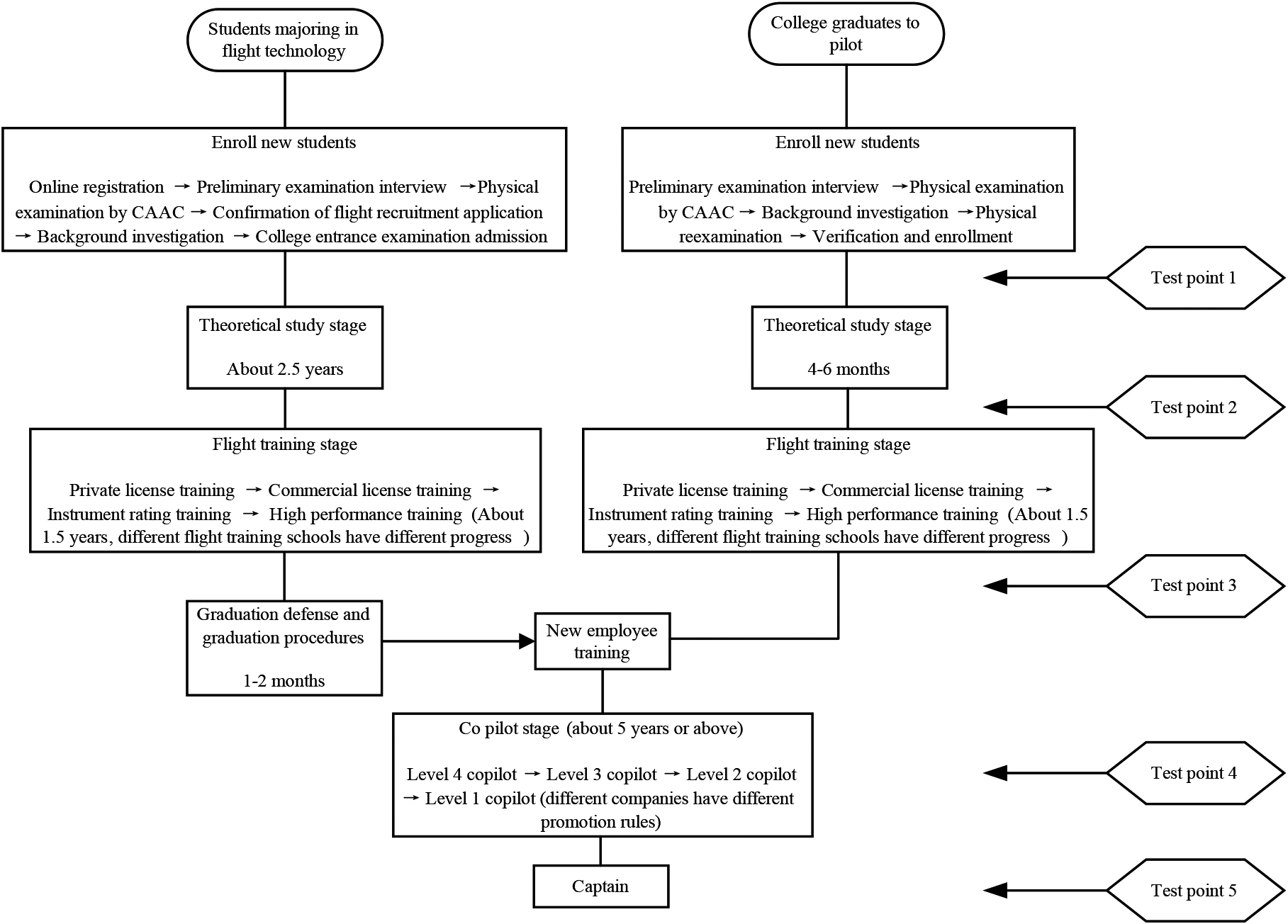
Airline transport pilot refers to a pilot who engaged in domestic and international airline transport on large aircraft, also known as an airline pilot or commercial transport pilot [19]. Compared with other types of pilot such as general aviation pilot, airline transport pilot is engaged in the operation of commercial airline, with higher requirements for safety and efficiency, and higher requirements for the selection and training of airline transport pilot.
Chinese airline pilots are mainly trained by civil aviation colleges, and civil aviation flying cadets are mainly from high school graduates, which are the main source of Chinese airline pilots [20]. The flight technology in China is a special occupational major, which belongs to the national education system. Its main task is to train professional flight talents for China’s civil aviation airline transportation [21]. The curriculum system of this specialty should not only meet the requirements of national undergraduate education, but also meet the requirements of civil aviation regulations for pilots’ licenses. After graduation, students majoring in flight technology can obtain a bachelor’s degree and pilot’s commercial license, and then they can directly work in transport airlines. This is the main mode of training airline transport pilots in China at present, also known as the integrated training mode or “cultivation” training mode.
A senior high school graduate, after studying flight technology major and become a captain, he should go through the following processes: obtaining the flight technology major in an aviation college, obtaining aviation theoretical knowledge, conducting flight training in flight training school, completing the graduation thesis and defense, entering the airline for new employee training after graduation, and becoming a copilot after 200 hours of flight operation observation. After conducting various training and accumulating 2700 hours of flight experience, the pilot will pass the assessment of CAAC and airlines and obtain the captain’s qualification.
In addition to students majoring in flight technology, there are other supplementary sources of Chinese airline pilots, including college graduates, retired military pilots, foreign pilots and general aviation pilots. College graduates are another common source of airline transport pilots in China, also known as “college graduates to pilot” (college graduates change their careers to flight) [6]. Some transport airlines will irregularly go to ordinary colleges and universities to recruit fresh college graduates who meet the standards of airline transport pilots according to their requirements. After short-term aviation theory training in flight training schools or civil aviation colleges, they will be sent to domestic and foreign Part 141 flight training schools for flight training and obtain the corresponding flight licenses. The training process of "college graduates to pilot" after entering the Part 141 flight training school is basically similar to students majoring in flight technology.
For both students majoring in flight technology and “college graduates to pilot”, except for self paid students, the cost of flight training is generally borne by the transport airline, and the “college graduates to pilot” can also receive some allowance. The specific training process of the two Chinese airline pilots training modes is shown in Fig. 1.
Participants
This is a study that has lasted for several years. The participants are 200 students majoring in flight technology and 200 “college graduates to pilot”, at present, they have all become captain. Ten years ago, at the beginning of the study (when they were just enrolled as flying cadets), the average age of students majoring in flight technology was 18.28
Methods
In this paper, we used the Cattell 16PF questionnaire to test pilots’ personality traits. The 16PF is an important way to deeply understand pilots’ personality characteristics and can be used as a reference scale for pilots’ psychological selection. The 16PF questionnaire includes 16 factors, which are Warmth (A), Reasoning (B), Emotional Stability (C), Dominion (E), liveliness (F), Rule Consistency (G), Social Boldness (H), Sensitivity (I), Vigilance (L), Abstractedness (M), Privateness (N), Application (O), Openness to Change (Q1), Self Reliance (Q2), Perfectionism (Q3) and Tension (Q4) respectively. STEN scores of 16PF are 10 points, 1
We conducted 16PF tests on students majoring in flight technology and “college graduates to pilot” respectively. There are five tests in total, which is after enrollment as flying cadets (the first test), before flight training (after the completion of theory courses, the second test), after the completion of flight training (the third test), after one year as a copilot (the fourth test), and after one year as a captain (the fifth test), respectively. Among them, the average time interval from the second test to the first test is 4–6 months for “college graduates to pilot”, and 2.5 years for students majoring in flight technology. The average time interval from the third test to the second test is 1.5 years. The average time interval from the fourth test to the third test is 15 months for “college graduates to pilot”, and 18 months for students majoring in flight technology. The average time interval between the 5th and 4th test is 7 years. The recruitment of participants is based on the principle of voluntary and informed consent. The research process and data is anonymous, and the privacy of participants will not be disclosed. All participants signed the informed consent form.
The specific time point of the test can be seen in Fig. 1. All data are processed and statistically analyzed through the SPSSAU data scientific analysis platform, and the main method is Independent-Sample
Results
Table 1 shows the comparison of the personality traits between students majoring in flight technology and “college graduates to pilot” when they were enrolled as flying cadets. It can be seen that there are many differences in the 16PF factors between them at the beginning of enrollment. In addition to Emotional Stability (C), Dominance (E), liveliness (F), Social Boldness (H) and Abstractedness (M), the other 11 factors including Warmth (A), Reasoning (B), Rule Consistency (G), Sensitivity (I), Vigilance (L), Privateness (N), Application (O) Openness to Change (Q1), Self Reliance (Q2), Perfectionism (Q3) and Tension (Q4) had significant differences (
Comparison of 16PF factor STEN scores between students majoring in flight technology and college graduates to pilot, the first test (
)
Comparison of 16PF factor STEN scores between students majoring in flight technology and college graduates to pilot, the first test (
*p< 0.05, **p< 0.01.
Before flight training (after the completion of theory courses), the personality traits of students majoring in flight technology and “college graduates to pilot” are shown in Table 2. At this stage, flight technology students have experienced about 2.5 years of college study and life, and completed the aviation theory courses, the personality differences between students majoring in flight technology and “college graduates to pilot” were significantly reduced compared with the first test. There were only four factors with significant differences (
Comparison of 16PF factor STEN scores between students majoring in flight technology and college graduates to pilot, the second test (
*p< 0.05, **p< 0.01.
After the completion of flight training, the comparison of personality traits between students majoring in flight technology and “college graduates to pilot” is shown in Table 3.
Comparison of 16PF factor STEN scores between students majoring in flight technology and “college graduates to pilot”, the third test (
*p< 0.05, **p< 0.01.
After one year as copilots, the comparison of personality traits between students majoring in flight technology and “college graduates to pilot” is shown in Table 4.
Comparison of 16PF factor STEN scores between students majoring in flight technology and “college graduates to pilot”, the fourth test (
*p< 0.05, **p< 0.01.
After one year as captains, the comparison of personality traits between students majoring in flight technology and “college graduates to pilot” is shown in Table 5.
Comparison of 16PF factor STEN scores between students majoring in flight technology and “college graduates to pilot”, the fifth test (
*p< 0.05, **p< 0.01.
From Tables 3–5, it can be seen that after flight training, the personality difference between the two types of flying cadets is no longer significant, and there is no significant difference between the various factors of 16PF.
In order to analyze the change of a pilot’s personality from a flying cadet to a captain, for students majoring in flight technology, we compared the results of the two neighboring tests, and compared the 16PF factor scores between enrollment as flying cadets and becoming captains. Since the time interval of each test is long, especially the time interval between the first test and the fifth test, most of which exceeds 10 years. In order to ensure the reliability of the test, the data analysis adopts Independent-Sample
Comparison of 16PF factors of students majoring in flight technology in different test times
*p< 0.05, **p< 0.01.
At the same time, in order to analyze the change trend of flying cadets’ personality in the training process, the average 16PF factor score at different stages is plotted, as shown in Fig. 2.
The change trend of the average 16PF factor score of flight technology students (from enrollment to captains).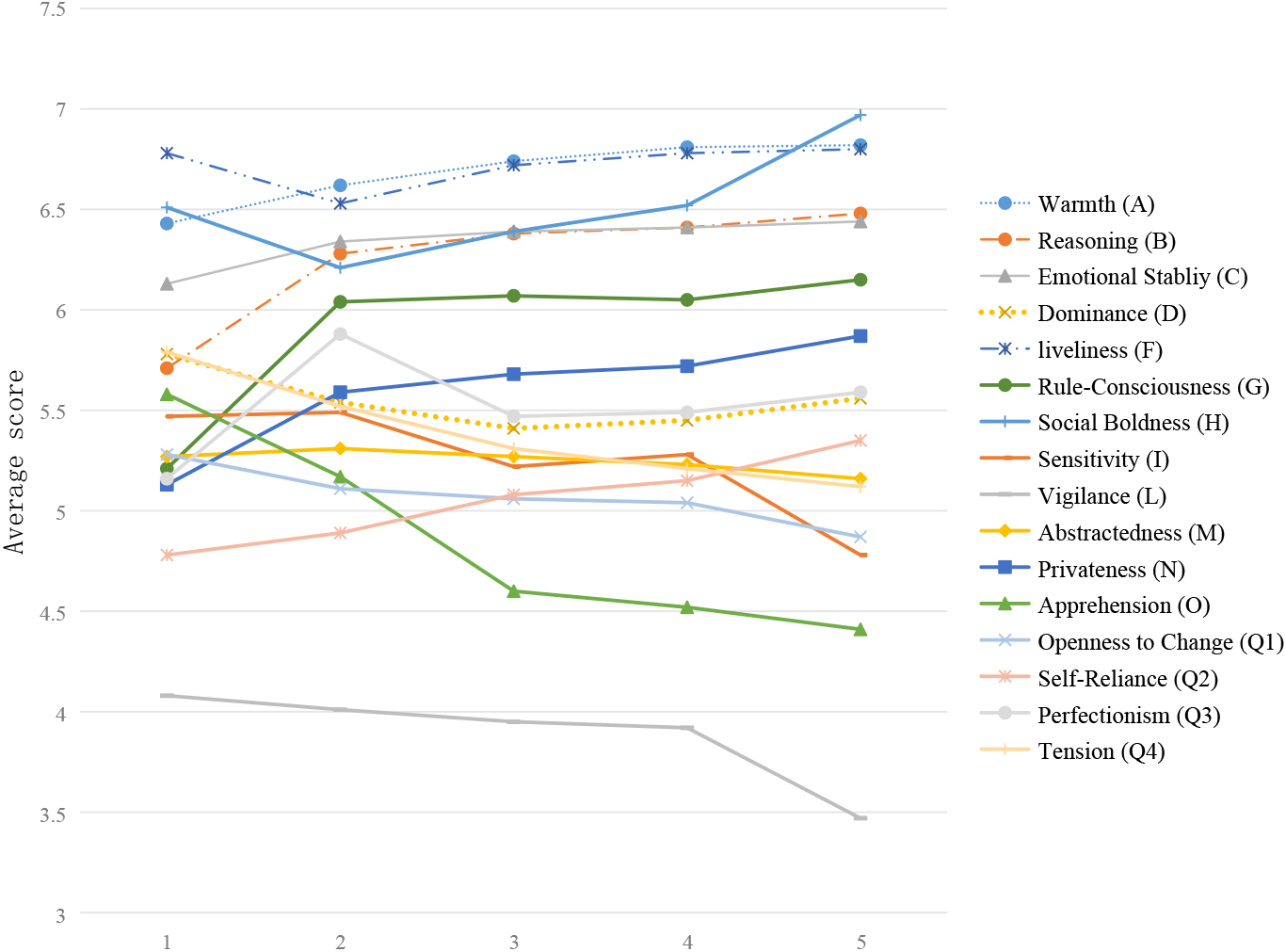
Comparison of 16PF factor of college graduates to pilot in different test times
*p< 0.05, **p< 0.01.
The change trend of the average 16PF factors score of college graduates to pilot (from enrollment to captains).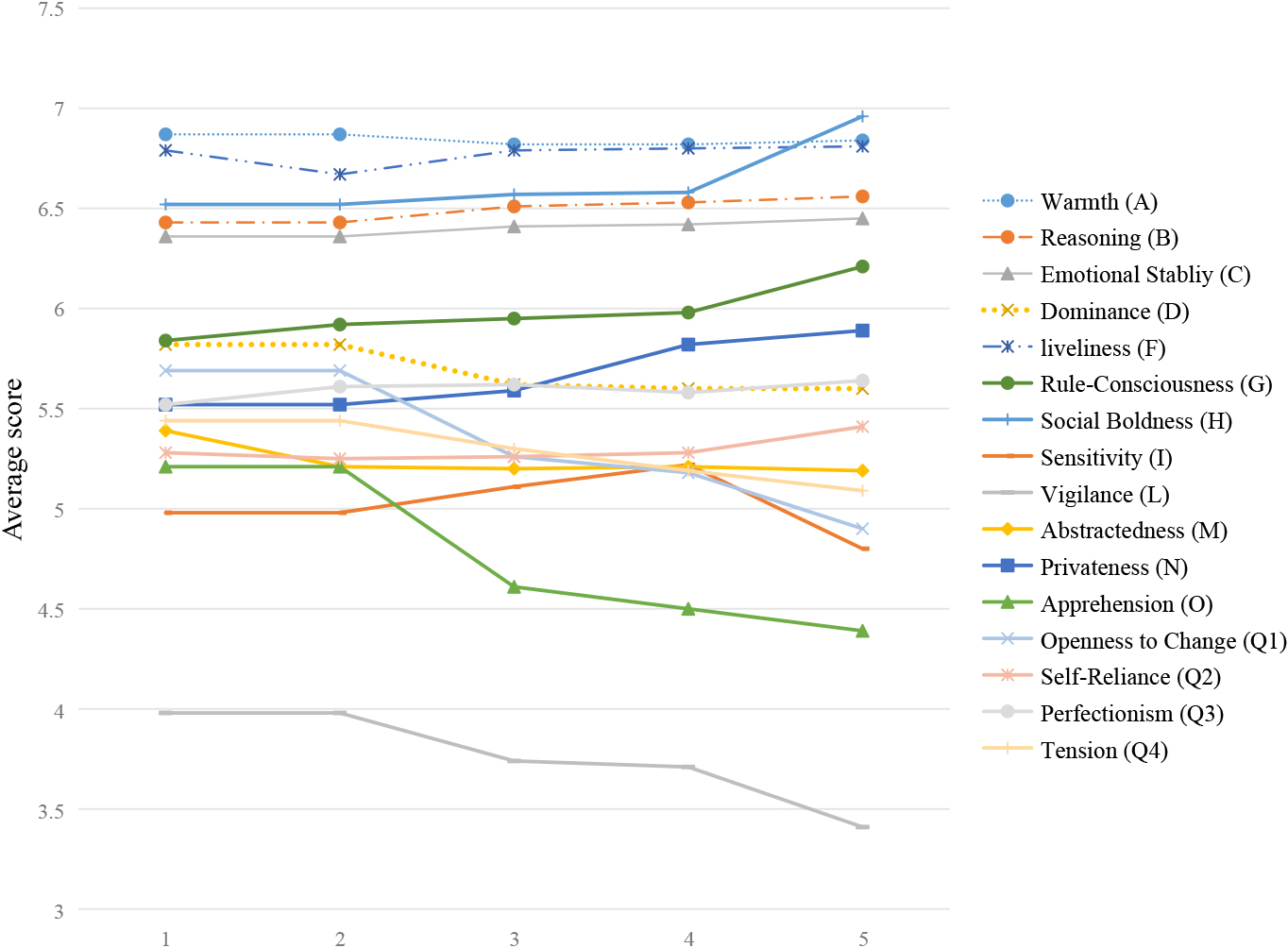
According to Table 6 and Fig. 2, among the factors of 16PF, the score of five factors including Warmth (A), Reasoning (B), Emotional Stability (C), Privateness (N) and Self Reliance (Q2) show an increasing trend in the process of pilots growing up from cadets to captains, and scores of these five factors after becoming captains are significantly different from those of newly enrolled pilots (
Vigilance (L), Apprehension (O), Openness to Change (Q1), and Tension (Q4) shows a decreasing trend with the training of flying cadets, and there are significant differences of those four factors between enrollment as flying cadets and becoming captains (
The score from the first test to the second test of Rule Consistency (G) is greatly changed, and the score of the last test is the largest. There is a significant difference between the first test and the second test (
Score of Sensitivity (I) in the first and second test does not change significantly. The scores decreased from the third test, and there is no significant difference between the third and fourth test. The score of the fifth test decreased significantly, there is a significant difference of the score between the fourth and fifth test (
There is the highest score of Perfectionism (Q3) in the second test, which is significantly different from the first test (
Through the same method, we compared the 16PF factor of “college graduates to pilot” from flying cadets to captains. The results are shown in Table 7.
For “college graduates to pilot”, in the process of becoming captains, changes of the average 16PF factor score as shown in Fig. 3.
It can be seen from Table 7 and Fig. 3 that among the 16PF factor in the training process of “college graduates to pilot”, the score of nine factors have no significantly difference between enrollment as flying cadets and becoming captains, including Warmth (A), Reasoning (B), Emotional Stablity (C), Dominance (E), liveliness (F), Sensitivity (I), Abstractedness (M), Self Reliance (Q2) and Perfectionism (Q3). Due to the relatively short time period between the first test and the second test, the score of 11 factors of 16PF remains unchanged. Before becoming captains, the score of Sensitivity (I) in the first four tests increased slightly, but there is no significant difference between them. During the process from the copilot to captain, the score changed significantly and with a significant difference (
There are seven 16PF factor scores significant difference between enrollment as flying cadets and becoming captains, including Rule Consistency (G), Social Boldness (H), Vigilance (L), Privateness (N), Apprehension (O), Openness to Change (Q1) and Tension (Q4) (
The score of Vigilance (L) shows a gradual downward trend, and the difference between the fourth and fifth time was the largest, but it does not reach the level of significant difference. The score of the first three tests of Privateness (N) changed little. From the fourth test, the score increases significantly, and the fifth test has scored the highest. Scores change trend of Apprehension (O) and Openness to Change (Q1) is the same, and score of the first two tests has not been changed. Since the third test, the scores have decreased each time, and the fifth test get the lowest score.
Under the two Chinese airline pilot training modes of flight technology students and “college graduates to pilot”, the selection methods of flying cadets are completely different. Flight technology students are selected from fresh high school graduates, while “college graduates to pilot” are selected from college graduates. The age difference between them is generally about 4 years. At the same time, the college graduates have completed the college studies, and the psychological state of all aspects is also close to that of adults in society. Therefore, at the beginning of enrollment, there was a large difference in personality between students majoring in flight technology and those who graduated from college. Among the factors of 16PF, except for five factors: Emotional Stability (C), Dominance (E), Liveliness (F), Social Boldness (H) and Abstractedness (M), there were significant differences between the other factors (
At the time of second test, the difference between the personality of “college graduates to pilot” and students majoring in flight technology decreased from 11 factors the first test to 4 factors, and the other 7 factors including Warmth (A), Reasoning (B), Rule Coordination (G), Vigilance (L), Privateness (N), Application (O), and Tension (Q4) have no significant difference. After 2.5 years of aviation college study, students majoring in flight technology have firmed their career direction, become more mature in mind, have a stronger ability to get knowledge, and are more adaptable to collective life. This is reflected in the increase of students’ scores of four factors: Warmth (A), Reasoning (B), Rule Consistency (G) and Privateness (N). In particular, the score of Rule Consistency (G) measured in this time is significantly different from those measured in the first time, indicating that college study in aviation colleges plays an important role in cultivating students’ perseverance. In China, flight technology majors are basically order based training. When students are admitted to this major, they will determine the airlines they will work for in the future. As a result, students are more harmoniously and more confident about the future. Therefore, Scores of Vigilance (L), Application (O) and Tension (Q4) are declining. Among the four factors that are significantly different between the students majoring in flight technology and “college graduates to pilot”, Perfectionism (Q3) of the students majoring in flight technology achieved the highest score in the second test, which is significantly different from the previous two tests. The main reason is that the students majoring in flight technology in China generally adopt paramilitary management, which will greatly strengthen the students’ collective consciousness and self-discipline, which explains the highest Perfectionism (Q3) score in the second test. With the training of flying cadets, when becoming captains, the Perfectionism (Q3) score of the “college graduates to pilot” is the highest, and the Perfectionism (Q3) score of the students majoring in flight technology is also the highest except for the second test. Flight safety is inseparable from good self-discipline, which also shows that paramilitary management is of positive significance to the training of pilots.
Since the third test, there has been no significant difference in the 16PF factor score between the “college graduates to pilot” and those majoring in flight technology. The time of the third test is after the flight training. At this time, both flight technology students and “college graduates to pilot” have become pilots in their identities. Their study, life and training experience are basically the same, so there is no significant difference in the 16PF factor score.
The fourth test is carried out when the flying cadets become copilots after one year, about 15 months after the third test. Between the two tests, the flying cadets mainly completed the transformation from trainees to airline employees. However, from the perspective of personality change, this stage has little influence on personality, and all 16PF factor scores have no significant change compared with the third test.
The last test is carried out when the flying cadets all become captains. Many 16PF factor score measured in this test are significantly different from those at the beginning of enrollment. For the students majoring in flight technology, the score of Warmth (A), Reasoning (B), Emotional Stability (C), Liveliness (F), Rule Consistency (G), Social Boldness (H), Privateness (N) and Self Reliance (Q2) all have reached the maximum value of five tests. Score of Sensitivity (I), Vigilance (L), Abstractedness (M), Apprehension (O), Openness to Change (Q1) and Tension (Q4) all have reached the minimum value of five tests. For “college graduates to pilot”, Reasoning (B), Emotional Stability (C), Rule Consistency (G), Social Boldness (H), Privacy (N), Self Reliance (Q2) and Perfectism (Q3) have reached the maximum value of five tests, while Sensitivity (I), Vigilance (L), Appearance (O), Openness to Change (Q1), and Tension (Q4) are the minimum value of five tests.
Conclusion
This study does have certain limitations. It should be noted that all participants in this study were male, which may pose a significant constraint in terms of generalizability to a broader population. However, considering the global airline industry’s current demographics, where the proportion of female pilots remains below 4%, the exclusive inclusion of male participants in this study is less likely to have a substantial impact on the overall conclusions. Furthermore, the study employed the widely recognized 16PF questionnaire to track the personality development of pilots. While this instrument has demonstrated its efficacy as a mature and reliable personality assessment tool, it is important to acknowledge that all participants shared a common educational background at the same aviation academy. Consequently, they may have been influenced by similar factors such as faculty, management, and environmental conditions, potentially introducing a certain degree of bias into the final research outcomes. To enhance the validity and generalizability of future research, it is recommended to include participants from multiple aviation academies.
From the above analysis, in the process of becoming a captain, there are three important stages in the development of a pilot’s personality. The first stage is the transition from a freshman to a graduate. For the students majoring in flight technology, college study has significantly changed the score of five 16PF factors. The second stage is flight training, in which the personality traits of the students as pilots begin to become obvious gradually. After the flight training, there are significant changes in the two factors of Application (O) and Perfectionism (Q3) for students majoring in flight technology, and for “college graduates to pilot”, there are significant changes in the two factors of Application (O) and Openness to Change (Q1). At the same time, due to the difference between the requirements of flight training, operating environment and the actual airline flight operation, some 16PF factors are different from the captain’s stage, such as the change in the Perfectism (Q3) score of the cadets, which may be related to breaking away from the paramilitary management. The third stage is from the copilot to the captain, which takes the longest time and has the greatest influence on all aspects of the trainees. From the last test results, the personality traits of a mature and excellent pilot should be reasonable, emotional stability, perseverance, courage, independence, self-discipline and self-confidence, calm at critical moments and strict compliance with the rules. Obviously, these characteristics are very important to ensure flight safety.
It is worth noting that existing research on pilot personality predominantly focuses on personality surveys or normative comparisons among active pilots or pilot trainees, aiming to identify the personality traits that align with the pilot profession. However, it is essential to recognize that personality is a dynamic construct that can undergo changes over time. Therefore, this study contributes to our understanding of how pilot personality traits develop under different training models and approaches, as well as their potential implications for future aviation work. By shedding light on the evolution of pilot personalities during the training process, this research emphasizes the importance of selecting appropriate timing and methods to foster and strengthen pilots’ psychological qualities.
Footnotes
Acknowledgments
First, we sincerely thank the student pilots of Shandong Airlines for their participation. In addition, the research is financed by the key project of undergraduate teaching reform of higher education in Shandong Province: Exploration and practice of the construction of “professional ideological and politics” of civil aviation in local universities-Take flight technology as an example (No. Z2022056) and the Binzhou University first-class undergraduate course construction project “Human factors and CRM” (No. 20), we also express our gratitude.