




Abstract
With the rapid development of information technology, electronic signature plays an increasingly important role in people’s production practice. However, there are a large number of hackers maliciously stealing information in the network. In order to avoid this phenomenon, we urgently need to strengthen the research on online electronic signature recognition technology. Based on the sparse classification technology of neural model, this paper constructs an online electronic signature recognition model by using convolutional neural network and sparse classification technology. We first extract the local features of online electronic signatures, construct feature vectors and perform sparse representation. Sub-model we construct a scheme for online electronic signature recognition based on neural models and sparse classification techniques using a combination of algorithms. We first extract the local features of online electronic signatures, construct feature vectors and perform sparse representation. At the same time, the features in the training image set are extracted, local feature sets are constructed, feature dictionaries are created, and the vectors in the feature dictionaries are matched with the global sparse vectors constructed by the electronic signatures to be detected, and the matching results are finally obtained. At the same time, the features in the training image set are extracted, the local feature set is constructed, the feature dictionary is created, and the vector in the feature dictionary is matched with the global sparse vector constructed by the electronic signature to be detected, and finally the matching result is obtained. In order to verify the accuracy of the model, we first extracted 1000 respondents for online e-signature recognition experimental results show that the recognition accuracy of online e-signature has been significantly improved. Finally, in order to determine the optimal number of training sets for the model constructed in this experiment, we analyzed the correlation between training and sample size and recognition accuracy. Finally, it was concluded that the recognition accuracy increased with the increase of the number of training samples. Electronic signatures can quickly examine the signature results, and electronic signature recognition can be used to fix and tamper-proof evidence to enhance the security and trustworthiness of signatures, and it is imperative to improve the security of electronic signatures. In this paper, we study online electronic signature recognition technology, using neural model and sparse classification to construct an efficient and accurate recognition model. Experiments show that the model is effective and the number of training samples affects the recognition accuracy. This paper provides a new approach for the development of this technique. When the training samples are greater than 1300, the recognition accuracy is stable at 95%. This research has certain theoretical and practical significance, and promotes the rapid development of online electronic signature recognition.
Introduction
With the rapid development of information technology, electronic signature replaces traditional paper signature in finance, business, hotel management and other areas have a wide range of applications. Electronic signature has stability and easy accessibility, representing the biometric characteristics of the signer is widely used in the identification of the signer. But electronic signatures still have certain risks, with the continuous development of network hacking technology, electronic signatures have the risk of being maliciously stolen, in order to solve this problem, we must strengthen the research of electronic signature identification technology. But manual identification of electronic signatures requires a lot of time, money, etc., and manual identification is an undesirable solution. In recent years, the rise of neural network technology and deep learning has promoted the development of modern information technology and provided an opportunity for the development of electronic signature recognition [1, 2].
Neural network models have been developed on the basis of neuroscience and bioscience, and the logic underlying them has greatly enriched the modern learning theory. The operation of neural models requires computer hardware capable of handling large batches of data, and only after training with large amounts of data can neural models be grounded into products. In order to prevent the malicious theft of network hackers, the current stage for online electronic signature recognition higher, the traditional recognition model can only roughly judge the signature and the owner’s identity match the question, the answer is “is not” the question, and now the development trend is to electronic signature process of all kinds of characteristics of information including pressure, fluency, stroke smoothness, time and other characteristics of information combined. According to these features, the neural network model can accurately estimate the matching degree between the electronic signature and the identity of the owner to meet the needs of various industries for electronic signature recognition [3, 4].
Compared with western countries, the electronic signature recognition technology in China is at a backward stage. In foreign countries, the convolutional neural network model proposed by LeCun et al. has greatly advanced the development of the field of handwritten recognition of electronic signatures. The convolutional neural network LeNet-5 requires a large number of data samples for training to achieve iterative learning of the neural network. Three core ideas exist in the LeNet-5 convolutional neural network, one is to create a local receiver domain, the other is to create a local domain with shared weights, and the third is to perform secondary sampling of data in the state space. In conclusion, the convolutional neural network LeNet-5 has greatly promoted the development of the field of electronic signature recognition. The skeleton signature recognition technology supported by filtering and dipolarization discovered in 1999 is also a major step forward in the development of electronic signature recognition technology [5, 6]. Although the research in this field has been very mature, but this problem of low accuracy rate of online electronic signature recognition is still not solved, in order to guarantee the information security of network users, we must research from the perspective of improving the accuracy rate of online electronic signature recognition.
Technical basis of online electronic signature recognition
Neural network model
Neural network model is a neuron system created by simulating human thinking. The function of individual neuron in neuron system is often single, but after coordination and cooperation between neuron systems, parallel processing, etc., it is possible to make simple neurons realize complex functions. The core of neuron system operation lies in the adjustment of connection weights. BP neural network is an important element in neural network model, BP neural network model requires large sample size, because the connection weights between the layers are generated by the regulation of information passed between the layers, the more layers of neural network, the higher the accuracy of the network. BP neural network consists of input layer, implication layer, output layer. And its specific network hierarchy is shown in Fig. 1 [7, 8].
BP neural network structure.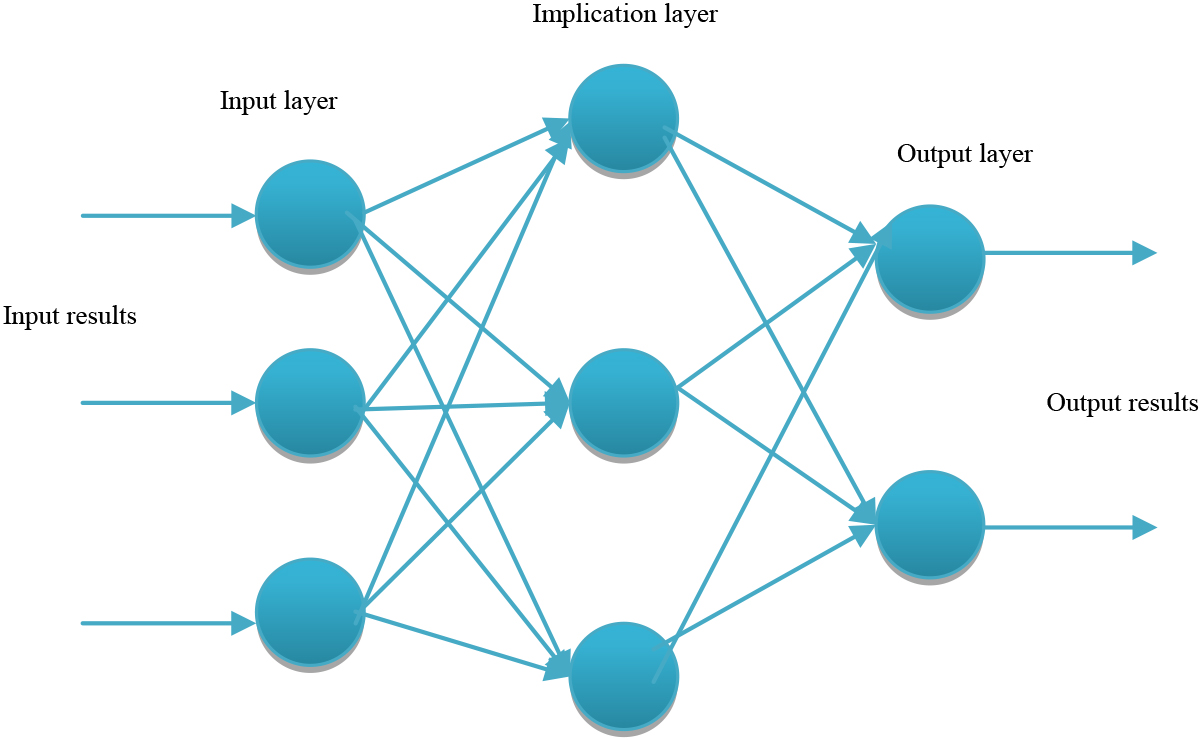
The multilayer structure of the neural network can be used to recognize electronic signatures. In the input layer, the image data of the electronic signature is converted into a one-dimensional vector, which is used as the input to the neural network. In the convolutional layer, multiple convolutional kernels are used to perform convolutional operations on the input data to extract local features of the electronic signature and generate a feature map. In the pooling layer, the feature map is down sampled to reduce the dimensionality of the data and retain the important feature information. In the fully connected layer, the output data of the pooling layer is connected to a fully connected neural network, and a nonlinear transformation is performed to output the probability values of each category. In the output layer, based on the output of the fully connected layer, the category with the highest probability is selected as the recognition result to determine whether the electronic signature is original or forged.
As shown in Fig. 1, the neural network structure has an input layer, an output layer and multiple implication layers, and the BP neural network mainly adopts a differentiable linear function as the activation function. the BP neural network is a continuous learning network, if the output result is wrong, the model will get the signal and correct its weights, and when the output result is correct, it will also change the corresponding weights. the weights of the BP neural network change dynamically and adjust the weights according to the learning result. The weights are adjusted according to the results of learning, with a certain degree of self-adaptability and reliability. The specific Eqs (1)–(3) for its application are as follows, the input of the implicit layer is shown in Eq. (1), the input of the output layer is shown in Eq. (2), and the output layer is shown in Eq. (3) [9, 10].
Equation (1) is the input formula of a neuron, which represents the sum of the weighted inputs received by a neuron, plus a bias term. The parameters in the formula are:
A major problem of electronic signature recognition is the recognition of images. The data dimension of image data is high, and effective recognition cannot be achieved if the traditional way is followed. Sparse classification technology can solve this problem. If there is a one-dimensional signal m, the sparse classification technique can realize the representation of one-dimensional signal m in N-dimensional space in the following form, after orthogonal transformation and normalization, we can get the
Schematic diagram of sparse classification.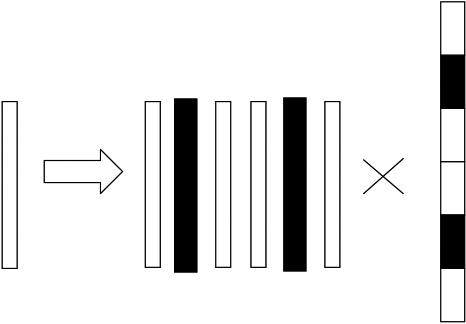
From the source of data, electronic signatures can be divided into online electronic signatures and offline electronic signature recognition technology, of which the technical difficulty is online electronic signatures. Online electronic signatures have extremely high requirements for the speed of computer operation and the processing efficiency of the model, and are more difficult to implement. Moreover, the online electronic signature is affected by the state of the signer, and the physical parameters embodied in the final signature vary, so the online electronic signature is dynamic, and the physical parameters embodied in the signature need to be constantly compared with the data stored inside the computer to obtain the final result.
With the rapid development of information technology, electronic signature of all walks of life is more and more widely used. But the electronic signature recognition technology is not mature, also faces various problems. Electronic signature recognition needs to involve many aspects of technology. The traditional recognition way mainly relies on the manual identification, the workload is big, the recognition accuracy is low, and there is human error, this way has seriously hindered the development of the electronic signature recognition technology. But with the continuous development of information technology, the current stage of electronic signature recognition mode has been mature, and can maintain a high recognition accuracy rate. Electronic signature recognition is a comprehensive application, for safeguarding the information security of all walks of life on the important significance [13, 14].
Figure 3 is the identification process of electronic signature, as shown in Fig. 3, before the process of electronic signature identification, the real electronic signature database must be constructed. In the process of identification, the feature information in the sample data to be detected is matched with the information in the database, and the match is output if it matches, and the error is output if it does not match. Sample detection is a complex project. The feature information in the electronic signature will be extracted must be used to image recognition technology, the signal obtained by image recognition technology will be processed must be used to sparse classification, the data further matching process must be applied to the neural network model [15, 16].
Electronic signature identification process.
Image recognition of electronic signatures must go through image enhancement, image noise reduction, image binarization processing, image normalization processing and other steps in order to be converted into a language that can be recognized by the computer. When the computer acquires the signature information of the signer, it may often have errors in information acquisition due to lighting and angle problems. In order to reduce the errors, we must enhance the image to weaken the influence of errors and improve the accuracy of recognition. Image noise reduction is to remove the noise from the captured pixels to further reduce the error. Binarization of images and normalization of images, etc. are to convert the images into a language that can be recognized by the computer. The specific mode of operation is shown in Fig. 4 [17, 18].
Image recognition model.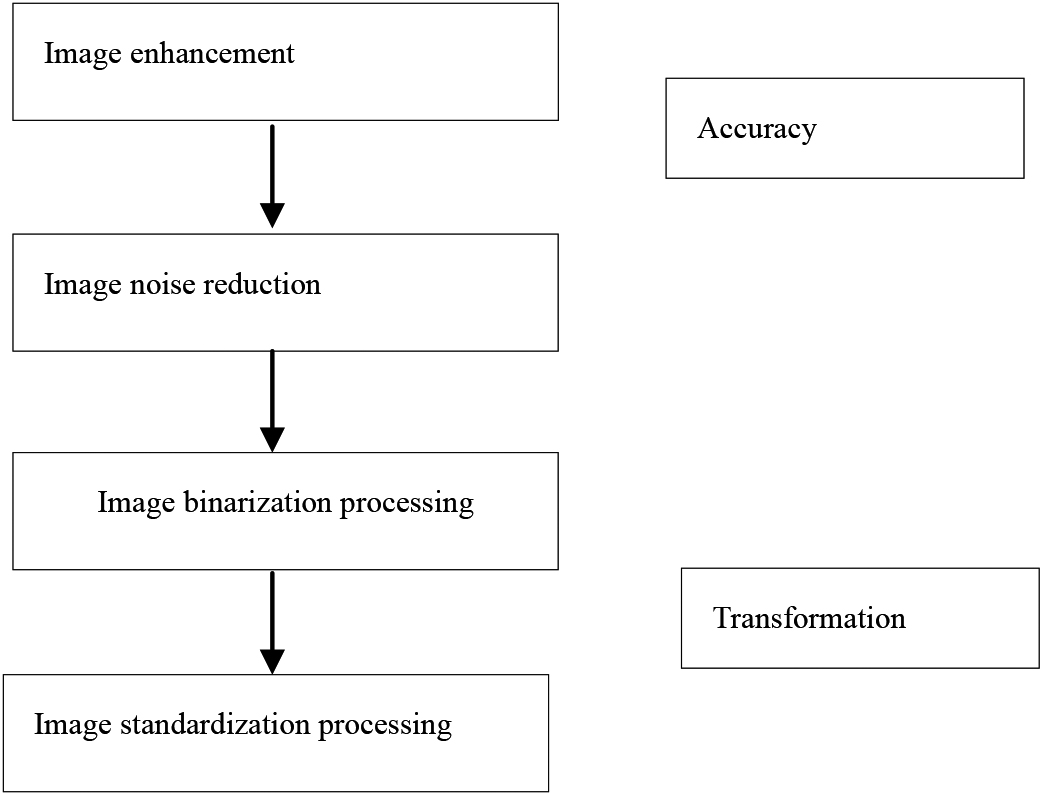
Online electronic signature feature extraction
Sparse coding of images has been applied very widely. In this study, we use techniques such as sparse coding to extract features of online electronic signatures and provide corresponding data for subsequent studies. In the process of feature extraction, the extraction algorithm is required to overcome the influence of different light and exclude the interference of noise points. Feature extraction is the extraction of global or local certain more prominent pigmentation points of an image. In this study, SIST is selected as a method for online electronic signature feature extraction.
SIFT is a technique widely used in computer vision, which can ignore the brightness, angle, light and other environmental factors of the image, and focus on the key points of the image, which can minimize the error of image extraction. First, feature extraction, establish a multi-dimensional image space, detect the global extreme points and local extreme points in the image space, and screen out the points that do not meet the requirements. Second, the features are described. Determine the orientation of feature points and generate feature vectors. Third, pattern matching is performed on the feature points to generate the feature set. The specific steps are as follows.
(1) Blur the image using Gaussian function. The blurred image of this signature image can be derived by performing convolutional neural network operations on the blurred template calculated using Gaussian function and the signature image that needs to be blurred. The formula for Gaussian blurring is shown in Eq. (4). Gaussian fuzzy formula in the practical application of the process of setting two main parameters, one is the fuzzy radius
(2) The Eq. (5) for generating a Gaussian blurred template is shown. In Eq. (5), h and m are the length and width of the Gaussian blurred template, respectively.
(3) Configuration scale space, scale space is the degree of blur in Gaussian blur. Its specific formula is shown in Eq. (6). where the “/” indicates that the convolutional neural network operation is performed.
(4)
The purpose of absorption processing of signals is to represent multiple data with as few atoms as possible in order to reduce the complexity of the processing. It also makes the signal representation more concise for processing. In 2014, Huang’s team proposed that unprocessed signals can be transformed into sparse signals by some kind of transformation. The main idea is such as Eq. (8), which is a function in the sparse function processing library and is the vector to be processed. Equation (8) can be approximated as a linear relationship between
After the encoded representation of the electronic signature, we need to use the algorithm to perform a spatial hierarchy of the SPM-derived feature encoding. In this study, we use the three-dimensional SPM algorithm to view the encoded e-signature graph as a collection of feature vectors. The spatially angled features are represented as points in a histogram. This three-dimensional algorithm overcomes the problem of missing spatial information in the traditional SPM algorithm and enables more accurate recognition. The SPM algorithm slices the information of the whole image, and the finer the granularity of the slices, the more accurate the final result is. The features in each slice are calculated step by step, and finally the total features are synthesized. This is shown in Eq. (9) [23, 24].
(1) Vector aggregation, the set of feature vectors that have been sliced and reorganized are aggregated again to obtain a maximum aggregation vector MaxV, who is the value of the largest component in the positive direction of the feature vectors in all regions is taken out to construct a K-dimensional vector matrix to represent the electronic regions to be identified. According to the figure shown in Eq. (10) [25, 26].
(2) The feature vectors are extracted from the set of samples involved in model training in the sample library and transformed into the form as in Eq. (10). The visual dictionary is then constructed based on the feature vectors extracted from the training set.
(3) The vectors in the sample library are matched with the vectors of the aggregated electronic signatures to be tested, and the matching results obtained are shown in Fig. 5, from which it can be seen that the matching accuracy is not high. To solve this problem, we use the LLC algorithm for matching, and the final matching success rate is shown in Table 1, which shows that the LLC algorithm has a high total matching degree. However, the matching in smoothness is only 0.75 [27, 28].
LLC algorithm pattern matching success rate
Linear way vector matching results.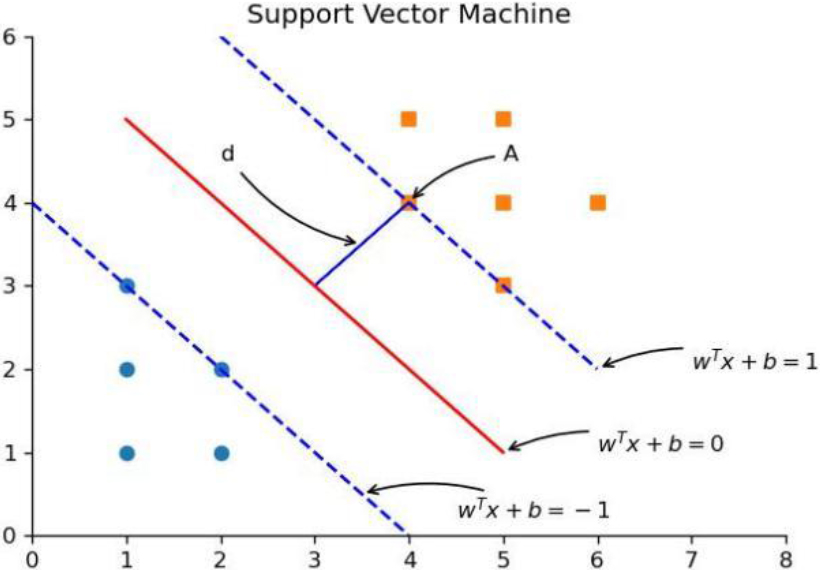
Stroke order: refers to the order and direction of strokes when writing Chinese characters, it is the norm and habit of Chinese character writing, which plays an important role in improving the speed and beauty of Chinese character writing. In the field of electronic signature recognition, stroke order is a feature that distinguishes different signers because different signers may have different stroke order habits.
Pressure: refers to the amount of force applied to the paper by the pen tip when writing, which affects the thickness and depth of the handwriting and plays a role in expressing the emotion and personality of the writer. In the field of electronic signature recognition, pressure is a characteristic that distinguishes genuine from forged signatures, because real signers usually have a certain pattern of pressure changes, while forgers tend to have less or more unstable pressure.
Smoothness: It refers to the continuity and fluency of the handwriting when writing, which reflects the coordination and quality of movement of the writer and is useful for assessing the skill level and neurological function of the writer. In the field of electronic signature recognition, smoothness is a measure of signature quality because real signers usually have high smoothness, while forgers often have low smoothness or show significant jitter or stuttering.
Force angle: It refers to the angle of inclination of the pen tip to the paper during writing, which affects the shape and direction of the handwriting and is useful for distinguishing different stroke types and font styles. In the field of electronic signature recognition, force angle is a characteristic that distinguishes different signers, as different signers may have different force angle habits.
The total match is a weighted average of the individual sub-matches.
In this model we construct a scheme for online electronic signature recognition based on neural models and sparse classification techniques, using a combination of algorithms. We first extract the local features of the online electronic signature, construct the feature vector and perform sparse representation. At the same time, the features in the training image set are extracted, local feature sets are constructed, feature dictionaries are created, and the vectors in the feature dictionaries are matched with the global sparse vectors constructed by the electronic signatures to be detected, and the matching results are finally obtained. The specific pattern is shown in Fig. 6.
Model summary.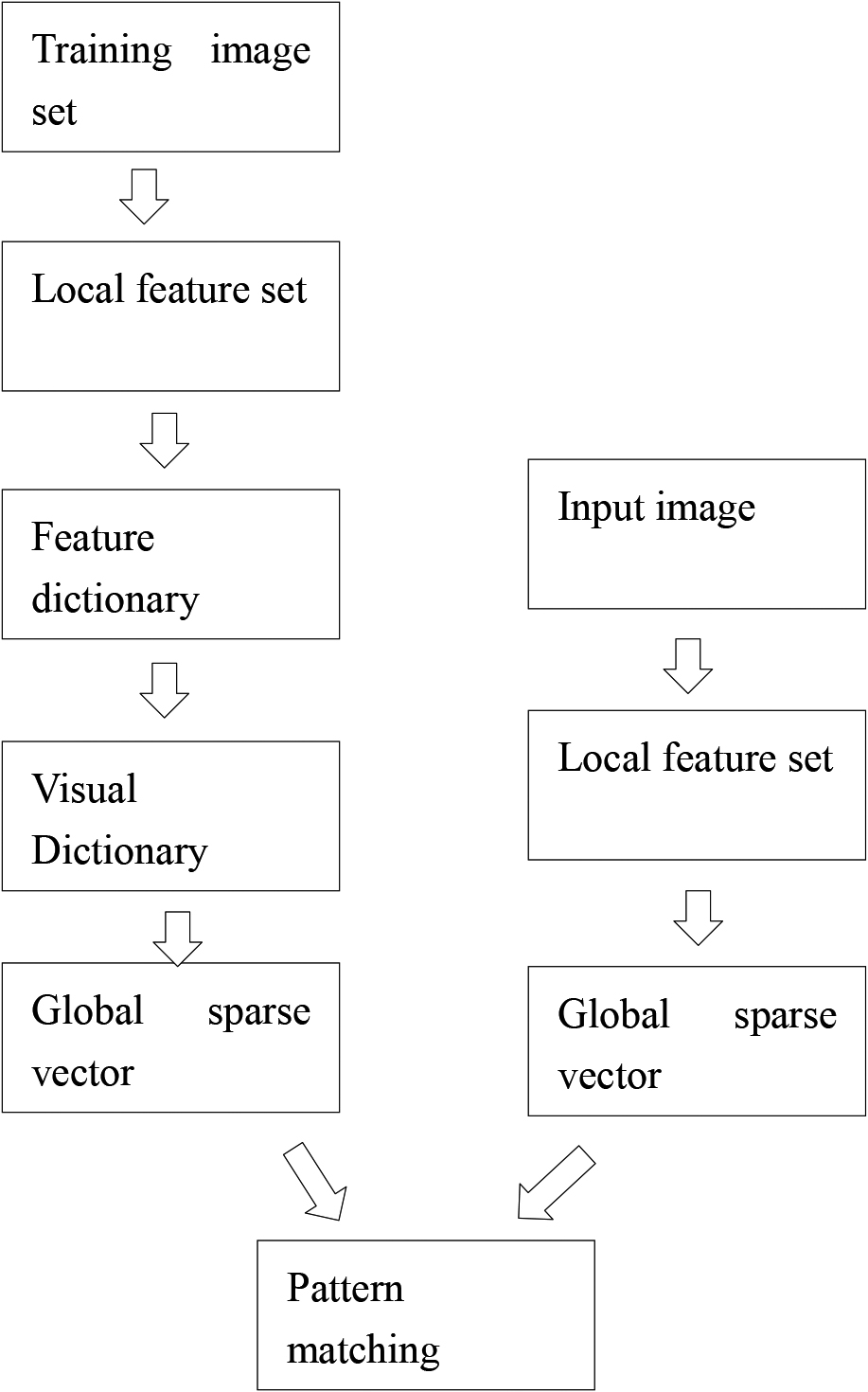
Feature extraction is the first step, which is the process of extracting feature information that reflects the signer from the image data of an electronic signature, and it provides input data for the subsequent sparse classification and matching test data. In this study, SIST is selected as the online electronic signature feature extraction method in this research.
Sparse classification is the second step, which is the process of sparse representation of the feature vector after feature extraction, and it provides a more compact and robust feature representation for the subsequent matching test data. There are many methods for sparse classification, and this paper uses sparse classification techniques based on neural models.
Matching test data is the third step, which is the process of matching the feature vectors after sparse representation with the vectors in the feature dictionary of known categories, calculating the similarity or distance, and selecting the most similar or nearest neighbor category as the recognition result, and it is the final output of the electronic signature recognition process. There are many methods to match test data, and in this paper, the LLC algorithm model is used for matching.
Feature extraction: The LLC algorithm model is a feature extraction method based on local linear coding, which can extract local features with rotation, scale and viewpoint invariance from images. the main steps of the LLC algorithm model are: (1) perform multi-scale SIFT feature extraction on images to obtain a set of feature vectors; (2) cluster the feature vectors to obtain a feature dictionary; (3) for each feature vector, a local linear encoding is performed with the nearest k dictionary elements to obtain a sparse coefficient vector; (4) for each image block, all sparse coefficient vectors are max-pooled to obtain a global feature vector.
Sparse classification: The LLC algorithm mode itself is a sparse classification method, which can represent the feature vector sparsely, i.e., multiply a sparse coefficient vector and a feature dictionary to approximate the original feature vector. The advantage of the LLC algorithm mode is that it can preserve the structural information of local features, while reducing the reconstruction error and coding complexity12.
Matching test data: The LLC algorithm mode can be used to match test data by comparing the global feature vector of the image to be recognized with the global feature vector of a known category, calculating the similarity or distance, and selecting the most similar or nearest neighbor category as the recognition result. The advantage of the LLC algorithm mode is that it can effectively deal with viewpoint changes, lighting changes, occlusions, etc., and improve the matching accuracy and robustness.
The above is the theoretical model constructed in this experiment. This model draws on the electronic signature recognition model constructed by previous authors and optimizes it, which is a significant contribution to the development of the electronic signature recognition field.
In order to verify the accuracy of the model constructed in this experiment, we randomly selected 100 respondents to participate in our validation experiment of electronic signature recognition technology. We first obtain the electronic signature data of these 100 respondents and store them in our local database. These data were used to train a neural network model and build a feature vector dictionary. Subsequently, these 100 survey respondents were allowed to perform online electronic signatures and match analysis using the model constructed in this study. We obtained the data obtained from the experiments after initial screening and removing outliers, and the data obtained are shown in Table 2. Table 2 shows that only one percent of the total number of survey respondents had a matching degree of 50% or less, which indicates that the model constructed in this experiment can effectively perform electronic signature recognition. It is the result of this experiment that only four people have a matching degree between 90% and 100%, which means that the accuracy of the model obtained from this experiment is not high.
Results of the first group of experiments
Results of the first group of experiments
To investigate what caused this phenomenon, we conducted another set of experiments. Expanding the number of survey subjects. We randomly selected 1000 people in the population. The experimental procedure of the appeal was conducted again. The obtained experimental results are shown in Table 3 is shown.
Experimental results of the second group
As can be seen in Table 3, when the sample size was expanded to 1000 survey respondents, the recognition accuracy of electronic signatures was significantly improved. The recognition rate below 50% is zero, and the recognition rate above 80% accounts for 70% of the total survey respondents. It can be seen that the problem in the first group of experiments is caused by the insufficient training sample of the model.
In order to determine the appropriate training volume, we conducted a correlation analysis between the number of training samples and recognition accuracy (weighted average). The specific results of the analysis are shown in Fig. 7.
Correlation analysis of the number of training samples and recognition accuracy (weighted average).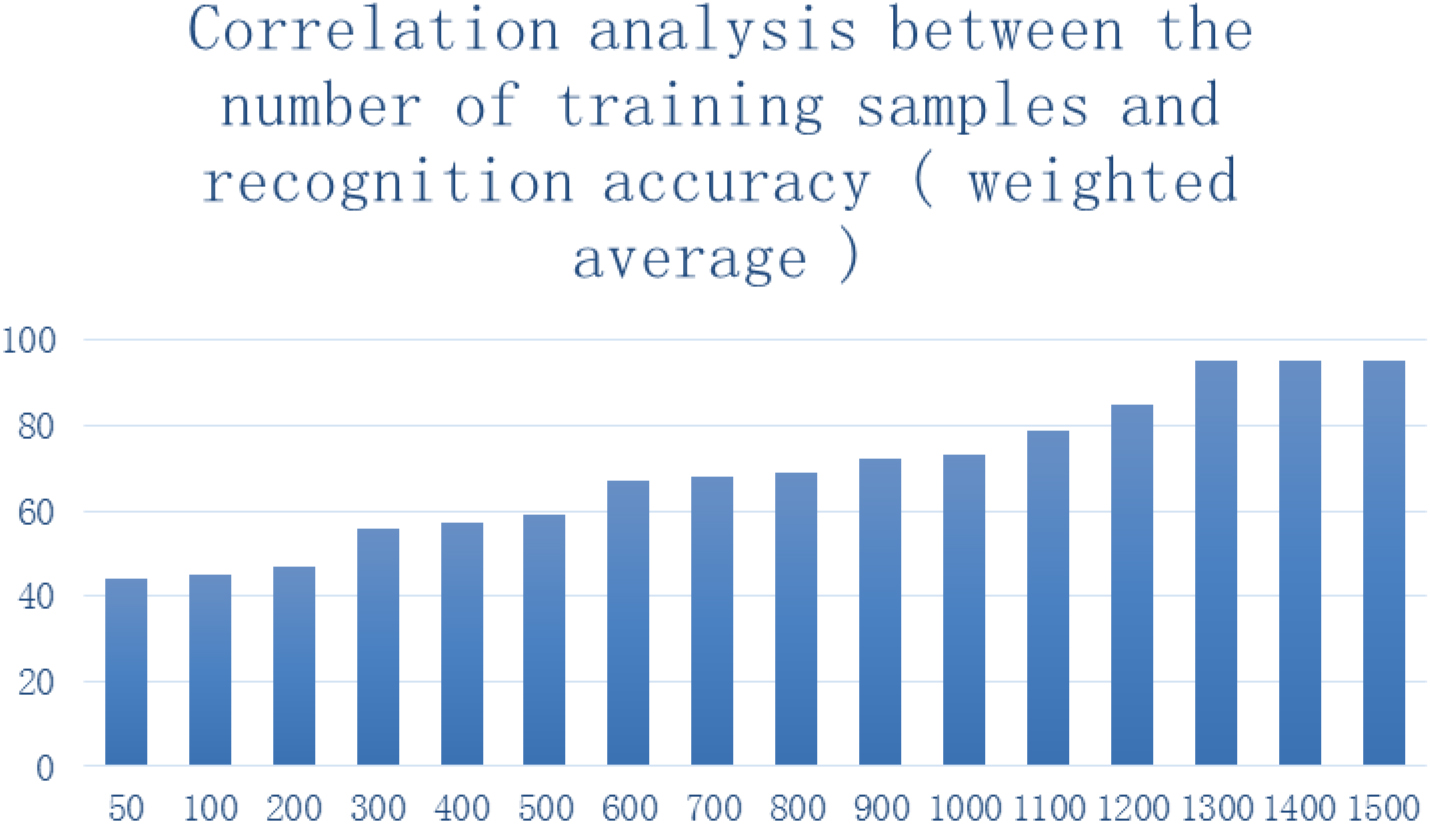
From Fig. 7, it can be seen that there is an approximately linear correlation between the number of training samples and recognition accuracy, but the recognition accuracy is stable above 95% after the sample size exceeds 1300. This indicates that the optimal sample size is 1300, and also indicates that the upper limit of recognition accuracy of the model constructed in this experiment is 95%.
The study proposed an original research method to combine writing pressure with DTW-SVM model for handwriting identification of electronic signatures, which achieves high accuracy improvement for writers, but the recognition rate and forgery resistance of electronic signatures are not high at this stage. The research result of this paper is that the sample recognition accuracy is as high as 98% when the training sample is above 1000, and at a certain.
We first extract the local features of online electronic signatures, construct feature vectors and perform sparse representation. At the same time, the features in the training image set are extracted, local feature sets are constructed, feature dictionaries are created, and the vectors in the feature dictionaries are matched with the global sparse vectors constructed by the electronic signatures to be detected, and the matching results are finally obtained. To verify the accuracy of the model, we first selected 100 survey respondents for online electronic signature recognition. After the experiment, it was found that the number of people with recognition accuracy of 90% to 100% was only four, in order to explore the occurrence of this phenomenon. In order to investigate whether this phenomenon is due to the small training sample, we conducted another set of experiments and selected 1000 respondents for the study, and the experimental results were that the online electronic signature recognition accuracy was significantly improved. Finally, in order to determine the optimal number of training sets for this experiment to construct the model, we conducted a correlation analysis between the training and sample numbers and recognition accuracy, and finally concluded that the recognition accuracy increased with the number of training samples, and the recognition accuracy was stable at 95% when the training samples were greater than 1300. This research has certain theoretical and practical significance, and promotes the rapid development of the field of online electronic signature recognition. The innovation of this article is mainly in the following three aspects. (1) The research idea of using coefficient classification technique of support neural model for online electronic signature recognition is novel, which is praiseworthy. (2) The article optimizes on the basis of the original model to improve the usability of the model. (3) The article uses a large number of diagrams and formulas to illustrate the content of the article in a clear and concise manner.
Footnotes
Acknowledgments
2023 Soft Science project of Henan Province