



Abstract
Sparse representation has been widely researched for image-based classification. However, sparse representation classification directly treats training samples as a dictionary, so it needs a large training set and is time consuming, especially for a large training set. To derive a small dictionary, many dictionary learning algorithms are researched. Thus, object recognition problem is transformed to optimize the sparse representation errors on the compact dictionary. The sparse representation optimization is constraint by
Keywords
Introduction
In the past few years, sparse representation, also called sparse coding, were widely researched by computer community. The technology of sparse representation was used for image denoising 1,2 image analysis, 3 image super resolution, 4 and especially image-based classification such as face recognition, 5 –11 automatic target recognition, 12 and traffic sign recognition. 13 Wright et al. 6 used sparse representation for classification task and proposed a sparse representation–based classification (SRC) in face recognition task. In SRC framework, training samples of all classes are arranged as columns of a matrix usually called dictionary, and the query image is considered linearly represented by the atoms of the dictionary. Most entries of the linear representation coefficient coding vector are zeros or approximate zeros, that is, the coefficient vectors are sparse. The minimal reconstruction errors are used for classification. However, when the training data set is larger, SRC is time consuming for all training samples are regarded as a dictionary.
In order to cut down the time consuming, many researchers proposed dictionary learning (DL) algorithms 3,5,11,14 –18 to derive a smaller dictionary. K-SVD algorithm 14 is the representative one of DL algorithms. An overcomplete dictionary can be learned from a training data set by K-SVD, which works well for signal representation but not for classification tasks. To address the image classification issue, Mairal et al. 3 added a discriminative reconstruction constraint and optimized both class discrimination and sparse reconstruction components based on K-SVD. In a study by Pham and Venkatesh, 16 a dictionary construction and joint learning algorithm was proposed for classification task. Later, a discriminative K-SVD (D-KSVD) was proposed for face recognition by Zhang and Li et al.5 The classification error was incorporated into the objective function based on extending K-SVD algorithm. The linear classifier was utilized for obtaining the query image’s label in D-KSVD method. Jiang et al. 17 introduced a new discriminative sparse coding error constraint to jointly learn a single dictionary and a linear classification, the algorithm is called label consistent K-SVD (LC-KSVD). The common character of the methods mentioned above is that a shared dictionary is learned during DL scheme. Different from the above methods, Yang et al. 18 proposed to learn a structured dictionary. Fisher discrimination dictionary learning method, which made the coding coefficients having big between-class scatter but small within-class scatter, was used in the classification scheme. Xu et al. 11 synthesized the advantages of the methods mentioned above. They proposed supervised within-class similar discriminative DL method, which incorporates linear classification error term and within-class representation coefficients constraint into objective function for face recognition.
The sparsity of the sparse representation coefficients is measured by
This article was organized as follows. In the second section, we described the related works about classification on sparse representation and CR, respectively. In the third section, we described the methodology of the DCRC algorithm. Experiments were performed in the fourth section using different well-known databases to prove the validity of the proposed method. The conclusions were given in the fifth section.
Related works
Brief introduction of sparse representation–based classification
SRC was first proposed for face recognition by Wright et al.
6
The SRC framework contains two procedures, sparse coding and classification. Suppose the training samples from K different classes are denoted as

where

or

where λ is a scalar constant to balance the sparsity and reconstruction error terms. Equation (3) is equivalent to equation (2).
The coding vector

where
Dictionary learning model
The SRC framework directly used training data set as the dictionary. In order to learn a smaller dictionary, DL model was proposed. DL model used the training data set to learn a corresponding compact dictionary

where
The first term in equation (5) denotes reconstruction errors, so the model is suitable for signal representation tasks but not for classification tasks. The model in equation (5) is an unsupervised DL framework, because the labels of the training set are not taken into account. A supervised DL framework is designed for classification tasks via adding discriminative terms into objective function. Xu et al. 11 synthesized the methods in literature 5,17,18 and proposed a supervised DL framework called SCDDL.
Classification based on collaborative representation
The DL methods mentioned above are

where λ is the regularization parameter. It is easy to derive the analytical solution of equation (7) as

where
It indicates that equation (6) makes the classification discriminative, while equation (7) makes the classification fast. Can we combine these models to make the classification procedure more discriminative and faster?
Discriminative collaborative representation for image-based classification
Drawing inspiration from literatures, 5,11,17 –19 we proposed a DCRC algorithm. The DCRC method was described as follows.
Discriminative collaborative representation–based dictionary learning
Suppose

where

Here, we set

where
Optimization scheme
The dictionary

If

We can alternatively update
Now, we fix the value of

We can derive

The objective function in equation (14) is differentiable, so we can obtain

Set

After obtaining the coding coefficient

The objective function in equation (17) is differentiable, so we can derive



Classification scheme
To collaboratively represent a given test sample z on normalized
The classification of

The maximum i-th element of
Flow of our algorithm
The DL is proposed for one-dimensional signal processing, while image-based classification is usually two-dimensional signals. Therefore, an image preprocessing is needed. First, we need to arrange the image data in a line as a vector. The transformation makes the original data being high-dimensional data. Thus, a dimensionality reduction (DR) processing is needed, for high-dimensional data lead to the inefficiency of data processing. In our method, the basic DR method called principal component analysis (PCA) 23 is used, for it is simple and widely used. The procedures of DCRC are summarized in Table 1.
The flow of discriminative collaborative representation classification algorithm.

Experiments for multimodal databases
To verify the validity of DCRC algorithm, we design two experiments with two databases: near-infrared database 24 and AR visible database. 25 We compared our algorithm with SRC, 6 CRC, 19 D-KSVD 17 algorithms on accurate recognition rate and time for classifying one test sample.
All the experiments were run on Matlab R2011a. The PC is Lenovo E40-80 notebook computer with an Intel Corel i5 2.30 GHz CPU and 8 GB RAM. The GPUs are AMD Radeon(TM) R5 M330 and Intel(R) HD Graphics 5500 with 2 GB RAM. We also employed sparse solver SPAMS 26 to optimize a standard sparse representation.
Experiment with near-infrared database
The near-infrared database contains 50 distinct subjects and 10 different infrared images for each one. Each image is

Samples from the near-infrared database.
With this database, we tested SRC, CRC, D-KSVD, and our method DCRC. The samples from the database were average divided into two groups: one group was used as training sample and the other group was used as test sample. In order to reduce the calculation cost, we used PCA
20
to reduce the dimension of the sample vector from
Table 1 shows that the proposed DCRC algorithm contains two procedures: DL and classification. In the dictionary training procedure, the representation reconstruction errors are quickly convergent as shown in Figure 2.

The representative reconstruction error.
The effect on the accurate recognition rate versus dictionary size is shown in Figure 3. The result shows that the curve is boosting quickly with the increasing atoms forepart, and terminal recognition rates change smooth to 99%. Dictionary size is the main factor affecting the recognition rate. The parameters

The accurate recognition rate versus dictionary size.

The coding coefficients of one test sample for SRC, CRC, D-KSVD, and DCRC. SRC: sparse representation–based classification; CRC: collaborative representation–based classification; D-KSVD: discriminative-KSVD; DCRC: discriminative collaborative representation–based classification.
Compared with SRC, CRC, and D-KSVD, the proposed method DCRC has very competitive recognition rate but with significantly lower complexity. We recorded the time for classifying one test sample of the three methods, and the results were shown in Table 2.
Face recognition rate and time for classifying one test sample of different methods using near-infrared database.

SRC: sparse representation–based classification; CRC: collaborative representation–based classification; D-KSVD: discriminative-KSVD; DCRC: discriminative collaborative representation–based classification.
The results indicate that the proposed method DCRC has the approximate recognition rate with the SRC, CRC, and D-KSVD methods for this database. The recognition rates are near the same or almost the same as each other, maybe because the near-infrared database is without noise. SRC and CRC directly used the training sample as a dictionary, while D-KSVD and DCRC learned a compact dictionary from the training set. Therefore, the latter two methods are faster for object recognition, and DCRC is the fastest one of all. To validate our method being competitive for recognition accurate rate, we designed a new experiment in subsection “Experiment with AR database.”
Experiment with AR database
The AR database contains images for 126 persons, with 26 images for each one. Each image is 165 × 120 pixels. This database is widely used for face recognition. Figure 5 shows some images of the AR database. We can see that these images are captured with different viewpoints, different illuminations, different facial expressions, and different disguises (sunglass and neckerchief). These interfering factors make it more difficult for face recognition. In order to validate our method is still effective for samples with noise, we designed an experiment with the AR database.
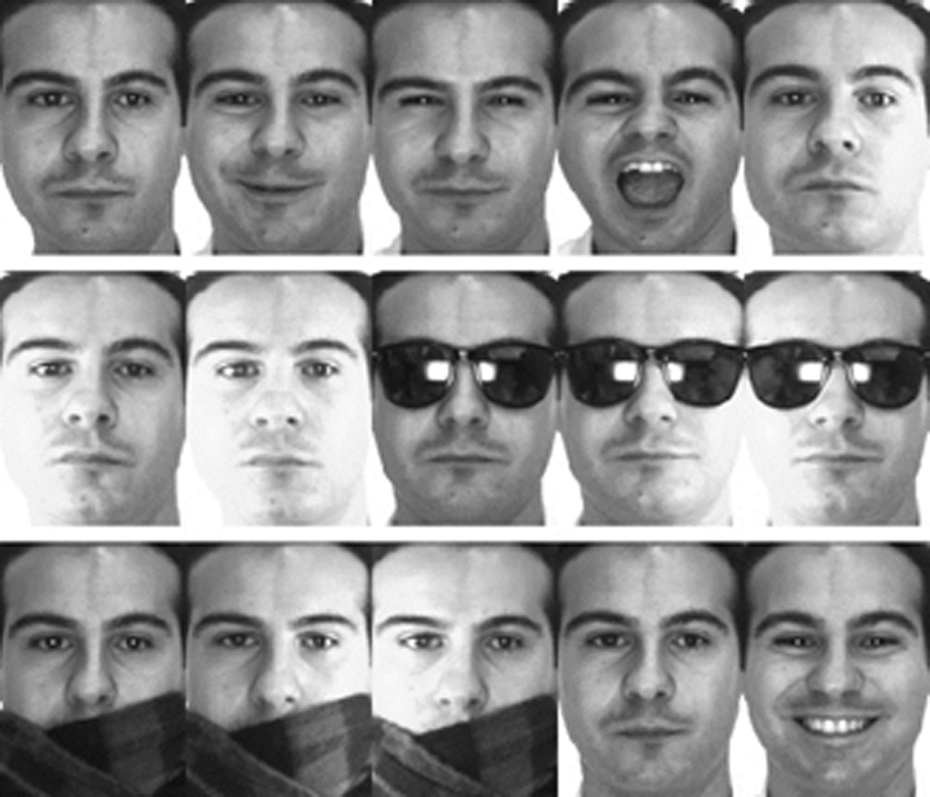
Samples from the AR database.
In our experiment, we chose 2600 images from 50 males and 50 females. For each person, there are 26 samples; we chose 20 samples for training and the other 6 samples for testing. First, we used PCA algorithm to reduce the character vector dimension from
Face recognition rate and time for classifying one test sample of different methods using AR visible database.

SRC: sparse representation–based classification; CRC: collaborative representation–based classification; D-KSVD: discriminative-KSVD; DCRC: discriminative collaborative representation–based classification.
The results show that the recognition rates of the four methods decreased in different degrees compared with the near-infrared results. The recognition rate of DCRC performs better than that of SRC, CRC, and D-KSVD. The occurrence of such results may be the interfering with noise. The D-KSVD and DCRC methods have the discriminative ability, while the SRC and CRC methods focus on representation of raw signals. Our method is robust for face recognition. The proposed method is the fastest one of the three methods.
Conclusions
A fast discriminative CR image classification method DCRC was proposed in this article. It incorporated the within-class scatter and the linear classification error terms into the objective function, so the method had the discriminative ability for classification. In order to decrease the computing time, we added CR mechanism to the objective function. The experimental results showed that DCRC had better recognition performance than the other three methods, and it was suitable for multimodal image (infrared or visible) classification. The calculating speed of our method was improved a lot.
Footnotes
Declaration of conflicting interests
The author(s) declared no potential conflicts of interest with respect to the research, authorship, and/or publication of this article.
Funding
The author(s) disclosed receipt of the following financial support for the research, authorship, and/or publication of this article: This work was supported in part by the National Natural Science Foundation of China (grant no 61403398).