




Abstract
Academic literature has mostly discussed digital skills concerning end-users’ capability to access and use single technologies. Against this background, the paper sheds light on a missing element: the digital literacy of those who frame ICT-mediated policies that pursue sustainable development. The paper offers a novel conceptualization of digital skills as the capabilities to understand the socio-technical assemblages that emerge in social contexts after the adoption of ICT-mediated policies. Exploring the case study of the United Kingdom’s Government Digital Service, the paper argues that empowering public administrators and civil servants with these digital skills is paramount to design, implement, and manage ICT-mediated policies that aim to achieve Sustainable Development Goals.
Introduction
The primary purpose of the United Nations’ Sustainable Development Goals (SDGs) is to advocate for an inclusive and comprehensive approach to overcoming the multifaceted nature of sustainable development (United Nations, 2015; 2022). Sustainable development is defined as “development that meets the needs of the present without compromising the ability of future generations to meet their own needs” (United Nations, 2022). The SDGs provide a framework that unifies various actors’ efforts to stimulate “inclusive and equitable economic growth, creating greater opportunities for all, reducing inequalities, raising basic standards of living” (United Nations, 2022). To achieve this, governments worldwide have adopted Information and Communication Technologies (ICTs) as pivotal instruments for enabling policies and strategies that address sustainable development (Medaglia et al., 2021; Misuraca et al., 2021). However, a prerequisite for harnessing the potential of ICTs for achieving SDGs is the possession of digital skills (O’Sullivan et al., 2021).
Digital skills can serve as potent facilitators of the SDGs. The capability to effectively utilize digital tools can expedite progress across various domains. For example, digital skills can provide access to information about markets, weather conditions, and farming methods. This information can boost farmers’ productivity and income. Consequently, it contributes to poverty alleviation and food security (Chandra & Collis, 2021) (SDG 1 – No Poverty, and SDG 2 – Zero Hunger). Digital skills can also enable the use of digital health technologies for monitoring and managing health, accessing health information, and making use of telemedicine services, thus contributing to better health and well-being (Asi & Williams, 2018) (SDG 3 – Good Health and Well-being).
In today’s digital age, digital skills are crucial for both students and teachers. They can enhance access to high-quality online educational resources, facilitate distance learning, and help develop essential competencies (Keeley & Little, 2017) (SDG 4 – Quality Education). Digital skills can empower women by opening up opportunities for education, employment, and entrepreneurship (World Bank Group, 2016) (SDG 5 – Gender Equality). They can also enable individuals to participate in the digital economy, fostering innovation and driving economic growth (Baller et al., 2016) (SDG 8 – Decent Work and Economic and Growth, and SDG 9 – Industry, Innovation, and Infrastructure). They can provide access to information and data necessary for understanding, monitoring, and mitigating climate change (Dwivedi et al., 2022) (SDG 13 – Climate Action). Lastly, they can facilitate communication and collaboration among various stakeholders, fostering partnerships for achieving the SDGs (Oliveira-Duarte et al., 2021) (SDG 17 – Partnerships for the Goals).
To achieve sustainable development for society, which intersects with the SDGs, it is essential to formulate policies that encourage the development of pertinent digital skills (Hidalgo et al., 2020). Literature on education and training (Tyagi et al., 2020) and sustainability (Muñoz-La Rivera et al., 2020) explicitly emphasize the importance of policies that enhance citizens’ digital skills to meet the objectives of sustainable development. Research in this field has focused on the adoption of specific educational programs to enhance digital skills (Falloon, 2020) and on the integration of citizens’ digital skills into a broader societal context (Eynon, 2021).
However, despite their value, these contributions have primarily focused on the design and implementation of a range of initiatives that encourage citizens to develop skills for using new technologies, i.e. digital skills policies (Eynon, 2021; Helsper & Van Deursen, 2015).
Research in the realm of digital policy design and implementation has frequently neglected a crucial aspect: the development and utilization of digital skills among the individuals responsible for designing, implementing, and managing these policies (Onyango & Ondiek, 2021). Similarly, with very few exceptions (Kruyen & Van Genugten, 2020), research has underplayed the importance of the digital skills of those tasked with designing, implementing, and managing ICT-mediated policies targeting SDGs. A review of digital government literature indicates a noticeable gap in research concerning the influence of public administrators’ and civil servants’ digital competencies on the formation, execution, and governance of ICT-driven policies promoting sustainable development. It’s only in recent times that this body of literature has begun to highlight the importance of the digital skills possessed by the creators of digital services, especially public administrators and civil servants, underlining that these competencies are crucial for the provision of improved public services (Kruyen & Van Genugten, 2020).
Against this background, we argue that understanding the importance of the digital skills of those expected to frame ICT-mediated policies is crucial for designing, implementing, and managing policies that fulfil the needs underlying sustainable development. Neither the SDGs framework nor the specific formulation of SDG 4, which focuses on education (Onyango & Ondiek, 2021), has addressed the significance of developing digital skills for those responsible for designing ICT-mediated policies to better support sustainable development. The paper aims to fill this gap by shedding light on the relevance of the digital skills of those in charge of designing, implementing, and managing ICT-mediated policies that address sustainable development.
The research question of this paper is:
What are the digital skills that civil servants and public administrators should possess to influence the design of effective ICT-mediated policies, to better promote sustainable development?
The paper offers several contributions. Firstly, it highlights a gap in the academic literature, which currently includes limited studies focusing on the relationship between public administrators’ and civil servants’ digital skills and the design of ICT-mediated policies to achieve sustainable development. By doing so, we call upon digital government scholars to renew their attention on the public administrators’ and civil servants’ digital literacy, its evolution, and its conceptualization.
Secondly, the paper aligns with existing calls for a more nuanced and profound understanding of the interconnections between digital government and the SDGs framework (Clark et al., 2022; Medaglia et al., 2021). Given the escalating significance of digitalization as an instrumental resource in fulfilling the objectives of the SDGs, it is untenable for public administrators and civil servants to exhibit deficient digital literacy (OECD, 2017). Adequate digital skills among public administrators and civil servants are essential to harness the numerous opportunities provided by ICTs for sustainable development. Furthermore, digital skills are necessary for gaining a thorough understanding of the potential of ICTs as powerful drivers to avoid a siloed and fragmented approach to sustainable development, resonating with the ethos of the United Nations as encapsulated in the SDGs initiative (O’Sullivan et al., 2021).
Thirdly, the paper offers practical implications to public administrators and civil servants. It highlights that the efficiency of ICT-mediated policies in achieving sustainable development is contingent upon the digital skills of those entrusted with their design, implementation, and management. These competencies are imperative to comprehensively understand the interplay and congruence of technological, institutional, organizational, social, cultural, and legal frameworks within the specific socio-economic milieu addressed by the policy. This holistic understanding facilitates the creation of synergistic policies that are robust, adaptable, and aligned with the multifaceted dimensions of sustainable development.
The paper is organized into several sections. Section 2 explores the literature to examine how scholars have discussed the imbrication between SDGs and digital skills for achieving sustainable development. Section 3 illustrates that the literature has inadequately discussed the relevance of the digital skills of public administrators and civil servants responsible for designing, implementing, and managing ICT-mediated policies that target sustainable development. Section 4 argues that addressing challenges related to the SDGs agenda requires a more structured and nuanced framing of digital skills to capture the various mechanisms that shape societal contexts. Accordingly, we conceptualise the context of ICT-mediated policies for sustainable development as a socio-technical assemblage (DeLanda, 2006; Deleuze & Guattari, 1988; Lanzara, 2009). Section 5 explains and motivates the methodological choices made in the paper. Section 6 presents the case study of UK Government Digital Service which is exemplary in highlighting how considering the socio-technical entanglement of ICT-mediated policies can lead to the effective empowerment of public administrators’ and civil servants’ digital skills development. This empowerment is a precondition for the deployment of effective ICT-mediated policies to achieve SDGs. Section 7 provides analytical discussion, while section 8 offers conclusions and outlines relevant implications for civil servants and public administrators.
Digital skills and SDGs literature review
The academic literature discussing digital skills in the light of socio-economic development can be roughly divided into three episodes (see Table 1). In the late 1990s and early 2000s, the concept of digital skills centred on the belief that access to Information and Communication Technologies (ICTs) presented opportunities for fostering economic growth. Initial studies emphasized the challenges associated with accessing technological devices and internet infrastructure (DiMaggio et al., 2004; Eastin & LaRose, 2000). Consequently, the literature mainly focused on strategies to enhance access to ICTs to meet citizens’ social and economic needs (Acemoglu, 2012; Warschauer, 2004). Despite ongoing challenges in accessing ICTs globally, research in the 2000s posited that merely providing devices and internet access is insufficient for fostering socio-economic development (Straubhaar et al., 2021). Shifting the focus from access to access and use of technology (Gonzales, 2016; van Dijk, 2005), scholars directed their research towards the growing number of public policies aimed at improving the digital skills of potential users. The new policy initiatives should extend beyond merely facilitating access to technologies; they must also encompass the cultivation of skills required to adeptly utilize these technologies. The widespread propagation of requisite digital skills is pivotal, enabling citizens, commercial entities, and society at large to fully exploit the advantages presented by services and opportunities driven by (Ebbers et al., 2016; van Laar et al., 2020). In this context, digital skills refer to the ability to operate different functions offered by the chosen technology.
Digital Skills literature focus over time
Digital Skills literature focus over time
More recently, research highlighted that possessing digital skills for using technology is not enough to overcome socio-economic inequalities (Van Deursen & Helsper, 2018; van Laar et al., 2020). If citizens are not adequately equipped to understand and process the information they access or cannot relate that information to relevant aspects of everyday life (Van Deursen & Van Dijk, 2014), using technology does not enable citizens to meet their needs and, consequently, achieve sustainable development. Therefore, the latest episode in the literature concludes that the ability to use technology to achieve specific outcomes is what is needed to support sustainable development. Accordingly, digital skills policies should shift their focus to help users make more valuable use of technologies to fulfil their needs (Livingstone et al., 2021).
This third stream of research examines what happens when users have access to and the ability to use ICTs. Ultimately, digital skills should empower users to generate tangible social outcomes through their access to and use of ICTs. To achieve tangible outcomes, users should be able to understand, contextualise, and adapt what these technologies offer to meet their contextual and contingent needs.
The release of the UN’s SDGs framework has sparked renewed attention to the relevance of digital skills in pursuing sustainable development. Scholars have echoed the evolution of the digital skills debate, advocating for a more nuanced approach to digital skills towards the achievement of SDGs purposes (Radovanović et al., 2020). Access to and access-and-use of technology are still considered paramount, particularly in developing countries (Sparviero & Ragnedda, 2021), however, scholars have increasingly focused on the digital skills required to connect the outcomes of technology with the fulfilment of the needs to achieve sustainable development (O’Sullivan et al., 2021). For instance, recent works have emphasized the necessity of investing in the digital skills needed by citizens to understand the outcomes produced by the use of technology to tackle societal issues and avoid growing inequalities in governance, citizenship, entrepreneurship, and smart-city development (Skill et al., 2020). The impact of better and more effective technology access and use has been benchmarked against the SDGs in general, or against a specific SDG within the UN framework (Sparviero & Ragnedda, 2021). For instance, digital government scholars have explored how the diffusion of digital skills among citizens can enhance both access (Soni & Mitchell, 2022) and consumption (Macaya et al., 2021; Van de Walle et al., 2018) of public services to produce inclusive and sustainable growth (Rodriguez-Hevía et al., 2020). Empowering citizens with specific digital literacy can generate beneficial effects towards the direct or indirect achievement of SDGs. This recent string of research primarily focuses on transferring the necessary skills to end-users, enabling them to overcome obstacles to sustainable development.
The literature often insufficiently addresses the critical role that the digital competencies of public administrators and civil servants play in designing, implementing, and managing policies mediated by ICTs, which are aimed at fostering sustainable development. The lack of digital skills among public administrators and civil servants has been identified as a problem that needs to be overcome to design, implement, and manage policies that are more effective in exploiting the potential of ICTs (OECD, 2017). For instance, recent assessments have revealed that the European Union’s public sector currently faces a shortage of 1.7 million employees with adequate digital skills (Chinn et al., 2020). In recent years, academics have increasingly focused on the digital skills that public administrators and civil servants must possess to be effective in formulating and implementing ICT-mediated policies (Ogonek et al., 2016; van Ooijen et al., 2019). Specifically, the awareness of ICT among public administrators and civil servants is considered essential in the process of drafting policies that are capable of achieving the expected SDG targets (Onyango & Ondiek, 2021). This renewed interest in public administrators’ and civil servants’ digital skills underscores the need to recognize the growing importance of digital transformation in achieving sustainable development. Hence, it is required that those who design, implement, and manage ICT-mediated policies possess the relevant competencies required to make these policies effective.
In alignment with the propositions of the UN SDGs, scholars advocate for a more comprehensive approach to enhance the digital skills of public administrators and civil servants (Kyriakopoulou et al., 2021). This new approach builds on the understanding that public administrators and civil servants should acquire digital skills regardless of their roles, seniority, or department affiliations to design, implement, and manage ICT-mediated policies effective to support sustainable development (van Ooijen et al., 2019). This approach steps away from traditional public sector strategies that pursue a more functional and sectorial digital empowerment of public administrators and civil servants. Examples of traditional strategies include outsourcing (Dickinson & Yates, 2021), hiring digital specialists (Wilson & Mergel, 2022), and establishing digital teams or units (Clarke, 2020).
While these efforts are indeed valuable, they often fail to appreciate the complexity of the relationship between digital skills and the multiple challenges faced by public administrators and civil servants in the pursuit of sustainable development. It is essential to detach public administrators’ and civil servants’ digital skills from individual technologies, functions, or policy purposes. Digital skills are encompassed within a broader perspective that connects technological literacy with many other dimensions that concur shaping the value the use of technology generates towards the sustainable development goals.
To design, implement, and manage ICT-mediated policies requires the need for a different set of digital skills to tackle sustainable development issues (Eynon, 2021). These digital skills aim to equip civil servants and public administrators with the necessary tools to design, implement, and manage ICT-mediated policies that produce beneficial outcomes meeting people’s needs (Livingstone et al., 2021; Van Deursen & Helsper, 2018). However, this emphasis on how the outcomes of digital skills policies targeting civil servants and public administrators impact sustainable development alters the needed digital skills public administrators and civil servants must possess. The success of ICT-mediated policies that seek to deliver beneficial outcomes for people and society necessitates the evaluation of both users’ online engagement and the tangible outcomes of this engagement (Helsper et al., 2015). Specific digital skills are required for two key purposes: 1) designing, implementing, and managing effective ICT-mediate policies that address citizens’ engagements to support sustainable development, and 2) evaluating these engagements. To yield tangible outcomes, these policies should always be designed, implemented, and managed looking at the context within which they are deployed, linking the policies to skills and types of engagement already present in society (Helsper et al., 2015). Figure 1 below summarises this argument.
Visualisation of the interaction between public administrators’ and civil servants’ digital skills and digital skills policies that target citizens to sustain SDG outcomes.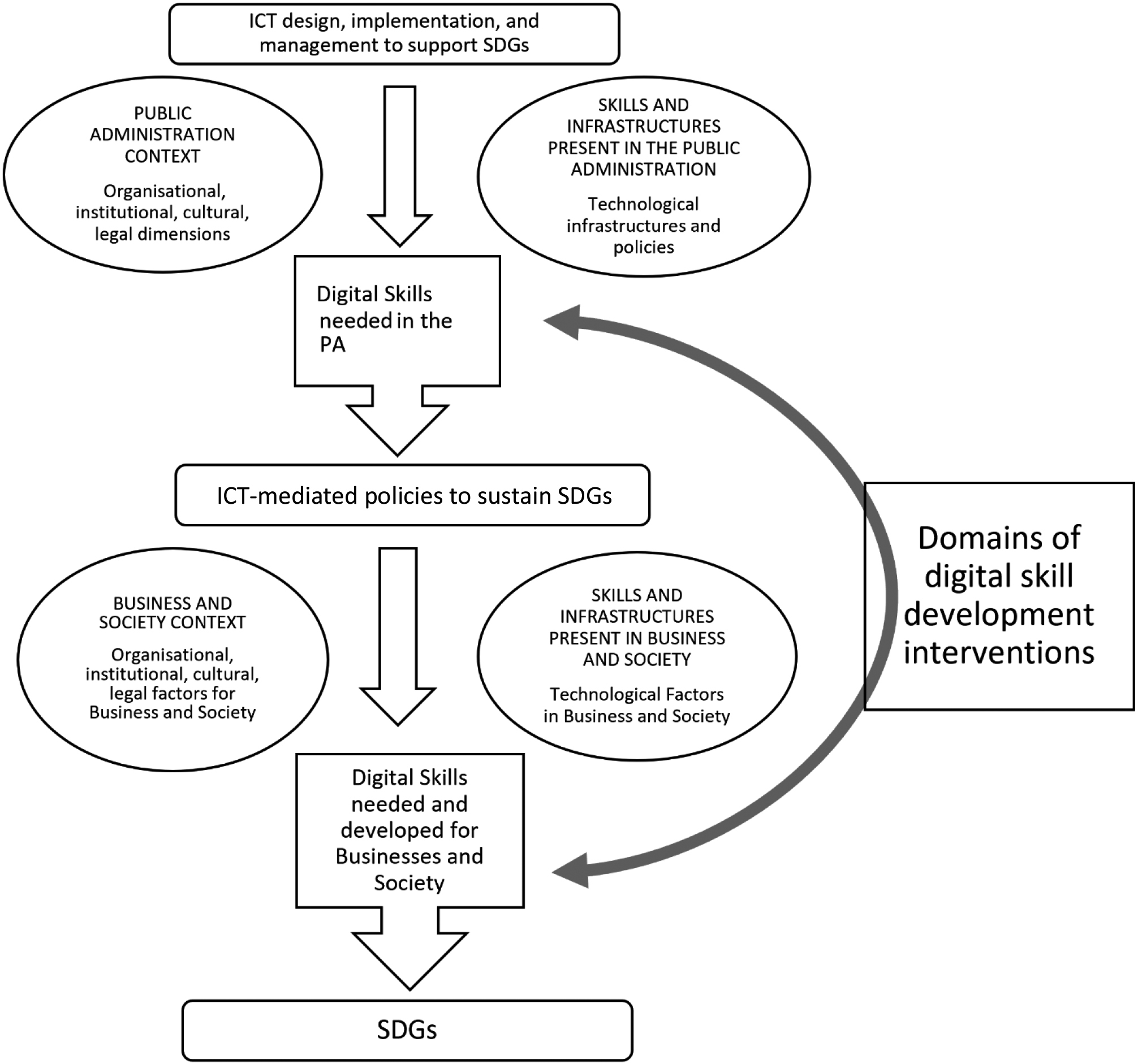
To understand the technological, as well as social, institutional, cultural, and legal dimensions of ICT-mediated policies that support SDG outcomes, it is crucial to comprehend the modular and cross-sectorial impact of the policies.
This paper explores the connection between the digital competencies of public administrators and civil servants and the broader socio-technical landscape. Rather than concentrating on isolated technological artifacts, it emphasizes the role of these skills in shaping, executing, and overseeing socio-technical dynamics. These dynamics are shaped by socio-technical systems that are interlinked and evolve through various interactions between technology and its application in different contexts. The focus is on how public administrators and civil servants utilize their digital skills to design, implement, and manage policies mediated by information and communication technologies (ICT) within these fluid socio-technical frameworks, moving beyond a narrow focus on specific technologies or isolated usage scenarios, like infrastructure access or specific software usage. Therefore, understanding the social environments where these policies operate becomes critically important (Helsper et al., 2015; Livingstone et al., 2021).
ICTs can effectively aid in achieving Sustainable Development Goals (SDGs) when policies are designed to capitalize on the capabilities of ICTs, producing concrete results that meet sustainable development needs. Creating policies that utilize ICTs to support SDGs demands a deep understanding of the intricate factors that influence the tangible outcomes derived from using ICTs. To grasp the complexity of digitally mediated interactions and the diverse ways ICTs bring about real-world benefits for users, we employ the theoretical perspective offered by assemblage theory (DeLanda, 2006; Deleuze & Guattari, 1988; Lanzara, 2009). Assemblages theory emphasizes the interconnected nature of ICTs with institutional, organizational, social, cultural, and legal dimensions. These connections ultimately determine the circumstances under which ICTs create value. This theory provides insights into the complex nature of these relationships associated with digital technologies’ usage and adoption. It also elucidates the mechanisms through which these transformations foster value creation, enabling users to satisfy their needs.
Comprehending the architecture of these interrelationships is crucial for elucidating the intricate nexus that delineates the mechanisms and processes through which digital technologies support sustainable development. These interrelationships materialize during the implementation of digital technologies within organizational or societal frameworks. The implementation trajectory is characterized by the normalization of pre-established processes and protocols inherent in the digital infrastructure. This standardization induces alterations in the structured normative, legal, organizational, institutional, and cultural frameworks, as well as in the prevailing dynamics that govern the unfolding of organizational or societal processes.
Assemblage theory comprehensively explicates the way ICT-mediated policies intertwine with pre-existing components within their deployment contexts, encompassing institutions, organizations, socio-cultural dimensions, legal frameworks, norms, and extant technologies. The application of technology within a social context results in its intricate entanglement with the social context established elements. The ramifications of these entanglements not only mould the contextual landscape of technology usage but also critically influence the utility and value that the technology imparts to its users. Assemblage theory unravels these interrelations, illuminating the underlying mechanisms and processes through which ICT-mediated policies efficaciously contribute to the attainment of sustainable development objectives. ICT-mediated policies are never deployed in isolation, it is through negotiation that ICT-mediated policies either align with or conflict with existing regulatory elements. Scholarly research indicates that the underlying dynamics of this negotiation transcend mere integration or juxtaposition (Lanzara, 2009). These dynamics manifest as socio-technical entanglement, involving a plethora of regulatory elements that, even in the midst of negotiation, maintain certain unique characteristics (Deleuze & Guattari, 1988). The interaction between ICT-mediated policies and other contextual determinants culminates in the formation of assemblages. A principal characteristic of these assemblages is their relational essence: their existence and functionality are contingent upon the interrelations that define them, suggesting a state of perpetual flux in their configurations (DeLanda, 2006).
The value generated by ICT-mediated policies to support SDGs is shaped against the context of technology use and the anticipated and unanticipated outcomes that arise in dynamic sociotechnical negotiations. To gain a nuanced understanding of how ICT-mediated policies unfold in organizational and societal environments, and how they reshape interactions and practices that produce tangible outcomes, it is essential to dissect these socio-technical negotiations (Gualdi & Cordella, 2022). ICT-mediated policies enhance value creation in relation to key elements of the adoption context, encompassing organizations, institutions, laws, norms, and cultural aspects. In supporting SDGs, these policies do not evolve in opposition to, nor remain aloof from, these contextual elements. Rather, they become intricately interwoven with the existing components, thereby forming assemblages that are notable for their loosely organized structure (Hanseth & Lyytinen, 2010).
Thus, the way these assemblages manifest and create tangible value for ICT users is pivotal in gauging the efficacy of ICT-mediated policies in meeting user needs and, consequently, in realizing SDGs. Employing the theoretical framework of assemblage theory, this paper conducts a thorough analysis of the multifaceted dimensions that influence the formulation, execution, and administration of ICT-mediated policies that proficiently underpin SDGs.
Methodology
In this section, a detailed justification for the chosen research design is presented. Our argument is underpinned by the qualitative case study research methodology, as conceptualized by Yin (2018) which serves as the structural basis for our study. The case study method is particularly apt for exploring phenomena within their real-life contexts (Baxter & Jack, 2012). Specifically, our study adopts an explanatory case study approach (Yin, 2018) to elucidate the evolution of certain phenomena that are beyond our influence, as they pertain to historical events (Yin, 2018). Aligning with this method, our research inquiry was developed after an extensive review of extant scholarly literature, which not only helped in pinpointing lacunae in existing knowledge (Yin, 2018) but also in formulating theoretical propositions. The literature review also enabled us to propose some theoretical propositions. We selected the case of the UK’s Government Digital Service (GDS) because it represents an example of a successful public initiative aimed at reframing digital skills policies to accommodate public administrators’ and civil servants’ competencies in designing, implementing, and managing ICT-mediated policies to meet users’ needs. The GDS experience is recognized as one of the most effective initiatives in addressing digital transformation (Klein, 2013), which enabled the UK to be ranked as the leading State for digital government by the UN in 2016 (United Nations, 2016). The GDS has had a unique impact on the UK’s digital transition, laying the foundation for the country’s achievements in several domains, including sustainable development. In 2018, the UK was ranked as the second-best performer overall in the ICT Sustainable Development Goals Benchmark, based on its accomplishments in ICT development and its progress towards sustainable development (Huawei, 2018).
Data collection for this study primarily relies on secondary sources, including (a) official reports and assessments created for and by the UK Government; (b) regulations and guidance enacted by the UK Government related to GDS; (c) sources such as Ministerial documents and technological specifications; and (d) assessments, evaluations, and policy documents prepared by committees and independent bodies. These sources provide a comprehensive foundation for our analysis and allow for triangulation
Case study: UK’s Government Digital Service (GDS)
Digital technologies have played a significant role in the UK’s high ranking in achieving the SDGs (Cabinet Office, 2021), and the GDS directly relates to several SDGs. The significance of achieving the SDGs is a primary objective for the UK government. The role of technology, specifically digital government, is crucial in driving progress towards these goals. However, it is acknowledged that the government alone cannot achieve these objectives. Both citizens and civil servants play essential roles in this endeavour. As stated by the UK government, “Central to our new strategy is the role of the responsible digital citizens. All government employees have a role to play, not just those of us charged with the delivery and adoption of digital services” (Department for Environment, 2020).
To establish a comprehensive framework that aligns ICT-mediated policies efforts with the SDGs, the UK government has implemented a new system in which the GDS assumes a key role. The GDS’s involvement in the Technology and Digital Leader Network, along with its responsibility for drafting the Technology Code of Practice guidance, highlights its pivotal position in integrating sustainability principles into government technology initiatives (Dunne & Jenkins, 2021).
With the launch of the GDS, the UK has made extensive investments in digital technologies within its public sector. The shift to ICT-mediated policies has not only made services more accessible and efficient but has also improved transparency, promoting SDG 16 (Peace, Justice, and Strong Institutions). The GDS has provided the necessary skills to integrate digital tools into its education system, promoting lifelong learning opportunities, thus contributing to SDG 4 (Quality Education). The GDS has also supported skills development for planning and implementing digital technologies such as telemedicine, electronic health records, and digital health apps, enhancing the efficiency and reach of the UK’s healthcare sector. This has significantly aided in achieving SDG 3 (Good Health and Well-Being). The GDS plays a crucial role in the Greening Government Commitments project, particularly through its involvement in the “Technology and Digital Leader Network”. This network, chaired by civil servants from the GDS, is responsible for examining and approving reports and strategies that contribute to the achievement of SDG 7 (Affordable and Clean Energy) and SDG 13 (Climate Action). Lastly, the GDS has introduced the digital inclusion scale measuring digital capability – as part of the government’s Digital Transformation Programme and the Digital Inclusion Strategy. The scale has helped reducing inequalities (SDG 10) and fostered economic growth (SDG 8).
GDS: The Government Digital Service in the UK
The GDS was established in the UK in 2011 in response to the increasing costs of ICT within the government and to enhance the effectiveness of government digital policies in supporting socio-economic development. As the former Minister for the Cabinet Office, Lord Francis Maud, stated in the foreword of the Civil Service Reform Plan: “Central Government where possible must become a digital organisation” (Cabinet Office, 2012). The UK government appointed Martha Lane Fox, a leading digital entrepreneur and co-founder of Lastminute.com, to analyze the challenges within the government’s digital strategy. She was also tasked with identifying possible solutions to improve the effectiveness of ICTs usage, making service provision easier and more efficient to meet the needs of citizens and businesses. Martha Lane Fox’s strategic review (2010) provided a set of recommendations that became the core foundations for the UK’s GDS strategy and development (Cabinet Office, 2012; Fox, 2010). Fox recommended reforms to the government’s overall approach and strategy for ICT-mediated policies. The reforms should put users’ needs, expectations, and skills at the center stage. User-centric logic became the key pillar for reorganizing the British ICT-mediated policies. For example, Fox recommended the establishment of “a new central team in Cabinet Office in absolute control of the overall user experience across all digital channels, commissioning all government online information from other departments”. She also suggested the appointment of “a new CEO for Digital in the Cabinet Office with absolute authority over the user experience across all government online services (websites and APIs)”.
GDS driving rationale
Building on the user-centric logic recommended in Fox’s report (Fox, 2010), the GDS was established under the leadership of Cabinet Office Minister, Lord Francis Maude in 2011. The overarching goal of the GDS was to ensure that services “are designed around the needs of the users rather than, as has far too often been the case, designed to suit the convenience of the Government” (House of Commons, 2013).
The focus on users’ needs, expectations, and skills, was the foundational principle upon which the UK government implemented GDS authority, structure, and key activities (Cabinet Office, 2012). The GDS decided to shift its focus towards harnessing existing digital skills in society, aiming to design ICT-mediated policies that align with the SDGs, rather than creating new digital skills. Digital skills of the users of the digital services became a resource to provide more valuable services, rather than a missing resource to be developed. Yet, to effectively focus on users, the UK government designed GDS to leverage the best organizational and personal skills within the public administration to identify users’ needs and design services effective to fulfil these needs (Cabinet Office, 2012). The approach and architecture at the core of the GDS consider the digital skills available within the public administration as a fundamental asset to properly understand which digital government solutions align better with users’ needs, expectations, and skills (Cabinet Office, 2016). The GDS did not expect users to acquire specific digital literacy to exploit digital services. On the contrary, GDS digital services were built by leveraging the competencies and technologies that were already widespread in society. Services that better align with users’ needs, expectations, and skills could produce more tangible outcomes for the users and better fulfil the goals they aim to achieve (Foreshew-Cain, 2016).
To achieve these goals, the GDS directs its activities and executes its tasks based on two key principles. On the one hand, the GDS develops public administrators’ and civil servants’ digital skills necessary to understand users’ needs, expectations, and skills. On the other hand, the GDS focuses on enhancing the provision of digital services across central and local public administrations by adopting a user-centric logic. A user-centric logic identifies users’ digital skills to design services that leverage existing skills to meet the needs of the present without compromising the ability of future generations to meet their own needs. The combination of the two dimensions is a unique characteristic of the GDS, which has allowed the UK government to design and deliver ICT-mediated policies in constant alignment with internal capabilities and users’ needs. This approach has proven highly effective in producing valuable outcomes for the users of ICT-mediated policies. As one former executive director of the GDS explained, the mission of the GDS is “To apply the culture, practices, processes, and technologies of digital era. To understand what they are, how they work, and how to put them to use to meet user needs” (Foreshew-Cain, 2016).
Enhancing digital skills within public administration: The Digital Academy
The GDS focuses on developing the digital skills required by public administrators and civil servants to design ICT-mediated policies that fulfill citizens’ expectations and needs (Cabinet Office, 2016). The GDS has not molded its strategy on teaching citizens how to use provided services. Instead, to identify the users of the services and their needs, the GDS recommends to (Government.Uk, 2017):
Identify who the likely users are and what they’re trying to accomplish. Analyze how they currently do it (for example, what services or channels they use). Identify the problems or frustrations they experience. Identify what users need from any service to achieve their goals.
To collect the right information, the GDS recommends those involved in this discovery phase to:
Review existing evidence of citizens’ use of the services. Interview and observe actual users of the services and potential users to identify their needs, expectations, and experiences in the use of the service. Talk to people who work with the actual or potential users of the service to better understand their needs, expectations, and experiences. Consider opinions or suggestions that do not come from users (e.g., caseworkers, call center agents, and charity workers) as assumptions that have to be proven by doing research with actual users.
The GDS’ approach places citizens at the center of the design and development process of ICT-mediated policies, with citizens’ skills considered as a key resource for the development of effective digital solutions.
With this setup, the GDS’ ICT-mediated policy design approach is path-dependent on users’ skills. The design leverages the skills available in society and how ICT-mediated policies are used by people to support their needs. The GDS’ focus on developing digital skills within the public administration and civil servants has built the skills they need to design and deliver ICT-mediated policies that produce tangible outcomes for the users. To achieve this result, the GDS has launched the Digital Academy program: a “project from the ground up to help people working in digital better understand how the UK government is working in new ways to build services for its users” (Sweeney, 2017).
The Digital Academy develops curricula to support the skills needed to transform public services by designing ICT-mediated policies that fully exploit the potential offered by digital technologies. The Digital Academy is not organized as a central hub for public sector training. To reach as many public administrations as possible, the academy has locations in four major UK cities: London, Leeds, Manchester, and Newcastle. What makes the GDS approach unique is that the focus of the training programs is not simply on teaching public administrators and civil servants to master the use of specific technologies but rather on how to plan and design digital technologies that align and complement users’ skills to help them better exploit the opportunities offered by digital technologies. Users, as well as technology, are at the center of the value generation propositions that drive the digital skills strategy at the core of the GDS initiative.
GDS service provision
To achieve the goals of designing services that fulfil users’ needs, the GDS embraced the user-centric logic since its foundation. The GDS recommends designing services that exploit technologies already available in society and hence utilized by businesses and citizens. The services provided by the GDS are either deployed to directly reach end-users, as in the cases of “Find a job” or “PAYE – pay as you earn”, or to create shared standards upon which different public agencies and bodies can design their own services to reach end-users, such as the GOV.UK design system. Common standards reduce the variety of digital skills users need to effectively benefit from the numerous services offered. In Table 2, we have listed the GDS clusters of intervention and related most relevant services as of 2023.
GDS Clusters of Interventions
GDS Clusters of Interventions
These initiatives complement each other to leverage the digital skills already present in organizations and society to offer services that produce social tangible outcomes. The user-centric logic is reinforced through the design, implementation, and management of specific services that, instead of imposing top-down solutions, complement what is already in use in society and the business context. Clearly, the GDS embraces the concept of digital skills not to provide access or to teach how to use specific technologies but to empower users to generate tangible social outcomes through the access and use of ICTs.
One digital service that illustrates well how the user-centric logic has been applied to the design, implementation, and management of an ICT-mediated policy crucial for achieving the SDGs is the digital ID solution provided by the Verify platform. Indeed, a robust digital ID that provides universal access to identification is a fundamental goal of SDG Target 16.9 (Dahan & Gelb, 2015). This target aims to “provide legal identity for all, including birth registration indicator” (World Bank Group, 2016, p. 194). While this target does not specifically mention a digital identity, scholars and experts have recognized the use of digital technologies as a key strategy in achieving this target. A digital ID can be viewed as a modern, efficient means of providing legal identity to all. Digital ID systems can also contribute to the achievement of other SDGs. For instance, they can promote financial inclusion (SDG 1), help provide quality education (SDG 4), enable decent work and economic growth (SDG 8), and support partnerships for the goals (SDG 17).
To address these needs, Verify was launched by GDS in 2014 (Government Digital Service, 2015) The purpose of Verify was to facilitate users’ identification for the consumption of digital services. To meet users’ needs and capabilities, the design and implementation of the Verify service had to acknowledge the specificity of the legal and institutional context in which it operates. In the UK, there is no single means of identification and hence no institutional infrastructure for the provision of a digital identity (Medaglia et al., 2022; Whitley & Hosein, 2008). To successfully deploy an ICT-mediated policy that does not depend on digital identity, unique institutional, legal, and technological solutions had to be deployed to enable the provision of digital services. The solution adopted by the GDS diverges from other successful cases, such as those in Estonia, India, Singapore, and the Scandinavian countries, which built the entire government digital infrastructure around a unique digital personal identity (Mergel et al., 2018). The GDS created a solution that could offer a unique digital ID to users, filling the gap left by the absence of a national ID. The Verify program leveraged resources and competencies already available in business and society. The digital ID is built using information retained by private sector organizations, in partnership with other private and public organizations which process and verify the available information to certify the user’s identity (Brown et al., 2017). Users who access Verify can select different third-party companies to confirm their identity before accessing GDS digital services. The evidence users provide about their identity (credit cards, subscriptions, bills) is then benchmarked with the data held by certified third-party companies (examples of providers include private businesses like Post Office, Verizon, Experian, Digidentity, and Mydex CIC). Those companies produce identity verification leveraging on the datasets they own. If the user’s identity is verified, the user can proceed to access the services they need.
Verify avoided the imposition of a new digital infrastructure that would have conflicted with the country’s institutional, legal, and cultural values, which precluded the deployment of a government-controlled ID system. Instead, the GDS pursued a solution that leveraged the digital tools and information already in use in society – and therefore familiar to citizens and business actors. In other words, the GDS exploited what was already available to coordinate the execution of the necessary tasks to verify users’ identity.
Through the Digital Academy, the GDS empowered civil servants and public administrators with the necessary digital skills to design ICT-mediated policies that utilize Verify (Government Digital Service, 2022). Where possible, standardizing user identification across multiple digital services facilitated the use of these services by citizens, thereby enhancing the value produced by these services.
Citizens have been at the center of the GDS strategy, being the ultimate target of every GDS service delivery. Citizens are considered a fundamental resource for framing the design and delivery of ICT-mediate policies (Education Department, 2018). The development of specific skills within the government and the public administration is also identified as a fundamental resource needed to design the service architecture necessary to focus on citizens’ needs, expectations, and capabilities as the central point of reference.
The approach adopted by the GDS, as illustrated in the Verify case, demonstrates how the public sector can restructure its organization and the design, implementation, and management of ICT-mediated policies. This restructuring enables the effective exploitation of the widespread diffusion of technologies in society to better meet citizens’ needs, thereby achieving SDGs targets more effectively (Livingstone et al., 2021). The delivery of digital services that can be accessed and used by a broad spectrum of users is crucial for inclusive socio-economic growth, in alignment with the sustainable development framework.
The GDS has adhered to two main principles: an internal focus on enhancing the digital skills of public administrators and civil servants, and an external emphasis on users’ needs and skills. Both principles enabled the GDS to (a) design and deliver effective ICT-mediated policies that support users’ needs, thereby contributing to sustainable development, and (b) equip public administrators and civil servants with the necessary digital skills to design, implement, and manage ICT-mediated policies. These policies can leverage existing user digital skills and the complex interplay of social, technological, organizational, institutional, and legal contextual factors. By adopting a user-centric design principle, the GDS was able to frame and harness the socio-technical relationships generated by digital technologies within their context of use. These relationships unfolded into what we have described as an assemblage.
GDS: Design, implementation, and management of socio-technical assemblages
The GDS’ approach acknowledges that digital skills affect not only the design, implementation, and management of ICT-mediated policies but also the utilization of technologies by citizens and organizations. This perspective on digital skills, inherently interconnected with societal and organizational dimensions and needs, has significantly influenced the ICT-mediated policies and competencies developed within the GDS. Indeed, the GDS recognizes ICT-mediated policies as an assemblage, acknowledging the interconnected nature of ICTs with institutional, organizational, social, cultural, and legal dimensions. It has never created new services without considering already existing solutions. Moreover, the GDS has never predetermined the technological tools and systems required to achieve expected outcomes.
Instead, through the Digital Academy, the GDS identified the development of digital skills capable of understanding the socio-technical entanglements between technology, users, and organizational, legal, and cultural factors as the primary drivers for designing, implementing, and managing ICT-mediated policies that effectively deliver tangible outcomes for sustainable development. For instance, in the case of Verify, the GDS utilized existing technologies and patterns of use to provide internal and external services effectively. Internal services mainly consisted of standardized offerings upon which public agencies could customize their own services to enhance workflows and task execution. This approach capitalized on a context where each public body or agency had its own functioning technological systems and services, aligned with the agency’s existing norms, culture, and practices.
The GDS chose to provide limited, standardized digital solutions, like Verify, on which agencies could then customize specific tools, programs, and styles. This approach not only prevented the duplication of basic digital solutions and ensured a sufficient level of alignment across different government structures but also guaranteed the delivery of more effective services that could meet the needs of a larger number of users.
The same logic was applied in the design and delivery of digital services used by the public. Successful initiatives such as Verify, or the launch and development of frameworks for platforms and cloud services, were designed to leverage existing digital technologies and the capabilities and skills that users had already developed using these technologies.
The example of Verify demonstrates that the GDS did not introduce digital services that could conflict with the digital capabilities of businesses or citizens that had already been developed around the use of various technologies. The GDS designed, implemented, and managed Verify by (a) building on users’ need for quick and secure identity verification, (b) utilizing data already available in society, such as datasets owned by private actors, (c) aligning users’ needs and skills with available technological outcomes without expecting the diffusion of additional functionalities or literacy, and (d) developing the necessary digital skills among civil servants and public administrators to leverage the services offered by Verify for the design of user-friendly ICT-mediated policies.
Recognizing that the value generated by Verify is determined by the context of its use and dynamically shaped by socio-technical negotiations during the design and application of all the ICT-mediated policies, the GDS capitalized on the development of digital skills. This approach aimed to help stakeholders understand the complex and interdependent relationships among technological, social, organizational, user-based, legal, and cultural factors. In turn, this understanding shaped how Verify supports policies that effectively contribute to sustainable development.
These digital skills are vital for designing ICT-mediated policies that complement existing resources and knowledge, leveraging technology already in use within society. Such policies aim to achieve inclusive and equitable socio-economic growth, leading to the realization of sustainable development goals (Radovanovic et al., 2020; Sparviero and Ragnedda, 2021). To meet these needs, the GDS launched Verify in 2014, which provides a modern and efficient approach to promote financial inclusion (SDG 1), quality education (SDG 4), decent work and economic growth (SDG 8), and partnerships for achieving these goals (SDG 17).
The GDS reinforced this logic by designing and delivering ICT-mediated policies tailored to meet users’ needs and skills. Over the years, the GDS has maintained continuous interaction with users to better understand their knowledge and use of digital technologies. This interaction has enabled the GDS to adjust and refine the digital skills needed to align ICT-mediated policies with users’ expectations and skills regarding digital technologies. These findings are consistent with works that emphasize the relevance of connecting digital skills with users’ needs (Livingstone et al., 2021; O’Sullivan et al., 2021), and account for the specific role of the public sector in fostering this approach.
Civil servants’ and Public Administrators’ digital skills
To achieve the aforementioned outcomes, the GDS has recognized the importance of digital skills for those individuals responsible for the design, implementation, and management of ICT-mediated policies. To navigate the complex socio-technical assemblages that shape the value produced by the use of digital services, the GDS has launched a unique program to empower public administrators and civil servants with the necessary digital skills. In other words, the Digital Academy was established to equip public administrators and civil servants with the digital skills needed to understand the contextual background within which ICT-mediated policies are framed and deployed and to effectively implement these policies so that users can fully benefit from the policy goals.
Through the Digital Academy, the GDS aimed to enhance the digital skills of public administrators and civil servants by creating a “scaffolding” of digital skills. This scaffolding assists these professionals in designing, implementing, and managing ICT-mediated policies that complement and leverage existing digital needs and competencies in society.
For public administrators and civil servants, understanding the dynamics of the socio-technical assemblages that shape the value users generate from digital services is more important than knowing the intricate functionalities of any technological system. This approach aligns with the same principle followed in the design and delivery of ICT-mediated policies. These findings resonate with existing literature (Kyriakopoulou et al., 2021; van Ooijen et al., 2019) that has already accounted for an evolution of digital skills among civil servants and public administrators that is more aligned with users’ needs.
The GDS does not expect end-users to acquire additional or specific digital skills to access and benefit from the provided digital services. Instead, it designs and delivers ICT-mediated policies that align with users’ needs and skills. To this end, the GDS invested in enhancing the digital skills of public administrators and civil servants to understand how to utilize existing socio-technical assemblages in society, making it easier for users to derive value from the offered ICT-mediated policies. The Digital Academy does not focus on teaching how to use digital technologies in a context-agnostic manner.
With this innovative approach, the Digital Academy addresses the need for the continuous training of public administrators and civil servants in the rapidly evolving field of ICT-mediated policies (Kruyen & Van Genugten, 2020). The GDS supports the development of digital skills among these professionals without losing sight of the specific contexts in which ICT-mediated policies are delivered and used. Expanding upon the existing digital government literature on public administrators and civil servants’ digital skills (van Ooijen et al., 2019), we highlight how the GDS has allowed public employees to improve their digital literacy in alignment with specific societal needs, resulting in better-tailored design of ICT-mediated policies that enhance the value generated for users. Encouraging continuous interaction between public administrators, civil servants, and citizens is not only endorsed but openly recommended. After all, the digital literacy of public administrators is most meaningful when it aligns with users’ needs, expectations, and skills (Helsper et al., 2015).
The findings of our paper provide evidence to support the conceptualization of civil servants’ and public administrators’ digital skills as a sociotechnical construct and explain how this can be useful in achieving SDGs goals. However, future research is needed to investigate the nuanced ways in which the public sector enables practices and actions to enhance digital skills. Specifically, we encourage digital government scholars to further examine the relevance of context-specific technological levels, which build on and utilize existing skills within government and society when investigating the design and delivery of ICT-mediated policies that effectively support SDGs. Such an endeavor is timely and relevant to enrich digital government research and provide key implications for public policymakers.
Conclusions
The UN Sustainable Development Goals (SDGs) framework encourages a coherent, inclusive, and cross-cutting application of digital technologies to achieve sustainable development objectives. Academic literature has addressed this aspect, with a focus on designing and implementing policies aimed at equipping citizens with the necessary digital skills
This paper emphasizes the importance of digital skills among public administrators and civil servants for achieving SDGs through the design, implementation, and management of ICTmediated policies. It also highlights the limitations of academic debate concerning the role of these professionals’ digital skills in achieving sustainable development (Kyriakopoulou et al., 2021). The paper argues that the academic discourse overlooks a crucial component of digital skills development: the digital skills of civil servants and public administrators responsible for designing and implementing ICT-mediated policies that generate tangible outcomes to meet citizens’ needs – an essential prerequisite for achieving sustainable development (Onyango and Ondiek, 2021).
The digital competencies and digital literacy of public administrators and civil servants are becoming increasingly important given the multi-sectoral applications of technology advocated by the UN SDGs framework.
To address this issue, the paper proposes a unique conceptualization of digital skills. Instead of the traditional framing, which includes access to and use of technologies, we suggest that digital skills should be more focused on understanding and identifying the various ways digital technologies are adopted within societal contexts (Helsper et al., 2015).
The paper adopts the theory of assemblages to capture the complex phenomena encompassing technological, social, and institutional factors at organizational, institutional, and societal levels. These factors are often highly interdependent and difficult to isolate, making the theory of assemblages a fitting perspective for this exploration.
The GDS case study illustrates the digital skills that public administrators and civil servants should possess to shape the value generated by ICT-mediated policies towards the achievement of SDGs. The GDS’s usercentric approach helps in conceiving the design, implementation and management of ICTmediated policies as complex, multidimensional negotiations involving technological, institutional, organizational, societal, and legal aspects. The effectiveness of such an approach in designing policies that are effective at delivering tangible SGD outcomes is highlighted.
Footnotes
Acknowledgments
This paper is based on ideas and concepts that were developed in the cooperation on “Compendium of frameworks on best practices and regulations on advanced digital skills and digital literacy: Priority issue 2 – Digital Skills and Digital Literacy (KOMINFO, Indonesia)”, commissioned by the International Telecommunication Union (ITU) for Indonesia’s G20 Presidency. We would like to thank Dr. Atsuko Okuda for leading the cooperation with the ITU. We also thank Serdar Türkeli and Fauzan Ansyari (UNU-MERIT) who worked with us on that project.
Authors Bio