




Abstract
Citizen-centricity is a common concept in digital government research and policy. However, there is little clarity regarding the concept in previous literature. To address this shortcoming, and build theoretical foundations for addressing both citizen-centricity and associated phenomena, we have examined how citizen-centricity is characterized in digital government research. This study is based on literature review of 66 journal articles. A combination of narrative analysis and ideal-type methodology identified themes concerning four modes of government, designated traditionalist, service-dominant, participatory, and transformative. Further analysis of associated types and research streams provides an overview of the theoretical understandings of citizen-centricity and methodological approaches applied to explore it in the literature. The findings contribute to contemporary theory on citizens in digital government by outlining an integrative framework of citizen-centricity. The paper concludes with proposals for further research, including efforts to enhance conceptual clarity and develop more dynamic theories.
Introduction
The notion of citizen-centricity is embedded in many, if not most, government policies and agendas on digitalization and digital transformation (Berntzen et al., 2016; European Commission, 2019; Regeringskansliet, 2012). However, theoretical advances regarding the nature of citizen-centricity reported in the digital government literature are sparse. An important complication regarding citizens in digital government contexts is that they may be referred to in many ways, such as information consumers, clients, customers, partners, and stakeholders (Alford, 2002; Axelsson et al., 2013; Flak & Rose, 2005; Liste & Sørensen, 2015; Rose et al., 2018; Sæbø et al., 2011; Thomas, 2013). These terms stem from different paradigms with widely differing expectations and degrees of engagement in the roles of governments and citizens (Rose et al., 2015).
As noted by Lindgren et al. (2019), additional studies are needed to reflect the ongoing digitalization of public services, to avoid the research field being characterized by overly optimistic narratives and capture the transformed interactions between citizens and governments. These interactions may vary from provision of digital services for citizens to educational activities to promotion of digital competence, and a need for further research to provide conceptual clarification on the topic has been noted (Sundberg, 2019).
While significant contributions have been made toward understanding the provision of citizen-centric services, including the efforts required to address organizational-level problems and resistance (Heeks & Stanforth, 2007), there is still little understanding of the underlying dynamics of citizen-centricity as a phenomenon. A few authors (e.g., Undheim & Blakemore, 2007) have considered the notion of citizen-centricity, but there has been a severe paucity of attempts to establish conceptual clarity regarding citizen-centricity, and identify associated research streams, theories, methodologies and topics in the digital government literature. We argue that this gap in the literature is a serious shortcoming, especially in the light of narratives surrounding digital government as a paradigmatic shift from bureaucratic structures towards more citizen-centered orientations. Against this backdrop, we argue that digitalization is ushering in a new era of government within the public sector that is associated with such narratives. Hence, there is an increasingly urgent need to understand the characteristics of citizen-centricity in the context of digital government. Aims of the study presented here are to address this need by identifying these characteristics in academic literature, and developing an integrative framework to provide conceptual clarity regarding the term. Thus, the following research (RQ) question is posed:
How is citizen-centricity characterized in digital government research?
The rest of the paper is structured as follows. Section 2 provides background information, and research methods applied in the study are presented in Section 3. Then the results are presented and analyzed in Sections 4 and 5, respectively, and conclusions are drawn in Section 6.
Background
Citizen-centric approaches are often associated with new paradigms and directions for governments, together with intensified use of digital technologies. This use often involves highly enthusiastic explorations of ways that digitalization can potentially help public organizations to become more citizen-centric (Dunleavy et al., 2006; Bryson et al., 2014). However, in practice, the many reported failures to achieve goals related to citizen-centricity, such as increases in servitization and participation (Heeks & Stanforth, 2007; Anthopoulos et al., 2016), demonstrate the complexity involved in adopting such approaches.
In line with previous research, we take an interest in how citizens are ‘configured’. For example, scholars have problematized how the notion of ‘users’ is constructed (Distel & Lindgren, 2019; see also, Shove & Rip, 2000; Sørensen, 2006; Woolgar, 1990). Other configurations include notions encapsulated by terms such as information consumers, clients (Liste & Sørensen, 2015), customers, and partners (Thomas, 2013). These terms stem from different paradigms that entail vastly different expectations and degrees of active participation by governments and citizens (Gidlund, 2015, p. 1). For example, the notion of ‘customer’ implies that it is possible to make choices about the kind of services that an individual will use, but ‘citizens’ often have little or no choice regarding government services (Gidlund, 2015, p. 2). Other examples are illustrated by Sanders and Stappers (2014) using the prepositions for, with, and by when describing different design logics: for customers, with users, and design by people. These prepositions indicate profoundly different relations and configurations associated with three identified notions of citizen: passive recipient, active participant, and empowered actor, respectively. Through a survey of representatives of national government agencies, Sundberg and Gidlund (2022) showed that these three design logics entail vastly different activities in government participation practices, because (for example) customers need to be ‘managed’, users use and participate in service design, and citizens with rights and obligations contribute to ‘citizen science’ initiatives. Meanwhile, Distel and Lindgren (2023) described how citizens are conceptualized differently in relation to four value positions proposed by Rose et al. (2015), ranging from an external entity that engage in self-services to a more active agent that actively participates in policy making.
Literature regarding an associated concept, e-participation, has been reviewed by several authors. Medaglia (2007) argued that this literature mostly consists of descriptive papers that have not been published in journals and include few definitions of key concepts and instruments of e-participation. This author identifies a need for additional conceptual clarity. In a grounded literature review intended to improve the coherence and structure of the associated conceptual framework Sæbø et al. (2008) suggested five potential themes for further research agendas (normative, instrumental, descriptive, evaluative, and technological). Medaglia (2012) also presented a research agenda for the area, highlighting the need for more participatory research approaches. However, while e-participation focuses on engagement and democracy-related activities, citizen-centricity is a broader concept that entails a wider range of activities within the government sphere. For example, it may be associated with a service ideal (Rose et al., 2015) involving managers seeking to maximize public value for citizens (Moore, 1995), e.g., government agencies and servants striving to add value for the public good through their activities. However, this raises several conceptual problems. As shown by O’Connor et al. (2022), there is a need to recognize ‘hidden’ forms of value-creation that do not directly target configurations such as ‘consumers’ or ‘customers’. Moreover, public value itself is a highly contested and far from stable conceptual construct (Alford & O’Flynn, 2009; O’Flynn, 2021). Thus, there is a need to build more solid theoretical foundations for understanding citizen-centricity as a diverse phenomenon. To do so, and to assemble and aggregate knowledge in digital government research, in this paper we present a literature review (described in the following section) to inform the creation of an integrative framework. By doing so, we respond to both calls to examine the status of digital government research (Bannister & Grönlund, 2017), and longstanding recognition of needs to deepen (Grönlund, 2010) and expand its theoretical foundations (Heeks & Bailur, 2007; Yildiz, 2007).
Research methods
To address our RQ (How is citizen-centricity characterized in digital government research?), we conducted a systematic literature review (Webster & Watson, 2002) and summarized the results narratively (Dixon-Woods et al., 2005) and thematically. The following steps outline our methodology:
First, we identified an area in need of review (citizen-centricity in digital government) (Section 1). Second, we selected inclusion criteria for literature (see, Section 3.1). Finally, papers that met these criteria were downloaded and analyzed. The analysis included interpretations of what constitutes ‘citizen-centricity’ in the selected papers, and a typology of different ‘types’ of governments aggregated from the findings (see, Section 3.2).
Sampling
After formulating the purpose of the study and research question, the search for relevant literature commenced. The sampling process is illustrated in Fig. 1 and further described below.
Summary of the sampling procedure.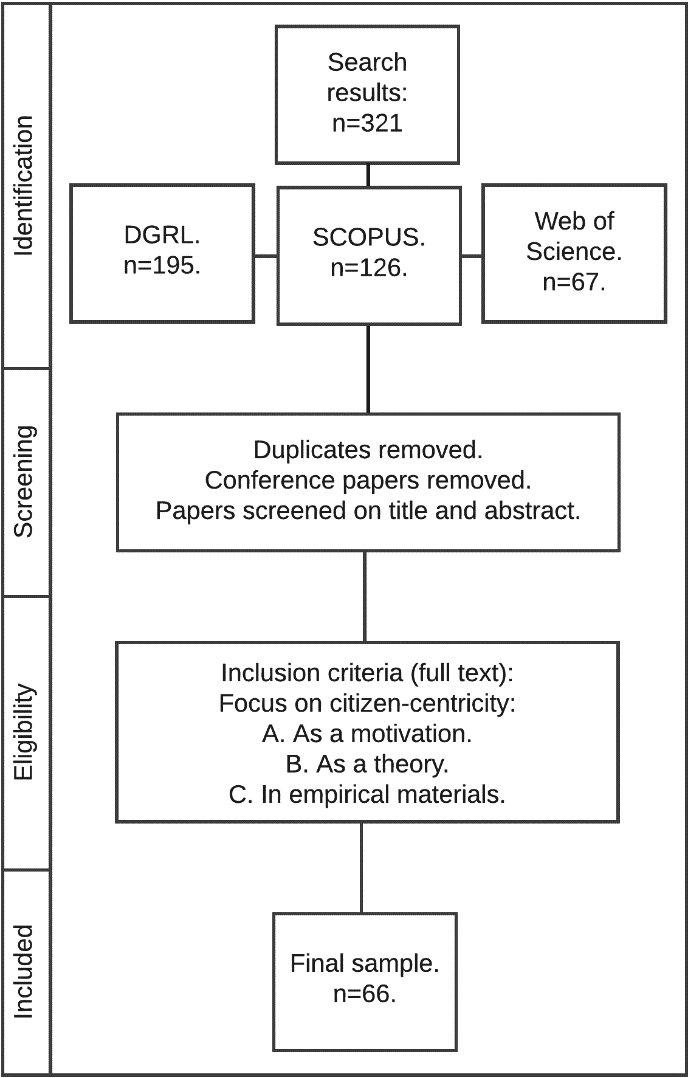
In this study, three scientific databases were used to search for relevant papers: the DGRL 17.5 digital government reference library and the SCOPUS (“the largest abstract and citation database of peer-reviewed literature” according to Elsevier (
To make the materials manageable, we only included journal papers. While this delimitation reduces the coverage of our sample, it enables presenting a narrative summary of each included article in the results section. We did not limit the materials to specific journals due to the multidisciplinary status of the digital government field, with authors from e.g., information systems and public administration (Heeks & Bailur, 2007). After downloading the papers they were screened to ensure that they addressed citizen-centricity, focusing on external, rather than internal processes and workflows (Lindgren et al., 2021). This was done by reading the full texts and excluding papers by authors who did not discuss the term specifically by: introducing it as a motivation for the study, using a theory associated with it, or empirically generating results associated with the term from findings in their study. Typically, such papers would mention citizen-centricity in their implications, rather than describing the relationship between governments and citizens in one of these specific manners. This process resulted in 66 papers.
Our analysis was performed in three steps. First, the findings are presented as narrative summaries of each included article (Dixon-Woods et al., 2005; Green et al., 2006). Second, themes were inductively constructed through open coding (Strauss & Corbin, 1990) as papers with common focal points and overarching topics (for example, presenting “barriers” to successfully implementing citizen-centric government) were grouped together. Third, ideal types were generated based on three aspects of citizen-centricity, sensitized by the literature presented in Section 2:
Characteristics of government (i.e., what is the main function of the government in the literature?). Governments may be more or less focused on citizens, and the transition to citizen-centricity may include a range of functions, such as the promotion of e-participation (Medaglia 2007; 2012; Sæbø et al., 2008). Role of technology (i.e., what is digital technology supposed to ‘do’). For example, technology can be used to supply (e-)services to citizens, but also to enable more interactive forms of activities (see e.g., Rose et al., 2015; Distel & Lindgren, 2023). Citizen configurations (i.e., how are citizens named and talked about in the literature?). Here, we pay attention to the terminology regarding the citizens in the papers and related theories (see e.g., Sundberg & Gidlund, 2022).
Thus, our review incorporated both elements of systematic reviewed (particularly use of search terms and descriptive notions that may be replicated by other authors) and interpretative elements (Boell & Cecez-Kecmanovic, 2014; 2015; Maclure, 2005) associated with narrative reviews (Turnbull et al., 2023). This procedure resulted in identification of four research themes together with a range of dimensions based on the above aspects that provided understandings of citizen-centricity associated with each theme. These dimensions, together with narrative constructs from the papers, constitute our integrative framework that we use to construct and identify associations between the ‘ideal types’ of government. The analysis of the papers required several iterations due to use of heterogeneous and varied language associated with citizens and the empirical contexts. However, the aim was to obtain a general overview rather than individually position every paper.
The notion of ideal types stems from Max Weber’s sociological theories and can be described as a tool to understand the world by highlighting certain features to define a hypothetical construction. By doing so, characteristic aspects of individual phenomena can be synthesized in order to explain the occurrence of social events (Hekman, 1983). Thus, ideal types are conceptual abstractions generated to make sense of complex contexts. The elements ascribed to an ideal type are to some extent arbitrary, they are not meant to reflect the ‘real’ world, but rather to represent it from a certain perspective or ‘imaginary reconstruction’ (Rex, 1977). The construction of ideal types also enables the generation of counterfactuals, i.e., contrasting types with ‘opposite’ features to the ideals. This analysis allows us to theorize (Weick, 1995) through the generation of ideal types and thereby capturing different dimensions of citizen-centricity as described in digital government research.
Results
Here, we present results from the literature review, which resulted in identification of four themes as presented in Table 1 and further elaborated in sections 4.1–4.4.
Research themes
Research themes
Before proceeding with descriptions of the themes, it is important to recognize that there is a degree of overlap between them, and some papers were easier than others to assign to a specific theme. This was inevitable in our analytical process as there will always be overlaps between different ideal types. However, these overlaps are subsequently used to further aggregate the results, and discuss how the different types relate to each other, to inform the creation of an integrative framework highlighting the dynamic and relational aspects of citizen-centric government.
Studies assigned to this theme investigate challenges and barriers that may hinder successful implementation of citizen-centric digital government. They vary in methodological approaches, and the results often include categorizations of identified challenges, ranging from political and legal issues to factors associated with organizational and managerial culture, and technological barriers.
One stream of papers assigned to this research theme discuss digital government in contrast to traditional modes of government where the citizen is a passive entity, as suggested by Saxena et al. (2022) in a paper entitled “From Bureaucracy to Citizen-Centricity”. These authors outline five challenges in this process: information inconsistencies, flawed website navigation, bureaucratic jargon, channel fragmentation and lack of support. However, as noted by Hayes et al. (2014), viewing digital government as a shift from a bureaucratic to a citizen-centric logic is an oversimplification. They argue that citizen-centric digital government is not a replacement for bureaucracy, but rather that these two logics are intertwined in an imbricated relationship. According to Alex (2011), key concerns to address in citizen-centric e-governance include equity, transparency, responsiveness, and accountability. Reddick et al. (2015) also highlight the importance of political efficacy and transparency in citizen-centric settings. In addition, Reddick and Jaramillo (2014) and Gjermundrød and Ioanna, (2015) discuss associated privacy issues.
Taylor and Lips (2008) criticize the notion that digital government is necessarily associated with citizen-centricity and argue that this should not be taken for granted. Other papers assigned to this theme specifically discuss barriers that may hinder implementation of citizen-centricity, often in specific national settings, a shared feature being criticism for failure to implement citizen-centricity (Mukamurenzi et al., 2019; Musgrave, 2004; Lee-Kelley & Kolsaker, 2004; Mofleh et al., 2008; Velicu, 2012; Hung, 2012; King, 2007; Kyakulumbye et al., 2019). Two studies include comparisons of barriers in different national contexts (Al-Nuaim, 2009; Spacek et al., 2020) and, as already mentioned, several contributors to this theme have provided categories of challenges.
Nam and Pardo (2014) studied municipal service centers in the USA and identified success factors and challenges divided into three categories: technological, organizational, and cross-organizational. Kolsaker and Lee Kelley (2006) criticized the UK government for excessively focusing on technological aspects, without sufficient understanding of citizen-centricity and thus adopting “a techno-centric model” that fails to engage citizens. They also identified conflicts or mismatches that required resolution between rationalist managerialism and participative communitarianism, technical solutions and organizational issues, policy objectives and administrative capabilities, as well as long- and short-term goals. Kernaghan (2005) identified four categories of barriers to implementation of integrated citizen-centric service delivery: political/legal, structural, operational/managerial, and cultural.
Theme 2: Service adoption
In work assigned to this theme, scholars specifically focus on the adoption of government services. They often do so by using derivates from the technology acceptance model (TAM), or frameworks for evaluating service quality.
Several scholars have studied determinants of use of government services in various national contexts (Alomari et al., 2012; Hujran et al., 2020; Urbina & Abe, 2017; Saleh & Alyaseen, 2021), as well as variables related to citizens’ use of social media (Alarabiat et al., 2021; Alalwan, 2013). Carter and Bélanger (2005) identified factors, such as ease of use and perceived trust, that they argued were essential for citizen adoption of digital government, and must be understood for successful implementation of citizen-centric digital government. Other scholars have compared and extended TAM models (Rana et al., 2013), or developed similar models with other types of variables (Naswir et al., 2019).
Important features of government services are that they are modelled on citizens’ life events rather than organizational structures (Sanati & Lu, 2010), and scholars highlight the need to build strong organizational capacities to generate such services (Chen, 2010). The terminology for citizens here is shifting, as exemplified by terms used in conjunction with the notion ‘proactive’ e-governance (Linders et al., 2018; Pawlowski & Scholta, 2023), which includes ‘users’ and ‘customers’ (Alshibly & Chiong, 2015; Dash & Jain, 2022), as well as ‘consumers’ (Alalwan, 2013).
As mentioned, scholars utilize frameworks, such as SERVQUAL (e.g., Osman et al., 2014) to assess citizens’ willingness to adopt digital services, sometimes in combination with TAM models (Sepasgozar et al., 2019). Thus, several types of service evaluation frameworks have been presented in papers assigned to this theme (Anwer et al., 2016; Gupta & Sury, 2017; Bhattacharya et al., 2012; Lal & Haleem, 2009; Singh & Singh, 2018; Sigwejo & Pather, 2016; Sorn-in et al., 2014). As in Theme 1, authors contributing to Theme 2 have presented findings from several national contexts, such as China (Chen & Zhang, 2021), Azerbaijan (Alguliyev, 2018), Hungary (Aranyossy, 2022), Ethiopia, Nigeria and South Africa (Tassabehji et al., 2019). The major difference is that scholars contributing to Theme 1 focus more on barriers, while contributors to Theme 2 focus on service adoption issues. In addition to public services, government websites have been evaluated in several studies assigned to this theme (Tan et al., 2013; Zhao, 2010). More recent studies have also investigated the use of AI (Scutella et al., 2022) in government service delivery, as well as utilizing novel methodologies such as topic modelling (Dash & Jain, 2022) to explore determinants of citizens’ use of services.
Theme 3: Participation
In studies assigned to this theme scholars have applied action-oriented approaches, presented tools for involving citizens as co-creators in participatory processes, or evaluated e-democracy initiatives (e.g., Lappas et al., 2017). Löfstedt (2007) proposed guidelines for designing citizen-centered digital government. Reddick et al. (2017) studied interactions between citizens and governments on Facebook. They recognized three levels of e-participation in citizen-centricity, ranging from a one-way mode of interaction (managerial) to two-way interaction (participatory). Most of the communication recorded in their case study was one-way (managerial). Van Velsen et al. (2009) presented a design process of public services, and highlighted the benefits of applying it in several iterative developmental cycles together with citizens. Giesbrecht et al. (2016) utilized action research to show how front office civil servants may serve as expert advisors to citizens, and contribute to value co-creation processes.
Theme 4: Smart and transformative government
Finally, scholars have presented digital government as a transformative phenomenon, in which flexible digital infrastructures enable citizen centricity. Marche and McNiven (2003) presented a two-dimensional framework of the internet’s impact on governments. Similarly, while Chen and Hsieh (2009) identified a new logic in digital government stemming from the New Public Management (NPM) ideal, Misuraca (2015) discussed opportunities associated with a new paradigm, called m-government (mobile government). In a similar fashion, opportunities associated with another term, t-government (transformative government), are described by Weerakkody and Dhillon (2008). In addition to providing digital spaces, scholars in this theme also highlight the importance of physical spaces, as exemplified by Brown (2005, p. 248): ”In the electronic environment, citizen capacity is a factor as well as citizen need and public administration is pulled to present itself where the public is located, physically and on-line.”
In this theme, smart cities are portrayed as arenas in which citizen-centricity plays out. Scholars here focus on a rich set of processes and features, ranging from involving citizens in the creation of services to regulatory frameworks designed to promote citizenship.” Lee and Lee (2014) referred to four modes of ‘electronic citizenship’ in smart cities, with citizens ranging from users of personalized services to political agents actively engaged in policy formulations and contributors to inputs to a ‘learning’ city. In addition, Marsal-Llacuna (2016) discussed human rights-related aspects of citizen-centricity in smart cities, and Alcaide and Rodriguez (2021) highlighted a need to account for differences between different city contexts (e.g., in developed or developing countries) when studying participation initiatives in smart environments.
A lack of theory-driven smart city implementations has also been noted, by Chatfield and Reddick (2016), who identified a need for shared visions of social innovation, with consideration of heterogeneous stakeholders’ conflicting values and their incorporation in a citizen-centric social governance framework. Finally, Breuer and Pierson (2021) have recognized citizens’ rights to shape their environments (collectively dubbed a “Right to the City”) and highlighted a need for creation of meaningful participatory activities. However, they also recognized a risk that already dominant actors and decision-makers may often retain control over ‘smart’ urban contexts.
5 Discussion: Characterizing citizen-centricity in digital government research
To aggregate the findings from the literature review, and thereby address the RQ posed in this study, we propose a typology of ideal types of government, which can provide clarification in further operationalization of the move towards citizen-centricity in public sector governance. The extant body of research on citizen-centricity does not share a common framework for classifying the dimensions of governance in a systematic fashion. Through our typology, we aim to reduce the ambiguity of the notion and citizen-centricity and its multiple aspects, and assist its placement in the context of digital government research in a more structured manner. In this section, in efforts to synthesize the literature on citizen-centricity, and assist transformations towards it, we apply notions identified in the reviewed papers to create an integrative framework of ideal types of government that clarifies the citizen-centricity concept.
Ideal types of government
To meet the aim to synthesize the surveyed literature and create an integrative framework to achieve conceptual clarity we identified the characteristics of citizen-centricity studied in the context of digital government. Aggregation of the four themes aided by the ideal-type methodology described in Section 3 resulted in the identification of four modes of government: ‘traditional’, ‘service-dominant’, ‘participatory’, and ‘transformative’. Results of the coding of the material are summarized in Table 2, and further elaborated below.
Results of the analysis
Results of the analysis
‘
While one line of criticism distinguishes between organization-centric and citizen-centric government, other scholars are more careful to signal a clear distinction between bureaucracy, and citizen-centricity. For example, Hayes et al. (2014) discuss citizen-centricity in relation to bureaucracy and describe how the former is involved in an imbricated relationship with the latter, as further elaborated below. Thus, in line with previous literature that highlights important values associated with established forms of government (see, for example, Rose et al., 2015; Bannister, 2017), we argue that it makes sense to talk about relational aspects between new and old paradigms rather than revolutionary replacements.
‘
‘
Finally, we identified a ‘
An important characteristic of governments of this type is the flexibility to produce and maintain and produce environments with diverse features that are valued by heterogeneous stakeholders. The ‘smart city’ is a manifestation of the ideal type of transformative government in our framework, and the associated literature identifies several elements of citizen-centricity in such settings. Examples include respect for human rights, citizenship, and ‘electronic’ citizenship management as part of efforts to learn from the inhabitants (and vice versa). The smart city represents an example of an arena where citizen-centricity plays out, characterized by notions such as ‘learning’ environments, where governance involves mediating between conflicting views of different groups of stakeholders (Chatfield & Reddick, 2016), which is essential in any environment (urban or rural) imbued with a range of heterogeneous values. As expounded by Bruer and Pierson (2021), these ‘smart’ environments are not simply deviations from bureaucratic ideals, and should be characterized by reconfigurations of (for example) legal frameworks that reinforce principles of collective empowerment rather than mere individual rights. Hence, this type is not characterized by institutionalization of citizen-centricity at the cost of deinstitutionalizing traditional modes of governments, but by incremental changes where several logics become intertwined with bureaucratic contexts. We refer to this process as a re-configuration, rather than replacement, of traditional government modes.
As the conceptualization of citizen-centricity is fragmented in the literature, we found that a more cohesive framework is needed to systematically analyze the implications of different modes of government. In the following text we consider these implications and how different modes of government form relations (as illustrated in Fig. 2), seeking to provide indications for researchers and practitioners of how citizen-centric government may emerge and be fruitfully developed.
An integrative framework of ideal government types.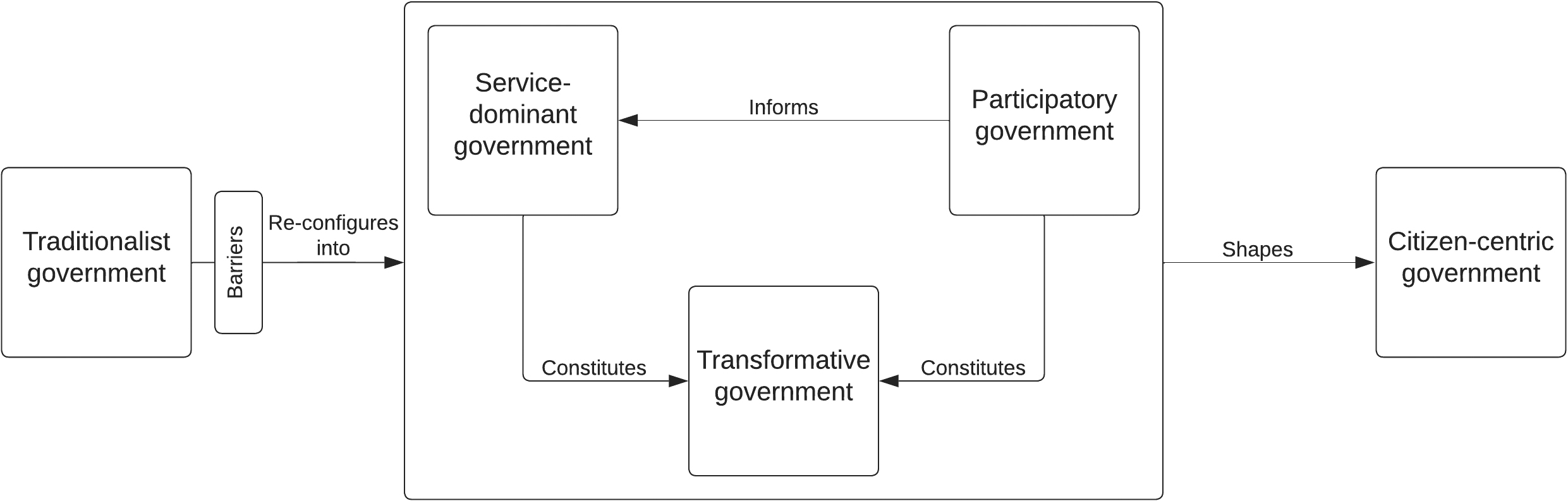
The previously presented modes of government inform our integrative framework, with assistance from narrative constructs from the material. These constructs are represented by the arrows in Fig. 2 and are further outlined below.
As noted by Bruer and Pierson (2021), through proper governance mechanisms, relations between citizens and governments can be “
As governments have intensified their production of digital or electronic (e-)services in recent decades, scholars have explored ways to
The purposes of the research reported here were to elucidate reported characteristics of citizen-centricity within the context of digital government through a literature review and generate an integrative framework, thus enhancing conceptual clarity of the notion. Our framework shows how citizen-centricity is characterized and informed by four perspectives, linked with ‘types’ of government modes identified from the literature: ‘traditionalist’, ‘service-dominant’, ‘participatory’ and ‘transformative’.
By doing so, we contribute to both theory and practice as described below.
First, our framework and analysis signpost several potentially fruitful directions for further research on citizen-centricity in digital government, including recognition of the dynamic processes involved, and hence incorporation of more dynamic elements in models and theories. Despite the widespread interest in citizen-centricity in the public sector, and particularly challenges associated with transition to this mode, there has been little academic effort to synthesize and aggregate knowledge of citizen-centricity in digital government settings. We aimed to address this gap, and this article presents an investigation of how citizen-centricity can be understood in the light of current knowledge of government modes. Our literature review based on ideal type methodology contributes to contemporary theories on citizens in government by presenting an integrative framework that highlights the fluid nature of the relations between these modes.
Second, our findings both provide encouragement for public managers and indicate a need to proceed cautiously. As shown, citizen-centricity can have different meanings, partly because the term citizen may refer to users, co-creators, customers, consumers or stakeholders. These configurations entail vastly different activities and require different competences. Thus, attempts to cater for them all simultaneously will likely fail or, at best, be complicated by conceptual confusion. However, our findings also suggest that these configurations may form new relationships, where they co-exist, with resulting modifications. Moreover, in these relationships public organizations may find the keys required to unlock the capabilities of the dynamic properties associated with innovative digital technologies.
Directions for further research
We propose two directions for further research.
First, as contributors to the studied corpus have used various terms when referring to citizens, without robust definitions, clearer conceptualizations and applications of the associated terminology are needed. To characterize expectations regarding the activities that governments, technology and citizens should support and engage in, it is vital for future researchers to avoid the ‘conceptual confetti’ sometimes found in the literature. As mentioned, there are vast differences between engaging in ‘customer’ management and design of services for ‘users’ on one hand and democratic initiatives in which citizens exercise their rights and obligations on the other (see, for example, Sundberg & Gidlund, 2022). We welcome more research to enhance conceptual clarity regarding these configurations.
Second, our study encourages further analysis of the relational aspects between different citizen configurations. Our findings highlight how they are entangled in imbricated relationships in the wake of emergent digital technologies, and built on divergent paradigms, with different expectations of what citizens, technologies and governments should do. Thus, to further elucidate citizen-centricity, more dynamic theories that can account for the processes involved more fully than those applied in current investigations are required (see, for example, Bensabat & Barki, 2007; Bannister, 2023). Our integrative framework provides an emergent path to potentially guide such studies.
Limitations
This paper conceptualizes the structure and substance of an integrative framework of ideal types of government, but we leave the door open for other academics and practitioners to test and/or adapt it to their contexts. We acknowledge, of course, that due to our choice of methodology the themes and types will inevitably overlap to some extent. Hence, the types should be interpreted as groups that represent certain perspectives that aid our analysis, and resemble each other in terms of some features (Wittgenstein, 2010).
Moreover, the integrative framework presented here is based on a review of journal papers identified using three databases. This may have resulted in some significant promoters and barriers for the presented government modes being missed. In addition, some of the articles included in the review are rather dated, suggesting that the terminology scholars use when referring to citizen-centric processes may have shifted. However, including articles with a relatively large range of publication dates enabled us to outline how treatments of the concepts have evolved over time (e.g., from discussing barriers and emerging ideas of transformative processes, to focusing on services and smart environments).
While it is important to note these limitations, it should also be noted that they do not undermine the article’s contribution to research and practice. The main novel scientific contribution lies in the conceptualization of the integrative framework of ideal types of government. The article not only systematically summarizes current knowledge of government modes, but goes a step further and combines it with an evolutionary idea, thus contextualizing the temporal relations between them. Having said that, our aim in this paper is not to present the shifts between these modes as a smooth and friction-free process. On the contrary, the different modes of government are rooted in divergent ideas (see, for example, Rose et al., 2015) and thus require different combinations of competences and changes in institutional settings to operationalize.
Footnotes
Authors’ biographies
Leif Sundberg is an associate professor at the Department of Informatics, Umeå University. Sundberg’s research interests involve digital government, artificial intelligence, philosophy of technology and risk society studies. Sundberg has a broad teaching experience from engineering management and information systems. He has published his work in journals such as Safety Science and Business Horizons and presented it at international conferences like IFIP EGOV-CeDEM-EPART and AMCIS.
Jonny Holmström is a professor of Information Systems at Umeå University and director and co-founder of Swedish Center for Digital Innovation. His research interests are digital innovation, digital transformation and digital entrepreneurship. He is serving at the editorial boards of CAIS, EJIS, Information and Organization, and JAIS. His work has appeared in journals such as Communications of the AIS, Design Issues, European Journal of Information Systems, Information and Organization, Information Systems Journal, Information Technology and People, Journal of the AIS, Journal of Information Technology, Journal of Strategic Information Systems, MIS Quarterly, Research Policy, and The Information Society.