




Abstract
BACKGROUND:
While linear transducers are the most accurate velocity monitoring devices, the horizontal motion of the barbell seems to affect its measurement error.
OBJECTIVE:
To explore the effect of cable inclination of the GymAware and T-Force linear transducers on the intra-session reliability and magnitude of kinematic variables during the Smith machine bench press exercise.
METHODS:
Twenty-eight resistance-trained males performed 2 blocks of 12 repetitions (4 repetitions at 40-60-80%1RM). In half of the repetitions with each load the two measuring systems were either vertically aligned with the barbell or positioned 15-cm away from the vertical projection of the barbell.
RESULTS:
Displacement and mean velocity variables were recorded with a high and comparable intra-session reliability regardless of the cable position and measuring system (CV
CONCLUSIONS:
These results indicate that repeatable findings of kinematic variables can be obtained regardless of the cable position, but for comparative purposes, the cable position should remain constant from the start to the end of the lifts.
Introduction
Monitoring movement velocity has not only become a simple and objective method to assess changes in an athlete’s physical performance [1, 2], but also to prescribe the loads according to the athlete’s daily readiness [3, 4] and monitor the level of effort being incurred during each resistance training set [5, 6]. However, this resistance training method known as “velocity-based training” requires accurate and reliable velocity monitoring devices for an optimal implementation of their applications in practice [7, 8]. Based on the findings of a recent systematic review [9], the linear position or velocity transducers (LPT and LVT, respectively) are the devices that present the greatest accuracy and reliability in comparison to other devices such as inertial measurement units, mobile phone applications, or optics devices. LPT and LVT systems consist of a sensor with a cable that is typically attached to the barbell and it measures barbell velocity by recording electrical signals that are proportional to the cable’s linear displacement (LPT) or velocity (LVT) [10, 11]. Therefore, since the displacement of the cable determines the final velocity output [12], coaches and strength and conditioning professionals should be aware of certain methodological factors that could affect velocity outputs [13].
The main source of error when measuring lifting velocity with LPTs or LVTs during resistance training exercises (squat, bench press, deadlift, etc.) is attributed to the horizontal motion of the barbell [14, 15]. This is of paramount importance considering that most of the strength training exercises involve a varied barbell path due to the need to coordinate a complex multi-articular system [16]. Furthermore, the free barbell trajectory does not always remain parallel to the ground throughout the lift and, therefore, the bias of barbell displacement measurement may increase as the position of the LPT/LVT deviates from the barbell center [12]. Some studies have attached two LPTs to each side of the barbell to reduce the measurement error, since it is possible to obtain a more precise central displacement position by quantifying both vertical and horizontal movements [17, 18]. In other investigations the exercises have been performed in a Smith machine, since this equipment restricts the movement of the barbell to the vertical direction [19, 20, 21, 22, 23]. In fact, it has been shown that the exercises carried out in a Smith machine provide displacement and velocity variables with a comparable or even greater reliability than the same exercises performed with free-weights [24, 25]. However, it is important to acknowledge that this testing equipment (i.e., four LPTs or a Smith machine) is not feasible in more applied settings [13]. Therefore, given the importance that the cable inclination seems to have on kinematic outputs, it would be of interest to intentionally manipulate the placement of LPTs and LVTs with respect to the vertical direction to elucidate its effect on the intra-session reliability and magnitude of commonly used kinematic variables.
The GymAware (GymAware PowerTool, Kinetic Performance Technologies, Canberra, Australia) is a commercially available LPT that has gained increasing popularity among researchers and coaches in recent years [26, 27, 28, 29]. The GymAware offers important features such as wireless-transmission and automated summary reports on a cloud-based system [26]. Furthermore, unlike other brands of LPTs, the GymAware also incorporates a sensor that measures the angle at which the cable leaves the spool [26, 28]. This angle sensor allows the quantification of the horizontal displacement of the barbell, which is supposed to be considered for calculating its vertical displacement using basic trigonometry [10]. For example, if the resultant mean velocity is 0.74 m
Specifically, the aim of this study was to compare the intra-session reliability and magnitude of the displacement and mean velocity variables recorded by the GymAware and T-Force when their cables were attached to the barbell vertically or with an inclination. We hypothesized i) a high and comparable intra-session reliability of the kinematic variables for the two measuring systems (GymAware and T-Force) and two cable positions (vertical and inclined), ii) lower values of displacement and mean velocity when using the T-Force at the inclined cable position because the angle of displacement of the cable with respect to the vertical is progressively reduced from the initial to the final position of the bench press exercise [10], and iii) no significant differences in the magnitude of the kinematic variables between the vertical and inclined positions when using the GymAware because this system incorporates an angle sensor which is expected to correct for the motion in the horizontal direction [26, 27].
Methods
Participants
Twenty-eight resistance-trained males (mean
Design
A cross-over design was used to examine the effect of the placement of LPT/LVT systems with respect to the vertical on the magnitude and intra-session reliability of the barbell displacement and mean velocity during the Smith machine bench press exercise. In a single session, participants performed two blocks of 12 repetitions (24 repetitions in total). Each block consisted of four repetitions (two repetitions at each cable position) performed against three loads (40%1RM, 60%1RM, and 80%1RM). The displacement and mean velocity of all repetitions were simultaneously recorded with the GymAware and T-Force systems (see below for further details). The average value of the two repetitions performed at each load and cable position was used for statistical analyses. Specifically, data of both blocks were used to address the first objective (intra-session reliability), but only the data of the first block was used to address the second objective (magnitude comparisons).
Procedures
Body mass (TBF-171 300A; Tanita Corporation of America Inc., Arlington Heights, IL) and stature (Seca 202; Seca Ltd., Hamburg, Germany) were assessed at the beginning of the session. The general warm-up consisted of dynamic stretching and joint mobilization exercises. Thereafter, participants performed an incremental loading test as part of the specific warm-up to estimate the bench press 1RM. Briefly, the incremental loading test consisted of four repetitions against the 45%, two repetitions against the 65%, and one repetition against the 85% of the self-reported 1RM. The rest between loads was set to three minutes. The lifting phase of all repetitions was performed at maximal intended velocity and the mean velocity of the lifting phase was recorded by the T-Force
Participant performing the Smith machine bench press exercise at the beginning (upper panels) and end (lower panels) of the lifting phase with the GymAware (at the right side of the barbell) and T-Force (at the left side of the barbell) attached vertically to the barbell (left panels) and with their cables inclined by placing the systems 15 cm behind the vertical projection of the barbell (right panels).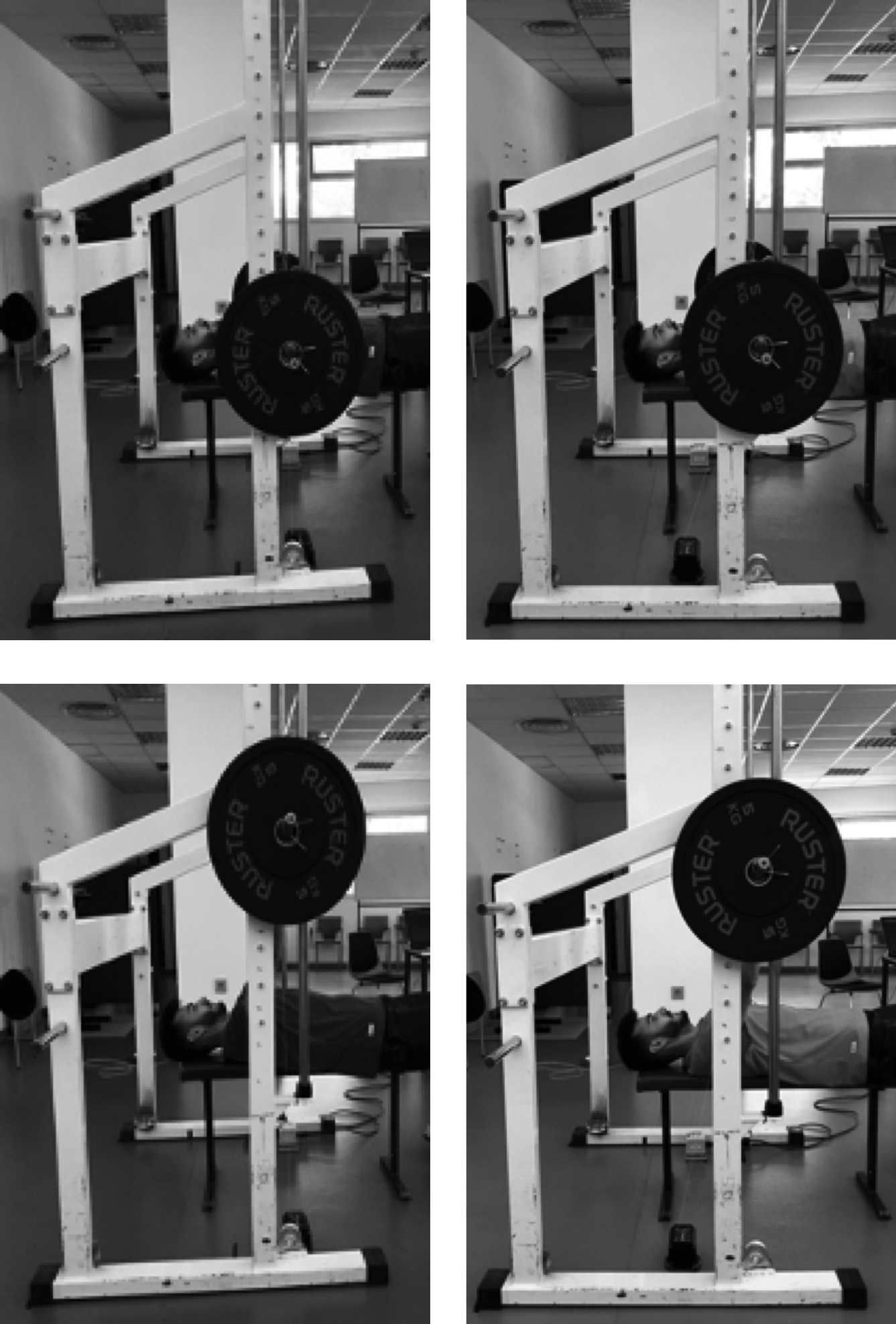
After warming-up, participants completed two identical blocks of 12 repetitions. Each block consisted of four repetitions against the 40%, 60%, and 80% of the previously estimated bench press 1RM. Half of the repetitions were performed with the two measuring systems vertically aligned with the barbell of the Smith machine, and the other half with the measuring systems 15 cm away from the vertical position (Fig. 1). The angle with respect to the vertical was recorded by the angle sensor of the GymAware and it was 20.2
Intra-session reliability of the displacement and mean velocity recorded by the GymAware and T-Force systems at different cable positions and relative loads during the Smith machine bench press exercise
1RM, one-repetition maximum; SD, standard deviation;
The displacement (i.e., distance covered by the barbell during the lifting phase) and mean velocity (i.e., average velocity from the beginning to the end of the lifting phase) of all repetitions were simultaneously recorded by the GymAware and T-Force systems. Both systems were attached to the opposite sides of the Smith machine barbell using velcro straps (Fig. 1). The specific characteristics of each system are provided below:
GymAware (GymAware PowerTool, Kinetic Performance Technologies, Canberra, Australia): The GymAware uses a variable rate sampling method with level crossing detection that assists in the interpretation of data points. The encoder provides approximately one electrical impulse every three-millimeters of barbell displacement with each value time stamped with a one-millisecond resolution. This method is utilized as it means the transducer adapts to the rate of change and removes noise associated with high frequency sampling as data is only recorded during movement. The GymAware software then is supposed to provide the vertical displacement using basic trigonometry considering the total displacement and angle. It has been noted that the GymAware measures the total displacement of its cable and incorporates an angle sensor that accounts for motion in the horizontal direction during predominantly vertical movements [26, 27]. The velocity data was calculated by the differentiation of the displacement data with respect to time. Data obtained from the GymAware were transmitted via Bluetooth to a tablet (iPad, Apple Inc., California, USA) using the GymAware v2.4.1 app, and to the online cloud before being exported to Microsoft Excel (Microsoft Corporation, Redmond, Washington, USA) and prepared for further analysis.
T-Force (T-Force System; Ergotech, Murcia, Spain): The T-Force is an isoinertial dynamometer that consists of cable-extension LVT interfaced with a personal computer by means of a 14-bit resolution analog-to-digital data acquisition board and custom software (v2.28). Instantaneous velocity is sampled at a frequency of 1,000 Hz and subsequently smoothed with a 4
Comparison of the displacement (upper panels) and mean velocity (lower panels) recorded at different loads between the vertical and inclined cable positions. Individual data are shown separately for the GymAware (empty dots) and T-Force (filled dots). 1RM, one-repetition maximum; ES, Cohen’s 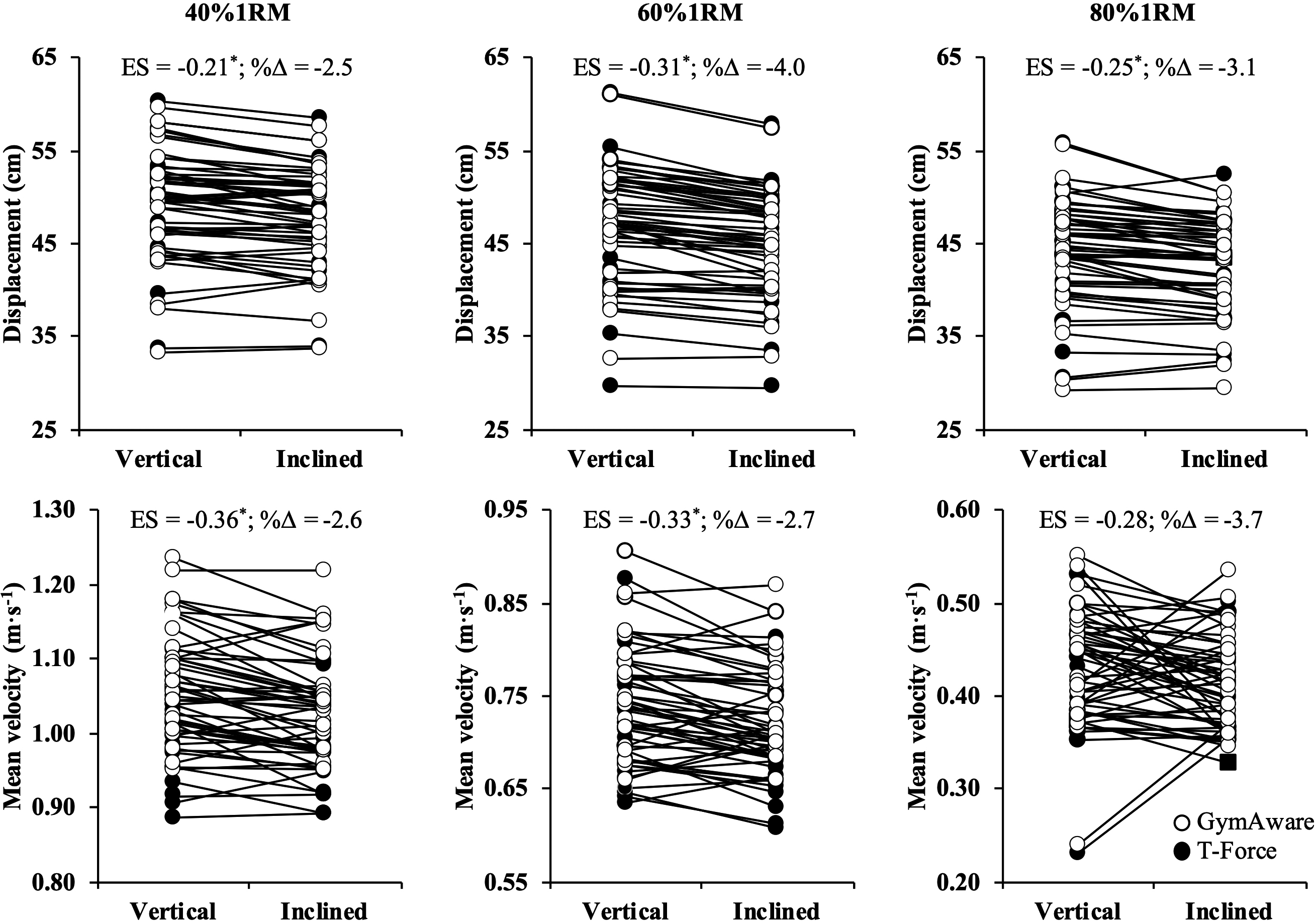
Descriptive data are presented as means, SD, and range. The normal distribution of the data was confirmed using the Shapiro-Wilk test (
Results
No significant (
The ANOVA revealed a significant main effect of the ‘system’ (F
Bland-Altman plots showing the differences for the displacement (upper panels) and mean velocity (lower panels) values recorded by the GymAware (left panels) and T-Force (right panels) systems fixed with a vertical and inclined cable position during the Smith machine bench press exercise. The plot depicts the systematic bias and 95% limits of agreement (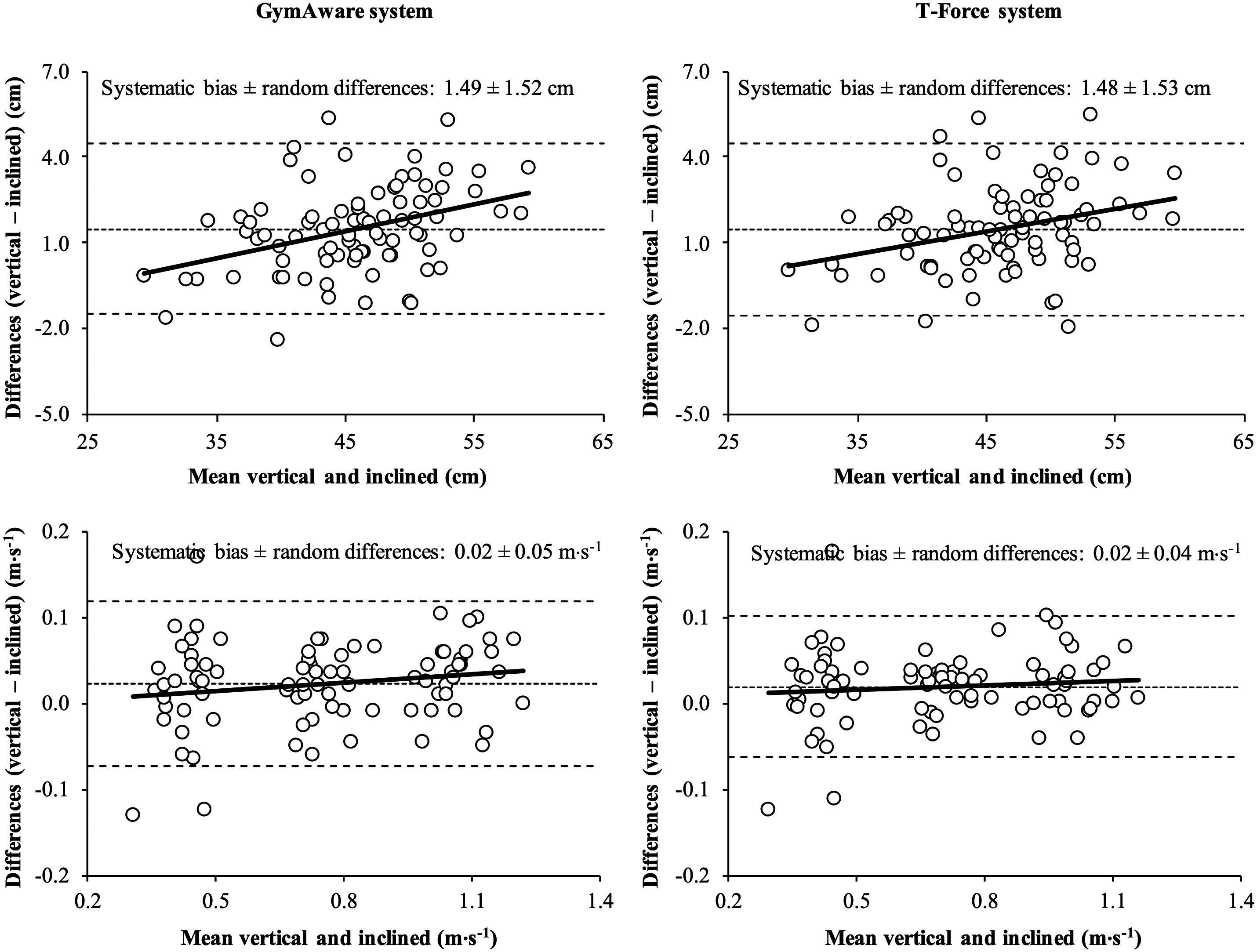
This study was designed to explore the effect of the inclination of the cable with respect to the vertical on the intra-session reliability and magnitude of kinematic variables (displacement and mean velocity) measured with the GymAware and T-Force systems during the Smith machine bench press exercise. The main findings revealed i) high and generally comparable intra-session reliability of the two systems (GymAware and T-Force) and two cable position (vertical and inclined) for both the displacement and mean velocity variables, and ii) lower displacement and mean velocity for the inclined cable position with the differences between the cable positions not being affected by the measuring system. These results indicate that reproducible measurements of mean lifting velocity can be obtained even when the cable of a LVT/LPT system is not vertically aligned with the movement of the barbell but it is pulled with a fixed inclination, however caution should be taken not to compare lifts performed with different inclinations of the cable because the magnitude of kinematic variables are affected by the inclination of the cable with respect to the vertical.
Being able to measure lifting velocity with a high reliability is of vital importance for implementing the numerous applications of velocity-based training [9]. Supporting our first hypothesis, the displacement and mean velocity variables were recorded with a high and generally comparable intra-session reliability by the two measuring systems (GymAware and T-Force) and two cable positions (vertical and inclined). These results are in line with Janicijevic et al. [39] who found a comparable intra-session reliability during the free-weight back squat exercise for the mean velocity recorded by the GymAware (CV
To our knowledge, this is the first study that has explored the effect of the placement of LPT or LVT on kinematic variables collected during the lifting phase in basic resistance training exercises. Supporting our second hypothesis, the T-Force system reported lower values of displacement and mean velocity when the spool was fixed 15 cm away from the vertical compared to the vertical condition. Of note is that during the inclined condition, the angle of the cable measured by the GymAware was reduced from 20.2
The GymAware is a particular type of LPT that incorporates an angle sensor at the base of the tether which is expected to be used to correct any horizontal movement using basic trigonometry [26, 28]. However, even though the GymAware has shown a high precision for measuring velocity and power output in various resistance training exercises [17, 29, 30, 31], to date no study had explored the usefulness of this GymAware feature. We confirmed that the angle sensor of the GymAware is sensitive to discriminate the angle of the cable at the initial and final positions of the bench press exercise. However, rejecting our third hypothesis, the GymAware system also provided lower displacement and mean velocity values in the inclined condition compared to the vertical condition. Even more important was the fact that the differences between the cable positions were comparable to these demonstrated by the T-Force system (i.e., similar systematic and random differences). However, it should be noted that the displacement was greater for T-Force, while the mean velocity was greater for the GymAware. These results are in disagreement with previous findings of Janicijevic et al. [39] who found higher mean velocity values (
Conclusions
The present study shows that, regardless of the inclination of the cable with respect to the vertical, both the displacement and mean velocity variables were recorded with a high intra-session reliability by the most common LPT (GymAware) and LVT (T-Force) during the Smith machine bench press exercise. However, the magnitude of the displacement and mean velocity was lower for the inclined than vertical cable position due to the reduction of the angle of displacement of the cable from the start to the end position of the lift. This underestimation of the kinematic variables was comparable for both measurement systems and, therefore, the angle sensor built into the GymAware does not seem to be effective to correct motion in the horizontal direction. However, it provided useful information about the angle of the cable at the initial and end positions of the lift. Therefore, provided that the changes in the inclination of the cable are constant from the start to the end of the lifts, strength and conditioning professionals could expect highly repeatable mean velocity values when collected by both the GymAware and T-Force systems.
Author contributions
CONCEPTION: Amador García-Ramos.
PERFORMANCE OF WORK: Alejandro Pérez-Castilla.
INTERPRETATION OR ANALYSIS OF DATA: Alejandro Pérez-Castilla and Amador García-Ramos.
PREPARATION OF THE MANUSCRIPT: Alejandro Pérez-Castilla.
REVISION FOR IMPORTANT INTELLECTUAL CONTENT: Alejandro Pérez-Castilla, Sergio Miras-Moreno, Agustín J. García-Vega and Amador García-Ramos.
SUPERVISION: Amador García-Ramos.
Ethical considerations
All participants were informed of the procedures to be used and signed a written informed consent form before initiating the study. The study protocol adhered to the tenets of the Declaration of Helsinki and was approved by the Institutional Review Board of the University of Granada (IRB approval: 2046/CEIH/2021).
Funding
The authors report no funding.
Footnotes
Acknowledgments
We would like to thank all participants that voluntary participated in this study.
Conflict of interest
Authors declare no conflict of interest.