




Abstract
BACKGROUND:
Vibration training can affect strength improvement. However, the role of the vibration frequency, in terms of knee muscle strength, is unclear.
OBJECTIVE:
To evaluate the effect of vibration training with the same amplitude and different frequencies on the isokinetic muscle strength of the knee in juvenile football players.
METHODS:
Juvenile football players were divided into four groups: low frequency (
RESULTS:
Compared with baseline, the peak extension torque of the knee at 60
CONCLUSION:
In juvenile football players, weight-free vibration training at 40 Hz and 50 Hz improves peak torque of the knee extensors at 60
Basic information of the study participants
Basic information of the study participants
Vibration training affects the muscle strength of the knee joint. During the vibrational training, the motor unit of the muscle group at the vibrational site is activated, stimulates the muscle fibers to participate in the contraction, promotes the contraction of the tendon, and facilitates the improvement of the joint strength [1]. Many studies have discussed the effect of vibration training on strength improvement from the perspectives of intervention time [1, 2], vibration frequency [3, 4, 5, 6, 7], and amplitude [8]. However, it is unclear whether the vibration frequency affects the improvement in knee joint muscle strength. One study that evaluated the effects of 24 weeks of vibration training with the same amplitude and different frequencies in older women reported that the high-frequency group (40–45 Hz) achieved better improvements in the muscle strength of the knee joint than the low-frequency group (10–15 Hz) [3]. Furthermore, 8 weeks of vibration training at 25–35 Hz and 35–50 Hz with the same amplitude significantly improved the dynamic testing peak torque (PT) of the knee extensor muscles of softball, swimming, and diving athletes, but vibration at 35–50 Hz achieved a better improvement [5]. In ordinary men who performed 4 weeks of vibration training at different frequencies (20 Hz, 40 Hz, and 60 Hz), the PT of the knee flexor and extensor dynamic muscles significantly increased in the 60 Hz group [6]. In contrast, young women who were not trained achieved better improvements in the PT and maximum isometric contractile force of the knee extensors after 8 weeks of vibration training with the same amplitude (2–4 mm) at 30 Hz than 50 Hz [7]. Good joint muscle strength is the basis of the physical quality of athletes, and effective scientific methods are needed to measure this parameter. The isokinetic muscle strength test method reflects the strength of the measured joint muscle group under different angular velocities, and reflects the endurance level of the muscle group by measuring the attenuation of repeated joint work [9, 10]. A review of the influence of vibration training on human muscle strength found that it remains controversial whether vibration frequency affects knee muscle strength. Under different angular velocity test conditions, the peak torque changes are different [11]. Furthermore, there is a lack of literature on the effect of vibration training on the endurance ratio (ER) in the knee joint of athletes, it is very important for athletes to maintain a good competitive state at the end of the match. The improvement of muscle group endurance plays a positive role in maintaining good sports performance. In addition, the most effective vibration frequency needs further clarification.
The present study evaluated the influence of vibration training with the same amplitude and different frequencies on the knee joint muscle strength of juvenile football players. The aim was to use isokinetic muscle strength tests of different angular velocities to provide a practical basis for improving the joint muscle strength of athletes. The hypothesis was that vibration training with the same amplitude and different frequencies has different effects on the knee joint muscle strength of juvenile football players, and that high-frequency vibration training achieves better improvements in knee joint muscle strength than training at medium and low frequencies.
Materials and methods
Participants
The study population comprised 54 elite male juvenile (age 14 to 18 years old) football players in Sichuan Province, China, who had been recruited by the provincial football management center as football reserve talents and had been trained intensively. Inclusion criteria: players in the top three teams in the provincial juvenile championship who passed the health examination and questionnaire screening and provided written informed consent after understanding the study purpose. Exclusion criteria: cardiac pacemaker; epilepsy; history of lower limb joint injury or surgery.
The participants were divided into (14 ones, 14 twos, 13 threes, 13 fours) the low-frequency group, medium-frequency group, high-frequency group, and control group by digital random distribution (Table 1). And the participants blinded to their allocation. No participants dropped out during the whole experiment. This study was conducted in accordance with the Declaration of Helsinki and approved by the school ethics committee (NO. 2019023)
Whole-body vibration training
The resonance frequency of the human body is approximately 5 Hz, the resonance frequency of the viscera and spine is approximately 8 Hz, and the resonance frequency of head is approximately 18 Hz, while frequencies of higher than 60 Hz can cause eyeball resonance [12]. To avoid the resonance causing harm, the vibration frequency in the low-, medium-, and high-frequency groups was set at 25 Hz, 40 Hz, and 50 Hz, respectively, and the amplitude was set at 3 mm [3, 13]. To keep the original training plan (Because the subjects recruited in this study are athletes, they carry out the same training program. In addition to their same original training schedule, additional whole body vibration training is added.) and intensity of all subjects unchanged, the low-, medium-, and high-frequency groups (vibration group) performed vibration training intervention using four Power-Plate vibration training instruments (American model Pro5 AIR™, vibration frequency range 25–50 Hz, amplitude range 1–3 mm, maximum weight 250 kg) three times per week for 12 weeks. Each subject completed five sets of static weight-free squats (There was no external resistance except the body weight of the subjects, 20 seconds/set with an interval of 10 seconds), half squats, deep squats, and left and right lunge squats (10 times/set with a 10-second rest between sets). For the half squats, deep squats, and left and right lunge squats, the subjects completed one complete movement in accordance with rhythmic prompt tones (with intervals of about 2 seconds). The control group completed the same actions as the vibration group without the vibration training instrument. A researcher supervised the whole process to ensure that the training quality was satisfactory.
Isokinetic muscle strength test
An isokinetic muscle strength tester (IsoMed 2000, Germany) was used to test the isokinetic muscle strength of the bilateral knee joints in the four groups at 0 and 12 weeks; muscle strength was tested during flexion and extension five times at 60
A study participant performing vibration training (left) and knee joint isokinetic muscle strength testing (right).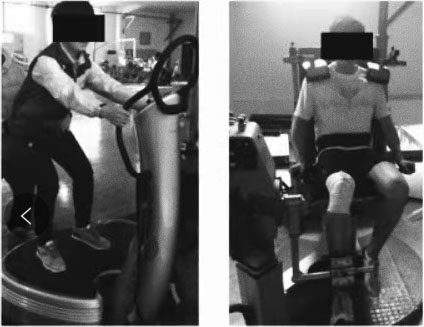
The isokinetic muscle strength was measured using the PT and ER. PT refers to the maximum output torque (Nm) generated by muscle contraction during the whole joint activity. An athlete’s slow strength is reflected by the results of testing at 60
The PT and ER of the knee joint of the four groups (the left and right data of each subject were averaged) were processed by SPSS Statistics 20.0. The PT and ER were presented as mean
Results
One-way analysis of variance showed that there were no significant differences between the four groups in age, height, weight, and training years (
Knee Joint Isokinetic Muscle Strength Test Results at Different Angular Velocities. 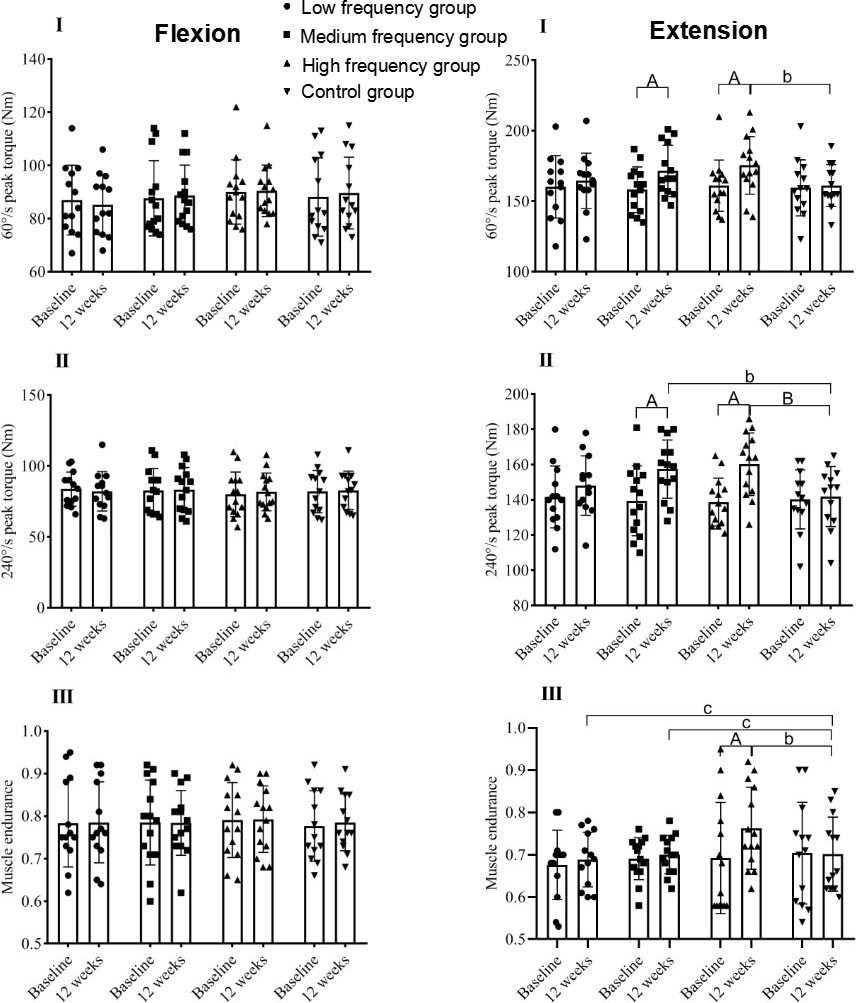
At week 0, there were no significant differences between groups in the peak flexion torque at 60
At 12 weeks, there were no significant differences between the four groups in the peak flexion torque at 60
There were no significant differences between the results at 0 versus 12 weeks in the flexion torque at 60
In the present study, juvenile football players completed 12 weeks of vibration training with the same amplitude and different frequencies (25 Hz, 40 Hz, and 50 Hz) to explore the changes in the PT and ER of the knee flexor and extensor muscles at 60
The main findings of the present study were that the PT of the knee joint at 60
During vibration training, the amplitude determines the centrifugal force borne by the muscle, frequency determines the acceleration force borne by the muscle, and additional load determines the tension of the muscle [17]. When the amplitude and additional load are unchanged, the acceleration force borne by the muscles increases with the increase in the vibration frequency. Previous studies have found that vibration training at higher frequencies achieves greater increases in isokinetic knee flexor and extensor muscle strength than training at lower frequencies in ordinary female college students (evaluated frequency range: 25–50 Hz) [5], older women (evaluated frequency range: 15–45 Hz) [13], and ordinary male college students (evaluated frequency range: 15–45 Hz) [18]. The present study found that vibration training caused similar changes in the knee extensor muscles in juvenile football players [5, 13, 18]. However, in contrast with previous studies [5, 13, 18], the present study found that vibration training had no effect on the knee flexor muscles of juvenile football players. This difference between studies may be related to the fact that no additional load was added in the present study, while Ren et al. [5]. added 30% of the maximum squat load. The interstudy differences in the age and occupation of the subjects may also have contributed to the inconsistent conclusions. The present study assessed juvenile football players who had been training regularly for a long time, which may be why the increase in the knee flexor muscle strength after vibration training was smaller than that in ordinary people who were not training regularly. However, a study of older adults who seldom carried out regular strength training found that the strength of the knee flexor muscles significantly increased after vibration training [13].
The mechanism of vibration training in improving joint muscle strength has been analyzed. During vibration training, the motion units of the vibrated muscle groups are further activated and the contraction function of the tendons is further increased compared with vibration-free training. Compared with vibration-free training, vibration training stimulates more muscle fibers to participate in contraction, and muscle strength is improved after repeated stimulation [19, 20]. Furthermore, vibration training increases the tension reflex of muscle temperature, blood flow, and vibration resistance at the vibrated part, and improves neuromuscular performance [21], which also improves muscle strength. Under the same vibration amplitude, the acceleration generated by higher-frequency vibration stimulation is higher than that generated by lower-frequency vibration stimulation, which affects the vibration intensity borne by muscles during vibration exercise. However, for relatively high-level athletes, the muscle performance is only improved when the vibration stimulation is large enough [17]. This may be the reason why the vibration training only had a marked effect in the medium- and high-frequency groups in the present study.
In the present study, the knee extensor endurance in the high-frequency group increased by 10.8%, and the knee extensor endurance in the high-frequency group was significantly greater than that in the low- and medium-frequency groups. However, the endurance of the knee flexor and extensor muscles did not significantly differ between the low- and medium-frequency groups. This shows that high- frequency vibration training under the same amplitude is conducive to improving the endurance of the knee extensor muscles of elite juvenile football players, while low- and medium-frequency vibration training is insufficient to improve the endurance of lower limb muscles.
During vibration training, the muscle fibers with a low threshold value at the vibrated part are caused to participate in contraction, thus relieving the fatigue of the muscle fibers with a high threshold value [22, 23]. In the present study, the degree of attenuation of the muscle work of the knee joint in the high-frequency group was weakened when 25 extensions were performed, while there was no similar finding in the low- and medium-frequency groups. We speculate that 12 weeks of vibration training at 50 Hz forced the low threshold muscle fibers of the knee joint of juvenile football players to participate in contraction, which was manifested in the improvement of ER in the high-frequency group. However, there was no obvious change in knee flexor endurance, which may be related to the lack of special flexor training and the particularity of the research subjects. A football match lasts for 90 minutes, and it is very important for football players to maintain a good competitive state at the end of the match. The improvement of muscle group endurance plays a positive role in maintaining good sports performance. The present results suggest that 50 Hz vibration training is beneficial in improving knee extensor muscle endurance for juvenile football players performing normal strength training.
The present study had certain limitations. As a limited number of juvenile football players could be recruited, the sample size was small (power is 0.8). In addition, no other indexes were analyzed to determine whether the results were influenced by the changes in muscle strength, amplitude, and single intervention time.
Conclusions
Weight-free vibration training at 40 Hz and 50 Hz improves the PT at 60
Author contributions
CONCEPTION: Liang Cheng, Hanxiao Xu, Benxiang He and Jianan Zhou.
PERFORMANCE OF WORK: Liang Cheng, Hanxiao Xu, Benxiang He and Jianan Zhou.
INTERPRETATION OR ANALYSIS OF DATA: Liang Cheng and Hanxiao Xu.
PREPARATION OF THE MANUSCRIPT: Liang Cheng, Hanxiao Xu, Benxiang He and Jianan Zhou.
REVISION FOR IMPORTANT INTELLECTUAL CONTENT: Liang Cheng, Hanxiao Xu, Benxiang He and Jianan Zhou.
SUPERVISION: Liang Cheng, Hanxiao Xu, Benxiang He and Jianan Zhou.
Ethical considerations
This study was approved by the school ethics committee (No. 2019023). Before the assessment, every participant received the same detailed information about the testing procedure and signed the informed consent.
Funding
This research was funded by a grant from the China’s key research and development plan (2019YFF0301704).
Footnotes
Acknowledgments
Thanks to the support of Sichuan elite male juvenile football players for this research.
Conflict of interest
All authors declare no financial or personal conflict of interest.