




Abstract
BACKGROUND:
Sprint drills are part of the soccer training routine for their resemblance to match activities. There is a lack of information in the literature about the changes in isokinetic skeletal muscle strength in response to sprint training.
OBJECTIVE:
This study evaluates the effects of eight weeks, on-season repeated sprint training with a change of direction on isokinetic strength parameters in well-trained youth soccer players.
METHODS:
Nineteen well-trained youth soccer players volunteered to participate in the study. The training program included three sets of six, 40 m (20
RESULTS:
Following the training period, dominant and non-dominant legs’ peak moment, work, and power values for both extensor and flexor muscle groups improved significantly at various angular velocities.
CONCLUSIONS:
Isokinetic strength enhancement may be explained with the induction of muscle hypertrophy following a prolonged period of sprint training.
Introduction
Professional soccer has an intermittent characteristic in which walking and low-intensity running are interspersed with high-intensity activity periods [1]. In a typical soccer match, a player conducts 1000 to 1400 short-time actions with frequent changes every 4 to 6 seconds and sprints approximately every 90 seconds, with an average duration of 2–4 seconds for each sprint [2]. Although high-intensity activities constitute a small portion of the total match activities, they have an intense impact on the result of the game such that straight sprinting is the most dominant action when scoring goals [2, 3]. For these reasons, sprint drills are regularly included as a part of the soccer training program [4, 5]. Repeated sprint ability (RSA) is defined as the athlete’s ability to produce the best possible average sprint performance (15–40 meters) over a series of sprints (3–15 repetitions), separated by short (15–20 seconds) recovery periods [5, 6]. Coaches prefer such exercise sessions due to their resemblance to those activities during actual matches [7].
Dynamic muscle strength (concentric or eccentric) rather than static (isometric) is commonly considered an essential component in sprinting. Sprint performance is a direct result of the impulse (the product of force and time) applied by the athlete against the ground during the propulsive phase of the gait cycle. The driving force generated during the braking phase is related to the strength of the hip flexors, hip extensors, knee extensors and plantar flexors [8]. In other words, the athletes who have greater strength in these muscle groups may produce faster sprinting times. In the literature, there are studies that evaluated the correlations between isokinetic muscle strength and sprint performance [8, 9]. Those studies’ main finding is that a correlation exists between peak knee extensor and flexor moment at the measured velocities (60, 150 and 240
The injuries that soccer players encounter mostly occur in the lower extremity and nearly half of them are related to hamstring muscles [14]. When the lower leg decelerates in the late swing phase of the gait cycle, the eccentric contraction of the hamstring in response to rapid and active knee extension cause hamstring injuries. Also, the hamstrings are prone to injury, when they function as active hip extensors during a rapid change from their eccentric to concentric action in the early swing phase [15]. Even though there are some controversies, an imbalance in hamstring/quadriceps muscles’ strength ratio (H/Q) is accepted as one of the causes of hamstring strains [16]. Thus, any kind of intervention that has the potential to improve hamstring muscles’ strength may prevent injury by increasing the H/Q ratio.
As mentioned above, coaches prefer training drills that show similarities with match activities on-season. When the relationship between sprint performance and muscle strength is taken into consideration, training modalities such as sprint may constitute a very valuable and practical drill to improve the players’ muscle strength in addition to an increase in speed and agility. This study evaluates the effects of eight weeks on-season repeated sprint training with a change of direction on isokinetic strength parameters in well-trained youth soccer players.
Methods
Subjects
Nineteen well-trained youth soccer players (17.5
Anthropometric measurements
The participants visited the laboratory after 12-h of overnight fasting. Before the exercise, the same person performed anthropometric measurements and used a scale, stadiometer, and a nonelastic measuring tape for body mass, height, and circumference measurements, respectively. A Holtain calliper was used to measure skinfold thickness. Thigh circumference and skinfold were measured from the anterior aspect of the thigh midway between the inguinal crease and the proximal border of the patella. Anthropometric data were used to calculate body fat percentage and muscle mass [17, 18].
Repeated sprint training program
Repeated sprint training program
The test was performed on a treadmill (HP Cosmos, Nussdorf – Traunstein, Germany), and breath-by-breath gas measurements were taken throughout the exercise using an indirect calorimetric system (PFT Cosmed, Rome, Italy). The system’s volume and gas calibrations were performed using a 3 L calibration syringe and calibration gases, respectively (16% O
Experimental protocol
The study lasted for twelve weeks. Pre- and post-training tests were performed one week before and one week after the repeated sprint training program. The final evaluation was performed at least 24-h after the last training session. The first two weeks of the ten-weeks training program was used for preparation, in which the volume of the training increased progressively (Table 1). Following the preparation period, the number of sets increased to three for every training session (weeks 3–10). Every set consisted of six, 40 m (20
Repeated sprint ability (RSA) test
The RSA test consisted of six, 40 m (20
Before the testing procedure, the participants completed a standardized warm-up session consisting of 15-min low-intensity running striding and three sub-maximal shuttle sprints. Following the warm-up session each participant completed a single preparatory 40 m (20
Concentric peak moment (PM) was measured with a Cybex Norm dynamometer (Computerized Sports Medicine Inc., USA). The backrest angle of the dynamometer’s chair was 90
Before the isokinetic strength measurements the participants warmed-up with a standardized session for 10-min with a bicycle ergometer (Monark 894 E, Sweden) (five minutes cycling 1 kg load at 65
The first set of the test protocol involved seven contractions of 240
Muscle strength testing protocol (angular velocity
number of repetitions)
Muscle strength testing protocol (angular velocity
Knee extensor and flexor muscle groups’ pre- and post-training VIS data for PM, work, and power values were compared. The detailed procedure for calculating the VIS data was given in elsewhere [22]. Briefly, the acceleration and deceleration phases of contraction were determined by taking the first derivative of velocity with respect to the range of motion. The data points near zero in the first derivative curve (fluctuations equal to 0
Statistical analysis
The results are presented as the mean
Results
Physical characteristics
The physical characteristics of the participants are given in Table 3. Even though the participants’ body weights, body fat percentage, and peak oxygen uptake did not change, thigh circumference (
Pre- and post-training characteristics of the participants
Pre- and post-training characteristics of the participants
Body mass index (BMI); peak oxygen uptake (
Repeated sprint ability test results of the participants before and after the training period
Statistical parameters of changes in isokinetic knee extensor and flexor muscle groups’ strength
Ext: Extensors, Flex: Flexors.
Comparison of pre- and post-training valid isokinetic sector peak moment, work and power data of the dominant and non-dominant leg extensor muscle groups. A. Peak Moment, B. Work, C. Power (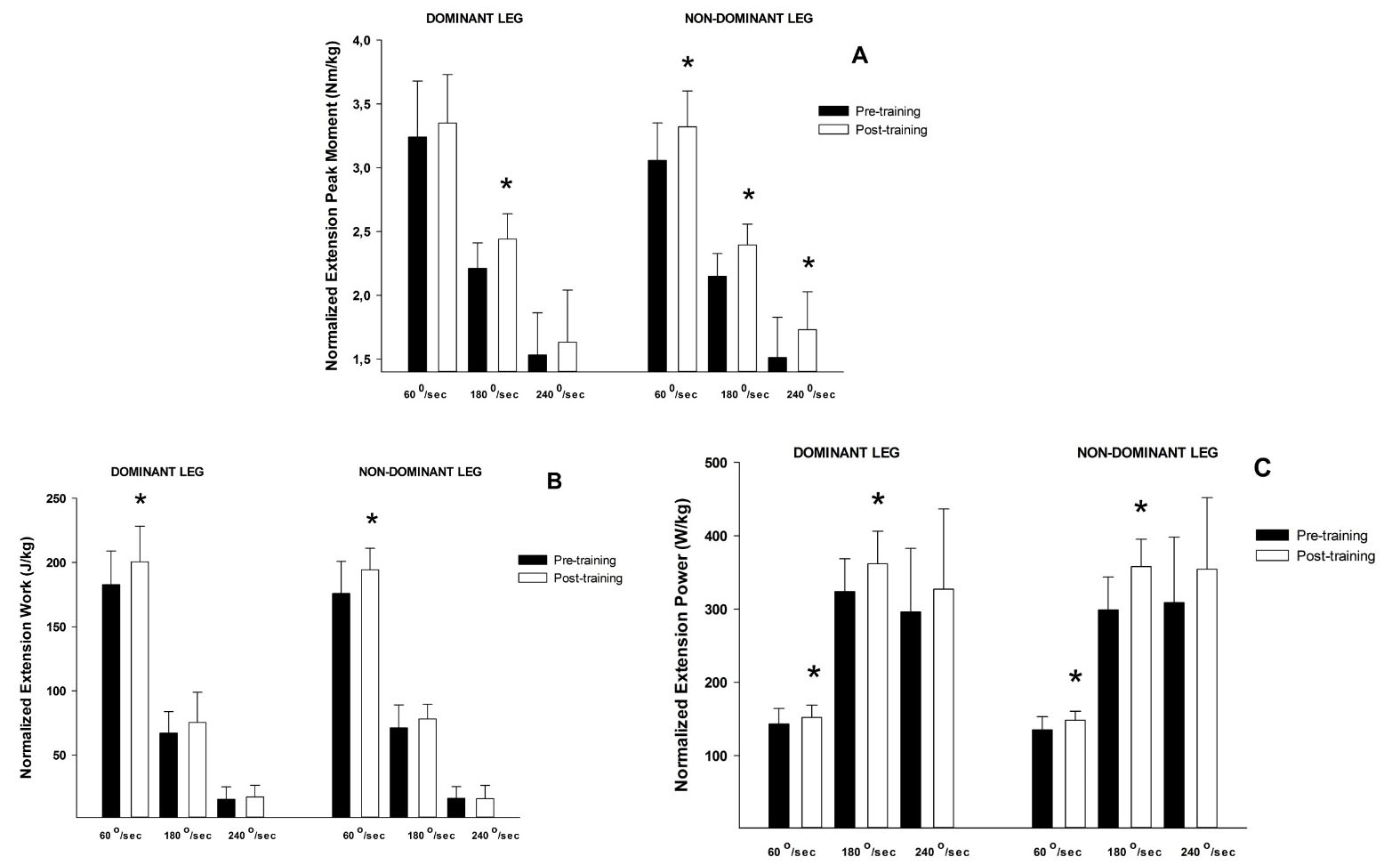
Comparison of pre- and post-training valid isokinetic sector peak moment, work and power data of the dominant and non-dominant leg flexor muscle groups. A. Peak Moment, B. Work, C. Power (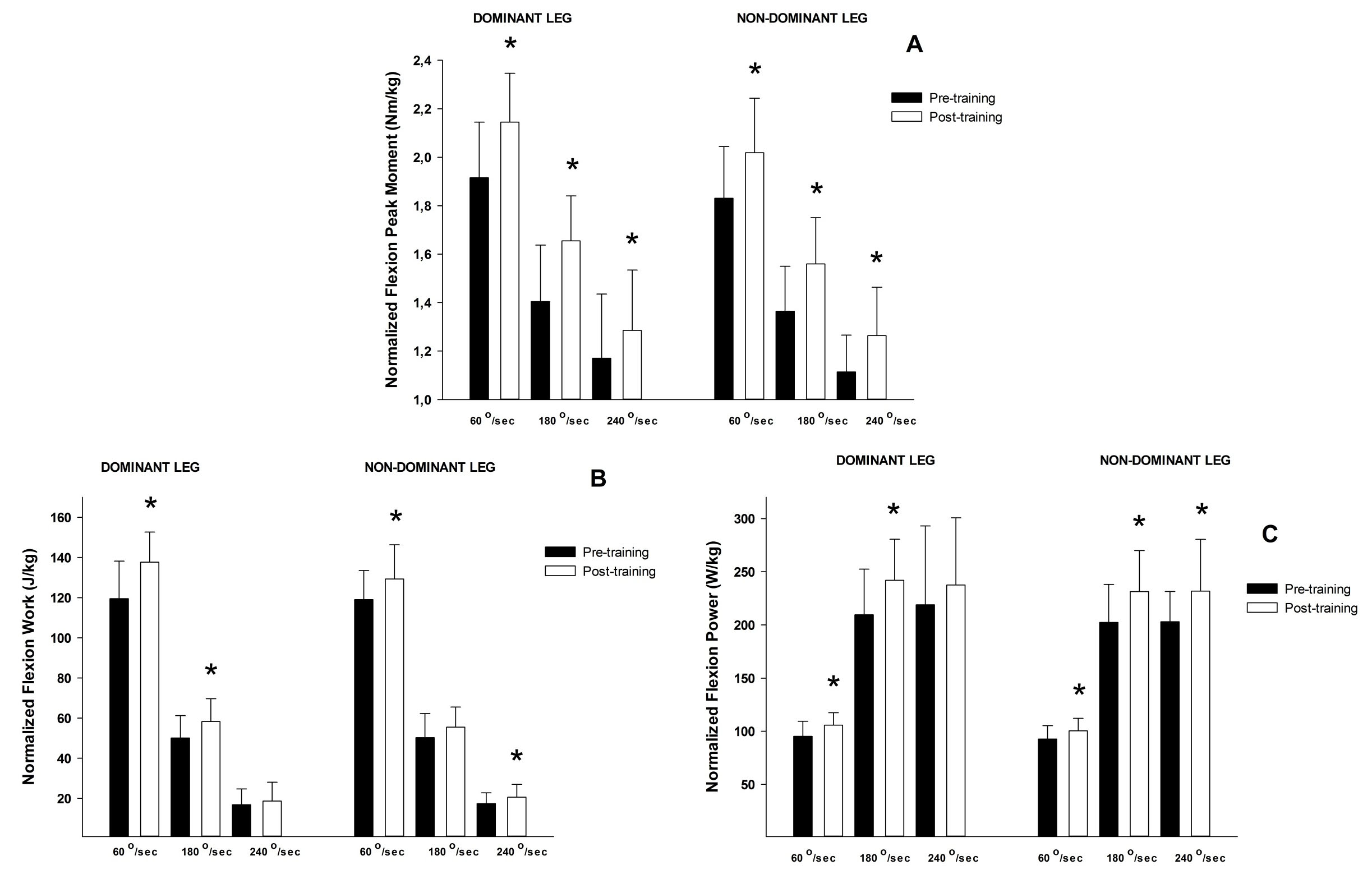
After the training period, the participants’ best sprint time (
After the training period, the participants’ dominant leg extension PM values increased significantly at 180
The dominant leg flexor group muscle PM values increased significantly for all three angular velocities after the training period. Non-dominant leg peak flexion moment values increased as well for all the angular velocities (Fig. 2A, Table 5). The dominant leg flexor muscle work values increased significantly after the training period at 60
Discussion
The main finding of this study is that eight weeks of on-season repeated sprint training significantly increased the isokinetic strength parameters of soccer players despite the lack of an improvement in their sprinting performance. Changes in muscle mass together with repeated maximal stimulation throughout the sprinting activity, may explain the isokinetic strength enhancement. Moreover, to our knowledge, this is the first study that evaluates the change in isokinetic strength parameters in response to sprint training.
Morphological adaptations to sprint training
Skeletal muscle exhibits morphological and metabolic plasticity in response to different forms of physical activity. A mutual relationship exists between athletic performance and skeletal muscle’s morphology. Muscle cross-sectional area and muscle fiber distribution determine the contraction speed and strength of the muscle. Morphological characteristics of the skeletal muscle, which may determine athletic performance are influenced by the training. However, Esbjornsson et al. demonstrated muscle fiber transformations towards IIA from both IIB and I at the end of six weeks of sprint training performed three times a week [25].
Furthermore, it was shown that sprint training ranging in duration from 8 weeks to 8 months has a significant influence on fiber size [26]. Similar to fiber size, significant increases in total muscle volume have been observed following nine weeks of sprint cycle training [27]. Thus, our participants’ muscle mass increase might be explained by the induction of muscle hypertrophy following a prolonged period of sprint training. Maughan et al. evaluated the correlations of muscle strength with lean body mass and cross-sectional muscle area and found a significant relationship [28]. Masuda et al. examined the relationship between cross-sectional muscle area and muscular strength in terms of isokinetic knee extension and flexion among well-trained soccer players and found a positive correlation [29]. In our study, the increase in the thigh circumference without a change in thigh skinfold may point out an increase in the cross-sectional area of the thigh musculature. Thereby, these findings may explain the isokinetic strength improvement with the increase in muscle mass.
Muscular activation throughout sprinting performance
Evaluation of muscle activation pattern during gate cycling may help investigators to understand the series of events during sprinting. Electromyography signals are frequently used to analyze the sequence and duration of muscle activity [30]. This effort is also crucial for the interpretation of the effects and effectiveness of sprint training. Analysis of the hamstring muscle mechanics during a straight-line sprinting showed that peak eccentric contraction speed of the muscle was significantly higher during the late swing phase than the late stance phase. This indicates the importance of hamstring muscle in generating forward ground reaction forces during the propulsive part of the stance in sprinting [30]. On the other hand Hader et al. found that the acceleration-deceleration dynamics associated with repeated sprints with a change of direction require high levels of eccentric loading [31]. These investigators had shown that the EMG activity to be phase-dependent and change of direction sprints caused greater quadriceps and hamstring muscle activities during and just after the turn, which is generally associated with the highest deceleration (breaking force) and the highest re-acceleration (propelling force) respectively [31].
In our study, eight weeks of repeated sprint training improved isokinetic extensor and mainly flexor muscles’ strength parameters of the dominant leg (Figs 1 and 2). However, the flexor muscles’ PM was significantly higher for all the three angular velocities following the training period. PM reflects a certain angular point in the range of motion, whereas work value is the area underneath the moment/range of VIS. Therefore, work data may be more informative to evaluate the progress in muscle contractile properties following a training period. During the sprinting with a change of direction, quadriceps muscles contract eccentrically in deceleration and contracts concentrically for the acceleration of the body in the propulsive phase. On the other hand, the hamstring muscles function as a knee stabilizer for decelerating the centre of gravity during the impact phase of the gait cycle and absorb forces associated with directional change [32]. Also, Besier et al. showed greater activation of biceps femoris during sprints with a change of direction and concluded that this activation is essential for coping with the internal rotation moments applied to the knee [33]. Moreover, as the hamstrings are the prime movers of hip extension, changing hip from a flexed to an extended position in the propulsion phase causes a higher muscle activation of the hamstring group during a sprint with a change of direction [31]. Thus, as shown in this study, the higher improvement in hamstring muscles strength could be due to their continuous stimulation during the directional changes in sprints.
Changes in sprinting performance after the training period
Our participants’ sprint performance did not improve following eight weeks of repeated sprint training towards the end of the season (Table 4). In the literature, there are controversial findings on the effectiveness of repeated sprint training. Some investigators found significant performance improvements [4, 34] whereas, others had shown that similar training did not improve sprint performance [35, 36]. A possible explanation of this discrepancy might be the sprint training’s seasonal timing. Haugen et al. concluded that off-season or early pre-season sprint training could generate the more substantial effects [5]. On the other hand, Campos-Vasquez et al. [37]performed repeated-sprint training with twenty-one U19 category soccer players for eight weeks and assessed their sprint performance at the end of the season. They found that the training did not change the best and mean sprint times significantly, which is in agreement with our study. They stated that the accumulation of fatigue throughout the season might reduce repeated sprint performance in the post-competition period [37]. Since our study took place towards the end of the season, the lack of improvement in sprinting performance could have resulted from the training’s timing concerning the season. Future studies are necessary to evaluate the effectiveness of repeated sprint training on performance throughout the season.
Limitations of this study
In this study, the concentric contraction characteristics of the extensor and flexor thigh muscle groups were evaluated. Since the eccentric strength properties of the mentioned muscle groups were not measured, any possible effect of repeated sprint training on this type of contraction was not evaluated. It may be valuable to investigate the changes in eccentric contractile properties following a similar training protocol. Beside that, high precision analyses of muscle mass may give more informative data about changes in strength parameters.
Conclusion
Our results suggest that isokinetic strength parameters of well-trained youth soccer players increased significantly following eight weeks of on-season repeated sprint training even though their sprint performance did not improve. The player’s muscle mass increased at the end of the training period. Isokinetic strength enhancement may be explained with the induction of muscle hypertrophy following a prolonged period of sprint training. Therefore, this type of training may help players to improve muscle strength favoring the hamstring muscles independent of improving sprint performance.
Author contributions
CONCEPTION: Kerem Özgünen, Ümit Adaş and Nedim Askeri.
PERFORMANCE OF WORK: Kerem Özgünen, Ümit Adaş, Abdullah Kilci, Cumhur Boyraz, Nedim Askeri and Özgür ünaşti.
INTERPRETATION OR ANALYSIS OF DATA: Kerem Özgünen, Ümit Adaş, Abdullah Kilci, Cumhur Boyraz and Özgür ünaşti.
PREPARATION OF THE MANUSCRIPT: Kerem Özgünen, Çiğdem Özdemir, Özgür ünaşti and Selcen Korkmaz Eryilmaz.
REVISION FOR IMPORTANT INTELLECTUAL CONTENT: Kerem Özgünen, Çiğdem Özdemir, Özgür ünaşti, Selcen Korkmaz Eryilmaz and Sadi Kurdak.
SUPERVISION: Kerem Özgünen, Çiğdem Özdemir, Özgür ünaşti, Selcen Korkmaz Eryilmaz and Sadi Kurdak.
Ethical considerations
The Ethics Committee of Çukurova University Faculty of Medicine has approved this study (91/17/04.09. 2019), carried out under the Declaration of Helsinki. The study was explained to all participants in detail, and informed consent forms were acquired.
Funding
The authors report no funding.
Footnotes
Acknowledgments
The authors have no acknowledgements to report.
Conflict of interest
The authors have no conflicts of interest to report.