




Abstract
BACKGROUND:
Bar velocity has been proved to accurately predict performance in several exercises.
OBJECTIVE:
To estimate the total number of repetitions during the NFL-225 Bench Press Test (NFL-225) based on bar velocity in collegiate football players.
METHODS:
Forty-six NCAA Division I football players performed as many bench press repetitions as possible with a standard load of 225 lbs. The variables used to estimate the total number of repetitions were: mean velocity of the fastest repetition achieved in the test (FR); mean velocity of the first repetition (V1); mean velocity of the first three repetitions (MV3); mean velocity of the first five repetitions (MV5); and mean velocity of the first 10 repetitions (MV10). Linear regression analyses were conducted to predict NFL-225 performance based on bar velocity.
RESULTS:
The prediction of the total number of repetitions was similar between the five mean velocities (FR:
CONCLUSION:
The mean velocities allowed the production of general regression equations for the estimation of the total number of repetitions in the NFL-225. V1 and MV3 presented as the best options due to their accuracy, time-efficiency, and reduced musculoskeletal stress.
Introduction
The National Football League 225 (NFL-225) bench press test is frequently performed by American Football players as a test of upper-body strength-endurance [1]. This test requires the athlete to perform as many bench press repetitions as possible using a set load of 225 lbs (102.3 kg) [1]. The NFL-225 test is one of several measures used in the NFL Combine, which is used as a showcase for American Football players to display their athletic abilities and help determine their professional draft status [2, 3]. For these reasons, this test is also frequently used by football programs in the National Collegiate Athletic Association (NCAA) Divisions I, II and III. However, due time constraints, administration of this test may be difficult. Indeed, developing a method to estimate performance on this test may be of value to strength and conditioning coaches with limited resources which would not detract from other forms of training considered higher priority.
Velocity-based testing (VBT) is a method of measuring velocity at which an individual can move an absolute load during a resistance exercise [4]. Results from VBT assessments have been used to estimate the one-repetition maximum (1RM) for several barbell exercises [4, 5, 6]. Briefly, to estimate the 1RM value it is necessary to measure the velocity of the bar at a range of submaximal loads (e.g., 20, 40, 60, and 80% 1RM). Velocity data at each submaximal load is plotted and a regression equation can be obtained. From the regression equation, 1RM values may be estimated based on the velocity of the first repetition [4, 5]. Indeed, previous research has discovered high validity of the VBT to estimate 1RM bench press performance (
The NCAA enforces a limited amount of time that strength and conditioning personnel can have contact with student athletes. In this sense, spending additional training time to perform the NFL-225 may take time away from other training priorities. Thus, the use of VBT to estimate NFL-225 performance may be a more time efficient option for testing and assessment. Therefore, the purpose of this study was to estimate the total number of repetitions in the NFL-225 among NCAA Division I American football players from barbell velocity and develop a prediction model to estimate performance for this test. This study also aims to determine if the average velocity of multiple repetitions is a better predictor of NFL-225 performance than a single repetition.
Methods
Participants
Archived data for forty-six (
Procedures
NFL-225 bench press test
Participants reported to the training facility and were tested between 0700 and 1300 hours. All athletes performed a dynamic warmup consisting of internal and external rotation exercises for the rotator cuff and a performed 8 repetitions with 60% of the estimated 1RM in the bench press. After a 3-minute rest period, each athlete performed the NFL-225 test using a standard Olympic barbell and weight plates weighing 225 lbs (102.3 kg). Participants were instructed to perform each repetition as fast as possible as many repetitions as possible without pausing. They were to lower the barbell until it touched the chest, and then explosively push the barbell upwards until reaching full-arm extension. The head, shoulders, and buttocks were required to remain in contact with the bench and both feet in contact with the ground throughout the test. The participants were also instructed to avoid bouncing the barbell off the chest during the descent phase of the lift. The test was terminated when the participant reached muscular failure or could no longer perform the repetition with proper form. Vigorous encouragement was provided by the training staff while performing the NFL-255.
Bar velocity
Velocity of the bar was recorded by a linear position transducer (LPT) (Tendo FitroDyne – Tendo Sports Machines, London, UK). The LPT was placed directly below the barbell to attain a vertical displacement of the LPT cord during the bench press exercise. The LPT was also secured to the floor with its cords attached to the right side of the barbell. Values of the mean velocity of the bar (i.e., the average velocity of the concentric phase) were recorded for each repetition and used for analysis. The adjustable filter of value was set to 15 cm to ensure the detection of all the repetitions during the test.
NFL-225 estimation
Mean velocities of several submaximal number of repetitions performed were used for the estimation of the total number of repetitions in the NFL-225. Velocities included mean velocity of the fastest repetition (FR), mean velocity of the first repetition (V1), mean velocity of the first three repetitions (MV3), mean velocity of the first five repetitions (MV5), and mean velocity of the first ten repetitions (MV10).
Statistical analyses
The first procedure applied was Shapiro-Wilk’s test to verify the normal distribution of the data. A linear regression analysis was then performed to determine if mean barbell velocity during NFL-225 could be used to predict the total number of repetitions performed. Separate linear regressions between mean velocity (FR, V1, MV3, MV5, and MV10) and the total number of repetitions performed on the NFL-225 were conducted. The goodness of fit of the linear regressions was assessed by coefficient of determination (
Results
A total number of 46, 46, 138, 230, and 400 repetitions were completed for FR, V1, MV3, MV5, and MV10, respectively. Participants completed an average of 17.5
General regression equations for the estimation of the total number of repetitions (TR) in the NFL-225 based on bar velocity
General regression equations for the estimation of the total number of repetitions (TR) in the NFL-225 based on bar velocity
FR
Relationship between the total number of repetitions and mean velocities. (A) mean velocity of the fastest repetition achieved in the test (FR), (B) mean velocity of the first repetition (V1), (C) mean velocity of the first three repetitions (MV3), (D) mean velocity of the first five repetitions (MV5), and (E) mean velocity of the first ten repetitions (MV10). 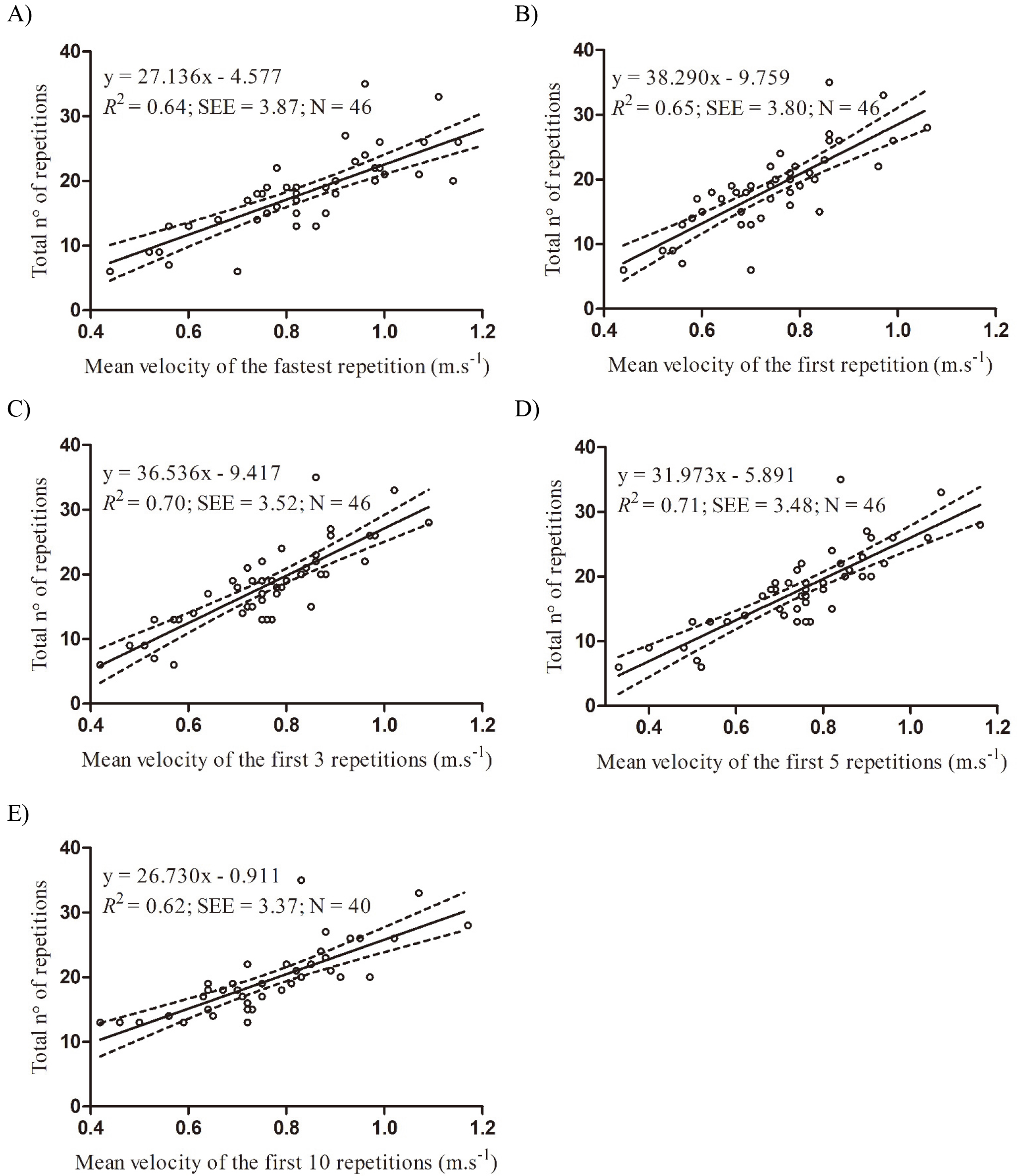
The linear relationship between mean velocity and TR was statistically significant for FR (F(1,44)
Residual plots showing the difference in number of repetitions between the prediction models and the actual total number of repetitions during the NFL-225. (A) FR 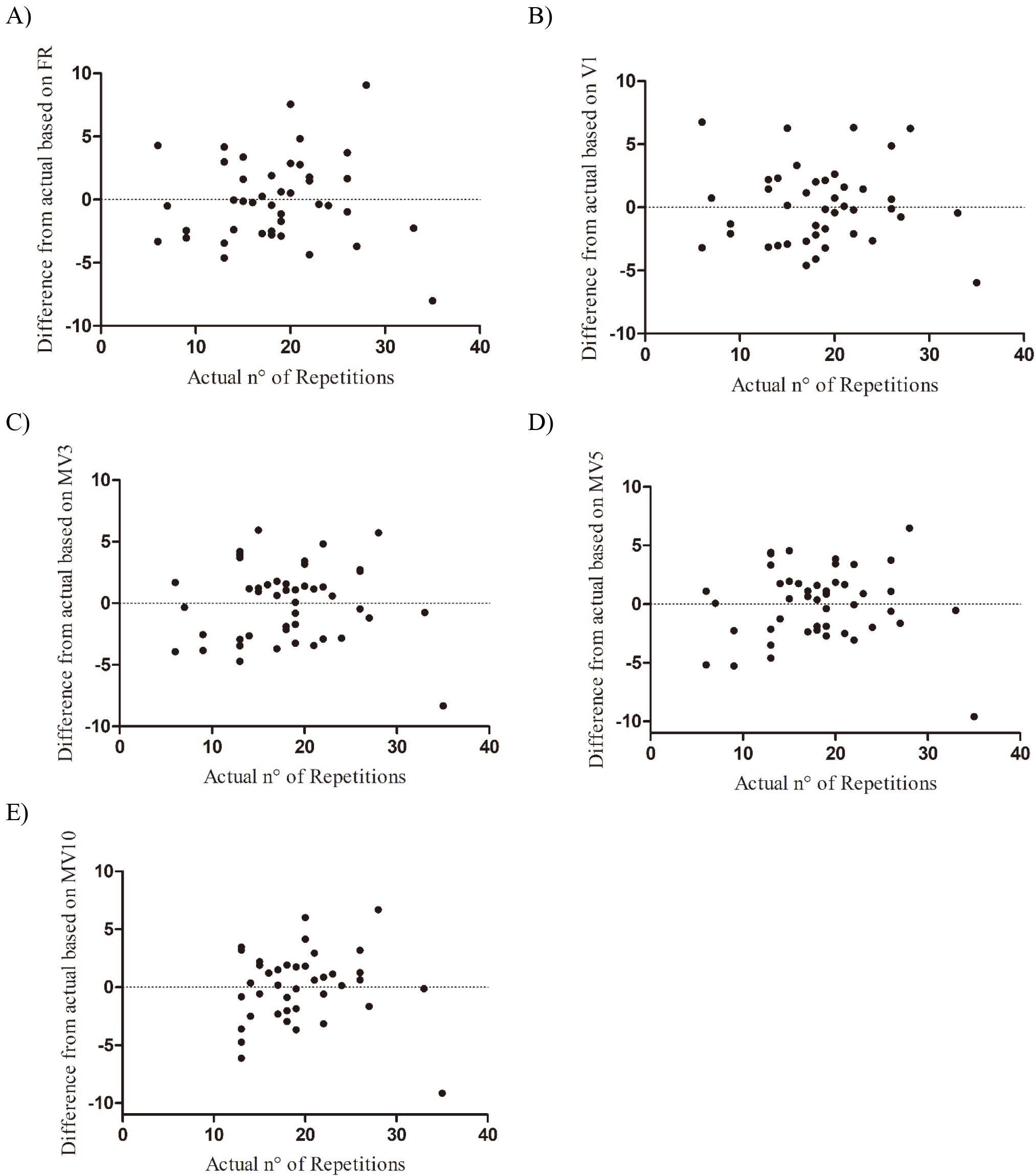
Residual plots, showing the difference between the predicted total number of repetitions based on the single regression model and the actual total number of repetitions were generated (Fig. 2). The visual plots from the residuals of each equation during the NFL-225 indicated good fits for linear models. The error associated with the prediction models remained consistent for all mean velocities (approximately
To the investigators knowledge, this is the first study to assess the potential accuracy of predicting the total number of repetitions during the NFL-225 in a cohort of Division I collegiate football players based on barbell velocity. This analysis revealed (a) mean barbell velocity measurements allowed the production of general regression equations for the estimation of the total number of repetitions performed on in the NFL-225, (b) similar accuracy between FR, V1, MV3, MV5 and MV10, and (c) V1 and MV3 seem to be the best prediction options as they have better time-efficiency and may reduce musculoskeletal stress.
The current study corroborates previously reported studies in that a single repetition can be used to estimate the total number of repetitions in the bench press [7]. Indeed, it should be noted that although similar, SEE was slightly higher for FR and V1 as opposed for MV3, MV5 and MV10. Garcia-Ramos et al. [7] reported a SEE of 3.57 when predicting the total number of repetitions in the bench press based on the mean velocity of the barbell. These investigators relied solely on the velocity of FR across a range of relative loads to predict the total number of repetitions. The researchers also reported that the FR was usually achieved at the first repetition. Interestingly, in the current study, only 20.8% of the subjects reached the FR on the first repetition, and approximately 79.2% of them needed to perform at least 5 repetitions to reach their FR. However, V1 demonstrated to be a good fit for the prediction model regardless of whether it was the FR. Based on these findings, it appears that V1 can be used to estimate performance in the NFL-225 in football athletes as accuracy was similar across the first 5 repetitions.
The findings from this study have several relevant practical applications for the assessment of muscular strength-endurance in football players. Prediction of the athletes’ performance in the NFL-225 based on a single repetition (i.e., V1) could improve testing efficiency and may reduce injury risk based on opportunity for exposure (i.e., performing more repetitions than necessary), and may be used as a potential fatigue monitoring tool while in-season. In preparation for events such as the NFL Combine, performing multiple trials of the NFL-225, even if spaced over several weeks, may be taxing on the individual. In this context, predicting the number of repetitions based on lifting velocity could inform the coach and athlete on training progress while allowing more time to focus on other forms of training and skill development. Furthermore, this assessment can easily be performed during training sessions (i.e., during a warm-up set) to estimate performance on the NFL-225 while minimizing the impact of fatigue on the development of other muscle qualities (i.e., strength and power).
While this was the first study to investigate the possibility of predicting the total number of repetitions in the NFL-225 based on mean velocities, some limitations should be acknowledged. First, in contrast to previous studies that used a Smith machine for data collection [6, 7, 9, 10], data in this study was collected using a standard, free-weight bench press exercise protocol. Although this may result in more between-subject variation, the equipment utilized in the current study is identical to that utilized at the NFL Combine providing a similar testing protocol to the NFL protocol. Second, external factors (e.g., stress, fatigue) should also be accounted for when utilizing prediction equations, as they are additional sources of error. While this was controlled for in this investigation, these factors may impact results if similar protocols are not followed. Lastly, the error associated with the proposed prediction method is approximately 20% of total number of repetitions. For this reason, results should be considered with caution. This indicates that although very practical, the velocity-based prediction method is not a substitute for the actual repetitions-to-fatigue test but a useful alternative in cases in which maximum tests are not feasible. The current study did not include a subsequent session in which the test-retest reliability could be assessed. For this reason, the extent to which the error in predicting the deviation from the actual score cannot be determined and neither its nature (i.e., homo- vs. heteroscedastic) can be characterized. Future studies should consider including a second session in which the reliability of the prediction equations based on the velocity of FR as well as in the others mean velocities may be determined from a submaximal number of repetitions for experienced football athletes. In addition, a cross validation study would allow for the evaluation of the accuracy of the equations presented in this study to different athletic populations (e.g., rugby athletes).
Conclusions
The findings of this study showed that the use of mean velocities allows predicting the total number of repetitions with in the NFL-225. Moreover, the error remained very similar across the different prediction models (approximately 3.5 repetitions). For this reason, the results support the use of the V1 and MV3 due to their accuracy, time-efficiency, and reduced muscle and joint stress.
Author contributions
CONCEPTION: Marcel Lopes dos Santos, James Jay Dawes.
PERFORMANCE OF WORK: Marcel Lopes dos Santos, James Jay Dawes, James Bryan Mann.
INTERPRETATION OR ANALYSIS OF DATA: Marcel Lopes dos Santos, James Jay Dawes.
PREPARATION OF THE MANUSCRIPT: Marcel Lopes dos Santos, James Bryan Mann, James Jay Dawes.
REVISION FOR IMPORTANT INTELLECTUAL CONTENT: Ricardo Berton, Robert George Lockie, Bert Hans Jacobson.
SUPERVISION: James Jay Dawes.
Ethical considerations
Archived data from the strength and conditioning was rendered anonymous and provided to the researchers
for analysis. The study was approved by the university Institutional Review Board for studies involving human subjects (IRB approval: ED-19-117-STW).
Funding
The authors report no funding.
Footnotes
Acknowledgments
The authors have no acknowledgements.
Conflict of interest
The authors have no conflict of interest to report.