




Abstract
BACKGROUND:
The relationship between strength and throwing velocity is much investigated in handball, but core strength is largely ignored. Only four studies have investigated the effect of core training on handball throwing velocity, reporting conflicting results in amateur players. However, lack of specificity and deficient technical execution of throwing in amateurs can obscure the results.
OBJECTIVE:
To examine the direct association between trunk flexion strength and throwing velocity in elite handball players, using women as a model.
METHODS:
Sixteen women players from an elite-level Norwegian handball team participated in the study. Strength in trunk flexion, shoulder extension, internal shoulder rotation, and forearm pronation was assessed using isokinetic dynamometer measurements (peak moment, total work, angular impulse). Throwing velocity in both the standing throw with run-up and the jump throw was determined from motion capture measurements. To account for arm strength, the association between trunk flexion strength and throwing velocity was examined using partial correlation analyses.
RESULTS:
No significant association was found between any measure of trunk flexion strength and throwing velocity for either throwing technique (explained variance
CONCLUSIONS:
The results indicate that isolated, dynamic trunk flexion strength is not a differentiating factor for handball throwing velocity in elite women players.
Introduction
In handball, throwing velocity is an important factor for scoring goals, as a higher ball velocity places a greater dependency on the goalkeeper’s ability to react or anticipate, and may compensate for a lack of accuracy or an inability to trick the goalkeeper with regard to ball placement. Further, throwing velocity typically increases with playing level [1, 2, 3], supporting its importance for performance. From a physical point of view, throwing velocity is primarily dependent on strength and technical execution. The relationship between strength and throwing velocity in particular has been the subject of much investigation in handball. In general, throwing velocity has been associated moderately to largely with both upper and lower extremity strength and power across throwing techniques in both sexes [1, 2, 4, 5]. In line with this, resistance training specific to overhead throwing with both moderate and heavy loads appears to improve throwing velocity [6, 7]. However, core strength is largely absent in the literature on handball throwing.
Across sports, the core is generally considered important for movement performance [8, 9], although, as repeatedly noted [10, 11], the scientific rationale behind this is often lacking. Indeed, no clear link between core strength and athletic performance has yet been established [12]. Rather, the notion appears to derive primarily from the assumption that a certain level of core strength is necessary for general movement stability and injury prevention [8, 10]. The most widely proposed explanation for the performance contribution of the core is essentially that greater core strength can benefit performance indirectly through improved working conditions for movement execution [8, 10, 11], enhancing the transfer of force between the lower and upper extremities and/or allowing the athlete to execute increasingly forceful movements while maintaining control.
Only four studies have investigated the effect of core training on throwing velocity in handball, reporting conflicting results. In senior amateur women [13] and junior men [14], six weeks of dynamic and static strength training did not increase throwing velocity in the standing throw with and without run-up and the jump throw compared to a control group. Contrastingly, in junior women, six weeks of sling-based training significantly increased velocity in the standing throw without run-up by 4.9% compared to a control group [15]. Further, in junior and amateur senior men, ten weeks of dynamic and static strength training significantly increased velocity in the standing throw with and without run-up and in the jump throw by an average of 4.3% (range 3.1–5.2%) compared to a control group [16]. However, as argued by the authors themselves [15, 16], it is unclear whether the mechanism by which these performance improvements were caused is direct (e.g., increased force generation) or indirect (e.g., better conditions for transferring force through the body) in nature.
From a purely anatomical point of view, force must necessarily be transferred through the core to move from the lower to the upper extremities. Although there are variations depending on the method of description, the handball throw – as most throwing motions [17] – is generally characterized by approximately proximal-to-distal sequential motions of the segments involved [18, 19, 20, 21]. It has been shown that most of the work on the ball is done in the last 50 ms before release [18]. Within this period, trunk flexion still occurs, reaching maximum velocity
In addition, the way in which ball velocity is produced might differ between throwing techniques. The presence or absence of ground contact during the throw (i.e., standing throw or jump throw) has been shown to affect the throwing motion in elite men [20], presumably due to different conditions for transferring force from the lower to the upper extremities. Further, throwing velocity in the jump throw has been suggested to depend on torque production capabilities in the upper extremities to a greater degree than in the standing throw, the latter of which allows for the possibility of continuously using the lower extremities to increase ball velocity [24]. What role the core plays in the execution of the respective throwing techniques is uncertain. With regard to kinematics, trunk flexion exhibits a slightly larger range and starts a little earlier in the jump throw than in the standing throw with run-up, but statistically the two throwing techniques are similar in this respect [20]. Interestingly, although men and women do not throw with a fundamentally different technique [25], they have been proposed to differ in the transfer of force; in the standing throw with run-up, men have shown more activity in the transverse plane (pelvis and trunk rotation, horizontal shoulder abduction) whereas women have shown more activity in the sagittal plane (trunk flexion), also reaching a higher trunk flexion velocity [26].
To date, the relationship between core strength and throwing velocity has not been investigated in elite players, which is necessary to eliminate the potential effect of the technical execution of throwing. A population of elite players is also the appropriate model for discriminating between what capacities require a sufficient level for a given performance outcome (e.g., throwing velocity) and what capacities indicate a more linear association. Further, since women show more activity than men in trunk flexion [26], the major trunk movement occurring simultaneously with the most work done on the ball [18, 19, 21], they represent a reasonable design for investigating the relationship between core strength and throwing velocity. Therefore, to better inform strength training practice, the aim of this study was to examine the direct association between standardized dynamic trunk flexion strength and overhead throwing velocity in elite women handball players in both the standing throw with run-up and the jump throw. Based on the totality of previous findings and the kinematics of the overhead throw, trunk flexion strength was hypothesized to be positively associated with throwing velocity. However, due to the uncertainty in the literature, no directional hypotheses were formulated with regard to potential different effects of trunk flexion strength between the two throwing techniques.
Methods
Participants
Sixteen women players from an elite-level Norwegian handball team participated in the study (mean
Experimental protocol and data analysis
Isokinetic strength tests
All strength tests were performed seated in concentric isokinetic mode using a Biodex System 3 PRO model 830–210 (Biodex Medical Systems, Inc., Shirley, NY, USA), set up in accordance with the manufacturer’s specifications and recorded at 100 Hz. The order of the tests was the same for all participants: trunk flexion, shoulder extension, internal shoulder rotation, and forearm pronation. Gravity compensations were made for the participants’ limb-segments and the dynamometer attachments. The angular velocities were lower than what typically occurs in handball throws (e.g., [3, 20, 27]), being selected after pilot testing as the highest velocities for which there was sufficient resistance to produce measurable force while maintaining the relative velocity differences between the movements (internal shoulder rotation
The participants performed a 10-min dynamic, self-regulated warm-up with ergometer cycling and elastic bands. Before each test, the participants were given instructions followed by a test-trial. They were further instructed to perform the movement as fast and forcefully as possible, with self-regulated rest between each of three repetitions. The participants received verbal support, but no visual feedback. All strength tests were completed within a period of 1-h.
For the trunk flexion test, the participants were secured with auto-adhesive straps horizontally across the femur and pelvis and diagonally across the chest from each shoulder, with the feet resting on the footrest and arms crossed over the chest. The ROM comprised the full possible range of the dynamometer attachment. Trunk flexion was performed at 120
For all arm tests, the participants were secured with auto-adhesive straps horizontally across the pelvis and diagonally across the chest from the contralateral shoulder, with the non-throwing arm resting in the lap. Due to slight differences in flexibility, ROM was individually adjusted to avoid discomfort and to minimize injury risk. Shoulder extension was performed with approximately 10
A sub-section of the tested ROM was extracted for analysis (45–80
Schematic diagram of the experimental setup for throwing tests. Eight cameras (white triangles) were angled toward the throwing area (black dotted line represents throwing line), located 8 m away from a 1 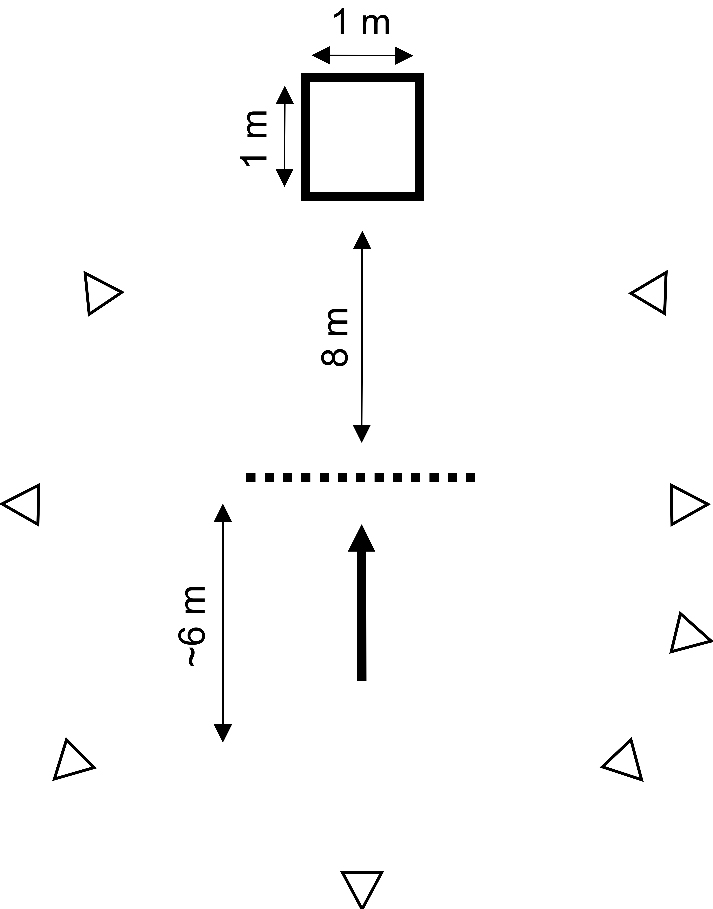
One week after the strength tests, throwing tests were performed on an inside court, with eight motion capture cameras (Oqus 400, Qualisys AB, Gothenburg, Sweden) placed in a circle around the designated throwing line (Fig. 1). The camera system was calibrated according to the manufacturer’s specifications and kinematic signals were recorded at 250 Hz using Qualisys Track Manager 2.10 (Qualisys). On each participant, passive spherical reflective markers (Ø 16 mm; Qualisys) were placed bilaterally on the lateral malleolus (ankle), trochanter major (hip), and on the middle phalanx III on the hand of the throwing arm. In addition, two markers were placed on opposite sides of the ball to detect its center, eliminating the contribution of spin to velocity. A 1
Following a self-regulated 15-min warm-up of treadmill running, dynamic stretching with elastic bands, and throwing activities (including familiarization with the test setup), the participants completed a 5-s measurement with a normal grip on the ball to determine the grip distance (mean distance between the middle phalanx III and the center of the ball). The participants then performed five standing throws (ST) and 5 jump throws (JT) for maximal velocity, each with a 3-step run-up. An attempt was regarded as successful when the participant hit the target area with the ball. The participants were given
The data were processed in Matlab R2016b (version 9.1.0.441655, Mathworks). Kinematic signals were spline interpolated where missing data gaps were
Statistical analyses
To examine the association between trunk flexion strength (peak moment, total work, angular impulse) and throwing velocity, second-order partial correlation analyses were performed for both throwing techniques with arm strength and body mass as control variables. To preserve statistical power, a composite variable (see e.g., [30]) representing arm strength was created for each measure of trunk flexion strength, calculated as the unweighted sum of shoulder extension, internal shoulder rotation, and forearm pronation. The correlations between run-up velocity and throwing velocity were checked using Pearson’s product-moment correlation coefficient. For all correlations, 95% confidence intervals (CI) were constructed using bootstrapping. Normality was assessed with the Shapiro-Wilk test as well as visually (histogram, Q-Q plot), and skewness and kurtosis z-scores were
Differences in partial correlations with trunk flexion strength between throwing velocity in ST and in JT were assessed with t-tests by comparing dependent
where
The differences in throwing velocity and run-up velocity between throwing techniques were checked using paired
Intraclass correlation coefficient (ICC) estimates with 95% CI were calculated based on a consistency two-way mixed model and within-participant coefficients of variation (CV) were calculated as the root mean square of individual CVs (Table 1). All statistical analyses were performed in SPSS version 24 (IBM Corporation, Armonk, NY, USA), except differences between partial correlations, which were analyzed using Microsoft Excel (Office 2016; Microsoft Corp., Redmond, WA, USA). The level of statistical significance was set at
Results
Descriptive values are shown in Table 1. Throwing velocity was significantly higher in ST than in JT (mean
Mean
standard deviation (SD) of descriptive variables (
16), with intraclass correlation coefficients (ICC) with 95% confidence intervals (CI) and within-participant coefficients of variation (CV)
Mean
With arm strength and body mass accounted for, the association between trunk flexion strength and throwing velocity was non-significant for peak moment for both ST (
Residual plots of the partial association between trunk flexion strength (peak moment, total work, angular impulse) and throwing velocity in the standing throw (top row: a, c, e) and in the jump throw (bottom row: b, d, f), controlling for composite arm strength and body mass. Solid lines represent least squares regression. No associations were statistically significant.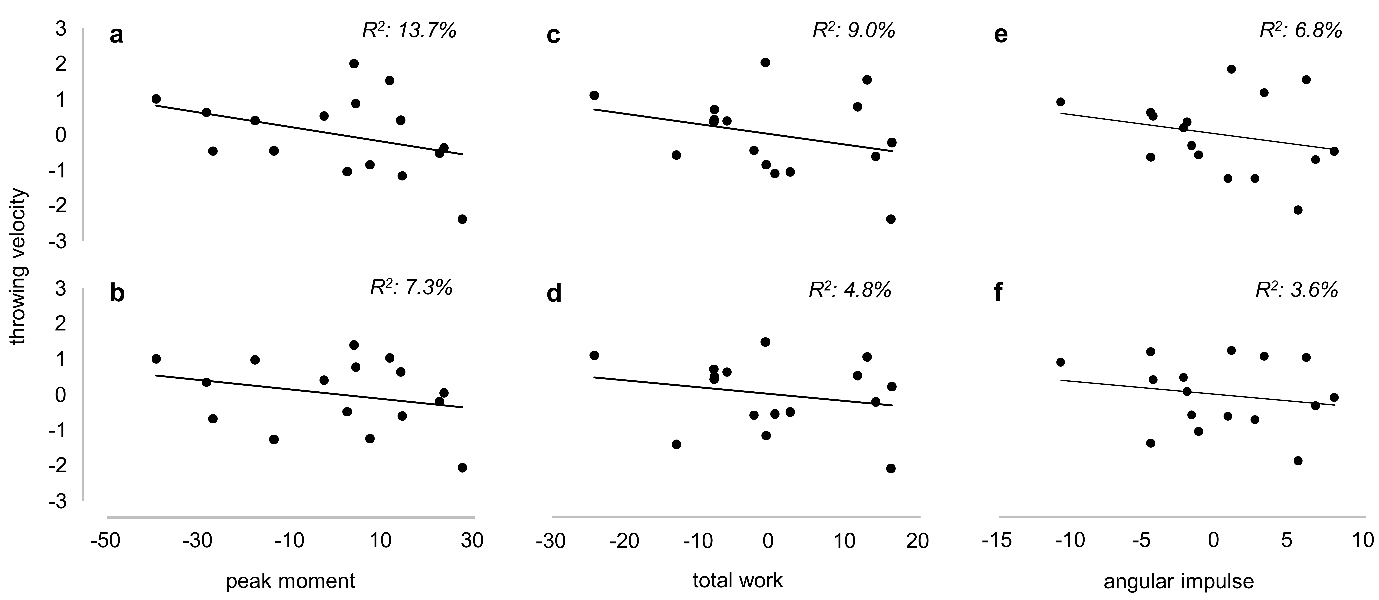
Similarly, the associations between trunk flexion strength and throwing velocity for peak moment, total work, and angular impulse were not significantly different from each other for ST (peak moment vs. total work:
The aim of this study was to examine the direct association between trunk flexion strength and overhead throwing velocity in elite women handball players in both the standing throw with run-up and the jump throw. Contrary to what was hypothesized, no significant association was found for either throwing technique for any of the measures of trunk flexion strength, and the explained variance was only
The main results do not support the idea that the effect of trunk flexion strength on handball throwing velocity could be direct in nature, with the mechanism simply being increased force generation, nor do they indicate that the role trunk flexion strength plays for throwing velocity differs between the throwing techniques tested. Interestingly, these results were consistent across different measures of trunk flexion strength targeting different strength capacities (peak moment representing the momentary absolute peak, total work representing the cumulative work over the entire performance-relevant ROM, and angular impulse representing the practical notion of “explosiveness”) in both throwing techniques, further bolstering the argument against a direct relationship between trunk flexion strength and throwing velocity.
The expertise of the participants should eliminate the possibility that a true effect of greater trunk flexion strength could have been obscured by poor technical execution of throwing. Rather, it can be speculated that they had all reached a sufficient level of strength, after which further increases no longer affect throwing velocity and hence other factors are determining. Whether a linear relationship between trunk flexion strength and handball throwing velocity exists below a certain level of strength is not known. Although the technical proficiency of players is invariably difficult to control, the apparent existence of a threshold for sufficient strength has been found previously [35], with weaker amateur women players displaying a significant linear relationship between one-repetition maximum bench press and throwing velocity, while the associations were lower and non-significant in stronger national and international elite women players. However, this might also simply indicate that at a lower level, the better players are typically better at everything. Overall, the results indicate that, at the elite level, dynamic trunk flexion strength should not be incorporated in training programs with the purpose of improving throwing velocity in women players.
It is worth noting that only concentric trunk flexion strength was measured in this study, as opposed to a more comprehensive test of core strength. Eccentric trunk extension strength is necessary to decelerate the trunk, which could facilitate the acceleration of the more distally located arm, per the principle of proximal-to-distal sequencing [17]. Therefore, it might influence throwing velocity. However, considering that trunk flexion reaches maximum velocity as late as
It has been stated that the challenge for researchers in identifying objective core strength measures that are relevant for dynamic athletic performance (i.e., sufficiently specific to the chosen performance test) is the complexity of the core anatomy [36]. Although there is much debate about what anatomical structures constitute the core and the definitions of both core strength and core stability (for detailed discussions on these topics, see e.g., [8, 10]), core strength and core stability are inextricably linked, as the stability must necessarily derive primarily from muscular strength. In the current study, no attempt was made to define the core, but rather a movement (trunk flexion) was chosen that both isolates musculature in the abdomen and the lumbo-pelvic region (which fall under most, if not all, definitions of the core) and is an identifiable part of the handball throwing movement [19, 21, 22, 26]. Further, isokinetic dynamometer measurements were chosen as the method to assess core strength in an effort to obtain an objective, standardized measure, with different measures of strength (peak moment, total work, angular impulse) to encompass a range of strength capacities. Considering the duration of movement (across all three measures of trunk flexion strength, the time from movement initiation to the end of the analyzed acceleration-phase ROM was 0.36
Insufficient specificity in testing might be a contributing factor to why core strength, despite its widely presumed importance in sports [8, 9], is notoriously difficult to relate to performance outcome [12]. In the existing literature, this issue is exemplified by common tests such as variations of the medicine ball throw regularly functioning both as a test of athletic performance (e.g., [36, 38]) and as a test of core strength (e.g., [39, 40]). This is problematic not only because of the potential issues related to the validity of the tests themselves but also because it makes it difficult to relate core strength to athletic performance across studies. The standardized test battery for core strength established by McGill [41] has also been employed when attempting to demonstrate a connection to athletic performance (e.g., [38, 42]), but this focuses on static endurance, and as such is not specific to the typically dynamic nature of sport-specific movements. However, in the current study, with an objective, standardized, isolated strength test of core musculature (isokinetic trunk flexion) that has shared kinematics with the chosen sport-specific performance test (the overhead throw), still no direct connection with throwing velocity was evident across a range of strength capacities. From a practical point of view, insufficient specificity can cloud the picture when performing regular testing of players to track performance-relevant progress and is something practitioners must be conscious of when gathering information on core strength from the scientific literature.
Based on the present results, if core strength does contribute to throwing velocity, as suggested by the outcome of some previous intervention studies in handball [15, 16], it appears more likely to do so indirectly (e.g., through facilitating the transfer of force from the lower to the upper body). An interesting supplemental theory, which has been postulated for the baseball throw, is that the rectus abdominis, which is important for trunk flexion, contributes to the centripetal force required for the circular motion of the arm [43]. This would connect the level of core strength to the angular velocity of the arm that can be achieved while maintaining the desired path of the handball throwing motion (i.e., proper technique), and is an avenue that deserves further exploration.
Limitations
It is important to note that a seated test configuration for measuring trunk flexion strength does not simulate the functional execution of the handball throw with regard to biomechanics. Rather, it is a measure of isolated segment strength, in which the measurement condition naturally represents a limitation with regard to the functional execution of a more complex movement. As such, the results must be interpreted with caution, i.e., as representing the direct association of throwing velocity with a strength capacity, not with a replication of the strength performance during throwing.
Further, based on the presumably different conditions for transferring force between throwing techniques [20], it could be argued that standing trunk flexion corresponds better to the functional execution of the standing throw, in which the lower body can contribute continuously, whereas seated trunk flexion corresponds better to the functional execution of the jump throw, in which a greater reliance on the upper body has been suggested [24]. In this, the test configuration used in the current experiment represents a potential limitation with regard to the standing throw. Given the similarity and consistency in results between the two throwing techniques, it is difficult to evaluate the level of influence this might have had on the outcome.
Notably, as discussed previously, only concentric trunk flexion was tested. Thus, there is likely an eccentric-concentric coupling occurring in the trunk flexors during the throwing movement that is not reflected in the test configuration. However, with self-regulated rest between repetitions, the participants performed the three repetitions in immediate succession (the time from the end of a repetition and from regaining the starting position after a repetition, respectively, to the start of the next repetition was 2.75
Lastly, this study did not include men, with suitable tests of trunk strength corresponding to their throwing kinematics. Therefore, the findings can only be considered representative for women.
Conclusion
No significant association was found between trunk flexion strength and overhead throwing velocity for either peak moment, total work, or angular impulse in either the standing throw with run-up or the jump throw. Of note, the strength of association did not differ between these two commonly used throwing techniques for any of the measures of trunk flexion strength or between measures of trunk flexion strength for the two throwing techniques. This indicates that isolated, dynamic trunk flexion strength is not a differentiating factor for handball throwing velocity in women players at the elite level. Accepting the widely held experience-based, practice-driven belief that core strength is in fact important for athletic performance, the absence of a direct relationship with throwing velocity necessarily strengthens the support for an indirect relationship. Overall, the results of the current study contribute to growing the body of knowledge on the under-researched relationship between core strength and athletic performance. Future studies should strive to use objective, standardized tests for measuring strength in core musculature and explore the potential mechanisms behind an indirect relationship between core strength and throwing velocity.
Author contributions
CONCEPTION: David McGhie, Sindre Østerås and Tommy Tomasa.
PERFORMANCE OF WORK: Tommy Tomasa, David McGhie and Sindre Østerås.
INTERPRETATION OR ANALYSIS OF DATA: David McGhie, Tommy Tomasa and Sindre Østerås.
PREPARATION OF THE MANUSCRIPT: David McGhie, Tommy Tomasa and Sindre Østerås.
REVISION FOR IMPORTANT INTELLECTUAL CONTENT: David McGhie.
SUPERVISION: David McGhie.
Ethical considerations
The study was approved by the Norwegian Centre for Research Data (project number 50503, November 15, 2016). Written informed consent was obtained for all participants. For participants
Funding
The authors report no funding.
Footnotes
Acknowledgments
The experiment was performed at the core facility Next Move, Norwegian University of Science and Technology (NTNU). The authors would like to thank the club and the participating players for their cooperation during the experiment, as well as Per Bendik Wik for valuable assistance in the laboratory.
Conflict of interest
The authors have no conflicts of interest to report. Given his role as an Editorial Board Member, David McGhie had no involvement nor access to information regarding the peer review of this article.