Explosive strength and change of direction speed (CODS) are relevant physical abilities in karate.
OBJECTIVE:
To examine the relationship between the characteristics of explosive strength and the 5-m linear sprint (5M) with CODS performance and ii) to examine the influential characteristics of explosive strength on CODS performance.
METHODS:
Eighteen cadet and junior karate athletes, eight females and ten males were evaluated. The physical abilities assessments included: squat jump (SJ), countermovement jump (CMJ), 5M and CODS. Also, pre-stretch percentage increase (PSA), eccentric utilization index (EUR) reactive strength index (RSI) were calculated.
RESULTS:
Superior performance ( 0.05) was documented in SJ, CMJ and CODS in male vs. female. Also, significant correlations between CODS with SJ and CMJ (0.70 to 0.80; 0.51 to 0.73; 0.05, respectively) and correlations (0.14 to 0.22; 0.01 to 0.04; 0.05) between CODS with RSI, EUR and PSA. Multiple regression model documented that only SJ significantly influenced CODS performance in male ( 60%; 0.009) and female ( 71%; 0.001).
CONCLUSION:
CODS correlate with SJ and CMJ. In particular, SJ influence CODS independently of gender.
Karate in the modality of kumite is a sport classified by age that includes cadets (14–15 years) and juniors (16–17 years) [1]. It is also described as a complex and multifactorial sport of considerable technical-tactical ability whose performance depends, among other factors, on understanding the interaction of the physical abilities that characterize it [2, 3]. For example, during kumite, athletes execute dynamic and explosive motor actions of attack and defense of high intensity and short duration (0.3 to 3.0 s) necessary to score points to the opponent [4, 5]. In fact, lower body explosive strength, usually assessed indirectly through the maximum height reached in squat jump (SJ) and countermovement jump (CMJ), among other strength tasks, has been shown to have a significant relationship ( 0.05) between acceleration and impact with the punch strike techniques in male and female karate athletes [6]. In addition, international male and female athletes report superior performance in height reached in SJ and CMJ vs. national or amateur athletes [2]. Therefore, the athletes require optimal development of explosive strength characteristics. On the other hand, some authors suggest that athletes need to continuously change direction [2, 7]. In this sense, agility, and particularly change of direction speed (CODS), among other physical abilities, has been shown to be a predictor of success (medalists in European championships) in female karate athletes [1]. Thus, explosive strength and CODS are physical abilities considered relevant in this sport.
In this context, some studies in combat sports have reported significant correlations ( 0.05) between CODS with SJ and CMJ, including karate [7], taekwondo [8, 9] and fencing [10]. However, although this analysis is frequently used in biomedical and sports sciences, it only allows us to determine the strength but not the direction of the relationship between the variables of interest [11, 12, 13, 14]. That is, it does not allow establishing the influence of one or multiple variables on the change of another variable (or dependent variable) [13, 14]. Furthermore, this type of statistical analysis is conditioned by statistical power (e.g. the level of statistical significance and the sample size) [12] and biases (e.g., selection biases; measurement and confounding biases) [15, 16, 17, 18]. According to the above, to accurately determine the relationship the physical abilities of explosive strength that could influence and/or determine in the performance in the CODS, some reports have used predictive models through linear regression analysis. The reports include young male soccer players ( 60; age 17 0.4 years) [19], female professional basketball players ( 12; age 24.25 2.55 years) [20], male and female college students ( 63; age 20.0 1.8 years) of team sports (soccer, team handball, basketball and volleyball; 80% of male and 75% of female) and to a lesser proportion in martial arts, gymnastics and dance [21], professional female soccer players ( 10; age 25.4 7.0 years) [22] and girls gymnasts ( 50; age 8 0.7 years) [23]. However, linear regression results show that jumping performance, linear sprint and other strength tasks explain in different proportions the changes in the variance of CODS performance, depending on the type of strength test applied, the CODS test performed and the gender analyzed. On the other hand, from SJ and CMJ, other indexes permit to analyze the eccentric strength through the eccentric utilization index (EUR) or the pre-stretch augmentation (PSA) and reactive strength from the reactive strength index [24, 25, 26, 27]. However, the relationship and influence of different characteristics of explosive strength including the aforementioned indexes on CODS performance in karate athletes is still limited. From a practical perspective, the monitoring and control of these components could be useful for coaches in the development of the different manifestations of explosive strength during physical preparation or training effect given their easy assessment and estimation [26]. and to identify the determinant and/or influential components in CODS performance. Therefore, the main purpose of the present study was i) to examine the relationship between the characteristics of explosive strength and the 5-m linear sprint (5M) with CODS performance and ii) to examine the influential characteristics of explosive strength on CODS performance. Among the hypotheses formulated, it is suggested that i) CODS performance would be significantly correlated with explosive strength characteristics and ii) concentric characteristics and the shortening-stretching cycle could significantly influence CODS performance.
Methods
Participants
The sample consisted of 18 karate kumite athletes distributed in 8 female (age 14 2 years; body height 153 7 cm; body mass 50.9 9 kg; the percentage of fat mass 26 5.6%; training experience 5 1 years) and 10 male (age 17 2 years; body height 168 5 cm; body mass 67.4 13 kg; the percentage of fat mass 12.2 6.5%; training experience 5 1 years) of cadet and junior karate official categories participate in this study. The athletes belonged to a national and international competitive karate school affiliated with the Chilean National Karate Federation (an organization recognized by the World Karate Federation or WKF). To be included, the athletes had to meet the following criteria: (i) systematic training for more than four years, for at least three times a week, (ii) uninterrupted training before their inclusion in the study for 6 months, and (iii) the absence of musculoskeletal injuries. All athletes and/or family members of athletes under 18 years of age were informed previously about the purpose of the assessments, associated benefits, experimental procedures, and potential risks, and gave informed consent before the first session. In addition, ethics committee approval was not required because the data were obtained as part of routine assessments at the beginning of the training season [28]. Nevertheless, the study was conducted in accordance with the Declaration of Helsinki on Work Involving Human Subjects [29].
Testing procedure
This was an observational, cross-sectional design examining the relationship between lower body explosive strength and 0–5 m sprint characteristics with CODS performance. Sample size calculation assumed 80% power with an alpha of 0.05 and was calculated using G-Power software version 3.1.9 based on previous literature [22]. Adequate sample size was calculated to be at least seventeen athletes for use in the regression analysis. The athletes were recruited during the month of February 2020, as part of the baseline fitness assessments for the annual period of specific physical preparation. The physical abilities studied were selected taking into account their relevance in this sport [2, 6] and the usual application of the tests used in the athletes analyzed. Prior to the assessments, athletes were instructed to: (i) sleep for 8 h, (ii) maintain their usual eating and hydration habits, (iii) not consume stimulant drinks prior to the assessments. The assessments sessions were conducted on two consecutive days with 24 h between sessions, in an enclosed area with a tatami floor (approved by the WKF) commonly used in the competition of this sport. On the first day in a fasting state, body height (cm) was assessed using a stadiometer (Bodymeter 206) with an accuracy of 1 mm following standardized protocols [30]. Briefly, the athletes were positioned without shoes, with heels together, back and buttocks touching the vertical surface of the stadiometer, and head positioned in the Frankfort plane. Subsequently, body mass (BM) and, percentage fat mass (%FM) were assessed using an electric bioimpedance scale (InBody120, 20 100 kHz tetrapolar tactile electrode system, model BPM040S12F07, Bio-space, Inc, Seoul, Korea with an accuracy of 0.1 kg) using standardized protocols [31]. On the second day, at the beginning of the physical fitness assessment session, athletes performed a typical warm-up in this sport, lasting 15-min, consisting of joint mobility, usual jogging for five min, dynamic stretching (three min), three SJ and CMJ tests (two min) and, a trial of the CODS test. The athletes were previously instructed to give their maximum effort during the assessments. The physical abilities were evaluated according to muscle intensity in the following order: i) SJ, ii) CMJ, iii) 5M and, iv) CODS. A 5-min rest interval was applied between each assessment. Care was taken to ensure sufficient rest between all tests to limit fatigue effects in subsequent trials and tests [32].
Explosive strength characteristics
Indirectly, lower body explosive strength characteristics were assessed by SJ and CMJ tests through the maximum height reached (cm) using an electronic contact platform (Ergojump; Globus, Codogne, Italy) with an accuracy of 0.01 m. The SJ test was used to evaluate concentric characteristics. For this, athletes were previously instructed to rest their hands on their hips, feet and shoulders wide apart, and adopt a flexed knee position (approximately 90) for 3-s, and then perform a maximal effort vertical jump. Meanwhile, the CMJ test was used to assess the slow stretch-shortening cycle (SSC). Previously, athletes were instructed to rest their hands on their hips, feet and shoulders wide apart; and perform a downward movement (no restrictions were imposed on the knee angle achieved) followed by a maximal effort vertical jump [33]. In both tests, they were instructed to land upright and bend their knees after landing. Subsequently, from the performance of the SJ and CMJ, the contribution of eccentric strength was indirectly assessed in absolute terms by the eccentric utilization ratio (EUR), using the equation EUR (CMJ/SJ) [25, 26]. Also, in percentage terms by pre-stretch increase (PSA) PSA ((CMJ SJ)/SJ) 100 [34]. The reactive strength was calculated by the reactive strength index (RSI) RSI (CMJ SJ) [34]. Three trials were completed, with a 30-s rest between attempts, and the best performing trial from both tests was used for subsequent statistical analysis.
Change of direction speed (CODS)
To assess CODS in a multidirectional manner (i.e., forward, lateral, and backward), the T-test was used, assessing the time required to complete the 40-m run, previously applied to karate athletes [35] and according to the recommendations of Seo et al. [36]. For this purpose, four “T” cones were established. Each participant started by running towards cone A (0- to 10-m), then to cone B (A-B: 5-m), touching the top of the cone with the right hand; then, the participant turned left and walked away as fast as possible with lateral steps towards cone C (B-C: 5-m) until touching the top of the cone. Next, they reversed directions and moved away using lateral steps towards cone D (C-D: 10-m) touching the top of the cone. After that, they backed off laterally to touch cone B (D-B: 5-m) and finally ran backward to cone A (B-A: 5-m). The speed was recorded by an automatic timing system using electronic photocells (Brower Timing System, Salt Lake City, UT) with an accuracy of 0.001-s. The gates were positioned 1-m above the ground. Athletes performed two trials with two min rest between attempts and the best time of two trials was recorded at the nearest 0.01-s for further statistical analysis.
Linear sprint in 5-m (5M)
To assess the acceleration of a linear sprint from 0- to 5-m, the time required to complete the test was recorded using photoelectric cells (Brower Timing System, Salt Lake City, UT) with 0.001-s accuracy. Participants started in a standing start 0.3-m before the first infrared photoelectric gate, which was placed 0.75-m above the ground [9]. They completed two trials with two min of passive rest between, using the best performing 5M test for subsequent statistical analysis.
Statistical analysis
All athlete data analyzed are presented using mean and standard deviation (SD) and statistically analyzed with the statistical package for the social sciences (SPSS) v.21 for Mac (Chicago, IL, USA) with the exception of the reliability of the assessments using the Hopkins [37] spreadsheet. Normality and homoscedasticity of variance of the data were verified by Shapiro-Wilk and Levene tests ( 0.05), respectively. Absolute and relative reliabilities were assessed using the typical error of measurement (TEM) as coefficient of variation (CV) and the intraclass correlation coefficient (ICC) [38]. A Student’s t-test for independent groups was used to determine the differences between physical abilities between the two genders. Cohen’s d was also applied to determine the magnitude of reported differences in physical ability performance in both genders. The correlation between the independent variables or physical abilities with the dependent variable or CODS was examined using Pearson’s correlation with the 90% confidence coefficient (90%CI) [32]. In addition, to validate the concept of generality, where a value 0.71 or higher would suggest a minimum common variance of 50%, the coefficient of determination () was estimated to express the strength of change in percentage terms in CODS performance according to the change in the independent variables [32]. The magnitude of the correlations and the magnitude of the test effect were interpreted using the following thresholds 0 to 0.30 [low]; 0.31 to 0.49 [moderate]; 0.50 to 0.69 [large]; 0.70 to 0.89 [very large]; and 0.90 to 1.0 [a near-perfect to perfect correlation] [32]. Subsequently, in order to help elite karate coaches estimate the degree of change in CODS performance from explosive strength characteristics, a multiple linear regression model with a forward stepwise regression analysis was used [39]. This involved a one-way analysis of variance (ANOVA) to determine the differences between the independent variables analyzed [39]. A standard residuals analysis to detect outliers [34]. Furthermore, the possibility of collinearity between predictor variables in the multiple regression models was examined using the variance inflation factor (VIF) and the tolerance (i.e. VIF 10 and tolerance 0.2) [40]. Finally verified by the Durbin-Watson test. The level of statistical significance was set at 0.05 and 90% confidence limits were used where appropriate (90%CI).
Reliability measures of the analyzed outcomes ( 18)
Female ( 8)
Male ( 10)
SJ (cm)
ICC ()
0.98 (0.94 to 0.99)
0.88 (0.71 to 0.96)
TEM (cm)
0.78 (0.60 to 1.30)
2.42 (1.87 to 3.54)
CV (%)
4.0 (3.1 to 6.8)
8.1 (6.2 to 13.9)
CMJ (cm)
ICC ()
0.98 (0.94 to 0.99)
0.93 (0.82 to 0.97)
TEM (cm)
0.97 (0.75 to 1.61)
2.14 (1.65 to 3.14)
CV (%)
4.5 (3.5 to 7.7)
7.8 (6.0 to 13.4)
5M (ms)
ICC ()
0.88 (0.62 to 0.97)
0.67 (0.23 to 0.88)
TEM (ms)
0.03 (0.02 to 0.06)
0.03 (0.02 to 0.05)
CV (%)
2.8 (1.9 to 5.0)
2.3 (1.6 to 4.2)
CODS (s)
ICC ()
0.97 (0.91 to 0.97)
0.94 (0.81 to 0.98)
TEM (s)
0.23 (0.16 to 0.42)
0.23 (0.17 to 0.38)
CV (%)
1.7 (1.2 to 3.1)
2.0 (1.4 to 3.6)
Data are presented as mean with 90% confidence interval (90%CI)
Means: ICC: intra-class correlation as ; TEM: typical measurement error as absolute terms; CV coefficient of variation as percentage. SJ: squat jump; CMJ countermovement jump; 5M: sprint to 0 to 5-m; CODS: change of direction speed.
Differences between the physical abilities of karate kumite athletes according to gender ( 18)
Female ( 8)
Male ( 10)
(90%CI)
Physical abilities
SJ (cm)
21.8 4.00
31.4 6.20
0.003**
1.6 (0.5 to 2.7)
CMJ (cm)
23.9 4.90
33.7 6.60
0.005**
1.5 (0.4 to 2.6)
5M (m s)
1.22 0.07
1.07 0.04
0.001***
2.9 (3.7 to 1.2)
CODS (s)
13.64 1.06
11.8 0.69
0.001**
1.9 (3.0 to 0.7)
RSI (index)
2.15 1.73
2.29 0.57
0.89
0.3 (0.8 to 0.9)
PSA (%)
9.99 8.44
7.53 7.93
0.54
0.2 (1.2 to 0.6)
EUR (ratio)
1.10 0.83
1.07 0.08
0.54
0.2 (1.2 to 0.6)
Data are presented as mean standard deviation. Means: : value; : cohen’s as effect size with confidence interval with the 90% (90%CI); Statistically significant differences: * 0.05; ** 0.01; *** 0.001. SJ: squat jump; CMJ countermovement jump; 5M: linear sprint from 0- to 5-m; CODS: change of direction speed; RSI: reactive strength Index; EUR: eccentric utilization ratio; PSA: pre-stretch augmentation percentage.
Correlations between CODS performance and physical abilities in the female and male karate kumite athletes analyzed ( 18)
Female ( 8)
Male ( 10)
90%CI
90%CI
SJ (cm)
0.85
0.73
0.006**
0.97 a 0.38
0.78
0.60
0.007**
0.94 to 0.29
CMJ (cm)
0.75
0.56
0.03*
0.95 a 0.09
0.71
0.51
0.01*
0.92 to 0.16
5M (ms)
0.81
0.65
0.01*
0.24 a 0.96
0.35
0.12
0.31
0.35 to 0.80
RSI (index)
0.14
0.02
0.73
0.76 a 0.62
0.02
0.00
0.94
0.61 to 0.64
EUR (ratio)
0.22
0.04
0.59
0.57 a 0.80
0.12
0.01
0.72
0.54 to 0.70
PSA (%)
0.22
0.05
0.58
0.56 a 0.80
0.12
0.01
0.73
0.54 to 0.70
Means: : correlation; : coefficient of determination; : -value; 90%CI: interval confidence with 90% SJ: squat jump; CMJ: countermovement jump; 5M: linear sprint 0 to 5-m; CODS: change of direction speed; RSI: reactive strength index; EUR: eccentric utilization ratio; PSA: pre-stretch augmentation percentage.
Results
Reliability of the assessments analyzed
Table 1 presents in detail the reliability analysis of the assessments. The reliability of most of the assessments was acceptable in relative (ICC 0.80) and absolute terms (TEM as CV 10%). Except for the 5M for male athletes in absolute terms.
Differences between performance in males and females
Table 2 presents in detail the differences between the performance of the analyzed outcomes of the athletes according to gender. Among the main findings were significantly superior performance in males vs. females for SJ, CMJ, 5M and CODS. On the other hand, no significant differences in PSA, RSI and EUR performance were documented.
Correlations
The analysis of the correlations is presented in detail in Table 3. Significant correlations ( 0.05) were documented in both male and female athletes between CODS with SJ and CMJ. In addition, a significant correlation ( 0.05) between CODS and 5M in female athletes. On the other hand, no significant correlations were recorded between CODS with RSI, EUR and PSA in both genders and between CODS and 5M in males.
Regression analysis
The multiple regression model based on the forward step method showed that the data analyzed did not show outliers that met the assumptions of collinearity and independent errors. Particularly in females, the model did not contain outliers (minimum standard residue: 1.23, maximum standard residue: 1.65), meeting the collinearity assumption (minimum tolerance: 1.00, maximum VIF: 1.00) and the independent error assumption (Durbin-Watson value: 2.56). Similarly, it was presented in males (minimum standard residue: 1.27, maximum standard residue: 2.01), complying with the collinearity assumption (minimum tolerance: 1.00, maximum VIF: 1.00) and the independent error assumption (Durbin-Watson value: 2.13).
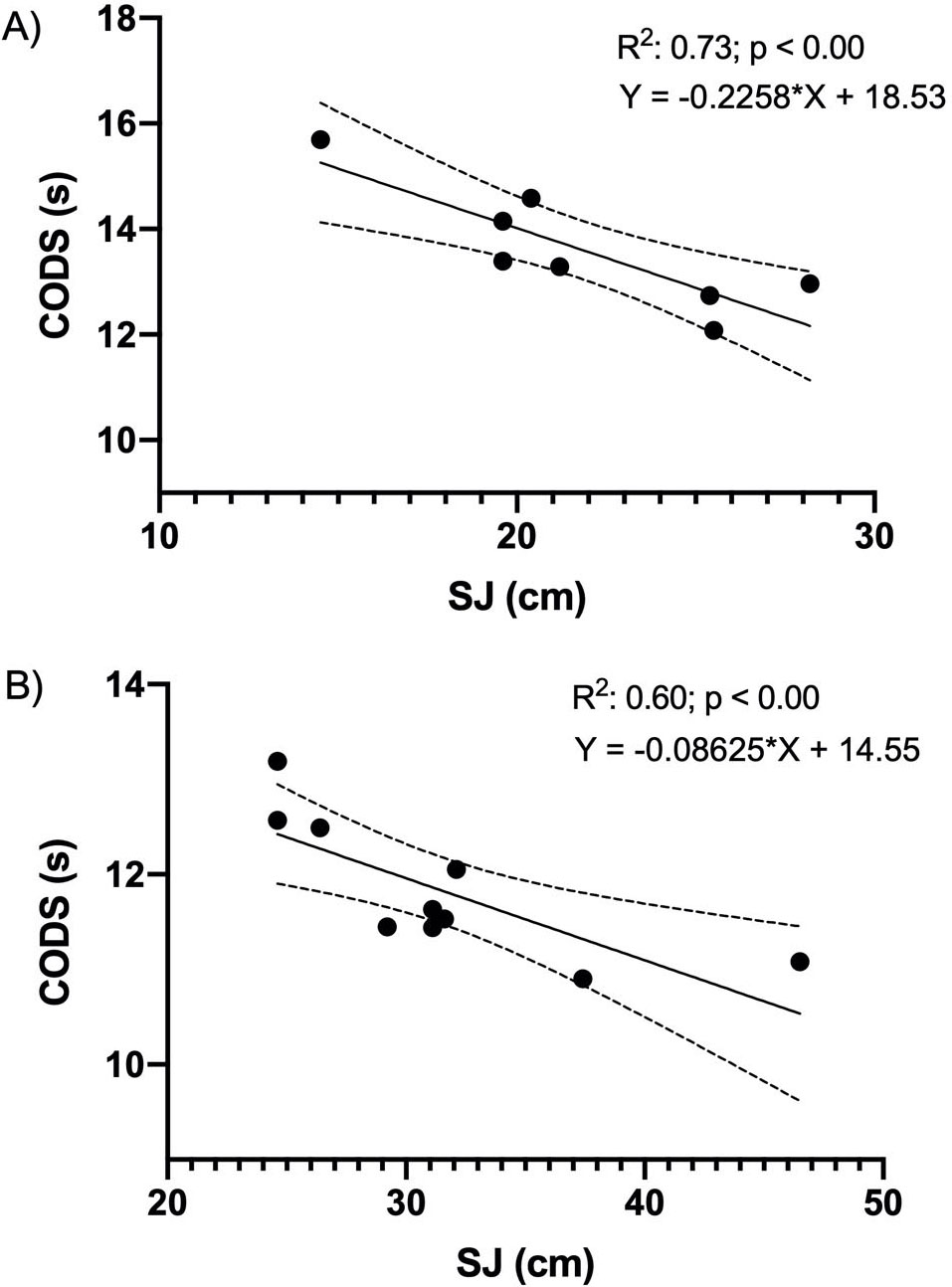
The multiple regression model based on the forward step method documented that the variable SJ can significantly ( 16.56; 0.007) predict the performance in CODS ( 18.53; 0.001) for females by 73% ( 0.73), using the following equation: CODS 0.2258 18.53.
In turn, the variable SJ can significantly predict ( 12.41; 0.008) the performance in CODS ( 14.55; 0.009), for males by 60% ( 0.60), using the following equation: CODS 0.08625 14.55.
Discussion
The main objective of the present study was (i) to examine the correlation between explosive strength characteristics and 0 to 5-m linear sprint with CODS performance and (ii) to examine the influential characteristics of explosive strength on CODS performance. Among the main findings, significant superior performance in male vs. female athletes was documented for most of the outcomes analyzed. Also, CODS performance correlated significantly with SJ and CMJ in females and males independently. Furthermore, only the SJ test was shown to be a predictor of CODS performance independent of gender. Therefore, only the first hypothesis was confirmed.
The results of the present study reported a significant correlation between CODS performance with SJ and CMJ in both genders independently. In addition, between 5M and CODS in female athletes. These results are consistent with previous evidence in combat sports of similar characteristics. In this sense, recently, Herrera-Valenzuela et al. [7] documented significant correlations between the specific CODS (Movement change in karate position Test) with SJ (0.65; 0.04) and CMJ (0.70; 0.02) performance in elite junior kumite karate athletes ( 10; 17.3 2.1 years) of both genders. Also, authors Ojeda-Aravena et al. [9] in taekwondo athletes of both genders ( 14; 19.3 3 years) reported significant correlations between the CODS (Taekwondo specific agility test) with SJ (0.64; 0.01), CMJ (0.56; 0.03) and 5M ( 0.70; 0.005). However, it is important to mention that the inclusion of both genders in the statistical analysis could have influenced the documented correlations due to the morphological, physical and physiological differences between the two genders [41]. In this line, the findings of the present study would confirm that the relationship between both components of explosive strength with the CODS would be independent of the gender of the athletes analyzed, even despite the significant differences in SJ and CMJ performance reported. On the other hand, the absence of correlation between CODS with 5M in male athletes could be due to the variability of the response of 5M performance, reflected in the relative reliability using the ICC.
Another relevant finding of the present study was that only SJ significantly influenced and/or predicted CODS performance in male ( 63%) and female ( 73%) athletes independently. These results differ from the majority of reports conducted mainly in team sports athletes. In this regard, for example, Popowczak et al. [19] in young male soccer players ( 60; age 17 0.4 years) using the 30-m CODS and horizontal jump tests documented that jumping performance significantly explained only 10% of the variance of the CODS and 9% of the variance of the changes in direction every 5M. Also, Spiteri et al. [20] reported that in professional female basketball players ( 12; 24.25 2.55 years) using two CODS tests (T-test and 505 test) with strength tests with different repetition maximum percentages (dynamic, concentric, isokinetic and eccentric) reported that both CODS tests were significantly related ( 0.05) with maximal dynamic, isometric, concentric and eccentric strength (0.79 to 0.89). Although eccentric strength was the only predictor of performance explaining 74 to 77% of the change in variance of performance in both CODS tests. Similarly, in male and female university students ( 63; 20.0 1.8 years) in team sports (soccer, team handball, basketball, volleyball; 80% male and 75% female) and to a lesser extent in martial arts (unspecified), gymnastics and dance, Sekulic et al. [21] using five CODS tests (T-test, Zig-Zag, the 20-yard shuttle test, agility with a 180 turn and the forward and backward running agility test) with SJ, balance and sprint tests of 10- and 20-m. The authors documented that speed and SJ (among females) and balance (among males) were significant predictors of CODS. On the other hand, in girl gymnasts ( 50; 8 0.7 years) Papia et al. [23] using two CODS tests: 10-m (5 5-m with a 180 turn) and 20-m (10- 10-m with a 180 turn) with SJ, CMJ, drop jump and horizontal jump, and 10- and 20-m sprint reported significant correlations ( 0. 05) between the variables examined, although, multiple regression analyses showed that jump performance explained a small amount of the variance of the CODS tests (18.4 to 27.1%) and sprinting ability (22.6 to 29.3%). On the other hand, recently Emmonds et al. [22] reported that in professional female soccer players ( 10; 25.4 7.0 years) the variables SJ, CMJ among others could predict 99% of CODS performance using the 505 test.
Accordingly, the greater relationship of SJ vs. CMJ with CODS performance differs from the findings of Herrera-Valenzuela et al. [7] who reported similar and partly higher correlations in CMJ in elite karate kumite athletes. They, in turn, presented similar explosive strength performance in SJ (34 6 cm) and CMJ (38 7 cm). Also, recently Molinaro et al. [42] analyzing Italian elite karate athletes of both genders ( 24) reported in flight time responses between SJ and CMJ (0.50-s). Kumite karate athletes reported statistically significant lower values in the eccentric time phase in CMJ vs. control group (subjects practicing physical activity practiced twice a week at a non-competitive level). Therefore it is important to analyze the differences between the performance of both tests. In this regard, hors Van Hooren and Bosch [43] and Van Hooren and Zolotarjova [44] have suggested that the differences often observed in performance in favor of CMJ vs. SJ may be mainly related to the greater absorption of muscle slack and accumulation of stimulation during CMJ, as well as the ability to use elastic energy with a small amplitude as a result of a well-developed ability to coactivate muscles and rapidly develop stimulation. However, a larger difference may reflect a reduced ability to reduce the degree of muscle slack and stimulation build-up in the rate of force development in the SJ, so a larger difference between jumps may not necessarily be a better indicator of high-intensity sport performance [9, 36]. Thus, the authors suggest that training protocols should focus on decreasing the differences in both jumps’ characteristics, and analyze the differences according to sport-specific characteristics [43, 44]. Specifically, from the results of Herrera-Valenzuela et al. [7] and Molinaro et al. [42] the training in karate athletes would be more focused on developing concentric aspects of explosive strength thus suggesting the need to improve eccentric characteristics [7, 42] considering that these strength characteristics are involved in deceleration during CODS [45]. Indeed, this could explain why the linear regression model did not include both CMJ and eccentric features by PSA and EUR and reactive features by RSI in the predictive model results. Furthermore, it is plausible that differences due to the nature of the different sports, the difference in competitive level of the athletes, the age of the athletes analyzed, the physical preparation of the athletes, the different CODS tests and the limited evidence specific to combat sports on the influence of the different components of explosive strength on CODS do not allow to be conclusive yet.
Predictive model of the change of direction speed (CODS) performance in the squat jump test (SJ). : Coefficient of determination; : -value. CODS: change of direction speed; SJ: squat jump. (a) Performance of CODS from SJ in females; (b) performance of CODS from SJ in males.
Among the limitations of the study are (i) the absence of test-retest reliability, (ii) the variability of the response according to biological maturity, (iii) the competitive level of the athletes analyzed. At the same time, potential biases include the physical preparation of the athletes analyzed. In this sense, future research (i) could verify the reliability of the findings by using designs that include test-retest reliability [3], (ii) classify athletes according to biological maturity [46], (iii) study the relationship between the CODS and the characteristics of explosive strength in international level athletes independently of gender and iv) verifying optimal physical preparation in order to be conclusive.
It is also important to note that, to the authors’ knowledge, this is the first study to report the relationship through correlation analysis and multiple linear regression modeling between CODS with explosive strength characteristics in karate athletes regardless of gender. In addition to using SJ and CMJ derived explosive strength indices, eccentric (PSA and EUR) and reactive (RSI) characteristics to study the relationship with CODS to control and monitor explosive strength characteristics.
Conclusions
CODS correlate with SJ and CMJ. In particular, SJ influence CODS independently of gender. In practical terms, coaches could use simple and inexpensive non-invasive tests such as the SJ and CMJ, as well as other easily calculated indices of eccentric and reactive characteristics of explosive strength to monitor physical abilities during the process and the effects of training programs on karate athletes. We also recommend further study of the relationship between CODS with explosive strength characteristics to verify whether concentric characteristics are ultimately the preponderant physical abilities of explosive strength in CODS in this combat sport.
Author contributions
CONCEPTION: Alex Ojeda-Aravena.
PERFORMANCE OF WORK: Alex Ojeda-Aravena.
INTERPRETATION OR ANALYSIS OF DATA: Alex Ojeda-Aravena, Tomás Herrera-Valenzuela, Pablo Valdés-Badilla and Jairo Azócar-Gallardo.
PREPARATION OF THE MANUSCRIPT: Alex Ojeda-Aravena, Tomás Herrera Valenzuela, Pablo Valdés-Badilla, Jairo Azócar-Gallardo, Victor Campos-Uribe and José Manuel García-García.
REVISION FOR IMPORTANT INTELLECTUAL CONTENT: Alex Ojeda-Aravena, Tomás Herrera-Valenzuela, Pablo Valdés-Badilla and José Manuel García-García.
SUPERVISION: Alex Ojeda-Aravena, Tomás Herrera-Valenzuela, Pablo Valdés-Badilla and José Manuel García-García.
Ethical considerations
This study was conducted in accordance with the Declaration of Helsinki on Work Involving Human Subjects. Ethics committee approval was not required because the data were obtained as part of routine assessments at the beginning of the training season. All athletes and/or family members of athletes under 18 years of age were informed previously about the purpose of the assessments, associated benefits, experimental procedures, and potential risks, and gave informed consent before the first session.
Funding
The authors report no funding.
Footnotes
Acknowledgments
We appreciate all the athletes of the Kenshokan school for their participation.
Conflict of interest
The authors have no conflicts of interest to report.
References
1.
de QuelÓMAraIIzquierdoMAyánC. Does physical fitness predict future karate success? A study in young female karatekas. Int J Sports Physiol Perform. 2020; 15(6): 868-873. doi: 10.1123/ijspp.2019-0435.
2.
ChaabeneHHachanaYFranchiniEMkaouerBChamariK. Physical and physiological profile of elite karate athletes. Sports Med. 2012; 42(10): 829-843. doi: 10.1007/BF03262297.
3.
ChaabeneHNegraYBouguezziRCapranicaLFranchiniEPrieskeO, et al. Tests for the assessment of sport-specific performance in Olympic combat sports: A systematic review with practical recommendations. Front Physiol. 2018; 9: 386. doi: 10.3389/fphys.2018.00386.
4.
IideKImamuraHYoshimuraYYamashitaAMiyaharaKMiyamotoN, et al. Physiological responses of simulated karate sparring matches in young men and boys. J Strength Cond Res. 2008; 22(3): 839-844. doi: 10.1519/JSC.0b013e31816a5af6.
5.
BenekeRBeyerTJachnerCErasmusJ, Hütler M. Energetics of karate kumite. Eur J Appl Physiol. 2004; 92(4-5): 518-523. doi: 10.1007/s00421-004-1073-x.
6.
LoturcoIArtioliGGKobalRGilSFranchiniE. Predicting punching acceleration from selected strength and power variables in elite karate athletes: A multiple regression analysis. J Strength Cond Res. 2014; 28(7): 1826-1832. doi: 10.1519/JSC.0000000000000329.
7.
Herrera-ValenzuelaTMiccono-GonzálezGFazekas-MolinaMAstorga-RojasGValdés-BadillaPOjeda-AravenaA, et al. Relación entre el Movement change in karate position Test con el rendimiento neuromuscular en atletas de karate: Un estudio piloto (Relationship between Movement change in karate position Test and neuromuscular performance in karate athletes: A pilot stud. Retos. 2020; (39): 505-508. doi: 10.47197/retos.v0i39.81409.
8.
ChaabeneHNegraYCapranicaLBouguezziRHachanaYRouahiMA, et al. Validity and reliability of a new test of planned agility in elite taekwondo athletes. J Strength Cond Res. 2018; 32(9): 2542-2547. doi: 10.1519/JSC.0000000000002325.
9.
Ojeda-AravenaAPAzócar-GallardoJHérnandez-MosqueiraCHerrera-ValenzuelaT. Relación entre la prueba de agilidad específica en taekwondo (tsat), la fuerza explosiva y la velocidad líneal en 5-m atletas de taekwondo de ambos sexos. 2021; (39): 84-89. doi: 10.47197/retos.v0i39.78395.
10.
TurnerABishopCChavdaSEdwardsMBrazierJKilduffLP. Physical characteristics underpinning lunging and change of direction speed in fencing. J Strength Cond Res. 2016; 30(8): 2235-2241. doi: 10.1519/JSC.0000000000001320.
11.
Ojeda-AravenaAHerrera-ValenzuelaTAzócar-GallardoJGarcía-GarcíaJM. Comentario de Ojeda-Aravena y cols. en: La alternativa metodológica del factor Bayes en la investigación clínica de nutrición. Rev Esp Nutr Humana Dietética. 2020; 24(4): 404-406. doi: 10.14306/renhyd.24.4.1239.
12.
KretzschmarAGignacGE. At what sample size do latent variable correlations stabilize? J Res Personal. 2019; 80: 17-22. doi: 10.1016/j.jrp.2019.03.007.
13.
Goss-SampsonM. Statistical analysis in JASP: A guide for students. JASP; 2019. Available from: https://jasp-stats.org/2019/08/21/statistical-analysis-in-jasp-an-update-to-the-students-guide-by-mark-goss-sampson/.
14.
BishopD. An applied research model for the sport sciences. Sports Med. 2008; 38(3): 253-263. doi: 10.2165/00007256-200838030-00005.
15.
SchootmanMPowellJWTornerJC. Study designs and potential biases in sports injury research. The case-control study. Sports Med Auckl NZ. 1994; 18(1): 22-37. doi: 10.2165/00007256-199418010-00004.
16.
HopkinsWMarshallSBatterhamAHaninJ. Progressive statistics for studies in sports medicine and exercise science. Med Sci Sports Exerc. 2009; 41(1): 3. doi: 10.1249/MSS.0b013e31818cb278.
17.
VandenbrouckeJPVon ElmEAltmanDGGøtzschePCMulrowCDPocockSJ, et al. Mejorar la comunicación de estudios observacionales en epidemiología (STROBE): Explicación y elaboración. Gac Sanit [Internet]. 2009; 23(2): 158.e1-158.e28. Available from: https://linkinghub.elsevier.com/retrieve/pii/S021391110800085X.
18.
HalperinIVigotskyADFosterCPyneDB. Strengthening the practice of exercise and sport-science research. Int J Sports Physiol Perform. 2018; 13(2): 127-134. doi: 10.1123/ijspp.2017-0322.
19.
PopowczakMRokitaAŚwierzkoKSzczepanSMichalskiR, Maćkała K. Are Linear Speed and Jumping Ability Determinants of Change of Direction Movements in Young Male Soccer Players? J Sports Sci Med. 2019; 18(1): 109-117. doi: 30787658.
20.
SpiteriTNimphiusSHartNHSpecosCSheppardJMNewtonRU. Contribution of strength characteristics to change of direction and agility performance in female basketball athletes. J Strength Cond Res. 2014; 28(9): 2415-2423. doi: 10.1519/JSC.0000000000000547.
21.
SekulicDSpasicMMirkovDCavarMSattlerT. Gender-specific influences of balance, speed, and power on agility performance. J Strength Cond Res. 2013; 27(3): 802-811. doi: 10.1519/JSC.0b013e31825c2cb0.
22.
EmmondsSNicholsonGBeggCJonesBBissasA. Importance of physical qualities for speed and change of direction ability in elite female soccer players. J Strength Cond Res. 2019; 33(6): 1669-1677. doi: 10.1519/JSC.0000000000002114.
23.
PapiaABogdanisGCApostolidisNDontiO. Jumping performance is not a strong predictor of change of direction and sprinting ability in preadolescent female gymnasts. Sci Gymnast J. 2018; 10(2): 273-283.
24.
WalsheADWilsonGJMurphyAJ. The validity and reliability of a test of lower body musculotendinous stiffness. Eur J Appl Physiol. 1996; 73(3-4): 332-339. doi: 10.1007/BF02425495.
25.
McGuiganMRDoyleTLNewtonMEdwardsDJNimphiusSNewtonRU. Eccentric utilization ratio: Effect of sport and phase of training. J Strength Cond Res. 2006; 20(4): 992-995. doi: 10.1519/R-19165.1.
26.
SuchomelTJSoleCJStoneMH. Comparison of methods that assess lower-body stretch-shortening cycle utilization. J Strength Cond Res. 2016; 30(2): 547-554. doi: 10.1519/JSC.0000000000001100.
27.
DantasMQueirosVS deFonsecaF de SAlmeida-NetoPF deTeixeiraRVSilvaLM da, et al. The stretch-shortening cycle efficiency is dependent on the maturational stage. Rev Bras Cineantropometria Amp Desempenho Hum. 2020; 22. doi: 10.1590/1980-0037.2020v22e72597.
World Medical Association. World Medical Association Declaration of Helsinki: Ethical principles for medical research involving human subjects. JAMA. 2013; 310(20): 2191-2194. doi: 10.1001/jama.2013.281053.
30.
CaballeroPGDíazJC. Manual de Antropometría. Cuba; 2003.
31.
McLesterCNNickersonBSKliszczewiczBMMcLesterJR. Reliability and agreement of various inbody body composition analyzers as compared to dual-energy x-ray absorptiometry in healthy men and women. J Clin Densitom. 2020; 23(3): 443-450. doi: 10.1016/j.jocd.2018.10.008.
32.
Suarez-ArronesLGonzalo-SkokOCarrasquillaIAsián-ClementeJSantallaALara-LopezP, et al. Relationships between change of direction, sprint, jump, and squat power performance. Sports. 2020; 8(3): 38. doi: 10.3390/sports8030038.
33.
Ramirez-CampilloRÁlvarezCGarcía-PinillosFGarcía-RamosALoturcoIChaabeneH, et al. Effects of combined surfaces vs. single-surface plyometric training on soccer players’ physical fitness. J Strength Cond Res. 2019; 34(9): 2644-2653. doi: 10.1519/JSC.0000000000002929.
34.
García-PinillosFPárraga-MontillaJASoto-HermosoVMLatorre-RománPA. Changes in balance ability, power output, and stretch-shortening cycle utilisation after two high-intensity intermittent training protocols in endurance runners. J Sport Health Sci. 2016; 5(4): 430-436. doi: 10.1016/j.jshs.2015.09.003.
35.
KoropanovskiNBerjanBBozicPRPazinNSanaderAJovanovicS, et al. Anthropometric and physical performance profiles of elite karate kumite and kata competitors. J Hum Kinet. 2011; 30: 107. doi: 10.2478/v10078-011-0078-x.
36.
SeoMWLeeJMJungHCJungSWSongJK. Effects of various work-to-rest ratios during high-intensity interval training on athletic performance in adolescents. Int J Sports Med. 2019; 40(8): 503-510. doi: 10.1055/a-0927-6884.
37.
HopkinsWG. Spreadsheets for analysis of validity and reliability. Sportscience. 2017; 21. Avalaible from: https://www.sportsci.org/2015/ValidRely.htm.
38.
HopkinsWG. Measures of reliability in sports medicine and science. Sports Med. 2000; 30(1): 1-15. doi: 10.2165/00007256-200030010-00001.
39.
MaloneySJRichardsJNixonDGHarveyLJFletcherIM. Do stiffness and asymmetries predict change of direction performance? J Sports Sci. 2017; 35(6): 547-556. doi: 10.1080/02640414.2016.1179775.
40.
LoturcoIKobalRKitamuraKFernandesVMouraNSiqueiraF, et al. Predictive factors of elite sprint performance: Influences of muscle mechanical properties and functional parameters. J Strength Cond Res. 2019; 33(4): 974-986. doi: 10.1519/JSC.0000000000002196.
41.
NaughtonGFarpour-LambertNJCarlsonJBradneyMVan PraaghE. Physiological issues surrounding the performance of adolescent athletes. Sports Med Auckl NZ. 2000; 30(5): 309-325. doi: 10.2165/00007256-200030050-00001.
42.
MolinaroLTaborriJMontecchianiMRossiS. Assessing the Effects of Kata and Kumite Techniques on Physical Performance in Elite Karatekas. Sensors. 2020; 20(11). doi: 10.3390/s20113186.
43.
Van HoorenBBoschF. Influence of muscle slack on high-intensity sport performance: A review. Strength Cond J. 2016; 38(5): 75-87. doi: 10.1519/SSC.0000000000000274.
44.
Van HoorenBZolotarjovaJ. The difference between countermovement and squat jump performances: A review of underlying mechanisms with practical applications. J Strength Cond Res. 2017; 31(7): 2011-2020. doi: 10.1519/JSC.0000000000001913.
45.
NimphiusSCallaghanSJBezodisNELockieRG. Change of direction and agility tests: Challenging our current measures of performance. Strength Cond J. 2018; 40(1): 26-38. doi: 10.1519/SSC.0000000000000309.
46.
MalinaRMRogolADCummingSPe SilvaMJCFigueiredoAJ. Biological maturation of youth athletes: Assessment and implications. Br J Sports Med. 2015; 49(13): 852-859. doi: 10.1136/bjsports-2015-094623.