




Abstract
BACKGROUND:
Although the common practice of verbal encouragement is scientifically supported, its effect on the maintenance of force output in fatiguing exertions is unknown.
OBJECTIVE:
To examine the effects of verbal encouragement on exercise-induced quadriceps and knee joint function during three sets of knee extension exercise.
METHODS:
Sixty-five healthy males (23.3 years, 175.8 cm, 75.3 kg) underwent testing using the administration of verbal encouragement (
RESULTS:
There was no verbal encouragement effect over three sets of exercise in quadriceps strength (condition
CONCLUSIONS:
Verbal encouragement appears to be effective in maintaining central activation, but is insufficient for promoting strength. This supports the idea that peripheral contributing factors play a larger role in force production when performing multiple sets of exercises.
Keywords
Introduction
Muscle fatigue is defined as loss of force-generating capacity or failure to maintain strength during continuous muscle contraction [1]. Depletion of energy sources (e.g., glycogen and phosphocreatine) [2] and/or accumulation of metabolic byproducts (e.g., H
Subject demographics (mean
95% CIs)
Subject demographics (mean
LEFS: lower extremity functional scale.
Providing verbal encouragement is one of the simplest and easiest ways to enhance the outcomes of muscle function. Previous data have consistently shown verbal encouragement is beneficial in regard to peak moment [5, 6] force output [7, 8], or cycling performance [9]. This phenomenon is thought to be from cognitive stimulation delivered to the central nervous system. There is sufficient data to suggest verbal encouragement has a positive outcome on aforementioned muscle [5, 8] and athletic function [7, 9]. However, the contribution of this centrally-driven factor has never been quantified with regard to maintenance of force output.
Muscle fatigue is also well-known to impair joint function, including joint position sense [10, 11, 12]. For instance, muscle fatigue in knee extensors [12] and hip abductors [11] increased the absolute errors in knee (2.5 to 3.5
Although the common practice of verbal encouragement is scientifically supported, there is limited objective data supporting this (such as that comparing measurement values before and after fatigue). Though a series of exercises (e.g., three sets in weight-lifting) is typically performed in the athletic field, the existing literature does not guarantee the effectiveness of verbal encouragement after the second set of exercise. Therefore, in this study, we sought to observe subsequent changes in quadriceps (e.g., strength and activation) and knee joint (e.g., replications) functions during three sets of isokinetic knee extension exercises with manipulation of verbal encouragement. We expected that, compared with the non-verbal condition, quadriceps strength and activation would be maintained with verbal encouragement. We further hypothesised that subjects in both conditions would show a similar reduction pattern in knee joint function.
Participants
Sixty-five healthy male college students (verbal encouragement:
Study design
The independent variables were condition (verbal and non-verbal) and time (baseline and times 1 through 3). The dependent variables were quadriceps strength (maximal voluntary isometric contraction; MVIC) and activation (central activation ratio; CAR), and replication of knee joint angle. Each subject experienced only one of the conditions, and the order of conditions was randomised with the random allocation function from a spreadsheet program (Excel; Microsoft Corp., Redmond, WA, USA).
Testing procedures
Upon completion of the informed consent and the LEFS, participants performed 10 minutes of warm-up cycling on a stationary bike at a self-selected pace (Fig. 1). Participants were then seated on a dynamometer (Cybex 770; Cybex Inc., Medway, MA, USA) for baseline measurements. Participant’s anterior thighs were shaved (if necessary) and cleaned with isopropyl alcohol prior to electrode placement. Two self-adhesive electrodes (Dura-Stick II; 7
Testing procedure. Regardless of the condition, verbal encouragement was given during baseline measurements and knee extension exercises (exercises 1 to 3). Visual feedback was not provided for either condition at any time point. Participants in the verbal encouragement condition received verbal encouragement during quadriceps strength training at times 1, 2, and 3. For knee joint function, replications of two knee joint positions (15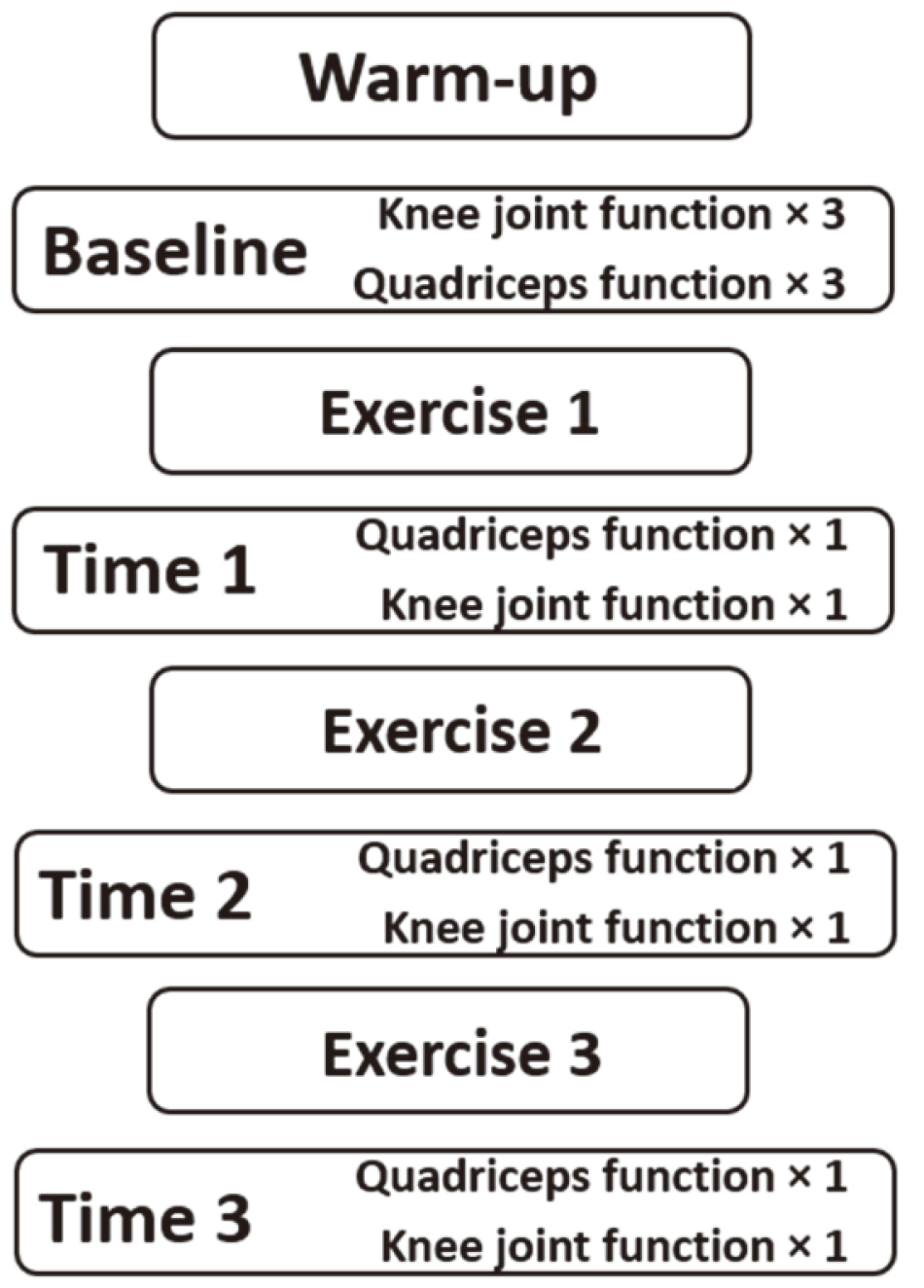
Baseline measurements were recorded first for the knee joint followed by quadriceps function (Fig. 1). Participants were blindfold during assessment of knee flexion replications. While participants sat on the dynamometer with their dominant hip locked at 85
To induce quadriceps fatigue, participants were asked to perform continuous isokinetic knee extensions (60
While participants were performing the first set of exercises, an opaque sealed envelope was opened to determine the condition. After each set of knee extension exercises, the same measurements as at baseline were recorded at times 1, 2, and 3. Quadriceps function was evaluated first, followed by knee joint function. Each dependent measurement was recorded only once during each 30-second rest interval between sets (Fig. 1). When assessing quadriceps strength and activation, verbal encouragement was provided for the verbal condition group. Verbal encouragement was provided by the two researchers (HL:
Changes in quadriceps function (mean
There was no condition
We performed an a priori power analysis based on previous research to calculate the sample size. We determined an expected mean difference in the MVIC of 0.44 N
Mean and SD values were calculated from each measurement at each time point. To test the effects of verbal encouragement over time, we performed a 2
Results
Quadriceps function
There was no verbal encouragement effect over three sets of exercise (condition
Change in quadriceps strength (N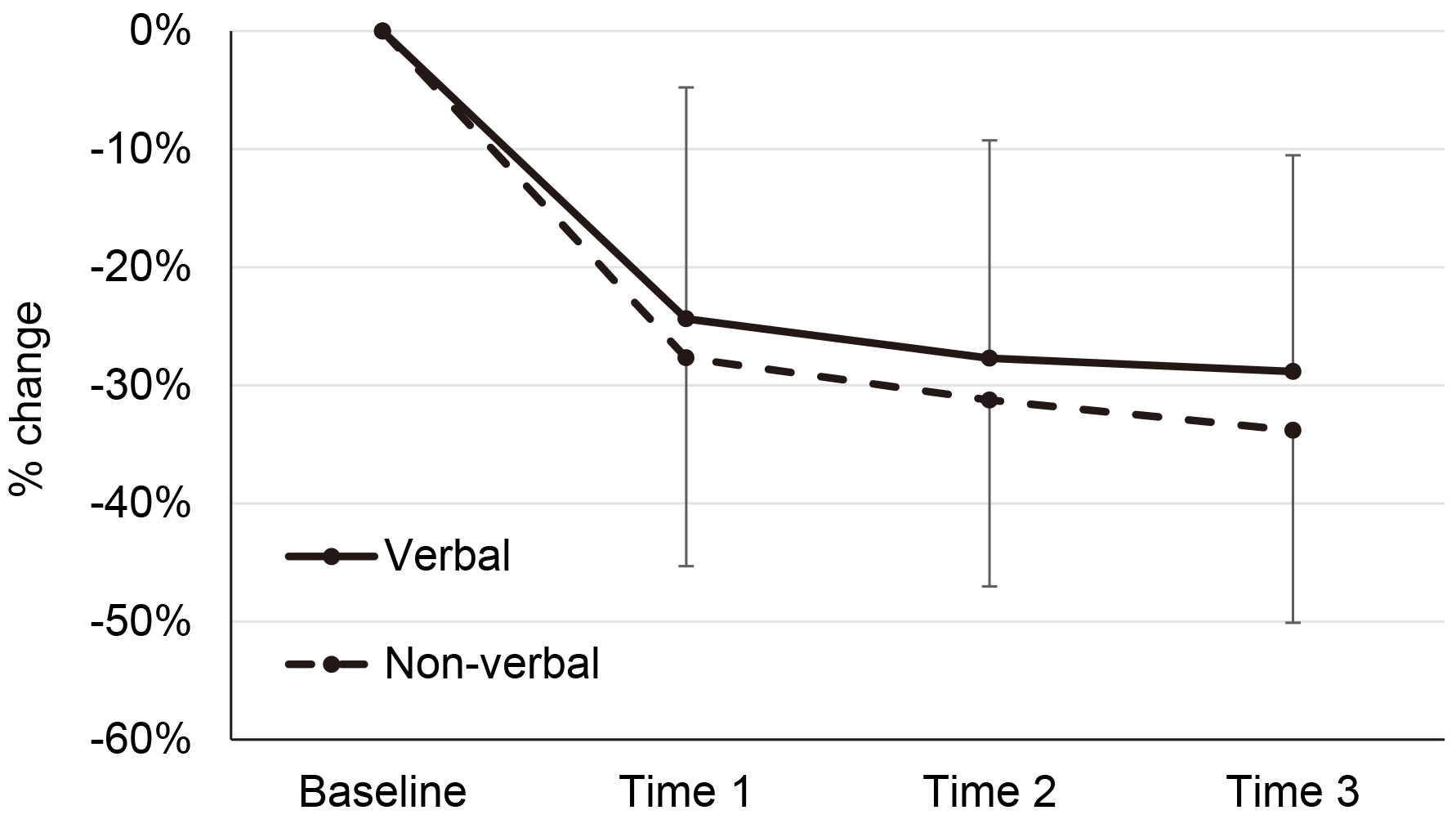
There was verbal encouragement effect on quadriceps activation (condition
Change in quadriceps activation (CAR) displayed as percentage change from baseline (upper and lower limits of the 95% CIs).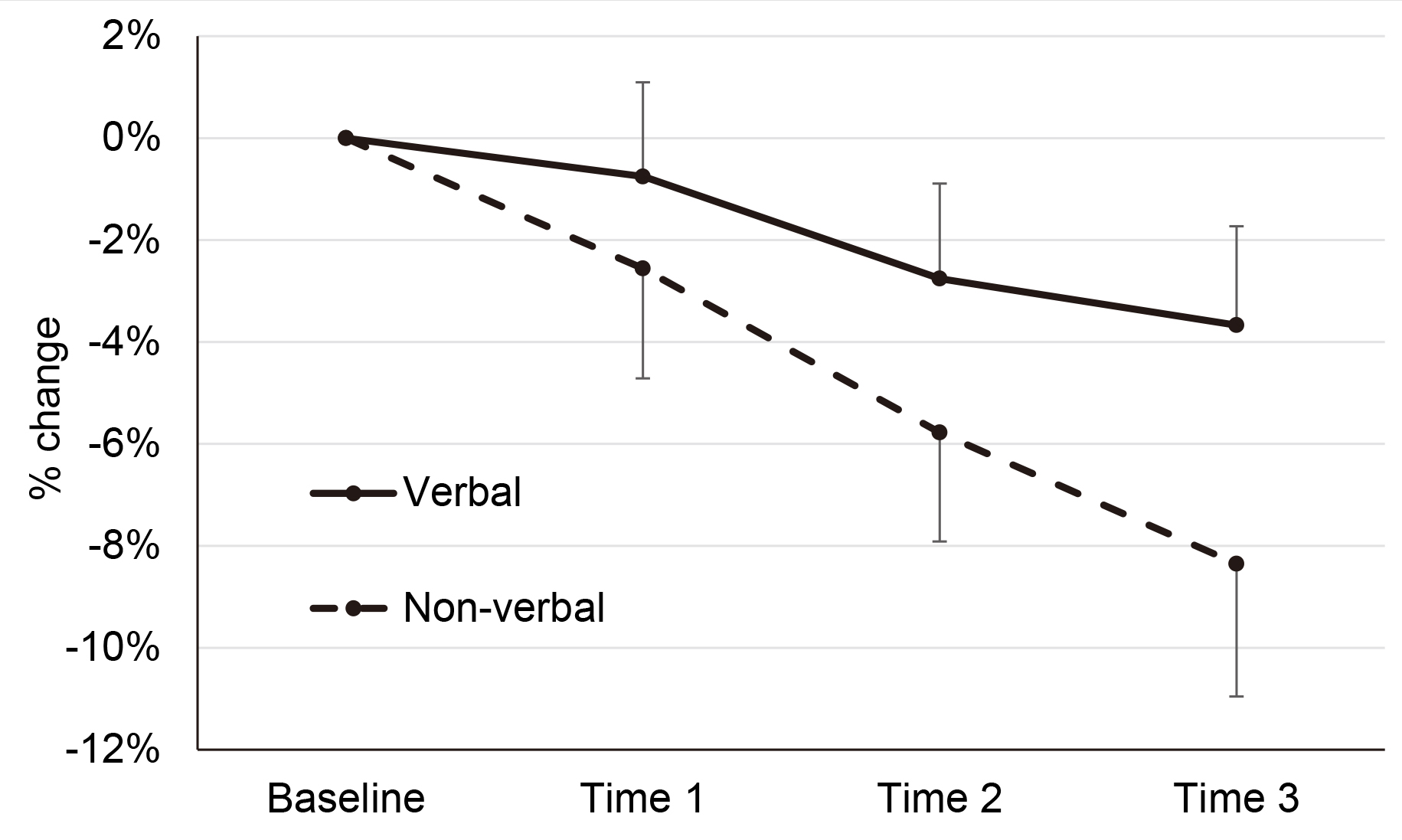
Changes in knee joint function (mean
There was no condition
During three sets of exercise, (condition effect:
The ability to perform knee joint replication did not change for either 15
Discussion
The two main objectives of the present study were (1) to explore the effects of verbal encouragement on fatigued quadriceps strength and activation during three sets of quadriceps exercises and (2) to evaluate the relationship between magnitude of quadriceps dysfunction and kinesthetic function at the knee joint. We observed that the patterns of reduction in strength and joint proprioception in the two conditions were very similar, indicating that our verbal encouragement did not appear to be effective on quadriceps force output during the three sets of exercise. Interestingly, however, quadriceps central activation was maintained in participants who received verbal encouragement. In contrast, quadriceps central activation gradually decreased in participants in the nonverbal condition. The difference between the two conditions after the third set (at time 3) was 0.051 in CAR (ES
While the changes in force output were almost identical for the two conditions, the reduction rate for central activation was more than twofold greater in participants in the non-verbal condition (e.g., 8.4% vs. 3.7% in the verbal condition at time 3). This could in part be explained by monoamine neurotransmitter activity and afferent feedback. In particular, there may have been an accumulation of serotonin and/or a decrease in dopamine concentration [22] in the non-verbal condition participants. In addition facilitation of groups III and IV afferents from the quadriceps may have suppressed the neural commands [22]. Regardless we assume that accumulation of metabolic byproducts [23] depletion of substrates [24] insufficiency in oxygen delivery [25] and deviation in muscle contractile properties [26] were similar in the verbal and non-verbal conditions. According to the previously discussed neurophysiological mechanisms, we speculate that verbal encouragement was effective at preventing central fatigue, maintaining subject willingness to perform and focus, and at enhancing the neural drive for maximal force. However, the preserved central activation (due to verbal encouragement) did not linearly influence the last stage of force production. A previous report [27] suggested central activation failure and intramuscular disturbance were responsible for approximately 20% and 80% of the total amount of muscle fatigue, respectively. This may explain why force output was not influenced by verbal encouragement despite its effects on central activation. Therefore, we suspect peripheral mechanisms (e.g. increased H
Alterations in joint position sense are a common consequence of exercise-induced strength reduction [12, 28, 29]. No prior study evaluated changes in knee joint proprioception during multiple sets of exercise. Therefore, we were interested in studying the ability to perform joint replications during multiple sets of fatiguing exercise. The acuity of joint replications at both angles was reduced after the first set, but there were no further alterations in joint function thereafter. Verbal encouragement provided during quadriceps contractions did not seem to affect our results. These results suggest joint function is more related to rate of strength changes than it is to central activation. Following strength reduction, altered afferent sensory input from mechanoreceptors [30], nociceptors [31] and proprioceptors [12] is thought to cause a reduction in conscious knee joint awareness. Since central activation indicates the ratio in the amount of neural drive from the cerebral cortex and the force output [32], it is possible central activation also plays a role in acuity of joint replications. There was no further decrease in quadriceps strength or knee joint function after the first set of exercise. We do not know if these two variables are directly related to one another, especially when muscle fatigue accumulated. Since an improvement of joint position sense with strength development was previously observed [33], future studies are needed to investigate the correlation between the two factors.
Several issues deserve further elaboration regarding the testing procedures and measurements. Muscle fatigue was induced by concentric quadriceps isokinetic contractions at 60
This study has several limitations. First, it consisted of men only in order to eliminate a potential confounder that might arise from sex difference. Thus, generalizing the conclusions to women cannot be made at this moment. Second, we acknowledge that our participants were not blinded. The document explaning the testing procedures provided information of random group allocations. After the first isokinetic exercise, participants were obviously aware of what group they were in, which could have affected participants’ maximal effort and motivation. Third, verbal encouragement was provided by two investigators (HL and JS) which may have not guaranteed the consistent stimulus. However, more than 90% of the verbal encouragement was provided by one researcher (HL). Additionally, the loudness was consistent with a small variation (97.1
Conclusions
Receiving verbal encouragement during three sets of knee extension exercise appears to be effective in maintaining the quadriceps central activation, but not for enhancing quadriceps strength and knee joint replication. This observation supports the idea that peripheral contributing factors such as energy delpletion or metabolic byproducts accumulation play a larger role than central factors in force production against exercise-induced muscle fatigue. Since centrally-driven fatigue could potentially affect muscle and joint function in subsequent exercises, we still recommend practicing verbal encouragement during multiple sets of exercise.
Author contributions
CONCEPTION: Hyunwook Lee, Jaeyoon Shin, Daeho Kim and Jihong Park.
PERFORMANCE OF WORK: Hyunwook Lee, Jaeyoon Shin and Daeho Kim.
INTERPRETATION OR ANALYSIS OF DATA: Hyunwook Lee, Jaeyoon Shin, Daeho Kim and Jihong Park.
PREPARATION OF THE MANUSCRIPT: Hyunwook Lee and Jihong Park.
REVISION FOR IMPORTANT INTELLECTUAL CONTENT: Hyunwook Lee, Jaeyoon Shin, Daeho Kim and Jihong Park.
SUPERVISION: Jihong Park.
Ethical considerations
This study was approved by the Kyung Hee University’s institutional review board (approval number KHSIRB 2015-010 dated 19/06/2015). All participants provided signed inform consent.
Funding
The authors report no funding.
Footnotes
Acknowledgments
The data of this study are part of Hyunwook Lee and Jaeyoon Shin’s undergraduate thesis project.
Conflict of interest
The authors declare that they have no competing interests.