




Abstract
BACKGROUND:
Postactivation potentiation (PAP) is an acute and temporary enhancement of muscular performance resulting from previous muscular contraction. Extensive research exists examining the PAP effect after a heavy resistance exercise but there is limited research examining the PAP effect after a plyometric stimulus to the pre-competition practices (e.g., warm-up) of well-trained athletes.
OBJECTIVE:
The purpose of this study was to investigate the acute effects of plyometric warm-up with different box heights on sprint and agility performance in national-level field hockey athletes at recovery time of immediately, 5 minutes and 10 minutes.
METHODS:
In a randomized crossover design, ten male national-level field hockey athletes performed 30-m sprint (with 10-m split) and agility test at baseline, immediately (
RESULTS:
Mean 10-m sprint times, 30-m sprint times and agility times were similar between trials at baseline (
CONCLUSIONS:
Both HIPW and LIPW may be effective in enhancing the pre-training or pre-competition practices in off-season for national-level field hockey athletes. However, the individualization of HIPW is highly recommended in order to maintain PAP effects for 10-m sprint times, 30-m sprint times and agility times throughout the 10 minutes when compared to LIPW.
Introduction
Plyometrics, which is very popular today, is a form of training that first became widespread among athletes in Eastern European countries in the early 1970s [1]. The success of European athletes has led to a more widespread use of plyometric training methods [2]. Plyometric training, accepted as a high intensity training program, usually involves combining strength and speed during movement [3]. There are two important factors in plyometric training. The first is the elastic structure of the muscle consisting of tendons and muscle fibers. When the muscle is stretched, the energy stored in these elastic structures can be used in a coordinated and conscious manner by the athlete, resulting in a stronger contraction. Secondly, there are muscle spindle receptors that sense the rapid tension of the muscle for activation of the stretching reflex and play a role in adjusting the tone of the muscle. In this way, the body is protected against possible injuries [4]. Plyometric training characterized by a specific muscle activation sequence consists of three phases; eccentric loading, amortization and concentric contraction phases [5]. The energy stored by stretching the elastic components of the muscle during the eccentric loading phase is used during the concentric contraction phase. The amortization phase is the time interval between the eccentric loading and the concentric contraction phase and is proportional to the increased amount of work. The shorter this phase, the faster the stored elastic energy is converted into mechanical energy and the contraction is considerably stronger. As the time increases, some of the elastic energy disappears as heat and the contraction force decrease. This process is commonly defined as the stress-contraction cycle [2]. Another important factor during plyometric exercises is the spine, because it controls the overall body balance and also absorbs concussion during jumping.
Plyometric exercises can be used in the training program if the athlete is required to make an explosive movement to accelerate his/her body mass or an object at a high level [5]. The ability of an athlete to move a part or all of his/her body at such a high speed with the help of extremities or to change directions frequently during a competition is indicative of a quick force performance situation [6]. The topic that should not be ignored at this point is that power performance is the combination of speed and force. So, if the athlete wants to obtain maximum power, strength and sprint performance must be improved [7]. Plyometric training, which firstly was used to increase the ability of the skeletal muscles to produce power [8], has demonstrated positive effects on other parameters of performance such as vertical jump ability, strength, agility, speed [9], balance and running economy [10]. At the same time, depending on the high density and compression strength of the joints and muscles, it reduces the frequency of musculoskeletal injuries and delays muscle fatigue [11].
In recent years, the interest in acute effects of plyometric training on athletic performance has increased. Athletes and coaches work hard to improve the physical and physiological parameters of performance [12]. In particular, athletes who play in various positions in different sports need to move according to their position and for this purpose they need train on improving both aerobic and anaerobic performance [13]. At this point, it is important to note that the plyometric exercises included in the training program should be planned to improve the parameters needed by the respective sport branch and the athlete’s position [14]. Additionally, there are important points to be taken into consideration to increase efficiency and decrease the risk of injury in plyometric training. Generally, it is necessary to have good strength before starting plyometric training. Also proper warming and cooling techniques should be included into the training program, it should be applied for 2 or 3 times a week and enough time for full recovery between the sets should be allowed during training [5].
Sprint and agility abilities are considered among the important performance components in many sport branches. Sprint defines the speed performance in a straight line while agility is used for speed performance in different directions [15]. High energy compounds such as adenosine tri-phosphate (ATP) and phosphocreatine (PC) are used for activities which require maximum speed in a short time. So, exercises to improve explosive performance should be included in the training program [16]. Athletes commonly use heavy resistance training (80–90% of maximum load), ballistic resistance training (30–60% of maximum load) or plyometric training to increase muscle strength and explosive performance. Although both heavy resistance training and ballistic resistance training increase explosive leg strength and dynamic performance, most authors agree that plyometric training is more effective due to containing the stretch-shortening cycle [17].
Field hockey is an Olympic sport branch played on a grass ground sized at 90
Many trainers and strength coaches struggle to improve athletic performance of their athletes in sports which sprint or change of direction tasks are constant elements of different sports’ movement (i.e., track and field, volleyball, soccer and field hockey). Therefore, plyometric warm up is effectively used in order to develop sprint and agility performance in many training regimes for wide-range of athletes who are from amateur to professional. As known the warm up is undertaken before athletic event, with the majority of effects being attributed to temperature-related mechanisms [20]. Temperature plays an important role in most bio-chemical processes. The average kinetic energy of molecules increases with increases in temperature, resulting in a greater probability for more effective, reaction-causing collisions [21]. Elam [22] showed that after warm-up, a muscle would contract more forcefully than without exercise because of the treppe phenomenon. This phenomenon is associated with post activation potential (PAP). Actually, any type of contractile activity is likely to activate the mechanism of PAP [23]. PAP has been defined as an enhanced muscle contractile response for a given stimulation following an intense voluntary contraction, which is measured as the maximum twitch force evoked by supramaximal electrical stimulation [24, 25, 26]. Basically, two mechanisms have been proposed; the first explanation is that contractile affects the phosphorylation of regulatory light chains via the myosin light chain kinase, and this makes the actin-myosin complex more sensitive to Ca
Therefore, the purpose of this study was to investigate the acute effects of plyometric warm-up with different box heights on sprint and agility performance in national-level field hockey athletes at recovery time of immediately (
Materials and methods
Participants
Ten male hockey athletes (age: 19.90
Procedures
Experimental design
The present study used a randomized crossover design. The study was carried out in the off-season period. The athletes participating in the study were measured for their sprint and agility performance on 6 different days with 24 hr apart. Athletes trained in the same order for both performance measurements; a 30-m sprint test was applied in the first 3 days and the Illinois agility test was applied in the last 3 days.
Pre-test procedures
All measurements were performed at least three hours (h) after lunch at the same time of the day between 15:00 and 17:00 o’clock. At first, anthropometric and body composition measurements were completed respectively. All performance tests were conducted at a constant environmental temperature and humidity (20–23
Data collection procedures
All participants were following a 5 min standard warm-up (running at 60–70% of maximum HR measured by Polar RS 400-Polar Electro, Kempele, Finland); pre-test measurements (30-m sprint test and Illinois agility test); 5 min rest, 5 depth jumps with 10–15 seconds (sec) rest intervals; and post-test measurement (immediately, 5
Experimental design of the study. Following a 5 minutes (min) standard warm-up period, pre-test measurements, 5 min rest, 5 depth jumps with 10–15 seconds (sec) rest intervals, and post-test measurements (immediately after the exercise, 5 min and 10 min after the exercise) were applied to the participants on the measurement days, respectively. 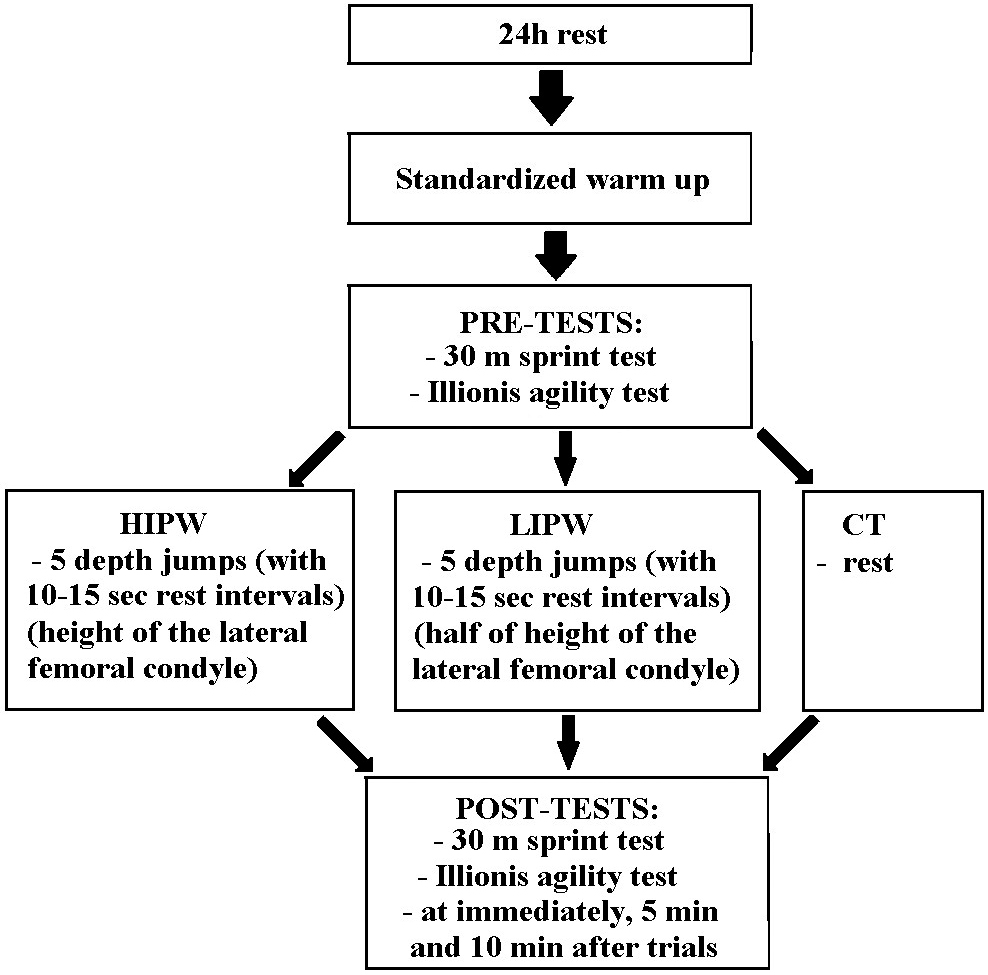
Sprint performances were evaluated over 30-m using infrared timing gates (Newtest 1000, Oulu, Finland) positioned at 0 m (start), 10-m and 30-m (finish) at a height of approximately 0.7 m from the ground using methods similar to Ramirez-Campillo [24]. Participants commenced each sprint following a countdown from the test administrator from a 2-point start position at a distance of 0.1 m behind the first timing gate. Participants were instructed to run at maximal effort throughout the full distance of the sprint. Timing started, splited and finished when the beams of the first (0 m), second (10-m) and last (30-m) gates were broken, respectively. On each test day, participants performed a single repetition at baseline and then a repetition at; immediately (
Statistical analysis
The statistical analysis were performed using the SPSS (Version 20; SPSS, Inc, Chicago, IL, USA) and data are presented as mean
Results
The results showed a normal distribution of the data and no violation of the homogeneity of variance. Mean 10-m sprint times (F
10-m sprint tsime
10-m sprint times were influenced by trial (trial x time interaction) F
Results (mean
SD) of 10-m, 30-m sprint and agility times at baseline, immediately, 5 minutes and 10 minutes after HIPW, LIPW and CT trials
Results (mean
Between-trial effects identified that HIPW 10-m sprint times were
30-m sprint times were influenced by trial (trial x time interaction: F
Between-trial effects identified that HIPW 30-m sprint times were
Agility times
Agility times were influenced by trial (trial x time interaction: F
Between-trial effects identified that HIPW and LIPW agility times were faster than CT, at all time-points of immediately (
Discussion
In the literature, studies on the effects of long-term plyometric training on sprint and agility performance are mostly encountered [6, 35, 36, 37, 38], while studies examining the acute effects of plyometric warm-up are very few [39, 40, 41, 42, 43, 44]. The purpose of this study was to investigate the acute effects of plyometric warm-up with different box heights on sprint and agility performance in national-level field hockey athletes. In the present study, results showed that individualized plyometric warm-up induce improvements in sprint and agility performance, additionally high-intensity plyometric warm-up is more effective than low-intensity plyometric warm-up. But since this effects persist at different times it would be more effective for the athlete to be adjusted according to the branch and activity time.
Most changes in the muscle response to warm-up are attributed to increases in muscle tissue temperature after physical activity, and muscle temperature has been shown to have a profound effect on isometric muscle function [45]. And, evidence suggest that postactivation potentiation (PAP) may enhance the ability of muscle to produce more force at a faster rate after previous muscle contractions. So, in recent years researchers have focused on the effects of PAP on athletic performance using dynamic movements and isometric maximum voluntary contractions. The majority of research on dynamic exercise in the lower body has used the squat exercise, with the number of repetitions, intensities, and rest periods varying among studies [25]. Mc Bride et al. [46], observed an improvement in 40 m sprint performance that after 3 repetitions at 90% 1 repetition maximum of heavy loaded squats. And, in another study reported that after 10 single repetitions at 90% 1 repetition maximum of the back squat created significant improvements in 10 and 30 m sprint performance [47]. These studies provide evidence that PAP has a beneficial effect on sprint performance.
On the other hand, plyometric exercises are develop level of stretching-shortening cycles more than other workouts and therefore more effective on sprint and agility performance, so more preferred [48]. According to the results of the biomechanical analysis in the 100 meter sprint, it consists of three main sections. The first part is the acceleration, the second part is the maintenance of the maximal speed and the third part is the reduction of the maximal speed. The performance in the acceleration part depends on the reaction time and the level of strength and power produced by the athlete during the acceleration [6]. Within this scope, Clegg and Harrison [49] reported that the stiffness of the muscle-tendon complex played a significant role in the rate of producing strength in running activity. Moore and Whitney [50] mentioned that as a result of plyometric training, the activating neural stimulation of the leg muscles of the subjects increased slightly. In addition, Arazi and Asadi [6]suggested that plyometric training facilitates the acceleration of the transition of the nervous-muscular system from eccentric contraction to concentric contraction. According to this information, the force formed by the contraction speed of the leg muscles is directly proportional.
Branderburg and Czajka [39] reported that lower body strength could be acutely enhanced when used by a warm-up incorporating a low volume of low intensity drop jumps. Similarly, Bullock and Comfort [40] reported that the used of drop jumps before a maximal squat enhances strength performance. Lima et al. [43] suggested the drop jump potentiation protocol increases countermovement vertical jump and sprint performance of athletes. In a study by Masamoto et al. [44], supported these findings. In the present study, the reason for the statistically significant change in sprint performance may be due to stretching reflexes formed during plyometric exercises. The energy stored by the participants with the vertical jump after the squat may have increased their sprint performance. More energy storage due to the higher height may cause the effect of the HIPW trial to take longer than the LIPW trial. The fact that this difference is only seen at 10-m showed that the heating intensity gives more effective results in the acceleration phase.
In addition, plyometric training reduces muscle reflex inhibition, increases muscle tension, and increases the sensitivity of golgi tendon organs and muscle spindles [51]. In the literature, many authors have linked the reason for increased agility values after plyometric training to increased number of motor units active during contraction and neural adaption [4, 38, 52, 53]. Nervous adaptation usually occurs with increased coordination between the central nervous system signals and the sensory organs of the muscle [52]. The difference between trials in our study showed that the severity and scope of plyometric warm-up effect agility performance over a short period of time.
Conclusions
The findings of the present study suggest that both HIPW and LIPW are practical methods to enhance the pre-training or pre-competition practices in off-season for national-level field hockey athletes. However, the individualization of HIPW is highly recommended in order to maintain PAP effects for 10-m sprint times, 30-m sprint times and agility times throughout the 10 minutes when compared to LIPW.
Accordingly, the authors suggest athletes and coaches consider the benefits of the depth jumps with individualization high intensity-low volume (5 repetitions) and short recovery time (i.e., within 10 minutes) can be added the protocol to the warm-up before the competition in order to produce a positive acute effects on sprint and agility performances.
Author contributions
CONCEPTION: Tugce Sener and Kerim Sozbir.
PERFORMANCE OF WORK: Tugce Sener and Kerim Sozbir.
INTERPRETATION OR ANALYSIS OF DATA: Kerim Sozbir and Umid Karli.
PREPARATION OF THE MANUSCRIPT: Tugce Sener, Kerim Sozbir and Umid Karli.
REVISION FOR IMPORTANT INTELLECTUAL CONTENT: Tugce Sener and Kerim Sozbir.
SUPERVISION: Kerim Sozbir.
Ethical considerations
This study protocol was approved by the Clinical Research Ethics Committee of the University of Bolu Abant Izzet Baysal University (Turkey) (Decision No: 2015/27 – Date: 30.04.2015). All participants were carefully informed about the experiment procedures and the possible risks and benefits associated with their participation in the study, and an appropriate signed informed consent document has been obtained in accordance with the Declaration of Helsinki.
Funding
The authors report no funding.
Footnotes
Acknowledgments
The authors are grateful to Prof. Dr. R. Gül Tiryaki SONMEZ from Department of Health Sciences, Lehman College, The City University of New York, for reviewing the manuscript.
Conflict of interest
The authors certify that there is no conflict of interest with any financial organization regarding the material discussed in the manuscript.