




Abstract
BACKGROUND:
Traditional and rest-pause systems are commonly used during resistance training. These systems have different rest times between repetitions that might affect neuromuscular status and fatigue level.
OBJECTIVE:
This study compared the acute effects of traditional and rest-pause resistance exercise done to muscular failure on countermovement jump (CMJ) performance.
METHODS:
Twenty-nine recreationally strength-trained adults of both sexes aged from 18 to 33 years old performed four experimental resistance exercise sessions (half back-squat exercise) in a randomized order. The experimental conditions were: Traditional system to muscular failure (TR-F; 4
RESULTS:
CMJ height decrease occurred at Post-15 s and 30 min for the TR-F, TR-NF, and RP-F sessions (
CONCLUSION:
Resistance exercise to muscular failure induced greater CMJ height decrement and internal training load perception than non-failure exercise, with RP-F leading to a higher acute neuromuscular performance impairment.
Introduction
Neuromuscular fatigue is a multifactorial and complex phenomenon for which etiology is not fully understood [1]. Although its concept is still the focus of wide debate in literature, fatigue might be defined as a temporary reduction of the capacity to generate force or power, which is gradually increased during a sustained exercise [1, 2]. In general, the decrease in force or power is accompanied by an increase in effort, and in case of continuity of exercise until exhaustion, muscle failure occurs [3, 4]. Thereby, a successful resistance training program requires an adequate manipulation of training variables (e.g., volume-load, rest intervals, velocity of execution) [5] and continuous monitoring of the acute effects (e.g., reduced performance and effort levels) that may influence the adaptations after repeated resistance training sessions.
Accordingly, a strategy commonly used within a resistance training (RT) routine is that the exercise is performed to muscle failure. Conceptually, muscular failure is the inability to move a load beyond a critical joint angle called “sticking point” [3] or the inability to perform a repetition over a full range of motion with a given load due to fatigue [6]. It was previously reported that exercises to muscular failure resulted in higher effort levels, metabolic stress, and neuromuscular function decrements [3, 7]. For instance, Moran-Navarro et al. [8] compared non-failure vs. failure parallel squat exercise with the equalization of total volume load (6
Countermovement jump (CMJ) height is a feasible and reliable test to monitor the neuromuscular status of the lower limbs [8, 9]. During resistance exercise sessions, loss of CMJ height (%) increased in a linear fashion as the number of repetitions in reserve approached to muscular failure [2]. Moreover, CMJ height decrement was significantly correlated with the session rating of perceived exertion (sRPE) after different sets of RE [10]. Thereby, monitoring CMJ height might help us to understand the neuromuscular fatigue response following exercise, specifically the magnitude of CMJ height loss with the effort experienced during the session [2, 10]. The assessment of the neuromuscular fatigue has an important implication for exercise prescription and monitoring, as the level of effort experienced during the training session dictates the dynamics of recovery [11, 12]. However, to date, little information is available in regards the acute neuromuscular status following different resistance training configurations (i.e., interaction of different system and strategies).
During resistance training, prescribing set configurations in order to attenuate neuromuscular fatigue may be important to achieve certain physiological responses and specific neuromuscular adaptations. This is because increased fatigue compromises neuromuscular performance within a session and the volume load of training [13]. Also, high levels of neuromuscular fatigue may require longer recovery time between resistance training sessions [8, 12]. Furthermore, there is evidence that fewer fatiguing protocols can result in similar strength gains compared to more fatiguing protocols [14, 15]. Thus, resistance training systems and strategies that potentiate the increased level of neuromuscular fatigue may be counterproductive when the volume of training needs to be maintained or maximized and neuromuscular recovery intra- and inter-sessions are reduced.
Amongst the training sets, the traditional (TRD) and rest-pause (RP) systems are commonly used during resistance training [13]. These systems have different rest time between repetitions that might affect neuromuscular status and fatigue level [16]. In the TRD system, the training set is structured with a certain number of repetitions being performed in a continuous fashion without rest between repetitions [17, 18]. On the other hand, the RP set has a brief rest interval (typically 10–30 seconds) between each repetition or blocks of repetitions performed [17, 19]. Unlike the TRD system, which results in loss of force [20], power [20, 21], and movement velocity [19, 20], RP system is able to maintain neuromuscular performance and/or attenuate fatigue (loss of force, power, and movement velocity) [19, 20, 21]. Indeed, the brief rest periods of RP seems to favor the recovery of the phosphagen and glycolytic energy systems (e.g., greater intramuscular adenosine triphosphate and phosphocreatine) [7, 17] and reduce the metabolic stress [7, 21] when compared to TRD.
Accordingly, previous studies showed the distribution of rest interval typically used in set configurations in TRD and RP set configurations affects the fatigue level and results in distinct acute neuromuscular responses [13, 22, 23]. Additionally, whether or not to perform repetitions to concentric failure during RE also influences the level of neuromuscular stress and promotes different acute responses, even when the total volume-load was equalized [8, 23, 24]. Although several studies compared the acute effects of different systems (TRD vs. RP) and strategies (failure vs. non-failure) on neuromuscular performance [8, 12, 13, 22], to the authors’ knowledge, a direct comparison of these resistance training systems adopting failure training strategy is limited, especially with equalized volume-load. Of note, given the lack of volume-load equalization between RE protocols in some studies [11, 12], it is unclear whether the greater acute neuromuscular fatigue reported following RE leading to muscle failure would be caused by the training strategy or by the total number of repetitions that has been 50% higher in comparison to the non-failure protocols [11, 12].
Considering that such systems are widely used in resistance training programs, understanding the effects after performing these configurations with repetitions until muscle failure or not provides relevant practical implications, once neuromuscular status and fatigue after the training session might influence the performance of subsequent sessions. Therefore, the aim of this study was to compare the effects of different resistance exercise systems (TRD and RP) and strategies (muscle failure and non-failure) on neuromuscular performance. It was hypothesized that the non-failure RP exercise would result in a lower rating of perceived exertion, metabolic stress, and impairment on neuromuscular performance when compared to other systems with different strategies.
Method
Participants
Twenty-nine adults of both sexes (15 men and 14 women) aged from 18 to 33 years old (23.8
The study was approved by the local Ethics and Research Committee following the ethical principles contained in the Declaration of Helsinki (2008). All participants who voluntarily participated in the research signed in a Free and Informed Consent Term.
Study design
To test our hypothesis, subjects participated in a counterbalanced, randomized cross-over investigation with four experimental conditions each separated by one week. Participants performed four experimental conditions following the two baseline visits to assess the reproducibility of CMJ and 15 repetition maximum (15RM) performance. The experimental conditions were randomized (www.randomizer.org). Participants performed the TRD and RP systems with (TRD-F and RP-F) and without muscle failure (TRD-NF and RP-NF) using the same exercise (parallel squat) (Fig. 1). The total volume-load (reps
Resistance exercise conditions
Resistance exercise conditions
Note. rep
Experimental design. Note. TQR 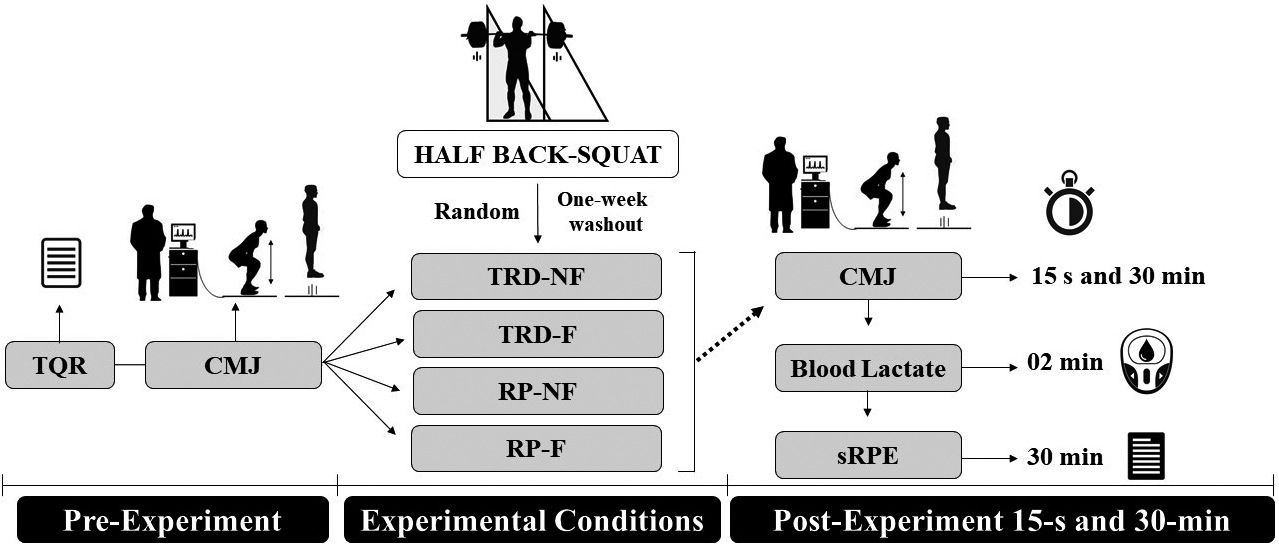
The 15RM test was performed to define the intensity load. The CMJ performance was evaluated at baseline, before (pre-experiment), Post-15 s, and Post-30 min following the experimental sessions. Perceived recovery status was measured before each experimental session. Blood lactate was measured two minutes after each experimental session. The session rating perceived exertion (sRPE) was obtained 30-min after each experimental session. All participants were familiarized with all testing procedures prior to the commencement of the study and already had experience with perceptual scales and CMJ test. Sessions were performed in the afternoon (i.e., 15:00 to 18:00), at the same time of day for each participant, since testing at different times of the experiment may affect the participants’ performance [26].
Resistance exercise sessions
The study protocol included four RE sessions, one for each experimental condition investigated (TRD-F, TRD-NF, RP-F, and RP-NF). The parallel squat exercise was performed in the resistance exercise sessions. The experimental conditions were: a) TRD system leading to muscular failure (TRD-F; 4
The RE sessions were preceded by a standardized parallel squat warm-up, which included two sets of 15 repetitions at 50 and 80% of 15 RM, respectively, with two minutes of rest between sets. During the execution of the parallel squat, participants’ feet were slightly wider than shoulder-width and toes pointed forward or slightly outward. The bar was placed in the upper portion of the trapezius muscle, slightly above the posterior portion of the deltoid muscle. The participants were instructed to hold the bar comfortably and slightly wider than the width of the shoulders. Finally, the participants squatted down until the thighs were parallel with the floor (90-degree angle) pushing the hips backward and flexing their knees and returned to the initial position.
Before each session, the participants were instructed to attend each experimental condition in a well-rested state (i.e., to abstain from any physical exercise and ingest alcohol 48 h prior to the sessions). In addition, caffeine was to be avoided at least 3-h before the experimental sessions. These data were self-reported before each experimental condition to check adherence to instructions and no participant reported not following the requirements.
CMJ performance across resistance exercise sessions
CMJ performance across resistance exercise sessions
Note. CMJ
An electronic contact jump mat (Hidrofit, Jump System, Belo Horizonte, Brazil) was used to analyze CMJ heights. Each participant performed three attempts with 30 s interval among trials. The best result was retained for analysis. The participants performed their CMJ with hands on their waist and no restrictions were placed on the knee angle during the eccentric phase of the jump. Also, participants were instructed to maintain the legs in a straight position during the flight and land at the take-off point. All participants were familiar with the test prior to the beginning of the investigation. In the present study, the intraclass correlation coefficient was 0.95 (CI 95%
Total quality recovery (TQR)
The TQR scale proposed by Laurent et al. [28] was used before each experimental condition to assess the level of perceived recovery. TQR is a scale that ranges from zero (very poorly recovered/extremely tired) to 10 (very well recovered/highly energetic).
Blood lactate concentration
The blood lactate concentration was collected two minutes following a RE session in each of the experimental condition (TRD-F, TRD-NF, RP-F, and RP-NF). A lactacidemic analysis was performed based on samples of
Internal training load
The internal training load was quantified by session-RPE [30]. The participants answered the following question 30 min after the end of the RE session in each of the experimental conditions (TRD-F, TRD-NF, RP-F, and RP-NF): “How was your training?”. The participants were asked to demonstrate the intensity perception of the RE session from the 10-point Borg scale (0
Statistical analysis
The Shapiro-Wilk test was used to evaluate the distribution of data. The Levenes’ test assessed homoscedasticity. Measures of central tendency (mean) and dispersion (standard deviation) were used to describe the research variables. Repeated-measures analysis of variance (ANOVA) was used to compare the level of perceived recovery, blood lactate concentration and internal training load between the experimental treatments. A mixed ANOVA of repeated measurements was used to analyze the conditions (TRD-F, TRD-NF, RP-F, and RP-NF)
Perceptual recovery and internal training load response across resistance exercise conditions. Note. TRD-NF 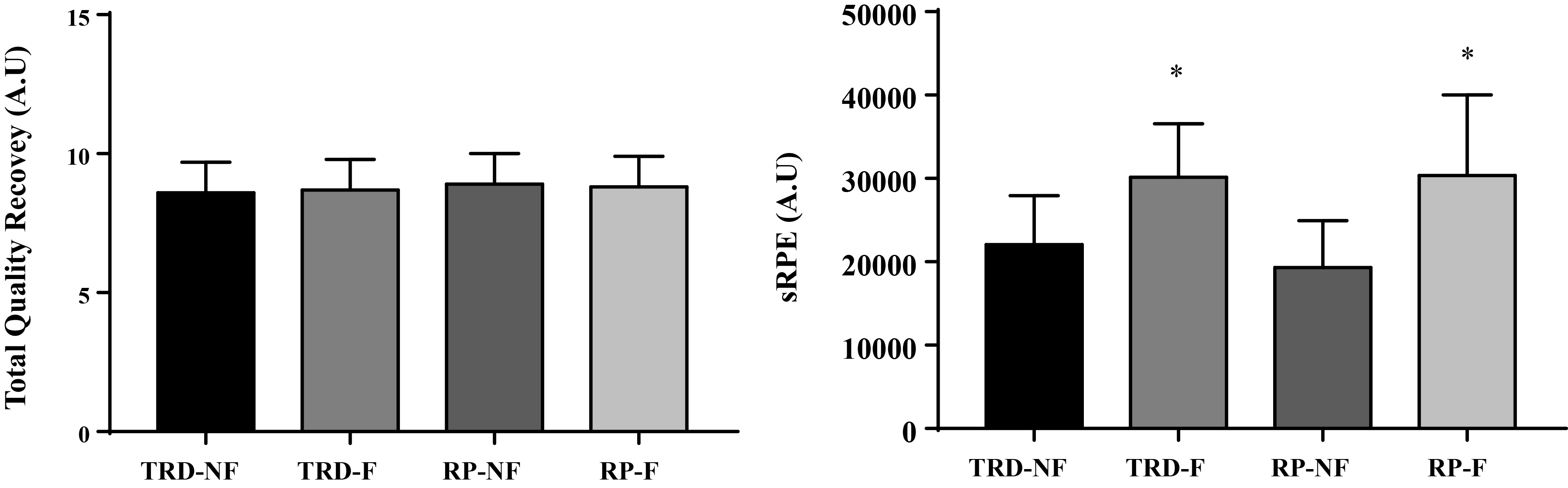
CMJ performance
Table 2 presents the CMJ performance across the RE conditions. Simple main time effect was observed (
TQR and internal training load
Perceptual recovery and internal training load are shown in Fig. 2. Similar perceptual recovery level was reported across the RE sessions (
Blood lactate concentration following resistance exercise conditions. Note. TRD-NF 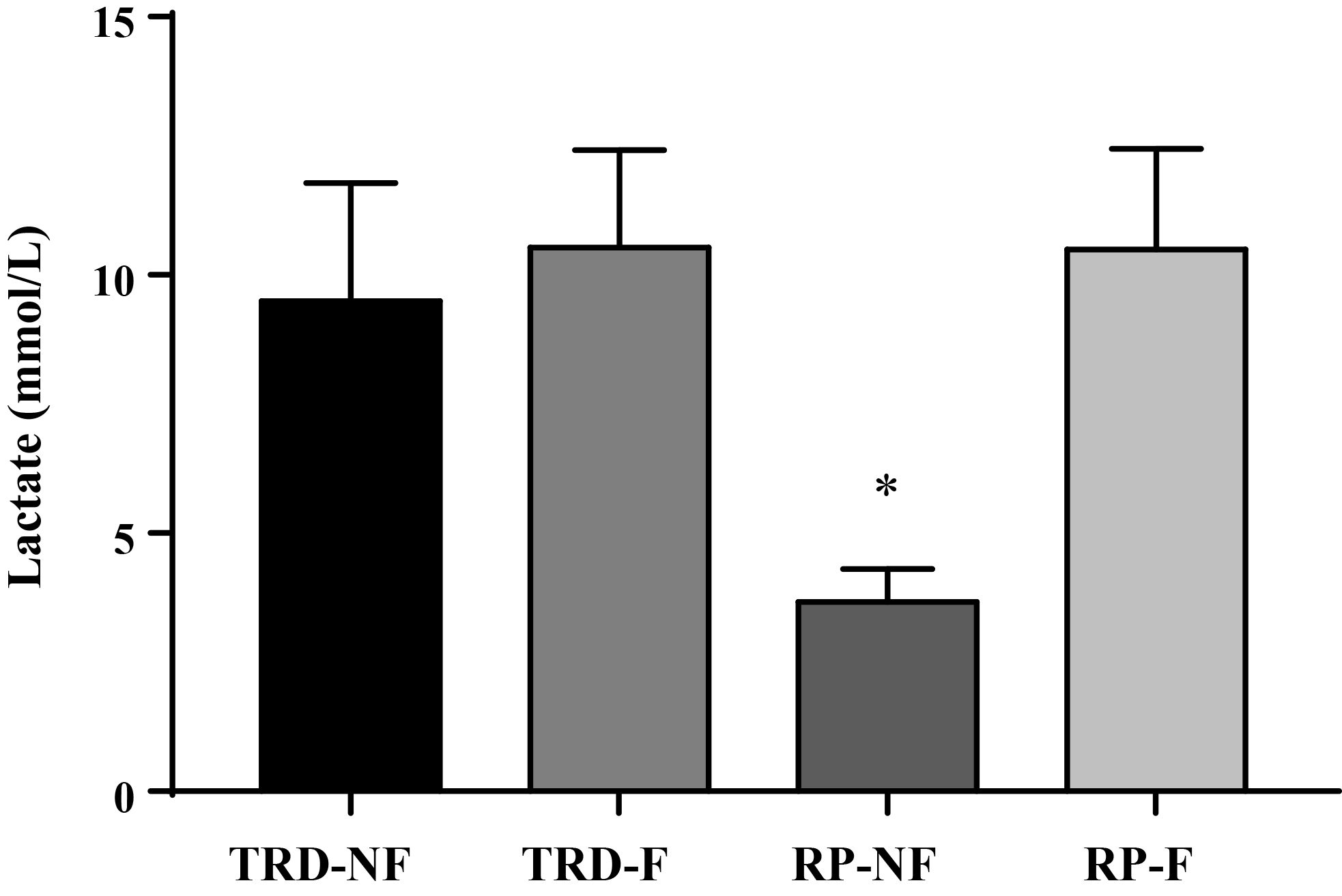
Figure 3 presents the blood lactate concentration following the RE sessions. Repeated measures ANOVA revealed that lower blood lactate concentrations were found following RP-NF condition (
Discussion
The main findings of the present study were a) RE to muscle failure, regardless the system (i.e., TRD or RP), induced greater neuromuscular performance decrements and internal training load than non-failure exercise, even when the total volume-load and the rest are both equalized across experimental conditions; b) RP-F condition (60 reps [15RM] with 30-s rest between each failure) leads to a greater CMJ performance decrement at Post-15 s and 30 min in comparison to the non-muscle failure conditions; c) RP-NF (1
Regarding CMJ performance, we observed that all experimental conditions decreased CMJ height at Post-15 s and 30 min, with the exception of the RP-NF condition. Specifically, both RE conditions to muscle failure (TRD-F and RP-F) induced greater CMJ performance impairment, even when the total volume-load was equalized between failure and non-failure conditions. Noteworthy, RP-F condition induced greater neuromuscular decrements. Previous studies showed that RE to muscle failure produces higher acute fatigue and mechanical/metabolic strain when compared with non-failure exercise [11, 12], even with equated-volume load [7, 8, 23, 24]. Therefore, force production is reduced and neuromuscular performance is impaired. Considering the aim of the current study, the mechanism was not assessed, but it was previously reported that impairment in neuromuscular performance was related to both central and peripheral factors [24, 32].
In line with the observed decrement in CMJ performance, we also found high-metabolic demand (i.e., blood lactate concentration [
In the current study, we observed similar high lactate concentrations (
Regarding the comparison between TRD and RP systems, it was previously suggested the RP system may induce less post-exercise fatigue than TRD protocols [13, 22, 23]. Indeed, RP-NF condition presents similar CMJ performance after the RE session and lower blood lactate concentration level compared to the other RE trials. Conversely, RP-F induced greater neuromuscular fatigue when compared with the other RE conditions. Those differences may be related to the prescribed rest period between each repetition [33]. For instance, RP-NF condition adopted a 10.2-s rest period between each repetition which may allow the replenishment of intramuscular creatine phosphate, removal of glycolysis byproducts (i.e. lactate and H
On the other hand, RP-F was prescribed based on fixed repetitions (i.e., 60 reps) interspersed by 30-s rest period across each concentric effort. Although the volume-load was equalized in the current investigation and both protocols were performed to muscle failure, RP-F exercise induced greater CMJ height decrement than TRD-F. This result might be explained by the 30-s vs. 200-s rest period during the RP-F and TR-F exercises, respectively. For instance, after the first concentric effort, the participants in the TRD-F exercise had 200-s of recovery, whereas the RP-F had only 30-s. This shows an important application since the length of the rest interval dictates the recovery that occurs between sets. Accordingly, the rest period is one of the most important variables that acutely affect neuromuscular fatigue [37]. Consequently, the shorter rest following concentric repetitions along with increased numbers of muscle failures to achieve the training load in RP-F exercise may induce greater mechanical stress during the session decreasing the CMJ performance.
Taken together, we found the implementation of different RE configurations with the total volume-load equalized induced a distinct neuromuscular response. RE leading to muscular failure induced greater neuromuscular performance decrement than non-failure exercise, with higher impairment after RP-F condition. From a practical perspective, the findings of the current study might provide useful data to prescribe resistance training sessions in order to attenuate the neuromuscular fatigue.
Despite the novel findings in the present study, some limitation should be pointed out. First, the adherence to the recommendations before testing were self-reported. Thus, we might not directly guarantee they were followed. A prolonged time course following exercise allows a greater understanding of acute neuromuscular response following RE protocols. Future researches are warranted to consider this issue. Second, no mechanical or muscle activity was accessed during the RE sessions. Thus, data acquired by linear transduce or electromyography could provide relevant information about the dynamic of intra-session fatigue level. Although the lack of this measure limits our data interpretation, the findings of our study still provides interesting data to strength and conditioning practitioners. Also, it should be noted that the total volume-load and rest between RE session are both equalized. This equalization provides greater understanding of the acute response following different RE strategies and system than previous studies that did not equate those prescription variables [11, 12]. In addition, in the present study, a multi-joint exercise for lower limbs was used, which prevents to the extrapolation of these findings to another type of exercise (e.g., single-joint) and another body segment (e.g., upper limbs and trunk).
From a practical perspective, the implementation of different RE configurations with the total volume-load equalized induced distinct neuromuscular response. RE leading to muscular failure induced greater neuromuscular performance decrement than non-failure exercise, with higher impairment after RP-F condition. This result provides an understanding about the time course recovery of neuromuscular status following those exercise configurations, suggesting that more recovery time between session may be necessary. Thus, when the training session aims to improve the total volume-load, frequency of training for the same muscle group, and neuromuscular status intra- and inter-sessions, it seems that RP-NF should be recommended. Moreover, it is proposed that greater volume loads imply in greater muscular adaptations [38], thus, perform RE configurations that allow the volume-load maintenance or increased may be preferred. These findings may help strength and conditioning professionals make decisions about which training configuration should be adopted when the goal is to reduce recovery time between sessions, favoring an increase in the frequency of training of a muscle group.
Conclusion
Regardless of the RE system adopted (TRD or RP), repetitions to muscle failure induced greater decrement in CMJ height and higher values of internal training load, with high-metabolic demand compared to non-failure exercise. Importantly, RP-NF did not affect CMJ performance at Post-15 s and 30 min, and low-level of lactate concentration and internal training load was found after RE session. Thereby, if the aim is to attenuate the reduction of neuromuscular performance of lower limbs, as well as reduce metabolic demand and lower psychophysiological stress, implementation of short rest between repetitions should be encouraged (e.g., RP-NF).
Author contributions
CONCEPTION: Leonardo S. Fortes and Manoel C. Costa.
PERFORMANCE OF WORK: Petrus Gantois, Fabiano S. Fonseca and Dalton de Lima-Júnior.
INTERPRETATION OR ANALYSIS OF DATA: Petrus Gantois and Fabiano S. Fonseca.
PREPARATION OF THE MANUSCRIPT: Petrus Gantois, Fabiano S. Fonseca and Leonardo S. Fortes.
REVISION FOR IMPORTANT INTELLECTUAL CONTENT: Bruna D.V. Costa and Edilson S. Cyrino.
SUPERVISION: Leonardo S. Fortes and Manoel C. Costa.
Ethical considerations
The present study was approved by the Research Ethics Committee of the Federal University of Pernambuco: Institutional Review Board approval number (2.581.474). All participants who voluntarily participated in the research signed in a Free and Informed Consent Term.
Funding
The authors report no funding.
Footnotes
Acknowledgments
The authors have no acknowledgments.
Conflict of interest
The authors have no conflicts of interest to disclose.