




Abstract
BACKGROUND:
Whole-body electromyostimulation (WB-EMS) is a new tendency in training used to complement conventional training.
OBJECTIVE:
The aim was to analyze the effects of training with WB-EMS on body composition, strength and balance in middle-aged women.
METHODS:
Twenty-eight women were randomly assigned to two groups: the WB-EMS group (age
RESULTS:
After the training program, the WB-EMS group showed lower values for the waist circumference (83.00
CONCLUSIONS:
The WB-EMS training program helps reduce the risk of falling and improves body composition variables and balance results in middle-aged physically active women.
Introduction
The change in body composition and the decline of functional capacity due to the aging process, even in healthy people, are aspects of study and have clinical significance for health worldwide [1]. According to previous epidemiological research, the aging process provokes the loss of independence to perform the basic activities of daily living [2], which is associated with significant changes in body composition such as loss of muscle mass and increase of body fat [3]. The reduction of lean body mass favors the progression of frailty in elderly people and some secondary disorders such as sarcopenic obesity [4, 5]. Sarcopenic obesity is characterized by the disproportion between the amounts of lean mass and fat mass without implication of body mass [6]. In addition, menopause and the changes in hormonal regulation favor an increase of body fat and loss of lean mass in women [7].
The aging process shows a progressive decline in tissue and organ functions which leads to a decrease in fitness [5]. As a consequence of lean mass loss, elderly people show a reduction in muscle strength and physical impairments, which result in a worse performance in balance tests and higher fall risk than young and middle-aged people, which helps to explain the loss of independence in the elderly [8]. In addition, a problem associated with loss of mobility and aging is the decrease in bone quality, which increases the risk of osteoporosis [9] and health disorders in relation to the aging process [8]. Endurance and strength exercises have shown benefits for muscle mass [10] and body fat [11] in older adults.
The changes produced by the aging process may affect this relation between lean mass and body fat and favor an inability to perform daily living activities in the elderly [4]. Many studies have shown a strong relationship between exercise and sarcopenia and the efficacy of endurance and strength exercise for its prevention and treatment [6]. Falls are a common cause of injury among older adults [12]. Most falls are associated with balance problems and lower limb injuries [12, 13], Strength training has beneficial effects on fall risk and health care use in older adults at increased risk for decline [14], besides, some research has shown that balance and neuromuscular training programs can positively influence neuromuscular coordination, muscle strength in the lower extremities [13] and flexibility [15].
Physical training has a positive impact on a large number of risk factors and diseases in elderly people [16], although recent studies show that this group of the population is far from fulfilling exercise recommendations necessary to avoid the loss of functional capacity [10]. Whole-body electromyostimulation (WB-EMS) is an excellent new time-efficient tool for increasing training intensity [17, 18], as it enables the simultaneous activation of 16 regions (e.g., upper legs, upper arms, backside, abdomen, chest, lower back, upper back, and shoulders; total size of electrodes:
The positive effect of local electromyostimulation has been demonstrated in athletes, healthy younger people [19], youth [21, 22] and elderly subjects [23, 24]. Recent research has analyzed the effect of WB-EMS on body composition [17], caloric expenditure [25] and functional capacity [17] in elderly people, although there are not many studies about the effects of WB-EMS on balance and bone density [26]. In addition, some of the latest studies have shown that this type of training is safe since it does not affect cardiopulmonary or psychological values [27]. Therefore, a WB-EMS training program, which includes different kinds of exercises, may increase lean mass, bone density and reduce the Fall Risk Index of the elderly population. Hence the purpose of this study was to analyze the effect of 8 weeks of WB-EMS training on body composition, strength and balance in a group of active middle-aged women.
Methods
Participants
Flow diagram of the study.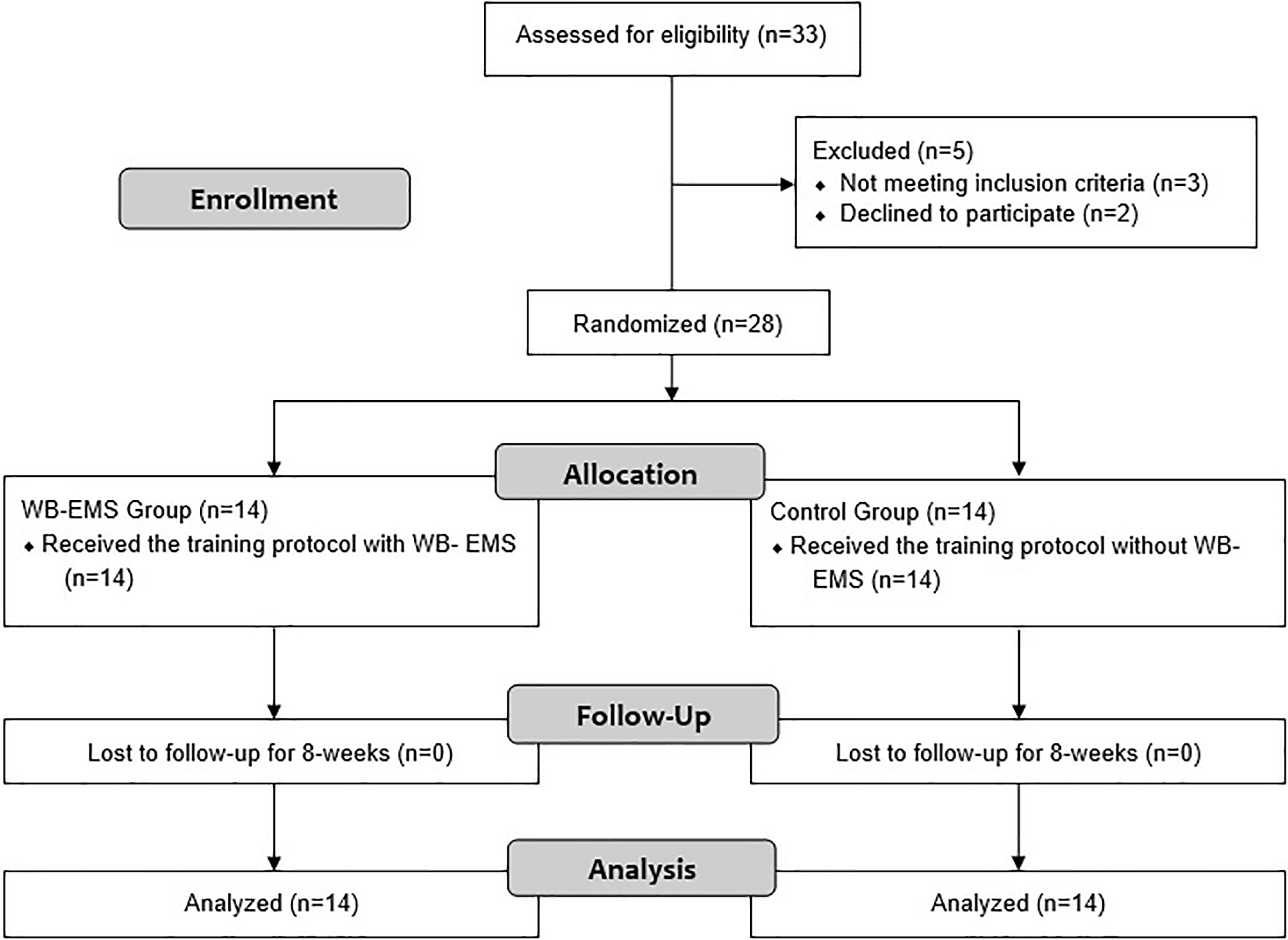
Twenty-eight physically active women between 40 and 60 years volunteered to participate in this investigation. Participants were randomly assigned to two intervention groups: the WB-EMS group (
The study was approved by the Ethics Committee of Clinical Research at the Hospital Complex in Toledo (Spain) (number 365, dated 08/04/2019) according to the principles of the latest version of the Declaration of Helsinki. All participants were informed of the experimental risk and gave written informed consent.
We performed an 8-week randomized controlled trial with a parallel group design involving middle-aged women to address our hypothesis. To ensure that participants adequately performed the WB-EMS exercise regime, we included only women with a long experience of endurance and dynamic strength exercises. Furthermore, both subgroups performed the same basic exercise training described below; however, WB-EMS did it with WB-EMS and control group (CG) did it without WB-EMS.
Endpoints representing our primary targets “body composition” and “maximum strength” were skeletal muscle mass and body fat directly assessed by dual-energy x-ray absorptiometry (DXA), isokinetic leg strength assessed by isokinetic dynamometer, and the balance level assessed by the Biodex Balance System (BBS). The study design allowed us to determine the additional effect of WB-EMS training on the above-mentioned endpoints in comparison with an isolated endurance and strength training program.
Whole-body electromyostimulation training protocol of the study
Whole-body electromyostimulation training protocol of the study
The WB-EMS protocol applied in the present study was intermittent, low intensity/low amplitude of movement, adapted from one used in recent studies [18, 25]. In detail, participants conducted a consistently guided and supervised 20-minute WB-EMS in 8 sessions, 1 session per week. A qualified professional taught the subjects to perform the exercises correctly at a pace of 2/2 seconds and guided them so that they correctly carried out the protocol during the session. Two bipolar electric currents were applied, the first for 10 minutes duration, with a frequency of 85 Hz and a pulse breadth of 350
The Control Group performed the training protocol without WB-EMS and the WB-EMS group performed the training protocol with the WB-EMS. This protocol is based on the alternation of parameters of strength electromyostimulation and parameters of cardiopulmonary and capillarization electromyostimulation, chosen according to previous studies for the frequency [30], and the pulse breadth [31]. We followed the indications of other studies that used WB-EMS for the duration of impulse and rest [17, 25, 26, 32]. Participants were asked to appraise the average intensity of a WB-EMS session and the regional intensity of the WB-EMS on a rating scale (Ratings of Perceived Exertion [RPE]) between 1 (very low) and 7 (very high). Current intensity of the WB-EMS was progressively increased during the intervention period depending on the RPE [17]. Training attendance was recorded using an excel table.
Test procedures
In the first place, the protocols were presented to the subjects, they were informed of the contraindications and subsequently signed the informed consent to participate in the research. The Physical Activity Readiness Questionnaire (Par-Q) [33] was also completed in order to discover if there was any disease that is contraindicated for the performance of physical exercise. Measurement tests were performed before and after 8 weeks of training by the same investigator and at the same time of day. All assessments were blinded.
Body mass (with the participant in underwear) was measured using a digital scale (model 707; Seca
Muscle strength of the knee flexors and extensors was measured using the Biodex System III Pro isokinetic dynamometer (Biodex Multi-Joint System 3, Byodex Medical System, New York, USA
Postural stability and balance were measured with the Biodex Balance System (BBS) (Biodex Medical System, Inc. Shirley, New York
Statistical analysis
The statistical analysis was performed using the software SPSS v 22.0 (SPSS Inc., Chicago, IL, USA). The values are presented as means
Results
Attendance rate of the WB-EMS training was 100%. No incidents of medical significance occurred during the training sessions.
The effects of the WB-EMS program related to body composition are shown in Table 2. Waist circumference significantly decreased 5.3
Results of body composition variables
Results of body composition variables
WB-EMS group (Whole-Body Electromyostimulation). CG (Control Group).
Results of the balance variables
WB-EMS group (Whole-Body Electromyostimulation). CG (Control Group).
The effects of the WB-EMS program on the balance test are shown in Table 3. After the intervention, in the WB-EMS group, the Fall Risk Index decreased 21.9
Results of the strength variables
WB-EMS group (Whole-Body Electromyostimulation). CG (Control Group).
The effect of the WB-EMS program after the intervention is shown in the results on strength in Table 4, but there were no significant differences for any of the two groups in the strength variables.
The present study aimed to analyze the effect on body composition, strength and balance of 8 weeks of WB-EMS training in a group of middle-aged physi- cally active women. WB-EMS is a new tendency in training used to complement conventional training. The principal findings of the study were improvements in balance and the decrease of waist and hip circumference and body fat in the WB-EMS group after eight weeks of training. For balance measurement, the WB-EMS group showed better values in the Fall Risk Index and in Deviation after training compared to the CG. Based on these results, the WB-EMS training benefits body composition and balance for middle-aged women.
Regarding body composition, waist and hip circumference decreased after the training program in relation to the pre-training condition in the WB-EMS group. Coinciding with our study, previous research [11, 17] has shown that WB-EMS training could be an efficient tool to reduce waist and hip circumference. Furthermore, the WB-EMS group achieved a greater decrease in waist and hip circumference than the CG after training, which may be a result of the high intensity of WB-EMS training compared to conventional training. In addition to body reference circumferences such as hip and waist circumference, other variables have been measured to explain the effects of WB-EMS training on body composition such as body fat, and cholesterol [38, 39]. In our research, the WB-EMS group showed lower values of body fat after training than in the initial condition, although previous studies did not find these differences after the intervention [17]. Therefore, the effects of WB-EMS training on body fat need to be clarified, and more studies are necessary. Finally, we did not find significant differences either between groups before and after training, in Bone Mineral Density coinciding with other studies that measured this variable [26].
Balance variables were analyzed by FRt, that makes it possible to obtain the Fall Risk Index and deviation [36]. Balance training showed effective results in reducing the fall risk and improving the level of mobility in the elderly [40]. Programs that incorporate balance training provoke adaptive responses in the neuromuscular system that improves women’s postural control, balance and functional ability [12]. Further, a short four-week program suggests that short duration programs in middle-aged women may be of benefit [41], but none have studied this with WB-EMS. In our study for the balance variables, the WB-EMS group improved in the Fall Risk Index in post-training measurements while the CG did not show any change. Furthermore, we found a significant difference between both groups in the post-training measurement. The difference may be a consequence of the alteration of the proprioceptive conditions during WB-EMS training which made higher demands on the vestibular system than conventional training because the stimulus was unknown [42]. In addition, some studies described a correlation among proprioception, force sense, quadriceps strength, the Quadriceps/Hamstring ratio, and balance [22], but in our study we did not find any relation between the balance gains after training with WB-EMS and strength variables.
WB-EMS training was described as a good training method to obtain an increase in muscle parameters compared to the conventional HIIT method [43]. Kemmler et al. [32], also found significant differences in leg extensor force after WB-EMS training. In addi- tion, other studies in sedentary people showed that HIIT and WB-EMS can be used as a strategy to improve the parameters of body composition, obtaining slightly better results with the application of WB-EMS during 3 sessions a week [44]. Contrary to the results of these studies, we did not find significant changes in strength variables in the WB-EMS group after eight weeks of training. This may be the result of the fact that the number of training sessions was insufficient to increase the strength of the women, who already had had previous physical conditioning, agreeing with other studies which did not find a strength gain either after WB-EMS training [39]. Therefore, the use of HIIT protocols with WB-EMS for trained middle-aged people should be studied in more depth to describe the number of sessions which are necessary to obtain an improvement in muscle mass and strength.
This study has a number of limitations. Due to the limited size of the sample to be analyzed, our study could have little power to detect significant differences in specific parameters of body composition, strength and balance, although we found improvements in balance and body composition in some variables that we have studied. Another of the limitations of the results in the present study is that they are representative of a healthy trained adult population between 40 and 60 years of age and, therefore, cannot be extrapolated to active, younger or older adults, including people with acute or chronic diseases.
Conclusions
Within the limitations of this study, our results suggest that in this group of middle-aged trained women, 8 weeks of WB-EMS training may produce beneficial effects in terms of body composition as well as balance. In this context, the WB-EMS training is an effective training mode, which eliminates the barriers of conventional resistance exercise, and is a safe and reasonable option to improve body composition and balance in middle-aged physically active women, decreasing the risk of falling which is a common cause of injury at this age and later.
Author contributions
CONCEPTION: Jorge Sánchez-Infante, Paula Esteban, Fernando Jimenez and Javier Abián-Vicén.
PERFORMANCE OF WORK: Jorge Sánchez-Infante, Alfredo.
Bravo-Sánchez, Pablo Abián, Paula Esteban, Fernando Jimenez and Javier Abián-Vicén.
INTERPRETATION OR ANALYSIS OF DATA: Jorge Sánchez-Infante, Alfredo Bravo-Sánchez, Pablo Abián and Javier Abián-Vicén.
PREPARATION OF THE MANUSCRIPT: Jorge Sánchez-Infante, Alfredo Bravo-Sánchez and Javier Abián-Vicén.
REVISION FOR IMPORTANT INTELLECTUAL CONTENT: Pablo Abián, Paula Esteban and Fernando Jimenez.
SUPERVISION: Pablo Abián, Fernando Jimenez and Javier Abián-Vicén.
Ethical considerations
The study was approved by the Ethics Committee of Clinical Research at the Hospital Complex in Toledo (Spain) (number 365, dated 08/04/2019) according to the principles of the latest version of the Declaration of Helsinki. All participants were informed of the experimental risk and gave written informed consent.
Funding
This study did not receive any funding.
Footnotes
Acknowledgments
We thank the participants for their contribution to the study.
Conflict of interest
All the authors declare that they have no conflict of interest derived from the outcomes of this study.