




Abstract
BACKGROUND:
For years, the effects of music on exercise performance have been researched. Recovery is extremely important for athletes, and therefore any factor that could affect it is of importance.
OBJECTIVE:
To assess the influence of listening to music on recovery after an anaerobic-exercise.
METHOD:
25 male athletes (age 21.76
RESULTS:
There was no difference in the mean blood lactate concentration and HR during the recovery with and without music (
CONCLUSIONS:
Music cannot improve recovery after anaerobic performance and it cannot be used as a mean to enhance recovery after an anaerobic-performance.
Introduction
Recovery after exercise is crucial for athletes. Several studies have been conducted to understand how postexercise recovery can be improved. The studies are of two types: one type states that listening to music is effective in postexercise recovery, and the other opposes this [1, 2]. In a study that examined athletes’ recovery in three ways after exercise, only cold-water immersion was found to be more beneficial [1]. In another study on recovery methods, jogging and core exercises after supramaximal activities had no additional effect on lactic acid (LA) during recovery; however, they had an impact on heart rate (HR) as core exercises decrease HR faster [2].
Effects of listening to music during exercise have been researched in several studies [3, 4, 5, 6, 7], but only a few studies have demonstrated the effects of music on postexercise recovery [8, 9]. Therefore, the influence of music on recovery remains unclear. Studies have shown that music positively affects hormones such as serotonin, dopamine, adrenaline, and testosterone, which affect the development of mental illnesses and regulate the emotional state of humans. Music also regulates physiological functions such as blood pressure and respiratory rhythm and maintains oxygen balance and blood supply to the brain [10]. Due to these positive effects of music, we hypothesized that it will speed up recovery. Furthermore, the use of post-task music is recuperative; it can contribute to recovery from injury, competition, or training [11]; however, there have been few empirical investigations into these potential benefits. While music offers pronounced recuperative effects in other areas such as education and health [12], the effect of music during recovery after supramaximal exercise is still unclear. Therefore, we assessed recovery while listening to music and without listening to music, and we examined LA and HR after anaerobic exercises. After a short period of maximal exercise, high levels of LA form in muscles causing acidosis in both extracellular and intracellular compartments [13]. Muscle fatigue correlates with muscle lactate. During intense exercise, blood lactate reflects the measure of anaerobic metabolism. Approximately 5 min after an anaerobic exercise, peak blood lactate values showed that muscle and blood lactate were unstable with higher concentrations of LA in muscles. To a great extent, removing lactate from blood depends on the level of exercise and metabolic speed [14].
In a study [8], motivational music during nonstructured recovery from intense exercise led to increased activity, faster lactate clearance, and reduced rate of perceived exertion (RPE); therefore, such music may be used by athletes to enhance recovery. Fast-tempo, positively-valenced music applied during recovery periods engenders a more pleasant experience. Music accelerates cardiorespiratory recovery between high-intensity training sessions [15]. To the best of our knowledge, there is limited evidence on whether music might affect lactate removal in recovery after exercise and more research is required in this area. This study examined the effects of listening to music during the recovery time after anaerobic exercises by measuring HR and LA levels.
Methods
Study population
The subjects were male students from the Faculty of Sports Sciences, University of Ondokuz Mayıs. Twenty-five male students, who were previously informed about this project’s risks and benefits, agreed to volunteer for this study and gave their written informed consent to participate. As the study involves human subjects, it was pursued with the approval of the Ethics Committee in Clinical Research of Ondokuz Mayıs University and conducted according to the Helsinki Declaration. The subjects were track and field athletes who train regularly for at least 6 days and 14 h in a week. Age (years), height (cm), and body weight (kg) were measured and recorded. The mean and standard deviation of age, height, weight, and body mass index were 21.76
Experimental design
Each subject arrived at the laboratory with instructions to be well hydrated, to arrive at least 3 h after having meals, and to have abstained from caffeine and alcohol for a minimum of 24 h. The subjects did not do any intense exercise 2 days before the tests. Three days before the main trial, the subjects were taken to the laboratory to conduct Wingate Anaerobic Test (WAnT) to become familiar with the procedure. In addition, in a familiarization trial, subjects listened to music during postexercise recovery.
All tests were conducted at the same time of the day for each subject and were separated with one week between each subject. Subjects accomplished the WAnT on two identical conditions. Tempo is the speed or pace of the music. It is expressed in beats per minute (bpm). Music tempo over 100 bpm was considered fast and less than 100 bpm slow [17]. For recovery, it would seem intuitive that slow music would be most efficacious when the goal is to return the body to homeostasis [18]. Because of this, slow music was chosen to listen to during recovery. Eventually, recovery was examined using two methods: “recovery with slow rhythm music,” and “recovery without music.” The order of the two conditions was selected randomly to prevent order effect. We examined the impact of music on nonstructured recovery. Thus, at the end of the WAnT, the subjects were instructed to “walk freely in the exercise laboratory.”
Mean values of power outputs for WAnT as W and W/kg.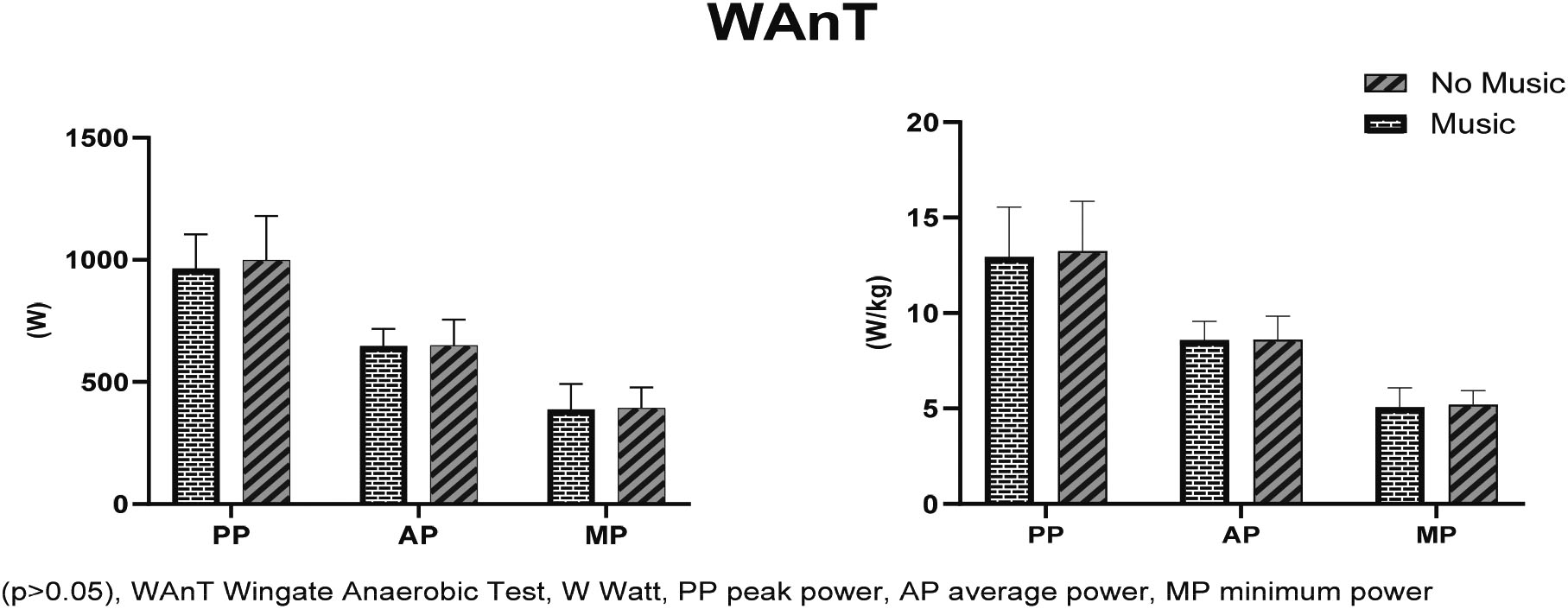
Music was played using Sandisk MP3 through personal headphones during recovery. In “no music” conditions, subjects still wore the headphones, but no music was played. Slow rhythm songs were selected from the Adele collection because of readily discernible beats. The names of the songs played were “He won’t go,” “One and only,” “I can’t make you love me,” “Skyfall,” and “Make you feel my love” (under 80 bpm). The music played continuously from the end of the WAnT until the end of the 15 min recovery. The music volume was equal to 70dB [19, 20].
The HR was monitored with a Polar (beats) HR monitor (Polar Electro Oy, Kempele, Finland). We measured HR at rest (before warm-up), immediately after the completion of the WAnT, and every minute of the 15 min recovery period. HR responses were collected using a receiver interfaced with a computer with Turbofit Software.
Earlobe blood samples were collected from each subject to obtain blood LA concentrations by a Nova Medical Lactate Plus Meter Analyzer. Blood samples were taken from the earlobe following sterilization rules. Earlobe was pierced with a Softclix make device that had a pen-like needle on its tip. The collected blood sample was dripped on a lactate test strip. The LA concentration in blood was obtained 13 s after placing the strip on a lactate plus device. Blood LA levels were measured at rest (before warm-up), immediately after the test, and at 1, 5, 10, and 15 min of recovery. Before each test, the analyzer was calibrated using a 5 mmol
HR and LA values with music and without music recovery conditions.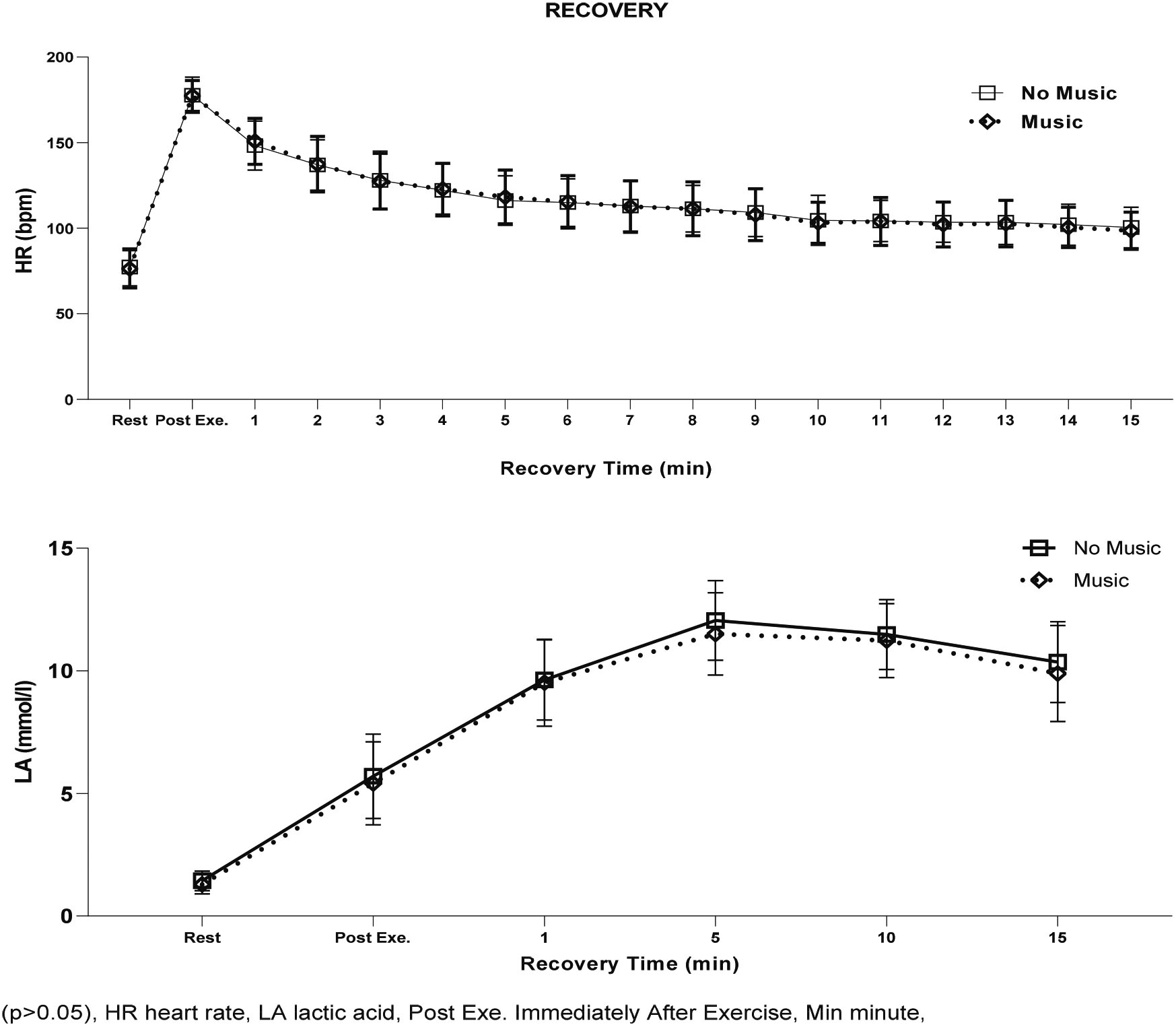
Subjects accomplished the WAnT at the same time and in the same indoor terrain, for both the music and the non-music conditions. No encouragement statements were allowed during the tests. The WAnT was conducted on a computerized Monark cycle ergometer (Model 894E, Varberg, Sweden). The cycle seat was adjusted to a predetermined height to allow complete knee extension with the ankle flexed at 90
Statistical analyses
Data were analyzed with SPSS 21.0. Normal tests and homogeneity of variance tests were conducted for the data and every variable. Paired test circumstances were used to compare the data for music and no music conditions. The level of significance was set at
Results
Figure 1 shows that the power output values during WAnT under two conditions. PP, AP, MP (W), and relative PP, AP, and MP (W/kg) values were not different between recovery with and without music conditions (
Figure 2 shows the HR and LA values during recovery after WAnT under two conditions. Recovery HR and LA values were not different between recovery with and without music conditions (
Discussion
This study examined the effects of listening to music during recovery after supramaximal exercise. There were no significant differences in the PP, AP, MP, and relative powers measured during WAnT and between the two recovery conditions. These values indicate that the subjects expended the same effort in the WAnT before the beginning of recovery with music and recovery without music. Exercise-induced fatigue levels were similar in both conditions. The increase in HR and LA after exercise according to the resting level indicates that fatigue was experienced.
In this study, recovery blood LA values were compared between the two conditions. Namely, LA values were measured during recovery with music and without music after WAnT. In the results, no significant difference was found between the two recovery conditions in terms of blood LA values. Jing and Xudong, who reported findings similar to our study, demonstrated no difference in blood LA during recovery between the relaxing music group and no music group [9].
Eliakim et al. examined the effect of motivational music during recovery from intense exercise. They determined blood lactate concentrations at 3, 6, 9, 12, and 15 min during recovery from exercise, with and without motivational music. In that study, there was no difference found in blood lactate concentration at 3, 6, and 9 min of the recovery with and without music [8]. These findings coincide with the results of our study. But unlike our study, Eliakim et al. found a significant effect of music on absolute blood lactate concentration toward the end of the recovery period at 12 and 15 min. They commented that only when fatigue decreased with HR decline did music have a significant positive effect on recovery [8]; however, in our study, we did not find such an impact. It is unclear what causes this discrepancy between the studies. The reason for this contradiction might be the training level of subjects. The subjects in our study train regularly for at least 6 days and 14 h a week. In the case of Eliakim et al., the subjects train 5–8 h a week [8]. Another reason for the contradiction could be the rhythm of the music. We used slow rhythm music (
In the current study, HR values were measured every minute for the 15 min recovery time after WAnT. It was found that HR values were not different between the two recovery conditions, which were with music and without music. This finding coincides with the results of a previous study as well [8]. In that study, there was no difference in the mean HR during recovery with and without music.
High-intensity exercise training is not typically associated with positive affective responses [15]. In our study, the intensity of the exercise was high, and the person could not even perceive the stimuli from the environment during recovery. That is, the subjects were so tired that music could not affect recovery.
Conversely, the current study’s results are different from the results of previous studies, which reported significant differences between recovery with music and without music. Significant effects and interactions were found in HR values under the two conditions in the previous studies [9, 24].
Jing and Xudong evaluated the effects of relaxing music (40 dB) on aerobic exercise-induced fatigue [9]. Their results showed that HRs, urinary protein, and RPE decreased after the application of relaxing music, and these declines were higher than those with no music applied. Unlike our study, the subjects in Jing and Xudong’s study [9] accomplished aerobic exercise that lasted 68.0
Savitha et al. examined the effect of music and different musical tempos on recovery time following a submaximal workout on a treadmill. With slow music, the recovery time of systolic blood pressure, diastolic blood pressure, pulse rate recovery, and RPE were faster when compared to both no music and fast music. Their study concluded that music enhances postexercise recovery, with slow music having a significant relaxation effect than fast or no music, and recovery time is independent of gender and individual music preference [24]. Unlike our study, subjects were not athletes although they were subjected to submaximal running workout on a treadmill machine in their study. Our subjects were athletes subjected to supramaximal exercise.
Inconsistencies exist in results between our study and other studies regarding whether music can change recovery blood lactate and HR. The differences between the studies’ findings may be due to differences in music tempo, training level of subjects, and exercise intensity.
One of the limitations of our study was that the subjects did not choose the music. They listened to the music chosen by us. In addition, the effect of fast rhythm music on recovery could have also been examined. In this study, recovery was assessed for 15 min after exercise. It could have been assessed for a longer time. In future studies, these limitations should be taken into consideration.
In conclusion, music has no real effect on lactate and HR recovery post-supramaximal exercise. Therefore, listening to slow rhythm music cannot improve recovery after high-intensity exercise. Music alone cannot improve recovery after anaerobic exercise.
Ethical considerations
The study is approved by the Ethics Committee in Clinical Research of Ondokuz Mayıs University (2016/307, October 3, 2016) and conducted according to the Helsinki Declaration. All subjects signed a written informed consent before participation.
Funding
This study was supported by Ondokuz Mayıs University’s Scientific Research and Development Support Program Project.
Footnotes
Acknowledgments
The author has no acknowledgments.
Conflict of interest
The author declares no conflicts of interest.