




Abstract
BACKGROUND:
Shooting accuracy and ball speed are important factors relating to scoring in handball that could be affected by skeletal muscle fatigue.
OBJECTIVE:
To explore the effects of muscle fatigue on male handball players’ shooting accuracy and ball speed.
METHODS:
Sixteen elite handball players (
RESULTS:
There were no significant differences between pre-fatigue and post-fatigue protocols in terms of accurate and inaccurate shots, and ball speed. Only wrist acceleration in the Y axis (
CONCLUSIONS:
Muscular fatigue does not affect shooting accuracy and ball speed in male handball players.
Introduction
Team handball is a competitive sport including full speed running, changes in speed and direction, jumping and overhead throwing [1, 2]. Overhead performance including speed and accuracy has critical importance in handball players, which is a determining factor of scoring goals [3]. Successful shooting requires maximum ball velocity; however shooting the ball fast is not enough to beat a good goalkeeper. Accuracy is also essential for optimum results. Passing accuracy provides either pace or continuity of the play or keeps pressure on the defense by allowing each attacker to be a scoring threat [4, 5]. In that point, Freeston et al. optimized the accuracy at the range of expert players’ shooting speeds at between 75% and 85% of their maximum speed [6].
Training with appropriate intensity is a key factor in improving performance and prevention from injuries. Maximal oxygen uptake (VO2max), maximal heart rate (HRmax) and individual lactate threshold are used as physiological breakpoints in the determination of exercise intensity. Meyer et al. [7] stated that 60 and 75% of VO2max as well as 70 and 85% of the HRmax considerably in relation. In that point during whole match, handball players’ mean heart rate was reported between 75–80% of maximum heart rate by Chirosa et al. [8]. By the way Michalsik et al. [9], stated relative work load during match-play on average 70.85
Shooting performance in handball could be affected by fatigue. The term fatigue has been defined as any reduction in maximal force generating capacity, irrespective of the force required for a specified task [10, 11, 12]. Neuromuscular fatigue affects the nerve and muscle physiology and biomechanical processes to produce muscle force and it depends on type of exercise performed [13]. A previous study [11] indicates that cumulative fatigue influences range of motion, isometric strength and kinematics and kinetics of throwing a ball of handball players. Fatigue decreases joint position sense in the shoulder and hip joints that may impair the accuracy in throwing and speed [14]. On the other hand, two studies [15, 16] showed that skeletal muscle fatigue did not affect ball throwing velocity, muscular balance and kinematics of shooting in handball and basketball. We therefore wondered whether shooting accuracy and ball speed would be affected after fatigue in male handball players. However, in variance with previous studies, we induced skeletal muscle fatigue in the laboratory and evaluated shooting accuracy and ball speed in the field setting.
Methods
Participants
Sixteen elite young male handball players (
Study design
The current study was made up of two sessions: laboratory and field test. Upon arrival at the laboratory participants underwent a treadmill test in order to determine VO2max values (75% of VO2max) for setting relative running speed of each participant for 30–15 intermittent fitness test [17] as the fatigue protocol. Field test session composed of pre-fatigue shooting test and post-fatigue shooting test. After determination of the optimal shooting velocities of the participants shooting to target procedure was applied. After that, the 30–15
The field test design.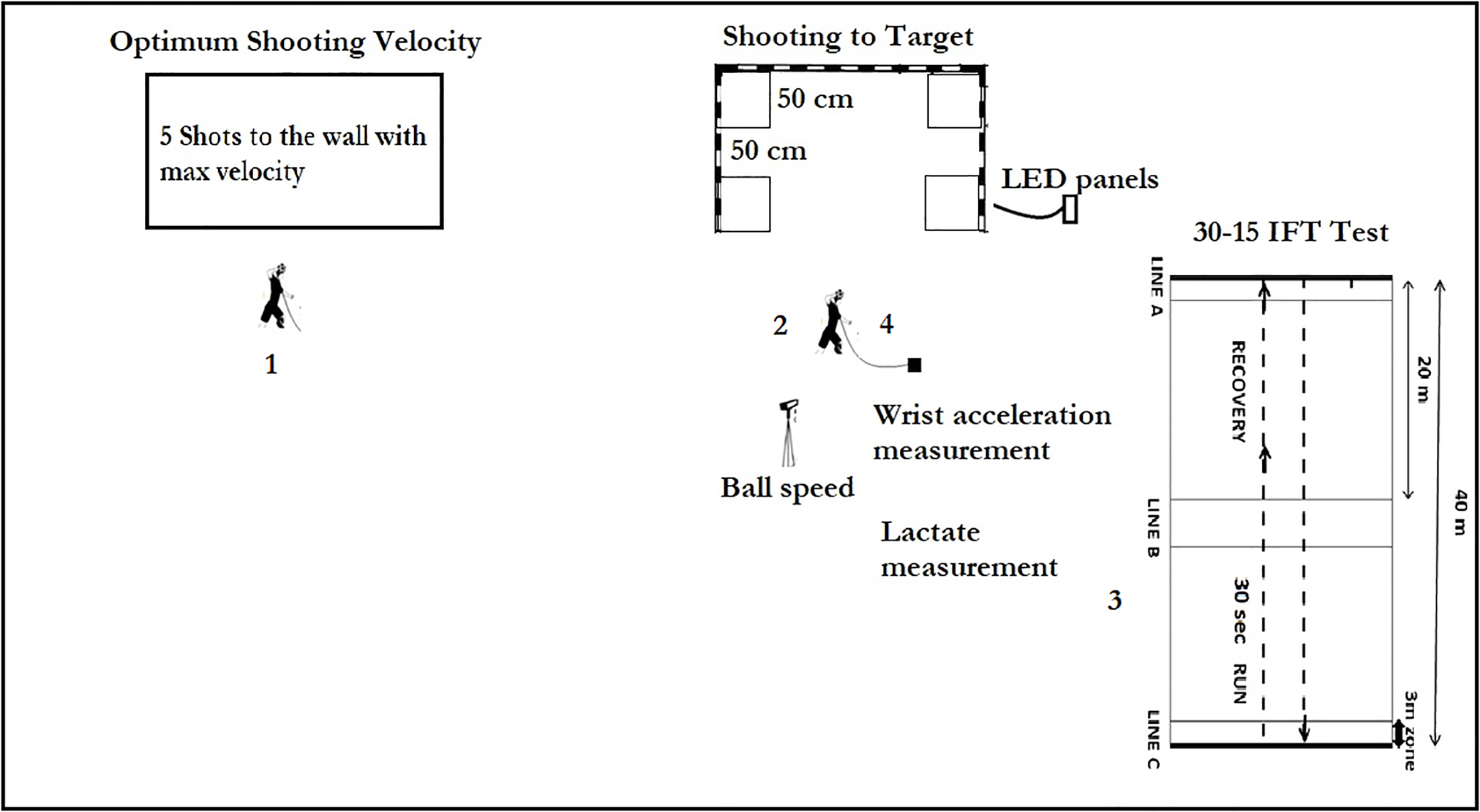
Blood lactate concentration over 8 mmol/L, 90% of HRmax values were calculated according to age, RER values
Handball players’ height measurement was performed with a stadiometer (Holtain, England, sensitivity
A heart rate (HR) monitoring system was fitted to each player before a treadmill test and the 30–15 intermittent fitness test (30–15
In order to obtain the VO2max values of the participants, pulmonary maximum oxygen uptake was measured by a breath-by-breath gas analyzing system (JAEGER MasterScreen CPX; Viasys Healthcare GmbH, Hoechberg, Germany) and the Jager LE 200 CE treadmill. The analyzer was calibrated before each test. The participants performed an incremental test on a treadmill with 0.5% slope. Treadmill speed began at 8 km.h
In order to measure participants’ blood lactate levels, 25
Paired sample t-test results for accurate and inaccurate shots before and after fatigue protocol
Paired sample t-test results for accurate and inaccurate shots before and after fatigue protocol
Before shooting to target test procedure, optimum shooting velocities of participants are determined and want them to shot at least with their optimal shooting velocity to prevent the athlete from developing a tactical method that will influence shooting accuracy during shooting. After a warm-up session, participants shot the ball as fast as possible to the entire goal area from a 7-m line without a target. Ball velocity was measured by Sports Radar Gun (SR 3600, USA) placed behind the participant and arranged to align with the height of his throwing arm. Except for minimum and maximum speeds, mean values of three shots were calculated, and 80% of shooting speed was accepted as optimum shooting velocity. During shooting procedures, a standard handball (diameter
Four equal-sized targets (50 cm
Shooting to target measurements
Each participant has shot four times at each of the four target locations, completing 16 shots. Participants had to maintain their feet in contact with the ground just behind the 7-m line; they had to use correct techniques and shoot with optimum velocity during 16 consecutive trials. Between trials, after being given a ball by a designated person standing 1 m away, the participant could handle the ball for 3 s, assume a standardized shooting position and be ready to react to the next visual stimulus. Accurate and inaccurate shots, shooting velocity and successes for each target were all recorded.
Wrist acceleration measurement
To determine wrist acceleration during shooting performance, a tri-axial accelerometer (SS27L,
Fatigue protocol
As a fatigue protocol, a 30–15
Paired sample t-test results for X, Y, Z axis values (msec) of wrist acceleration during shooting before and after fatigue protocol
Paired sample t-test results for X, Y, Z axis values (msec) of wrist acceleration during shooting before and after fatigue protocol
Paired sample t-test results for ball speed (km/h) values in accurate and inaccurate shots before and after fatigue protocols
VO2max30-15
30-15 Intermitted Fitness Test (30-15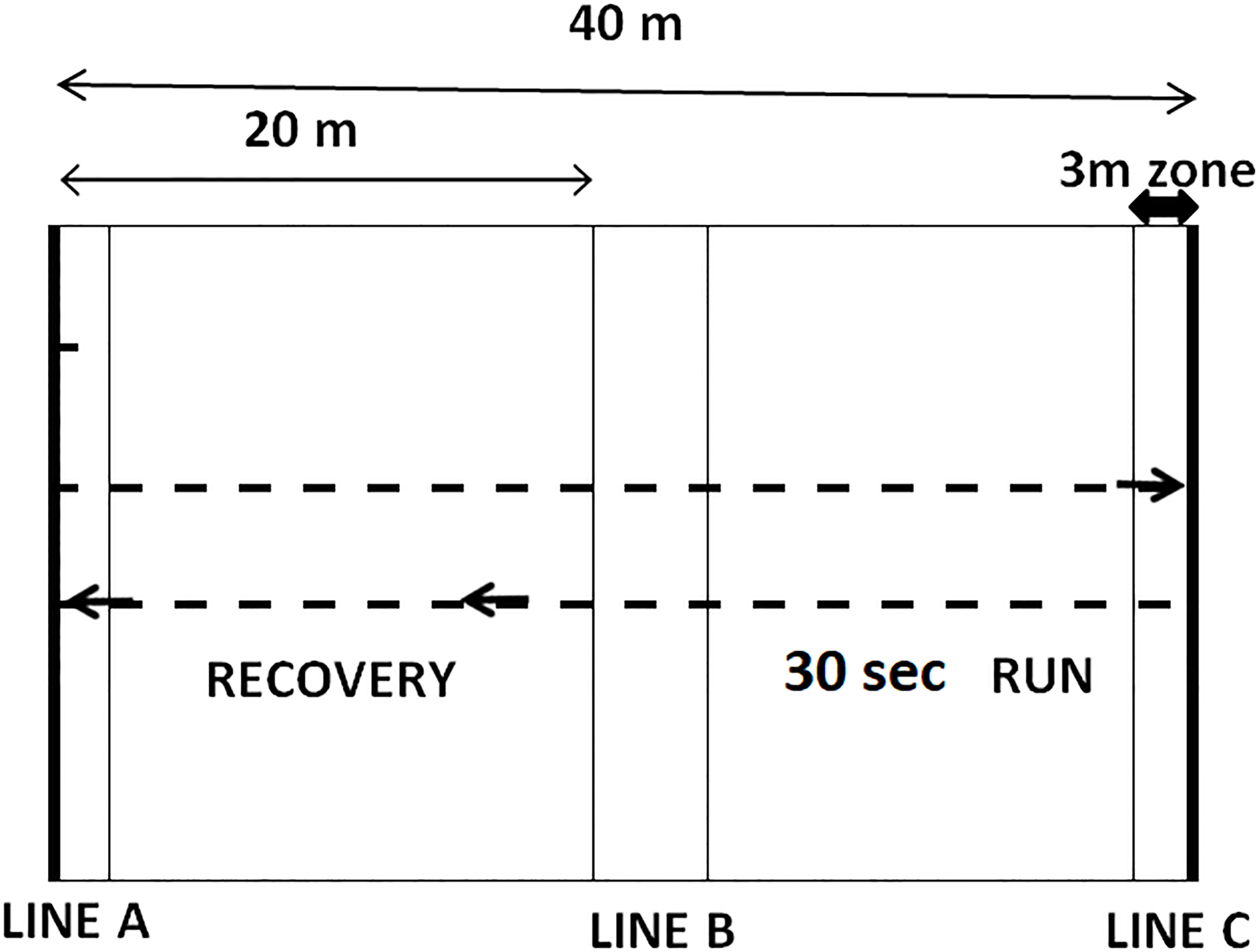
After the completion of the 30–15
Statistical analysis
Paired sample t-test was used to determined differences in the shooting accuracy, ball speed and wrist acceleration before and after the fatigue protocol.
Results
Paired sample t-test results indicated no significant differences on shooting accuracy before and after the fatigue protocol (Table 1). Similarly, paired sample t-test results revealed no significant differences on axes of wrist acceleration in the accurate shots. For inaccurate shots, results showed no fatigue effects on axes of wrist acceleration, with the exception of Y axis values (
Discussion
This study primarily assessed the effects of muscle fatigue on male handball players’ shooting accuracy. As further research questions, we examined muscle fatigue’s effects on ball speed and wrist acceleration.
With respect to our results the fatigue condition did not change handball players’ shooting accuracy. In other words, accurate and inaccurate shot performances before and after the fatigue protocols were similar. According to related literature about team handball’s match profiles, effective playing time for an entire match was reported over approximately 70% of total effective playing time [26] and the number of attacks (57.5
On the other hand, Tillar and Ettema compared novices and experts in terms of speed – accuracy trade-off in overarm throwing. They reported that, while novices may show a trade-off, expert players could control their techniques and manage optimized throwing patterns without showing effects of fatigue [28]. Parraga, Sanchez and Ona also reported that throwing speed did not affect accuracy [29]. In addition, García et al. reported that ball speed did not affect throwing accuracy [30]. Enoka stated that unless athletes were highly motivated, most terminated exercise before their muscles became physiologically exhausted; thus, elite athletes highly motivate themselves, especially for match conditions, and although they do reach fatigue, they can continue top performance [31]. In another supporting study, Andrade asserted that ball speed did not change at the end of the fatigue condition both for accurate and inaccurate shots [15]. In other words, experienced players, especially, better able to cope with fatigue conditions and still optimize their throwing velocity and techniques. In this situation, related studies supported the current results.
For wrist acceleration, this study’s results show that only movement in the Y axis (from back to forward) only was affected by the fatigue condition for inaccurate shots. In handball throwing technique, mechanical energy transfers in sequence from the starting point to the ball release, respectively, for the hip, trunk, shoulder, upper arm, forearm and hand. Therefore, the part of the mechanical energy generated in and around the shoulder is transferred to the hand [31]. From that point, throwing motion follows an orbit from back to forward. In the current study, chances of movement pattern of Y axis during or inaccurate shots after the fatigue condition can be explained by players attempting to optimize their technique to avoid effects of fatigue.
The study was restricted by the elite young male handball players. If the same study design was performed on female handball players or if local fatigue protocol was applied instead of general fatigue protocol, the result could be different. In addition, the number of each target was limited to four shots in order to avoid elimination of fatigue effects during shooting.
Conclusion
The results of this study suggest that muscle fatigue has no effect on shooting accuracy and ball speed in elite male handball players. Further studies that focus on the effects of various local fatigue protocols on the variables analyzed are recommended.
Footnotes
Conflict of interest
The authors declare no conflict of interest regarding publication of this manuscript.