



Abstract
Background:
Specific kinematic factors have been found to contribute to faster pitch speeds, with poor mechanics leading to injury.
Purpose:
To discuss the kinematic parameters that predict faster ball velocity among baseball pitchers.
Study Design:
Systematic review.
Methods:
Using the PRISMA (Preferred Reporting Items for Systematic Reviews and Meta-Analyses) guidelines, the authors utilized the Cochrane Database of Systematic Reviews, PubMed (2008-2019), and OVID/MEDLINE (2008-2019) databases. Eligible articles included those that reported on kinematic factors predictive of ball velocity across youth, high school, collegiate, and professional levels of play. The quality of all included studies was evaluated by 2 reviewers using the Appraisal tool for Cross-Sectional Studies (AXIS). The lack of consistent study design or outcome variables precluded meta-analysis.
Results:
A total of 584 studies were identified from the initial search with 12 included in final analysis (930 pitchers in total; 429 [46.1%] youth, 164 [17.6%] high school, 153 [16.5%] collegiate and 184 [19.8%] professional) with mean ball velocity of 71.1 mph (114.4 km/h). The average AXIS score was 16 out of a possible 20. The shoulder played a significant role in the generation of velocity-induced torques. Hip and shoulder separation was associated with a 2.6 ± 0.5 mph (4.1 ± 0.8 km/h) increase in velocity, whereas increased shoulder movement of the nonthrowing arm was negatively correlated with initial ball velocity (r2 = 0.798). Furthermore, hip/shoulder separation, decreased movement of the nonthrowing shoulder, trunk power and timing of maximum trunk rotation, increased contralateral trunk tilt and increased sagittal-plane trunk tilt, and decreased knee flexion at ball release were all associated with higher fastball speeds.
Conclusion:
Multiple upper extremity and trunk kinematic parameters affect ball velocity, with significant contributions from the throwing shoulder and trunk, as well as nondominant arm. Understanding kinematic predictors of faster ball velocity can help guide training regimens.
Pitching is a complex movement requiring the coordination of sequential muscles and joints as the motion progresses. Biomechanical analyses have been performed on youth, collegiate, and professional pitchers, and the pitching kinematics and kinetics have been extensively detailed.9,25 Professional throwers can reach pitching velocities exceeding 100 mph (160.9 km/h), 43 with several studies having identified specific kinematic factors that may contribute to faster pitch speeds.3,6,12,20,33,38 The cocking phase of throwing transfers energy from the lower extremity, through the core and trunk, and up to the upper extremity, 6 and several corresponding kinematic factors have been identified that affect pitching velocity.3,6,12,20,33,38 Knee flexion at front foot contact has been found to correlate with shoulder and elbow torque as the motion proceeds to the upper extremity12,33 and has been shown to affect ball velocity in adult pitchers. 3 Increased ball velocity at the time of ball release has also been associated with higher peak knee flexion and lead knee extension angular velocity. 20 The temporal relationships between the trunk and joint angular velocities during a pitch have been shown to affect ball velocity.20,38 Additionally, several studies have noted the importance of greater maximum shoulder external rotation in achieving higher pitching velocity.20,22,41 Other important variables in achieving high velocity are elbow flexion torque, increased shoulder horizontal abduction at foot contact, 13 greater lateral trunk flexion at ball release,22,28 and greater forward trunk tilt.8,20,38
Developing the appropriate pitching mechanics to safely achieve faster ball velocities starts with the youth pitcher, as pitching mechanics have been found to change as the pitcher matures. 15 An understanding of pitch mechanics that lead to increased ball velocity can guide coaches in working with young players as they develop. Therefore, the purpose of this systematic review was to discuss the kinematic parameters that predict faster ball velocity among baseball pitchers. We hypothesized that kinematics from the trunk and lower extremities would provide significant contributions to ball velocity.
Methods
Article Search Process and Eligibility
Articles were extracted in accordance with the 2009 PRISMA (Preferred Reporting Items for Systematic Reviews and Meta-Analyses) statement.22,23 The query for studies was performed in February 2023 for literature pertaining to kinematic predictors of ball velocity in high school, collegiate, and professional baseball pitchers utilizing the Boolean search phrase “((((pitch velocity) OR (pitch speed)) OR (ball speed)) OR (ball velocity)) AND (baseball).” The query was performed using the Cochrane Database of Systematic Reviews, PubMed (2008-2019), and OVID/MEDLINE (2008-2019) databases.
Eligible articles included those written in the English language that reported on kinematic predictors of ball velocity in pitchers of all playing levels. Included were studies with evidence levels of 1 to 3 that directly compared cases and controls or level 4 studies that performed a subanalysis that allowed for information necessary to generate metaregressions. Additionally, articles were excluded if categorized as conference abstracts, narrative or systematic reviews, case reports, technical notes, and letters to the editor.
Once the above search query was applied to search article titles and abstracts within the noted databases and the results were reviewed to meet eligibility criteria, 2 researchers (C.C., J.A.E.) independently reviewed eligible articles. After removing duplicate articles, article abstracts were reviewed to ensure the study population included youth or adult baseball pitchers. Remaining articles were screened for inclusion of kinematic parameters related to ball velocity, and a final round of screening removed articles that lacked available full texts, were missing raw data, excluded upper extremity kinematics, and were published by the current research group. Discrepancies in the final article list were reviewed for consensus with the remaining authors.
Search Results
A total of 584 studies were identified from the initial search with publication dates ranging from 1999 to 2023. After a review of the reference sections, no additional studies were added. Of the initial studies, 12 articles ¶ were deemed appropriate for analysis in the study. A flowchart of the study inclusion process is shown in Figure 1. The lack of consistent study design or outcome variables precluded meta-analysis.
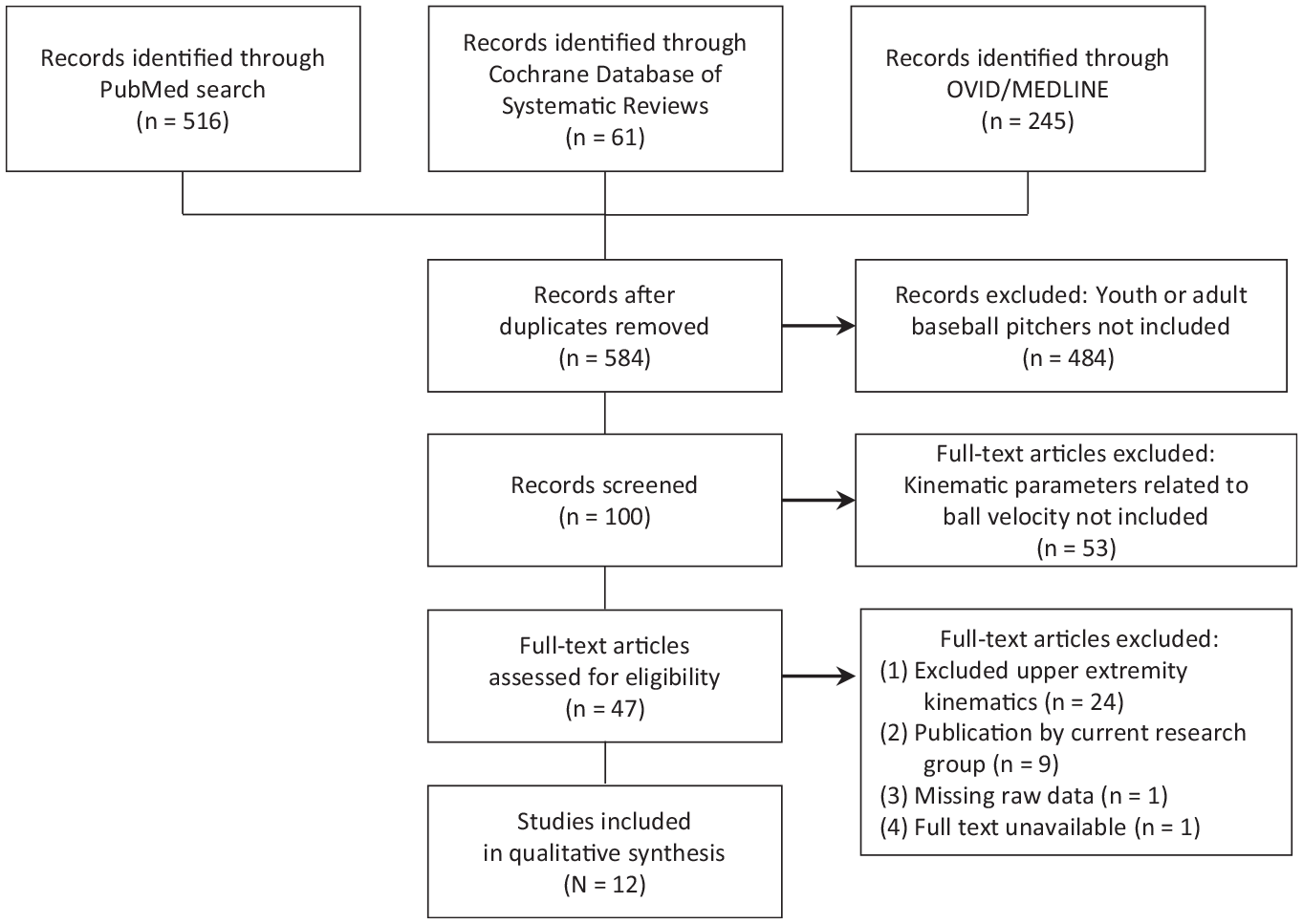
PRISMA (Preferred Reporting Items for Systematic Reviews and Meta-Analyses) flowchart of article search and selection process.
Quality Assessment
The Appraisal tool for Cross-Sectional Studies (AXIS) 11 was used to evaluate the quality of all included studies. Two reviewers (A.K. and C.C.) scored each study, and any discrepancies were mitigated by consensus agreement or excluded altogether.
Results
Study Characteristics and Patient Demographics
Of the 12 studies included in this review, there were 9 descriptive laboratory studies: Alderink et al, 4 Aguinaldo and Escamilla, 1 Dowling et al, 10 Keller et al, 16 Murata, 24 Oyama et al, 27 Smith et al, 35 Solomito et al, 36 and Tanaka et al 40 ; and 3 single-episode cross-sectional studies: Cross et al, 7 Orishimo et al, 26 and Sgroi et al. 34 There were 930 pitchers in total, with 429 (46.1%) youth, 164 (17.6%) high school, 153 (16.5%) collegiate, and 184 (19.8%) professional athletes. The mean age was 17.2 years (range, 12.1-25.5 years). Mean age stratified by competition level was reported as youth (14.7 ± 2.6 years), high school (15.9 ± 1.3 years), collegiate (20.2 ± 1.5 years), and professional (21.9 ± 2.0 years). The mean pitcher weight was 76.3 kg and mean height was 178.0 cm. Mean ball velocity was 31.8 m/s (71.1 mph [114.4 km/h]). The included studies used a variety of biomechanical assessments including induced velocity analysis, marker motion analysis, video motion analysis, use of a goniometer, and use of a wearable sensor sleeve. The study characteristics are summarized in Table 1. Studies categorized by anatomic location and kinematic contributors to ball velocity are described, with specific measurement descriptions for kinematic parameters of interest provided in Table 2. The results of the AXIS quality assessment showed an average score of 16 out of a possible 20 across all studies (Appendix Table A1).
Summary of Study Characteristics a
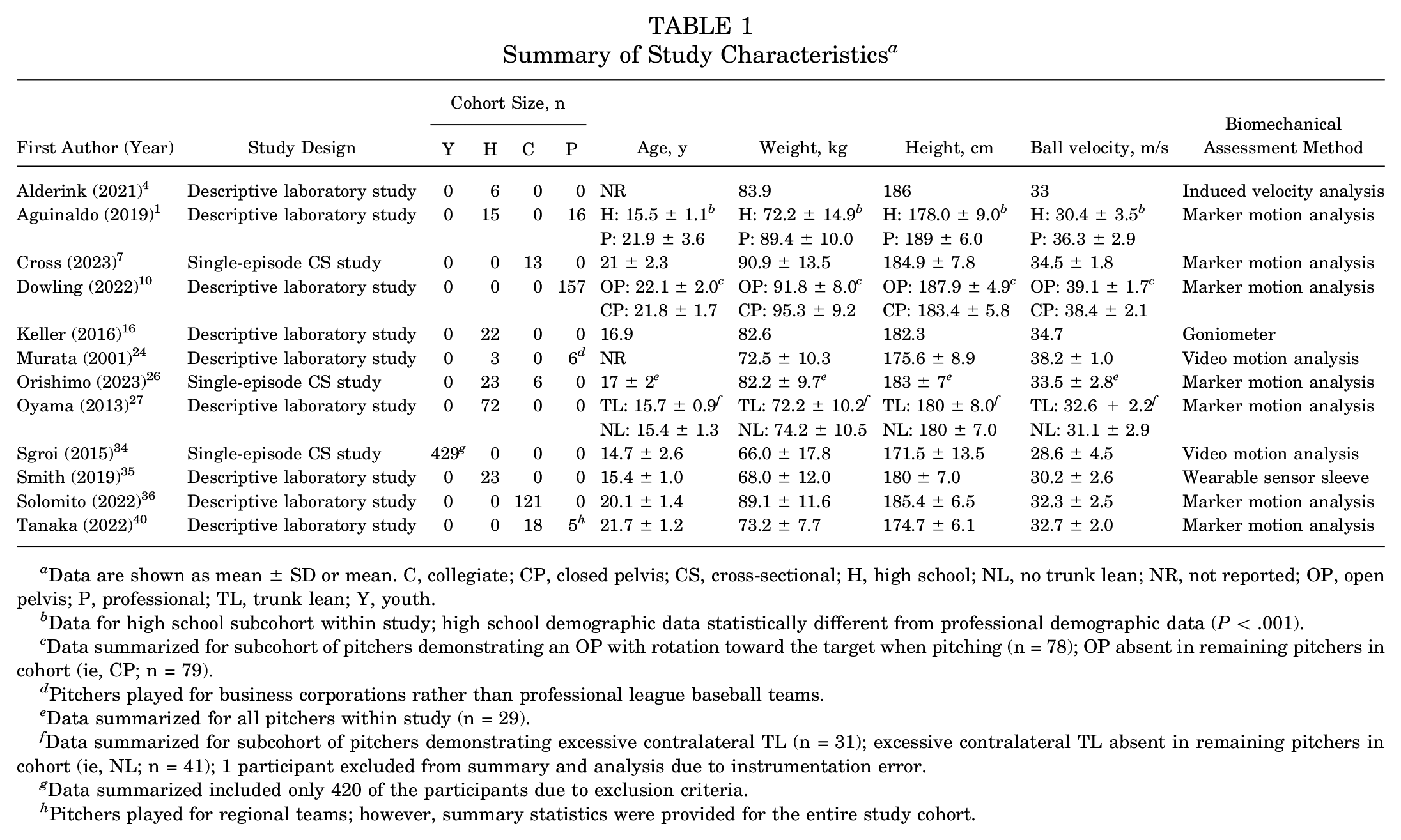
Data are shown as mean ± SD or mean. C, collegiate; CP, closed pelvis; CS, cross-sectional; H, high school; NL, no trunk lean; NR, not reported; OP, open pelvis; P, professional; TL, trunk lean; Y, youth.
Data for high school subcohort within study; high school demographic data statistically different from professional demographic data (P < .001).
Data summarized for subcohort of pitchers demonstrating an OP with rotation toward the target when pitching (n = 78); OP absent in remaining pitchers in cohort (ie, CP; n = 79).
Pitchers played for business corporations rather than professional league baseball teams.
Data summarized for all pitchers within study (n = 29).
Data summarized for subcohort of pitchers demonstrating excessive contralateral TL (n = 31); excessive contralateral TL absent in remaining pitchers in cohort (ie, NL; n = 41); 1 participant excluded from summary and analysis due to instrumentation error.
Data summarized included only 420 of the participants due to exclusion criteria.
Pitchers played for regional teams; however, summary statistics were provided for the entire study cohort.
Kinematic Parameters of Interest

Arm: Centripetal/Coriolis Effects From the Upper Arm and Forearm Velocities
Alderink et al 4 collected pitching data from 6 high school pitchers who pitched ≥35.8 m/s (80 mph [128.7 km/h]). A 14-segment biomechanical model was constructed, and induced velocity analysis of pitching was used to evaluate contributions of torques generated by different segments of the body. The analysis found that the velocity-induced torques at the shoulder just before release were the greatest contributor to ball velocity, accounting for 31% of the total modeled ball velocity. The elbow provided 18% of the total modeled ball velocity. In particular, movement of the upper arm segments, which the authors approximated to be the centripetal/Coriolis effects from the upper arm and forearm velocities, was found to contribute the most to ball velocity at 58%. Conversely, they found that the lower extremities (mean contribution, −1.3%) and the wrist (mean contribution, −6.9%) contributed minimally or negatively to ball velocity.
Shoulder
Shoulder-Joint Movement Index of the Nonthrowing Arm
Murata 24 divided pitchers into unskilled (n = 3) and skilled pitchers (n = 6) based on the opinion of each group’s original coaches (using criteria such as performance in games and initial fastball speed) and evaluated the effect of movement in the nonthrowing shoulder on ball velocity. The shoulder-joint movement index (SJM) was a calculated measurement of the displacement of the shoulder of the nonthrowing arm. The SJM tended to be higher in the unskilled group (unskilled group SJM = 38.3; skilled group SJM = 35.2; SJM unitless; P > .01), which also had lower initial ball velocity (unskilled group velocity = 35.96 m/s; skilled group velocity = 38.22 m/s; P < .01). In a subsequent regression analysis, they found that SJM was negatively correlated with initial ball velocity (r2 = 0.798). Furthermore, they found that less SJM in the x direction was particularly predictive of initial ball velocity (r2 = 0.832).
Separation of Hips and Shoulders
Sgroi et al 34 conducted a single-episode cross-sectional study involving 429 youth and adolescent pitchers and used a multivariate analysis using parameters such as demographics, physical examination, kinematics, and observed mechanical factors to determine predictors of ball velocity. The most important factors affecting ball velocity were age, height, hip and shoulder separation, and stride length as a percentage of the patient’s height. Age accounted for 66% of the variance in ball velocity (r2 = 0.658; P < .001), whereas hip and shoulder separation (r2 = 0.027; P < .001) and stride length (r2 = 0.016; P < .001) explained 4.3% of the variance. Separation of hips and shoulders was defined as a binary “yes” in pitchers for whom a period could be identified during which the pelvis rotated to face home plate while the shoulders continued to face third base during the cocking phase. Hip and shoulder separation was associated with a 2.6 ± 0.5 mph (4.1 ± 0.8 km/h) increase in velocity (β = 2.621).
Similarly, Orishimo et al 26 followed 29 high school and collegiate pitchers and evaluated the effect of trunk velocity, peak pelvic velocity, and hip-shoulder separation at foot contact on pitch velocity. Peak trunk velocity alone, which was determined between stride foot contact and ball release, was found to account for 25% of pitch velocity variability (P = .006). Peak trunk velocity was found to be positively correlated with hip-shoulder separation at foot contact, peak pelvis velocity, and the timing of peak pelvic velocity (r2 = 17%, 23%, and 16%, respectively).
Glenohumeral Internal Rotation Deficit
Three studies found that the glenohumeral internal rotation deficit (GIRD), defined as the difference between dominant and nondominant shoulder internal rotation, is not predictive of ball velocity.16,34,35 Sgroi et al 34 found in their univariate regression that GIRD is not correlated with ball velocity (Pearson r = 0.069; P = .166). Smith et al 35 examined the pitches of 23 high school baseball players and found no correlation between GIRD and ball velocity (P = .333). Keller et al 16 recruited 22 high school pitchers and found no relationship between ball velocity and GIRD (r = −0.09; P = .683).
Shoulder Strength, Internal Rotation Torque
Cross et al 7 followed 13 collegiate pitchers and noted significant correlations between pitching velocity and shoulder strength. Isokinetic shoulder external rotation and internal rotation (r = 0.567 and 0.613, respectively), as well as concentric shoulder external rotation (r = 0.657) at 90 deg/s were significantly correlated with increased pitch velocity. Additionally, concentric shoulder external rotation at 180 deg/s (r = 0.603) was also significantly correlated with increased pitch velocity.
Trunk
Trunk Rotation Time, Velocity, and Trunk Power
Aguinaldo and Escamilla 1 measured pitching biomechanics of 16 professional and 15 high school baseball pitchers, noting trunk power was a significant predictor for ball velocity in high school players (β = 0.612; P = .015) and professionals (β = 0.883; P < .001). They found that trunk power accounted for 37.5% of the variance in ball velocity among high school pitchers and 88.3% of the variance in ball velocity in professional pitchers. The authors concluded that trunk power and timing of maximum trunk rotation predicted ball velocity for both cohorts. For high school players, the authors suggested the adoption of an “inefficient pitching pattern” in which earlier trunk rotation leads to a lower pitching output as measured by the ratio of ball velocity to maximum elbow varus torque when compared with professionals.
Dowling et al 10 retrospectively reviewed the pitching evaluations of 157 professional pitchers with a focus on pelvic rotation at foot contact. Pelvic rotation was defined as a line from the anterior superior iliac spine in relation to the coordinates of the pitching evaluation. Pitchers were divided by open or closed pelvic rotation based on the position of the pelvis with relation to home plate (perpendicular to or facing home plate). Pitchers with open pelvic rotation (greater rotation toward home plate) had significantly faster pitch velocities compared with the closed group (rotated away from home plate) (P = .029). Additionally, pitchers with open pelvic rotation had longer stride length, greater knee flexion, greater lead knee extension, and faster peak lead knee extension velocity compared with the closed group (P < .01, P = .029, P < .01, and P < .01, respectively).
Tanaka et al 40 evaluated 18 collegiate pitchers with a focus on the effect of the normalized trunk rotation velocity at the time of peak pelvic rotation velocity on pitch speed. Normalized trunk rotation velocity was calculated as the degree to which the trunk rotation is suppressed when pelvic rotation velocity is reached. The length of time between peak pelvic rotation velocity and peak trunk rotation velocity was calculated as the time from foot contact to peak trunk rotation angle relative to the pelvis. The authors noted that a longer time between peak pelvic rotation velocity and peak trunk velocity was correlated with faster pitch speed (r = 0.473; P = .047). Additionally, a lower trunk rotation velocity was associated with faster ball speed.
Trunk Tilt
Several studies have evaluated the effect of trunk tilt on ball velocity, including a descriptive laboratory study by Oyama et al 27 and a cross-sectional study by Sgroi et al. 34 Oyama et al 27 examined the pitching technique of 72 high school pitchers with a specific focus on contralateral trunk tilt. Excessive contralateral trunk tilt was defined as a binary “yes” or “no” if during the instant of maximum shoulder rotation, the side of the pitcher’s head ipsilateral to the throwing limb was deviated from a vertical line passing through the pitcher’s stride foot ankle by more than a head width. Compared with those without, players with excessive contralateral trunk tilt were found to have increased ball velocity (trunk lean group velocity = 32.6 ± 2.2 m/s; no lean group velocity = 31.1 ± 2.9 m/s; P = .19). They also found that excessive trunk tilt was associated with greater elbow proximal force (103.9 ± 12.7 %weight vs 93.2 ± 13.9 %weight; P = .001), shoulder proximal force (104.8 ± 14.1 %weight vs 94.3 ± 15.5 %weight; P = .004), elbow varus torque (4.29 ± 0.73 %height × weight vs 3.84 ± 0.8 %height × weight; P = .017), and shoulder internal rotation moment (4.21 ± 0.71 %height × weight vs 3.75 ± 0.78 %height × weight; P = .011). Pitchers with excessive contralateral trunk tilt also demonstrated decreased forward flexion of the upper torso at stride foot contact (−0.72°± 9.4° vs 7.0°± 8.5°; P < .001), decreased upper torso rotation angle (88.1°± 8.8° vs 95.6°± 11.0°; P = .003) and decreased sagittal trunk tilt (−34.6°± 11.2° vs -21.9°± 8.0°; P < .001) during the arm-cocking phase, suggesting excessive contralateral trunk tilt may be a compensation for inadequate lower trunk recruitment, possibly in the setting of prior injury or weakness of the hip/abdominal muscles.
Sgroi et al 34 performed a univariate analysis of kinematic parameters in youth and adolescent pitchers and noted that ball velocity correlated with forward trunk tilt at ball release (Pearson r = 0.171; P = .001) and lateral trunk tilt at ball release (Pearson r = 0.191; P < .001). On multivariate analysis, forward trunk tilt was found to be weakly correlated with ball velocity (r2 = 0.002; P = .04).
Lower Extremity: Knee Flexion Angle
Solomito et al 36 followed 121 collegiate pitchers to determine the relationship between increased knee flexion throughout the pitching motion and pitch velocity. The study demonstrated a significant correlation between knee flexion angle at maximum external rotation and ball release. Every 10° increase in the knee flexion angle led to decreased ball velocity by 0.9 mph (1.4 km/h) at maximum external rotation and 1.8 mph (2.8 km/h) at ball release (P = .01 and .024, respectively).
Discussion
The main findings of this review suggest the following kinetic parameters are most important among playing levels in the generation of faster ball velocity: (1) motions of both the throwing shoulder and the nonthrowing shoulder can contribute to the generation of faster ball velocity; (2) timing and the degree of separation of the pelvis and upper torso may play an important role in attaining faster ball velocity by way of maximum utilization of the kinetic chain; and (3) increased ball velocity has been shown in pitchers with increased contralateral as well as sagittal trunk tilt. This review provides evidence that emphasizes the importance of the kinetic chain and trunk to shoulder energy flow in the generation of ball velocity.
Internal rotation torque from the shoulder has been shown to provide the greatest contribution to ball velocity with some contributions from the elbow at late cocking. 4 A shoulder abduction position of 90° has been speculated in prior studies to be the optimal position in maximizing the functional stability of the shoulder in the plane of the scapula and, in turn, ball velocity.21,30 Even more, maximum shoulder external rotation has repeatedly demonstrated a positive relationship with ball velocity in the literature.14,20,39,41 Cross et al 7 showed an increase in pitch velocity correlated with shoulder external rotation force and shoulder compressive force, suggesting that an increase in shoulder rotation force leads to increased shoulder compressive force, and therefore, increased pitch velocity. Additionally, external rotation force was noted to be significantly correlated with pitch velocity, in accordance with prior studies highlighting this important contribution to pitch velocity. These prior reports have been supported by the theory that with increased winding during the arm cocking phase, additional stored elastic energy and stretch are generated, which can then be utilized to maximize the accelerating force supplied to the ball for an increased duration or latency during the ensuing acceleration phase. 29 Studies have not shown a decrease in ball velocity in pitchers with GIRD.16,34,35 This suggests that a focus on preserving shoulder internal rotation with appropriate mechanics and posterior capsular stretching may help prevent elbow injuries. 5
Sgroi et al 34 reported hip and shoulder separation (also known as “pelvis-trunk separation”) as a significant predictor of ball velocity in a cohort of youth pitchers. The authors hypothesized that hip and shoulder separation was related to the “summation of speed” principle, which states that the greatest transfer of force occurs when the subsequent segment begins rotating at the moment at which the prior segment reaches maximum angular velocity.31,32 Professional pitchers with faster ball velocity have also shown increased upper torso rotation earlier in the pitching cycle, as well as a faster peak upper torso rotation velocity. 17 Orishimo et al 26 found that peak trunk rotation velocity had a moderate effect on ball velocity, with contributions from hip-shoulder separation and higher peak pelvic velocity to overall peak trunk rotation velocity. This suggests that pelvis-torso separation can therefore be considered a crucial factor in the kinetic chain given its effects on the efficiency of energy transmission to the throwing arm, resulting in faster pitch velocities.2,3,28 Tanaka et al 40 found that a smaller normalized trunk rotation velocity was associated with faster pitch speed but also with larger elbow valgus and shoulder external rotation torques. Pitchers may limit trunk rotation velocity to improve the efficiency of the pitching motion, at the risk of increasing the risk of injury for shoulder or elbow injury. Subsequently, Orishimo et al hypothesized that pitch velocity can be increased without modifying upper extremity mechanics, by focusing on pelvic and trunk rotation mechanics that do not increase elbow valgus torque or shoulder external rotation torque. When counseling young pitchers, coaches should focus on core muscle strength and emphasize the timing of the pelvic and trunk rotation moments.
Trunk power and tilt have also been associated with ball speed. Previous work has suggested that the trunk is a large contributor to the total angular momentum of a pitch and that proper timing of trunk rotation allows optimal transfer of energy to the upper extremity.2,28 Pitchers with earlier trunk rotation generate significantly greater valgus torque at the elbow, 3 suggesting that poor sequential body motion leads to more internal rotation torque at the throwing arm as a compensatory method.2,3 Aguinaldo and Escamilla 1 noted that high school pitchers had significantly earlier onset of maximum trunk rotation to maximum pelvic rotation velocity when compared with professional pitchers.
Increased sagittal trunk tilt and contralateral trunk tilt have also been associated with faster ball velocity.18,19,28,37 Oyama et al 27 observed increased ball velocity in high school pitchers with increased contralateral trunk tilt. Pitchers may be able to achieve a more favorable cocking position during the windup and before forward propulsion during the arm acceleration phase by increasing lateral tilt of the torso. Sagittal trunk tilt has also been found to strongly correlate with ball velocity in professional pitchers, more so than high school players, especially during late stages of the pitch. 19 Increased sagittal trunk tilt has been theorized to increase energy transfer to the upper extremity by allowing the pitcher to maintain contact with the ball longer, increasing the accelerant force applied. 37
Pelvic rotation is an important part of the kinetic chain during the pitching motion and is involved in the transfer of energy to the upper extremity. Pelvic rotation has been studied in high school and collegiate athletes, with a wide range of values noted, suggesting that amateur pitchers may not have developed efficient pitching mechanics during their earliest training. 42 Dowling et al 10 examined pelvic rotation in professional pitchers and noted a correlation between increased stride length and landing with an open pelvis. This suggests that a longer stride length improves the efficiency of energy transfer through the kinetic chain by allowing increased time for the pelvis to reach an open position at foot contact. Pitchers landing with an open pelvis also have greater lead knee extension,10,41 which has been noted in professional pitchers. 20 Solomito et al 36 reinforced the focus on knee extension and pitch velocity by noting that greater knee flexion was associated with a decrease in ball velocity. This reinforces the importance of efficient energy transfer throughout the pitching motion, by stabilizing the lower extremity to allow the trunk to rotate and complete the kinetic chain to the throwing arm.
Limitations
This review is not without limitations. As with all systematic reviews, the quality of the data reported is limited by that which is reported in the literature and is dependent on the quality of the methodology of each individual study. However, several prospective studies were included, and level of evidence was included as an inclusion criterion. This study focused primarily on kinematic factors associated with ball velocity in both youth and professional pitchers; however, kinematics of the lower extremities can provide critical power and was not examined. Additionally, correlations between kinematics and injury risk were not the primary focus of this study and can be included in future reviews. Last, while this study presents a qualitative review of the literature, no meta-analysis of results was conducted; thus, the summative interpretability of the results is limited.
Conclusion
Multiple kinematic parameters affect ball velocity, with significant contributions from the throwing shoulder and trunk, as well as nondominant arm. Furthermore, timing and the degree of separation of the pelvis and upper torso as well as increased contralateral and sagittal trunk tilt all likely contribute to the generation of faster ball velocity. Understanding kinematic predictors of faster ball velocity can help guide training regimens.
Footnotes
Appendix
AXIS Quality Assessment of the Included Studies a

| Question | Alderink (2021) 4 | Aguinaldo (2019) 1 | Cross (2023) 7 | Dowling (2022) 10 | Keller (2016) 16 | Murata (2001) 24 | Orishimo (2023) 26 | Oyama (2013) 27 | Sgroi (2015) 34 | Smith (2019) 35 | Solomito (2022) 36 | Tanaka (2022) 40 |
|---|---|---|---|---|---|---|---|---|---|---|---|---|
|
|
||||||||||||
| 1. Were the aims/objectives of the study clear? | 1 | 1 | 1 | 1 | 1 | 1 | 1 | 1 | 1 | 1 | 1 | 1 |
|
|
||||||||||||
| 2. Was the study design appropriate for the stated aim(s)? | 1 | 1 | 1 | 1 | 1 | 1 | 1 | 1 | 1 | 1 | 1 | 1 |
| 3. Was the sample size justified? | 0 | 1 | 0 | 0 | 0 | 0 | 0 | 0 | 0 | 0 | 0 | 1 |
| 4. Was the target/reference population clearly defined? | 1 | 1 | 1 | 1 | 1 | 1 | 1 | 1 | 1 | 1 | 1 | 1 |
| 5. Was the sample frame taken from an appropriate population base so that it closely represented the target/reference population under investigation? | 1 | 1 | 1 | 1 | 1 | 1 | 1 | 1 | 1 | 1 | 1 | 1 |
| 6. Was the selection process likely to select subjects/participants that were representative of the target/reference population under investigation? | 1 | 1 | 1 | 1 | 1 | 1 | 1 | 1 | 1 | 1 | 1 | 1 |
| 7. Were measures undertaken to address and categorize nonresponders? | NA | NA | NA | NA | NA | NA | NA | NA | NA | NA | NA | NA |
| 8. Were the risk factor and outcome variables measured appropriate to the aims of the study? | 1 | 1 | 1 | 1 | 1 | 1 | 1 | 1 | 1 | 1 | 1 | 1 |
| 9. Were the risk factor and outcome variables measured correctly using instruments/measurements that had been trialed, piloted, or published previously? | 1 | 1 | 1 | 1 | 1 | 1 | 1 | 1 | 1 | 1 | 1 | 1 |
| 10. Is it clear what was used to determine statistical significance and/or precision estimates (eg, P values, confidence intervals)? | 0 | 1 | 1 | 1 | 1 | 1 | 1 | 1 | 1 | 1 | 1 | 1 |
| 11. Were the methods (including statistical methods) sufficiently described to enable them to be repeated? | 1 | 1 | 1 | 1 | 1 | 1 | 1 | 1 | 1 | 1 | 1 | 1 |
|
|
||||||||||||
| 12. Were the basic data adequately described? | 1 | 1 | 1 | 1 | 1 | 1 | 1 | 1 | 1 | 1 | 1 | 1 |
| 13. Does the response rate raise concerns about nonresponse bias? | NA | NA | NA | NA | NA | NA | NA | NA | NA | NA | NA | NA |
| 14. If appropriate, was information about nonresponders described? | NA | NA | NA | NA | NA | NA | NA | NA | NA | NA | NA | NA |
| 15. Were the results internally consistent? | 1 | 1 | 1 | 1 | 1 | 1 | 1 | 1 | 1 | 1 | 1 | 1 |
| 16. Were the results for the analyses described in the Methods presented? | 1 | 1 | 1 | 1 | 1 | 1 | 1 | 1 | 1 | 1 | 1 | 1 |
|
|
||||||||||||
| 17. Were the authors’ discussions and conclusions justified by the results? | 1 | 1 | 1 | 1 | 1 | 1 | 1 | 1 | 1 | 1 | 1 | 1 |
| 18. Were the limitations of the study discussed? | 1 | 1 | 1 | 1 | 1 | 1 | 1 | 1 | 1 | 1 | 1 | 1 |
| 19. Were there NO funding sources or conflicts of interest that may affect the authors’ interpretation of the results? | 1 | 1 | 1 | 1 | 1 | 1 | 1 | 1 | 1 | 1 | 1 | 1 |
| 20. Was ethical approval or consent of participants attained? | 1 | 1 | 1 | 1 | 1 | 1 | 1 | 1 | 1 | 1 | 1 | 1 |
| 15 | 17 | 16 | 16 | 16 | 16 | 16 | 16 | 16 | 16 | 16 | 17 | |
1 = yes; 0 = no; NA = not applicable; AXIS, Appraisal tool for Cross-Sectional Studies.
Final revision submitted March 16, 2023; accepted April 26, 2023.
One or more of the authors has declared the following potential conflict of interest or source of funding: M.E.K. has received education payments from Smith & Nephew. J.S.D. has received education payments from Gotham Surgical, consulting fees from Arthrex and Trice Medical, nonconsulting fees from Arthrex, royalties from Arthrex and Linvatec, and hospitality payments from Horizon Pharma. J.B.C. has received education payments from Arthrex and hospitality payments from Smith & Nephew. AOSSM checks author disclosures against the Open Payments Database (OPD). AOSSM has not conducted an independent investigation on the OPD and disclaims any liability or responsibility relating thereto.
