




Abstract
BACKGROUND:
Warm up exercises are common practice before training and competition in almost every sport. Although, swimming is a popular sport throughout the world, studies on the effects of warm-up are scarce.
OBJECTIVE:
The purpose of this study is to compare the effects of different stretching warm-up and exercise protocols on swim performance.
METHODS:
Fourteen sub-elite college women swimmers volunteered to participate in the study. The four stretching and warm-up protocols they followed were; (I) without stretching (WS); (II) static stretch (SS); (III) in-water (IW); and (IV) dry land (DL).
RESULTS:
There was a significant main effect for 50-meter front crawl (F
CONCLUSIONS:
Pre-event low-intensity IW warm-ups may be optimal for 50-meter front crawl and breaststroke swimming performance.
Introduction
Pre-training or competition ready stretching exercise protocols (SEPs) and warm-up protocols (WUPs) have attracted the interest of trainers because research indicates that they are associated with some positive effects on performance in sport [1, 2]. In the literature, SEPs and WUPs are classified as different approaches or protocols. Generally, it is suggested that static SEPs (SS), dynamic stretches (DS), ballistic and specific swimming WUPs are carried out on dry-land (DL) and in-water (IW) before training or a competition. During the warm-up, the circulatory system delivers the needed blood to the tissues and the rise in body temperature keeps the body heat constant. Regular workouts increase the minute volume of the heart and there is little increase in the heart rate. Thus, exercise movements that have a positive effect on the circulatory system and development of the vessels contribute to the pumping of the blood from the heart to all parts of the body more easily [3]. WUPs are recommended due to the increment in muscle temperature brought about by the priming exercises as indicated in multiple physiological and metabolic alterations that influence performance in sport [4]. The higher muscle temperature facilitates performance; therefore, it is suggested that temperature may enhance performance by inducing decreases in the viscous resistance of muscle, a speeding up of the rate-limiting oxidative reactions, or an increase in oxygen delivery to muscles [5, 6]. Increased performance is related to vasodilation of muscle blood vessels and a rightward shift of the oxyhaemoglobin-dissociation curve after warm-up. Haemoglobin releases nearly twice as much oxygen at 41
WUPs are a thoroughly acknowledged practice preceding nearly every athletic competition. However, while a warm-up is considered necessary for ideal performance by many trainers and athletes, there is little scientific evidence to support its effectiveness. Additionally, the limited studies conducted have produced conflicting findings. WUPs are generally based on the trial and error experience of the athlete or trainer, rather than on scientific research [4, 5]. Even though WUPs are an extensive practice among swimmers [10], little is known about the optimum procedures that produce improved readiness for a given event. Several factors and the confusion between their relationship mean that any characterisation of the primary properties of the best WUPs is bold. This could be the why the literature reveals complicated findings and the issue has remained separate for some time [4, 1, 11]. There has been some research into the effects of different WUPs on 50 and 100-meter swimming performance [12, 13, 14]. Some studies include the front crawl and others include breast stroke swimming performance [12, 13]. Balilionis et al. [12] found that individual data indicated that 19% of participants performed best in the 50-yd category after short warm-ups (WU), 37 % after no WUs, and 44% after regular WUs. The heart rate was significantly higher after regular WUs (100
Experimental design flowchart.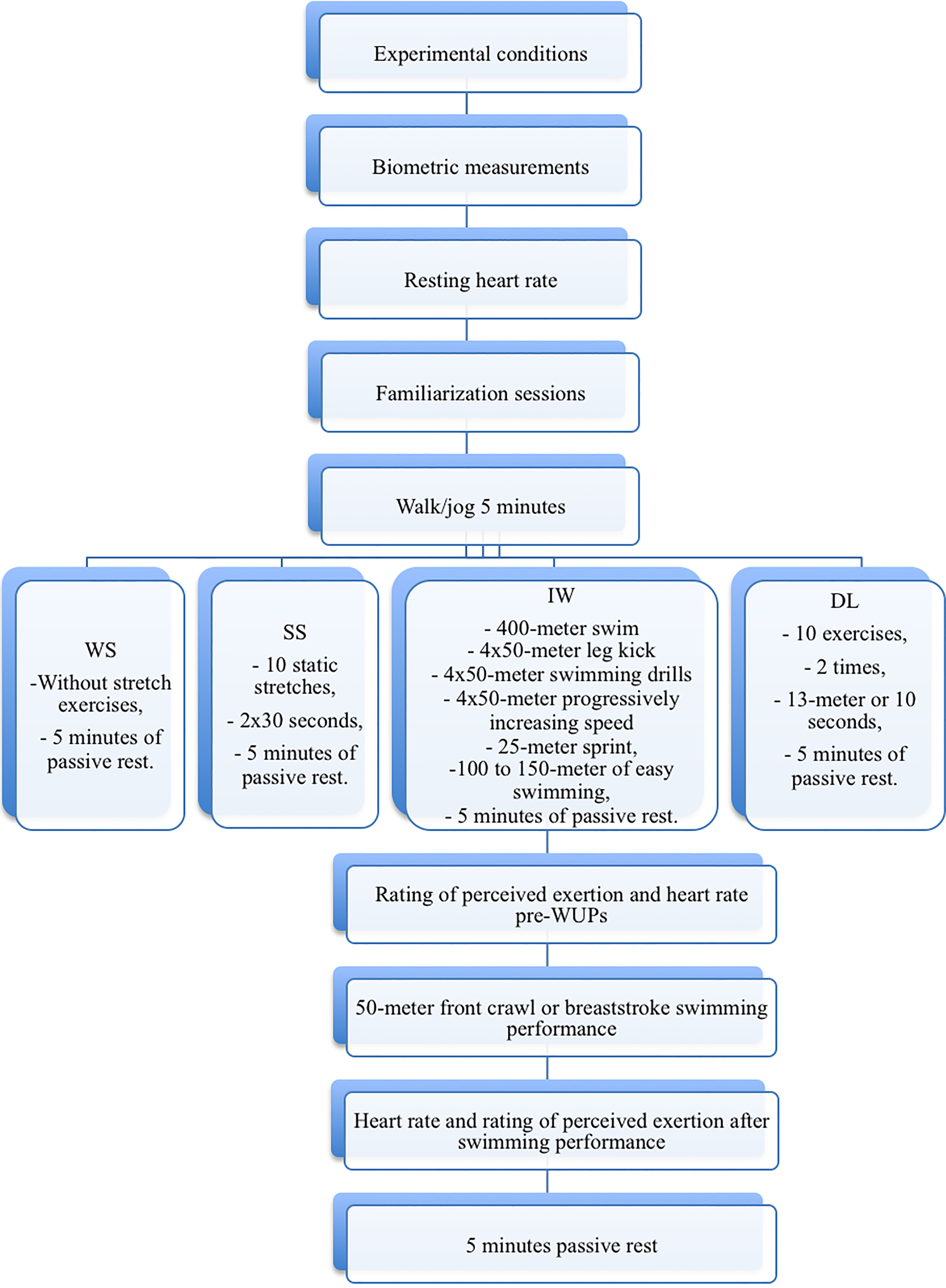
However, there is no one study that specifically mentions the effects of different SEPs and WUPs on both the 50-meter front crawl and breaststroke swimming performance.
The purpose of this study was thus to examine different SEPs and WUPs on swimming performance on sub-elite women swimmers. We hypothesized that IW warm-up would positively contribute to the swimmers’ response in maximal 50-meter front crawl and breaststroke swimming performance. It was also hypothesised that SS would negatively affect swimmers’ response to 50 meter front crawl.
Subjects
Fourteen sub-elite i.e. individuals who had not achieved the elites’ criteria, yet all qualified for at least one Turkey National Championship, college women swimmers volunteered to participate in the study. Their age, height, body mass, body fat and body mass index were 22.5
Procedure
There is only one group of swimmers in the study. They participated in two familiarisation and eight data collection sessions in an indoor swimming pool. Prior to data collection, all swimmers participated in two familiarisation sessions during which they practiced all SEPs and WUPs. This introductory period was designed to reduce the influence of any learning effects caused solely by the mechanics of performing the study protocols. Each stretching and warm-up protocol lasted between 10 and 12 minutes. Swimmers warmed up in groups, and two coaches supervised each period of SEPs and WUPs. All swimmers were asked not to participate in any moderate to vigorous physical activity before each SEP and WUP session. Throughout the familiarisation sessions the swimmers became familiar with the different SEPs and WUPs (WS, SS, IW, and DL). The entire SEPs and WUPs were carried out at the same time of day (10.00 am, to avoid the effect of diurnal variations) in a swimming pool with a water temperature of 27
SEPs and WUPs Sessions
During the SEPs and WUPs sessions, the participants stretched the main muscle groups they would use during the front crawl and breaststroke (shoulders, biceps, triceps, back, abdominal, quadriceps and hamstring muscles). The repetitions of 50-meter tests started just as they would in any official competition with front crawl swimming. The heart rate was recorded every five seconds. After each protocol, the monitors were interfaced with a computer and the heart rate data was downloaded for statistical analysis. The swimmers wore portable heart rate monitors (Polar V800 Electro Inc, Kempele, Finland) during each of the WUPs. Monitors were attached to the swimmers with a lightweight chest strap and wristwatch. A secondary analysis was performed to assess the cardiorespiratory demand.
WS: All swimmers did five minutes run, then were seated for three minutes and did not perform any stretching.
SS: After the five minutes run each participant stretched the target muscles of the right upper and lower extremities slowly and carefully until they reached a position where they felt mild discomfort for 30 seconds. Immediately after this, stretching was implemented in the same manner on a similar target muscle on the left side. This sequence was applied twice. The next target upper or lower extremities muscle was stretched after a rest period of ten seconds in accordance with the guidelines from the American College of Sport Medicine [15]. The SEPs were implemented using the horizontal flexors and extensors of muscles (see Table 1).
Static stretching exercises
Static stretching exercises
Dry-land warm-up exercises
IW: The warming heart rate of swimmers were determined as 40% of the maximal heart rate. The maximum 50-meter swimming performance were determined according to heart rate of the swimmer using the Karvonen formula [12, 16]. The first 50-meter front crawl swimming test in each condition started ten minutes after a warm-up of 1200-meters that included a 400-meter moderate swim, four x 50-meter leg kicks, four x 50-meter swimming drills, four x 50-meter swims that progressively increased in speed, a 25-meter sprint, and 100 to 150-meters of easy swimming [17].
DL: This warm-up protocol consisted of 10 minutes of 10 DL exercises that increased in intensity from moderate to high (see Table 2). The swimmers performed each DL exercise over a 13-meter distance, then rested for approximately 10 seconds, then repeated a similar exercise for 13-meter after which they returned to the starting point. All swimmers were continually instructed to maintain proper form throughout the performance of the DL protocol (e.g. vertical torso, knees towards chest, up on their toes etc.). This protocol was created so as to be in keeping with the WUPs typically used to prepare athletes for sports participation [18, 19].
The volunteers were asked to rate the WUPs and 50-meter front crawl and breaststroke swim performance using Borg’s 15-point scale [20]. The scale was clarified in detail and assisted by a visual aid. The RPE was defined post-all WUPs and post 50-meter front crawl and after each breaststroke swim performance [12].
Swim performance
In each trial, the swimmer was requested to set on the starting block and to take off after official verbal commands and the starting signal. The swimmers began the time trials with a dive from the starting blocks. All swim performances were manually recorded (using Adidas GR 10 Coach stopwatch, Germany) by an experienced coach (holding a Turkish State-National level licence). The footage from digital video cameras (Canon HD HF 10, Tokyo, Japan) positioned at the 5, 25 and 45-meter marks was used to determine the start [21].
Statistical analysis
The statistical analysis was initially carried out using the ‘Shapiro Wilks’ normality test and the homoscedasticity test. All the variables presented normal distribution and homoscedasticity. The effects of the four SEPs and WUPs protocols were analysed using an ‘ANOVA for Repeated Measures’ (WS x SS x IW x DL) and the sphericity was checked using ‘Mauchly’s Test’. When the assumption of sphericity was not met, the significance of the F ratios was adjusted according to the ‘Greenhouse-Geisser’ procedure. Pairwise tests were run to further investigate the effect of each condition. The effect sizes were calculated and classified to determine the magnitude of changes among the experimental conditions as proposed by ‘Cohen’s d’. An effect size classified as 0.2 was deemed small, 0.5 medium, and 0.8 large [22]. The findings are presented as mean
Results
Swim performance
There was a substantial main effect among WUPs on the 50-meter front crawl (F
Heart rate
There was no significant main effect between the SEPs and WUPs for the HR 50-meter front crawl (
There was a significant main effect for the HR post 50-meter front crawl (
The main effect of WS, SS, IW, and DL, SEPs and WUPs on 50-meter front crawl and breaststroke swim performance, pre and post HR, warm-up RPE, 50-meter swim RPE (
14, values are given as mean
standard deviation)
The main effect of WS, SS, IW, and DL, SEPs and WUPs on 50-meter front crawl and breaststroke swim performance, pre and post HR, warm-up RPE, 50-meter swim RPE (
(WS: Without Stretch, SS: Static Stretch, IW: In-water, DL: Dry-land, HRR: Heart rate resting; HRPre: Heart rate pre swim time; HRPost: Heart rate post swim time; WUP RPE: Rating of perceived exertion; Warm-up protocol bpm: beat per minute; *: Significant difference (
Effect size values
WS: without stretching; SS: static stretch; IW: in-water; DL: dry-land; ES: effect size.
The RPEs for each trial are shown in Table 3. A significant main effect for the RPEs after WUPs were explored with the following results; front crawl,
Table 4 shows a comparison between the 50-meter front crawl and breaststroke and the values of effect size in terms of four WUPs. In the 50-meter IW trial, the swimmers were faster, with small magnitudes of difference (ES
Discussion
The purpose of the current study was to compare the effects of different WUPs on maximal 50-meter front crawl and breaststroke swim performance. 50-meter front crawl and breaststroke swimming were selected because measuring any longer swimming protocols would have decreased the effect of the WUPs [21]. Our main results can be summarised as follows: (1) the four WUPs caused a different effect on the 50-meter front crawl and breaststroke swimming performance, (2) the best 50-meter front crawl and breaststroke was found after IW protocol and compared with that after WS, SS, and DL. These results provide evidence for the positive effect that IW protocols can have on front crawl and breaststroke performance and serve to confirm what other previous studies have found [6, 12, 13, 23]. Until now, there have been few investigations into front crawl and breaststroke performance using four WUPs. Previous research has been sceptical about several of the findings and there was some disagreement with the evidence of the effects of WUPs. One study found a significantly faster 100-yard swim time after 15 minutes of swimming WUs compared with no WUs [24] which supports the findings of our study. However, some studies found no significant differences in 50 and 100-meter swim times between 400 or 800-meter swims with WUs and without [25]. A possible explanation for this could be that there is insufficient time to increase muscle and core temperatures and also due to the design of the study. The RPE after front crawl and breaststroke 50-meter swimming was not significantly different among the WUPs. This shows that swimmers produced the same results after each 50-meter swim trial regardless of WUPs and despite the variable levels of RPE beforehand. Our study supports the findings of Balilionis et al. [12] and Romney and Nethery [25], who found that the RPEs were not significantly different between the WUPs after a 100-yard trial.
Swimming WUPs serve to raise the body’s core temperature, improve blood flow, respiration rate, HR, and flexibility of the muscles, which may prepare a swimmer for optimal swimming performance [5, 12]. In our study, HR was significantly different after four WUPs. These findings help to support the earlier results by Mitchell and Huston [24]. Formerly, reported improvements in swimming performance after IW protocols have been connected to an increase in the HR causing an increase in the baseline VO
Regarding the main purpose of the current study, the swimmers performed second fastest in the 50-meter front crawl and breaststroke after a DL warm-up. In terms of DL warm-ups, some studies have reported that swimming performance is similar to that produced following an IW warm-up [20, 29, 30]. These results show that a DL warm-up might be a potential alternative for swimmers. Furthermore, one study reported that psychological changes might enhance performance in athletes and indicated that warm-ups improve readiness and ensure there is sufficient time to concentrate before the training and the race. This might contribute to the best performance in the 50-meter front crawl and breaststroke swimming after IW. A reason for this could be that some swimmers are demoralised and lack motivation to race with WS and SS which could explain a tendency towards slower performance in the 50-meter front crawl and breaststroke WS and SS WUPs in this research.
SS practices are widespread in the warm-up routines of athletes and strength practitioners in an attempt to enhance their performance and decrease the risk of injury [31]. But previous studies have indicated that SS acutely reduced maximal strength [32, 33], strength endurance [34], and power [35]. Kokkonen et al. [34] suggested that pre-event static stretching significantly decreased jump height. Specifically, in our study SS warm-up decreased the 50-meter front crawl (30.35 seconds) and breaststroke (41.8 seconds) performance. This finding is consistent with those in the aforementioned studies. Our study suggests that pre-event SS warm-ups may influence neural mechanisms that could adversely affect muscular performance during swimming training or competitions by reducing motor unit activation and muscle-tendon unit stiffness [32, 36, 37]. Also, theoretically, greater muscle activation for a given velocity may increase energy expenditure and therefore, accelerate the onset of fatigue [31].
In summary, carrying out the SS protocols acutely decreased the 50-meter swimming performances. We also provide evidence that pre-event low-intensity IW warm-ups may be optimal for the 50-meter front crawl and breaststroke swimming performance. However, further study is required to investigate the impact of a WU effect on longer swimming event times.
Some limitations of the current research should be mentioned. First, a potential concern in the present research may be the single gender design and the small number of participants.. Second, this research was performed for a specific race event (50-meter); different distances (100, 200-meter, etc.) or swimming techniques (backstroke, butterfly) may elicit different adaptations, as might different ages and use of male swimmers.
Conclusions
The IW warm-ups performed by the swimmers were effective in optimising their 50-meter front crawl and breaststroke swimming performance. Some positive responses to DL revealed the swimmers’ individuality and confirmed the idea that warm-up procedures should be considered as an individualised approach to optimising swimmer performance. Thus, there is no single model that should be copied and adopted by all swimmers. It is fundamental to consider the biological individualities of swimmers, and therefore, group procedures should be handled with caution as they risk compromising optimal performances. Swimmers and coaches should carry out tests on more than one occasion to establish consistent responses to different WUPs and thereby establish their own individual and optimal warm-ups. However, the results are clear in demonstrating a positive effect, so future research is required to better understand the ideal structure of warm-up procedures for swimmers.
Footnotes
Conflict of interest
The authors have no conflicts of interest to declare.