




Abstract
BACKGROUND:
Shoulder muscle strength has vital importance during passing, spike, shooting and turning underwater.
OBJECTIVE:
To compare bilateral absolute and relative shoulder extension-flexion peak moments of volleyball, handball, underwater hockey, and badminton players and to determine whether the decline in the average moment, power, and work measures were consistent with observed bilateral peak moment relationships.
METHOD:
A total of 44 healthy male athletes (16 underwater hockey: 22.45
RESULTS:
The differences between Dominant vs. non-dominant shoulder extension peak moment strength ratios (
CONCLUSION:
Peak moment only measurements could be inadequate to determine strength discrepancies among different sports branches and the assessment of the declines in the average moment, work and power parameters between the sets may be more beneficial for the examination of shoulder strength characteristics in athletes.
Introduction
As a consequence of the time spent in sporting life, such as training and competitions, the physical demands of each sports branch result in different musculoskeletal adaptations [1]. The physiological adaptations of athletes vary depending on the general characteristics of the sports branch [2]. Because of the inherent ability of skeletal tissue to adapt to physical activities, there are certain patterns of movements that affect the range of motion (ROM) levels of each sports branch. These different adaptations occur in response to exercise levels and specific movement patterns [3]. Factors such as increasing participation rates of athletes in any activity and also aging induce chronic changes in musculoskeletal structures over time. According to the type of movement demands in each sport, the musculoskeletal system is exposed to tensile or compressive loads. Correspondingly, due to the sports-related musculoskeletal adaptation and repeated actions on a musculotendinous unit, a decrement in joint range of motion, changes in biomechanical patterns, decreased force production, and a considerable risk of overuse injuries in athletes involved in repetitive overhead activities [4, 5, 6]. Increases in muscle strength, muscle mass, or range of motion in the joints with adaptations to the exercise may cause a positive or negative effect on the musculoskeletal system [7]. The shoulder joint is an extremely mobile joint and too much flexibility in the musculature of the shoulder can impede maintaining stability. Owing to its anatomical structure and range of motion characteristics, the shoulder joint is prone to injuries such as ligament sprains, muscle strains, internal impingement, rotator cuff tendinitis and high volumes of repetitive trauma. These repetitive microtraumas stress on the shoulder joint can cause changes in the range of motion mechanics of the shoulder, excessive joint mobility, instability or lack of strength at end ranges of motion [8]. On the other hand, due to the fatigue resulting from the overuse of the shoulder joint may also compromise proper movement form and techniques [9]. Thus, in case the normal flexibility of the connective tissue around a joint is not maintained, a decrease in the range of motion, a possible decrease in performance or an increased risk of injury may occur over a period of time.
Understanding the magnitude of shoulder muscle strength is essential in handball, volleyball, badminton and underwater hockey as these sports branches cover similar kinematic motion chains in the shoulder extremity. The strength of shoulder muscles is directly associated with the spike and shooting performance in badminton, handball and volleyball branches. Overhead actions such as throwing, spiking and serving place large amounts of stress at the shoulder joint and as the shoulder girdle is easily compromised this joint requires the proper strength to maintain stability, mobility and to prevent injury [10, 11]. Particularly, as a result of the high angular velocity and force produced in the shoulder joint in the initial stages of the shooting or spike actions and the transfer of this force to the whole arm in these branches also increases the scoring rates during these actions. Shoulder muscle strength also has an essential role in underwater hockey and it is closely related to the speed of the turn under the water. However, repetitive use of the dominant hand possibly could lead to an asymmetrical development of the muscles around the upper girdle, favor to the dominant hand and result in an imbalance between the left and right shoulder girdles of underwater hockey players [12]. Wang et al. [13] asserted in their study that the effect of arm dominance on reduced mobility was significant compared to the non-dominant arm and larger muscle mass could inhibit range of motion [13].
Evaluation of muscle strength imbalances plays a vital role in preventing the potential risk of injury to athletes and helps to develop a most applicable strategy for reducing injury risk [14, 15]. Overhead kinetics during the pass, spike and shoot actions constitute an important element in sports branches such as handball, volleyball, badminton and underwater hockey. It is noteworthy that an improved shoulder muscle strength is of great importance in these type of sports as the athletes need to perform repetitive bouts of high-velocity upper limb movements especially in the limbs involved in high-velocity actions [16, 17]. As shoulder injuries and pain are common in overhead sports [18] the development of precise evaluation interventions are essential to mitigate these risks resulting from insufficient evaluation methods.
Peak moment measurements are commonly used to determine strength characteristics in athletic performance and to assess strength asymmetry in injured and non-injured athletes. These measurements are normally considered to be the “gold standard” when performed using an isokinetic dynamometer [19].
Peak moment has been the main focus of attention regarding muscle strength deficit in the shoulder joint. The assessment of bilateral muscle peak moment deficit is generally considered to be the best criteria used in the evaluation of strength characteristics of the shoulder joint [20]. However, the assessment of shoulder extension-flexion peak moment ratio, average moment, work and power decline from first to the last set and the changes in average moment, work, and power occur in the shoulder extension-flexion. Depending on the range of motion in addition to peak moment measurements, allows us to determine the area under the moment curve which may be a more valuable indicator of muscle strength characteristics of athletes. Peak moment is an instantaneous measure of moment output of the joint and only measures muscle function at one point in the range of motion and it may possibly overestimate the moment output of the joint throughout the remaining range of motion.
With this in mind, the scope of this study was three-fold: 1. to compare the shoulder extension-flexion peak moment measurements and whether overhead sport branches induce similar shoulder strength adaptations; 2. to determine the changes in average moment, work and power parameters between the sets and among different type of sports were consistent with observed bilateral peak moment relationships; 3. to examine the effect of the changes in the range of motion on average shoulder extension-flexion moment, work and power outputs.
Materials and methods
A total of 44 male right side dominant collegiate athletes (16 underwater hockey players (22.45
Procedures
The anthropometric parameters (body fat mass, lean body weight, weight) were assessed using Bioelectrical impedance analysis (Tanita 418-MA Japan). Height was also measured by means of a stadiometer in the standing position (Holtain Ltd., UK).
Participants were tested on Humac Norm CSMI Cybex isokinetic dynamometer in the supine position and were encouraged throughout the test. Gravity correction was performed before the test. Stabilization straps were placed over the pelvis and chest, and participants positioned their arms across their chests during familiarization and testing. Following 10 sub-maximal warm-up contractions of the shoulder muscles, subjects were instructed to perform 5 maximal concentric shoulder extension-flexion movements at 60
Anthropometric and isokinetic strength parameters of participants (Mean
SD)
Anthropometric and isokinetic strength parameters of participants (Mean
LBW, lean body weight; PBF, percent body fat; Ex_R, right extension; Ex_L, left extension; Flex_R, right flexion; Flex_L, left flexion; DE:NDE, dominant extension vs. non-dominant extension ratio; DF:NDF, dominant flexion vs. non-dominant flexion ratio, ROM, range of movement.
Comparison of absolute (a) and relative (b) isokinetic non-dominant shoulder extension peak moment parameters among groups. Values are presented as mean 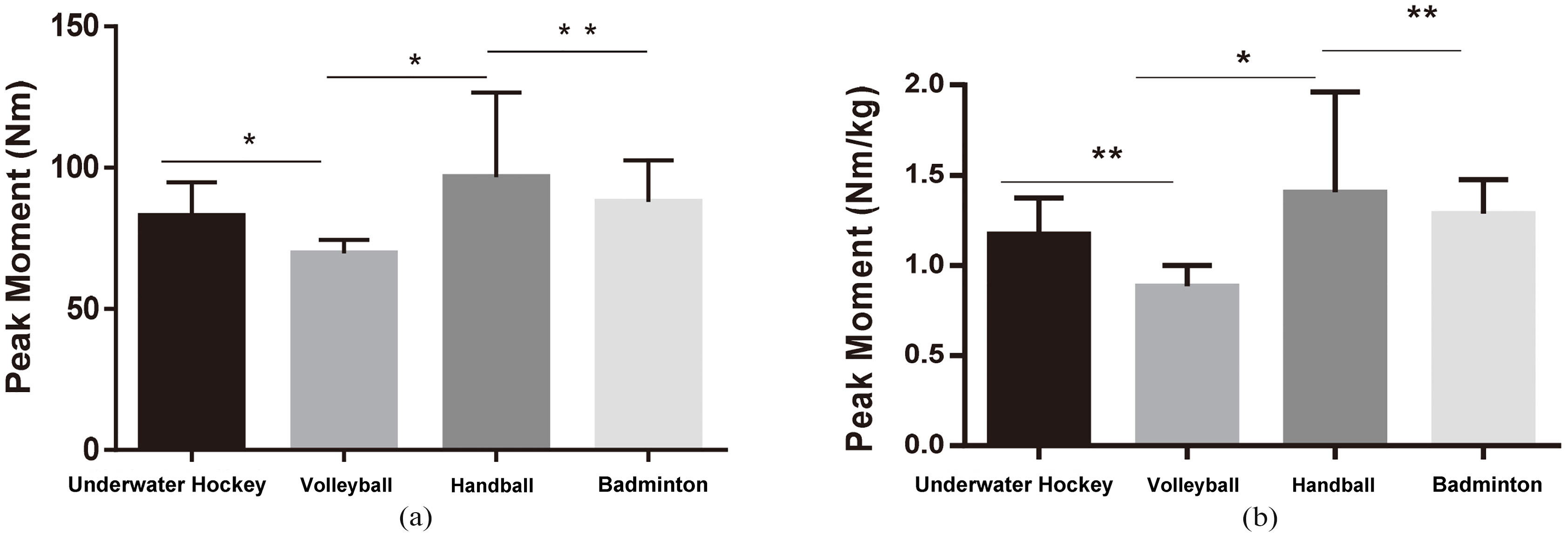
Comparison of dominant and non-dominant shoulder extension strength deficit. Values are presented as mean 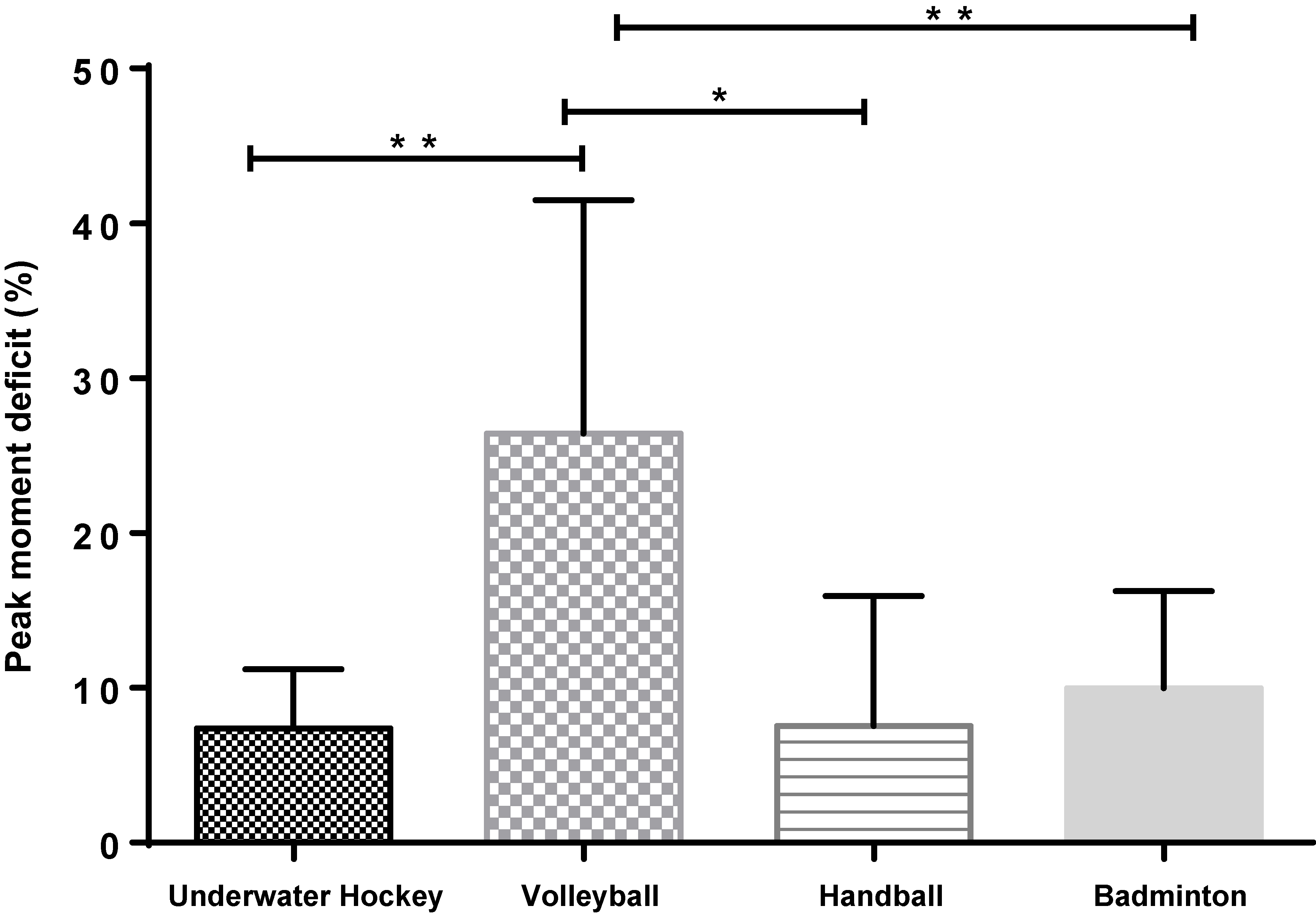
The work, average power and mean shoulder extension (MPME) and flexion (MPML) peak moment for each set was determined. For example, the decline in peak moment performance during the 5 repetitions of reciprocal shoulder contractions from first to the second test and first to the third set was determined: (MPME of 5 reps in the first set – MPME of 5 reps in second set/MPME of 5 reps in the first set). This formula was also used to determine the mean peak moment, work, and average power from the first to the second set, and first to the third set. The range of motion values of each participant was adjusted individually. The range of motion values used in the calculation of a range of motion related moment, work and, power indicates the ROM at which athletes reached their highest moment, work and, power parameters in each set. Dominant shoulder extension and flexion range of motion parameters of each participant were recorded during each set for all repetitions to determine the range of motion-related shoulder extension and flexion peak moment ratio changes during 3 sets of isokinetic testing. Percent extension and flexion peak moment strength differences between dominant and non-dominant shoulder were determined using the equation below (
The data was analyzed using Kruskal Wallis H and Mann-Whitney U statistical analysis to assess inter-group and intra-group differences. Descriptive statistics were used to summarize data, whilst the Pearson moment correlation coefficient determined the correlations of the variables at a 95% confidence interval. The level of statistical significance was set at
The range of motion related dominant shoulder extension (3a, 3b, 3c) and flexion (3d, 3f, 3e) peak moment, work, and power ratio changes during 3 sets of isokinetic testing.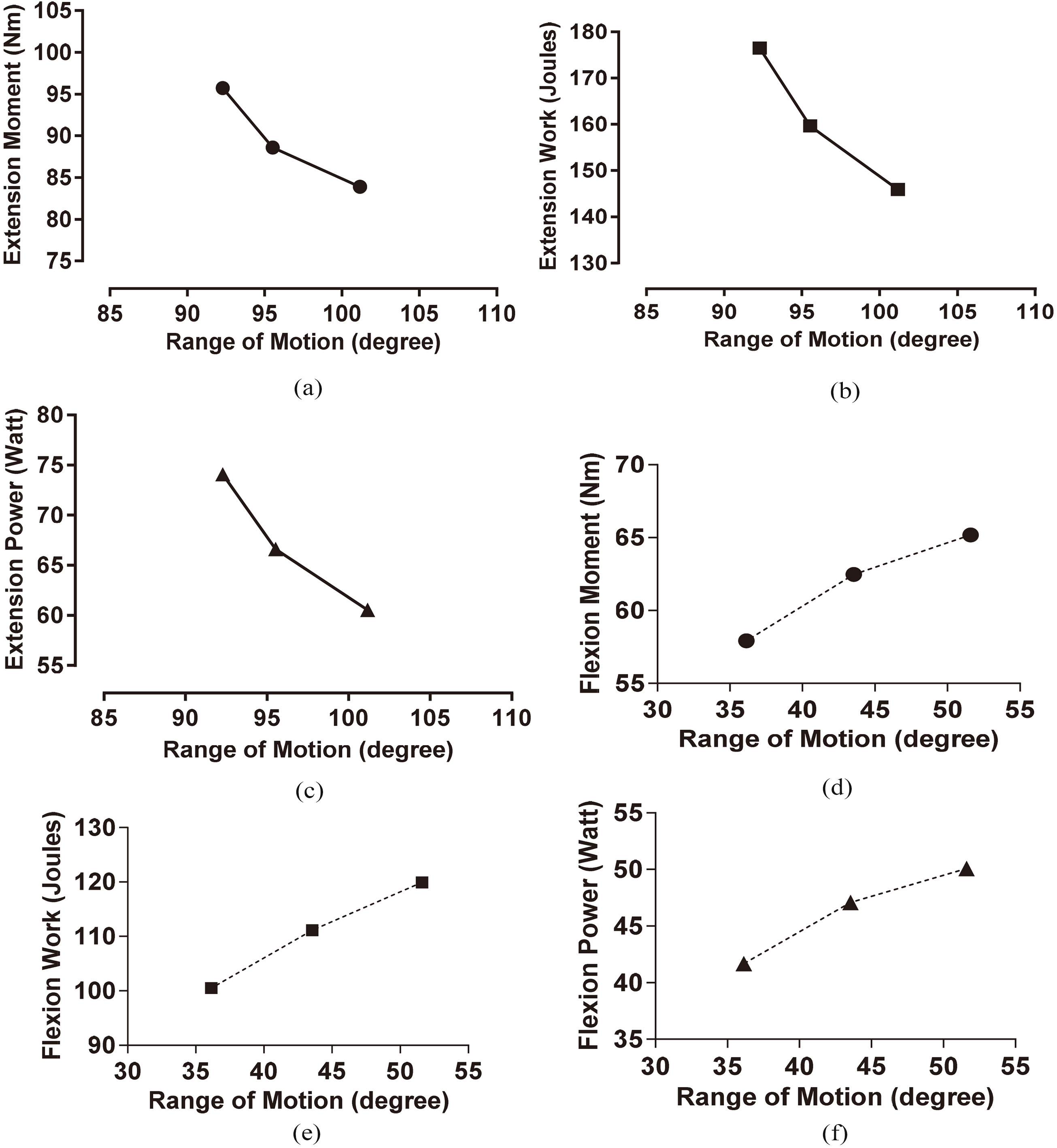
There was no significant difference in absolute shoulder extension (
Dominant vs. non-dominant shoulder extension peak moment strength ratios (
The results of the Mann-Whitney U analysis indicated that there was a significant difference between volleyball and badminton branches in mean extension moment decline (U
Comparison of percent mean shoulder extension moment (a) and work (b) decline of the dominant side from first to third sets. Values are presented as mean 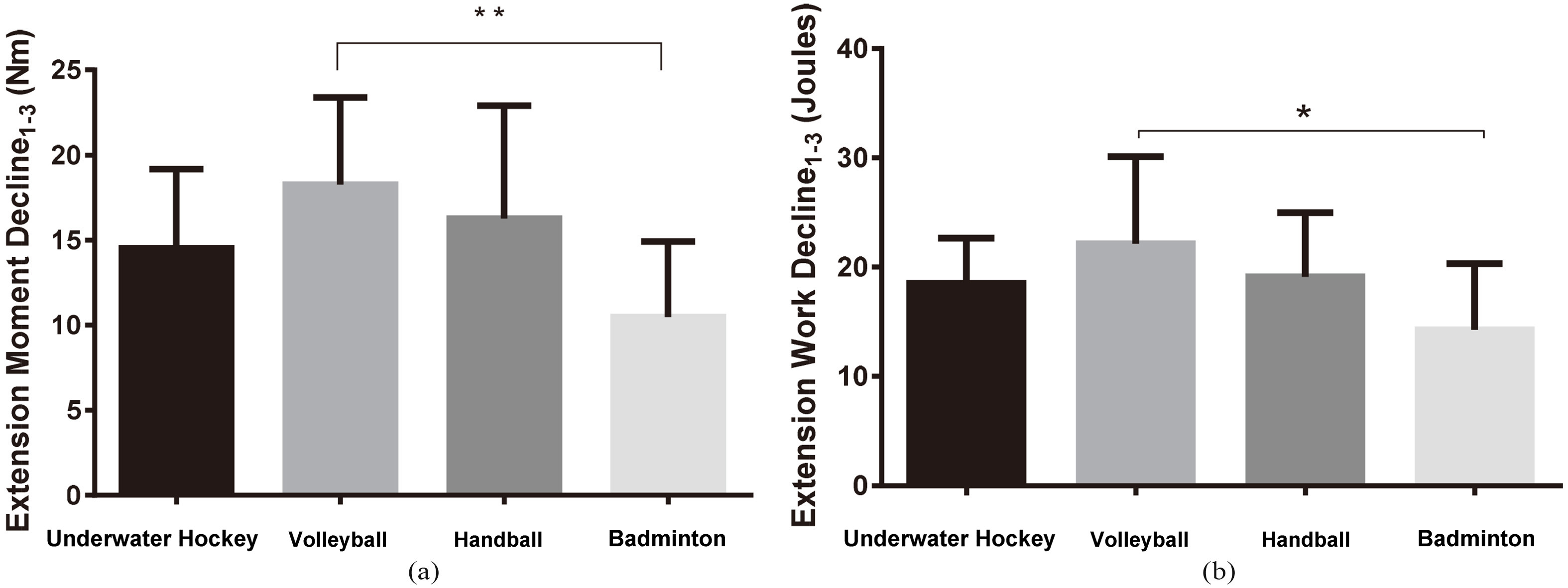
Mechanical work is performed when each contractile unit of muscles are contracted in a sequence of order during exercise. The rate of the power produced at a specific angle or throughout the whole movement of the joint is the result of a dynamic contraction action [21]. Despite no significant inter-group differences, peak moment values for right shoulder extension and flexion were found greater in volleyball, handball, and underwater hockey while badminton players showed lower right shoulder extension and greater right shoulder flexion peak moments. When the movement patterns of volleyball, handball, badminton and underwater hockey take into consideration it was expected in this study that despite similar co-activation characteristics of shoulder extensor and flexor muscles during pass, shoot, spike and underwater actions neuromotor dominance would have an effect on peak moment measures among groups due to fact that the rate and velocity of the different range of motion related movements constitute different amount of impact on dominant shoulders in these different types of sports. However, there was no statistically significant difference in dominant absolute shoulder extension, relative shoulder extension parameters, absolute shoulder flexion and relative shoulder flexion parameters among groups.
As shown in the Fig. 1, peak moment strength ratios were found statistically significant among groups between dominant and non-dominant shoulder extension, and the highest shoulder extension peak moment deficit occurred in volleyball players. The majority of volleyball players mainly tend to use one arm as the dominant arm during forceful spikes and overhead serves during the training season, and these repetitive loads on the shoulder joint increases the potential of muscle damage or degeneration from eccentric overload especially during the deceleration period following a forceful spike or overhead serve action [22].
The range of motion related extension and flexion peak moment strength ratios in shoulder extremity shows great heterogeneity as seen in Fig. 3. This variation in strength ratios clearly indicates the potential risk of muscle damage or degeneration in an upper extremity following strenuous exercises as a result of the fatigue. Additionally, the significant difference occurred between volleyball and badminton branches in terms of dominant and non-dominant mean shoulder extension moment decline (18.25
Despite the similar activation patterns of shoulder muscles during shooting, spike and smash in handball, volleyball and badminton, the general rules of the branches, the size and weight of the balls and the different defense strategies of the opponent defense players differ from each other and characterize different upper extremity adaptations in this sport branches [23, 24, 25]. It has been reported that handball players shoot approximately 48 000 shots in a single season, and the average throwing speed is 130 km/h during the jump shot, which generally accounts for 73–75% of the branch [26, 27]. Due to the demand of different physical and physiological attributes in handball, players perform throwing actions with different workloads and this consecutive changes in athletes’ throwing shoulders are performed at different angles with a different range of motion. On the other hand, Kugler et al. [28] reported in their study that an elite volleyball player, practicing between 16 and 20 hours a week, may perform 40 000 (or more) spikes in a single season. As the spikes, or attacks, are typically high-velocity shots in these sports branches, in case of the presence of agonist-antagonist strength deficiencies players are more likely to develop shoulder pain and dysfunction. As seen in Table 2, MFM 1–3, MFW 1–3 and MFP 1–3 showed a tendency to be higher than those in the shoulder extensor muscles. Agonist-to-antagonist contraction strength deficits in the joints could lead to shoulder injuries due to the dominance of one side in these sports branches. There was a positive and significant correlation between range of movement and dominant shoulder extension absolute peak moment, and range of movement and dominant shoulder extension relative peak moment strength among groups. Additionally, the impact of muscular fatigue on the moment, work, and power (Fig. 3) also cause variations in the degree of range of motion during repetitive actions.
Percent mean moment, work and power decline in dominant shoulder extension and flexion between the sets (Mean
SD)
Percent mean moment, work and power decline in dominant shoulder extension and flexion between the sets (Mean
MEM, mean extension moment; MEW, mean extension work; MEP, mean extension power; MFM, mean flexion moment; MFW, mean flexion work; MFP, mean flexion power.
To this end, it is essential to improve extensor and flexor muscle strength symmetrically as these muscle groups have a vital function as accelerators and decelerators. Although underwater hockey focusing more on agility and flexibility than strength during the performance compared to the other sport disciplines in this study the lowest dominant and non-dominant shoulder flexion peak moment ratio, MFM 1-3 and MFW 1-3 occurred in underwater hockey players and this could be associated with the resistance of the water during training and competitions induce more symmetrical adaptations in the shoulder joints of underwater hockey players.
Smash performance is one of the key elements among the technical actions used during single games in badminton as it constitutes 14.82% of badminton strokes [29]. It has been reported that shoulder joint movement during the impact phase during the smash closely relies on the combination of shoulder extension and internal rotation in the abducted position [30].
In the preparation phase of smash action shoulder extension and abduction have a complementary role in the completion of the movement of the right elbow in posterior and lateral directions [31]. Takenori et al. [32] found a significant correlation between the internal rotation moment of the shoulder in the abducted and externally rotated position and racket velocity during the badminton forehand smash (
To this end, determination of the decline in the range of motion related average moment, power, and work measures in addition to peak moment measurements can provide valuable information to minimize the strength related joint injuries and improve muscular performance in overhead sports branches. Additionally, we speculated that decreasing the amount of trauma placed on the shoulder, designing strengthening programs for the musculature surrounding the shoulder girdle, and implementing stretching exercises to maintain proper range of motion in overhead athletes not only help them with reaching their optimal performance levels and decrease the risk of injury resulted from insufficient training regimens and improper form and techniques but also allow them to improve overall quality of life. To the best of our knowledge, this is also the first study to evaluate isokinetic shoulder strength characteristics of underwater hockey players. Further research into these aspects can improve the knowledge within the sport and assist practitioners make comprehensive comparisons between different studies which may lead to the development of more specific training regimens into strength requirements of underwater hockey players. In combination, based on the findings of the current study, assessment of strength characteristics of athletes from different sports branches may underestimate strength asymmetry if based on the peak moment exclusively.
Footnotes
Conflict of interest
The authors declare no commercial or financial relationships that could be construed as a potential conflict of interest.