Strength assessments are used to monitor physical progression and evaluate the impact of training interventions, which is extremely valuable for both athletic performance and clinical populations. For results to be useful, measurements must be relevant, reliable and show sensitivity to change.
OBJECTIVES:
The aim was to establish the practicality of isometric force assessment at two different knee-joint angles; 90 (ISO) and 120 (ISO). More specifically, to address the familiarisation effects, reproducibility and sensitivity of measurements associated with each method of assessment, and the discrepancy in force output when altering the angle at the knee joint.
METHODS:
Thirty-five strength trained males attended three sessions; familiarisation (), test () and retest (), separated by 7 days. During each session, ISO and ISO was assessed using an incline leg press device.
RESULTS:
Force output was similar during , and for ISO and ISO, separately ( 0.05). Measurements taken from both assessment methods demonstrated good reproducibility (ICC 0.96, CV 5%) and showed sufficient sensitivity to detect changes in performance. Force output was greater during ISO (5153 1446 N) versus ISO (2660 597 N, 0.001) but the magnitude of the difference in force output showed great intra-subject variability.
CONCLUSION:
Isometric assessment performed on a leg press device requires minimal habituation to demonstrate a good degree of reproducibility and sensitivity to detect small changes in performance. It is a simple and practical method to evaluate strength at different joint angles, which may prove useful in strength diagnosis in performance and clinical contexts.
The ability of the neuromuscular system to produce force is considered a key component in determining athletic performance success, particularly in strength/power based sports [1]. Moreover, it has been associated with decreased injury risk [2] and so is considered to be an important quality for a wide variety of sports and clinical situations. Because of this, the ability to exert force is a primary training focus for many sports. There is a demand for maximum force assessment so practitioners can assess the individual needs of an athlete or patient, determine neuromuscular status, prescribe individualised training loads, monitor acute and chronic performance and evaluate the overall efficacy of strength programmes [3].
Isometric multi-joint tests are a common method of assessing maximal force capacity. There are numerous lines of enquiry that have used squat [4, 5, 6, 7] and mid-thigh pull [8, 9, 10] exercises. However, the anatomical position required to perform these tests can compromise the trunk and spinal column due to high levels of compression, increasing the potential for injury. As such, this assessment modality may not be best suited to populations that have little lifting competence and/or are at high risk of injury. Isometric assessment performed on an inclined leg press machine provides an alternative solution. The exercise requires minimal technical proficiency and supports the trunk, yet still requires multi-joint coordination of the lower limb. Therefore, isometric leg press assessment could facilitate strength evaluation for those unable to adequately or safely perform other isometric assessment modalities. Or simply, it can offer an alternative approach to lower body strength assessment.
To date, there is a paucity of work examining isometric leg press assessment, despite its common use in applied practice. The reliability and validity have been briefly addressed [6, 11, 12, 13, 14] using equipment not generally used in an applied athletic and rehabilitation setting. Therefore, it seems apt to address the practicality of isometric leg press tests using equipment and postures that are common among applied practice. To aid implementation of the assessments and interpretation of the data, it is paramount to document the effects of familiarisation on subsequent measures of performance, address the reproducibility of repeated measurements and the sensitivity of the assessments in detecting meaningful changes in performance. These factors would help to determine the suitability of isometric leg press tests as a tool for monitoring and neuromuscular evaluation in performance and clinical settings.
Consequently, the aim of this study was to establish the practicality of isometric force assessment at two different knee-joint angles; 90 (ISO) and 120 (ISO), using a 45 incline leg press machine that is representative of those commonly used in strength and conditioning gyms, applied training environments and rehabilitation settings. Specifically, this investigation addressed the familiarisation effects, reproducibility and sensitivity of measurements associated with each of the assessments, and identified the discrepancy in force output when altering the angle at the knee joint.
Methods
Subjects
All study procedures and requirements were outlined and discussed prior to the participants providing written, informed consent. Ethical approval was granted by Northumbria University Research Ethics committee in accordance with The Declaration of Helsinki. Thirty-five strength trained males (mean SD age, stature and body mass: 31 5 years, 178 8 cm and 85 13 kg, respectively) volunteered to participate in this study. The mean resistance training history was 13 6 years with a background of strength-power sport (e.g. rugby, combat, powerlifting, Olympic weightlifting, track sprint cycling, athletics). All participants were free from musculoskeletal injury with no history of musculoskeletal, neuromuscular or cardiovascular disorders. The volunteers were asked to avoid unaccustomed and strenuous exercise prior to and between the testing sessions. They were instructed to attend each session in a fed and well-hydrated, and to keep this consistent routine (nutrition, sleep and general exercise) prior to each testing session.
Experimental design
A within-subjects, repeated measures design was used to investigate the reproducibility of force output during isometric assessment at 90 and 120 knee-joint angle (ISO and ISO, respectively). Participants attended the laboratory on three separate occasions; familiarisation (), test () and retest (), separated by 7 days. During each session, bilateral isometric force output was assessed at both knee-joint angles in a randomised order. All sessions were identical to allow investigation into the repeatability of peak force output at each knee-joint angle. Data were collected for large subgroup of the sample ( 23) during to determine initial learning effects and for the full group ( 35) during and .
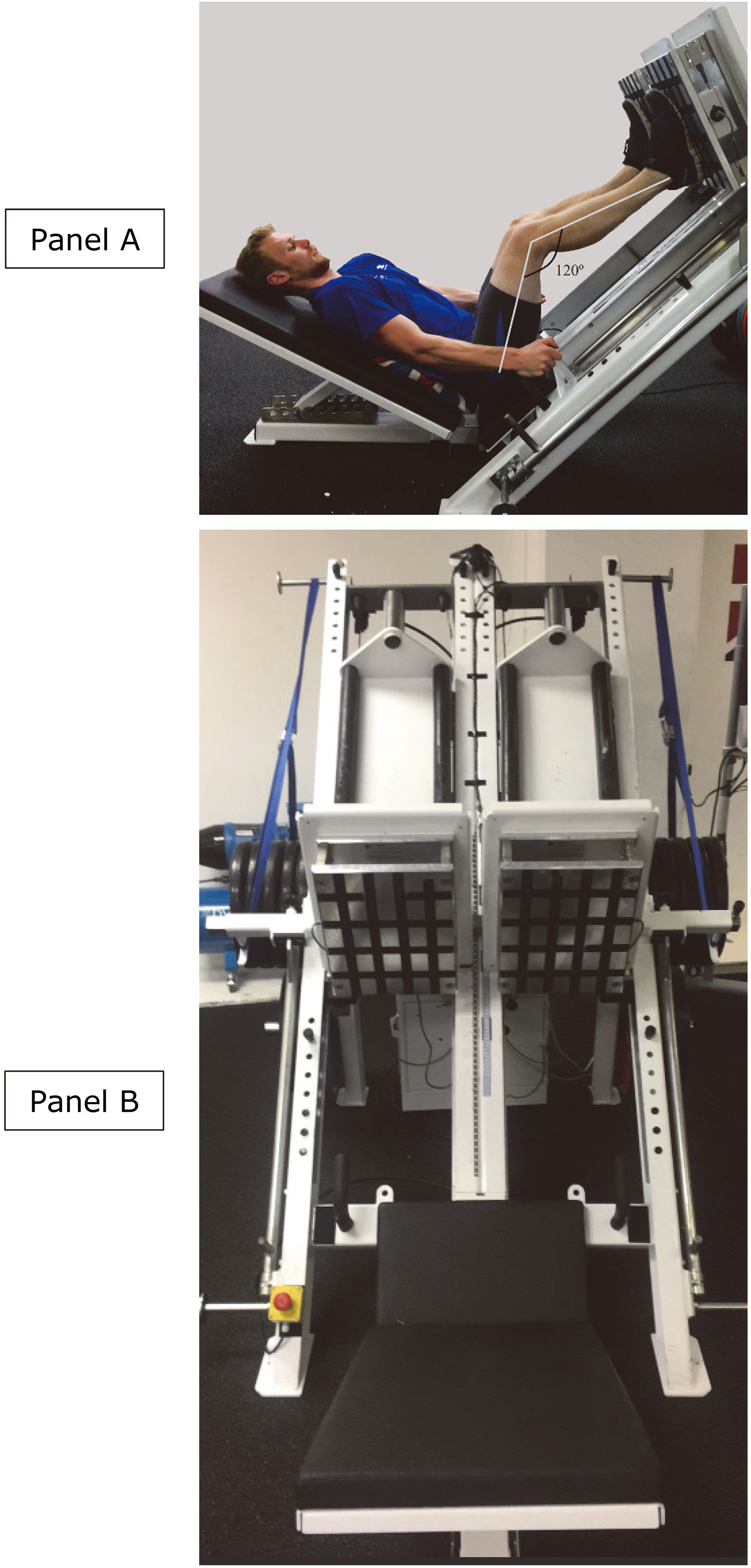
The experimental set-up. An example of the position required for the ISO test (Panel A) and the isometric leg press device with the carriage secured with ratchet straps (Panel B).
Isometric force assessment
A standardized warm-up was completed prior to strength assessment [15]. To determine maximum isometric force output, the leg press foot carriage was secured to ensure the required knee-joint angle (90 or 120, verified by goniometry) was attained. An example of the body position during ISO assessment is shown in Fig. 1. These angles were chosen as the angle at the end range of motion of conventional dynamic exercise is commonly restricted to 90 at the knee and the angle to optimise absolute peak force is 120 at the knee, based on pilot testing and information from professional strength and conditioning coaches. For each isometric assessment two preparatory efforts were conducted; 1 50% and 1 75% perceived effort, separated by 30 seconds rest. Testing consisted of 3 maximal 5 second efforts interspersed by 3 minutes rest, for each knee-joint position. Testing between each knee joint position was separated by 10 minutes to reduce the potential for fatigue. Participants were advised to ‘progressively build up force towards pushing as hard as possible until instructed to stop’. The same strong verbal encouragement was provided for all efforts. Unilateral force measures were summed to reflect the bilateral nature of the exercise. The trial with the highest peak force was used for analysis.
Equipment and instrumentation
All assessments were conducted on a 45 incline leg press machine (Sportesse, Somerset, UK, Fig. 1). Engineering modifications and instrumentation facilitated the performance of isometric assessments and the acquisition of force output. The machine’s default is to act as a traditional leg press device, but modifications allow it to be converted to an isometric device. The isometric function of the leg press operates via an inbuilt locking mechanism that can secure the carriage at any position along the machines framework. To prevent any movement upon force application ratchet straps ( 600 kg limit) were used to ensure the carriage remained in place and maintained the integrity of knee and hip joint angle. The leg press foot carriage comprises of two smaller, independent carriages that connect with a removable steel bar. The foot carriage consists of two parallel steel plates with 4 s-type load cells (300 kg limit per cell) which were mounted between each plate in each corner. The load cells acquire data at 200 Hz and fed into a combinator to create a single voltage output which was relayed to data acquisition software (LabVIEW 6.1 with NI-DAQ 6.9.2, National Instruments Corporation, USA) and analysed offline.
Reproducibility of peak force measurement during ISO and ISO assessment across three sessions
Assessment
ISO
ISO
Session
Sample size
23
23
35
23
23
35
Mean difference (%)
1.
3
2.
3
0.
6
1.
4
1.
7
0.
7
Mean difference (N)
36.
8
68.
0
15.
2
80.
7
96.
4
38.
4
Upper 95% CI (N)
57.
8
140.
2
69.
7
175.
8
307.
5
202.
1
Lower 95% CI (N)
131.
5
4.
1
39.
4
337.
2
114.
6
125.
4
SD mean difference (N)
231.
7
176.
5
164.
7
627.
6
516.
5
391.
8
Lower LOA (N)
417.
2
414.
0
337.
9
1149.
4
1108.
8
806.
3
Upper LOA (N)
490.
9
278.
0
307.
6
1310.
9
915.
9
729.
6
SE of mean (N)
48.
3
36.
8
27.
8
130.
9
107.
7
66.
2
value
0.
45
0.
08
0.
59
0.
54
0.
38
0.
57
ICC
0.
95
0.
97
0.
96
0.
93
0.
95
0.
96
TE (N)
163.
8
124.
8
116.
4
443.
8
365.
2
277.
1
CV (N)
120.
3
106.
1
89.
2
318.
5
288.
1
214.
1
CV (%)
4.
2
3.
7
3.
4
5.
6
5.
1
4.
2
Lower 95% CI (%)
2.
8
2.
6
2.
4
3.
6
3.
5
3.
1
Upper 95% CI (%)
5.
2
4.
9
4.
4
7.
2
5.
9
5.
1
SWC (N)
143.
7
138.
7
119.
0
325.
7
325.
3
288.
6
SWC (%)
5.
0
4.
8
4.
5
5.
7
5.
7
5.
6
SRD (N)
454.
0
346.
0
322.
8
1230.
1
1012.
3
768.
0
SRD (%)
15.
8
12.
1
12.
1
21.
6
17.
8
14.
9
Abbreviations: N newton, CI confidence interval, LOA limits of agreement, SE standard error, ICC intraclass correlation coefficient, TE typical error, CV coefficient of variation, SWC smallest worthwhile change, SRD smallest real difference.
Statistical analysis
To examine the effects of familiarisation, a repeated measures ANOVA was used to determine the difference in force output between the three sessions ( –, 23). To examine the reproducibility of peak force measurement, the following analyses between – and – for 23, and – for 35, were conducted; Bland-Altman limits of agreement (LOA) method [16], intraclass correlation coefficient (ICC), coefficient of variation (CV, %) including their 95% confidence intervals (CI), typical error (TE). Additionally, a paired samples t-tests was conducted to identify statistical differences in the mean force output for IS0 and ISO between and , for 35. To determine the sensitivity of the measurements and establish criteria that signifies the smallest meaningful change in performance, two commonly used approaches were used; smallest worthwhile change (SWC 0.2 between-subjects SD [18]) and smallest real difference (SRD 1.96 SEM [17], where SEMSD – ICC).
To identify the discrepancy in force output due to altering the angle at the knee joint, a paired samples t-tests was used to compare ISO and ISO measurements. The magnitude of differences in force output between joint angles for each participant were calculated. Pearson’s correlation analysis was used to establish the relationship between these differences and performance during ISO and ISO, separately. Accompanying between-session and between-joint angle comparisons, effects sizes were calculated and interpreted in accordance with Hopkins [17]. Statistical significance was set at alpha level () 0.05, a-priori. All analyses were conducted using Excel (Microsoft Office, 2010) and SPSS (Version 24.0; SPSS Inc., Chicago, USA) software.
Results
Using a sample size of 23, ISO force output was similar across all three sessions; : 2861 724 N (95% CI: 2548–3174), : 2898 731 N (95% CI: 2582–3214) and : 2830 666 N (95% CI: 2542–3118, 1.02, 0.37, 0.04). Alike, ISO force output was similar across all three sessions; : 5667 1664 N (95% CI: 4947–6387), : 5748 1652 N (95% CI: 5033–6462) and : 5651 1642 N (95% CI: 4941–6361, 4.06, 0.67, 0.02). Using a sample size of 35, ISO force output was similar between : 2668 629 N (95% CI: 2460–2876) and : 2653 571 N (95% CI: 2463–2842, 0.55, 0.59, 0.01). Alike, ISO force output was similar between : 5172 1443 N (95% CI: 4694–5650) and : 5134 1469 N (95% CI: 4647–5621, 0.58, 0.57, 0.03).
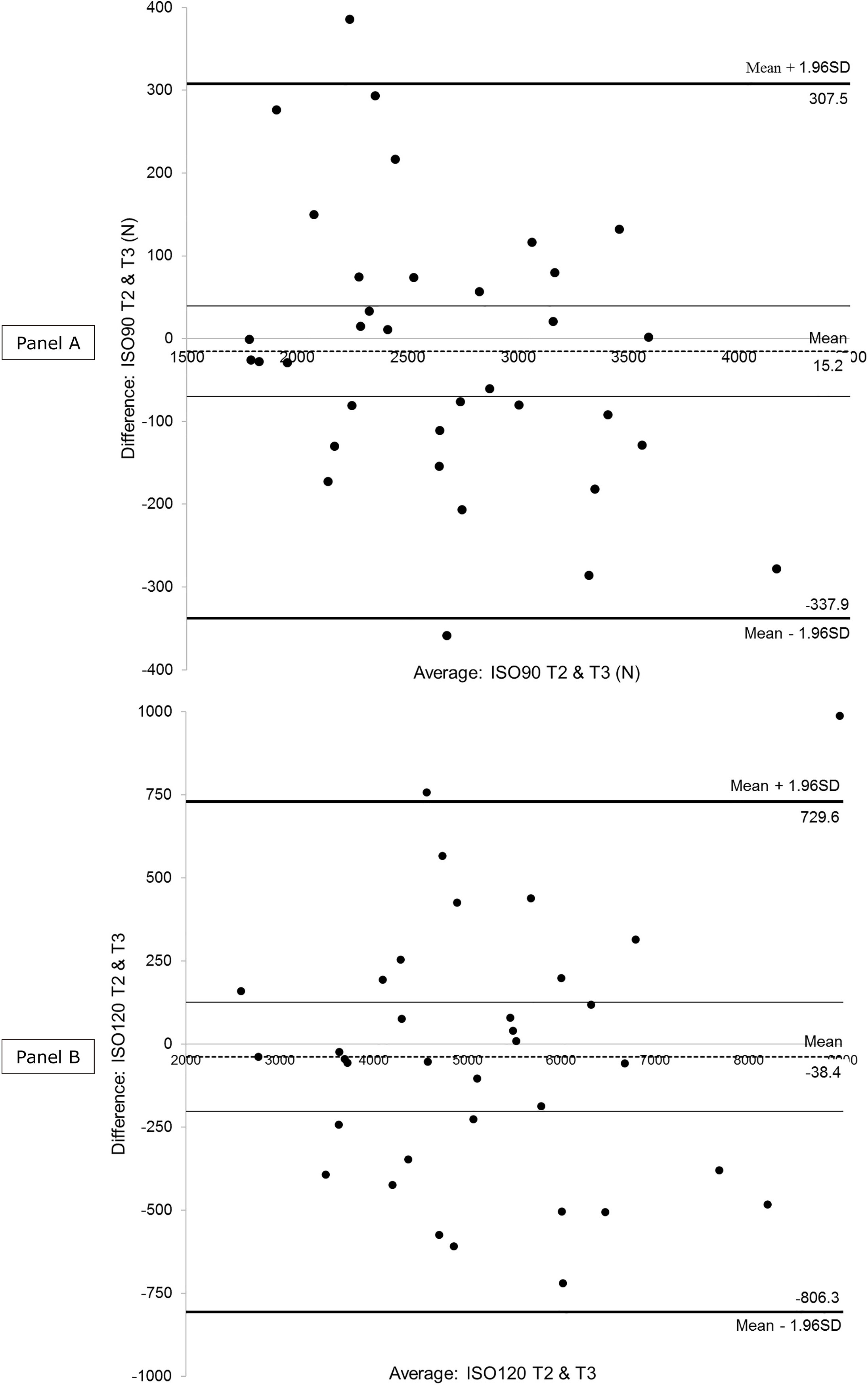
Bland-Altman plot for ISO (Panel A) and ISO (Panel B). Dotted line represents calculation bias (mean difference). Thin solid lines represent calculation precision (95% confidence intervals). Thick solid lines represent the upper and lower limits of agreement.
Bland-Altman analysis highlighted the agreement (bias, precision and LOA) between all repeated measurements (Table 1). Bland-Altman plots comparing measurements associated with and , for ISO and ISO ( 35) are shown in Fig. 2. Measurements taken during ISO and ISO assessments demonstrated a good degree of reproducibility (see Table 1); when using a sample size of 23, reproducibility of peak force associated with vs were improved compared to those associated with vs . However, when using a larger sample size of 35 the reproducibility of peak force associated with vs showed further improvement. The criteria for detecting meaningful change in performance were very different when calculated using different methods (SWC vs SRD, Table 1). The criteria offered by the SRD reflected that offered by Bland-Altman LOA.
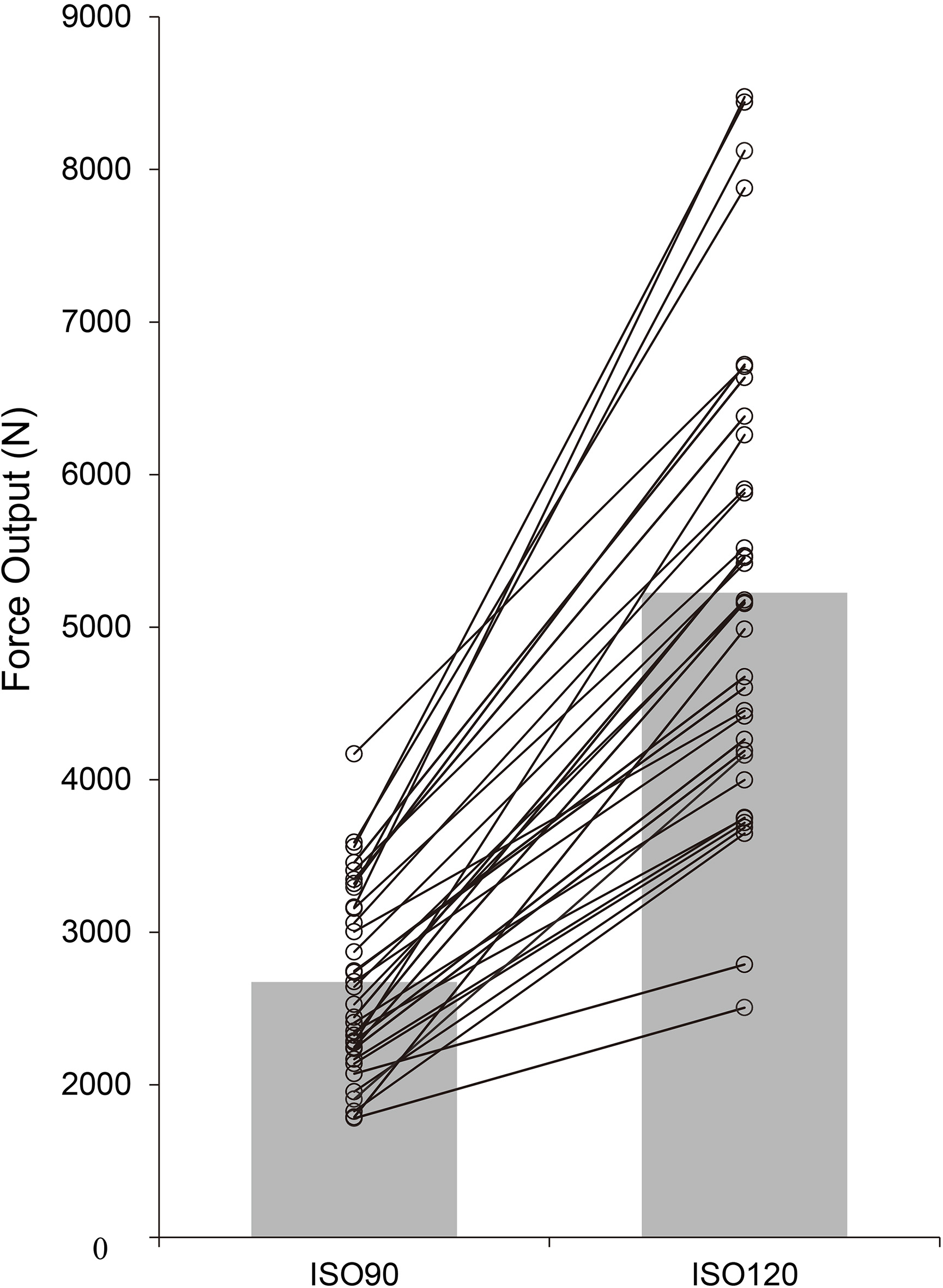
Force output was joint angle specific; ISO: 5153 1443 N (95% CI: 4674–5632) and ISO: 2660 595 N (95% CI: 2463–2858). The magnitude of the difference in mean force output was large ( 14.1, 0.001, 2.26). In all cases, force output during ISO exceeded force output during ISO. The relationship between force output between joint angles was strong; 0.78 ( 0.001). However, the differences in force output between joint angles for individual subjects were not consistent and ranged from 697 N to 5805 N (Fig. 3). The disparity was strongly related to the force producing capacity during ISO ( 0.93) as opposed to ISO ( 0.50).
A paired-data scatterplot showing isometric force output at 90 and 120 knee joint-angle. Grey bars represent mean values.
Discussion
The aim of this study was to establish the practicality of isometric force assessment at two different knee-joint angles; 90 (ISO) and 120 (ISO) using a 45 incline leg press machine that is representative of those commonly used in strength and conditioning gyms, applied training environments and rehabilitation settings. Specifically, this investigation addressed the familiarisation effects, reproducibility and sensitivity of peak force measurement associated with each isometric assessment, and to identify the discrepancy in force output when angle at the knee joint was altered. It was anticipated that these data would help to determine the suitability of isometric leg press tests as a tool for monitoring and neuromuscular evaluation in performance and clinical settings. We found that isometric assessment performed on a leg press device required minimal habituation to demonstrate a good degree of reproducibility and sensitivity to detect small changes in performance. It is a simple and practical method to evaluate strength at different joint angles, which highlight intra-subject variability in joint-angle specific force output. This information may prove useful for strength assessment in performance and clinical contexts.
Isometric strength performance was relatively stable from the first session, although familiarisation served to increase the reproducibility of peak force measurements across subsequent sessions. After a single familiarisation session, the measurements demonstrated a good degree of reproducibility. Importantly, these data align with the reproducibility (ICC: 0.92–0.99) of other isometric leg press devices [12, 14], whilst being consistent with the absolute and relative reproducibility of more established methods frequently used in applied practice; isometric mid-thigh pull; ICC: 0.96, CV: 4% [9, 10] and isometric squat; ICC: 0.89–0.99, CV: 4% [4, 18]. In the current study the CV, including confidence intervals, compared favourably ( 5%) when based on previous assessments [9, 19]. It is important to highlight that measuring performance across a greater number of testing sessions might augment reproducibility indices further. Notwithstanding, based on the current data, isometric assessment performed on a leg press device required minimal habituation to demonstrate a good degree of reproducibility and therefore can be considered an efficient and relatively stable means to evaluate lower body strength.
The criteria for assessing meaningful changes in performance differed between calculation methods. The SWC and SRD both exceeded the error and variability associated with each test and therefore demonstrate that the ISO and ISO assessments are “lower-noise” methods that have sufficient sensitivity to detect changes in performance. The SRD offers more stringent criteria, reflecting the LOA offered by Bland-Altman analyses (Fig. 2). These methods require moderate to large changes in performance (12–15%) to be classified as meaningful whereas the SWC offers criteria that is marginally in excess of the error of the test, and therefore requires relatively smaller changes in performance (4–6%) to be classified as meaningful. Consequently, the ability to detect small changes in performance using less stringent criteria increases the practicality of the test, especially in athletic contexts where small improvements are considered to be of high value [20]. Although more stringent criteria may overlook small changes or reduce the ability for conclusions being drawn about smaller effects following an intervention, the likelihood of interpreting error as meaningful changes in performance would be lower [20]. An important point that has emerged from these data is that SRD (%) at ISO is a good deal lower ( 5%) than ISO, and therefore may be clinically more attractive as lower SRD will mean that meaningful changes would emerge earlier/faster. Given that the inclined leg press provides a potentially safe and tolerable method of exercising we believe that the findings of the present study would be of value in assessing and training of various target populations, including for example, athletic and geriatric. A potential caveat to this proposition is that some elderly and clinical populations (arthritic, for example) are often compromised in more flexed knee positions and might have functional deficits at ISO, despite this joint position being of great functional relevance in everyday tasks such as sit-to-stand, and stair climbing and descending. Consequently, the application of these data (to populations with compromised function) must be viewed with some caution and is perhaps an avenue for future exploration. Overall, these data demonstrate that isometric assessment performed on an inclined leg press is sufficiently sensitive to detect meaningful changes in lower body isometric force output. However, the criteria used to detect meaningful and important change should be based on the context to which it is being used and the individuals that are being assessed. This ensures that the assessments are relevant, and the outcomes are interpreted appropriately.
The assessment of strength at two different positions enabled the quantification of joint-angle specificity of force output. Peak force output during ISO was 50% of peak force output during ISO. This finding is comparable to others (45–55%) who have employed similar joint angle constraints during 1RM back squat [6] and isometric horizontal leg press assessment [21]. Differences in force output are attributable to changes in the muscle length-tension relationship and the alteration of muscle moment arm length imposed by the body segment orientation [22]. Intuitively, one might expect ISO to have a greater force generating capacity than ISO given the length-tension relationship of the knee flexors; however, multi-joint exercises such as the leg press incorporate numerous muscle groups (gluteal and triceps surae, for example) that also contribute force production. Whilst we cannot ascertain the contribution of each muscle group to overall force production, this work highlights that more extended knee positions during an inclined leg press task generates greater force than 90. From a broader perspective, it is important to consider the task being assessed and the potential contributions being made by different muscle groups and hence the lever arm moments in multi-joint exercise, like the inclined leg press, might outweigh optimal cross-bridge formation of individual muscle groups.
Consequently, these data highlight the different qualities of isometric force expression during an inclined leg press activity. More specifically, ISO employs a mechanically advantageous joint configuration and is perhaps more indicative of an individual’s force generating capability. Conversely, ISO employs a less mechanically advantageous joint configuration and, whilst still a measure of maximum force capacity, it detects an individual’s ability to exert force when in a more restricted position, which is arguably more representative of the joints lower force generating capacity. Importantly, the magnitude of the difference in force output between joint-angles show large intra-subject variability (Fig. 1) and appears to be largely associated with force capacity at 120 knee joint angle. Thus, attaining individual isometric strength profiles at multiple joint angles allows practitioners to observe the extent to which an individual can apply force at different positions to gain a greater insight into the training needs of the individual to guide exercise prescription.
In summary, isometric efforts performed on an incline leg press machine allows the assessment of coordinated lower limb, multi-joint assessment. This method has a high degree of practicality to examine isometric strength, especially for those with a high injury risk, such as compromised by spinal loading or inability to competently conduct the required position during lower-limb multi-joint exercises like the squat and deadlift. In addition, administration of the isometric tests is simple, time efficient, and require minimal skill to perform. The data from these assessments serve to enhance our understanding of isometric force production and provide a means to evaluate isometric strength, diagnose the individual needs of an exerciser, prescribe individualised training loads, monitor acute and chronic performance and assess how isometric strength qualities change in response to a training intervention.
Footnotes
Acknowledgments
This work was completed under a joint funded doctoral studentship between the English Institute of Sport and Northumbria University. The authors would like to thank the sponsors for funding and use of their facilities. Also, to our colleagues and participants for their assistance with the project.
Conflict of interest
The authors declare no conflict of interest.
References
1.
StoneMHMoirGGlaisterMSandersR. How much strength is necessary? Phys Ther Sport.2002; 3(2): 88-96.
2.
LauersenJBBertelsenDMAndersenLB. The effectiveness of exercise interventions to prevent sports injuries: a systematic review and meta-analysis of randomised controlled trials. Br J Sports Med.2014; 48(11): 871-7.
3.
SheppardJChapmanDTaylorK-L. An Evaluation of a Strength Qualities Assessment Method for the Lower Body. 2011; 19(2): 4-10.
4.
BazylerDCBeckhamKGSatoKK. The Use of the Isometric Squat as a Measure of Strength and Explosiveness. J Strength Cond Res.2015; 29(5): 1386-92.
5.
BlazevichAJGillNNewtonRU. Reliability and validity of two isometric squat tests. J Strength Cond Res.2002; 16(2): 298-304.
6.
MarcoraSMillerMK. The effect of knee angle on the external validity of isometric measures of lower body neuromuscular function. J Sports Sci.2000; 18(5): 313-9.
7.
VerderaFChampavierLSchmidtCBermonSMarconnetP. Reliability and validity of a new device to measure isometric strength in polyarticular exercises. J Sports Med Phys Fitness.1999; 39(2): 113-9.
8.
De WittJKEnglishKLCrowellJBKalogeraKLGuilliamsMENieschwitzBE, et al. Isometric Midthigh Pull Reliability and Relationship to Deadlift One Repetition Maximum. J Strength Cond Res.2018; 32(2): 528-33.
9.
JamesLPRobertsLAHaffGGKellyVGBeckmanEM. Validity and Reliability of a Portable Isometric Mid-Thigh Clean Pull. J Strength Cond Res.2017; 31(5): 1378-86.
10.
ThomasCComfortPChiangC-YJonesPA. Relationship between isometric mid-thigh pull variables and sprint and change of direction performance in collegiate athletes. J Trainology.2015; 4(1): 6-10.
11.
DopsajMIvanovićJ. The Analysis of the Reliability and Factorial Validity in the Basic Characteristics of Isometric F-t curve of the Leg Extensors in Well Trained Serbian Males and Females. Meas Sci Rev.2011; 11(5).
12.
IvanovićJDopsajM. Reliability of force-time curve characteristics during maximal isometric leg press in differently trained high-level athletes. Measurement.2013; 46(7): 2146.
13.
MilicMIvanovicJDopsajM. Characteristics of the Bilateral Isometric Force-Time and RFD-Time Curve of Leg Extensors in High Trained Serbian Male Fencers and General Trained Population. Braz J Biomotricity.2013; 7(2): 90-9.
14.
PapadopoulosCTheodosiouKNoussiosGGantiragaEMeliggasKSambanisM, et al. Evidence for Validity and Reliability of Multiarticular Leg Extension Machine. Int J Appl Sci Technol.2013.
15.
HardenMWolfARussellMHicksKMFrenchDHowatsonG. An Evaluation of Supramaximally Loaded Eccentric Leg Press Exercise. J Strength Cond Res.2018.
16.
BlandJMAltmanDG. Measuring agreement in method comparison studies. Stat Methods Med Res.1999; Apr 1; 8(2): 135-60.
17.
LexellJEDownhamDY. How to assess the reliability of measurements in rehabilitation. Am J Phys Med Rehabil.2005; 84(9): 719-23.
18.
DrakeDKennedyRWallaceE. Familiarization, validity and smallest detectable difference of the isometric squat test in evaluating maximal strength. J Sports Sci.2018; 1-9.
HopkinsWG. How to Interpret Changes in an Athletic Performance Test. Sportscience.2004; Jan 1; 8(1): 1-7.
21.
DrinkwaterEJMooreNRBirdSP. Effects of Changing from Full Range of Motion to Partial Range of Motion on Squat Kinetics. J Strength Cond Res.2012; 26(4): 890-6.
22.
DemuraSMiyaguchiKShinSUchidaY. Effectiveness of the 1RM Estimation Method Based on Isometric Squat Using A Back-Dynamometer. J Strength Cond Res.2010; 24(10): 2742-8.