




Abstract
BACKGROUND:
Compensating unstable situations is an important functional capability to maintain joint stability, to compensate perturbations and to prevent (re-)injury. Therefore, reduced maximum strength and altered neuromuscular activity are expected by inducing instability to load test situations. Possible effects are not clear for induced instability during maximum legpress tests in healthy individuals.
OBJECTIVE:
To compare isokinetic legpress (LP) strength and lower-leg muscle activity using stable (S) and unstable (UN) footplates.
METHODS:
16 males (28
RESULTS:
The main finding revealed a significant reduction in Fmax under UN condition: 11.9
CONCLUSION:
Unstable LP reduced force generation and increased the activity of PL and TA muscles which confirmed greater neuromuscular effort to compensate instability. This may have some implications for resistance testing and training coupled with an unstable base in the prevention and rehabilitation of injury to the neuromusculoskeletal system.
Introduction
Subject characteristics (mean
SD)
Subject characteristics (mean
The use of unstable surfaces like balance balls and wobble boards as an element in resistance training has in recent years gained a special niche in rehabilitation and sport programs [5]. Resistance training with unstable surfaces (RTU) is alleged to enhance training adaptation and the neuromuscular control which reduce the risk of ankle sprain recurrence after a major ankle sprain by providing greater stimuli [4, 5, 6, 23] but in terms of outcome measures such as the force output and muscle activity, the effect of RTU is not clear. Several studies considered the acute effect of RTU on force generation and muscle activity with different stability devices to investigate the functional mechanisms of these exercises [7, 8, 9, 12, 14, 15]. Saeterbakken and Filmland reported that compared with a stable squat the force output measured by force cells attached to an Olympic bar was higher than unstable supporting surfaces with no differences in muscle activity [22]. However, no difference in one repetition maximum (RM) and EMG activity in the chest press in stable vs. unstable (UN) situations were reported by Goodman et al. [9]. These contradictory effects of RTU might be due to different methodological approaches used in the above studies. RTU is considered as one of the important parts of rehabilitation in recurrent ankle sprain however, the evidence is not consistence that RTU is more effective than strengthening using resistance [23]. Furthermore, it is important to apply relative loads instead of an absolute one to have a standard comparison as resistance training is prescribed as a repetition maximum load or a percentage of it. Therefore, more standardized test methods for analyzing and defining the RTU are necessary.
The unstable squat has been the most utilized testing situation for evaluating RTU by measuring force output and muscle activity of the lower limbs [22]. Unstable surface caused 34% reduction of 1RM in McBride et al. study while only a 7% loss of 6-RM was reported by Andersen et al. whilst squatting on a foam cushion [1, 17]. In the McBride et al. study [17], the type of the unstable condition was not specified, therefore; using different surfaces might be the reason behind these differences. Consequently, more standard unstable surfaces are needed in order to have comparable results. Isokinetic leg press (LP) is a closed kinetic chain method which uses a dedicated device for measuring total leg strength, in either bi-or unilateral mode [2, 8, 13, 15, 18]. No effect of gender, bilateral deficit and leg alignment on force and muscle activity of medial gastrocnemius, peroneus longus, biceps femoris, vastus lateralis, semitendinosus, biceps femoris during eccentric legpress exercise have found [15]. A difference was found between S and UN footplate in peak and mean force values [15]. Isokinetic legpress could get equipped with stable and unstable footplates Although the foot is fixed in this footplate, the footplate has some degree of freedom of inversion/eversion movement (unstable footplate characteristics can be found in the methods section). Therefore, the maximum dynamic strength under stable and UN conditions can be measured.
Given the unclear nature of some of the previous findings, the purpose of this study was to comparatively explore the effect of UN vs. stable support in performing maximum isokinetic legpress tests where the outcome measures include the maximum force output as recorded by the dynamometer and the EMG activity of the lower leg muscles. We hypothesized that UN support would have a detrimental effect on the force while enhancing the muscular activity of the ankle stabilizing muscles.
Participants
Sixteen men between 20 to 40 years of age participated in this study (Table 1). Subjects were included if they were healthy, without any lower limb complains and physically active for more than 2 hours per week (h/w). Participants with a history of previous surgeries to the musculoskeletal structures (i.e. bones, joint structures and nerves) in either lower extremity as well as a history of a fracture in either lower extremity requiring realignment were excluded. Further, subjects with acute injury to the musculoskeletal structures of other joints of the lower extremity in the previous 3 months were excluded [10]. In addition, ankle integrity was evaluated by the Foot and Ankle measure (FAAM) questionnaire [19]. Subjects were excluded if the ADL scale was
Instrumentation
Muscle activity of peroneus longus (PL), tibialis anterior (TA) and soleus (SOL) of the right leg were analyzed using bipolar surface EMG (Myon, Switzerland, bandpass filter: 5
Isokinetic legpress device from frontal view and the flexible (unstable) footplate with 15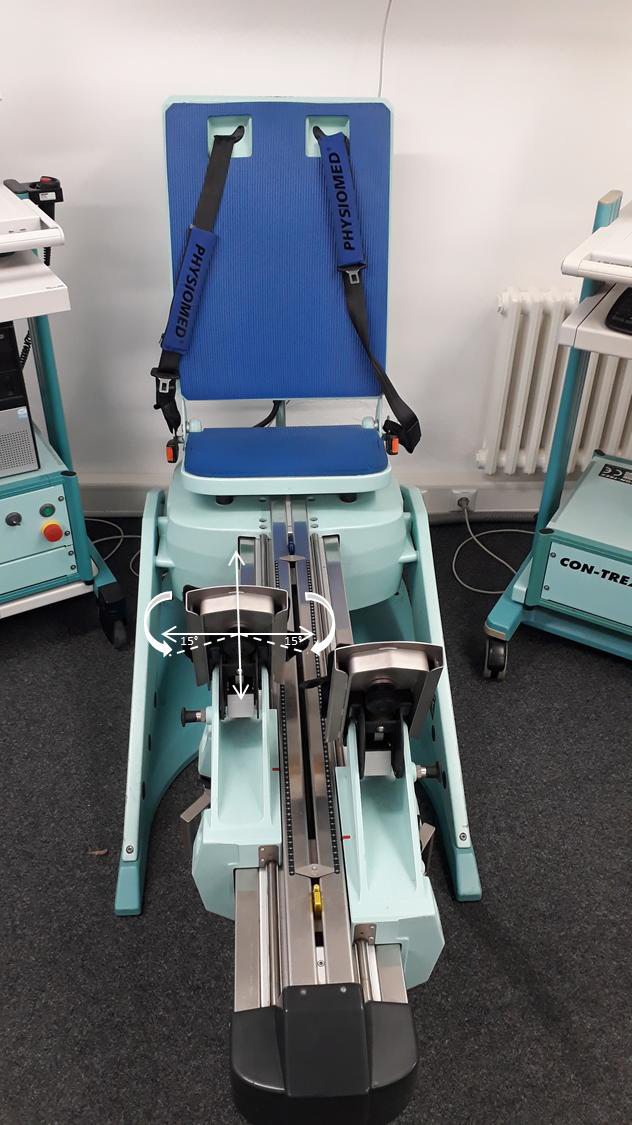
Testing procedures.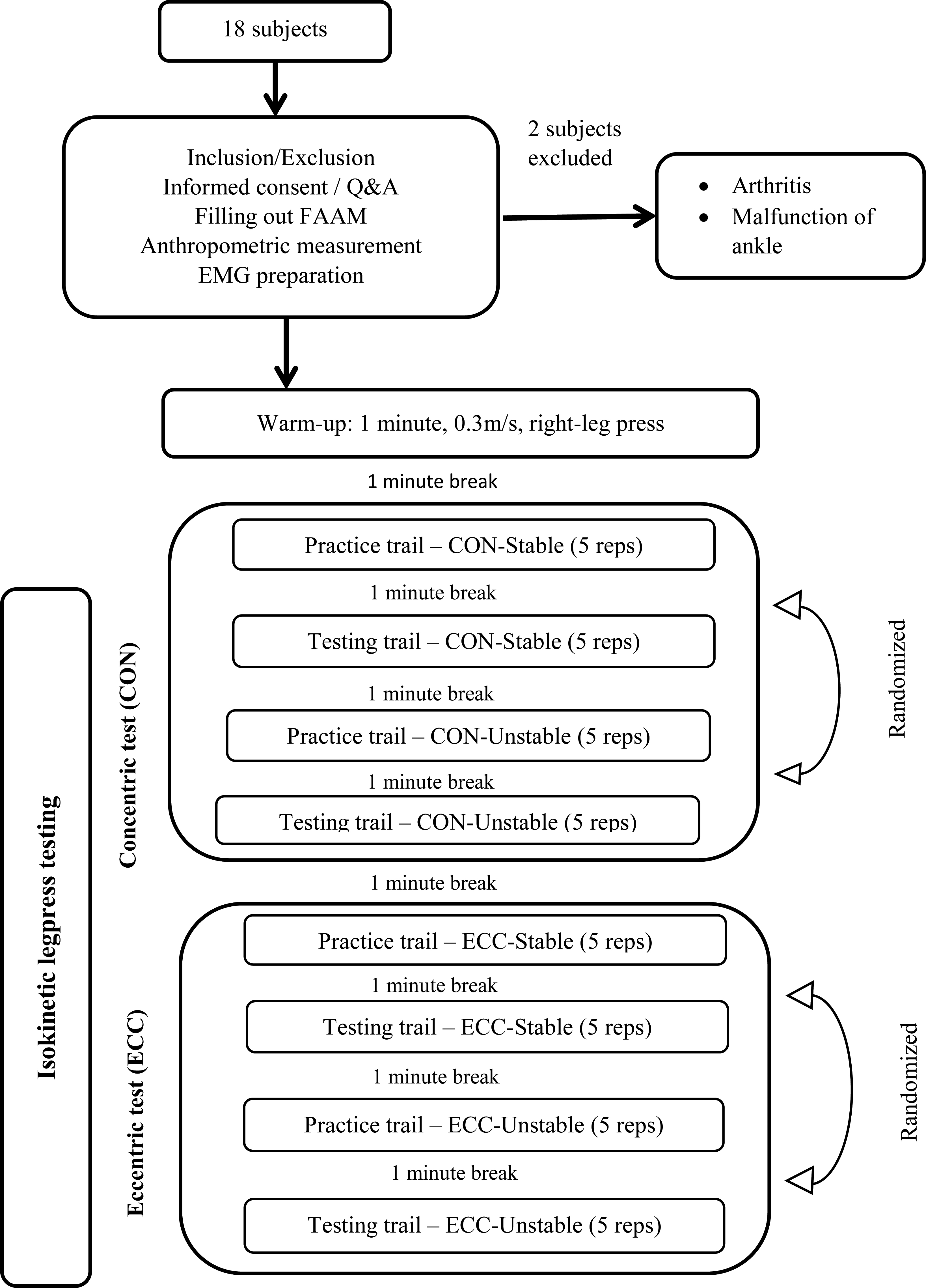
Initially, height and weight were measured. Subjects were prepared for recording muscle activity and maximum isokinetic strength. Standard shoes were given to all subjects. The experimental procedures are depicted in Fig. 2.
Subject fixed with right leg in the isokinetic legpress device in neutral ankle position (100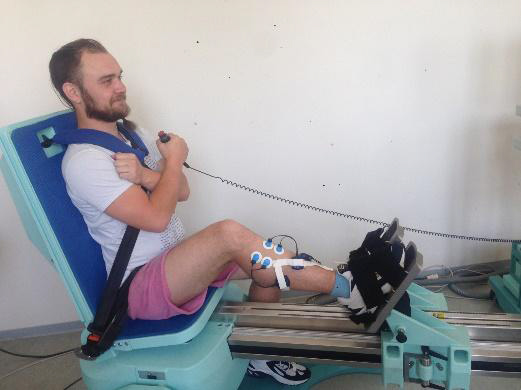
Normalized muscle activity [%] of A) Tibialis anterior (TA), B) Peroneus longus (PL) and C) Soleus (SOL) muscle. RMS of TA in concentric mode and RMS of PL in both contractions were significant. *Significant difference between conditions (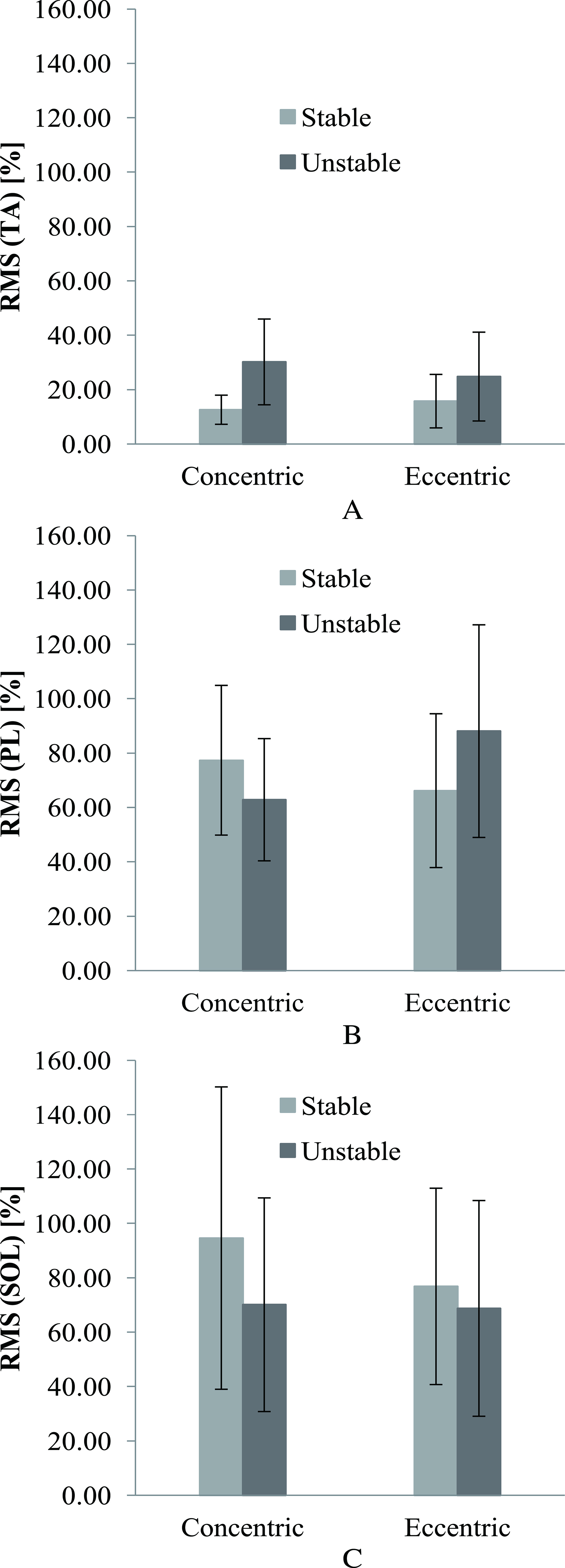
Subjects were secured in a seat with a harness across the trunk to limit compensatory total body movements (Fig. 3). The range of motion (ROM) was set to approximately 70
IBM SPSS Statistics 22 and Excel 2013 were used to analyze the data. The maximum force (Fmax) in N, was obtained from the average of the five trials in both CON and ECC contraction in the S and UN conditions. Root mean square (RMS) of the amplitudes of each trial were analyzed for all three muscles (TA, PL and SOL) (IMAGO process master, LabView
Mean and SD of legpress concentric and eccentric force [%] in two condition of stable and unstable footplates
Mean and SD of legpress concentric and eccentric force [%] in two condition of stable and unstable footplates
*Significant differences between conditions,
Variations in Fmax
The values obtained in the S and UN conditions in the concentric and eccentric mode are displayed in Table 2. A significant decline in force production was found using UN footplate in both dynamic contractions (concentric: 11.9
Variations in normalized RMS
There was a significant difference in this variable between S and UN condition in PL muscle in ECC mode (
Discussion
The main findings of this study were that maximum isokinetic force of lower limb reduced, and changes happened in muscle activity of tested muscles. Using unstable footplates during maximal isokinetic lower limb testing reduced maximum force which is in line with previous studies [3, 16, 17, 20]. The reduction in Fmax can be attributed to the need to stabilize the ankle joint at the expense of extending the knee.
Amount of force reduction in this study was different from previous experiments (12% CON, 24% ECC). McBride et al. in 2006 reported a 46% reduction in Fmax in isometric squatting on inflated balance disks [16]. Similar results were found in another study which indicated that maximal strength during UN squatting was 35% to 46% less than during a stable one [17]. Performing 6-RM of normal squat and Bulgarian squat on Swiss ball also reduced force by 7% and 10% respectively [1]. However, differences in the testing procedures could explain the variations in the rate of reduction. In the McBride et al. 2006 study, Fmax was measured statically while in the two other studies the squat was tested dynamically [1, 16, 17]. Furthermore, where the UN surface was provided by an inflated balance disk [16] dynamic normal and Bulgarian squat was performed using a Swiss ball [1, 16]. It, therefore, seems that not only different UN conditions but also the type of muscle contraction and strength tests can affect the amount of force production.
The present findings indicate that the reduction of force in ECC was almost twice as high as in the CON mode. Eccentric contractions generally produce the greater mechanical output [8] but the observed reduction could be due to different inhibitory mechanisms which are located at both pre-and postsynaptic sides of the motorneurons whose function it is to prevent potential damage to the muscle [8].
Muscle activity differences (35
Unstable LP caused significant increases in TA activities as one of the antagonist muscles but only in CON contraction (58.3
In the present study, EMG activity of TA and SOL muscles during CON effort was higher than in ECC effort but not significantly for the small sample. Furthermore, PL activity in LP showed significantly higher RMS in ECC (64.5% increase) compared to the CON (16.9% decrease), supporting the role of PL muscle in controlling ankle movements, in the face of substantial reductions in SOL and TA activity during UN condition. The activity of SOL muscle in unstable condition decreased 35% and 11.8% in concentric and eccentric mode respectively, however, the lack of statistic difference might be due to high variability among subjects in this exercise. This change was also seen in TA muscle where activity increased 36.5% in ECC contraction.
The ability to measure force and muscle activity during eccentric contraction is especially meaningful since it is under eccentric conditions that injuries most often occur. The significant relative reduction in the ECC Fmax compared to its CON counterpart serves to highlight its important feature. Admittedly, omitting measurement of the quadriceps activity denies a stronger position on the issue of Fmax reduction and this certainly deserves another study. In addition, the sample consisted of male subjects only and given some pertinent inter-gender differences, a study involving women is needed. ACL injury in female athletes is reported to be 3 times higher in basketball and soccer than male athletes [21]. At last, a more homogeneous group in terms of sports discipline and the amount of weekly exercise need to be recruited to reduce the variability among the results.
In conclusion, reduction of maximum force and increased muscle activity of TA and PL as antagonist and stabilizers of the ankle joint are expected variations during the performance of isokinetic LP equipped with unstable footplates. This observation adds support to the notion that exercising under unstable support conditions could functionally enhance the strength of the ankle stabilizers thus serving in the prevention of ankle injuries and/or their rehabilitation.
Footnotes
Conflict of interest
The authors declare no conflict of interest.