Small-sided games (SSG) are widely used in soccer due its potential to improve technical, tactical and physical performance. Different approaches are used to modify physical demands during SSG. Despite this, little is known about the impact of rule modifications on the internal load imposed to young soccer players.
OBJECTIVE:
This study aimed to compare the magnitude of the internal load imposed on young soccer players between small-sided soccer games with different amounts of goals.
METHODS:
Sixteen male athletes (15.7 0.43 years, 64 7 kg, 1.71 0.05 m, 21.8 1.7 kg/m) performed a SSG with one goal (SSG1) and three goals (SSG3) in a randomized order separated by 48 hours. The markers of internal load were: i) percentage of maximum heart rate (%HR, ii) Edward’s Training Impulse (TRIMP), and iii) performance on the repeated sprint ability (RSA) test immediately post-SSG. Paired t-test and repeated measures ANOVA were used to compare the direct (i.e. Edward’s TRIMP and HR) and indirect (i.e. RSA) markers of internal load between the different SSG formats. A p-value 0.05 was set as statistically significant.
RESULTS:
HR was higher in the SSG1 compared to the SSG3 (91 2% vs. 89 3%; 0.05). No difference was found in the Edward’s TRIMP (SSG1: 86.4 15.7 arbitrary units; SSG3: 78.2 12.8 arbitrary units; 0.15). Performance on the RSA test was worse post-SSG1 compared to the post-SSG3 ( 0.01). SSG1 elicits a higher internal load than SSG3.
CONCLUSIONS:
Therefore, the amount of goals in SSG may impact the internal load imposed on young soccer players.
Small-sided games (SSG) are widely used in soccer due its potential to improve technical, tactical and physical performance [1, 2, 3, 4]. Recently, a systematic review and meta-analysis conducted by Hammami et al. [5] showed that SSG improve maximal oxygen uptake (VO), agility, repeated sprint ability (RSA), sprint performance of 10 and 20 meters, vertical jump, and intermittent resistance in team sports athletes. In addition, the authors observed larger effects of SSG on endurance, agility, and technical aspects when compared to traditional or agility training. Therefore, SSG contributes to improve the athletes’ physical performance [1, 6] and it includes specific aspects related to the technical and tactical dynamics of the respective sport discipline [7, 8, 9]. It should be noted that these above mentioned benefits is observed in professional and young athletes of different age groups [10].
It should be noted that different approaches are used to modify the physical demands and thus directly influence the psychophysiological response of the athlete (i.e. internal load) during the SSG. Among these factors are the pitch area, player number, rule modification, goalkeepers, game duration, work/rest ratio, and coach encouragement [10, 11]. Despite this, given the uncountable possibilities of rule modification in the SSG, little is known about the impact of this factor on the internal load in the soccer players. In a practical perspective, coaches modify playing rules in SSG to increase or decrease internal load, or develop specific technical and tactical skills [12]. Therefore, a better understanding of the impact of rule modification on internal load in soccer players can provide valuable information for coaches regarding the use of SSG over the training process and competitive season.
The main aim of soccer is to score goals. One common rule modification used by coaches in SSG is the amount of small goals per team. The rationale is that a higher amount of small goals per team would induce more offensive and defensive actions by the players [13] and, in turn, this scenario may increase internal load to the soccer players. However, to the best of our knowledge no study has investigated the impact of SSG with different amount of goals per team on the internal load in soccer players. Therefore, this study aimed to compare the magnitude of the internal load in young soccer players between SSG with different amounts of goals (SSG1 vs. SSG3). It was hypothesized that the SSG with three goals per team would induce a higher internal load in players than the SSG with one goal.
Methods
Participants
Sixteen under-17 male soccer players (age: 15.7 0.43 years, body mass: 64 7 kg, height: 1.71 0.05 m, BMI: 21.8 1.7 kg/m) volunteered to participate in this study. The subjects were randomly allocated to either four teams with four players each one. It should be noted that the teams were composed of four soccer players from different positions randomly defined; i.e. each team was formed by a defender, a fullback, a midfielder and an attacker. The participants typically trained two hours per day involving physical, technical and tactical components five times per week (Monday: Prevention – General Force – Special Force – Special Resistance; Tuesday: Tactical Technician; Wednesday: Prevention – General Force – Tactical Technical; Thursday: Coordination – Tactical Technical; Friday: Regenerative; Saturday: Game; Sunday: General rest). All the players and technical staff were informed about the objectives of the study and signed a free and informed consent form, according to resolution 196/96 of the National Health Council. The study was approved by the ethics and research committee of the Federal University of Rio Grande do Norte before starting the assessments. The study protocol followed the guidelines decreed by the Declaration of Helsinki.
Procedures
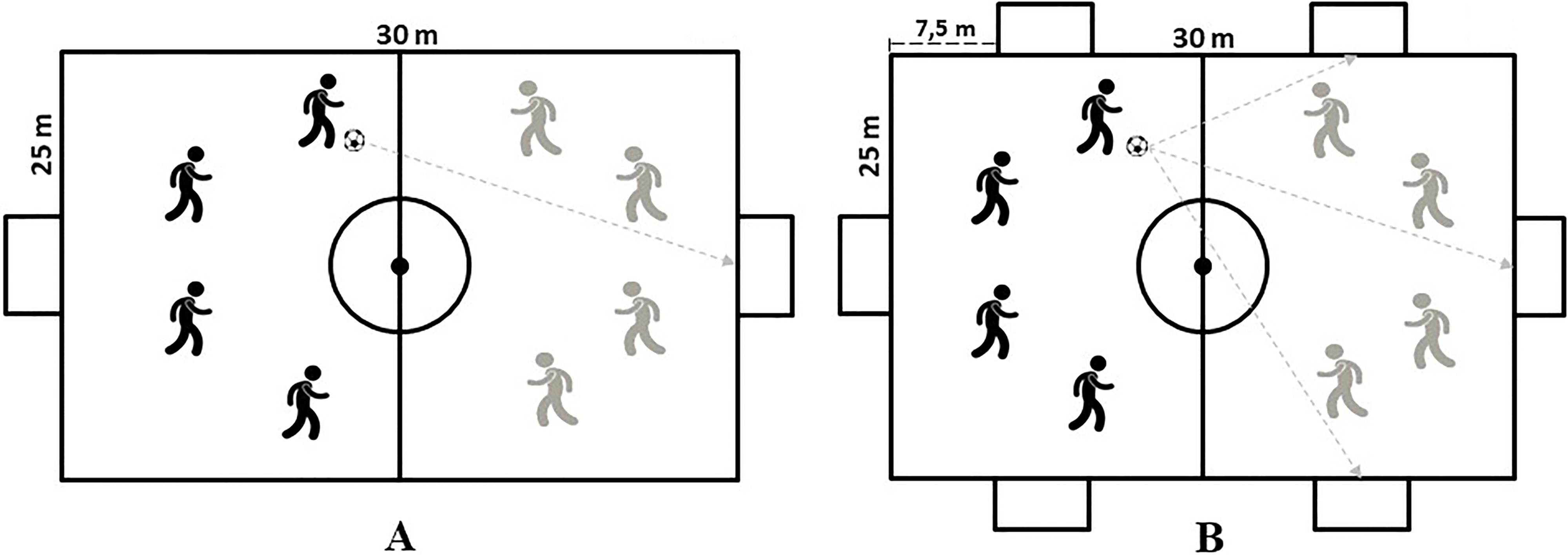
This is an experimental study with a cross-over design and a randomized order. In order to analyze the influence of the number of goals on the internal load of the athletes, two SSG were realized: A) SSG with 1 goal for each team (SSG1); B) SSG with 3 goals for each team (SSG3). The SSG1goal vs. SSG3 formats were chosen due their common use by conditioning coaches to induce different amount of offensive and defensive actions and, as a consequence, internal load [12]; i.e. SSG3 is commonly used as a more intense SSG compared to the SSG1.
Schematic representation of small-sided soccer games formats SSG1 (A) and SSG3 (B).
Body mass was measured by a scale (W200/5, Welmy), and a Sanny brand stadiometer was used to measure height. The Yo-Yo Intermittent Recovery test level 1 was used to estimate the VO max and the maximal heart rate (Yo-Yo HRmax) of the athletes. This test comprises of repeated 2 20 m runs back and forth with 10 s of active rest period at the end of each bout. This test finishes when the subjects are unable to achieve twice in succession the final line of a given stage of the test. The total distance covered by each athlete was considered including the last 2 20 m interval completed. This test is valid and frequently used in team sports with intermittent characteristics such as soccer [14].
Small-sided soccer game
Both SSG formats (SSG1 or SSG3) were played by the teams in two different sessions and separated by 48-hour interval against the same opponent. The SSG were held in the morning between 8:30 and 9:30 am. The mean ( SD) temperature and humidity during the both SSG were 27.2C ( 0.3) and 76% ( 1.4), respectively (Meteorological Database for Education and Research). The order of games was randomized. All the athletes were adapted to the SSG since they were part of the regular training program. A standard warm-up of 10 minutes was performed before the SSG using races with and without change of direction and alternating with static and dynamic stretching. The games had a total duration of 20 minutes divided into 4 sets of 5 minutes with recovery periods of 2.5 minutes (work: rest ratio of 2:1) [12]. Water was provided freely during the recovery interval to help maintain hydration of the players. The players were verbally encouraged throughout the session by the same researcher in order to keep up a high work-rate [10]. The games were held on natural grass fields with the pitch area fixed at 750 m (Pitch dimension: 30 25 m; area per player: 94 m) (Fig. 1). Several balls were placed around the dimensions of the field to be immediately restored when necessary so that the dynamics of the games were maintained. Each drill was performed under the supervision, coaching and motivation by several coaches. In order to maintain hydration, the participants were instructed to drink water before, during, and following both SSG.
Internal load indicators
Heart rate (HR) monitoring of the athletes was evaluated using a heart rate monitor (Polar RS800). The calculation of the internal load estimate was made from the product of the accumulated time in each HR zone by its corresponding factor (50–60% 1; 60–70% 2; 70–80% 3; 80–90% 4; 90–100% 5), as suggested by Edwards [15]. The sum of all zones was used to determine the magnitude of the internal load for each of the SSG. In addition, the maximum heart rate (HR) percentage was considered for analysis. Finally, the players were submitted to the repeated sprint test immediately after the SSG, as proposed by Rampinini et al. [16]; i.e. the athletes started from a line, sprinted for 20 m, touched a line with one foot, and came back to the starting line as fast as possible. After 20 s of passive recovery, the players started again (6 40 m (20 m 180 rotation 20 m with 20 seconds recovery between the sprints)). This procedure was used to analyze the impact of each SSG on peak anaerobic power, starting from the premise that the SSG generated greater internal load on the players, which in turn would generate greater reduction in the performance of repeated sprints. Therefore, this test was used as an indirect indicator of the internal load on the athletes in the SSG. For performance analysis in this test we used the average sprints times, which were recorded using Multisprint Full photo cell.
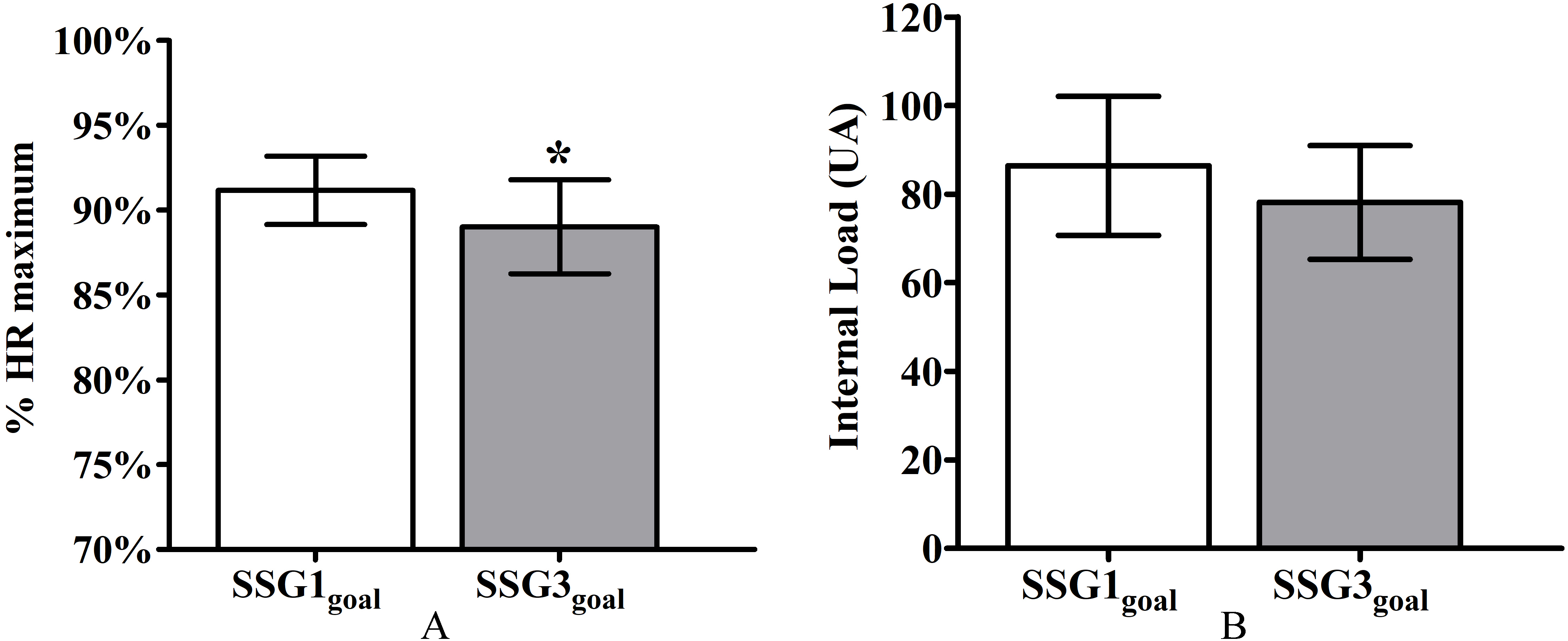
Mean and SD for (A) percentage value of heart rate and (B) Edwards method – TRIMP for each SSG. Significant difference from SSG1 to SSG3 ( 0.05).
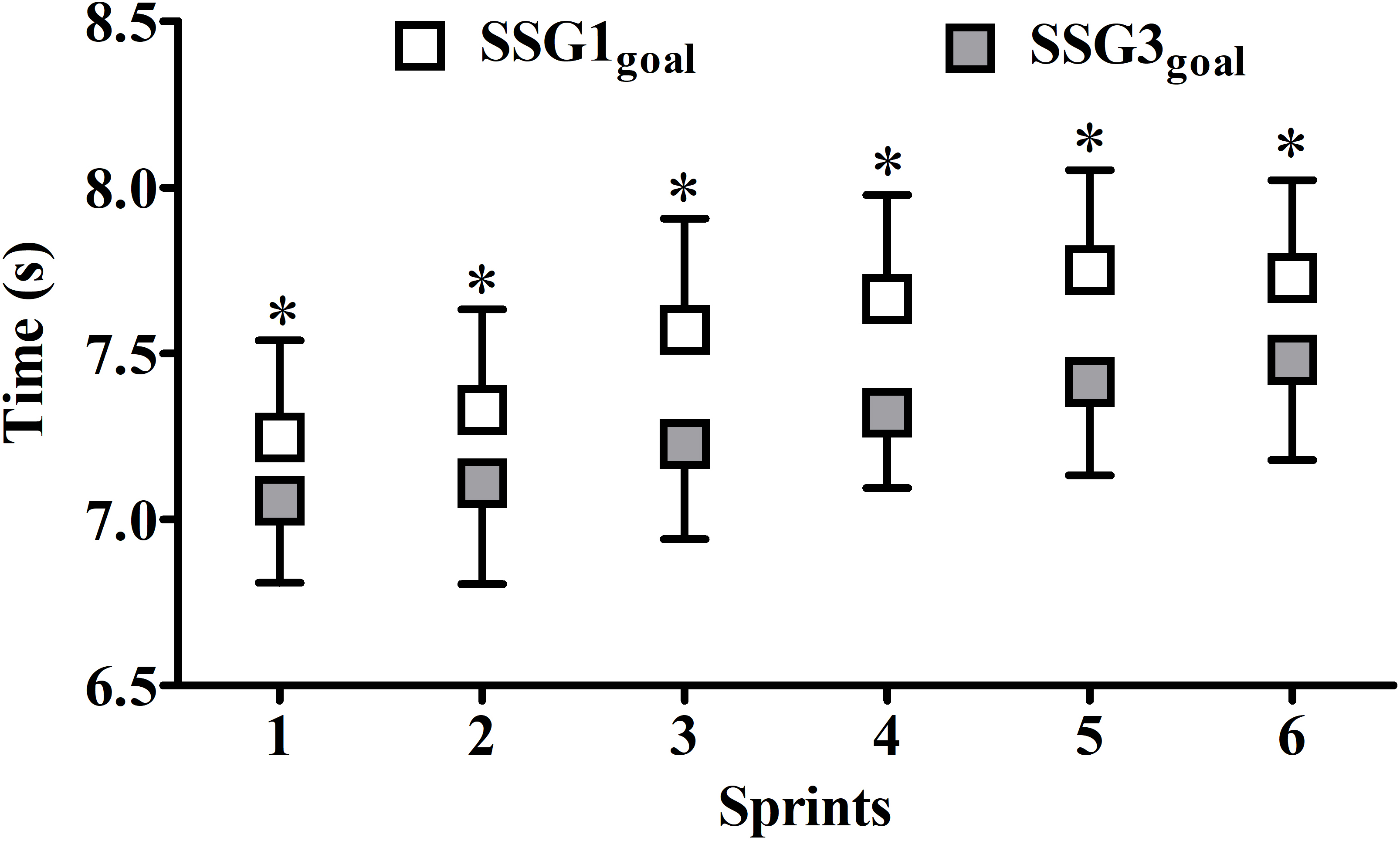
Performance in repeated sprint test after the both SSG. Significant difference from SSG1 to SSG3 ( 0.01).
Statistical analysis
Data normality was tested using the Shapiro-Wilk test. Data are expressed as mean and standard deviation. ANOVA with repeated measures was used to compare the internal load indicators between the SSG and the average of the times on the repeated sprints test between games. Bonferroni adjustment was used when a statistical significance was observed. A p-value 0.05 was considered statistically significant. The Cohen [17] test was used to analyze the effect size (d), considering “0–0.19 insignificant”, “0.2–0.49 small”, “0.5–0.79 medium” and “0.8 or more as large”. The statistical package SPSS 19.0 for Windows was used for statistical treatments.
Results
Figure 2 depicts the results of HR and TRIMP observed in both games. HR was higher in the 1 goal game compared to 3 goals (F 5.185, 0.04, 0.34), with values of 91 2% vs. 89 3% of the maximum HR, respectively. Despite the trend towards higher TRIMP in the 1 goal game compared to 3 goals (86.4 15.7 AU vs. 78.2 12.8 AU), the values did not reach statistical difference (F 2.402, 0.152, 0.19).
Figure 3 depicts the results of the repeated sprints test after the two SSG models. The performance in all sprints was lower after the SSG1 compared to the SSG3: (F 27.15, 0.001, 0.46), sprint 1 (7.2 0.3 vs. 7.1 0.2 s); d 0.9; sprint 2 (7.3 0.3 vs. 7.1 0.3 s; d 1.1); sprint 3 (7.5 0.3 vs. 7.2 0.2 s; d 2.2); sprint 4 (7.6 0.3 vs. 7.3 0.2 s; d 2.1); sprint 5 (7.7 0.3 vs. 7.4 0.2 s; d 1.4); sprint 6 (7.7 0.2 vs. 7.4 0.3 s; d 0.9),
Discussion
The objective of this study was to compare the magnitude of the internal load on young soccer players between SSG with different amounts of goals (SSG1 vs. SSG3). Our main finding was that the game with a lower number of goals generated a greater internal load on the athletes, considering the higher values of HR and the greater reduction in the performance of repeated sprints in the game with one goal compared to the game with three goals.
Our main result contradicts the hypothesis of the study that a SSG with a higher number of goals would induce the players to attack and to defend more (i.e. sprints, changes of direction, lower recovery time at low intensity), which as a consequence would generate greater internal load compared to a game with fewer goals. Although the parameters related to the external load (i.e. distance traveled, number of sprints, number of changes of direction, etc.) were not evaluated, it is possible to imagine that the athletes presented greater internal load in the game with a goal due to greater necessity to create opportunities to achieve the goal. In this sense, future studies should be conducted assessing the movement pattern, distance traveled and amount of sprints performed by the athletes in the different SSG formats in order to quantify the external load.
Our data support the idea that a simple change in the SSG format can modify the magnitude of the internal load on athletes. Thus, if the idea is to induce greater internal load to the players, the SSG with only 1 goal seems more adequate compared to the SSG with 3 goals for each team. It is important to note that no other modifications were made in the SSG, such as pitch area, number of players, or number of passes allowed, among others. Despite differences in the magnitude of the internal load between the games, both induced a high physiological demand on the athletes, which is expected for this type of training [8, 18, 19]. Corroborating our findings, previous studies indicate that athletes have a mean HR greater than 90% of maximal HR during the SSG [8, 20, 21]. In addition, the athletes perform several movements at high and maximum intensity within a similar context of technical and tactical demand to that faced in official matches. The average intensity reached in games with one and three goals was 91% and 89% of the maximum HR, respectively.
Previous studies have pointed out that the intensity reached in training involving SSG is sufficient to induce improvement in athletes’ aerobic power [19, 20, 21]. In this sense, seeing that there is a difference between the internal load on the players with SSG involving different amounts of goals, the number of goals must be considered when the goal is to induce work focused on the improvement of aerobic power [5]. In addition, it is important to note that the intensity achieved in the SSG is similar to that achieved in short-term intermittent training [22], therefore, SSG can also be considered for the concurrent development of physical aspects and technical skills in young soccer players [23]. This aspect allows conditioning coaches to manipulate variables related to the tactics and to promote specific team actions without losing the high demand of internal load on the athletes [24]. Therefore, performing training routines with SSG seems to favor the transfer of cardiorespiratory, metabolic and neuromuscular demands to soccer athletes in a specific way, which mimics what will be found in competitive matches.
The use of repeated sprints which requires intermittent movements of high intensity is related to physiological responses that directly influence the physical performance of soccer players [16]. In this way, improving the ability to maintain repeated sprints should result in higher physical performance in team sports. Therefore, it is important to better understand the training strategies that can improve this capacity [25]. In our study, it was observed that the performance in the repeated sprint post-game test after the game with 1 goal was worse when compared to the SSG with 3 goals. This result suggests that goal play may have involved increased metabolic and neuromuscular demand, probably related to the increased need for movement, as well as technical and tactical actions to create spaces to achieve the goal. Therefore, we believe that the amount of goals in the SSG soccer can modulate the physical, technical and tactical actions, modifying the dynamics of the game. Faced with these supposed scenarios, greater reduction in performance on the repeated sprint test was observed after the game with 1 goal. Due to the greater magnitude of the internal load generated by SSG1, future studies can be carried out analyzing if this game configuration would chronically bring greater physiological adaptations and improvement in performance compared to the game with more goals. Despite the novelty and practical relevance of the findings, this study presents some limitations that should be highlighted. The inclusion of more robust external load parameters (e.g. GPS or accelerometer measures) as well as the evaluation of the psychophysiological state (e.g. rating of perceived exertion) of the athletes during SSG that could provide a more comprehensive analysis on the training load imposed on players in small-sided soccer games. Future studies should include external loading measures to confirm whether the greater internal burden imposed on athletes in the game with fewer goals is associated with higher external load (e.g. number of sprints, greater number of technical actions, lower uptime at low intensity, etc.).
From a practical point of view, in knowing the magnitude of the internal load by different SSG configurations, including varying the number of goals, the coach can adjust the use of this training strategy throughout the training process in order to improve the physical, technical and tactical aspects of the athletes.
In conclusion, the number of goals influences the magnitude of the internal load on young soccer players in SSG. A smaller number of goals seems to increase the magnitude of the internal load on players. Therefore, coaching staffs should select the SSG setting appropriate to their goals.
Footnotes
Conflict of interest
No potential conflict of interest was reported by the authors.
References
1.
HalouaniJChtourouHGabbettTJChaouachiAChamariK. Small-sided games in team sports training: a brief review. J Strength Cond Res. 2014; 28(12): 3594-3618. doi: 10.1519/JSC.0000000000000564.
2.
ImpellizzeriFMMarcoraSMCastagnaC, et al. Physiological and performance effects of generic versus specific aerobic training in soccer players. Int J Sports Med. 2006; 27(6): 483-492. doi: 10.1055/s-2005-865839.
3.
YoungWRogersN. Effects of small-sided game and change-of-direction training on reactive agility and change-of-direction speed. J Sports Sci. 2014; 32(4): 307-314. doi: 10.1080/02640414.2013.823230.
4.
TravassosBGonçalvesBMarcelinoRMonteiroRSampaioJ. How perceiving additional targets modifies teams’ tactical behavior during football small-sided games. Hum Mov Sci. 2014. doi: 10.1016/j.humov.2014.10.005.
5.
HammamiAGabbettTJSlimaniMBouhlelE. Does small-sided games training improve physical-fitness and specific skills for team sports? A systematic review with meta-analysis. J Sports Med Phys Fitness. 2017; [Epub ahead of print]. doi: 10.23736/S0022-4707.17.07420-5.
6.
Los ArcosAVázquezJSMartínJ, et al. Effects of small-sided games vs. interval training in aerobic fitness and physical enjoyment in young elite soccer players. PLoS One. 2015; 10(9). doi: 10.1371/journal.pone.0137224.
7.
CouttsAJRampininiEMarcoraSMCastagnaCImpellizzeriFM. Heart rate and blood lactate correlates of perceived exertion during small-sided soccer games. J Sci Med Sport. 2009; 12(1): 79-84. doi: 10.1016/j.jsams.2007.08.005.
8.
BrandesMHeitmannAMüllerL. Physical responses of different small-sided game formats in elite youth soccer players. J Strength Cond Res. 2012; 26(5): 1353-1360. doi: 10.1519/JSC.0b013e318231ab99.
9.
HodgsonCAkenheadRThomasK. Time-motion analysis of acceleration demands of 4v4 small-sided soccer games played on different pitch sizes. Hum Mov Sci. 2014; 33(1): 25-32. doi: 10.1016/j.humov.2013.12.002.
10.
RampininiEImpellizzeriFMCastagnaC, et al. Factors influencing physiological responses to small-sided soccer games. J Sports Sci. 2007; 25(6): 659-666. doi: 10.1080/02640410600811858.
11.
DellalALogo-PenasCWongDPChamariK. Effect of the number of ball contacts within bouts of 4 vs. 4 small-sided soccer games. Int J Sports Physiol Perform. 2011; 6(3): 322-333. doi: 10.1123/ijspp.6.3.322.
12.
Hill-HaasSVDawsonBImpellizzeriFMCouttsAJ. Physiology of small-sided games training in football: A systematic review. Sport Med. 2011; 41(3): 199-220. doi: 10.2165/11539740-000000000-00000.
13.
PullingCTwitchenAPetteferC. Goal format in small-sided soccer games: Technical actions and offensive scenarios of prepubescent players. Sports. 2016; 4(4): 53. doi: 10.3390/sports4040053.
14.
BangsboJIaiaFMKrustrupP. The Yo-Yo intermittent recovery test: A useful tool for evaluation of physical performance in intermittent sports. Sport Med. 2008; 38(1): 37-51. doi: 10.2165/00007256-200838010-00004.
15.
EdwardsS. The heart rate monitor book. Med Sci Sport Exerc. 1994; 26(5): 647.
16.
RampininiEBishopDMarcoraSMFerrari BravoDSassiRImpellizzeriFM. Validity of simple field tests as indicators of match-related physical performance in top-level professional soccer players. Int J Sports Med. 2007; 28(3): 228-235. doi: 10.1055/s-2006-924340.
17.
CohenJ. Statistical power analysis for the behavioral sciences. Stat Power Anal Behav Sci. 1988; 2nd: 567. doi: 10.1234/12345678.
18.
AbrantesCINunesMIMacXãsVMLeiteNMSampaioJE. Effects of the number of players and game type constraints on heart rate, rating of perceived exertion, and technical actions of small-sided soccer games. J Strength Cond Res. 2012; 26(4): 976-981. doi: 10.1519/JSC.0b013e31822dd398.
19.
GabbettTJenkinsDAbernethyB. Game-based training for improving skill and physical fitness in team sport athletes. Int J Sports Sci Coach. 2009; 4(2): 273-283. doi: 10.1260/174795409788549553.
20.
Da SilvaCDImpellizzeriFMNataliAJ, et al. Exercise intensity and technical demands of small-sided games in young Brazilian soccer players: Effect of number of players, maturation, and reliability. J Strength Cond Res. 2011; 25(10): 2746-2751. doi: 10.1519/JSC.0b013e31820da061.
21.
MalloJNavarroE. Physical load imposed on soccer players during small-sided training games. J Sports Med Phys Fitness. 2008; 48(2): 166-171.
22.
DellalAChamariKPintusAGirardOCotteTKellerD. Heart rate responses during small-sided games and short intermittent running training in elite soccer players: A comparative study. J Strength Cond Res. 2008; 22(5): 1449-1457. doi: 10.1519/JSC.0b013e31817398c6.
23.
RadziminskiLRompaPBarnatWDargiewiczRJastrzebskiZ. A comparison of the physiological and technical effects of high-intensity running and small-sided games in young soccer players. Int J Sports Sci Coach. 2013; 8(3): 455-466. doi: 10.1260/1747-9541.8.3.455.
24.
Torres-RondaLGonçalvesBMarcelinoRTorrentsCVicenteESampaioJ. Heart rate, time-motion, and body impacts when changing the number of teammates and opponents in soccer small-sided games. J Strength Cond Res. 2015; 29(10): 2723-2730. doi: 10.1519/JSC.0000000000000932.
25.
BishopDGirardOMendez-VillanuevaA. Repeated-sprint ability part II: Recommendations for training. Sport Med. 2011; 41(9): 741-756. doi: 10.2165/11590560-000000000-00000.