




Abstract
OBJECTIVES:
There is no consensus regarding the mechanism of strength enhancement of regular whole-body vibration training (WBVT), which involves only neural or neural plus muscular adaptation. This discord could be based on lack of protein supplement to diet in WBVT. This study aimed to clarify the effects of adding protein to the diet on hypertrophy and strength during whole-body vibration training (WBVT).
METHODS:
Young healty male adults, 20–30 years old were grouped into control (
RESULTS:
There were significant within-group differences between the post and in pre-training strength values of muscular strength but no between-group differences were noted. There were no changes in leg muscle area, body fat ratio and lean body mass in the control group.
CONCLUSION:
Protein supplementation does not affect strength and muscle mass after WBVT.
Introduction
In recent years, whole-body vibration training(WBVT) has become a prominent strength-training model, and its popularity has been increasing. With regard to performing exercises for leading a healthy life, research on WBVT has increased because of the positive effects on neuromuscular performance for groups unwilling or unable to exercise regularly, including the elderly and individuals with limited time for exercise [1]. Although there are conflicting findings, several studies show an increase in muscle strength and power in the short term [2, 3] as well as long term [4, 5, 6, 7, 8].
Different suggestions have been put forward on the mechanism of enhancement of neuromuscular strength resulting from regular whole-body vibration training. One explanation involves neural and/or muscular adaptation. The strength increase induced by WBVT may be explained by the optimisation of muscular performance as a consequence of neuromuscular facilitation (neural changes, such as increased firing rate and synchronisation of motor units, increased intramuscular coordination and alteration of proprioceptive responses) [4, 9]. It is argued that these positive changes result from muscle activations induced by spinal reflexes, such as the tendon reflex, H-reflex and especially tonic-vibration reflex [1, 10]. On the other hand, WBVT can also cause trophic changes in muscles. Some studies have shown that the strength increase is induced by hypertrophy if the duration of the vibration training is sufficient [7, 11, 12, 13].
The hypertrophic effect in muscles, resulting from WBVT, may be explained by a hypergravity effect and hormonal changes. It has been argued that hypergravity can increase the transverse area and its strength [4, 9]. However, there is no evidence to support the validity of this hypothesis. Meanwhile, it has been shown that there is an increase in growth hormone and testosterone levels and a decrease in cortisol levels within the acute period after WBVT [14]. It has been claimed that this acute effect, which is seen after each training session, can cause an increase in muscle mass. However, there have been studies showing no hypertrophic effect on skeletal muscles due to WBVT [7, 15, 16]. In addition, another study showed no change in growth hormone, insulin-like growth factor-1, total and free testosterone, cortisol, insulin and glucagon levels within the acute period after vibration training [17].
Regular physical activity with sufficient protein intake is very important for athletic performance and to the concept of regular exercise for a healthy life. A relationship between sufficient protein intake and strength exercises is clear [18]. Protein intake should be more than the recommended daily allowance so that protein synthesis can be effective and a clear increase in muscle mass can be achieved by the anabolic effect in muscles induced by exercise [19]. To the best of our knowledge, there is currently no study supporting or refuting this effect. One reason for the conflicting results regarding muscle hypertrophy in WBVT might be insufficient protein intake. Providing sufficient protein intake, just like in strength training, can make the potential hypertrophy response clearer as a consequence of the vibration exercise.
The aim of this study was to hence to analyse the effect of dietary protein intake on the potential muscle hypertrophy response accompanying regular WBVT. Sedentary young adults performed whole-body vibration exercise for 3 months, and changes in muscular force and body composition according to dietary protein intake were evaluated. Our hypothesis was that muscular hypertrophy would be more pronounced with a clearer increase in muscular force as a result of regular WBVT with increased protein intake.
Materials and methods
Subjects
The study was conducted on 29 sedentary volunteer men between 20 and 30 years of age who had no health problems and had never done regular physical activity. Volunteers were randomly divided into two groups: a control group (
Procedures
All experimental subjects performed WBVT 3 days per week for 12 weeks. Baseline measurements (pre-test) were done before the training program started. Final measurements (post-test) were done within 24 and 48 h after the last day of training.
Training volume and intensity of whole body vibration program
Training volume and intensity of whole body vibration program
Table 1 lists the vibration exercises conducted by both groups using vibration platforms (Aspire 588, Istanbul, Turkey). All volunteers jogged for 10 min (40%–50% of maximum heart rate) and performed stretching exercises for 10 min before starting the vibration training. At the end of the training session, they walked at a slow tempo for 5 min to cool down.
The protein group was given whey protein, and the control group was given a starch-based additive as carbohydrate to analyse the effect of dietary protein along with WBVT on muscular hypertrophy and muscular force. The protein group was given whey protein (1 g/kg) as a milk-based protein extract (Hardline BiproWPI90, Istanbul, Turkey). The control group was given a corn-based short-chain carbohydrate (1 g/kg) (Hardline Carbopure, Istanbul, Turkey). The additives were isocaloric (energy value of starch is 384 kcal/100 g and energy value of protein is 394 kcal/100 g). The estimated daily amount of protein for each person was given in two portions in a bottle of water (300 mL) before and after the exercises on training days. Both of the products were given as 0.5 g/kg dose on an empty stomach in the morning on the nontraining days.
Strength measurements
Maximal grip strength of the dominant hand was measured using a hand dynamometer (Takei-Grip-D, Takei Scientific Instruments, Tokyo, Japan) as previously described [20] with results recorded in kilograms. Maximal lower-body strength was measured using a leg dynamometer (Takei Scientific Instruments) as previously described [20] with results recorded in kilograms. For assessing explosive strength, maximal jump height was measured using a jumpmeter (Takei Scientific Instruments) as previously described [21] with results recorded in centimetres.
The strength of knee extensors and flexors was evaluated on a motor-driven dynamometer (Cybex International Inc., Ronkonkoma, NY, USA). Isometric and isokinetic strength was evaluated using 60
Body composition assessment
The mid-thigh circumference (cm) and thigh skinfold measurement (cm) were used to calculate leg muscle area as previously described [22].
Body fat ratio and lean body mass were determined using bioelectrical impedance analysis (BIA). BIA was conducted using a model TBF 300 body composition analyzer (Tanita, Tokyo, Japan). BIA involves passing a low-voltage, high-frequency current through the human body. Before applying BIA, the experimental subjects were asked to ingest no drinks or food 4 h before the test and no alcohol or caffeine 12 h before the test, to not exercise 6 h before the test, to take no diuretic agents 7 days before the test, and to urinate 30 min before the test [23].
Body density was measured by hydrostatic weighing and corrected for residual lung volume. Underwater weight was measured in a water tank in which a swing chair was suspended from a hanging scale with a 10-kg capacity and 10-g sensitivity. The subjects were instructed to exhale maximally and then submerge and remain as motionless as possible for approximately 5 s while the hydrostatic weight was recorded. The average of the three heaviest hydrostatic weight values among 10 measurements was used for analysis. All measurements were done with the subjects in a fasting state after they urinated and defecated or expelled flatus shortly before the hydrostatic weighing. Each subject wore a tight-fitting swimming suit that was rubbed to expel any trapped air bubbles. Residual lung volume was estimated using the Boren calculation [24]. Body fat ratio and lean mass were calculated from body density using the Siri equation [25].
Strenght assesment of groups for arms and lower-body using dynamometer (kg) and jump height (cm), before and after whole body vibration training.
Strenght assesment of groups for arms and lower-body using dynamometer (kg) and jump height (cm), before and after whole body vibration training.
Results are presented as mean
Results
Before and after the regular WBVT period, there was no difference in body weight, height, or body mass index measurements within or between the two groups.
Strength measurements
Hand-grip and lower-body strength and jump height values for the groups are shown in Table 2. A statically significant increase (
The peak values of isometric and isokinetic strength are illustrated in Fig. 1A–D. Isometric extension muscular strength values were significantly increased by 10.2
The peak values of isokinetic strength were significantly increased (
Body composition assessment
The percent body fat values measured using BIA are shown in Table 3. Although there was an insignificant decrease in the control group, percent body fat was significantly decreased (
Body composition assesment of groups for body fat ratio (%, using bioelectrical empedance and hydrostatic weighing), lean body mass (kg, using bioelectrical empedance and hydrostatic weighing), leg muscle area (cm
) before and after whole body vibration training
Body composition assesment of groups for body fat ratio (%, using bioelectrical empedance and hydrostatic weighing), lean body mass (kg, using bioelectrical empedance and hydrostatic weighing), leg muscle area (cm
Changes in the isometric extension (A) and flexion (B) peak strength, isokinetic extension (C) and flexion (D) peak strength of groups. White bars show pre-training, black bars show post-training measurements. 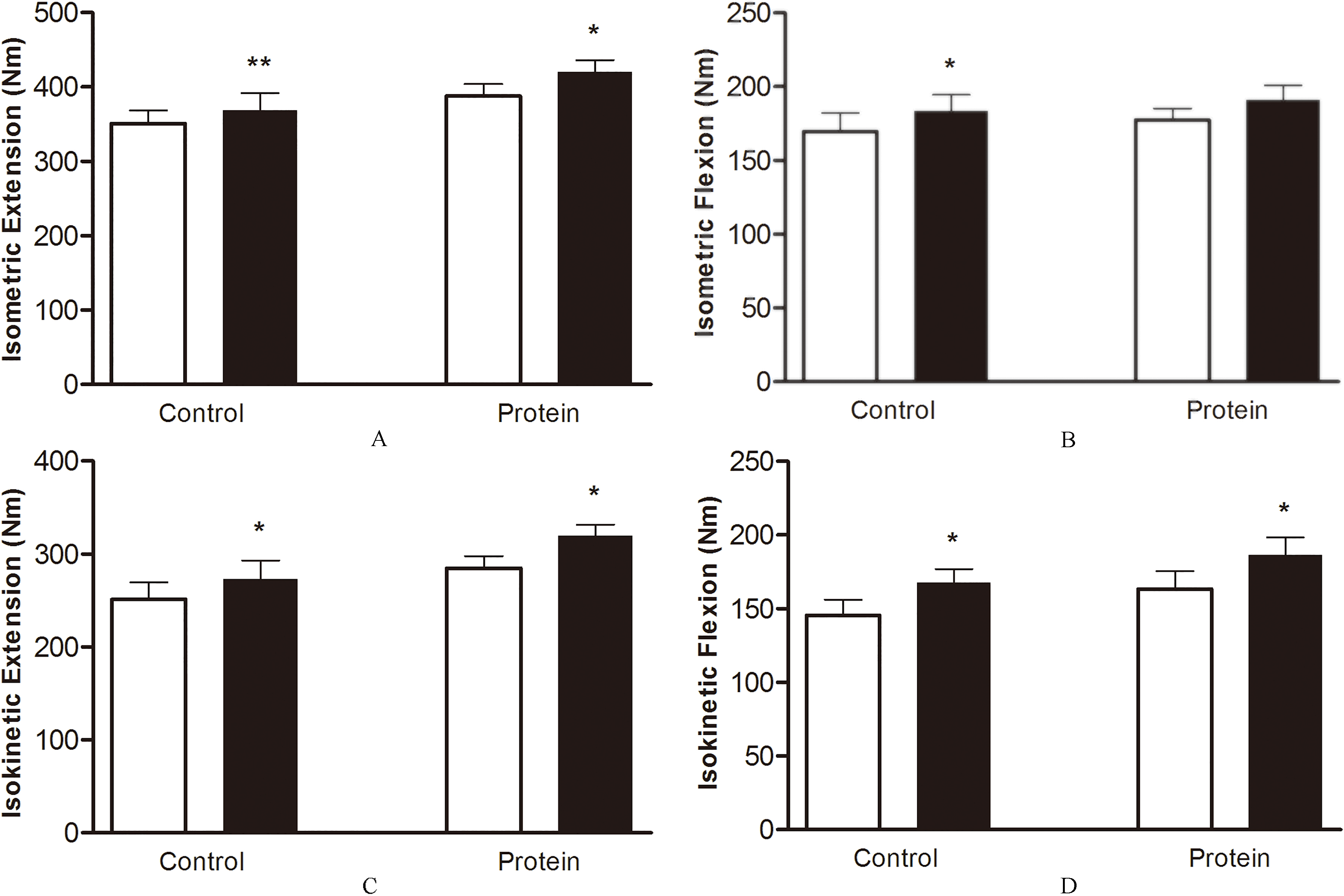
Regular physical activity is essential for a healthy life, and several techniques and methods have been developed to encourage people to exercise regularly. Whole-body vibration exercise is one of the techniques presented as a strength-training method. Increase in strength and progression of hypertrophy in skeletal muscle hypertrophy induced by WBVT were evaluated with respect to additional protein in the diet. After 12 weeks of WBVT, we found that the muscle strength of volunteers in the protein group did not significantly increase compared with that of volunteers in the control group. In addition to this, no increase in muscle mass was observed in either group as a consequence of vibration training. This study evaluated for the first time the effect of dietary protein intake in conjunction with WBVT and determined that there was no effect on the increase in strength induced by vibration training.
There is a huge difference in scientific compared with unscientific research on whole-body vibration exercise, which has increased in popularity in recent years. In this context, it seems that the number of scientific publications is insufficient. However, numerous results appear when one looks for information regarding vibration exercise on the internet. In unscientific sources, even the parameters that have not been studied or proved have been reported to be promising. In addition to this, although vibration training has been accepted as a strength exercise, there are many conflicting results regarding the strength increase according to classic strength-training. Although in studies on upper-extremity strength changes it is argued that there is no increase or change in the acute period after vibration exercise, there are some conflicting results regarding lower-extremity strength [1, 10, 26].
In this study, experimental subjects performed WBVT for 3 days per week for 3 months. To observe the chronic effect of vibration exercise and to exclude the effect of acute changes in strength, measurements were taken at least 24 h after the last training session. Although upper-extremity strength evaluated using hand-grip strength measurements increased in both groups, there was no significant difference in the strength increase between the two groups. Regarding lower-body strength, a significant increase was observed in both groups. However, vertical jump height increased approximately 5% in both groups. Although this increase was significant in the control group, it was close to, but did not reach, statistical significance in the protein group. Very few studies report no change in lower-extremity strength resulting from long-term WBVT [3, 27], while a considerable number of studies report an increase in vertical jump height [8, 21, 27].
The isometric and isokinetic strength changes in our volunteers after 12 weeks of WBVT were evaluated using a computerised dynamometer. At a 60
Regarding the strength results for our study, the increase in both groups was an expected result and supports the literature reporting a strength increase in the chronic period as a result of vibration training. However, the original aspect of our study is that strength increase has been at the similar levels in both groups, and there was no difference between the groups. The subjects who had additional protein added to their diet during their 3-month WBVT did not have a greater increase in strength compared with the subjects who had additional carbohydrate added to their diet.
Although there is no clear agreement on the strength increase due to vibration training, differences of opinion regarding the mechanisms of the strength increase related to vibration are much greater. It is generally thought that of the two components of strength, neural and muscular, the increase is due to differences in the neural component after WBVT [1, 36]. Acute changes in strength after a single session of vibration exercise occur in approximately 60 min, which is explained by changes in the neural component [4]. As a consequence of regular vibration training, the strength increase measured 24–48 h after the last session of vibration exercise is more likely due to changes in the muscular component, i.e. the contractile machinery of muscle [9]. Hypertrophy in muscles can be effective to increase strength as a consequence of WBVT [5, 13, 31]. Supporting this view, increases in growth hormone and testosterone levels after vibration exercise and a decrease in cortisone levels have been reported [14]. However, other studies have claimed that there is no hypertrophic effect in muscles and that there are no hormonal changes after WBVT [7, 17, 15, 16].
Regarding the strength increase after long-term vibration training, the different results of studies on muscle hypertrophy might be because the amount of dietary protein intake was not taken into account. The effect of protein intake on athletic performance has been known very well for a long time. Anabolic signal pathways activated by exercise are potentiated by nutrition in an important manner [32]. Even some scientists have argued that clear acquisition of muscle mass can occur only if there is sufficient protein intake although strength exercises are the basic anabolic stimulus [26]. In studies of the changes in muscle mass after WBVT, protein intake has not been taken into consideration so far. Considering the possible anabolic stimuli induced by vibration training, ignoring sufficient protein intake could have prevented the response for effective hypertrophy. For the protein group, we gave a 1 g/kg protein supplement in addition to the protein they normally took daily in their diets before and after each training session. In addition, 0.5 g/kg protein was given on the days without training in order to maintain the anabolic stimulus induced by vibration training. The control group, was given a carbohydrate supplement calorically equal to the protein supplement. Changes in body composition were measured and compared.
We tried to evaluate the body composition changes of the experimental subjects caused by WBVT by different methods. Percent body fat was evaluated by bioelectric impedance and an underwater weighing method. After the training period, both groups had a decrease in percent fat according to both. However, only the decrease in the bioelectric impedance measurement of the protein group was statistically significant. It is not clear why the results of our study regarding percent body fat conflicted with those of other studies [5, 33, 34, 35, 36]. Considering that there was no significant change according to the underwater weighing method, in both groups, our results support that vibration training resulted in no change in percent body fat.
Hypertrophy in skeletal muscles, which is critical parameter of our study, was evaluated by BIA, thigh muscle area and an underwater weighing method, which represents the gold standard for determining body composition [37]. When lean body mass was evaluated by BIA, although the increase between the initial and final measurements of the protein group was a small (0.83%), it was statistically significant. Furthermore, there was no difference in the initial and final measurements or the percent increase between groups. The surface area of the extension muscle did not significantly increase in either group, and there was no significant difference between groups. In a similar way, lean body mass measured by the underwater weighing method was not different between or within the groups. In general, neither whole-body vibration exercises nor dietary protein intake caused hypertrophy of skeletal muscles of the experimental subjects.
In conclusion, in this study of young adult men, dietary protein intake provided no additional strength increase and had no effect on muscle mass during WBVT for 3 months. Our results demonstrate that the suggestion that muscle hypertrophy is a mechanism of increasing strength after long-term vibration training is not valid. Rather, our results indicate that neural factors were probably the cause for increasing strength by vibration training. However, further studies are needed to evaluate different responses in different groups of experimental subjects, especially in older persons.
Conflict of interest
The authors have no conflict of interest to report.
Footnotes
Acknowledgments
This work was supported by the Akdeniz University Research Projects Unit under Grant (2010.03.0122.006).