




Abstract
BACKGROUND:
Research suggests that effect of continuous static stretching on sport performance and/or injury prevention depends on the total stretching volume.
OBJECTIVE:
To analyze the acute effects of three short duration static stretching interventions of four lower limb muscle groups (15, 30 and 60 seconds per muscle) on the eccentric isokinetic peak force (PF) and peak power (PP) measures obtained during leg press exercise.
METHODS:
A total of thirteen amateur athletes, 7 men and 6 women, completed four different interventions in a randomized order on separate days: one control (non-stretching) and three static stretching (SS) interventions (1
RESULTS:
Measures were compared via a magnitude-based inference analysis. The results of this study showed no significant main effects between intervention-paired comparisons for any PF and PP measures.
CONCLUSION:
The findings of this study suggest that sport-relevant durations of SS have no effect on eccentric strength and power performance during leg press exercise and hence, the role of SS as a method to reduce the relative risk of injury is questionable.
Introduction
For decades, static stretching (SS) has been recommended as part of a typical pre-exercise warm-up because it was considered an effective method to improve joints range of motion [1], thus promoting performance [2] and reducing the relative risk of injury [3, 4]. Recent evidence has suggested a dose-response effect of pre-exercise SS on maximal concentric and isometric muscle strength and power performance, so that SS durations longer than 60-s are likely to cause a small to moderate reduction in performance, whereas shorter-duration (
However, before excluding SS entirely from warm-up routines, its effects on injury risk should be addressed. If indeed SS elicits any negative effects in terms of risk of injury, then it should be excluded, at least in those instances where the evidence is convincing enough. In this sense, the scientific literature is not well supportive of the role pre-exercise SS has on risk prevention [8, 9]. To elucidate the role of pre-exercise stretching on injury prevention [8], it was suggested that the effects of pre-exercise stretching on the likelihood of sustaining an injury should be analyzed in relation to the specific type of injury (i.e. muscle strains, ligament tears) and focus on a particular primary risk factor associated with that injury.
Epidemiological studies have revealed that muscle injuries are the most prevalent injuries reported in sporting contexts [10, 11]. In particular, hamstring muscle injuries reported the highest incidence rates in a varied field of sports [12, 13, 14, 15], in both sexes [16, 17], with often large periods of inactivity [18] and high recurrence rates [19] as a consequence. Most muscle injuries (including hamstring muscle injuries) are often created by fast eccentric actions of the muscles, resulting from high intensity sprinting, jumping and bouncing movements that rapidly exceed their threshold of tolerance (e.g. capacity to absorb mechanical energy). For example, hamstring muscle injuries usually occur during the later part of the swing phase of sprinting when the hamstrings are contracting eccentrically (energy absorption) to decelerate the knee extension movement generated by the quadriceps [20, 21]. Consequently, limited eccentric strength has been widely considered as a primary risk factor for muscle injuries in general [4] and for hamstring muscle strains in particular [22].
Therefore, studying the acute effect of pre-exercise SS on eccentric muscle strength might provide insight to better understand the role of pre-exercise SS as a measure to reduce the relative risk of injury. It seems reasonable to hypothesize that pre-exercise stretching-induced impairments in eccentric muscle strength predispose the athlete to muscle injuries. However, this hypothesis has not been well validated since only a few studies have examined the acute effect of pre-exercise SS on eccentric strength [23, 24, 25, 26, 27, 28, 29]. The analysis of the overall results reported by all of the abovementioned studies revealed small to moderate (
Therefore, the main purpose of the current study was to analyse the acute effects of three short duration static lower extremity stretching interventions (15, 30 and 60 s per muscle group) on maximal eccentric muscle strength and power measures obtained from a multi-joint eccentric leg flexion isokinetic testing procedure in amateur athletes. We hypothesized that there would be a negative dose-dependent effect of SS on the maximal eccentric muscle strength and power measures with 60 s of SS resulting in a significant muscle performance impairment, but shorter durations – 15 and 30 s – having little effect.
Material and methods
Subjects
Thirteen subjects, consisting of 7 men and 6 women who were amateur athletes from different kinds of sports (soccer, track and field, basketball, volleyball) completed this study (mean
Other exclusion criteria were: (1) histories of neuromuscular diseases or musculoskeletal injuries specific to the ankle, knee, or hip joints over the past 6 months; (2) missing one testing session during the data collection phase and (3) presence of self-reported delayed onset muscle soreness at any testing session. Before any participation, experimental procedures and potential risks were explained fully to the subjects both verbally and in writing. Written informed consent was obtained from the players. The Institutional Research Ethics Committee (Faculty of Physical Culture, Palacký University Olomouc) approved the study.
Procedure
A randomized, post-test only crossover study design, in which subjects performed all experimental conditions, was used to address the aims of this study. The use of a pre and post-test crossover design was discarded as previous similar studies have suggested that the duration of the pre and post intervention assessment procedures might be too long and subsequently subjects might feel fatigued to undertake the post-warm up assessment and hence bias the results [30].
The independent variables were the four different interventions (control [non-stretching] and three different stretching interventions). The dependent variables included four multi-joint maximal eccentric isokinetic strength and power measures.
Subjects visited our laboratory on five occasions, with a week’s rest interval between sessions. The choice of a week interval between testing sessions was because Dirnberger et al. [31] suggested that nearby a week’s rest interval may be necessary to restore optimal muscle function after carrying out these maximum strength measurements. To minimize circadian and other similar effects on physical performance, each subject carried out all experimental sessions at the same time of day and under the same environmental conditions (room temperature at 25
During each experimental session, subjects began by performing a 5-min low to moderate intensity active aerobic warm-up (stationary bicycle with individual load adjustment (1.5 watt per kilogram of body weight and the cadence of 70 rpm). Once this active warm-up was completed, subjects proceeded to carry out one of the three stretching interventions or the control intervention (non-stretching). The order of interventions was randomised per person to avoid carry-over effects. The rationale of using this design (general aerobic warm-up
The assessment of the eccentric isokinetic strength and power measures during leg press exercise was carried out 2–3 minutes (post-test) after the active aerobic warm-up and interventions were completed. Each experimental session was carried out under the strict supervision of the researchers. For a better understanding of the study design and procedures, a schematic representation is displayed in Fig. 1.
Schematic representation of the study design.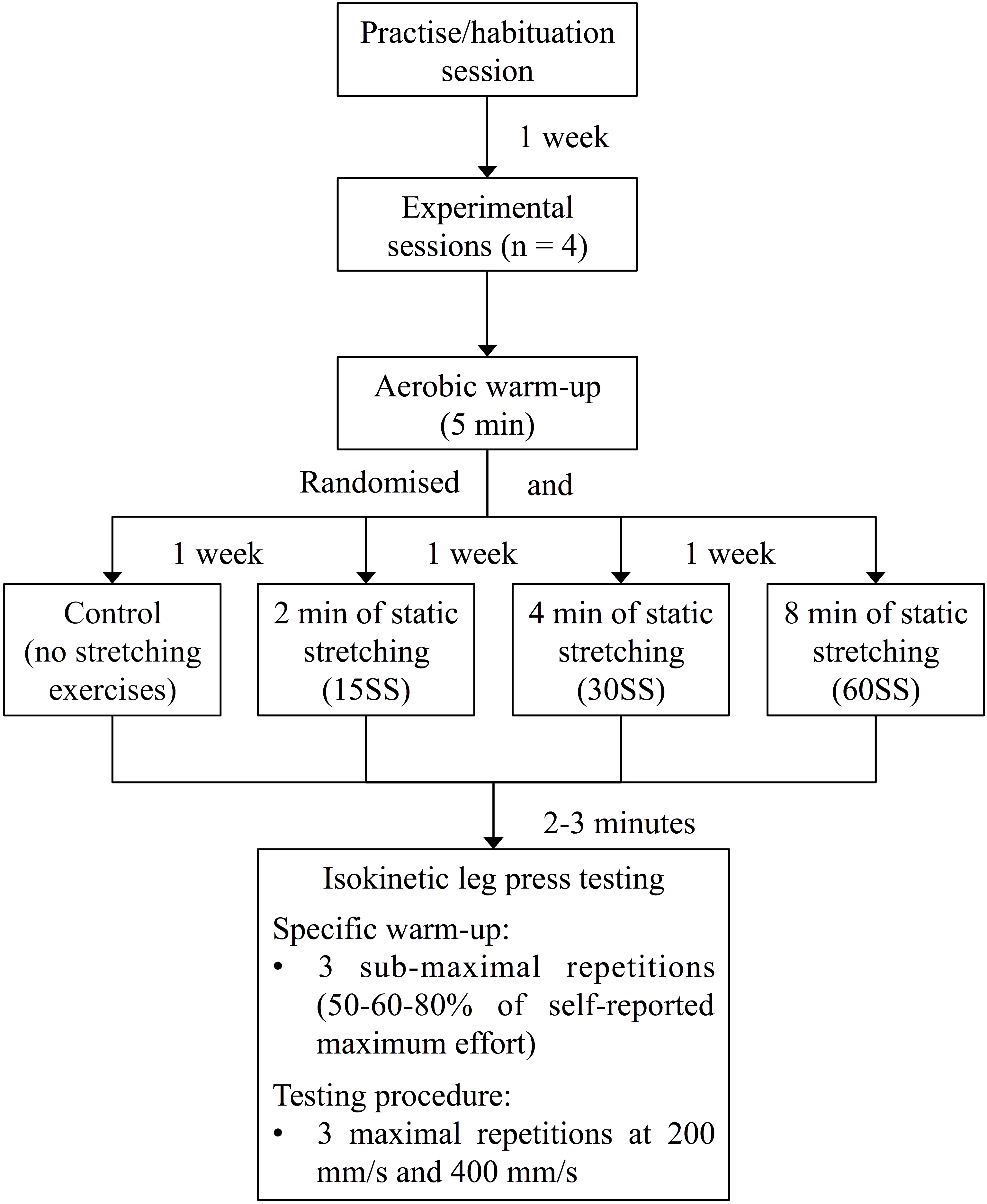
An IsoMed 2000-system isokinetic dynamometer (D&R Ferstl GmbH, Hemau) was used to determine eccentric isokinetic PF and PP during leg press exercise. The system was calibrated according to the manufacturer’s instructions immediately before each test session and verified immediately after to ensure that no changes occurred in sensitivity.
The testing procedure and setting suggested by Dirnberger et al. [31] was carried out as they reported minimum oscillations in knee angles (approximately 5
Subjects were seated and secured in an upright position with the hip flexed at 55
The secured position of the subjects during isokinetic testing on the IsoMed device.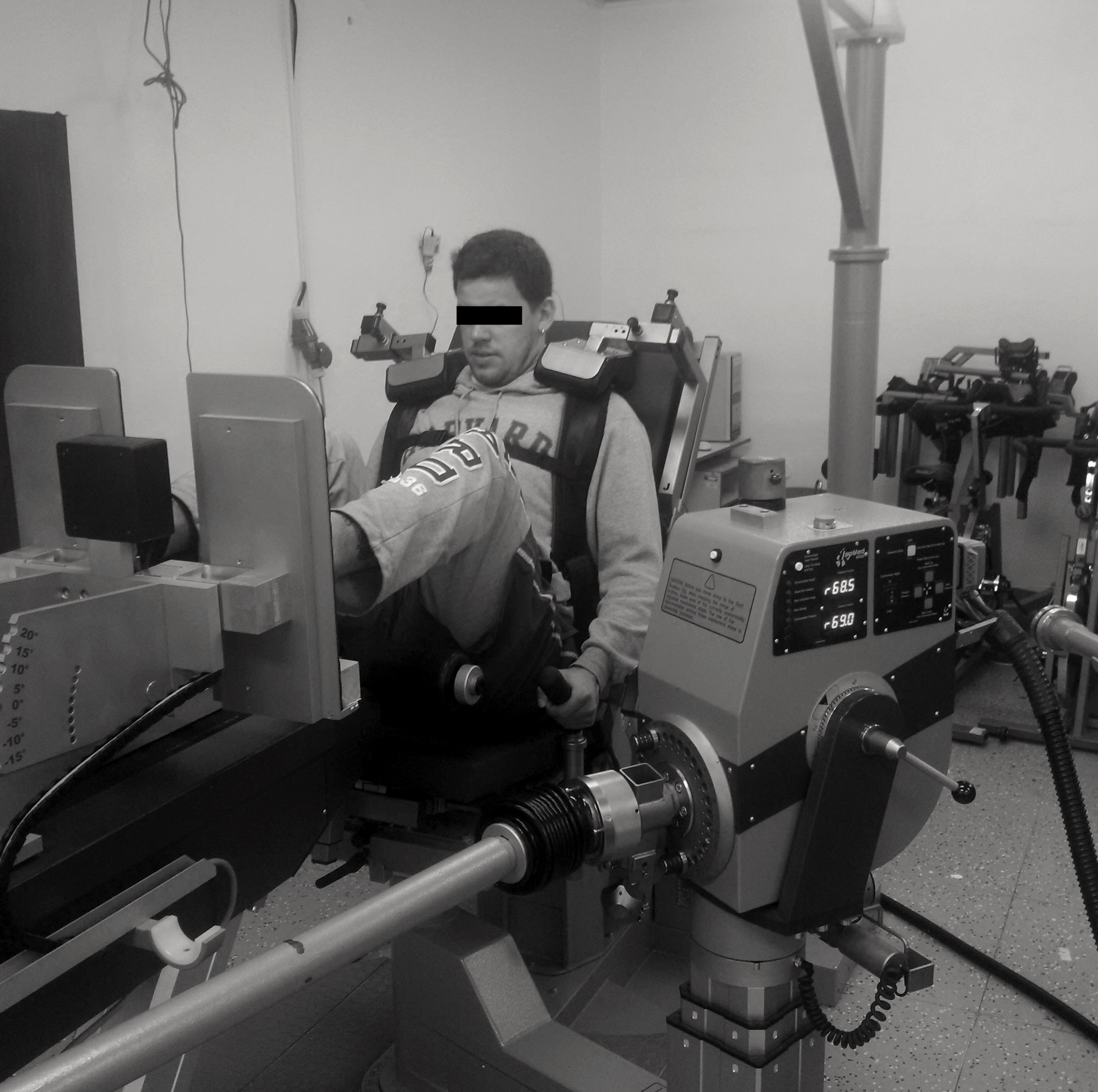
Subjects underwent a warm-up by performing three submaximal (50–60–80% of self-reported maximum effort) eccentric isokinetic (200 mm/s) actions of the thigh muscles before the isokinetic leg press assessment was carried out. Testing was carried out at two different constant linear velocities of the leg-press adapter in randomised order (200 mm/s and 400 mm/s). Three maximal attempts were performed at each testing velocity. A rest of 30 s was allowed between attempts and 2 min between velocities. The number of maximal muscle actions and the rest period durations were chosen to minimise musculoskeletal fatigue, which is unlikely to occur with only two muscles actions at two velocities (200 and 400 mm/s) and a 30-s rest between muscles actions and 2 min rest between testing velocities. Subjects were encouraged to resist as hard and as fast as possible and to complete the full range of motion. Subjects were told to abort the test if they felt any discomfort or pain. During the test, all subjects were given visual feedback from the system monitor. They were also verbally encouraged by the investigator to give their maximal effort, and the instructions were standardised by using key words such as “resist”, and “hard and fast as possible”. For the eccentric PF and PP measures, the best value of the three trials at each velocity through the testing sessions was used for subsequent statistical analysis. These measures have demonstrated high inter-session reliability scores, with standard error of measure scores lower than 10% and ICC scores higher than 0.9 [31].
In each stretching session, subjects performed four static stretching exercises designed to stretch the major muscle groups used during running and reflect the stretching typically performed by athletes and recreationally active people. Stretching exercises performed by athletes were as follows: 1) supine hip flexion stretch with partner assistance (gluteal muscles), 2) lunge quadriceps stretch (quadriceps femoris muscles), 3) standing calf muscle stretch on a step (calf muscles), and 4) standing hamstring stretch (hamstring muscles). The static stretching sessions differed only in the single stretch duration (15, 30 and 60 s); whereas the other stretching loads characteristics (technique, intensity, repetition and exercise positions) were identical. The stretching exercises were performed in a randomised order under the direct supervision and guidance of the investigators.
Each stretching exercise was completed on the right and left leg before another exercise was performed. No rest interval was allowed between legs, stretch repetitions and exercises. The intensity of stretching was self-determined but set to the threshold of mild discomfort, not pain, as acknowledged by the subject.
Stretch durations of 1
Statistical analysis
Descriptive statistics (means
The magnitude-based inferences of differences between interventions were calculated for each variable. The smallest substantial effect was used to determine whether the observed changes were considered substantial or trivial. The smallest substantial effect was calculated as 0.20 of the pooled between interventions SD [35]. A 90% confidence interval was applied to the between interventions difference using an online spreadsheet [36] to calculate the probabilistic inference of each observed difference being greater than the smallest substantial effect. The qualitative descriptors proposed by Batterham and Hopkins [35] were used to interpret the probabilities (clinical inferences based on threshold chances of harm and benefit of 0.5% and 25%) that the true effects are substantial or trivial:
Effect sizes, which are standardised values that permit the determination of the magnitude of differences between groups or experimental conditions [37], were also calculated for each of the variables using the method previously described by Cohen [37]. Cohen assigned descriptors to the effect sizes (d) such that effect sizes less than 0.2 represented a small magnitude of change while 0.2–0.8 and greater than 0.8 represented moderate and large magnitudes of change, respectively.
The current study considered a “substantial” main effect when a change was noted between paired-comparisons in PF and PP measures that had reported a probability of the worthwhile differences of “likely” or higher (
Mean
standard deviation values for peak force (PF) and power (PP) at 200 mm/s and 400 mm/s during eccentric multi-joint leg flexion movements among experimental conditions (control [non-stretching], 15 s static stretching [15SS], 30 s static stretching [30SS] and 60 s static stretching [60SS])
Mean
Net effects (expressed as standardised mean differences and 90% confidence intervals) of the stretching interventions in comparison with the control condition (paired comparisons) on the peak force (PF) and power (PP) measures at 200 mm/s and 400 mm/s during eccentric multi-joint leg flexion movements. The probabilities of an effect being in favour of the control/trivial/in favour of stretching intervention (15SS, 30SS or 60SS) are expressed as percentage values. Clinical inference is also provided. The vertical shaded lines represent the smallest worthwhile effect (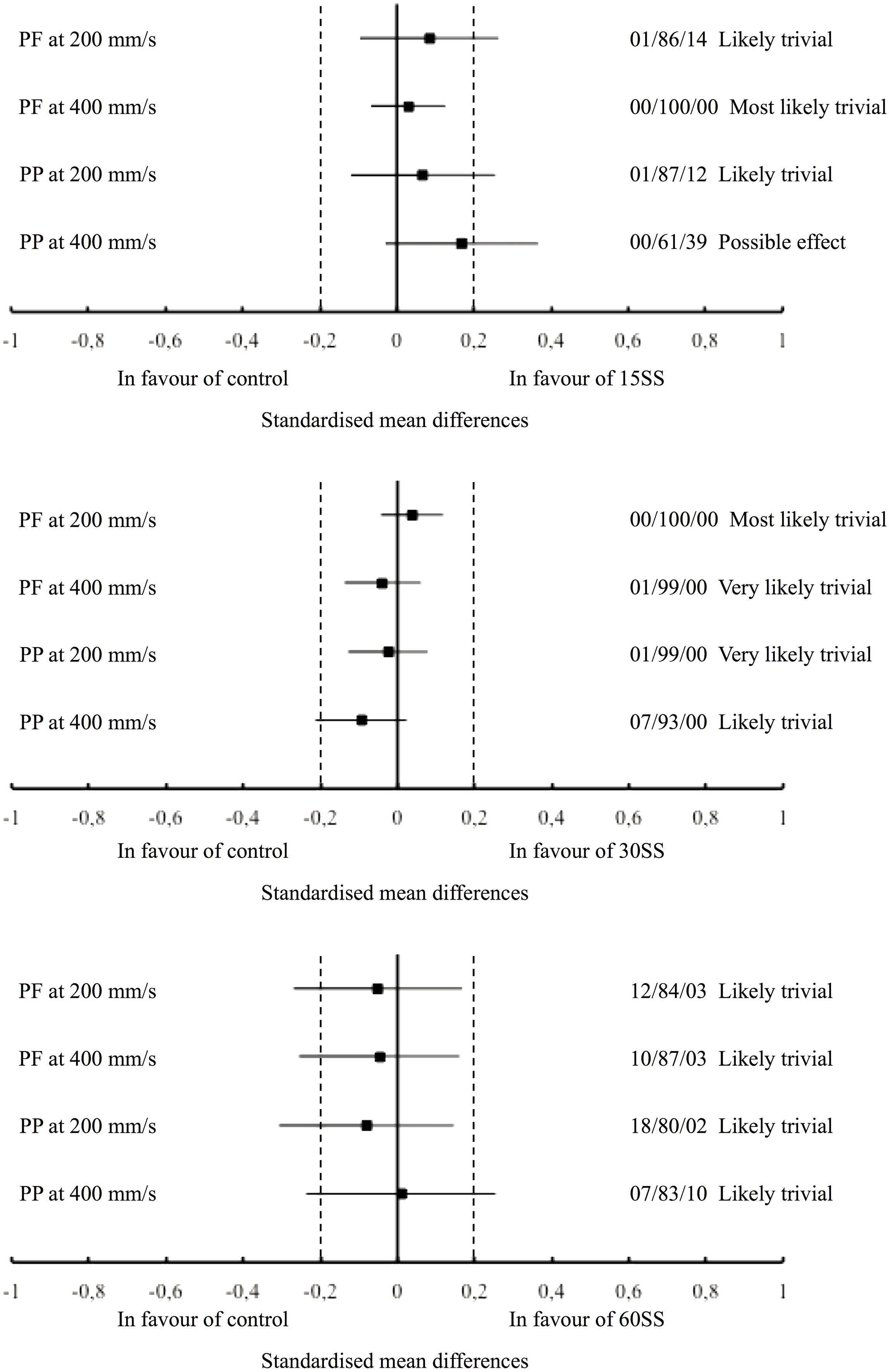
Net effects (expressed as standardised mean differences and 90% confidence intervals) among the stretching interventions (paired comparisons) on the peak force (PF) and power (PP) measures at 200 mm/s and 400 mm/s during eccentric multi-joint leg flexion movements. The probabilities of an effect being in favour of any stretching intervention or trivial are expressed as percentage values. Clinical inference is also provided. The vertical shaded lines represent the smallest worthwhile effect (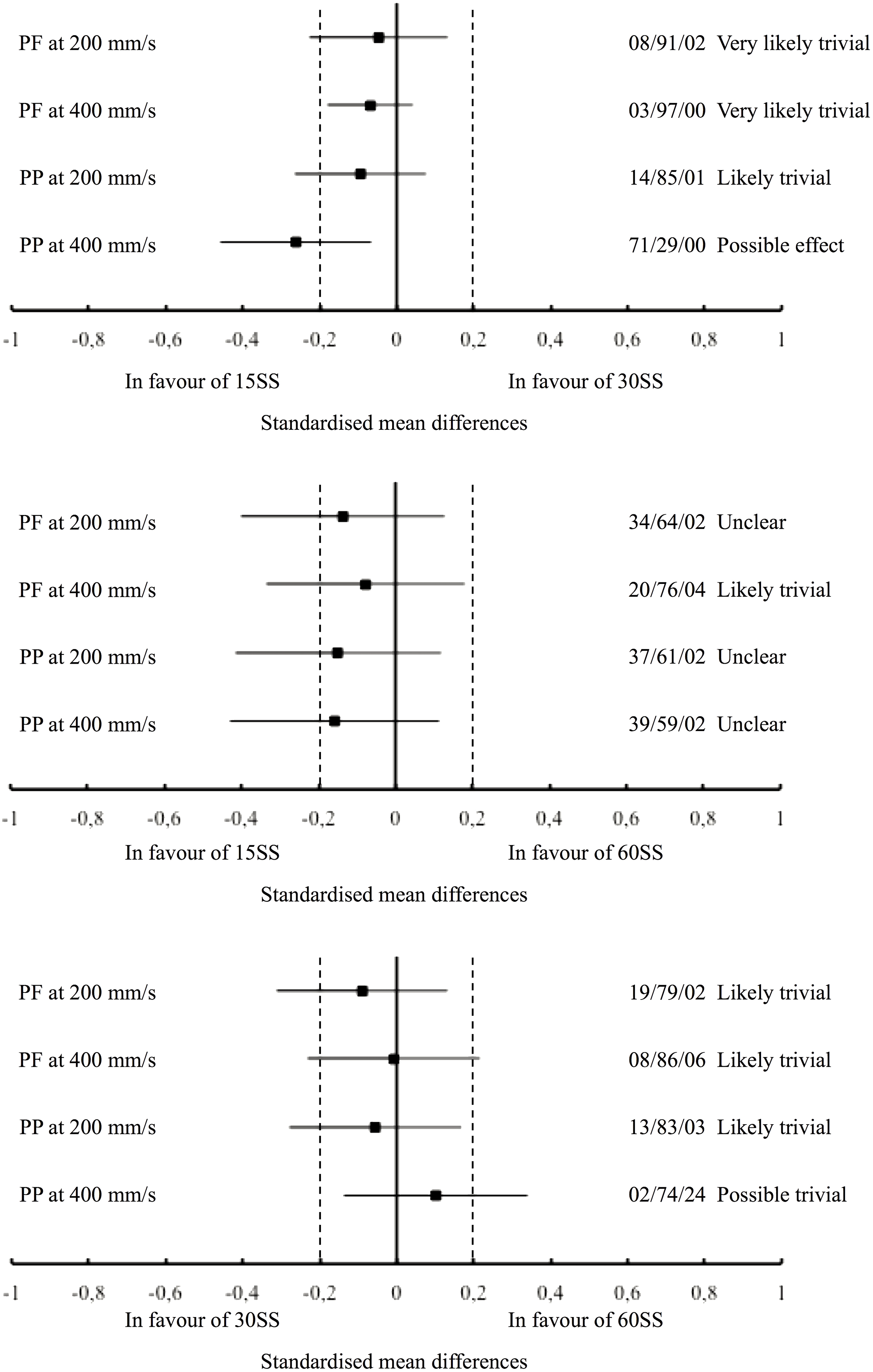
The post interventions results are reported for descriptive purposes in Table 1 (control, 15SS, 30SS and 60SS). The paired controls vs. stretching interventions standardised mean differences with their corresponding 90% confidence intervals for the eccentric PF and PP measures are displayed in Fig. 3. No substantial differences (likely trivial differences with a probability
Discussion
In an attempt to further elucidate the role of pre-exercise SS as a method to reduce the relative risk of injury, the current study evaluated the acute effects of three different short SS durations (15, 30 and 60-s) on maximal eccentric muscle isokinetic strength and power performance. Thus, the primary finding of the present study showed that 15, 30 and 60-s of SS exercises designed to stretch gluteal, quadriceps, hamstring, and calf muscles had neither a positive nor a negative effect on PF and PP measures obtained at two different linear velocities from a multi-joint eccentric leg flexion isokinetic testing procedure.
In as much as we are aware of, although the current study is the first to determine the acute effect of short SS durations on eccentric PF and PP for the leg flexor muscles, its results are consistent with the only previous study that has examined the acute effects of a sport-contextualised SS protocol (2
Although the mechanisms responsible for the lack of any short duration SS-induced changes on eccentric measures are not well known, a possible explanation could be based on the fact that the stimuli elicited by these SS durations might not be enough to produce any relevant alteration in the mechanical components of the skeletal muscle contraction and/or in the muscle activation patterns. However, as stated in previous studies, longer SS durations might adversely affect maximal eccentric muscle strength measures. Collectively, these findings appear to suggest the existence of a dose-response effect of pre-exercise SS on maximal eccentric muscle strength and power performance. Although a similar dose-response effect of SS has been also reported on maximal concentric and isometric strength measures [5, 6, 7], it should be noted that the threshold of stretch duration to elicit impairments in eccentric strength measures might be higher (
Therefore, the results of the current study, in conjunction with those previously reported in the literature [24, 25, 26, 27, 28, 29], do not support the use of SS during pre-exercise warm-up because no positive effects have been found on eccentric strength and power measures.
Recently, the use of so-called dynamic stretching (DS) in pre-exercise warm-ups as an alternative to the SS was examined [38]. DS involves the performance of a controlled movement through the ROM of the active joint(s). In contrast to SS, promising evidence exists indicating that DS might induce improvements in strength and power performance (independently of the muscle contraction type) [39]. After a well-designed literature review, Behm and Chaouachi [39] reported that, similar to the SS, a DS dose-response effect might exist in which greater overall peak force and power improvements were observed when
Although the current study is novel in some aspects (i.e. design, testing procedure, stretching intervention), some limitations should be noted. The first is that this study did not directly evaluate changes in the joints range of motions attributable to the SS interventions. Therefore, it is not known if the SS interventions were actually effective in increasing joints range of motions, although previous studies that have used similar stretching doses have reported increases in joint range of motions [34]. Another possible limitation of the current study is the sample size used. Although we recruited 13 subjects, this number of subjects was similar than those used in most of the previous studies [24, 25, 26, 27, 28, 29].
Conclusions
The results of the current study indicate that sports-relevant durations (15, 30 and 60-s) of SS have neither adverse nor positive effects on eccentric linear pattern of knee flexion strength and power measures and hence the role of SS as a measure to reduce muscular strength and power is questionable. Therefore, the current findings, in conjunction with those derived from previous studies regarding the null (durations
Footnotes
Acknowledgments
All the authors of this research study would like to thank all athletes and laboratory staff who participated in this research study. The results of this research study do not constitute endorsement of the product by the authors or the journal. There are no financial, social and other conflicts of interest that could potentially affect the submission of the manuscript. The present study was funded and supported by the VEGA 1/0410/17 grant with the title Changes in muscle imbalances, body posture and flexibility in athletes.
Conflict of interest
The authors declare no conflicts of interest.