




Abstract
BACKGROUND:
Calisthenics was a term used to define a generic set of body weight exercises. Such term is now used to define a world wide spread discipline based on body weight and gymnastics exercises.
OBJECTIVE:
The aim of this study was to administer a calisthenics training protocol and evaluate its effects on posture, strength and body composition in untrained individuals.
METHODS:
Twenty-eight male participants (24.2
RESULTS:
The SG improved their posture (with open eyes
CONCLUSIONS:
Calisthenics training is a feasible and effective training solution to improve posture, strength and body composition without the use any major training equipment.
Introduction
The term calisthenics originally referred to a set of body weight exercises used in the United States to improve the general fitness level of female school children [1]. The term of Greek origins comes from the words “Kàlos” that means beauty and “Sthénos” that means strength. In other parts of the world, for example in Australia, such term indicates a female-only competitive sport that incorporates skills from dance and gymnastics [2]. Over the years, this term has been generalized to a set of bodyweight skills aiming to improve health and fitness. These exercises have been used in different environments such as medical [3], military [4] and schools [5, 6] to improve individuals physical features. The term calisthenics is now used to indicate a defined physical activity with similar features to gymnastics but mainly performed outdoors, in parks, using high bars, parallel bars and rings. The aim of this discipline is to increase strength in a variety of its expressions, such as performing the maximum number of repetitions of pull-ups or parallel bar dips with and without an external overload, for strength endurance, or to lift the maximum possible weight in the previous mentioned exercises, for maximal strength, and perform gymnastic based skills of increasing difficulty, for isometric strength. This discipline is also known as street workout and although there still isn’t a federation recognized by the International Olympic Committee (CIO), there is a private organization known as World Street Workout and Calisthenics Federation (WSWCF) [7], with its headquarters in Riga, Latvia, that promotes its diffusion and organizes local and international competitions. There are also other private organizations that organize and promote the diffusion of calisthenics worldwide and organize international competitions [8].
Calisthenics due to its low costs of practice, being this mainly practiced in public parks and its easiness, requiring none or minimal equipment (such as a high bar or parallel bars) has been seen to be effective for aesthetic physical development and has been gaining increasing popularity over the years [9]. However, to date no scientific publication has studied or taken into account such discipline, and besides the results provided by “classic calisthenics” studies on children and military, where the use of burpees, dumbbells, elastic bands and aerobic training [4, 10] provides positive results, the effects of such sport on physical characteristics still needs to be investigated.
Therefore, the aim of this study was to administer a calisthenics training protocol to untrained individuals and evaluate the changes in physical characteristics, as strength endurance, posture and body composition expressed as fat mass and free fat mass after an 8 week intervention.
Materials and methods
Participants
Twenty-eight male participants (24.2
Before data collection, written informed consent was obtained from all subjects, and the investigation was approved by the university’s Institutional Review Board for the Protection of Human Subjects.
Individuals with traumas, taking any kind of medication or with chronic pathologies were excluded from investigation. Individuals, who were also engaged in structured training activities, strength based sports or athletes, were also excluded from investigation. The study was performed in compliance with the Helsinki Declaration.
Calisthenics based training protocol
Calisthenics based training protocol
RM: Repetition maximum.
The participants were divided into 2 groups: a Calisthenics based Intervention and a Control Group. Each participant underwent: 1) a body composition analysis, 2) a posturographic assessment, 3) a hand-grip test, 4) a push-up test and a pull-up test both to repetition maximum (RM). The tests were administered in the above listed order, to allow a proper posturographic assessment uninfluenced by the strength tests.
Grip-strength was used to evaluate upper limb general strength [11]. The pull-up and push up tests ware used to evaluate endurance-strength as indicators of the increase in the physical level of the participants [12, 13, 14, 15]. Secondly, calisthenics is born as a weight-free discipline, thus the strength evaluation was carried out without the use of overloads. Each test was performed at baseline and after 8 weeks. All strength assessments were undertaken at the same day at the same time and by the same investigator.
The SG group trained three times a week, using the protocol defined in Table 1, on non-consecutive days whereas the CG continued with their normal daily routines without engaging in any structured training activities. All the participants of the SG group were familiarized with the exercises before the training session and all of them were able to complete the training regimen.
Body-composition analysis
An Akern bioelectrical impedance analysis (BIA) 101 physiological data analyzer (AKERN SRL, RJL Systems, Detroit, USA) was used to perform a BIA in the morning after an overnight fast and the first urine void. All procedures were performed with the subjects lying supine on a non-conductive flat surface after their shoes, socks, and any kind of metal jewelry (earrings, bracelets, necklaces, etc.) had been removed. The transmitting electrodes were placed on the posterior surface of the right hand at the distal end of the third metacarpal bone and on the anterior surface of the right foot at the distal end of the second metatarsal bone, at least 5 cm from the receiving electrodes, which were positioned between the radial and ulnar styloids and between the medial and lateral malleoli of the ankle.
Postural assessment
For the posturographic assessment, each participant performed the Romberg test using standardized positioning: The feet were placed side-by-side, forming an angle of 30
Strength measures
Grip strength test
Hand-grip strength was measured through a digital dynamometer (KERN MAP 80K1, KERN&Sohn GmbH, Barlinger, Germany). Each participant performed three trials with both hands with a two minute rest between each trial. The participants were instructed to hold the dynamometer in the hand in a comfortable position with the arm fully extended and were instructed not to touch any part of the body with the dynamometer, except for the hand being measured. The display of the dynamometer was aligned to the face of the examiner. The participants were standing during the entire test with the arm straight down at the side, the elbow in full extension, the forearm in neutral position, and the wrist also extended. The highest of the three trials was considered for statistical analysis.
Push-up test
The push-up test was performed on a flat, stable surface, with the hands placed slightly wider than shoulder-width apart, and fingers pointed forward with the body horizontal to the surface. The participants were instructed to maintain a neutral spine and feet together position, throughout the entire movement. Once again, in order for the repetition to be recorded, the correct depth needed to be met. This was considered when each elbow formed an angle of at least 90
Pull-up test
The-pull up test was performed with each participant grasping an overhead bar with a pronated grip and the elbows completely extended with the hands placed slightly wider than shoulder-width apart. A repetition was counted each time the participant raised his body until the chin was above the bar during the concentric phase of the movement and then returned to the starting position during the eccentric phase of the movement. The test ended when the participants were no longer able to perform additional repetitions or when they could no longer maintain a correct posture. Each participant performed a single trial.
Training protocol
The participants of the SG group exercised three days a week on non consecutive days.
The training protocol concentrated on upper limb extensors on the first training day, on the upper limb flexors on the second training day and on the lower limbs and additional technical exercises the third training day.
Every training day the participants warmed up for 5 minutes using specific low intensity exercises targeting the muscles used during the subsequent training session. Elastic rubber bands and weight-free exercises were used during the warm up phase.
The training routine is described in Table 1. During the first four weeks all the dynamic exercises comprised 4 sets performing repetitions to exhaustion, whereas 6 sets performing isometric holds for 10 seconds for each set were administered for the static exercises. The only differences were during the third day, where the wall handstand hold, considered as an isometric exercise, was held for 30 seconds for each set. The leg training adopted was a Tabata interval-training program that consisted in completing 20-second all-out squats and lounges with a 10-second rest period in-between for 8 rounds [19]. The fifth and sixth week a set was added to each exercise, and another set was also added the seventh and eighth week, with exception of the tabata interval-training program. Core training was performed using the hollow body position (Fig. 1f) administered for 4 sets holding the isometric position for 45”. At the end of each training session, stretches of the targeted muscles were performed. Each stretch was maintained for 1 consecutive minute for 3 sets for each muscle. Each exercise is illustrated in Fig. 1.
Anthropometric parameters and baseline measurements
Anthropometric parameters and baseline measurements
Data are presented as means
Illustration of the calisthenics exercises: Dynamic Planche leans: From a to b and back to a. Static Planche lean: b as an isometric hold. Tucked front pull: From c to d and back to c. Tucked front lever: d as an isometric hold. Skin the cat : From d to e, passing from c, and back to d. Hollow body position: f as an isometric hold.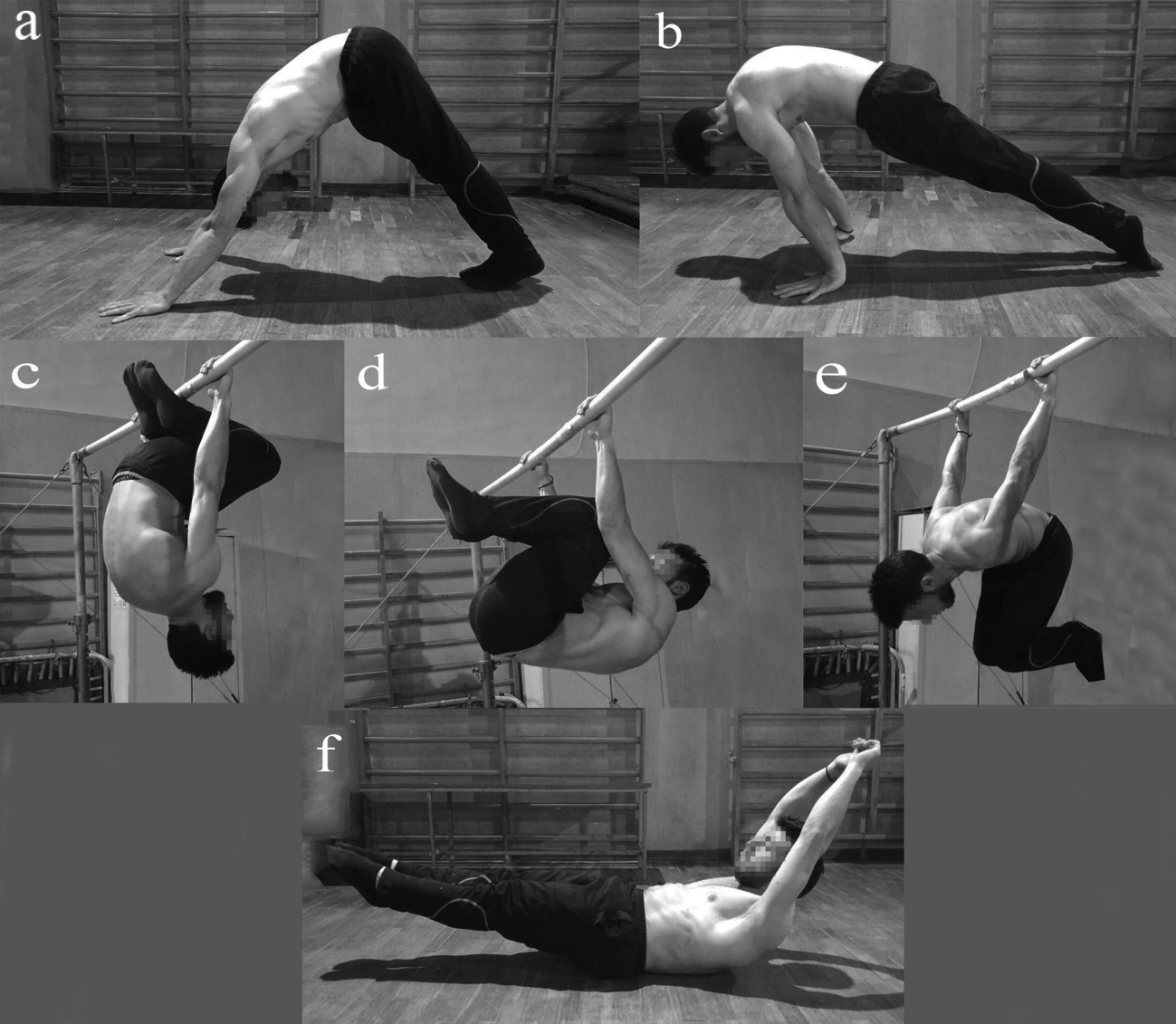
Descriptive statistics as means and standard deviations have been used to present data. Percentages have also been used to present differences between pre and post intervention. A paired t-test was used to analyze differences between pre and post intervention within groups. An unpaired t-test was used to analyze differences between groups when appropriate. Significance was set at
Results
Baseline measures are summarized in Table 2. The posturographic assessment showed a significant decrease of the length of the statokinesigram between pre and post measures (847.4
Post intervention measurements
Post intervention measurements
Data are presented as means
Length of the statokinesigram for both groups. A significative improvement is shown between SG pre vs. SG post for the OE and the CE tasks (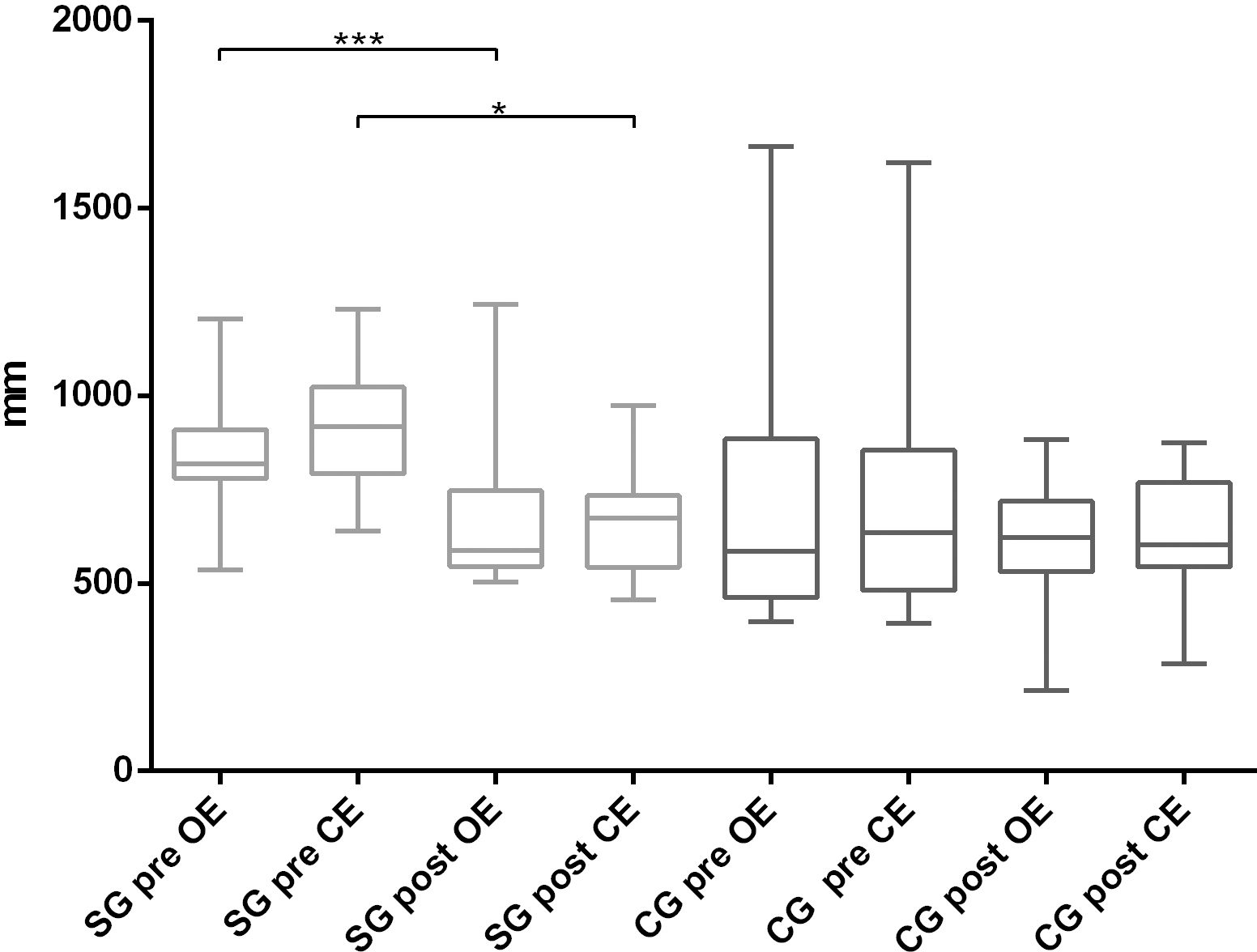
No differences were shown in the Hand-grip strength test for both the SG and CG in both hands. A significative improvement in both the push-up and pull-up tests was shown in the SG group (45.3
Repetitions of the push up-test. A significative improvement (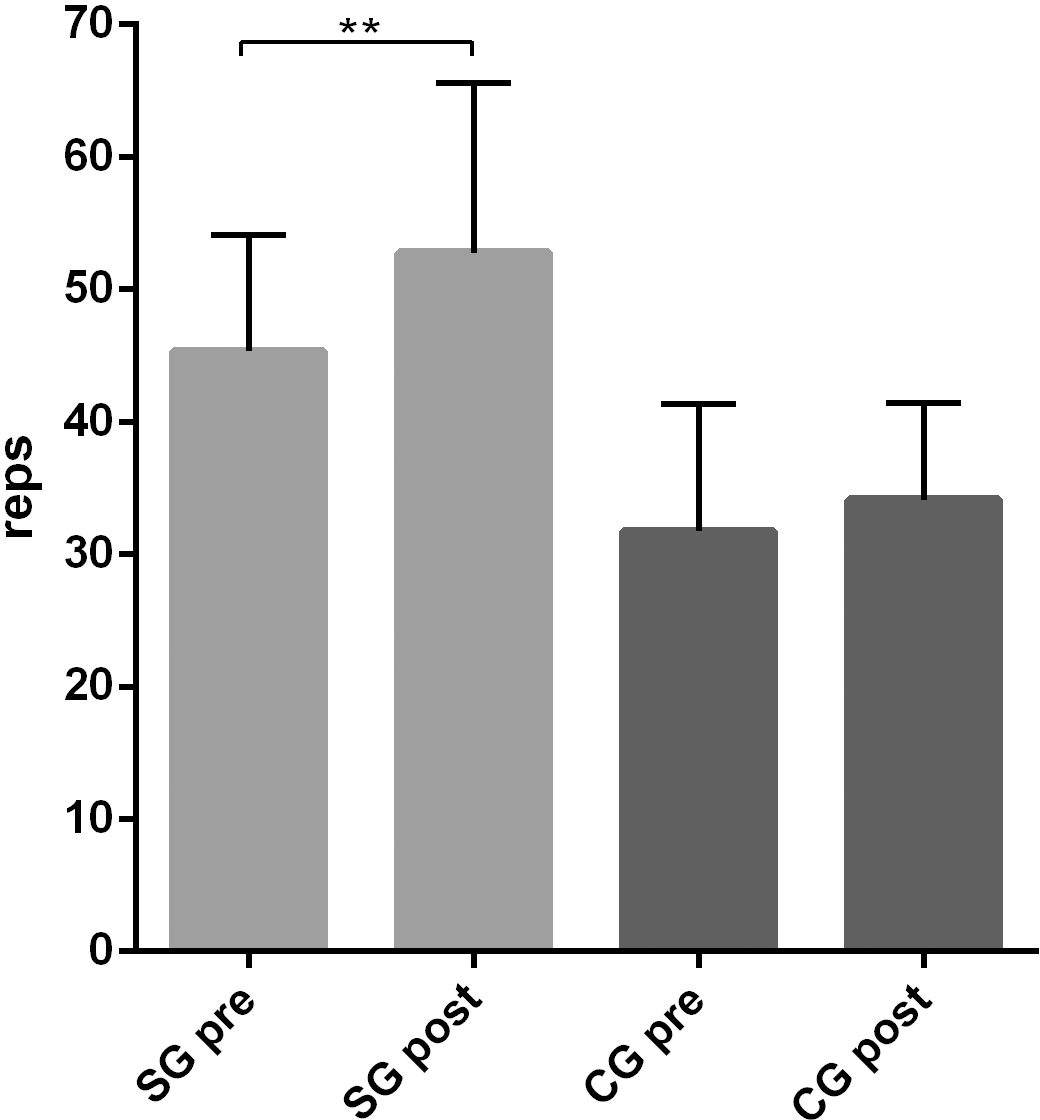
Repetitions of the pull up-test. A significative improvement (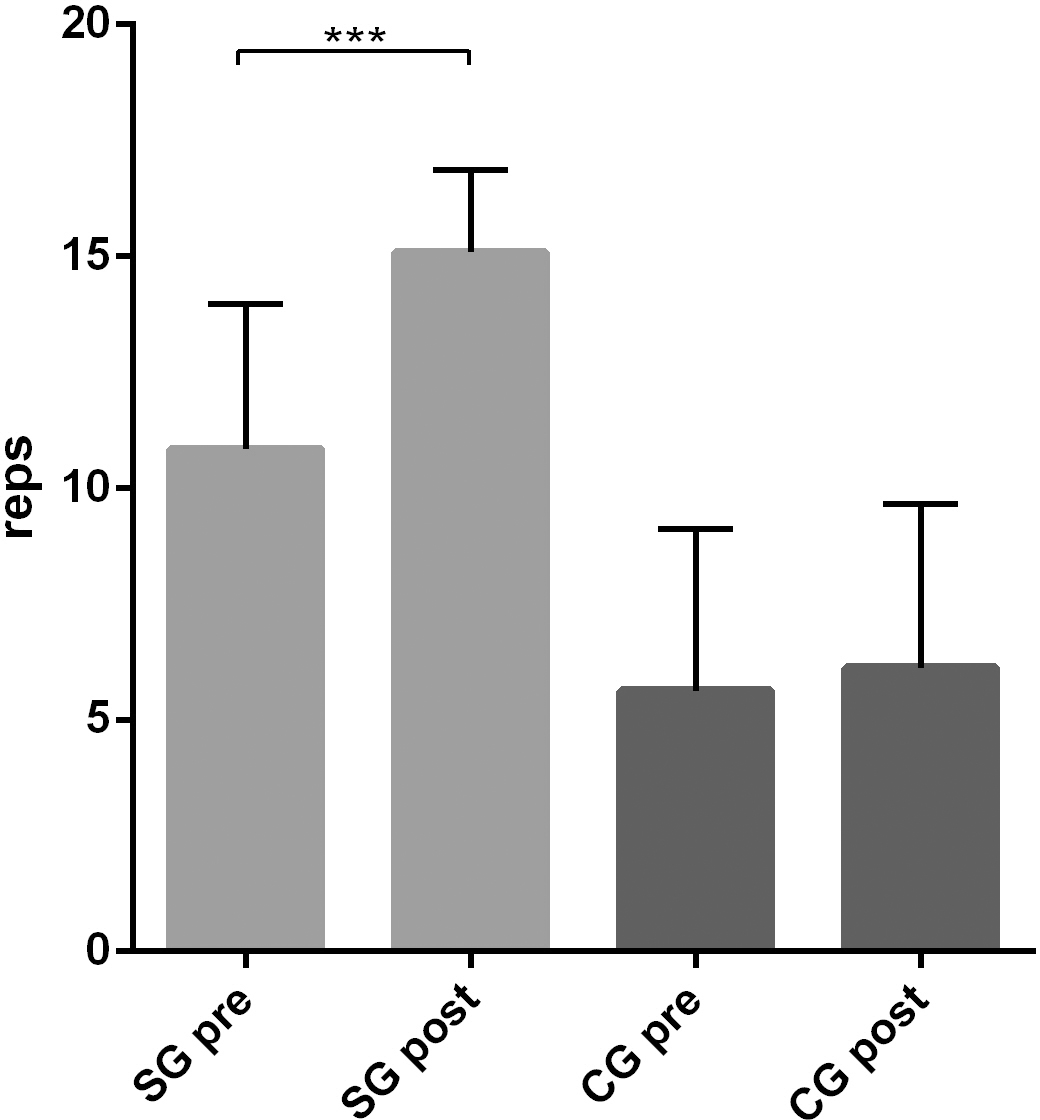
Percentage of body fat from the body composition analysis. A significative improvement (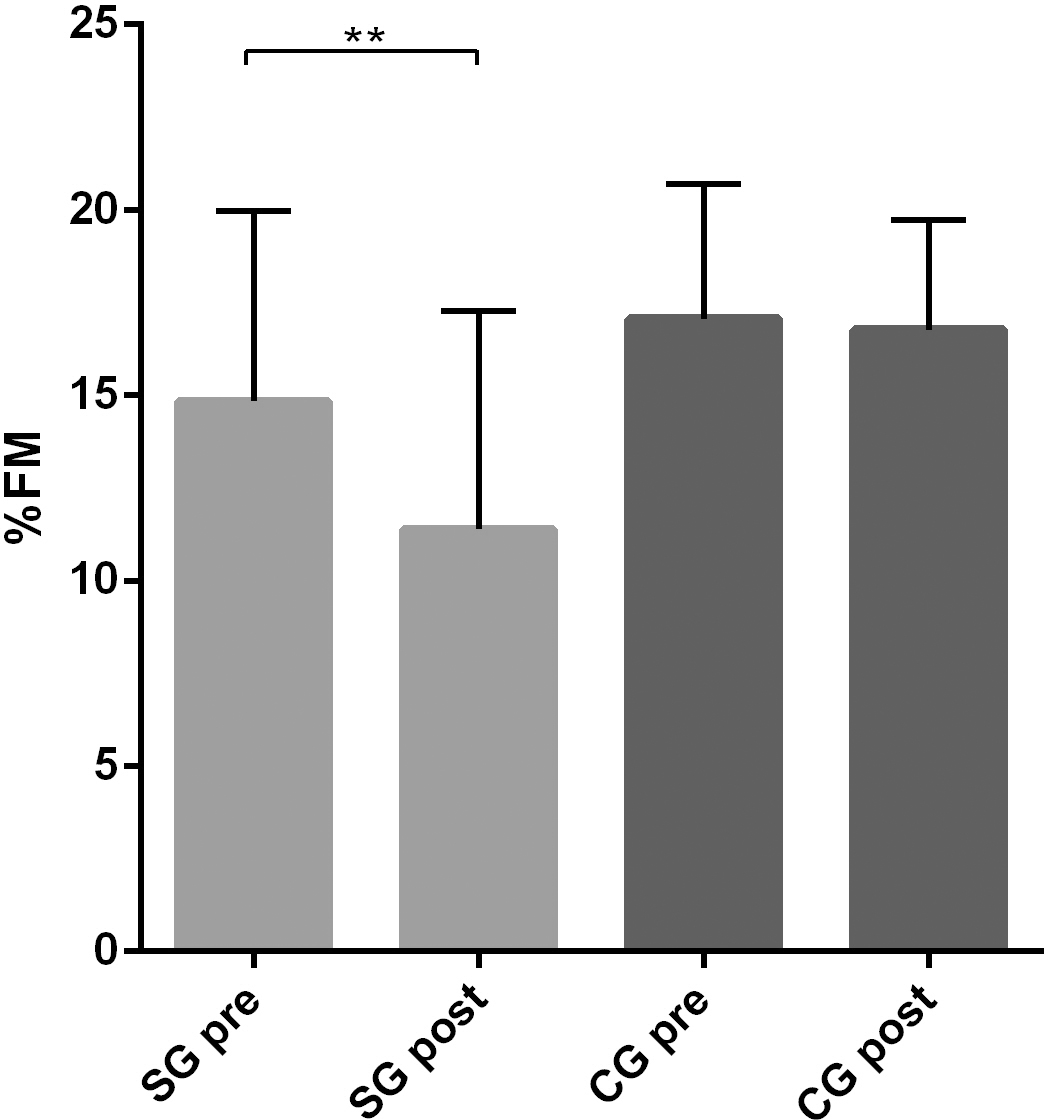
A decrease in fat mass was shown after the intervention period for the SG group (14.8
The aim of this study was to evaluate physical characteristics as strength, posture and body composition in untrained individuals after a calisthenics training intervention and our main results show a general improvement of physical features after the 8 week intervention.
The main improvement was found on the length of the statokinesigram, with a decrease from the baseline measures in both OE and CE tasks in the SG. The statokinesigram is a bidimensional representation of the foot base ground-reaction vector, known as CoP and is the result of the body sway of the frontal and sagittal planes on the horizontal plane [20]. Such decrease indicates a reduced body sway and therefore an increased postural control meaning the participants ware more stable [21]. Such improvement can be explained by the core training that the SG underwent. The hollow body position as a specific core exercise and the planche and front lever in a secondary manner (in both dynamic and static phases) target the core muscles that provide a stabilizing effect. Similar results were achieved by Bjerkefors et al. [22] after transversus abdominis training with and without body hollowing. The authors report an increase of the activation of the deep abdominal wall that has been described as a specific supporting and stabilizing muscle of the spine. An increase of the activation of the transversus abdominis also increases feedforward postural adjustments, thus leading to an improved motor control [23]. Other responsible mechanism could be the vestibular adaptation due to the inverted position maintained during the handstand-holds [24, 25]. The inverted stance position may be compared to vestibular rehabilitation training that is mainly based on head and eye movements [25]. An exercise that aims to improve proprioception and balance on hands may also be responsible for the postural improvements in an upright position. This could also explain the improvements achieved with CE, by the SG group, where the posture and the sway aren’t influenced by visual stimuli.
Other main improvements seen in the SG were the measures from the push-up and the pull-up tests with an increase of 16.4% and 39.2%, respectively, compared to the baseline measures. It is interesting to note that the participants did not specifically train these movements. However, the Planche exercises as seen in Fig. 1 (from 1a to b and back to 1a for the dynamic Planche and Fig. 1b for the static planche) have as target muscles the upper limbs (mainly the extensor musculature) with involvement of the deltoids during the lean phase, the triceps and the forearms during the whole movement and the pectoralis minor, the serratus anterior, the teres major, the teres minor and the trapezius during the protraction (in the lean phase of the movement) and the retraction during the returning phase. These muscles have been seen through electromiographic assessments to be involved during the push up exercise [26, 27]. Other muscles are also involved during the stabilizing part of the movement such us the erector spinae and the rectus abdominis.
The front lever exercises as seen in Fig. 1 (from 1c to d for the front lever pulls and Fig. 1b for the static front lever) have as target muscles the deltoids during the stabilizing phase of the movement, the latissimus dorsi, the biceps brachi and the brachioradialis during the concentric phase of the movement during the front lever pulls, the triceps during the static front lever and the pectoralis minor and the serratus anterior during the protraction of the scapulas. Other muscles are also involved during the stabilizing part of the movement such us the rectus abdominis and the erector spinae. These same muscles have been seen through electromiographic assessments to be activated during the pull-up exercise [28, 29, 30]. There is no doubt that notwithstanding the pushups and the pull ups were not specifically trained an increase in the endurance-strength of same muscles that are involved during those exercises will also be beneficial to improve general upper body strength. It has to be noted that the choice of the endurance tests was determined by the model provided by the calisthenics training. However, it has been previously reported that these tests, notwithstanding are a popular mean for the assessment of physical abilities, are related to problems in discriminating individuals at the low end of the scale. Many individuals across different studies have been seen to perform a 0 in such tests, with the weight of each participant being a limiting factor in the execution of the tests [31, 32, 33]. Although none of the tested participants scored a 0 at any test.
Notwithstanding the increase in pushups and pull ups, the results of the hand grip test did not show any improvement in either group. Probably, due to the nature of the test, 8 weeks are not enough to promote increases in such measure. However, the two groups showed similar measures, either at baseline and post-intervention, confirming that the outcomes of the hand-grip dynamometry are mainly age related [11, 34].
Other improvement shown by the SG was the reduction in fat mass from 14.8
Conclusions
Calisthenics is an effective physical activity for the improvement of postural sway, strength-endurance and has a positive effect on body composition, significantly reducing body fat mass. Such activity has been seen to elicit physical features in untrained individuals allowing all the participants to complete the training program. It can therefore be considered easy to practice and accessible to almost everyone. Adequate training facilities should be implemented to allow the diffusion of calisthenics as a form of physical fitness and well being.
Conflict of interest
The authors declare no conflicts of interest.
Funding/support
No financial support has been provided for the realization of this manuscript.