




Abstract
Machine learning techniques, especially deep learning, have achieved remarkable breakthroughs over the past decade. At present, machine learning applications are deployed in many fields. However, the outcomes of software engineering researches are not always easily utilized in the development and deployment of machine learning applications. The main reason for this difficulty is the many differences between machine learning applications and traditional information systems. Machine learning techniques are evolving rapidly, but face inherent technical and non-technical challenges that complicate their lifecycle activities. This review paper attempts to clarify the software engineering challenges for machine learning applications that either exist or potentially exist by conducting a systematic literature collection and by mapping the identified challenge topics to knowledge areas defined by the Software Engineering Body of Knowledge (Swebok).
Introduction
Software systems with intelligent components based on machine learning (ML) techniques have been widely developed and are now applied in various fields, such as electronic commerce, finance, manufacturing, healthcare, entertainment, and the automotive industry. These practical applications (ML applications) have been anchored by significant advances in ML techniques and software platforms for ML development. ML techniques have been copiously researched and published over a broad range of topics. In particular, the breakthrough in deep learning research is the driving force behind the advance of ML techniques. Many papers on deep learning techniques, including learning algorithms, performance improvement, evaluations, and applications, have been extensively published.
However, the systematic development, deployment and operation of ML applications faces major difficulties (e.g., [1, 2, 3, 18, 21]). The methodologies and tools of software engineering (SE) have greatly contributed to a wide range of activities in the lifecycles of traditional information systems, but are difficult to implement in ML application projects because ML applications and traditional software systems differ in fundamental ways. An ML application involves at least a computational model (an ML model) which is trained on some training data, and which processes additional data to make some inferences. The behavior of an ML model-based program depends on the training data, and is often unpredictable. This phenomenon introduces various uncertainties into the system’s outcomes [4, 5]. The lifecycle process of ML applications also differs from that of traditional software processes. Figure 1 is a simplified workflow diagram of a supervised ML application. The workflow comprises a requirements analysis, data-oriented works, model-oriented works, and DevOps works. The requirements analysis performs the data-analysis activities of the system requirements and the following data-oriented works. The data-oriented works include the data collection, data validation, data cleaning, and feature extraction. Model-oriented works cover the model design and construction, model training, evaluation, and optimization. Finally, the DevOps works cover activities such as model deployment, monitoring, control, and retraining. The workflow includes many feedback loops. Note that the model evaluation and monitoring may loop back to any of the previous works, and the model training may loop back to feature extraction.
A workflow example of supervised machine learning applications.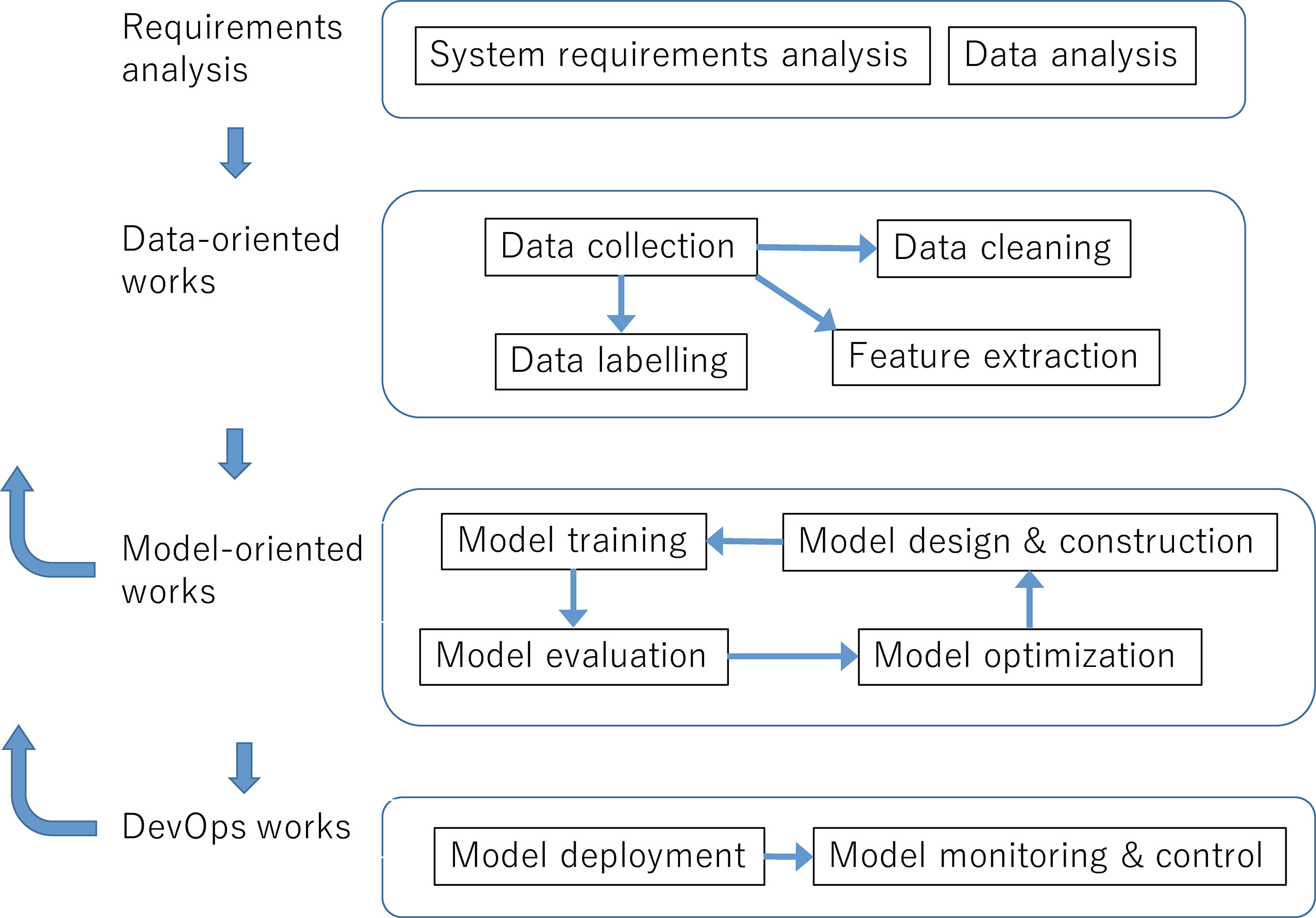
Machine learning algorithms, models and related techniques are rapidly evolving and new challenges are emerging. Such situations make software engineering practices for ML applications more difficult activities.
Given the various challenges in software engineering of ML, we surmise that SE challenges for ML applications cover a similarly wide range of topics. SE challenges for ML applications have been discussed in many papers [15, 16, 17, 18, 21], but to our knowledge, no survey paper has clarified the overview of SE challenges for ML applications, that is, what SE challenges have been discussed? and which SE research topics are closely related to each challenge?
The Software Engineering Body of Knowledge (Swebok) [6] classifies software engineering topics into knowledge areas. We presume that this comprehensive framework is helpful to seek answers to the following research questions.
RQ1: What SE challenges for ML applications have been discussed and potentially exist? RQ2: Which knowledge area is closely related to each of them?
Using the frequently appearing keywords in each Swebok knowledge area and ML-related keywords, we first performed a systematic paper collection. We reviewed the collected papers and mapped the challenge topics to Swebok knowledge areas.
This paper reports the preliminary results of our work. Section 2 provides a short description of Swebok. Section 3 introduces the research method, and Section 4 reports the research results. The paper concludes by discussing the limitations of this work in Section 5.
Swebok Version 3.0 [6] is the most recently published version of the body of knowledge for the field of software engineering. Its 15 knowledge areas (KAs) summarize basic concepts and include a reference list pointing to more detailed information. The KAs are listed below:
Chapter 1 Software Requirements Chapter 2 Software Design Chapter 3 Software Construction Chapter 4 Software Testing Chapter 5 Software Maintenance Chapter 6 Software Configuration Management Chapter 7 Software Engineering Management Chapter 8 Software Engineering Process Chapter 9 Software Engineering Models and Methods Chapter 10 Software Quality Chapter 11 Software Engineering Professional Pra- ctice Chapter 12 Software Engineering Economics Chapter 13 Computing Foundations Chapter 14 Mathematical Foundations Chapter 15 Engineering Foundations
To categorize SE challenges, we consider the KAs specific to software engineering (Chapters 1–12). We do not use the KAs of Chapters 13–15, because these are also the foundational KAs for other engineering fields.
Search keywords extracted from Swebok3.0 KAs
Search keywords extracted from Swebok3.0 KAs
Paper collection
A voluminous number of papers on machine learning and its applications have been published in many international conferences, journals and websites. This trend is continuing and may be accelerating. Researches on machine learning applications such as security, medical systems, and automated vehicles are interdisciplinary. Researches involving both ML and SE, which include a number of emerging topics, are also interdisciplinary. A literature search of specified conferences and journals on ML and SE failed to find adequate papers for our purpose; we thus designed a systematic paper collection based on the snowballing approach [7].
Start set
The first step generates search keywords from the frequently appearing keywords in each KA extracted by a text mining tool [8], excluding the foundational KAs (Chapters 13–15). The extracted keywords are listed in Table 1. Each keywords is the name of the corresponding KA except “Software Engineering Professional Practice” and “Software Engineering Economics”. We generate search keyword pairs to use the Google search engine by combining each keyword from Swebok with the ML-related keywords “machine learning”, “deep learning”, and “artificial intelligence”.
To construct the start set, we defined the following inclusion criteria for the selection of papers (websites) reported by the Google search.
Papers that discuss or report SE challenges for ML applications, and survey software engineering techniques (e.g., software testing) for ML applications. Papers published in journals, proceedings of international conferences, workshops, and technical reports (including arXiv), after 2000. The most recent version (if multiple versions have been published).
Additional papers were collected by searching with the frequently appearing keywords in the above collected papers. These keywords were “Model engineering”, “Automated Machine Learning”, “Metamorphic testing”, and “Technical Debt”.
We iteratively conducted backward and forward snowballing with the start set described in 3.1.1. By this process, we additionally collected the following papers:
Papers that overview the challenges of ML techniques. Survey papers on ML techniques. Papers that survey the challenges of ML applications.
The above inclusion criteria were necessary because we cannot discuss SE challenges without discussing the evolving ML techniques, growing application domains, and emerging ML challenges.
After reviewing the collected papers, we identified the challenge topics from the perspectives of SE and ML, and formed a relational map between the challenges and Swebok KAs. The image of relation map is shown in Fig. 2. Paper A describes the challenges related to the software requirements, design, and quality of ML applications. Paper B reviews challenges on some kinds of learning algorithms that impact the design and construction of ML applications. These challenges are related to Software Design and Software Construction. There are papers that surveys an application domain of machine learning such as security, medical systems, and automated vehicles. However, some of survey papers describing the specific challenges of the application domain and machine learning are outside of the SE perspective. Such papers were excluded from the mapping. The mapping and challenge topics in each KA will be detailed in Section 4.
The image of relation map.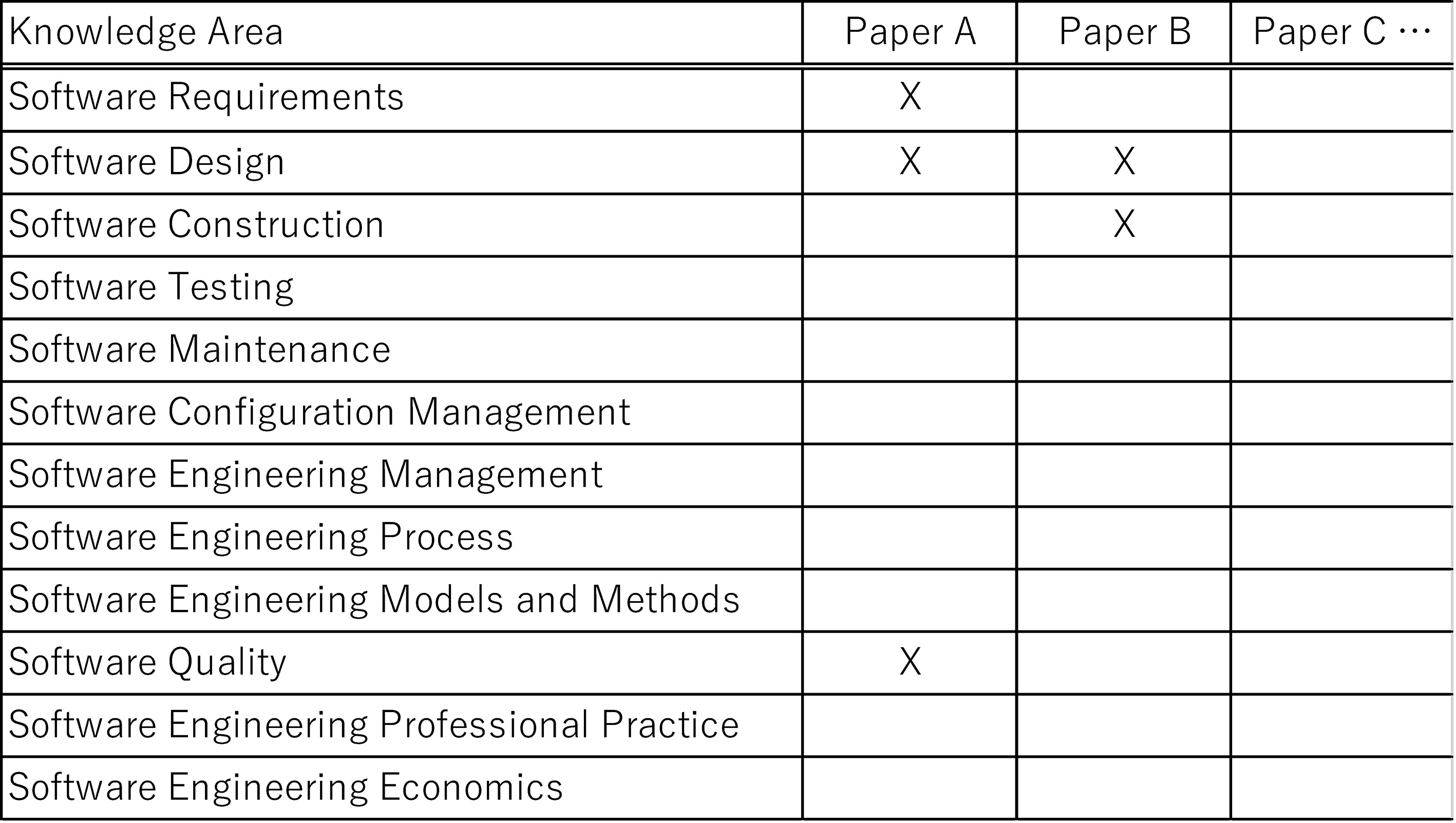
The inter-annual changes of the number of selected papers within the years 2000–2019.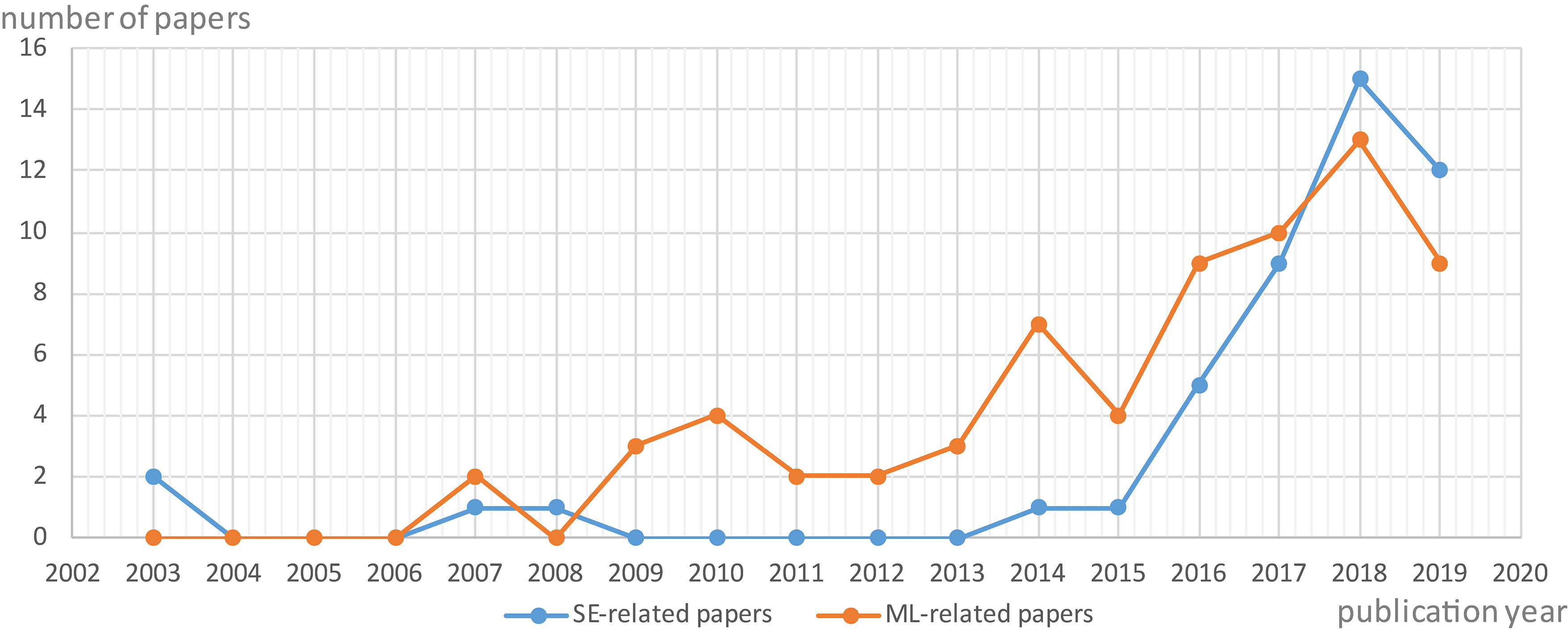
The literature search process in the previous section yielded 115 papers (see Table 2). SE-related papers refer to SE challenges or survey software engineering techniques (e.g., software testing) for ML applications. ML-related papers cover challenges on ML techniques, survey papers on ML techniques, and ML applications. In the first phase of the paper collection (Start Set), we selected 13 papers: 12 SE-related papers and one ML-related paper. The ML-related paper surveyed the verification and validation of ML-base systems in the automotive industry [20]. In the following phases (Iterations 1 and 2), we selected 35 SE-related papers and 67 ML-related papers. The number of ML-related papers was significantly increased (by 51 papers) after Iteration 2, because ML techniques anchor ML applications; accordingly, SE-related papers also refer to papers on ML techniques and challenges.
The numbers of selected papers
The numbers of selected papers
Figure 3 shows the inter-annual changes in the number of selected papers in the 2000–2019 period (where the papers in 2019 were published from January to September). Note that the selected papers do not address individual techniques. The first SE-related paper after 2000 was published by Senyard et al. [13] in 2003. Few papers were published from 2004 to 2014, but significantly more were published from 2015 onward. Meanwhile, the number of ML related-papers moderately increased from 2008. This increase suggests that SE practices and their challenges for ML applications have drawn attention from research communities and practitioners since 2015. These trends are consistent with the general trends of publications on secure deep learning research [19].
The number of mapping papers to each KA.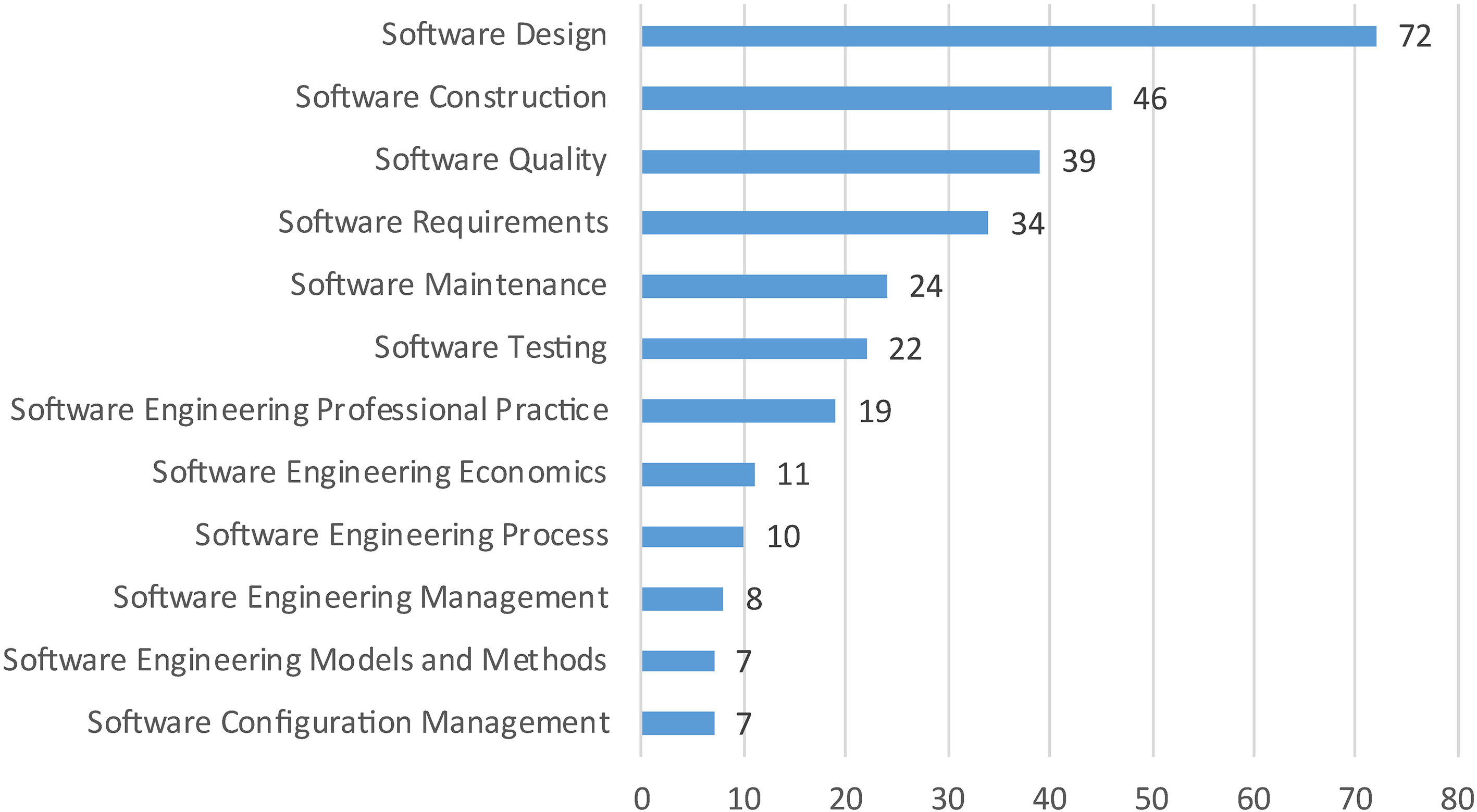
Figure 4 shows the number of papers related to each KA of Swebok. Among the 115 selected papers, 108 papers were related to KAs. Software Design was related to the most number of papers in the mapping process, followed by Software Construction. Various topics were related to Software Design and Software Construction, and many survey papers addressed the ML-specific techniques and challenges of these two KAs.
In the remainder of Section 4, we will briefly describe the KAs, quoting the definitions of Swebok3.0, then overview the challenge topics in each KA.
Definition by Swebok3.0
“The Software Requirements knowledge area (KA) is concerned with the elicitation, analysis, specification, and validation of software requirements as well as the management of requirements during the whole life cycle of the software product.”
Challenges
Software requirements activities for ML applications involve ML-specific activities, namely, data and feasibility analysis, requirements elicitation, requirement specifications, and validation of ML-functions and performances. These activities are difficult because the requirements may change frequently in large-scale systems such as automated vehicles, they are also very complex [59, 90]. Khalajzadeh et al. [25] points out “a need to better capture requirements, changes in the requirements, and adaptation of the specified process. …we want to better support domain expert end users in their requirements management for AI-based systems, providing approaches to capture their requirements not so much about the software solution but the domain problem, available data and business intelligence needed to solve it”. They identified a research direction in the development of tools that capture the requirements, changes in those requirements, and adaptations of specified processes.
ML techniques are widely used and are being integrated into mission critical systems; accordingly, safety, security and V&V (validation and verification) has become critical issues. Various topics on software requirements have been discussed [12, 13, 19, 20, 30, 32, 35, 47, 48, 49, 61, 82, 89, 90, 102, 103, 104, 106, 107, 119]. Develo- ping domain specific languages and tools for ML applications is a research direction for these challenges [12, 66]. Along with safety, the interpretability of ML applications has become hotly discussed. “What is interpretability?” and “How to realize it?” are widely discussed in artificial intelligence (AI) communities (e.g., [51, 3, 87, 104, 117, 119]). Interpretability as a property of software requirements has emerged with the progress of ML techniques and applications. Fairness is another emerging property [26, 118].
Requirement activities on data-oriented works have brought new challenges. Lwakatare et al. [15] and Kim et al. [40] reported the difficulty of specifying desirable datasets. Furthermore, the needs to preserve the privacy and safety of sensitive datasets and to ensure legal compliance with a new regulation such as the European General Data Protection Regulation may impact research directions in requirements engineering [18, 24, 60, 105].
Software design
Definition by Swebok3.0
“A software design (the result) describes the software architecture – that is, how software is decomposed and organized into components – and the interfaces between those components. It should also describe the components at a level of detail that enables their construction.”
Challenges
As noted in Fig. 4, many papers were related to the Software Design knowledge area. The selected papers were divided into the following categories:
Security, Safety and V&V: Design challenges for security, safety and V&V of ML applications [12, 13, 19, 20, 27, 30, 33, 35, 47, 48, 49, 61]. Software Structure: Challenges on the software structure of ML applications. This category includes the complex software modules of ML algorithms [14], anti-patterns in ML applications [17], and various design issues in ML models (model selection, customization and reuse) [16, 34, 58, 59]. Data Design: Design issues on data collection, pre-processing, cleaning, labeling and augmentation, including big data challenges [17, 23, 25, 26, 27, 31, 33, 41, 44, 74, 75, 76, 105, 114, 115, 116]. Visualization: Technical challenges on visualization techniques for the design of ML applications [25, 56, 63, 122, 123]. Tools: Needs of designing tools for ML applications, such as tools for non-expert ML designers, visualization tools for understanding the relationships between data and the behavior of algorithms, tools for ensuring interoperability with other tools, and domain-specific language (DSL) support [16, 25, 42, 66]. User Interface: Challenges on user interface design such as the interaction between users and ML applications [93, 94, 95, 96]. Automated ML (Auto ML): The design and construction of well-performed ML models is time consuming, requires a significant amount of resources and highly specialized experts. These demands have hindered the development of ML applications in industry. Automated machine learning (AutoML) is a new research topic that aims to resolve this problem [29, 54, 55, 64, 78, 109, 113]. ML techniques (except AutoML): Brodley et al. [71] argued that application-driven research begets novel ML techniques. The contrary can also be true; that is, the challenges and solutions on ML techniques such as data processing (e.g., feature extraction) [62, 70, 124], ML algorithms/ models (e.g., transfer learning) [43, 68, 69, 79, 80, 86, 97, 101, 110, 111, 112, 116], and specific ML functions (e.g., interpretability) [32, 104, 105, 121] can influence the structure and implementation of ML applications.
Definition by Swebok3.0
“The term software construction refers to the detailed creation of working software through a combination of coding, verification, unit testing, integration testing, and debugging. The Software Construction knowledge area (KA) is linked to all the other KAs, but it is most strongly linked to Software Design and Software Testing because the software construction process involves significant software design and testing.”
Challenges
As mentioned above, the Software Construction KA is strongly linked to the Software Design and Software Testing KAs. When selecting papers relevant to this KA, we focused on the link between design and construction. Selected papers for this KA are also related to the Software Design KA (except Islam et al. [28], who reported the challenges facing the use of ML libraries). On the contrary, some papers related to the Software Design KA were not related to the Software Construction KA [12, 13, 19, 20]. These papers did not discuss the challenges of constructing ML applications, but their topics were potentially closely related to construction challenges.
Software testing
Definition by Swebok3.0
“Software testing consists of the dynamic verification that a program provides expected behaviors on a finite set of test cases, suitably selected from the usually infinite execution domain.”
Challenges
ML testing has drawn significant attention within the research and industrial communities because it is both important and difficult. Many researches on ML testing have been published, but many challenges remain and still emerging.
We identified ML testing challenges in the following type of papers:
Research papers on ML testing which also discuss challenges on testing [11, 45, 50, 77]. Survey papers on the security, safety or V&V for ML applications [12, 19, 30, 48, 107, 119]. Survey papers on the data or model management for ML applications [23, 26, 27]. Papers discussing the SE challenges for ML applications [17, 18, 21, 59, 83] or the challenges in an application domain [90].
The various challenge topics on ML testing are listed below:
Oracle Problem: How to make reliable test oracles with less human intervention for ML applications. Cost Reduction: Cost reduction techniques of ML testing, including the cost reduction of traditional methodologies such as search-based test-case generation, test prioritization, and test-case minimization. Testing ML techniques: Many of current researches focus on supervised learning. There are challenging issues on testing other ML mechanisms such as unsupervised learning, reinforce learning, transfer learning and meta-learning. Testing Properties: Testing of ML specific properties such as overfitting, interpretability and fairness. Benchmarks: The design and construction of reusable testing assets for ML applications. Testing Data: Testing for data validation and data cleaning. For designing secure ML applications, adversarial testing on the training data and data testing to detect privacy violations can be challenging issues. Mutation Testing: The design and embedding of mutants to improve simulations of real-world ML bugs.
Definition by Swebok3.0
“In this Guide, software maintenance is defined as the totality of activities required to provide cost-effective support to software. Activities are performed during the pre-delivery stage as well as during the post-delivery stage. Pre-delivery activities include planning for post-delivery operations, maintainability, and logistics determination for transition activities. Post-delivery activities include software modification, training, and operating or interfacing to a help desk.”
Challenges
In real-world ML applications, uncertain events might occur in the deployment phase. The environment of production ML might largely differ from the environment the ML models were trained and evaluated. In a ML applications, the ML models may be frequently retrained with concept drifts and thus change behavior autonomously in unintended ways. These situations can pose various maintenance challenges of ML applications:
Troubleshooting: Identifying problems, diagnosing the root causes and influences of failures, and correcting faults (debugging) in the deployment phase. Automatic recovery from failures includes reconfigurations and code repairs [10, 15, 16, 17, 18, 19, 35, 36, 37, 42, 83]. Runtime Monitoring: Selection of the metrics used for monitoring, live monitoring of system behavior that allows automated responses without direct human intervention, and dynamic monitoring for runtime verification and certification [17, 19, 24, 30, 47, 48]. Data Management: Tools for data dependencies, automatic data validation and cleaning during runtime, and concept drift adaptation [17, 23, 60, 69]. Model Management: Challenge topics on ML model management in the deployment phase, including model validation, decisions on model retraining, adversarial settings, and backwards compatibility of trained models. The governance issues in model management also fit within this category [27, 34]. Operating Environment: In ML applications, the deployment phase will most likely add new functional modules to the existing system. In the deployment and operation phases, the platform and infrastructure of the ML application might greatly differ from the training and evaluation environment of the ML model. These differences pose compatibility, portability and scalability challenges [24, 59, 107].
Definition by Swebok3.0
“Software configuration management (SCM) is a supporting-software life cycle process that benefits project management, development and maintenance activities, quality assurance activities, as well as the customers and users of the end product.”
Challenges
To operate real-world ML applications, the complex data configuration management is indispensable as well as the software configuration management. Amershi et al. [16] points “machine learning is all about data. The amount of effort and rigor it takes to discover source, manage, and version data is inherently more complex and different than doing the same with software code.” A large-scale ML application involves a wide range of configurable objects such as the models and their options, the data and the pre- or post-processing of data [17]. As mentioned in 4.5, there are challenges on ML model management and governance [18, 27, 34, 65, 88]. Configuration management tools for ML applications should be designed in consideration of the above properties and challenges.
Software engineering management
Definition by Swebok3.0
“Software engineering management can be defined as the application of management activities – planning, coordinating, measuring, monitoring, controlling, and reporting – to ensure that software products and software engineering services are delivered efficiently, effectively, and to the benefit of stakeholders.”
Challenges
This KA is concerned with topics on the software engineering project management. We selected 8 papers which include the topics and identified the following challenge issues:
Risk Management: Risk management of the development, deployment and operation of ML applications is critical, but is rendered difficult by various uncertainties [17, 24]. Effort Estimation: Estimating the effort of an ML project is challenging because it is difficult to know to what extent the ML model will achieve its goal, and to estimate how many iterations will be needed to reach the state in which the performance gets acceptable levels [18, 83]. Corporate Compliance: In a real-world ML application project for a company, the development, deployment and operation may be severely affected by the effort of complying with the privacy policy of the organization and the legal framework. These demands impose challenges from both technical and management perspectives [16, 34, 60, 107].
Definition by Swebok3.0
“In this knowledge area (KA), software engineering processes are concerned with work activities accomplished by software engineers to develop, maintain, and operate software, such as requirements, design, construction, testing, configuration management, and other software engineering processes.”
Challenges
We identified 10 papers which includes the topics on software process of ML applications. The software development lifecycle for non-ML applications is inadequate for ML applications because of the lack of consideration for data-oriented and model-oriented works including their lifecycle managements. Khomh et al. [21] posed two questions: “How should software development teams integrate the AI model lifecycle (training, testing, deploying, evolving, and so on) into their software process?” and “What new roles, artifacts, and activities come into play, and how do they tie into existing agile or DevOps processes?”
Several software processes for ML applications have been proposed [13, 19, 30, 67, 88, 89]. Amershi et al. [16] discussed the process maturity model for building ML applications. Tool support for the development process can be a further challenge issue. Patel et al. [38] argues that “it is clear that non-expert tools need to support the entire exploratory and iterative process of applying statistical machine learning algorithms.” Ishikawa et al. [83] reported the difficulties to make customers better understand the properties of ML applications such as imperfections. Trial-based processes can address these difficulties, but further researches are needed to build a solid foundation for the engineering disciplines.
Software engineering models and methods
Definition by Swebok3.0
“Software engineering models and methods impose structure on software engineering with the goal of making that activity systematic, repeatable, and ultimately more success-oriented. Using models provides an approach to problem solving, a notation, and procedures for model construction and analysis. Methods provide an approach to the systematic specification, design, construction, test, and verification of the end-item software and associated work products.”
Challenges
To identify papers related to Software Engineering Models and Methods, we focused on formal methods and domain specific languages. Hains et al. [12] proposed research directions: Domain-specific languages (DSL) and tools for a formal specification, UML class diagrams for representing datasets, model-based testing tools and theorem-proving techniques. Portugal et al. [66] briefly surveyed DSL for machine learning in Big Data. They reported “no DSL was found that targeted the expression of systems requirements”. The remaining papers related to this KA also discussed the challenges on the formal approach of ML techniques [13, 47, 48, 49, 102].
Software quality
Definition by Swebok3.0
The Swebok Guide asks “What is software quality, and why is it so important that it is included in many knowledge areas (KAs) of the SWEBOK Guide?” Actually, software quality is an umbrella term for multiple facets. It refers to whether the software products possess the desired characteristics, the extent to which a software product possesses those characteristics, and the processes, tools, and techniques by which the developer achieves those characteristics. Throughout its history, the term software quality has been differently defined by researchers and organizations. The Software Quality KA provides definitions and “the practices, tools, and techniques for defining software quality and for appraising the state of software quality during development, maintenance, and deployment.”
Challenges
The Software Quality KA broadly covers topics on software quality. The software quality challenges in ML applications also embrace various topics. The representative challenge is software testing, which is excluded here because it was discussed in Section 4.4. The other challenge topics in software quality are listed below:
Quality Assurance: Software quality assurance is “a set of activities that define and assess the adequacy of software processes.” It confirms that the software processes can complete the target task and that the software products fulfil their intended purposes [6]. Some papers have discussed the question “What is the adequate quality assurance for ML applications? and how to perform it?” [13, 19, 21, 30, 61, 81, 82, 85, 89, 90, 102]. Validation & Verification: V&V is the integral part of software quality assurance for ML applications. Many papers addressed technical challenges of V&V for ML applications [13, 30, 47, 48, 49, 90, 102, 119]. Fault Analysis: Trouble shooting issues of ML applications such as fault characterization, detection and elimination [10, 22, 36, 37, 122] (see also 4.5). Component Quality: Training data, ML models and ML platforms (e.g. scikit-learn [125], Tensor flow [126], Weka [127]) is the key components of ML applications. The challenges on the quality of each components have been discussed. The challenge issues on data quality for ML applications includes data anomaly [23], imbalanced or biased data, encrypted data [60], data evaluation/cleaning [39, 40, 41, 74, 114, 115], novelty detection [31]. The quality of ML model and ML platform are mainly discussed in the context of testing (see Section 4.5). Quality Measurement: Breck et al. [45] suggested a quality measure of ML applications. They proposed a test scoring method to measure the production readiness of a given ML application. Quality measurement for ML applications is closely related to system safety. Varshney et al. [103] discussed the definition of safety from the view of reduction or minimization of risk and epistemic uncertainty associated with unwanted outcomes that are severe enough to be seen as harmful. The measures for risk and uncertainty of ML applications can also become safety measures. Corbett-Davies et al. [118] proposed a measure for evaluating fairness of ML applications. Safety and Security: Mission critical systems in some domains are strongly required safety and security. There are industry standards which address safety or security such as DO-178 [128], ISO26262 and ASIL [129] and Common Criteria [130]. How to conform ML applications to these standards is difficult but important challenges to realize mission critical ML applications in industry [20, 30, 35, 61, 82, 90, 119]. Ethics and Regulations: The ethics of ML applications relate to issues on safety, privacy and discrimination [20, 24, 49, 59, 103, 106]. Ethical topics should be included in quality evaluations of ML applications. Some papers have discussed the impact of regulations on the development/deploy- ment of ML applications [20, 24, 49, 87, 103, 105]. The imposed regulations will also affect the quality of ML applications.
Definition by Swebok3.0
“The Software Engineering Professional Practice knowledge area (KA) is concerned with the knowledge, skills, and attitudes that software engineers must possess to practice software engineering in a professional, responsible, and ethical manner.”
Challenges
The lifecycle process of ML applications includes wide range of works such as data analysis, data pre-processing, data cleaning, ML model design and construction, system deployment and operations (e.g. monitoring, debugging and retraining). The skills needed for these works may go far beyond the scope of traditional software engineering. Developing the skill set for ML applications is the major challenge related to this KA [15, 16, 27, 32, 39, 40, 59]. The other topics related to this KA were identified as follows:
Group Dynamics and Psychology: To construct and efficiently deploy a high-performance ML application, various stakeholders with different knowledge sets, skills and cultures should participate in the project. The main challenges in this category are collaboration to ensure a successful project and adequate communication with customers [17, 18, 21, 27, 40, 59, 83]. Economic Impacts: The business impact of real-world ML applications is a crucial factor. ML applications engineers should possess the techniques and skills to analyze the business impacts (see also Section 4.12). Ethics and Regulations: The ethics and regulation of ML applications also relate to the professionalism of ML applications engineers (see Section 4.10).
Definition by Swebok3.0
“This knowledge area (KA) provides an overview on software engineering economics. Economics is the study of value, costs, resources, and their relationship in a given context or situation. In the discipline of software engineering, activities have costs, but the resulting software itself has economic attributes as well. Software engineering economics provides a way to study the attributes of software and software processes in a systematic way that relates them to economic measures.”
Challenges
Software engineering economics is crucial for read-world ML applications in industry. Besides economic topics, this KA covers risk and uncertainty management. However, very few of our collected papers discussed the challenges related to this KA. These challenges can be divided into two categories:
Risk and Uncertainty management: Technical debts which may result in maintenance cost escalation [17]. Other challenges in this category are project risk estimation [24, 107], and difficulties in estimating the effort arising from uncertainties in ML applications [18, 83, 92]. Economic Impact: Lucas et al. [60] reported the difficulties of translating ML results into real business impacts. Most of the performance metrics on ML techniques are not easily understood by customers, who are expected to be unfamiliar with ML techniques. Therefore, customers cannot easily translate metrics such as accuracy into relevant key performance indicators such as revenue. Dahlmeier [84] highlighted challenges that make it difficult to translate the results into impactful innovation in natural language processing (NLP) research. They pointed out “lack of value focus” in the current NLP researches. The same problem may exist in ML researches. As another research priorities, Russell et al. [49]discussed optimizing AI’s economic impact which includes labor market forecasting, market disruptions through the use of AI techniques and policy for managing adverse effects.
In this review, we attempted to broadly outline the SE challenges for ML applications by a systematic review and mapping them to knowledge areas (KAs) in Swebok3.0. As the result, 115 papers were selected by our systematic collection. Among them, 108 papers were mapped to KAs of Swebok. The remaining seven papers surveyed ML applications of some specific domain such as robotics [91, 98, 99, 100], medical systems [46], networking [72] and machine translation [120]. They mainly discussed on domain specific challenges; their challenges and solutions may be potentially related to software engineering activities for such domain applications.
The broad range of challenge topics were extracted through the mapping. They were related to several KAs. In particular, safety, security and V&V for ML applications are major challenge topics over several KAs. We also identified challenge topics for engineering practice such as ethic and regulations, economic impacts and risk managements.
The research method designed for our purpose is based on the existing systematic methods [7, 9]. This paper reports the results of two iterations of the snowballing approach for paper collection. We believe that the collection result is comprehensive to some extent, but that more iterations would provide more comprehensive results. Note that even the most comprehensive collection would provide only a snapshot because related papers are published daily. In our backward and forward snowballings, the additional papers to include were selected by one researcher. The relation mapping was also conducted by the same researcher. To achieve more objective and persuasive conclusions, multiple persons must review, select and map the included papers. Threats to the validity of this method must also be carefully discussed.
Although the current results are preliminary and subjected to the above limitations, we expect that they will help to elucidate the whole aspect of SE challenges for ML applications.
Footnotes
Acknowledgments
This work was supported by JSPS KAKENHI Grant Number JP19K03011.