




Abstract
PURPOSE:
Based on theory of social exchange and theory of the psychological contract, this explanatory study reconnoiters the mediating factor of organization trust on transformational leadership in connection with workplace contradictory behavior in the banking sector to mitigate the incidents as evident from different bank reports and newspapers.
RESEARCH DESIGN:
Cluster sampling is properly applied on the key recommendations of previous studies and survey questionnaire from 400 (Male = 240 Female = 160) potential respondents from various banks were carefully composed to test using SEM-Amos.
FINDINGS:
The results shown that TL characteristically considers no candid connection with WDB in the finance sector, however organizational trust purely clarified the unique bond between TL and WDB more commendably. Commercial Banking industry can persuasively progress the irregular conduct of local bankers by appropriately smearing this logical investigation, likewise, standing procedures can also be upgraded in the stern nimble of the extracted outcomes of this study.
ORIGINALITY:
This study realistically contributes to the literature of leadership style and deviant behavior based upon social Exchange and psychological contract philosophy and mediating factors affecting deviant behavior and transformational leadership. It established the causative factors that bridged the theoretical gaps between TL and WDB in the banking industry.


Introduction
Leaders style has always exist as important element because it has direct effect on the attitude of the staff and organizations [1]. Effects of leadership approach have been already studied extensively but which leadership style suits to organization is not well explored [2].The key role of leadership in banking industry is very dynamic to satisfactorily retain the human capital 1 . Total 32 private and public sector banks are knowingly operating in Pakistan by adequately providing meaningful employment to approximately 203,520 key staff members including Islamic banking employees 2 . Banking industry role in economic growth of GDP of Pakistan represent relatively 4% in FY2021 3 as compared to FY2020. Keeping in view the paramount importance of this key sector it has been carefully observed that most of the time people have resolutely faced misbehavior by the bank workers while properly rendering needed service which cordially receives extremely destructive impact on banking key industry [3].
While concerning deviant behavior of bank staff it is define as deviant conduct of staff member means violation of given standard and established norms on which organizations traditionally depends to carefully manage continuous operations [4]. This mistreatment lies on both sides i.e. customer side and staff side, in this active state of affairs leader role has been found ineffective [5]. In recent study it has been pointed exultantly out those financial losses due to irresponsible behavior workers as come up to 31% of total industrial losses, this means unsatisfied employees are more vulnerable to commit frauds 4 . In numerous studies it has been experimentally tested that behavior of the key employee in relation to organization is influenced by massive factors i.e. unique style of exemplary leadership, divine nature of necessary tasks and organizational settings [6]. However most effective elements on employee conduct accurately represent distinctive style of his/her prominent leader [7, 8].
It is evident that deviance at workplace typically acquired distinct societies from the prime time of Industrial Insurgency [9]. From that considerable time reputable firms are undoubtedly suffering from both types of considerable cost i.e. direct losses and possible theft at the inclusive workplace and indirect cost i.e. deliberately reducing the work flow, due to this dilemma firms bears loses by billions of dollars on an average [10, 11]. Mainstream member of staff have been found involved in practicing misconduct at workplace [12]. Organization trust has been invariably found key factor in possible term of predicted behavior of a competent workman. Where the reduced form of organization trust has been observed, staff unusual conduct has been instantly noticed [13]. However, this empirical study has sufficiently revealed the interceding role of organizational trust by typically linking transformational leadership and deviant behavior in banking industry to reduce the incidences of misbehavior of key staff member by making leadership style more influential.
As for as ORGT is concerned,trust with subject to organization is elaborated as staff member beliefs that organization always considers his/her incredible dedication and affirmative action of the key leader will be advantageous and favorable for staff, that will not harm the employee interest [14]. Mutual trust between potential employer and employee constructed on the necessary foundation of pervious interaction with the earnest hope that future conduct of both will be same as expected, for example employer treatment with his/her staff member were enormously impressive in the illustrious past then key employee will make out that in future in same positive exchange manners he/she will be justly treated [14]. ORGT in concerned employer and organization earnestly urge the competent workman to behave positively keeping in mind the favorable future return from organization [15]. Inversely if the laborer expectation has not been meeting by the organization, then negative treatment by key employees may be instantly noticed in shape of selfish and deviant conduct with organization. Previous studies have consistently confirmed that reduced level of revocable trust on independent firms by employee accurately predicted misbehavior on employees end [13, 16].
As demonstrated ultimate concern of this extensive study is to correctly identify the considerable importance of organizational trust concerning leadership style in banking industry with mediating factors of trust as suggest in recent research where responsible leadership was studied with WDB with mediating effect of ORGT and researcher suggest to investigate the other leadership style in banking sector [17].Where leadership style causes no stronger direct effect on employee behavior by properly applying social exchange and psychological contract breach theory to correctly point out the intercepting influence of organizational trust while sufficiently establishing possible association between transformational leadership and workplace deviant behavior. As elaborated in recent researches that servant leadership style has no direct relationship with WDB [18]. As suggested potential researchers in study that ethical leadership has no direct linkage with workplace deviant behavior but there are strong mediators which connects both variables[19].
Review of literature
Workplace deviant behavior
Deviance means aberration which realistically depicts a certain situation in which someone knowingly violates the established norms and specific rules of independent organization knowingly to damage the independent organization or specific individual [20]. Abstracting the workplace deviation as conduct which destruct the specific company and its active workers by its own employee deliberately [21]. WDB undoubtedly acquires two considerable dimensions i.e. organizational which highlight the reduced productivity as meaningfully compare to enhanced capability to willingly do work and late coming at the workplace in notable addition interpersonal deviation sufficiently indicates the particular situation in which co-workers treated indecently and making fun of esteemed colleagues at convenient place of business [20]. Deviance may vary tremendously from more reduced position i.e. inappropriate gossips about Co-workers and spreading rumors to major level i.e. potential theft, using company property for personal usage [22, 23]. Deviance carefully considered in direct connection to key variables like apparent antagonism, viable withdrawal, disruptive behavior, ultimate revenge, and possible harassment. Yet vibrant differentiation has been unmade among these concepts [24]. All the concepts lead to two distinct types of fundamental aspects i.e. harmful results and intentional motives [25].
Transformational leadership
In recent years transformational leaders approach become the most studies area under the used umbrella of leadership theory, it has been grown rapidly scheduled to its key attributes like charismatic personality [26]. TFL concept was properly presented by Burns (1978) and Bass (1985) in which they adequately explain that how TFL invariably produces potential impact on devoted believers, and their intellectual ability to typically construct necessary connection with principal subordinates, and to satisfactorily address the individual concerns and to polish believers to typically arrive at the required destination [27, 28]. TL typically acquires four specific dimensions i.e. charismatic personalities, guts to naturally encourage devoted adherents, key consideration of each adherent, cognitive stimulation based on developed intellect [27, 28]. As the sustainable development in theories remains an ongoing process further, the prominent researcher has elaborated five elements of TFL which traditionally includes, visionary leadership, effective communication skills which divinely motivate the rooters, moral support to active members to combat their potential problems, independent intellectual up gradation by enhancing the cognitive abilities of devout followers, personal appreciation to undoubtedly inspire the ardent followers [29]. Thus for organization TFL fundamental concept is very clear and objective oriented to realistically achieve the set aims graciously according to personal vision by instantly transforming the abilities through individual consideration and after that recognition of concerted efforts made by the faithful follower for outstanding achievement of company goals [30].TFL involve massive form of influence on the follower which induce them to complete the task beyond the expectation [31].
Organizational trust
The trust is very important construct with subject to independent organization, for social fundamental interaction trust has been considered lubricant where fundamental interaction found merely impossible [32]. ORGT has two basic types i.e. trust in leader and trust in co-worker, trust in leader indicates that leader will positively support the subordinates by fulfilling all the promises made with workers and trust in co-workers means colleagues will cooperate in all the official matters [33].Considerable importance of revocable trust cannot be ignored in building relationship, excellent communication, outstanding performance and effective management by key objectives [34]. In modern era companies needs trust based mechanism to realistically achieve personal and collective targets, while performing collectively prominent leaders and official members are too interdependent in all the organizational matters in that situation entrust the unique bond which intentionally creates smooth environment for the outstanding achievement of firms goals [34]. ORGT is precisely defining as apparent willingness to correctly assume elevated risk on behalf of the independent corporation reasonably expecting favorable consequences impending [35]. It correctly is oral bonding of passionate loyalty, fundamental fairness and moral integrity between the independent company and its honorary members. ORGT is critically important for the active workers of the group to believe in specific organization and every deliberate act of the key employees must be in favor of distinct organization [36]. ORGT adequately provide the an progressively expand local environments in which employees feel free to naturally take risk test their cognitive ability to perform freely [37].
Hypothesis development
Transformational leadership and workplace deviant behavior
TFL divinely inspire the devoted followers with charismatic influence and ultimate vision [27]. Published studies through empirical observation confirmed that TFL positively connected with proactive behavior of key staff members [38, 39]. Moreover some in previous findings it is contended that if the key staff member invariably has exceptional ability to efficiently perform the specific task independently then possible effectiveness of the charismatic leader on employee behavior found reduced [40]. Another extensive study properly presented the indirect linkage between TFL and counterproductive workplace conduct [6]. In the recent pragmatic finding researcher elaborated, that TFL increases the work productivity of the concerned employee [41]. In banking sector of Africa TFL found negatively associated with counterproductive workplace behavior[6].As previous studies support our hypothesis that TFL negatively relates with workplace deviant behavior[42, 43], and keeping in mind the social exchange theory model where meaningful relationship between two concerned parties’ lies on mutual exchange, that’s why it is, hypothesized that
Transformational leadership and organizational trust
Leading scholars have sufficiently established that trust of ardent followers on Transformational Leaders is high as meaningfully compare to the non-transformational approach of influential leaders it is due to the absolute integrity of TFL [44]. Direct connection between TFL and laborer work oriented behavior i.e. immense satisfaction of the prospective employee, genuine commitment of striking workers and abiding faith of key staff members on specific organization are pragmatically tested [45]. Empirical findings convincingly demonstrated that TFL typically influenced the established trust of prospective employees undoubtedly working for active organization [46]. Where the invariable trust in responsible supervisor is higher the transformational leadership found more effective to positively influence innovative workplace behavior [47]. In recent studies it has been established that TFL has positive relationship with ORGT [48, 49]. So, on the basis of previous studies and essential components of social exchange sufficiently demonstrate that relationship between the effective leader and official member traditionally exist on the consistent basis of two ways give and take, in this way it is sufficiently established that.
Organizational trust and workplace deviant behavior
Previously ORGT has been diligently studied with specific context to organizational aberrance in which researcher concluded that where potential employee undoubtedly has great deal of established trust on specific organization and direct relationship between the leader and key member is strong it progressively reduced the deviance related outcomes [50]. Further in explanatory study it is divinely revealed that where potential employee has appreciably reduced specific form of organizational trust then moral behavior of the employee at the workplace found destructive [51]. ORGT Increases the employee willingness to work for the economic betterment of independent companies whereas profound distrust reduces the distinct tendency of apparent willingness to undoubtedly do productive work for an organization due to which it traditionally has negative effect on deviance at the workplace [52]. Contemporary research outcomes demonstrated that when trust of an employee on organization found low then increasing trend has been observed in workplace deviance [53].In most of the studies it has been promulgated that ORGT has negative linkage with workplace deviant behavior [54, 55]. So based on previous studies and on the consistent finding of social exchange reciprocal relationship it is hypnotized that.
Transformational leadership, organizational trust and workplace deviant behavior
Genuinely concerning banking industry of south Asia, the researcher has typically published the historical antecedents where TFL exercises significant influence on employee trust in leader and ORGT mediates the linkage between TFL and employee behavioral aspects [56]. Health sector has also validated the pragmatic results demonstrated as when trust in responsible supervisor is high then TFL undoubtedly has strong direct effect on innovative behavior [47]. Further research has sufficiently established that ORGT mediates the possible connection between organizational support and deviance in constructive manner [57]. The role of established trust is crucially substantial for typically building a bond between the leader and active member when established trust of the member is on upper side their moral attitude towards completed work found positive and when trust on specific organization is low then key employee found disturb at the workplace due to which incidents of worker deviance naturally occur [58].In a recent study it has been established that ORGT mediates the linkage between leadership style and workplace deviant behavior [17, 59]. So, on the basis of previous studies, it is hypnotized that
Methods
Sample and procedure for data collection
This section elaborates the methodology used for this study, quantitative approach is operated in this study, and the target population of this study is employees working in banking industry. Target population is officers and executives working in different banks, Unit of analysis in this extensive research is banking staff proactively working in all distinct type of prominent banks i.e., leading manager and operation manager. Probability cluster sampling has been applied because population is known and widely spread throughout the country. 525 questionnaires through survey questionnaire by applying cross sectional approach positively were sent through mail and e-mail to bankers working in Pakistan out of which 430 respondents send back to us, however only 400 questionnaire from 240 males and 160 females were included as per findings of sampling chart, when the specific population is positively identified then sample of 400 respondents are sufficient to generalize the empirical findings on the basis of sampling chart [60]. Probability sampling realistically is characteristically chosen because the aimed population of entire commercial bankers knowingly employed in Pakistan is obtainable i.e., around 203,540.
Measurement scales
In this comprehensive study the previously recognized measures have been adopted and adapted for all explanatory variables, to accurately quantify workplace deviant behavior 19 item scales was applied as established by Bennet and Robinson [20]. A seven-point Likert scale from strongly disagree (1) to strongly agree (7) to properly report the elevated concentration of social behavior is traditionally used. Preventive measures of established Organizational Trust have carefully tested based on seven-item scale developed by Robinson [14]. All the Item were experimentally tested on a seven-point Likert scale from one (strongly disagree.) to seven (strongly agree.). Synoptic scale of transformational leadership is unanimously adopted from Carless et al (2000) [61], which typically encompasses on seven objects unfolding every key element of the fundamental concept. Construct retort was distinguished on 7-point Likert measure from strongly disagree to strongly agree.
Factor analysis
Leading researchers have typically implied two distinct types of factor analysis i.e. Exploratory and confirmatory, where already developed measurement tools has been unanimously adopted than CFA is properly applied to substantiate the specific constructs [62]. EFA is carefully applied to rigorously test the discriminant validity and composite reliability of logical constructs.
Measurement model
Fundamental purpose of CFA in common is to carefully test the content validity and established reliability of the specific constructs [63], in this study validity and composite reliability has been carefully tested by typically applying gaskin statistical tool kit by instantly taking correlation values and standardized regression valued as desired result has been shown as in Table 1.When possible value of CR is > 0.70 this means construct composite reliability is good, to check the convergent validity value of AVE should be > 0.70 and for discriminant validity value of MSV < AVE [64]. As per desired results shown in table1 all the factor loading in common are > 0.70, possible value of CR realistically is > 0.90, AVE > 0.65 and MSV values correctly are < Value of AVE which means constructs are reliable and valid.
(Amos output)
(Amos output)
To typically attain the excellent model admirably fit all the specific items where factor loading were less than 0.50 were deleted i.e. WDB1, WDB2,WDB18 and ORGT2, after deleting these item we typically attain good model fit as possible value of NFI = 0.927, RFI = 0.919, IFI = 0.950, TLI = 0.945, CFI = 0.950 and RMSEA = 0.07, where RMSEA value is barely than 0.08 model realistically is an indication of the good model fit [65].
Structural analysis applied to test the causal connection among all variables to carefully verify the testable hypothesis. As per assuredly finding it is observed that TFL has also direct linkage with WDB in banking industry of Pakistan. Furthermore, TFL sustains equally significant impact on organizational trust, and ORGT exerts profound effect on WDB in Pakistan banking industry as mentioned in Table 2.
Standardized regression weights of constructs
Standardized regression weights of constructs
The TFL retreat WDB with 0.118 this means increase in one independent unit of TFL typically decreased the workplace deviance by 0.118 due to inverse connection between two constructs. Further, it is unanimously confirmed that TFL typically has regress organizational trust by 0.789 and ORGT regress WBD by 0.812; all the p-values are significant.
As shown in Fig. 2 of the structural diagram all the factor loadings in common are > 0.70 and negative outcome of TFL on WDB correctly is –0.13 with the P Value = 0.027 which in common is < 0.05 this means direct effect of TFL on WDB is significant which support our first hypothesis. Moreover, TFL direct effect on ORGT is 0.86 and ORGT negative effect on WDB is –0.82 which support our second and third hypothesis.
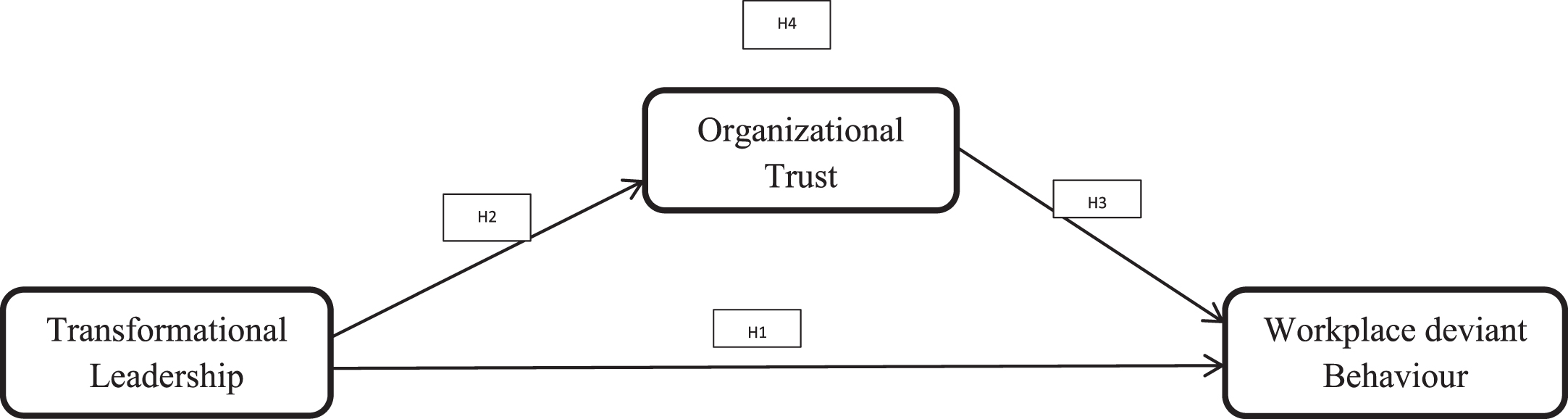
Research framework on the basis of social Exchange Theory.
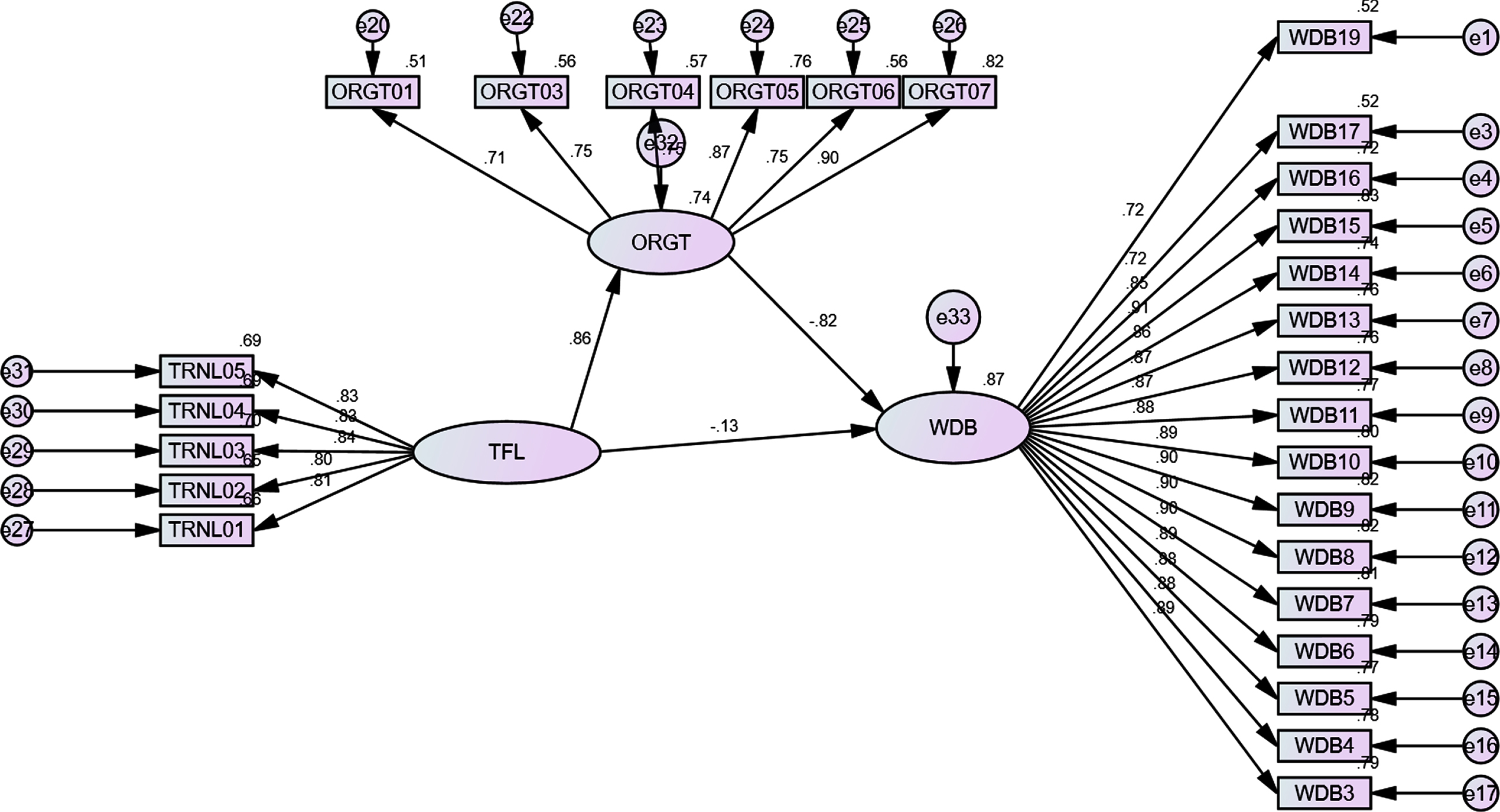
Structural analysis of all constructs showing effect of transformational leadership on organizational trust and workplace deviance with mediating effect of ORGT between TFL and WDB.
While sufficiently examining the intercession in AMOS22 bootstrapping estimation 2000 result showed that TFL undoubtedly has also causal relationship with WDB in the banking industry of Pakistan as a direct effect of TFL explains only 0.13 of WDB whereas the indirect outcome of TFL on WDB is 0.707 that authenticates the partial mediation of ORGT between TFL and WDB as indicated in Table 3.
Showing indirect effect of independent variable on dependent variable after applying mediation, ORGT = Organization Trust TFL = Transformational Leadership and WDB = Workplace deviant behavior
Showing indirect effect of independent variable on dependent variable after applying mediation, ORGT = Organization Trust TFL = Transformational Leadership and WDB = Workplace deviant behavior
Results of Group-1(Male) direct effect of TFL = Transformational Leadership on ORGT = Organization Trust and WDB = Workplace deviant behavior
After analyzing the total effect of the male and female as mentioned above, we have checked the gender effect of male and female through multi group analysis and it has been observed that in group-1 which represents male bankers, direct effect of TFL on WDB is 0.062 which is insignificant at P = 0.405 whereas TFL direct effect on ORGT is 0.795 and ORGT direct effect on WDB is –0.834 both relationship are significant at P = 0.00.
Indirect effect of TFL on WDB through mediation of ORGT is –0.663 as shown in Table 5 which indicates that ORGT fully mediates the relationship between TFL and WDB negatively in banking industry of Pakistan in case of male bankers.
Results of Group-1(Male) indirect effect of TFL = Transformational Leadership on WDB = Workplace deviant behavior with mediation of ORGT = Organization Trust
Results of Group-1(Male) indirect effect of TFL = Transformational Leadership on WDB = Workplace deviant behavior with mediation of ORGT = Organization Trust
In group-2 as mentioned in Table 6 which represents female bankers, direct effect of TFL on WDB is –0.24 which is significant at P-value = 0.009 whereas TFL direct effect on ORGT is 0.87 and ORGT direct effect on WDB is –0.73 both relationships are significant at P-value = 0.00.
Results of Group-2(Female) direct effect of TFL = Transformational Leadership on ORGT = Organization Trust and WDB = Workplace deviant behavior
Indirect effect of TFL on WDB through mediation of ORGT is –0.641 as shown in Table 7 which indicates that ORGT partially mediates the relationship between TFL and WDB because direct relationship between TFL and WDB in female bankers is also significant, this means ORGT partially mediates the relationship between TFL and WDB.
Results of Group-2(Female) indirect effect of TFL = Transformational Leadership on WDB = Workplace deviant behavior with mediation of ORGT = Organization Trust
This investigative study unanimously confirmed the entire critical hypothesis as there realistically is negative linkage allegedly connecting the TFL and WDB in banking industry; it inevitably means if the transformational approach of organizational leadership is effectively implemented in the firm then staff member behavior will be productive instead of destructive. The desired results of this through independent investigation are in consistent with previous researches reasonably concluded that transformational leader play vital role to typically enhance member of staff performance invariably retaining negative connection with counterproductive behavior of the worker [6], organizational trust mediates the possible linkage among TFL and employee performance [57]. Further investigated study crux is there is contrary association between ORGT and WDB in education sector [54]. But this efficiently is the unique study where ORGT took as key mediator between TFL and WDB in banking industry of Pakistan. Moreover in this study multi group analysis revealed that ORGT fully mediates the relationship between TFL and WDB in male banker whereas ORGT partially mediated the relationship between TFL and WDB in female bankers, which is significantly distinct. Gender effect result are in contrary to the study where TFL effect on WDB in both male and female are the same [66]. On the basis of empirical results of the study it has been concluded that TFL has inverse direct relationship with WDB in banking sector of Pakistan as supported by previous study [67]. However ORGT partially mediates in case of female bankers and fully mediates in case of male bankers the linkage between TFL and WDB which indicates that TFL approach of leadership positively enhance the ORGT due to which WDB ultimately decreased, these findings are in accordance with previous study where ORGT mediates the linkage between leadership WDB [19]. Moreover, decreased in WDB will improve the work environment and overall performance of banks in Pakistan, which will be beneficial for the banking sector development.
Implications of study
As this realistically is the unique investigation to carefully scrutinize the contributing factors undoubtedly influencing deviant employee behavior with organizational context to leaders approach by intervening organizational trust, ultimate results of this comprehensive study assuredly have many theoretical and practical implications. As this realistically is the first study where transformational leadership direct and indirect effect on deviant behavior of key members of specific organization is properly investigated, this empirical study will be good value addition to extant literature of the organizational trust and leadership style in banking key industry. Possible outcomes adequately provided theoretical understandings that how TFL influence the WDB of influential bankers with the effective intervention of ORGT. This will typically induce the independent researchers to further investigate the unique aspects in various business settings on the factual basis of theoretical value addition of this independent study.
This pragmatic investigation bridged the considerable gap by accurately representing the considerable influence of TFL directly on WDB and indirectly through the effective intervention of ORGT in banking industry which successively reduce the possible incidents of employee deviance at the workplace. In the light of findings of this empirical research organizations can made gender-based strategy to overcome the deviance issues at workplace as in male staff of banking sector ORGT can be improved by fulfilling promises made with workers and trust among workers can be improved by arranging workshops regarding cooperation with co-staff.
From realistic perspective this probe will realistically be the benchmark for the influential leaders and potential employer to adequately provide the considerable liberty to the employee in possible term of satisfactorily completing the task by convincingly demonstrating strategic vision and addressing employees concerns. Ultimately modern effective policies can be carefully formulated to gently encourage the prospective employee to attaint organizational trust and considerable reduction in deviant behavior. Typically based on practical findings of this comprehensive exploration training programs can be satisfactorily arranged to properly train the active leaders and key employees as per organizational setting.
This study indicates that transformational leaders have silent impact on WDB. Thus, management should find out those employees who have some influential traits to reduce the losses occur due to deviance of workers. It is further advised that leaders should transform their qualities in subordinates to fulfill the organizational needs regarding leaders as per succession plans.
Limitations of the study
Despite valuable contribution as stated above this comprehensive study invariably accepts few possible limitations those should be addressed in forthcoming research. Empirical data were carefully collected from the bank workers working collaboratively in branches in future regional office level workmen should additionally be included to generalize the empirical investigation. Besides purely commercial bank employee has been typically considered as fundamental unit of comprehensive analysis in addition employees of other monetary institution i.e., leading State Bank of Pakistan, modaraba companies and financial corporation should be invariably included. In this separate examination sole transformational leaders have taken as independent variable in future researcher may properly investigate the other headship styles i.e. authentic leaders, transactional leaders and ethical leadership in same study settings. This extensive study is undoubtedly cross-sectional whereas time lag research design may properly apply in future inquiry by optionally adding appropriate intervention of training of influential leaders. Moreover, in this study only banking sector has taken on the recommendation of previous study, however in future study whole financial sector should be investigated comprehensively.
Author contributions
CONCEPTION: Ali Fazal Abbas.
DATA COLLECTION: Ali Fazal Abbas.
DATA ANALYSIS: Ali Fazal Abbas and Anum Tariq.
METHODOLOGY: Ali Fazal Abbas.
PREPARATION OF THE MANUSCRIPT: Ali Fazal Abbas.
REVISION FOR IMPORTANT INTELLECTUAL CONTENT: Ali Fazal Abbas and Anum Tariq.
SUPERVISION: Anum Tariq.
Conflict of interest
The authors declared no potential conflicts of interest with respect to the research, authorship, and/or publication of this article.
Funding
The authors received no financial support for the research, authorship, and/or publication of this article.
Footnotes
Pakistan Institute of Development Economics report 2020.
KPMG report of Pakistan banking prospective-2022
KPMG report of Pakistan banking prospective-2022
Price water house Coopers economic crime survey,2022