




Abstract
In the present study we set out to study the meaning of organizational context by investigating the direct and indirect effects of organizational context (indicated by structural factors and working conditions for managers) on managers’ and subordinates’ perceptions of leadership. A sample of 105 managers and 1126 subordinates participated in the study. Data consisted of self-reports in questionnaires (one for managers and one for subordinates) together with organizational data provided by HR and analyzed by means of a multilevel mediation analysis. The results indicate that managers that have better working conditions are also better equipped to engage in positive transformational leadership behaviors. In addition, the results also indicate that when managers put in extra effort to be visible in the organization their followers are more likely to assess them as transformational and trustworthy.
Keywords
Introduction
Line managers are of special interest in leadership studies, as they act between the organization’s operational and strategic levels. At the strategic level, ideas, plans and visions are developed, whereas at the operational level, different occupational groups carry out the core activities of the organization. This means that line managers must be able to understand and translate the logics of the strategic levels and communicate core work practices from employees at the operational level back to the strategic level. In this respect, contextual factors linked to prerequisites for communication and working conditions for line managers, such as the size of the work group they lead, access to resources, and opportunities for dialogue with higher management, could be argued to be important for their ability to contribute to organizational functioning (Björk and Härenstam, 2016). In this respect, when striving for healthy and effective operations, the context of leadership behavior—specifically that of line managers—is an important aspect to consider.
It has been argued that the context of leadership behavior is a somewhat overlooked factor when considering the effects of leadership (Antonakis et al., 2003; Johns, 2024; Liden and Antonakis, 2009), or when it comes to understanding what circumstances affect leaders’ behaviors. Although there are a number of studies focusing on the impact of leadership on different outcomes, such as followers’ motivation and performance, it has been argued that no one specific leadership behavior is valid under all circumstances. On the contrary, leadership is enacted in a contextual setting and varies over situations. The idea of context has been acknowledged within leadership research—such as in Fiedler’s contingency theory (1978), in which the focus is directed towards contextual factors as moderators of the leadership behavior effects. Another approach is the situational leadership model (Hersey and Blanchard, 1969) where the focus is on leaders’ ability to adapt to different contexts. In both of these theories, contextual conditions are treated as moderators between leadership style and outcomes of leadership, assessed mainly at the employee level.
However, in this study, we focus on contextual factors as predictors of leadership behavior itself; as factors that facilitate or hinder managers’ abilities to act in organizations and influence how subordinates perceive their leaders. Consequently, we investigate two main issues in the present study. First, we investigate the direct effects of organizational context on how managers act, i.e., their leadership behavior. Evidence from previous research indicates that organizational structures and job characteristics will be of importance and affect leadership behavior and its outcomes (Johns, 2024; Oc, 2018). For example, it has been found that structural factors such as the organization’s level of horizontal, vertical, and spatial differentiation have an impact on the leader’s activities (Larsson and Hyllengren, 2013; Scharf and Berntson, 2025; Wallin et al., 2014). Additionally, organizational prerequisites for managerial work, such as task complexity and time pressure, have been found to be salient for leadership behavior (Oc, 2018).
Second, we investigate the direct and indirect effects of organizational context on subordinates’ perceptions of leadership behavior: i.e., how organizational context is associated with subordinates’ perceptions of leadership and the mediating role of leadership behavior, as assessed by the leaders themselves. In previous studies, evidence has been found for an association between organizational context factors—e.g., span of control—and perceptions of leadership (Lundmark et al., 2020). Moreover, research indicates a relationship between leadership enactment and followers’ perceptions of transformational leadership behavior (Tepper et al., 2018).
In summary, it could be argued that contextual factors—both structural factors and work characteristics—are associated with both managers’ and subordinates’ perceptions of leadership, but transformational leadership behaviors, such as being present and involving subordinates in decision-making processes, may also be related to subordinates’ perceptions of their managers’ leadership.
The organizational context
Contextual aspects, defined as the “situational opportunities and constraints that affect the occurrence and meaning of organizational behavior” (Johns, 2006: 386), have been argued to be vital in order to understand individual behavior in organizations. In Gary Johns’ (2006) article on the meaning of context in organizations, he differentiates between omnibus and discrete contexts. An “omnibus context” refers to the general context in which organizations operate. It is a way of describing the setting or the arena of an organization—Johns (2006) refers to the why, the who, the where, and the when of the organization. Considering such environmental factors, general societal trends, along with macro-economic factors, are taken into account to better understand the environment in which an organization operates (Oc, 2018).
The discrete context, on the other hand, is related to the meso-level factors that influence organizational behavior. Studies involving the discrete context consequently focus on organizational characteristics that matter for individuals. Johns (2006) refers to three subdimensions of the discrete context—task, social, and physical context. Task context refers to those organizational characteristics that constitute work, and are exemplified by autonomy, uncertainty, accountability, and resources. Autonomy reflects to what extent an individual or organization has the opportunity to act flexibly within organizational boundaries. Uncertainty, on the other hand, refers to role clarity; or to what extent clarity exists regarding organizational goals and boundaries. Accountability reflects whether actions and decisions made in an organization bear legitimate grounds, and resources refers to what extent individuals in an organization have the right resources to fulfil their goals (Johns, 2006).
The social context is concerned with social dynamics within an organization and what this means for the individuals in it. The social environment could be argued to both pose constraints to and offer opportunities for communication within an organization. Johns (2006) emphasizes three subcomponents, such as social density, which refers to where people are located in the organization; and social structure, which refers to the composition of the group in terms of age, gender, and status. The third subcomponent referred to is social influence, which is a way of describing the meaning of norms and types of communication within an organization. Finally, the third component of the discrete context is the physical context, which refers to the importance of office environment, considering factors like lighting, temperature, and office design. In the present study, we focus on task and social context. While physical factors may be of great importance in various field settings, the managers in the present study primarily work in an office environment, where such factors may have little impact on leadership behaviors.
Leadership behaviors
Research on leadership has focused on ideal leadership behaviors for a long time. One of the most influential theories in this respect emphasizes transformational leadership as beneficial. Transformational leadership is identified as the process through which leaders influence individual and organizational performance beyond expectations (Bass and Riggio, 2006), and can be described by its four dimensions. Idealized influence means that leaders act as role models, and their behaviors and values affect the behaviors and attitudes of their followers. Inspirational motivation reflects how leaders inspire their followers with their vision, whereas intellectual stimulation reflects how leaders challenge and support their followers’ ideas. Individualized consideration reflects leaders’ attention to their followers and their presence in the operation. Transformational leadership behaviors are suggested to engage, inspire, and influence employees to grow as individuals, and it has been suggested that transformational leadership behaviors are related to follower motivation and job satisfaction (Judge and Piccolo, 2004), organizational commitment (Wang et al., 2011), performance (DeGroot et al., 2000), role models (Judge and Piccolo, 2004; Knies et al., 2016; Wang et al., 2011), safety behaviors (Clarke, 2013), intention to leave the organization (Engelbrecht and Samuel, 2019), and well-being (Inceglou et al., 2018; Nielsen et al., 2008; Tafvelin et al., 2018).
Transformational, as opposed to more traditional leadership behaviors, means that leaders are suggested to act as role models with a focus on the individuals in the group, challenging and listening to what their followers have to say. In the present study, we investigate leadership from both managerial and subordinate perspectives. When asking managers about their leadership behaviors, we focus on two specific aspects of transformational leadership: their visibility and presence in the organization, as well as to what extent they foster participation in decision-making processes and the organization of work. In addition, we ask managers about their tendency to relieve their subordinates of high workload and about taking on tasks that should be done by the subordinates themselves. This third leadership behavior could be argued to be more negative in nature: both for the managers themselves, as they increase their workload, and for subordinates, as it decreases their autonomy at work. When asking subordinates, on the other hand, we have included a specific measure of transformational leadership (Carless et al., 2000), including both perceptions of leadership behaviors and the leader as a person. Moreover, we ask how subordinates perceive the trustworthiness of their manager. We include trust, since we believe that it is a relevant aspect of the leader–follower relationship, and previous research has emphasized that trust is an important mechanism in allowing transformational leadership to occur (cf. Browning, 2014; Le and Lei, 2018).
Contextualizing leadership
In previous research, it has been argued that contextual aspects in leadership studies have been understudied and are less prioritized than individual factors (Liden and Antonakis, 2009). This does not mean that it has not been in focus at all. For example, in Fiedler’s (1978) contingency model of leadership, the core idea is that situations moderate the effect of leadership behavior. Accordingly, the structure of tasks in a work group or role definitions (what managers can and cannot decide) influences the effects of leadership behaviors. The contingency model of leadership has received substantial criticism (Ayman and Adams, 2012), but it is one of the first models to introduce the meaning of context for managers in organizations. In 2009, a special issue in Human Relations focused on context in psychological leadership research (Liden and Antonakis, 2009), emphasizing, for example, the role of the group in leadership effectiveness (Williams et al., 2009) and the role of distance between the leader and group members for leadership outcomes (Cole et al., 2009). Further, in a systematic review from 2018, Burac Oc highlights a number of different contextual aspects that matter for leadership outcomes. Thus, task complexity, job autonomy, and social and spatial distance are emphasized as important aspects influencing the outcomes of leadership (Oc, 2018). In a recent article, Johns (2024) points out the lack of contextualized leadership studies, where specific factors determine the nature and effect of leadership in different contexts.
However, in these studies of leadership, context is primarily considered a moderating factor that influences the impact of leadership behavior. Less frequently, context is explored as an independent predictor of leadership behavior. In this respect, Larsson and Hyllengren (2013) studied the effects of contextual characteristics on developmental leadership. Drawing from interactionism (Endler and Magnusson, 1976), they argue that leadership behavior is dependent on a combination of individual characteristics and abilities and the context in which leaders operate. The contextual aspects are divided into three subcategories: the group context, organizational context, and the environmental context. In the group context, the authors emphasize how group constellation, norms, and cohesion are vital factors influencing leaders’ abilities to be developmental (Larsson and Hyllengren, 2013). The organizational context is argued to be manifested through horizontal, vertical, and spatial differentiation. In this respect, the organizational context, as described in Larsson and Hyllengren (2013), is close to Johns’ (2006) description of the discrete context, focusing on the task context (horizontal), the social context (vertical), and the physical context (spatial). The third subdimension of context, the environmental context, refers to the context in which the organization operates (compared to the omnibus context in Johns, 2006) highlighting economic, legal, social, and cultural aspects.
In addition, the importance of structural and working conditions for leadership behavior has been emphasized in a few empirical studies. In a study of healthcare managers, Lornudd et al. (2016) found that higher job demand levels were related to more vague leadership behaviors. In addition, Lundqvist (2013) found support for the relationship between social support and leadership behaviors among managers in a meta-analysis. Furthermore, previous research has found support for the association between span of control and managerial work, indicating that a larger span of control is associated with poorer working conditions for managers and more negative leadership behaviors (Lundmark et al., 2020; Wallin et al., 2014).
The present study
When investigating how context may affect leadership behaviors, organizational structures (such as span of control) as well as working conditions (such as demands and social support) seem to be of importance. However, this is primarily relevant when discussing how context matters for leaders’ assessment of their leadership behaviors. As managers and their subordinates have different assignments, tasks, authority, and social positions within the organization, the enactment of leadership is more relevant when investigating subordinates’ perceptions of leadership (Wang et al., 2019). Consequently, in the present study, we set out to investigate the effect of organizational context on leadership from both a managerial and a subordinate perspective, studying the direct and indirect effects of contextual factors on perceptions of leadership among both managers and subordinates.
Managers’ assessment of leadership behavior
When it comes to managers’ assessment of their possibilities to act as leaders, previous studies suggest that structural factors, along with working conditions, could predict leadership behaviors. Although research is scarce, previous results support the idea that factors like span of control are related to leadership behavior (Larsson and Hyllengren, 2013; Lundmark et al., 2020). In addition, vertical communication in the organization—for example, through regular meetings with higher management—has been suggested to be relevant (Björk and Härenstam, 2016; Larsson and Hyllengren, 2013). When it comes to work environmental factors, previous research has highlighted demands and support as possible predictors. According to the literature on specific demands for managers, factors such as organizational control deficits, conflicting logics, resource deficits, support from higher management, and support from colleagues seem to be relevant (Larsson and Hyllengren, 2013; Lundqvist, 2013; Oc, 2018; Wallin et al., 2014). Hence, our first research question is:
RQ1: Is there an association between organizational context (in terms of span of control, regular meetings with higher management, organizational control deficits, conflict of logics, resource deficits, support from higher management, and support from managerial colleagues) and leadership behaviors (in terms of present leadership behavior, relieving leadership behavior, and participative leadership behavior)?
Subordinates’ assessment of leadership behavior
As managers and subordinates have different positions in the organization, we argue that the organizational context may affect managers and their subordinates differently. While structural and working conditions related to the structure could be argued to primarily impact managers’ possibilities to enact their leadership, it is plausible that the organizational context indirectly affects subordinates’ perception of their managers’ leadership behavior. In this respect, we argue that the enacted leadership of managers may mediate the effect of organizational context on subordinates’ perception of leadership. This means that in the second part of this study, in addition to direct effects, we investigate the indirect effects of contextual factors on subordinates’ perception of leadership, but also how trust in the leader is perceived by the subordinates. Hence our second research question is:
RQ2: Is there an association between (a) organizational context (in terms of span of control, regular meetings with higher management, organizational control deficits, conflict of logics, resource deficits, support from higher management, and support from managerial colleagues) and subordinates’ perceptions of leadership behavior and trust in their manager? Is this association (b) mediated by managers’ enacted leadership behavior (indicated by their present leadership behavior, relieving leadership behavior, and participative leadership behavior)?
Methods
Procedure
Data in the present study were part of a larger research project (ORFiOS) investigating organizational prerequisites, working conditions, and leadership and individual outcomes such as health, performance, and mobility among managers and employees in a Swedish municipality. The municipality had approximately 80,000 residents and 7000 employees. Its organizational structure follows that of Swedish municipalities in general. It has eight different operations: municipal administration, childcare and education, labor market and welfare, culture, leisure and recreation, rescue services, technical services, urban planning and environment, and care. Two of the operations were significantly larger than the others (childcare and education and care), accounting for about 6000 employees. One operation, culture, had very few employees but also a quite large number of intermittent employees working during seasons or at specific events (these individuals were not included in the study). In addition, unlike many Swedish municipalities, the one in the present study was organized without a chief executive officer for the whole municipality. Rather, each operation was sorted directly under its respective governing committee. The director of the municipal administration was responsible for the coordination and governance of all operations.
Two web surveys were distributed in fall 2019; one to managers and one to employees. In total, a sample of 343 managers and 3955 employees were invited to participate in the study. In the sample, all managers were included, whereas a sample of employees were invited to participate in the study. The sub-sample of employees was formed due to two operations being much larger than the others (childcare and education, and care, comprising about 3000 employees each). In these two operations, a random sample of 30% of units were selected to be included in the study. The sampling was conducted by the research group. In the present study, we employed a multilevel analysis, meaning that only organizational units where both the manager and employees were invited to the study could be included. As a result, not all managers were eligible to participate in the present study, due to a sub-sample of managers not having employees who were invited. The final sample consisted of 105 managers and 1126 employees in 105 organizational units. The average number of individuals in the organizational units was 10.7.
Measures
In the study, variables were included reflecting context and leadership behavior for managers as well as perceptions of leadership behavior among subordinates.
Managerial context variables
The organizational context was measured with both external measures (where the information was reported by HR for each unit), and via self-reports from the managers. The external measures included span of control and regular meetings with management, whereas the self-reported measures included organizational control deficits, conflict of logics, resource deficits, support from higher management, and support from managerial colleagues. Span of control was indicated by a continuous variable, where higher levels indicated that a manager had responsibility for more employees (range: 5–48). Regular meetings with management indicated whether managers had regular vertical contact where their operations were discussed (dichotomous variable, 0 = no, 1= yes). Organizational control deficits indicated to what extent managers perceived that decisions made on a strategic level did not apply to their operations. It was measured with a three-item index (Eklöf et al., 2010). A sample item was “Decisions made on a higher level in the organization are difficult or impossible to carry out in my unit.” Conflict of logics indicated the conflict of different types of work tasks for managers. This was measured using a two-item index (Eklöf et al., 2010). A sample item was “There are conflicts between administrative tasks, developmental tasks, and employee-related tasks.” Resource deficits indicated to what extent managers perceived that they did not receive sufficient resources to attain their goals. It was measured with a three-item index (Eklöf et al., 2010). A sample item was “Your operation does not have sufficient resources due to decisions made by higher management, politicians, or other government agencies.” Support from higher management was measured with a three-item index (Eklöf et al., 2010), in which one example item was “I have good support from superiors when I need to discuss my operations.” Support from managerial colleagues was measured via a two-item index (Eklöf et al., 2010), where an example item was “I have good support from managerial colleagues, when I need it.” All items (on the scales pertaining to organizational control deficits, conflict of logics, resource deficits, support from higher management and support from managerial colleagues) were formulated as statements with the introduction “If you think of the last six months: how often does the following occur?” Responses were made on a five-point Likert scale, ranging from 1 (never/almost never) to 5 (always/almost always).
Leadership behavior assessed by the managers was measured with three indexes. All items were formulated as statements with the introduction “If you think of the last six months: how do you work as a manager?” Responses were scored on a five-point Likert scale, ranging from 1 (not true at all) to 5 (entirely true). Present leadership behavior was measured with a three-item index (Eklöf et al., 2010). A sample item was “I am available to my employees.” Relieving leadership behavior indicated to what extent managers relieved their employees from burdens and carried out assignments that were supposed to be conducted by the employees. It was measured with two items (Eklöf et al., 2010), and one sample item was “I carry out tasks that my employees should do but do not have time to.” Participative leadership behavior reflected to what extent managers actively tried to get their employees to participate in decision-making at work. It was measured via a three-item index (Eklöf et al., 2010), and a sample item was “I invite my employees to be part of decisions.”
Perception of leadership behavior (by subordinates) was measured with one index. Transformational leadership was measured with a seven-item index, the Global Transformational Leadership Scale (GTL) (Carless et al., 2000). Responses were scored according to a five-point Likert scale (1 = seldom/never to 5 = very often/always). One sample item was “How does your closest manager often act? . . . fosters trust, involvement and cooperation among team members.” In addition, we added another outcome to the assessment of trust in the leader, as this aspect should be closely related to transformational leadership. Personal trust was measured using a three-item index (Härenstam et al., 2024). Responses were made on a five-point Likert scale (1 = do not agree at all to 5 = completely agree). A sample item was “I have confidence in my immediate manager and in their way of leading the work.”
All items from the questionnaires are reported in Appendix A.
Analysis
The research questions were analyzed by means of multilevel analysis. The reason for using a multilevel analysis was that employees were nested into work units and consequently shared contexts with each other (Hox, 2010). Each manager and subordinate were tied to a specific work unit through a unit identifier. The multilevel analysis was carried out in Mplus 8.9 (Muthén and Muthén, 1998–2023). First, we investigated the nested structure in an empty model, investigating intra-class correlations (ICC(1)). Second, we specified a 2-2-1 multilevel mediation model, where organizational context factors (span of control, regular meetings with management, organizational control deficits, conflict of logics, resource deficits, support from higher management, and support from managerial colleagues) were specified as between-level predictors, leadership behaviors (present leadership behavior, relieving leadership behavior, and participative leadership behavior) as between-level mediators, and subordinates’ perceptions of leadership behaviors (transformational leadership and personal trust) as level one outcomes. Table 1 shows descriptives and correlations, and Table 2 and Figures 1 and 2 present results from the multilevel analysis.
Between-level correlations below the diagonal (N = 105) and within-level correlations above the diagonal (N = 1126). Descriptives for managers (variables 1–10; N = 105) and employees (variables 11–12; N = 1126). Cronbach’s alpha in the diagonal.
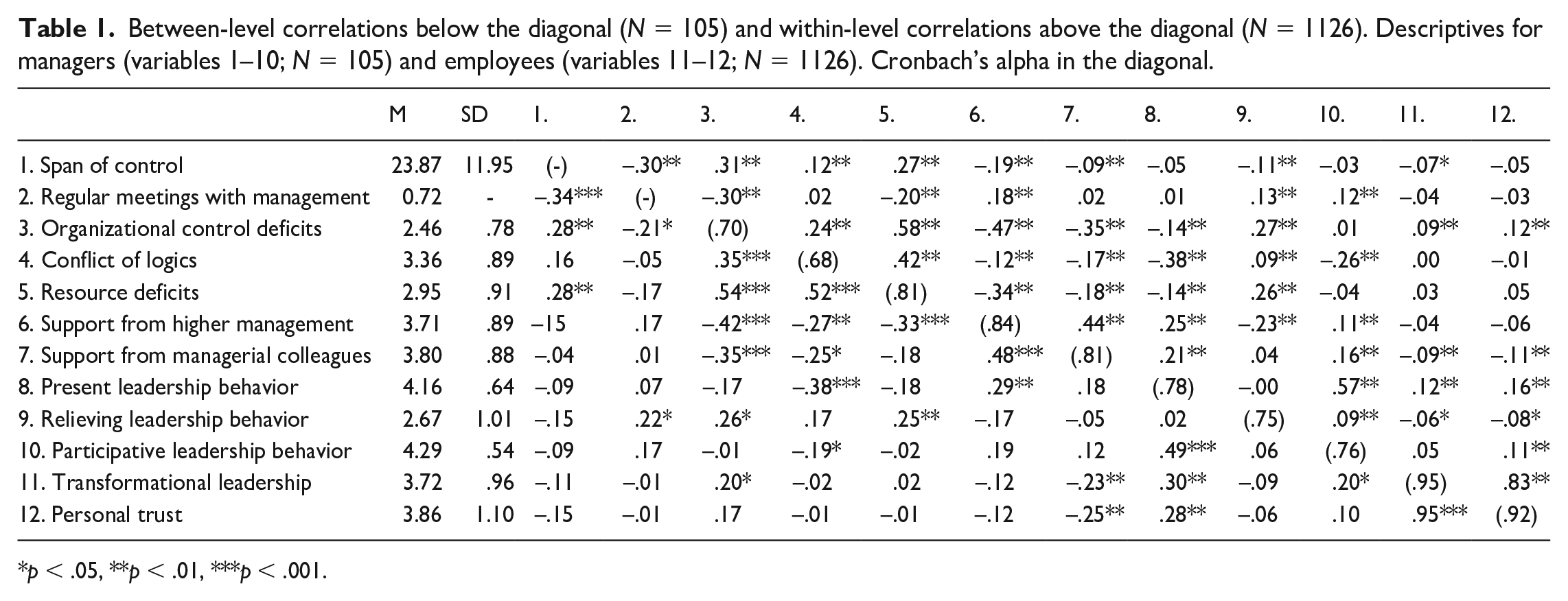
p < .05, **p < .01, ***p < .001.
Multilevel mediation analysis—direct effects. Unstandardized coefficients (with 95% confidence intervals) are reported for the five outcome variables on level 1 and 2. For the level 1 outcomes, transformational leadership and personal trust, ICC(1) is reported.
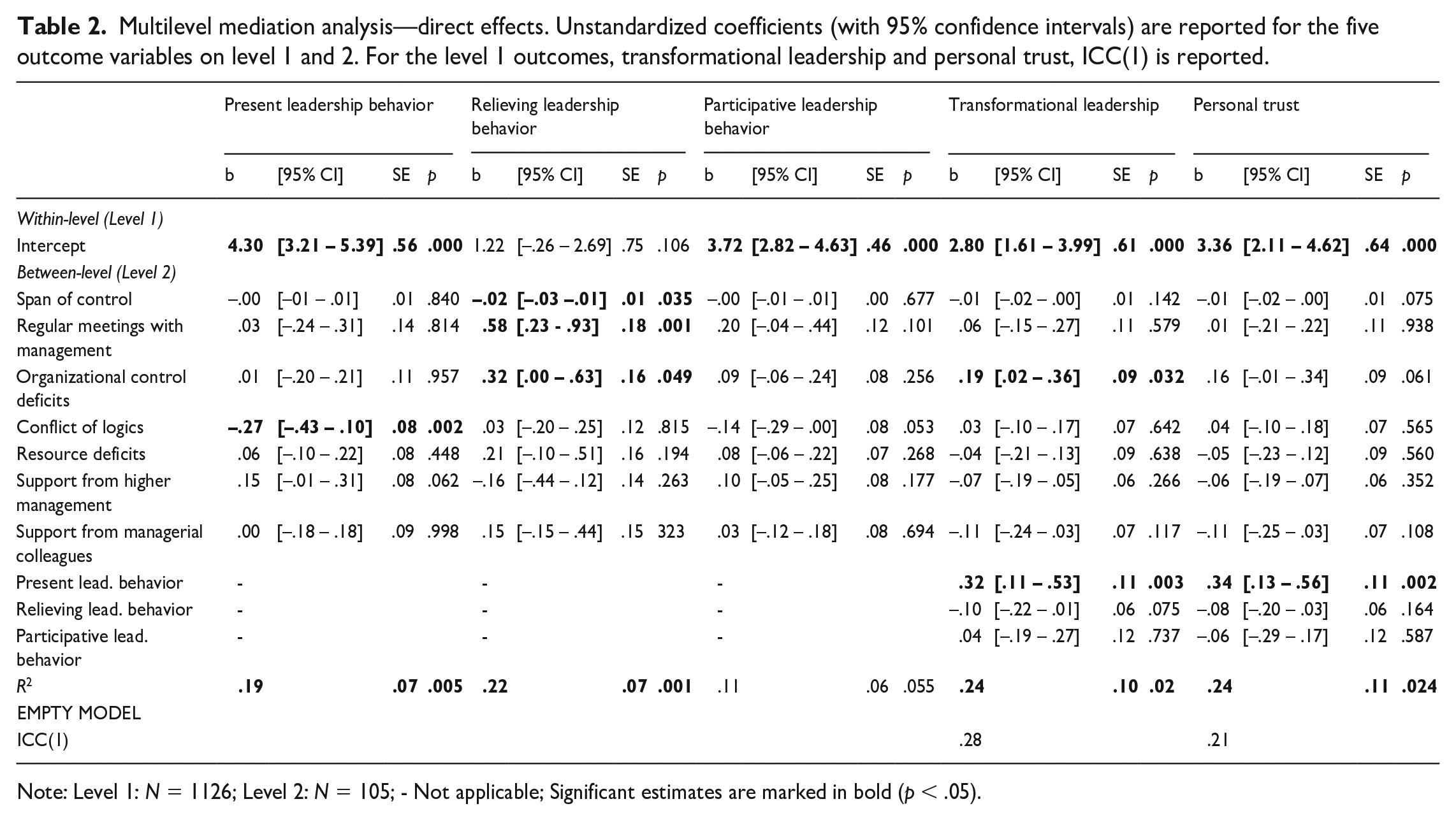
Note: Level 1: N = 1126; Level 2: N = 105; - Not applicable; Significant estimates are marked in bold (p < .05).
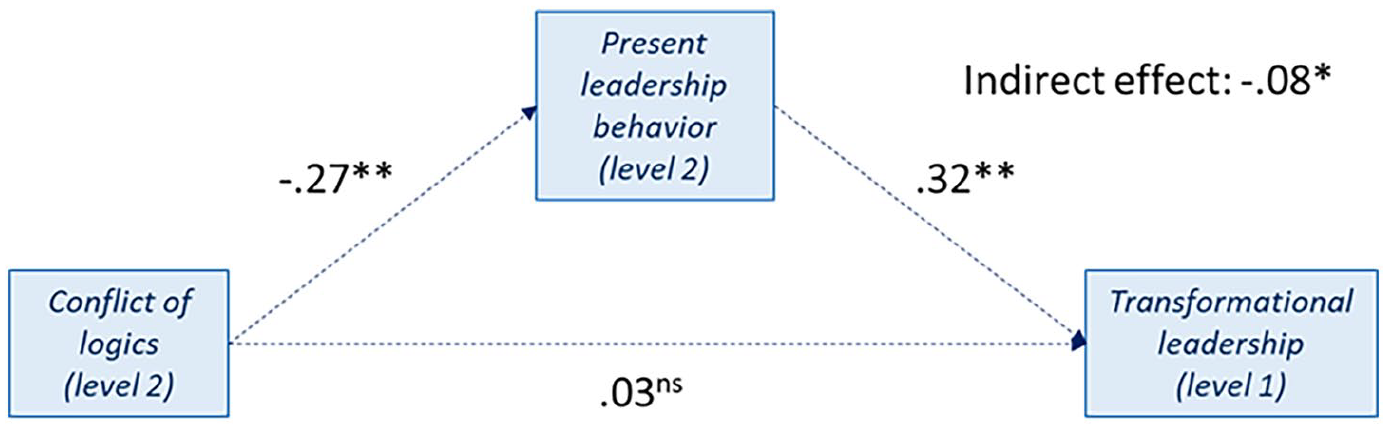
Indirect effect of conflict of logics on transformational leadership (via present leadership behavior).
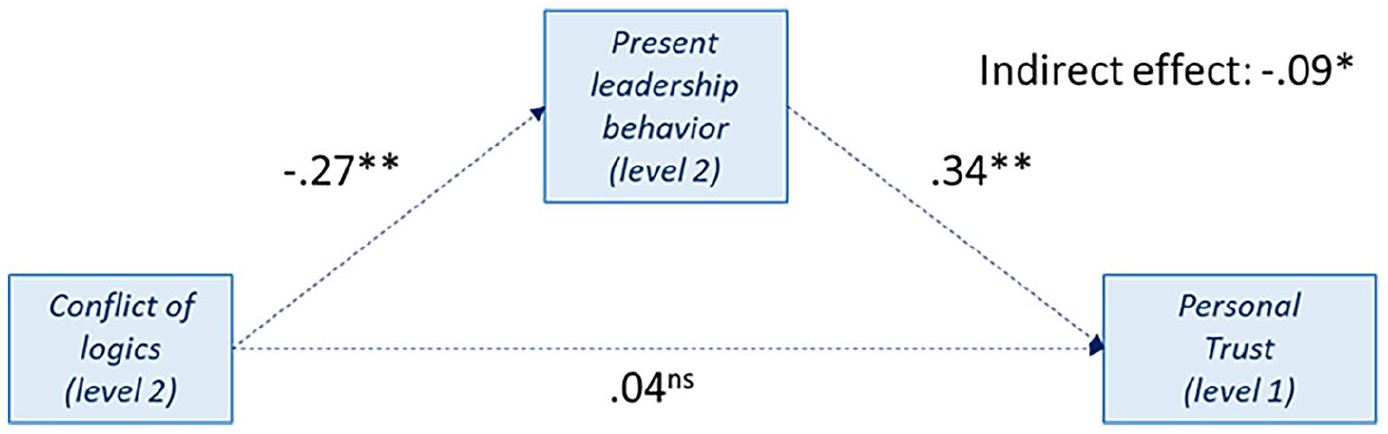
Indirect effect of conflict of logics on personal trust (via present leadership behavior).
The study was approved by the Swedish Ethical Review Authority (ref. no. 2019-02686).
Results
Table 2 presents the results from the multilevel analysis. Looking at the intra-class correlation (ICC(1)), 28% of the variance of transformational leadership and 21% of the variance of personal trust could be attributed to the unit level, indicating that the behavior of leaders is, to some extent, experienced similarly by subordinates.
Predicting leadership behavior reported by managers
The association between organizational context and leadership behavior was investigated in the first three models of the multilevel analysis (Table 2) (RQ1). Span of control and regular meetings with higher management were entered together with organizational control deficits, conflict of logics, resource deficits, support from management, and support from managerial colleagues predicting three separate outcomes (present leadership behavior, relieving leadership behavior, and participative leadership behavior). The results indicate that conflict of logics was negatively associated with present leadership behavior (b = –.27, p = .002), suggesting that managers with more conflict of logics in their context reported lower levels of present leadership behaviors. In the second model, span of control was negatively associated with relieving leadership behavior (b = –.02, p = .035), while regular meetings with management (b = .58, p = .001) together with organizational control deficits (b = .32, p = .049) were positively related to the outcome variable. These results suggest that managers who have fewer subordinates, more regular meetings with higher management, and higher levels of organizational control deficits engage in relieving their subordinates from their workload.
Predicting subordinates’ perceptions of leadership behavior and trust
For both transformational leadership and personal trust, present leadership behavior—as reported by managers—was the most important predictor (b = .32, p = .003 for transformational leadership and b = .34, p = .002 for personal trust). In addition, organizational control deficits (b = .19, p = .032) were positively related to transformational leadership. No other predictors had significant associations with their outcomes.
The mediating role of managers
Further, we investigated whether there were any indirect effects of organizational context on subordinates’ perceptions of their managers’ leadership behaviors. In one specific case, there were significant indirect effects—the association between conflict of logics and both transformational leadership (Figure 1) and personal trust (Figure 2) were mediated by present leadership behavior.
Discussion
In the present study, we set out to study the meaning of organizational context for the leadership behaviors of managers and perceptions of leadership among their subordinates. We did that by investigating the direct and indirect effects of structural and working conditions among managers and perceptions of leadership behaviors among managers and subordinates in a municipal organization.
The association between organizational context and managers’ leadership behaviors
The results from this study indicate a few things. First, we found support for an association between working conditions among managers and their leadership behaviors. The presence of conflicting logics in the operation was negatively associated with being present and visible as a leader. Moreover, the results indicated an association (although weaker, with a p-value of .053) between conflict of logics and the active fostering of participation among subordinates, implying that when managers report conflicting tasks, with possible role conflict as a result, they tend to report less engagement in positive leadership behaviors such as being present in the organization and the fostering of participation. The results are in line with previous research suggesting that complex and difficult working conditions are important prerequisites for leadership behaviors (Lundqvist, 2013; Oc, 2018). Furthermore, support from higher management was positively associated with present leadership. The association was non-significant (p = .062), but we think it is relevant to discuss, as it indicates the importance of a coherent organizational structure in which managers on different levels communicate with each other. In previous studies, support and trust from higher management have been found to be important for managers, especially on the operative level (Corin, 2016).
The third variable, relieving leadership behavior, is a factor that could be argued to be negative both for the individual manager and for subordinates. Relieving, in this respect, means that managers take on work that should be done by their subordinates. In the present study, we found a positive association between organizational control deficits and relieving leadership behaviors, indicating that managers who report an incoherent organizational structure, with strategic decision-making that is difficult to implement on the operational level, also report that they engage in relieving leadership behaviors. It could be argued that this is in line with the reasoning from Oc (2018), who suggests that task complexity is negatively related to leadership behaviors. Another possible explanation is that control deficiencies affect employees’ ability to perform well, and a possible coping strategy for first-line managers is to compensate for this deficiency by taking over employees’ work. In previous studies, it has been found that control deficits are related to managers’ task complexity and well-being (Björk et al., 2013).
Interestingly, the results from the present study indicate that managers who have regular meetings with higher management and with a lower control span, report higher levels of relieving leadership behaviors. The results are somewhat surprising, as it could be expected from previous studies that it would be easier to engage in positive leadership behaviors with a lower control span and with regular meetings with higher management (Björk and Härenstam, 2016; Lundmark et al., 2020). A possible explanation is that the association is reversed, suggesting that managers with different staffing problems have closer contacts and more meetings with higher management. In addition, it could be argued that leaders with few subordinates are more involved in daily work and engage in more regular tasks in addition to their management tasks. In a qualitative study it was found that managers with many subordinates were less informed about daily operations and had fewer opportunities to offer support when problems occurred. Rather, managers with many subordinates experienced that they needed to distance themselves from their staff and expected them to carry out work tasks independently, even if they asked for support (Forsberg Kankkunen, 2014). Consequently, there may be more than one explanation regarding the results concerning relieving leadership behaviors, and we believe that more research is needed to gain a better understanding of such leadership behavior.
Taken together, the results from the present study indicate a significant but somewhat weak effect of the organizational context on managers’ leadership behaviors. The analyses reveal an effect of conflicting logics on present leadership behaviors (i.e., when the logics of different work tasks such as administrative, developmental and employee-related tasks collide) and the fostering of participation in decision-making practices. These results indicate that managers who have better working conditions are better equipped to engage in positive transformational leadership behaviors.
The association between organizational context and subordinates’ perceptions of their leader
Our second research question focused on the association between the organizational context and the perception of the leader among subordinates. In this respect, we investigated both the direct effect of organizational context and the mediating effect of enacted leadership behaviors. The results from the multilevel analysis indicate a few factors may be more important than others. First, present leadership behaviors among managers were associated with perceptions of both transformational leadership and personal trust. Thus, subordinates tend to perceive their managers as transformational when managers report that they focus on being present and visible as leaders. This association can be interpreted as leaders who are present are more often evaluated in a generally positive way, both when it comes to leadership practices, indicated by transformational leadership, and the trustworthiness of the leader. The findings are in line with previous research suggesting that transformational leadership and the forming of trusting relationships is dependent on being present and visible in the organization (Browning, 2014; Le and Lei, 2018).
Second, organizational control deficits were positively related to transformational leadership and to personal trust (although non-significantly, p = .061), indicating that when decisions made on strategic level are difficult to follow at the operational level, employees find their managers to be more transformational and trustworthy. On the one hand, this finding is somewhat surprising, as previous studies have indicated that task complexity is negatively associated with positive leadership behaviors (Oc, 2018). On the other hand, previous research has emphasized the existence of compensatory behaviors among leaders, meaning that when managers perceive difficulties in the organization—e.g., conflicting logics or organizational control deficits—they compensate with behaviors that are experienced as positive by their subordinates (House, 1996) and the results may be that while managers experience high job demands, subordinates experience a trustful and engaged leader.
Participatory leadership behaviors, assessed by the leaders themselves, were, however, not associated with transformational leadership and trust in the leader when evaluated by the subordinates. Possibly, the type of operation, the complexity, and the degree of standardization of the work task (omnibus contextual factors) may have an impact on the possibility of managers to involve their subordinates in decision-making processes. Operations like caring, social services, and teaching constitute a large part of municipal services, which also is the case in our sample. In earlier studies, it has been found that managers in these types of operations have worse working conditions and other prerequisites to perform than managers in technical municipal services (Berntson et al., 2012; Björk and Härenstam, 2016; Forsberg and Härenstam, 2022), which may impact the results.
The results from the present study indicate that enacted leadership behaviors may have a mediating role in the relationship between organizational context and perceptions of leadership among subordinates. The results suggest that conflicting logics have an indirect effect on both transformational leadership and personal trust, mediated by present leadership behaviors. When managers experience a conflict between the more strategic aspects of management, such as operational development, and the more operative aspects, such as personnel issues and administrative tasks, they engage less in being present and visible among staff members. In turn, this is associated with perceptions of being less transformational and trustworthy among subordinates. In previous research, organizational context has been argued to be related to managers’ work situations and their possibilities of engaging in positive leadership behaviors (Oc, 2018). The results confirm this association, but also contribute knowledge about the link from organizational context, via managers’ behavior, to subordinates’ perceptions of leadership. Consequently, if we want to enhance leadership behaviors we cannot only focus on managers—but we have to take a look at the organizational structures and their prerequisites for managers.
The findings from the multilevel analysis indicate that individuals within workgroups share a substantial amount of variance when it comes to both transformational leadership and personal trust. When it comes to transformational leadership, 28% of the variance is shared within work groups, and for personal trust, this figure is 21%. We believe that this is an indicator that the subordinates’ perceptions of leadership and trust are grounded in leadership behaviors.
Taken together, the results from the present study indicate that managers’ leadership behaviors can predict how subordinates perceive them as leaders. When managers put in extra effort to be visible in the organization, their subordinates are more likely to assess them as trustworthy and transformational.
Methodological considerations
There are a few limitations to the present study. First, the sample comes from a single organization, increasing the possibility of introducing bias into the data. For example, we cannot rule out that there were specific circumstances in this organization that affected the estimates in the analyses. Possibly, this may explain that we did not find any correlations between span of control and leadership behaviors, as suggested in previous studies (cf. Larsson and Hyllengren, 2013; Lundmark et al., 2020). In studies where structural factors have been found to have an impact on managers’ work and well-being, the samples have been more diverse and have come from a variety of municipalities (cf. Berntson et al., 2012). Second, the choice of context variables in our multilevel analysis is worth discussing. We included variables that reflect both structural and more personal working conditions for managers. For example, span of control indicates structural relationships to subordinates, whereas regular meetings indicate structural relationships with higher management that have been found to be important for first-line managers in previous studies (Björk and Härenstam, 2016). However, we found only a few associations between the chosen contextual variables and reported leadership behaviors. Other possible relevant factors for how managers enact leadership include type of operation, access to administrative support, and competence in the work group (cf. Björk and Härenstam, 2016). Group-related contextual factors, such as staff composition and complexity in work tasks, would be interesting to analyze as predictors of how followers assess their leaders’ behavior and trustworthiness (cf. Larsson and Hyllengren, 2013). Furthermore, for both managers and subordinates, volatility in the organization is a contextual factor that may impact how leadership is enacted (Härenstam et al., 2022).
Third, the choice of including both transformational leadership and trust in the present study deserves a comment. Transformational leadership via the GTL index (Carless et al., 2000) is used in a number of studies as an indicator of leadership behavior. Still, it has been argued that measuring leadership through subordinate perceptions could be contaminated by halo effects: i.e., the measure reflects likeability rather than actual leadership behaviors (Fischer et al., 2024). In the present study, we included a measure of personal trust because trust is an important part of the forming of transformational leadership behaviors (Browning, 2014; Le and Lei, 2018). However, the results indicate a strong association between transformational leadership and trust, suggesting that there is a relationship between how subordinates perceive the leader as an individual and his or her leadership behaviors. On the other hand, the high levels of shared variance of both transformational leadership and trust could be an indicator of the measures reflecting actual leadership behaviors. Still, more research is needed to gain a better understanding of these associations.
A strength of the present study is the use of multiple data sources. We included data from registers (external assessments of the organizational structure), managers, and from subordinates in the organization. Although this may be one possible explanation for few associations, it is also a strength, given that we want to discuss how contextual factors influence leadership.
Concluding remarks
The main finding from this study is that organizational context is associated with both managers’ leadership behaviors and subordinates’ perceptions of leadership. We can conclude that more coherent organizational structures with fewer conflicting logics introduce better prerequisites for managers to engage in positive leadership behaviors such as being present and fostering participation in decision-making. In addition, we can conclude that leadership behaviors of managers, being particularly visible, are associated with positive perceptions from subordinates, indicated by transformational leadership and personal trust. In the present study, the results indicated that there is an indirect effect of organizational context on subordinates’ perceptions of their leaders, mediated by managers’ behavior. In a wider sense, this means that it is important to improve and maintain working conditions for public sector managers in order to foster positive leadership behaviors.
Footnotes
Appendix A: Item list
Declaration of conflicting interests
The authors declared no potential conflicts of interest with respect to the research, authorship, and/or publication of this article.
Funding
This work was made possible by a grant from AFA Insurance (Dnr: 180066), which insures employees within the private sector, municipalities, and county councils. The authors report there are no competing interests to declare.
