




Abstract
BACKGROUND:
Research is focused on companies that offshored their production and operate in the international business environment, in the current globalized world placed generically under the 4.0 index, inspired by the fourth industrial revolution.
OBJECTIVE:
The paper aims to draw up a structured and multilayered framework for identifying sources of risks related to the work environment and to the human resources management in this context.
METHODS:
An extended analysis of information in the literature and on the web is conducted to define the mentioned conceptual structure and to identify domains, processes, and actions that should be considered hosting such risks. First filtered by the authors based on their experience as consultants and managers in international projects, results are then validated by successive feedbacks from their peers.
RESULTS:
Two levels of the framework are detailed, the first correlating globalization and 4.0 development stage challenges, identifying the risk sources within a matrix detailing on one dimension technological progress, governmental & legal issues, cultural patterns, and on the other, domains sensitive to risks regarding the human resource, such as work performance, working skills, working ethics & discipline, and working models, environment & tools. The second level focuses on the sources of risks arise due to a company’s digital transformation with regard to the choice of the working models configuration, employees’ recruitment & hiring, training, working planning, organization & control, and setting up working regulations.
CONCLUSIONS:
The results are intended to provide support for easier and more comprehensive identification of work and human resources related risks in the mentioned context.



Introduction
Civilization and wellness were always dependent on the degree in which people are working and developing connections between each other in the process of creating and exchanging goods. Throughout times both working, and human interconnection had faced huge transformations, mainly due to progress in technology, reflected also in people’s ways of thinking, of relating to each-other and with reality.
In more recent times, on the one side, new technologies, particularly digitalization and advanced automation (robotics and artificial intelligence) have brought a dramatic change of production and human work processes. From this point of view, the present industrial realities being assembled under the generic of a 4th industrial revolution and extended, under the index 4.0, to the related processes (Industry 4.0, Innovation 4.0, Work 4.0 etc.). On the other side, the same technology advancements (mainly in communication and transportation) have facilitated the cross-border movements of people, products, information and knowledge, the production offshoring, and outsourcing that extended at a global scale, have received recently [1] a name: “Globalization 4.0”. Today’s life, in all its dimensions: economic, social, political, scientific etc., cannot be separated anymore from the characteristics and trends of the mentioned 4.0 stage of development, that unite technology and globalization in an undividable reality. The WEF White Paper [2] claims that “major shifts underway in technology, geopolitics, environment and society” will demand different approaches of all stakeholders for answering to the new raised challenges for a smart sustainable future.
Today’s pandemic situation has changed dramatically the perspectives in living, working, and making business. Apparently disadvantaging (at least for a period of time) the cross-border openness, mobility and business, incriminated by some as reflecting the limits of the globalization and of the transnational solidarity, this situation has shown more than ever, on one hand, how dependent on and connected to each other we are in the today’s world and, on the other, that we have to hurry in preparing ourselves for alternatives in our ways of living, for new ways of working, communicating, teaching & learning, shopping, etc. that integrate new technologies with both their positive consequences as well as the price of adaptation that has to be paid.
In such a context, an adequate human resources (HR) management becomes a key condition for succeeding in any business, social, or political domain, the “Human resources 4.0” (HR4.0) imposing itself as a commonly used concept [1]. People selection, training, management, motivation, organization, surveillance, as well as their health, safety, and wellbeing in the working places, raise specific challenges and risks for companies working in an international business environment. These risks need to be identified, evaluated, and mitigated to minimize possible business losses.
This paper assumes to define and present a structured approach to identify the main domains where companies working in the international business environment will have to face risks related to their human resources from the perspective of current developments and those foreseen for the work in the times to come. The first part of the analysis is sought for domains sensible to risks at the cross path between the key trends of the 4.0 development stage and globalization, and their impact dimensions with the main risk categories relevant for human resources encountered in international business. A second layer is focusing on specific work-related risks that emerge when using digital working models, environments, and tools. Some considerations on how ergonomic requirements are particularized in this case complete the paper. The outputs of the above-mentioned analysis are structured in a conceptual framework that is intended to provide future support for risk evaluation and management in specific cases.
Background
Given the previously stated intentions of the paper, this research is focused on the future of work and employee related challenges at the confluence of globalization 4.0 trends and the domains of applicable risks that a company faces in the international business environment. This intention also indicates the basic concepts to be introduced and made explicit here.
Globalization 4.0
Globalization, beyond being an extremely popular concept, it designates maybe the most implacable trend of the human civilization. As concept, it is covered by many definitions that highlight its multiple valences. Some, e.g. [3, 4], are pointing out especially the processes (incorporation, integration, interdependence, sharing, movement) or the actors (states, companies, people), its main dimensions (economic, cultural, political, environmental), others, e.g. [5, 6], are pointing its objects more or less material (market, products, technology, information, capital, jobs) or immaterial ones (values, principles, legal rules), or focusing on actions (trade, transportation, free movement of people, outsourcing - offshoring) and impacts (on economic development, people wellness and wellbeing or poverty, environment health or pollution, states independence or the power of multinational companies). There are also attempts to provide a comprehensive, holistic approach to this concept by assembling information from various sources [7].
When globalization is currently mentioned, it refers generally to the modern, large-scale phenomenon that begun in the 19th century but, as process, its roots could be placed in the early history of humanity, when exchange of goods became trade, extending over countries borders. The “silk road” even if it is not the oldest, could be a significant example in this sense, being updated recently as support for a modern but similar approach. During its history, the content and characteristics of the globalization process have evolved significantly. As in the case of industrialization process, globalization phases have been baptized with similar indexes. [8] places the globalization 1.0 phase from the end of 15th to the beginning of 20th century; this last century hosting the globalization 2.0, while in 2007, globalization 3.0 was considered the current phase starting from 2000. Even if some of the Friedman’s ideas were criticized by prestigious authors (e.g. Stiglitz), its globalization phases were largely accepted and, when recently a new approach was considered necessary, Globalization 4.0 has been a natural adopted name.
Globalization 4.0, adopted as flagship for the 2019 World Economic Forum in Davos, is not a newborn concept, being mentioned in publication some years ago, e.g. [9], yet its deployment as content and characteristics is relatively new and even nowadays, it is far from being a mature one. Digitalization, large scale automation & artificial intelligence, cloud computing, IoT, Internet 4.0, big data & cybersecurity are just some of these current, mainly technological, challenges that, together with the continuous raising of competition for markets and resources and the global climate change as an effect of unsustainable development, are impacting on all dimensions and levels of the economic, political and social life. In order to face the new wave of globalization each region and country [10], as well as companies and organizations, have to assume their convergence with the global vision and requirements, including in updating their professional and educational systems, regulations, and infrastructure.
The international business environment
In today’s business environment the real competitiveness has an international reference, only adaptable companies that manage to be competitive globally can aspire to keep their long-time sustainability. For such companies, the immersion in the international business environment is inevitable and its rapidly shifting conditions in the marketplace, is forcing management to constantly review and adapt its core competencies. Here, companies are confronted with a higher level of complexity and disruptions brought by the new waves of globalization and the irresistible technological changes. The tendency to offshore a part of the production and service activities and processes can lead companies to transform themselves into virtual organizations, where all the main functions could be outsourced, leading to the formation of flexible networks and agile organizational structures. Offshoring has become and probable will remain one of the most widely used strategies by companies in developed countries to maintain or increase their competitive advantage [11].
International business is equally of interest for companies and nations, researches in the field showing a major interest at a global level, not only in the business environment, but also in the political field [12, 13]. Global political leaders are reflecting intensively on offshoring benefits and risks [14]. In this moment, besides the effects of COVID-19 crisis, in the economic developed world, there emerged high concerns regarding job losses due to the massive transfer of activities to other locations like China [15]. Both global leaders and top management of large companies are concerned with making the right decisions and initiating actions related to the outsourcing strategy aimed at accessing skilled labor at low cost and shortening transport routes from suppliers to their clients. To maintain these benefits in the changing contextual conditions, managing risks in a right way is becoming a key issue for success. The importance of risk management is even greater when we consider the risks in the continuously growing supply chains [16], with a significant impact on the income, quality, and delivery deadlines, as well as those coming from the cross-cultural influence on the behavior of the human resource.
Management plays a primordial role for any business; its decision influences even the survival of the company, poor managerial approaches can be deadly for the business itself. The business unit managers are usually focused on complying with targets, reducing financial risks, and fulfilling the standard requirements. In the present international business environment, dominated by complexity and dynamism, managers must focus rather on flexibility and capacity to understand and adapt to the continuous change on the technological, human resources, supply chains, political and social dimensions. Such businesses emphasize the importance of contextually understanding the change processes and to have the capability to provide adequate answers. This includes having a clear image about the risks assumed doing business in a certain domain, time, and place.
Work 4.0 and HR 4.0
The world of work is changing globally under the pressure of megatrends such as technological progress, mainly digitalization, artificial intelligence and automation/robotization, that together with the increasing integration (already mentioned under the generic of Globalization 4.0) are assembled sometimes generically under the name of “globotics”, to which we may add population aging and a change of generations. In this context are emerging new jobs, new ways, and new tools of working that are demanding new skills, new ways of thinking, leading and communicating, which impose, in turn, new requirements toward education and training, as well as to human resource employment and management [17–19]. A new generation, the “generation y” or “millennials”, born between 1981 and 1996, with a new pattern of life and behavior, will deliver the majority of the global workforce during the next decade (many sources indicate 75% in 2025).
All these together determine a new vision to work, called by some in the technical language of the moment “Work 4.0” and which will have to be accomplished by employees with specific characteristics, called in the same language as “Human Resources (HR) 4.0”. It is a situation that raises challenges, offers opportunities, but also brings important risks to all stakeholders dealing with legislating work, educating people, as well as for the employers [17].
Two very recent documents one issued by The International Labor Organization (ILO) through the Global Commission on the Future of Work founded in 2017 [20], and the other by the World Economic Forum (2) considers as necessary a new “human-centered” approach to work, supposing from both governments and business organizations to invest in: people’s capabilities, enabling their skilling, reskilling and upskilling; adequate legislation and regulations on work and employment; specialized institutions to ensure professional guidance and supervision in this issue.
On the other side, [2] submits to attention some imperatives for business leaders to implement the right HR strategy: Development of new leadership capabilities and enhancing employee experience for the 4th Industrial revolution; Integration of Technology in the Workplace; Building an agile and personalized culture, Establishing metrics for valuing human capital and Embedding diversity and inclusion. These actions and strategies suggested as necessary to be undertaken by governments and business organizations are synthesized in Fig. 1.
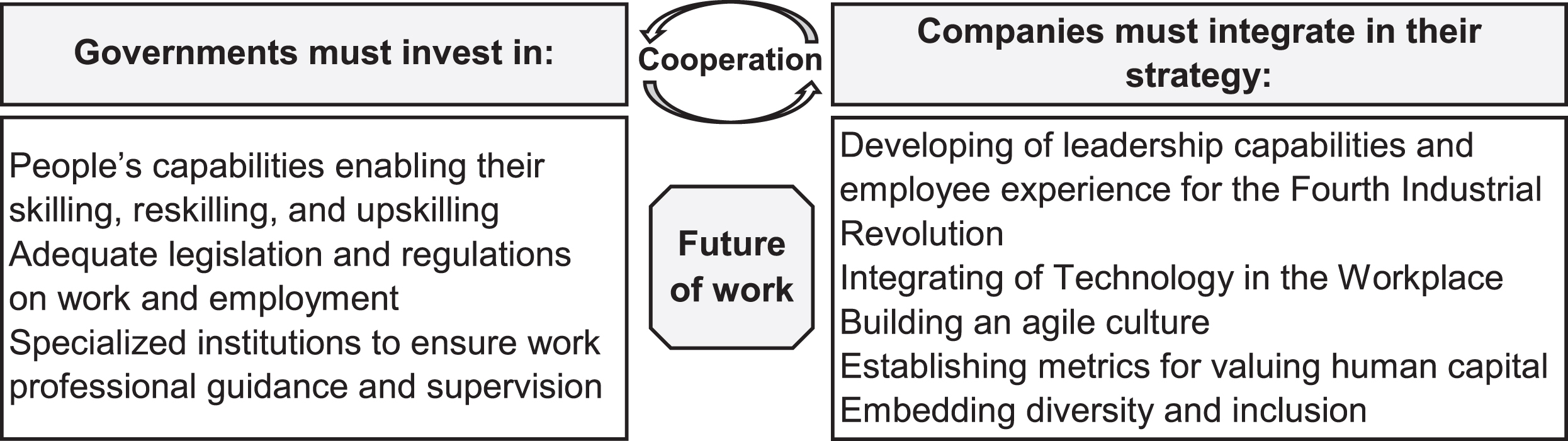
A human centered approach to future of work.
Through its stated intention, the present research assumed the drawing of a conceptual framework that structure the search of risks related to human resources of the companies doing business in the international environment, in the conditions of the 4.0 trends and globalization. The risk sources are sought at the confluence of 3 constructs (Fig. 2): Risks domains faced by companies operating in the international business environment, particularly those addressing their human resources. Current trends of 4.0 era and globalization having impact on the companies’ activity, in particular on their human resources. Domains, processes, and actions related to human resources management where risks may arise.
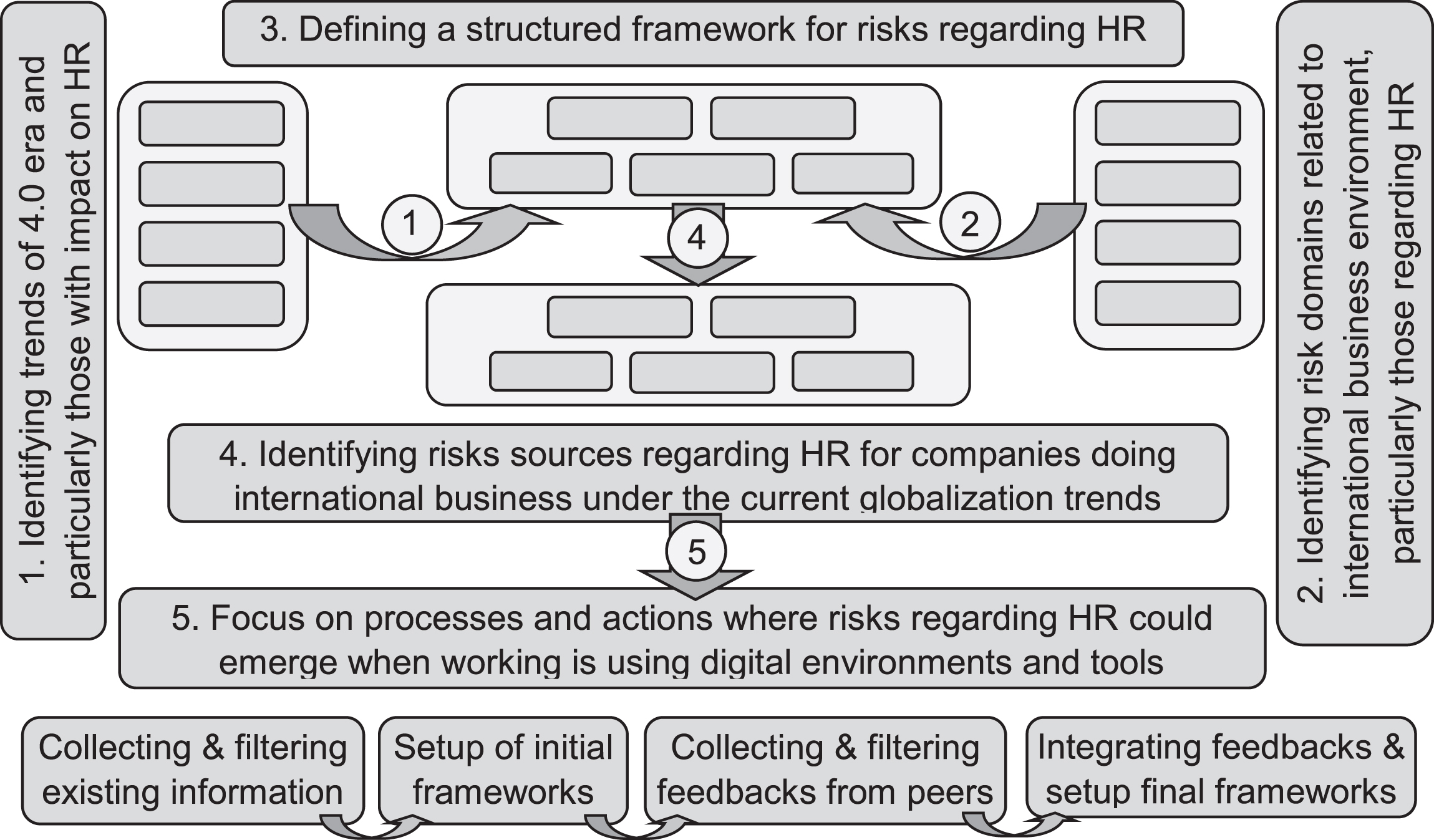
Research Methodology.
The identification of each of the constructs’ elements and structure established a distinct stage of research; their order is indicated also in the figure. The main research tool used was the analysis of the current literature and of the accessible information on the web. Its critical filtering and its structuring have benefited from the remarkable experience of the team of authors, who work in positions and networks that require skills and generates knowledge in areas such as international consulting services, cooperation in international business and projects, cross-border knowledge transfer; all relevant to the subject studied here. In order to gain in maturity and validate the obtained structure and content of the conceptual framework, a successive consultation process was used (similar to a Delphi investigation but using individual discussions or email feedbacks) performed by each of the authors with colleagues, who have relevant experience in the domain. The observations thus acquired were filtered by the authors and integrated into the results.
Trends of 4.0 development stage and globalization
The concept “Industry 4.0”, was firstly launched within a German Government High-Tech Strategy 2020 Action Plan [21]. It is aimed mainly as a platform to promote the increasing of digitalization within products, production, value chains, and business models. The Industry 4.0 as concept designates a 4th Industrial revolution and usually includes in its understanding technology issues such as cyber-physical systems (CPS), the Internet of Things (IoT), Internet of Things and Services (IoTS), Industrial Big Data and others. The term has grown and spread as a worldwide use, with the 4.0 index beginning to be perceived as characteristic for the present stage of world development.
Starting from the “Industry 4.0” concept, similar expressions have emerged: “Innovation 4.0” [22, 23]; “Society 5.0” [24, 25], “Logistics and supply chain 4.0” [26], “Education 4.0” [27], “Human resources 4.0” [1] and “Work 4.0” [18] and others similar. In today’s highly interconnected and interdependent world, the 4.0 index describes a specific stage in the technological, economic and social evolution of human civilization whose processes described by the 4.0 concepts cannot exist independently, each inherently being connected to and inheriting from the others their dimensions, characteristics, and trends. Therefore, if we analyze the specific trends of Industry 4.0, Globalization 4.0, or Labor 4.0 and Human Resources 4.0 we will find a high degree of overlap and convergence.
Table 1 proposes a perspective on the main trends of the 4.0 development stage, aiming to identify their impact on organizations operating in the context, in particular on their human resources. The analysis is intended to facilitate the subsequent identification of the main risk categories regarding the human resources that companies will face by operating under such conditions. The table summarizes information from several relevant sources, including: [18, 28–31].
Trends of the 4.0 development stage and globalization and their impact
Trends of the 4.0 development stage and globalization and their impact
Note: Risks categories considered as being relevant for a company human resources are highlighted with
In the Table 1 are highlighted those aspects of the impact of the 4.0 stage trends that affect human resources favoring the emergence of risks in this field and focused by the present research.
A critical research of the literature and of the relevant information on the web has delivered the basis in creating the following structure of the domains of risks expected when doing business in international environments. In the followings just some of the consulted references, considered as having a higher relevance, are mentioned: [32–40].
Benefiting from their previous experience and the opportunity of current activity in the international business environment, using the consultation of collaborators with experience in this field, the authors undertook a thorough analysis of the risk domains and sources here recorded, to identify those that are relevant to human resources. The results of the mentioned analyzes are summarized in Table 2, providing a basis for the next steps of the research.
Risks domains for companies operating in the international business environments
Risks domains for companies operating in the international business environments
Note: Risks categories considered as being relevant for a company human resources are highlighted with
Although in organizations human resource management is not exactly at the center of the concerns of those involved in risk management, it must be counted as an important source of risk for companies. In the present phase, the authors undertook an extensive search of existing references in the literature and on the web on the risks related to human resources. Their number and consistency confirm the importance and attention that this subject enjoys, both in the field of knowledge and as well as in the world of specialists. The research phase has targeted to collect the main involved constructs when approaching human resources related risks in companies and to define a comprehensive structure in which these constructs fit in and that can be used for future risk identifications in a certain context (the “4.0 stage of development and globalization” and “Digitalization” being contexts particularly targeted in the present paper).
An large number of information sources have been reviewed for the collection and critical analysis of the mentioned constructs, from books containing extensive analyzes on HRM such as: [41–49], papers that treat holistically or on a specific segment the problem of risks related to HR such as: [50–54], and documents from various sites providing information such as “the most important risks regarding HR” some being mentioned here: [55–59], whose consistency has been verified by a confrontation between each other and critically filtered by the authors.
The list of structures thus collected which, after a filtration focused on relevance and redundancies elimination, was including over 50 such constructs, was initially grouped on two levels, first containing dimensions/aspects of HRM sensitive to risk and second referring to company actions in relation to human resources where hazards emergence have to be taken into account. The structure provided for each of the two levels covers and includes all the identified constructions and can constitute a logical framework for identifying and processing the risks regarding the human resource in the company (see Fig. 3).
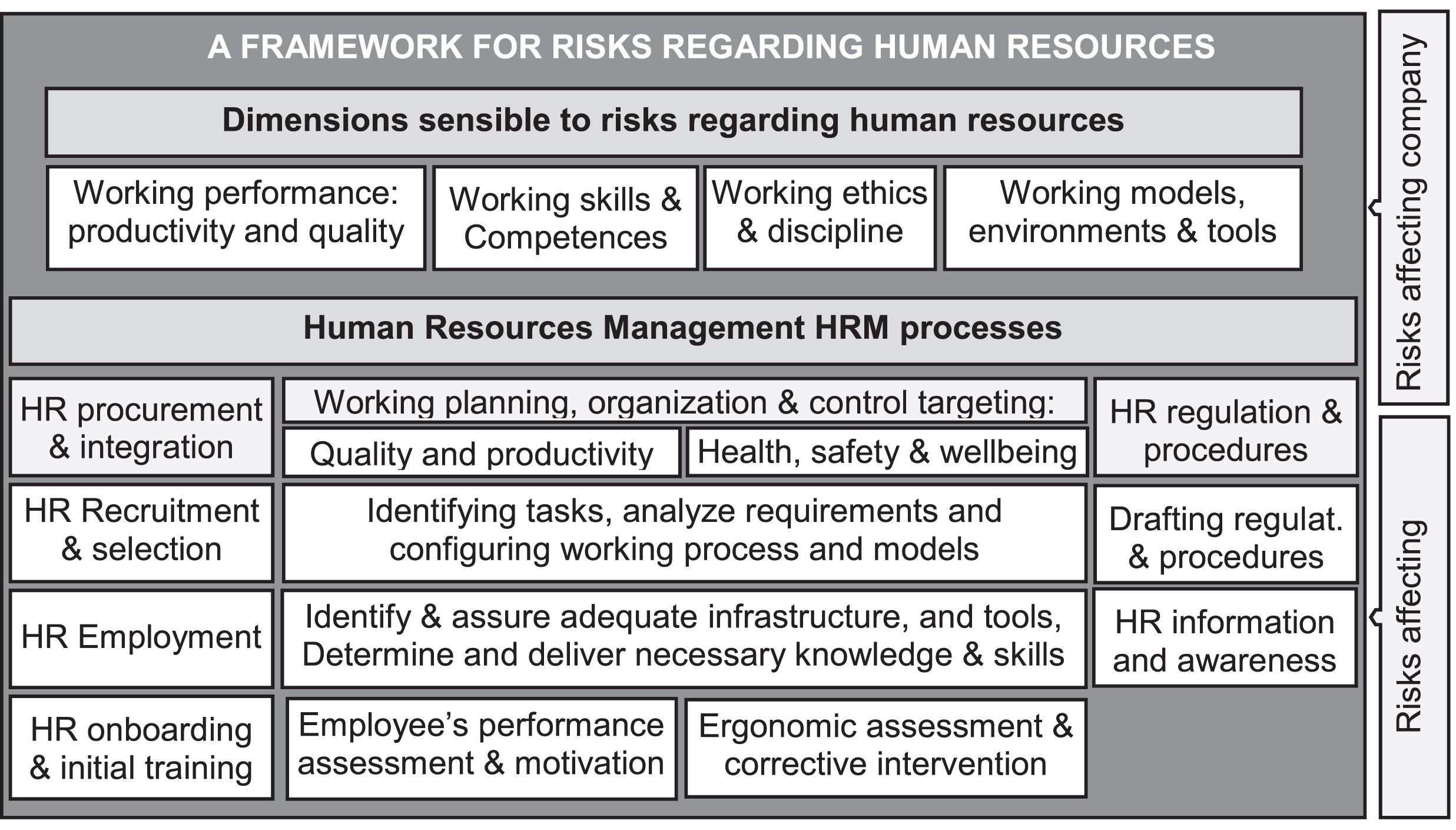
Working dimensions and main company actions regarding human resources sensible to risks.
Based on the analysis of the information in Tables 1 and 2 relevant to HRM 3 several directions have been identified, on which the trends associated with globalization and the 4.0 phase of economic development could have a relevant impact on the human resource in companies and host areas of emerging risks. These are: Technological, especially digitalization and digital automation, Legislative and governmental measures (their adequacy to the development phase in question), and the Working cultural pattern referring to the employees’ answer to cultural differences (between nationalities or generations) when working in new environments and working models and/or with new working tools.
These mentioned directions were correlated in a matrix with the 4 dimensions sensible to risks regarding human resources identified in 4.3 and Fig. 3. For identifying the risks domains at their intersection, an extended analysis of information available on the literature and the web has been undertaken, here being mentioned only those considered most relevant: [17, 60–65]. Results have been submitted for discussion between the authors, each having the possibility to ask for feedback from a number of peers, who themselves accumulated experience and knowledge in the field of international business. The results are recorded in Table 3 in a matrix form. This matrix represents the first level of the structure of human resources related domains, where companies operating in the studied context (International business environment in the 4.0 development stage) can search and identify the risks they may face.
A framework for human resources risks in companies operating in 4.0 environments
A framework for human resources risks in companies operating in 4.0 environments
In the next phase, the present research has focused on sources where risks could arise in connection with human resources when a company passes through a digital transformation in its activities. In this context working models such as working in the office, remote working, working from home, together with their contextual characteristics have been taken into consideration. Starting from the idea that risks are events that can obstruct the achievement of certain objectives, in the case of working in the mentioned digital context, the analysis considered as reference two categories of objectives: those emerged from work performance (quality and productivity) as well as employees’ work discipline, that lead to a direct business advantage of the company. These are targeted mainly by adequate measures on employees’ recruitment, selection and training, organization/management, and motivation assembled under the generic of work and human resources management processes. those focused on the protection of employees’ work health and safety as well as their work wellbeing and satisfaction in a digital context (using digital specific models, in a digital environment, using digital tools, generating digital products, etc.), and which are impacting on long-term not only employees’ stability and their commitment to work but also on their performance. The concern to configure in a proper sense the elements of this digital working context, answering to its complex and multiple types of requirements to create an adequate working environment for employees is called by some sources [66] as “digital ergonomics”. This involves much more as previous efforts to assure an environment, equipment and tools that facilitates physically the human work, extending its competences and concerns to cognitive, emotional, and cultural aspects of working, interhuman communication and human machine interfaces. The digital ergonomics raises for the next years huge interdisciplinary research challenges to reach an unprecedented community between humans and intelligent work environments capable to adapt to each other to deliver both performance and wellbeing [67].
The results of the above mentioned analysis is synthesized in the Table 4, representing a framework where, as in a previous section, are not pointed out the risks themselves but the processes and actions where these could arise, so each company can identify its specific risks. These risks sources are placed in the logical order of human resources management interventions identified in Fig. 3.
A framework for human resources risks sources that emerge within current working places, environments & tools due to “Digitalization”
A framework for human resources risks sources that emerge within current working places, environments & tools due to “Digitalization”
For companies, surviving and being successful in the current globalized and rapidly changing business world, supposes understanding and accepting its challenges and adapting of own business activities to the requirements raised by its characteristics and trends. The rapid progress in technology, particularly digitalization and intelligent automation, as well as the change of generations and culture, makes out of human resources and work management key issues of this adaptation process. New working models in new working environments and using new tools require specific employees’ skilling, re-skilling and up-skilling, for a new organization of work, for new paradigms on work safety, health and wellbeing, and many others similar actions. To deal with such complex tasks, managers must adopt an agile strategy, moving attention from keeping under control the business processes to identifying and managing their risks. Identifying risks connected to human resources is the first step of such a strategy and, a structured framework of the domains and stages of related activities and actions where these risks may occur could deliver precious support for doing that.
The present paper proposes such a framework, delivering two levels of it: a general one, that correlates globalization and 4.0 development stage challenges, identifying the main risk sources within a matrix detailing on the first dimension: technological progress, governmental & legal issues, and cultural change and patterns, and on the other the domains sensible to risks regarding human resource in a company activity such as work performance, working skills& competencies, working ethics and discipline, and working models, environment & tools. a particular one, that focus on the risk that a company face on its digital transformation relating to choosing the configuration of working models, employees’ recruitment & hiring, training, working planning, organization & control and setting up working regulations.
Taking into account that each company exists and runs its activities in a specific context, in order to deliver a framework with large applicability, at both levels of the mentioned analysis, not the identification of risks themselves was targeted, but the recognition of the domains, processes and actions where these could arise. So, results could keep their flexibility, each company being able to identify its own specific risks in the field of human resources management.
Based upon the above presented results, future research on potential risks brought by remote work and working from home models is intended to be developed.
Author contributions
CONCEPTION: Sorin Popescu and Roxana Santa
METHODOLOGY: Sorin Popescu and Roxana Santa
DATA COLLECTION: Sorin Popescu, Roxana Santa, Florian Teleabă and Hannelore Ileşan
INTERPRETATION OR ANALYSIS OF DATA: Sorin Popescu, Roxana Santa, Florian Teleabă and Hannelore Ileşan
PREPARATION OF THE MANUSCRIPT: Sorin Popescu and Roxana Santa
REVISION FOR IMPORTANT INTELLECTUAL CONTENT: Sorin Popescu, Roxana Santa, Florian Teleabă and Hannelore Ileşan
SUPERVISION: Sorin Popescu