




Abstract
This article presents the findings of research on the European steel industry as it transitions toward Industry 4.0. Drawing on data generated through semi-structured interviews, the authors reflect on the distinction between routine and non-routine work which has informed much recent research on technology effects on jobs. First, they propose to distinguish between ‘deterministic’ and ‘probabilistic’ technological approaches, the latter illustrative of the Industry 4.0 model and characterised by the use of algorithms and statistical learning. Next, the authors maintain that jobs that have been labelled as ‘routine’ may entail a range of tasks that Industry 4.0 technologies remain unable to entirely automatise, which has led to broadening skillsets and a prominence acquired by transversal skills. Hence, the authors suggest overcoming the routine/non-routine dichotomy and deterministic assumptions on workers’ substitution in favour of a continuum-based conceptualisation of tasks and a more nuanced investigation of technology effects.
Introduction
Reflecting on the relationship between technology and work and employment is nothing new in the realm of the social sciences, but the rise of the ‘digital workplace’ has brought again special attention to this area of scholarship (Howcraft and Taylor, 2014). Ground-breaking technological developments, such as algorithms, machine learning, artificial intelligence and so on, have led to a focus on anticipating the implications of these technologies for workers. But, despite the many efforts made in this direction, there has been little agreement on what the most plausible future scenarios might be, with contrasting claims of technological unemployment, job polarisation or upskilling (e.g. Arntz et al., 2017; Autor, 2015; Ford, 2015; Frey and Osborne, 2017; Goos et al., 2014; Susskind and Susskind, 2015).
In this article, we offer a contribution to these debates reflecting on the emergence of Industry 4.0 as an industrial paradigm, drawing on the European steel industry as a case study. Industry 4.0 is argued to represent a departure from previous manufacturing technologies 1 and summarises the idea of manufacturing companies now aiming to achieve digital interconnections of all elements of the value-added chain (from raw materials and pre-products, down to logistics and customer feedback), transforming analogue data into digital data and using cloud computing and data science to improve efficiency and competitiveness (Schröder, 2016).
The rise of new digital technologies is likely to have numerous and profound consequences for the future of work, although as noted above there is some debate amongst scholars on what these are likely to be. One prominent strand of debate approaches the issue by distinguishing between different types of work – routinised work with machines on the one hand, and non-routinised cognitive work on the other – and then associating them with different effects (e.g. Autor et al., 2003; Frey and Osborne, 2017; Goos et al., 2014). For example, according to Frey and Osborne (2017), ‘technological unemployment’ will affect mainly occupations that appear to be characterised by routine tasks while non-routinised work is better shielded from adverse technological consequences. Other scholars, such as Pfeiffer (2015: 21–22), have challenged the central distinction between routine machine work and non-routine cognitive work as representing a ‘huge oversimplification’ that does not reflect ‘the diversity and complexity of real work on and with machines and equipment’. Given, as Pfeiffer notes, some unrealistic assumptions about the nature of work, it is therefore questionable whether the routine vs non-routine distinction is leading to useful or realistic insights into what the likely effects of new digital technologies are going to be.
To give some sense of scope and scale across Europe (as the focus of the article), CEDEFOP 2 (2023) provides estimates on the percentage of workers in the EU27 who are deemed to be at a high risk of automation (the estimates refer to 2022). The analysis reveals that the effect of automation varies across different occupations. For instance, only a share ranging from 2% to 4% of managers belong to this category. On the other hand, operators and assemblers are supposed to be more affected, with percentages ranging from 13% to 17%. Similarly, trades workers range from 11% to 18%. Notably, assemblers, machine and plant operators, and handicraft and printing workers exhibit the highest risk, with an estimated 18% facing potential automation. Additionally, 15% of metal and machinery workers, who constitute a significant portion of the manufacturing industry (and more so in the steel sector), are considered to be at risk.
In making our assessment of Industry 4.0 as it applies to the European steel industry, we start from the premise that the relationship between technology-induced workplace transformation and the replacement by automation of low- and mid-skilled workers is non-linear. Our main argument follows Pfeiffer’s (2015) analysis to argue that jobs labelled as ‘routine’ may in fact entail a range of tasks that new technologies remain unable to entirely automatise and that human supervision, intervention and coordination are crucial to ensure that automatised processes run flawlessly. Our approach will, however, go beyond Pfeiffer in two particular ways.
First, we aim to contrast clear-cut and deterministic applications of the Autor et al. (2003) routine work with machines/non-routinised cognitive work dichotomy and to advance current scholarly discussion on technology effects in the workplace by suggesting a conceptualisation of tasks that overcomes the routine/non-routine categorisation on which many of the recently published forecasting exercises are based. Our conceptualisation is grounded in a distinction between ‘deterministic’ (i.e. single lanes of operation) and ‘probabilistic’ (multiple lanes of operation characterised by the extensive use of algorithms and statistical learning) approaches to technological innovation and leads us to think of tasks as a continuum, rather than a dichotomy, characterised by different degrees of human intervention.
Second, our industry case adds to, and corroborates, a growing body of literature that maintains that there is a distinct development in the prominence acquired by transversal skills (often referred to as soft skills) (Cimini et al., 2020; Spöttl and Windelband, 2021). Such skills, in their association with Industry 4.0 technologies and non-routine tasks, are critical at every occupational level and increasingly needed as a complement (but certainly not a replacement or substitution) to relevant technical skills. Our data on the European steel industry suggest that, even in highly digitalised and automatised production settings, transversal skills requirements such as problem-solving, leadership, communication, adaptability and autonomy are important to accompany the technological transition, effectively use the new technologies introduced, and perform the assigned tasks.
Overall, the objective of this article is to challenge deterministic assumptions regarding the substitution of workers, which rely on rigid distinctions between routine and non-routine tasks. Instead, it aims to advance an interpretation of tasks as a continuum that accounts for a more nuanced understanding and helps to factor in the increasing importance of transversal skills as we move along the continuum from tasks that are strictly based on coded sequences and logical computation, to more complex ones.
To substantiate and illustrate our arguments, we draw on data generated within the scope of an ongoing European project that addresses the twin transition (digital and green) of the European steel industry. In the following, we review literature addressing the impact of technologies on work and employment, and particularly on jobs (both in numbers and contents) and scholarly debates on the distinction between routine and non-routine tasks, as well as discussions of skills content. Next, we outline the methodological framework in which the data were collected and analysed and we present the main findings of our research. Finally, by drawing on our sectoral findings, we offer a contribution to debate by proposing a different take on routine/non-routine tasks and distinguishing between two different approaches to automation (deterministic vs probabilistic).
Theoretical approach
Technology effects on work and (un)employment
As noted above, there are often particular consequences for work and employment (including causing unemployment) that flow from the insertion of new digital technologies in the workplace, but the discussion often tends to rehearse old dilemmas and perennial concerns (Howcraft and Taylor, 2014). Discussion of technology and employment may well, for example, lead to a discussion of technological determinism whereby technology, as an objective and external force, once inserted in the workplace becomes determining of different aspects of the organisation of work and employment (e.g. Blauner, 1964). Others may counter such perspectives and bring the ‘social’ back into dialogue with technology, with its effects then understood as socially and politically variable (Gallie, 1978). What is recognised here is that the relations of power and control are critical to the development, selection and deployment of workplace technology and the seemingly irresistible logic of efficiency and productivity (e.g. Braverman, 1974). But if we are to narrow down the discussion of technology effects on work and employment to what is most important in the scope of this contribution, it seems to us that it is necessary to focus on how assumptions on the relationship between tasks and jobs, on the one hand, and technological capabilities, on the other, are reflected in the estimations made in forecasting studies.
In assessing works on Industry 4.0 technologies, one accusation might be that it is often discussed in determining ways, with the inevitability of highly rewarding work for some (Brynjolfsson and McAfee, 2014) and technologically induced unemployment for others (Frey and Osborne, 2017; Neufeind et al., 2018). The well-known work of Frey and Osborne (2017), in particular, is a common reference for claims of mass technological unemployment, in quite deterministic ways (including for Industry 4.0, but not exclusively). These authors categorised occupations based on their ‘susceptibility to computerisation’ and – important for this article – is the way Frey and Osborne (2017: 254) draw on the distinction between routine and non-routine tasks and between cognitive and manual tasks proposed by Autor et al. (2003). Frey and Osborne’s intention was to measure the extent to which the number of replaceable jobs is expected to increase following breakthroughs in technologies such as Big Data and Machine Learning. The latter distinguished between low-, medium- and high-risk occupations (depending on their probability of computerisation) and concluded that 47% of the employment in the United States was in the high-risk category.
Subsequent studies have, however, questioned such findings especially in relation to the magnitude of the impact on jobs that was expected. Arntz et al. (2017), for instance, showed that the results depended highly on the methodology adopted. In their study, they tested two different approaches, at occupation level and job level. While assuming the existence of homogeneous tasks at the occupation level produced a bi-polar structure (with the majority of jobs assigned to either low or high risk of automation) and classified 38% of jobs in the US at high risk of automation, assuming task variation within occupations generated only a moderate polarisation (with most jobs exposed to medium risk) and classified only 9% of US jobs at risk. Dengler and Matthes (2018) tested the same approach in the German labour market and compared their findings with Frey and Osborne’s. They found that 47.2% of German employees were at risk of automation when applying an occupation-based approach, a finding very similar to Frey and Osborne’s. However, the figures changed radically when running a task-based approach; in that case, only 15% of German employees appeared to be threatened by a high risk of substitution. It is with this task-based approach in mind that we now turn to a more focused discussion of routine and non-routine tasks.
Routine and non-routine tasks
The distinction between routine and non-routine tasks has played an important conceptual and methodological role in many of the forecasting exercises that have been published on the implications of digital technologies (e.g. Frey and Osborne, 2017) as it offers a neat categorisation that can be somewhat linearly linked with job automation and expected levels of jobs substitution. This dichotomy was proposed by Autor et al. (2003), who define routine tasks as tasks that ‘can be accomplished by machines following explicit programmed rules’, and non-routine tasks as those for which ‘the rules are not sufficiently well understood to be specified in computer code and executed by machines’ (Autor et al., 2003: 1283). This is further combined with a distinction between manual and cognitive tasks. Moving from this, Autor et al. infer and test two assumptions: (a) that technology substitutes for workers in carrying out routine cognitive and manual tasks, and (b) that technology complements workers in carrying out problem-solving and complex communication activities (i.e. cognitive non-routine tasks).
In particular, Autor et al. maintain that the capability of computers to perform cognitive tasks is limited and that tasks demanding flexibility, creativity, problem-solving and complex communication (non-routine cognitive tasks) do not lend themselves yet to digitalisation. Their findings show that the share of the labour force employed in occupations characterised by non-routine analytic and non-routine interactive tasks increased between 1960 and 1998 in the United States. At the same time, the share of the workforce employed in occupations characterised by routine cognitive and routine manual tasks declined. Moreover, the share of the labour force employed in occupations intensive in non-routine manual tasks also declined. Since highly skilled workers are likely to hold a competitive advantage in dealing with non-routine tasks, their findings also support the skills-biased technological change (SBTC) assumption that technological advancement skews the labour market towards higher educated workers, and they claim a causal effect in this direction (e.g. Acemoglu, 2002; Goldin and Katz, 2008).
While the distinction proposed by Autor et al. has been very influential, it has also been challenged. Some have criticised the clear-cut separation between routine and non-routine tasks (Pfeiffer, 2015, 2016, 2018), while others have advanced the idea that new technologies increasingly have implications for non-routine tasks as well (Frey and Osborne, 2017; Susskind, 2019), thus undermining the current analytical relevance of the distinction. With regard to the latter strand of critique, Frey and Osborne (2017), whilst drawing on Autor et al.’s distinctions in their own work, maintain that with the improvement of sensing technologies and with the rise of Big Data and Machine Learning, a wide range of non-routine cognitive tasks is now within reach of technology. Similarly, advancements in robotics are widening the range of non-routine manual tasks that robots can take over from human workers. Indeed, the authors maintain that ‘it is largely already technologically possible to automate almost any task, provided that sufficient amounts of data are gathered for pattern recognition’ and that such tasks are not subject to engineering bottlenecks to computerisation (Frey and Osborne, 2017: 261).
Susskind (2019) also argues that the distinction between routine and non-routine tasks is undermined by the most recent technological developments and does not hold anymore from a conceptual standpoint. While it assumes that the only way to automate a task is to understand, articulate and replicate the steps followed by a human being when performing that task, ‘many new technologies are performing tasks by deriving and following rules which, on inspection, do not resemble the rules that human beings follow at all, tacit or otherwise’ (Susskind, 2019: 284). Thus, when one considers that digital technologies such as ‘deep learning’, ‘machine learning’ and ‘neural networks’ are capable of deriving their own rules bottom-up to perform certain tasks, ‘the inability of human beings to articulate their thinking processes is no longer such a tight constraint on automation’ (Susskind, 2019: 285). What counts instead, Susskind argues, is whether or not a task is ‘routinisable’ from the standpoint of a digital system or a machine, and this opens up the threat of workers’ replacement by self-learning technologies.
Pfeiffer (2015, 2016, 2018) also has criticised the routine/non-routine dichotomy, but her argument is rooted in a reflection on the absence of clear boundaries between the two in the practice of real industrial settings. Offering some examples from the automotive industry, Pfeiffer criticises the tendency to simplistically equate working on machines with manual routine work (Pfeiffer, 2015, 2016) (and thus entirely automatable according to Autor et al.). In her fieldwork, Pfeiffer (2016) identified, for instance, that on the assembly line, a worker responsible for eight ‘welding and handling robots’ intervened 20 to 30 times per shift, not because of failures but mainly to prevent them. She also noted that 90% of workers held at least three years of vocational training, contrary to what are the common assumptions about skill polarisation effects. Pfeiffer (2016, 2018) highlights that the more automated, digitalised and complex a production environment becomes, the more human experience becomes important in ensuring that all the processes run smoothly.
Pfeiffer’s main argument is that even workers located in areas of production that are commonly associated with routine tasks need to possess a great deal of specialist knowledge, combined with context-specific and experiential knowledge (see, for example, Stroud and Weinel [2020] on embodied expertise and tacit knowledge in the steel industry). This is due to the high interdependence of digitalised and automatised processes: ‘while in highly complex and heavily digitized production environments, the significance of living labour is quantitatively decreasing, its role in maintaining these complex production processes is becoming ever more important. This fact nonetheless remains invisible to most statistical approaches to the issue’ (Pfeiffer, 2018: 213).
We might also include in this discussion the contribution by Ribeiro and Collins (2007), who build on Collins and Kusch’s (1998) distinction between polimorphic and mimeomorphic actions. Although not relying on a distinction between routine and non-routine tasks, they employ a similar premise to come to similar conclusions as Pfeiffer. From their perspective, ‘a polimorphic action is an action that is generally executed with many different behaviours, depending on the social circumstances’ (Ribeiro and Collins, 2007: 1419). On the other hand, a mimeomorphic action ‘is generally carried out with the same behaviour on every occasion’ (Ribeiro and Collins, 2007: 1419). Thus, machines can be designed to reproduce mimeomorphic actions since these lend themselves to be automatised more easily (just as routine tasks in Autor et al.’s view). The main argument of the authors is that even when rules of action are expressed for a certain task and incorporated into machines, tacit knowledge is still necessary to effectively run the machine. The main difference is that such tacit knowledge is now ‘supplied by members of the wider human group in which the machinery is embedded’ (Ribeiro and Collins, 2007: 1418).
Although some have maintained that in modern economies there is a consistent shift towards transforming polimorphic tasks into more mimeomorphic ones (through automation), thus causing deskilling, Ribeiro and Collins argue that this is ‘an unfortunate choice of term because many mimeomorphic actions carried out by humans require a great deal of skill’ (Ribeiro and Collins, 2007: 1425). This is because mimeomorphic and polimorphic actions are most often intertwined. Furthermore, machine-adjusted mimeomorphic actions imply that polimorphic actions are still performed, but are dispersed among a number of different roles, the machine user, the machine designer, the maintenance specialist and so on (Ribeiro and Collins, 2007).
The debates discussed above point to a need to go beyond dichotomies and to recognise the more subjective, embodied and tacit knowledge and expertise that inform workers’ engagement with the material realities of their work and employment, which often appear to be overlooked in the debates on technological advancements (Pfeiffer, 2018). Further to this, a particular emphasis in our analysis is on the changing nature of jobs and skill requirements paralleling Industry 4.0, particularly for production workers, and the extent to which their apparent routine or mimeomorphic work tasks are misunderstood in the way Ribeiro and Collins (2007) and Pfeiffer (2016) have stressed.
Technology effects on skill content
Scholarly reflections on the changing contents of jobs and subsequent skills requirements are not new in the domain of the sociology of work. Already in the late 1980s, Zuboff (1988) contrasted ‘automating’ with ‘informating’ and remarked how while the former had an effect in extending managerial control over workers, the latter can have a democratising effect over power relations as workers have access to information stored in open databases, thus undermining traditional hierarchies. Also, Zuboff noted the changing content of jobs with a progressive moderation of manual and body-based skills, and a parallel increase in the reliance on cognitive and symbolic skills.
As justly noted by Barley (1996), ideal-typical occupations such as the assembly line worker are temporally bound as the features of such occupations evolve along with the workplaces. As an example of this, Barley notes how technicians could represent a new ideal-type, which is characteristic of modern workplaces, and which breaks the traditional separation between blue-collar and white-collar workers. While in the past most occupations have revolved around the manipulation either of objects, or symbolic representations, or people, technicians in modern workplaces represent a growing link and integration between these different domains (Barley, 1996). This reflects a broader and ongoing process which is even more evident nowadays. With Industry 4.0, objects translate into symbolic abstractions and vice versa seamlessly. The importance of contextual and semiotic knowledge for troubleshooting in technicians’ work underscored by Barley (1996) resonates with Ribeiro and Collins’s arguments on polimorphism and embedded knowledge.
On specific skillsets accompanying the potential of such workplace transformations, there is systematic evidence in the literature of the growing importance of transversal skills across industries and occupations. Reflecting on upskilling theories, Liu and Grusky (2013) posed an important question about the skills that were in greater demand in the third industrial revolution. Investigating skills demands in the US between 1979 and 2010, the authors found an increasing demand for analytical, creative and managerial skills, which led them to comment that the technological revolution was ‘as much a social revolution as a technical one’ (Liu and Grusky, 2013: 1351).
Considerations of this sort seem to be even more so for Industry 4.0. Here, as others have noted, skill needs are expanding to include a wider range of transversal skillsets (e.g. communication, teamwork, problem-solving, adaptation) most often associated with higher technical or managerial grades (see Spöttl and Windelband, 2021). Transversal, or soft skills are generally intended as personal characteristics and behavioural traits that enhance an individual’s interactions, job performance and career prospects (Short and Keller-Bell, 2019), but we note that debates on the multifaceted concept of skill add some complexity to such definitions. Indeed, the dilemmas are noted by Attewell (1990), who usefully identifies four main traditions through which the concept of skill might be understood (positivism, ethnomethodology, Marxism and Weberian) that help shed light on the approach we take to understanding (transversal) skills in the context of our study.
Specifically, we underscore the merit of ethnomethodology and its call to reflect on what is invisible and taken for granted, and adopt an understanding of skill that is largely informed by such considerations. This approach to understanding the concept of skill suggests that skill attributes disappear when they are hidden by a seamless course of action but become visible when some interruption of the ordinary makes them evident. In this understanding, ‘widely shared skills tend to become perceptually devalued, while esoteric activities seem complex’ (Attewell, 1990: 431). Such an understanding expands the concept of skills and is particularly useful when reflecting on transversal skills.
Transversal skills (i.e. the perceptually devalued) may include social and relational skills such as communication and teamwork, as well as more personal characteristics such as problem-solving or adaptability. A systematic review conducted by Hecklau et al. (2017) evidenced 14 critical competencies for working in highly automatised and digitalised settings, grouped into four core categories: personal, social, methodological and domain-related. And recent research by Spöttl and Windelband (2021) has underlined the degree of complexity and interconnectivity that Cyber-Physical Systems (CPS) bring, necessitating and foregrounding transversal skills associated with process monitoring and optimisation, data literacy and analysis and software proficiency. Other scholars, e.g. Cimini et al. (2020), reflecting on the impact of Industry 4.0 on organisational structures, have highlighted the interest of companies in developing social and personal skills along with IT and digital ones.
Such perspectives and understandings strongly align with the arguments proposed above by Pfeiffer (2015, 2016) and Ribeiro and Collins (2007). Hence, part of the contribution in what follows is to make room for discussion of a wider array of skills needs (in addition to technical skills) associated with the technological transition, which are informed by a greater complexity in the sociotechnical contexts afforded by Industry 4.0 technologies and questions related to routine and non-routine work (see Antonazzo et al., 2023).
Methodological approach
To reflect on the routine/non-routine tasks dichotomy, its relationship with automation potential and jobs replacement, and technology-induced skills needs, we focus on a sectoral case study, that of the European steel industry, which provides an interesting example of a traditional manufacturing industry facing digitalisation and automation.
We draw on data from a large and significant Erasmus+ project that addresses the challenges of the European steel industry’s digital transition and related skills needs. Within the project, empirical work has been conducted on five national case studies, Germany (DE), Spain (ES), Italy (IT), Poland (PL) and the United Kingdom (UK), with each hosting a significant steel industry, both in terms of employment and production levels. Eurostat data (2021) offer evidence of the penetration of Industry 4.0 in companies operating in the manufacture of basic metals and fabricated metal products across Europe, where the use of industrial robots appears to be the most common trait, although the level of adoption differs between countries.
The steel industry, as the focus of the project from which the data derive, provides an example of a sector characterised by rapid technological and organisational change and thus an instructive case for the themes we cover. The selection of Italy, Germany, Poland, Spain and the United Kingdom provides a diverse representation of the European steel industry and different institutional arrangements (Amable, 2016). Such diversity is coherent with the logic of ‘maximum variation’ (Onwegbuzie and Leech, 2007), where the variation among the sample enhances its illustrative capacity. Collectively, these countries account for a significant portion of steel production in Europe as they ranked among the six top producers in the EU28 in 2020 (Eurofer, 2021). Furthermore, they exhibit varying levels of technological development in the sector, market dynamics and education and training approaches, thus ensuring a good level of within-sample variation.
To discuss technological developments within the sector and impacts on jobs and skills, we used data generated through semi-structured interviews with companies’ representatives (HR managers, production managers, training centre managers) and trade unions. We also used data obtained through open-response questionnaires that were distributed to companies’ representatives where linguistic barriers or time scheduling issues made it more convenient for the respondent to answer in this way. This data collection method served to reach more respondents in Poland and Spain, while in the other three countries interviews were considered sufficient to produce data saturation. The questionnaire was translated into the national languages and followed the same structure of the interview protocol to ensure consistency of the data. In both the interview protocol and the open-ended questionnaire, the questions were organised around three core areas: (a) understanding of Industry 4.0 and its implementation in the company; (b) effects on jobs within the company and emerging skills needs; and (c) remarks on vocational education and training (both initial and continuing).
The sub-sample of companies in each country was constructed through convenience and snowball sampling. The project partnership involved several European steel producers which constituted the first case studies. The sample was subsequently extended thanks to the project network where other partners acted as mediators to approach further companies. All the companies in the sample were large companies (=< 250 employees), which ensures that the information collected accounts for a significant part of the national industries. Representatives of relevant trade unions (either sectoral or workplace-based, where this was possible) were also approached through the project partnership.
The chosen sampling approach enhanced practical feasibility. By limiting the number of countries and focusing on representatives from large companies, we were able to conduct in-depth interviews and manage the dataset more effectively. The focus on large companies, at the expense of SMEs, was also determined to a large extent by the remit of the project from which the data derive – a criticism noted and addressed to some extent during the course of the project’s four years, but mainly through project recommendations rather than in data collection.
The research initially planned as fieldwork had to be rearranged because of the Covid-19 pandemic. Interviews were conducted between March 2020 and March 2021 remotely via telephone, Skype or Zoom and lasted between one and two hours. Questionnaires were distributed at a later stage where more responses were needed to produce data saturation (more specifically, the number of questionnaire responses collected was nine in Poland and three in Spain). In total, this article draws on a pool of 42 interviews and questionnaire responses distributed across the five case study countries (Table 1). One extra interview was conducted with a European Trade Union Confederation representative, and an extra questionnaire was administered to a European producers’ association. The interviews have been processed and thematically coded using a qualitative analysis software and the coding structure discussed and agreed by the research team.
Distribution of interviewees.
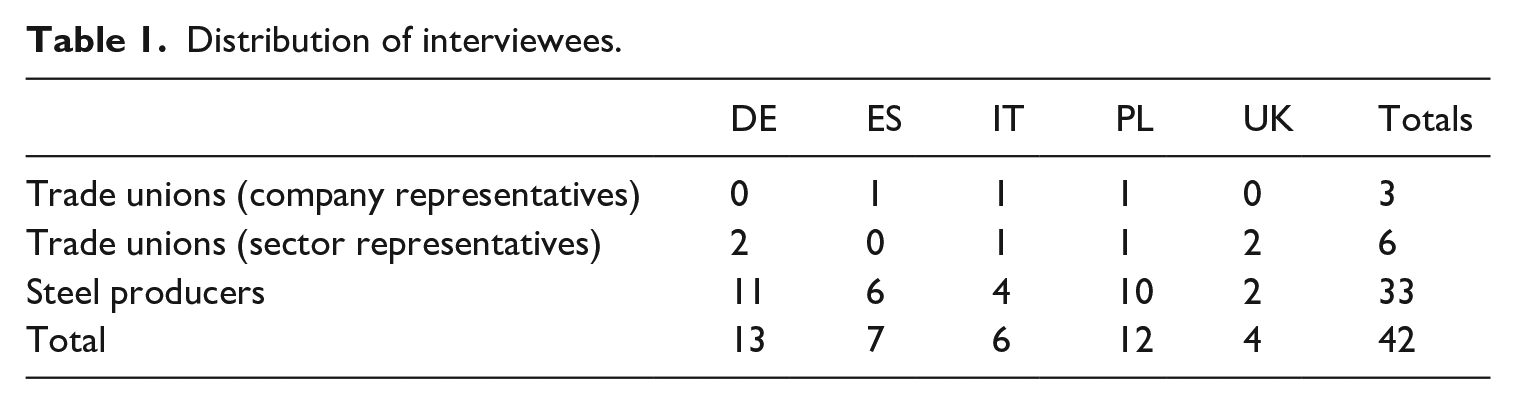
The study incorporates multiple stakeholder perspectives, including companies’ production managers and HR managers, employers’ associations as well as union representatives (company and sector reps, see Table 1). We acknowledge that interviews conducted with managers would not allow direct insights into workers’ daily practices, but the circumstances of the project did not permit us to conduct interviews directly with workers. Nevertheless, we take the view that training, HR, production managers and, to some extent, union representatives can offer a bird’s-eye view of the changes occurring in the workplace and related training needs. Production and HR managers, for example, hold crucial positions in the companies, overseeing day-to-day practical and strategic activities, and participating in decision-making processes, and thus we considered these types of respondents adequate to the aims of the study. Union representatives’ views helped to acquire insights into what workplace developments vis-a-vis new technologies might mean for those they represent.
We acknowledge, however, that an imbalance in the number of interviews conducted with company representatives limits an effective investigation of the tensions between employers and labour that may emerge from the developments we discuss. As it was, with what data were available we note and report a convergence of views, rather than divergence – even if a basis for conflict is likely produced. Hence, whilst more labour data might have produced different outcomes, what we report in what follows are consistent and shared assessments on the direction of, as well as the effects of, technology on tasks and jobs from the different stakeholders.
Finally, we acknowledge the differences in national institutions and patterns of industrial relations across the five countries. However, as the aim of this study is not to compare the case study countries but rather to illustrate common trends across the sector, we do not address such differences in our analysis (see, for example, Bechter et al. [2012] for a similar account when discussing industrial relations across the sector).
Findings
In this section of the article, we draw on our data to discuss our findings. We reflect on the technological transformation of the European steel industry, before discussing how workers come to complement the insertion of Industry 4.0 technologies rather than be substituted by them and how transversal skills play an increasingly important role in the tasks steelworkers perform. We then provide a brief summary overview.
Automation and digitalisation in the steel industry
The European steel industry has undergone over the past decades a process of restructuring and technological innovation, which has also had consequences for the skills profile of the workforce (Stroud and Weinel, 2020). Of late, there is evidence of Industry 4.0 penetration across the sector (Murri et al., 2021), but our interviews show that its extent differs from site to site, and from country to country. Despite such differences, it is still possible to sketch out the more general trends with regard to Industry 4.0 across the sector as evidenced by our cases. Stakeholders at the European level and from different sides of the employment relationship describe the sector as still uneven in technological terms, but nevertheless highly digitalised and automatised: Steel is a sector that has already advanced considerably on its digitisation agenda. (Producers’ Association, Europe. Questionnaire response) You might have one company that has already made a lot of changes [. . .] You might have others who’ve done no digitalization, and they’re not prepared [. . .] The feedback we’ve got from a lot of our steel experts is the sector has already been digitized quite a lot already. (Trade Union Representative, Europe)
The familiarity with automation was indeed confirmed by other interviewees, as well as the various levels of sophistication present in the different sites. Two of the most important drivers of automation in the industry appear to be performance enhancement and reliability: Familiarity with automation is intrinsic to the steel industry, at least from what I’ve seen over the last 35 years. Every 20 years or so, the plants are modernised, mainly due to the unavailability of spare parts. The size and energy involved tend to make automation levels basic, but this is not true everywhere [. . .] Obviously the reliability criterion applies, I automate to improve performance and reliability. (Production Manager, IT)
What has certainly come with Industry 4.0, is the volume of data and the capacity to analyse them and derive valuable information from any process in which data are captured. Indeed, thanks to more advanced sensors and measuring technologies, many more data sources are now embedded in the various processes that make up the companies and a vast amount of data becomes available for real-time, as well as historical, analysis: You need more sensors for sure but also as I have shown you before a lot of the sensors are already integrated into the new technologies we use. When I look at new technologies then sensors belong firmly to this category. (Head of Training Centre, DE) Data collecting in general. . . Analysis with AI of all these data. There is an algorithm that reaches conclusions with AI and supports the decision-making process [. . .] Now the priority is to collect as many variables [data] as possible. (Rolling Mill Manager, ES)
Thanks to these new developments, the volume of information produced in real-time, and from different sources across the sites, offers the companies many more opportunities to act and improve their processes: We have experienced years, or better decades, of technological change [. . .] we now have data, we can collect them, analyse them, act on the data [implement changes] and that is the great advantage we have now. (Head of Training Centre, DE)
Data generation and capturing are also used to improve the reliability of systems, offering the opportunity to implement predictive maintenance models, which reduce the risk of system failures: There is another very important area, which concerns the command and control of machines. So, all the new technologies that serve to improve the control of machines, and thus make them much more robust and reliable, which also involves predictive maintenance. (Automation Manager, IT)
Another area in which Industry 4.0 technologies can be found in steel companies is that of quality assurance, for instance in the case of defects detection of rolled steel: We are making big investments in one of the company’s great values, which is product quality. Here we have installed various technologies, some of them very sophisticated, such as automatic image recognition, which recognises a millimetre of scratch on a tape running at a speed of 10 m/s, on various machines. (Automation Manager, IT)
Robotics is another aspect that is gradually being integrated into steel production: [Recently we have had] the introduction of ABB robots [. . .] the labs have implemented quite a new automation system. So, automation is obviously a key thing within the works. (Company Training Advisor, UK)
What is evidenced here is that the European steel industry is progressively moving towards Industry 4.0 with firms starting to make use of Internet of Things (IoT) 3 solutions, advanced automation, sensors and big data analytics to improve energy efficiency and resource management, as well as quality monitoring and defects detection (see Murri et al., 2021). These general trends set the background on which our discussion of the conceptual relationship between routine and automation, and the subsequent implications for jobs and skills, is contextualised.
Substitution vs complementarity
As shown in the previous section, the steel industry (like many other manufacturing industries) is not new to the automation of what are considered simple routine tasks when this is economically convenient. While this might reduce the number of workers employed in certain areas (cf. Stroud and Weinel, 2020), there is the also potential for it to increase the complexity of those roles (Pfeiffer, 2015). The question then is the extent to which workers can easily adapt to changed tasks and processes: There will be simplifications of work but at the same time there will be more complex and difficult tasks and the simple work will increasingly be automated because, slightly exaggerated, the simple and the complex tasks incur the same costs [when humans are involved] [. . .] but I believe that for us the advantage is that our people are much more holistically trained and are therefore far more flexible in their response to new developments and changes. (Head of Training Centre, DE)
Hence, it is more likely that the qualitative role of workers has increased with automation, thus challenging the idea of deskilling (Pfeiffer, 2016). Where simple (or routine) tasks will be replaced by robots, or algorithms, new requirements will emerge, particularly in supervision, analysis and maintenance. The underlying question is not whether entire occupations will be replaced by technology, as was assumed by studies such as that of Frey and Osborne (2017), but in what way the automation of specific tasks (Arntz et al., 2017; Dengler and Matthes, 2018) will reconfigure existing jobs.
Our interview data point to the need for more holistically trained workers that can easily adapt to technological changes within the companies providing some sectoral evidence of upskilling: We are working in the direction of a multiskilled workforce [. . .] they are involved in training programmes so that a worker will be able to work in lamination, but also in other parts of the production, and also be able to do some of the maintenance. (Human Resources Officer, ES)
On an empirical level, the relationship between task automation and substitution, we argue, is of a non-linear type, and workers’ displacement should not be assumed on the mere basis of task automation. The extract below illustrates our point. The automatic defect detection of rolled products is a good example of both Industry 4.0 technologies and an apparently simple routine task that has been automatised. However, the automation of this task does not rule out human supervision, which requires not only a thorough understanding of the product and its possible defects, but also a good understanding of the technology used (i.e. classification algorithms) and both its capabilities and downsides: The technology is easy, it’s up and running. But then you need someone who understands the phenomenon and makes the machine understand what it has to do. [. . .] And that he [sic] understands that if I continue to show it a certain defect, which in reality is not important to me, the system begins to think that that defect is important, and therefore spends much more energy of calculation on that defect compared to another thing that was perhaps important. (Automation Manager, IT)
This example shows how a task that could in principle be entirely replaced by a digital device requires still in practice the contribution of human workers. Another interviewee from a different company remarked that, while an entire part of the lamination process was due to be almost entirely automatised, the final segment of quality control was still to be performed by workers to ensure the expected standards of the product: The lamination will be almost completely automatized. And it will be supervised by technical operators there in the line. However, the quality control of the final product will not be automatized. As I said, we produce high quality special steel, so if we will find some problem in the final part of the product, this is going to be reworked and this part is not going to be automatized, this will still be manual. (Human Resources Officer, ES)
Another response underlined how workers need to possess enough understanding of the process to be able to refuse the suggestions given by the machine, if it is not appropriate to the specific situation: It requires more depth to refute suggestions that the machine makes to you, it requires a better awareness of the production environment and communications as well. (Steel Producers’ Association, ES)
The importance of contextual knowledge and practical experience was remarked several times by our interviewees, from both worker and employer representatives, and directly associated with technological developments. Contextual knowledge and practical experience help to make visible that very human contribution that ensures that automatised tasks run smoothly: In the rolling mill or in the smelting furnace, everything is automated and what the worker has to do is a good analysis of the data. And then, with this data analysis, he [sic] has to transfer the solutions to unforeseen events and problems by modifying these data, these parameters, to how they should produce in practice. For me, good data analysis and the ability to translate the data into real production is fundamental. (Trade Union Representative, ES)
Here, workers are required to make sense (which is an inherently polimorphic action) of the data they are presented with by machines and digital devices and to project them onto real-work situations, and act upon them accordingly.
Transversal skills
Previous research conducted in the manufacturing industry in the context of Industry 4.0 found that the ‘mastering of networked systems with decentralised intelligence, the ability to deal with data and their analysis as well as the ability to safeguard a flawless operation of the plants count among the most important requirements for work on production sites’ (Spöttl and Windelband, 2021: 42). Likewise, our data show that in the steel industry the shift from the previous forms of automation to current Industry 4.0 applications requires transversal skills to a much greater extent, along with those technical skills that are always relevant to the sector (metallurgy, mechanics, electronics, etc.).
The skills discussed include communication, problem-solving, critical thinking, leadership, teamworking, data analysis skills and so on. As underlined by a representative of a European steel producers’ association: With high probability, the work in Industry 4.0 will provide to all employees significantly higher complexity, abstraction and problem-solving requirements. In addition, employees are demanded for self-organization, a very high degree of interdisciplinary, self-directed action, communicative skills and abilities. (European Producers’ Association)
Research by the current authors has previously pointed out the need for higher technical skills (especially in engineering, material sciences, physics, chemistry and IT) in the steel industry, which should be integrated with transversal skills to cope with fast-changing workplaces and to navigate the industrial transformation (Antonazzo et al., 2023). Similar considerations have been offered by our interviewees: Technical competences will be very important, as the physical, chemical and mechanical processes won’t change. So, we need to train well our pupils and workers on that. But also we realised in our company that we need to offer some training on soft skills, such as communication, problem solving, team-working, because they work in a team and well managed interaction is very important to work properly. (Company Training Officer, PL)
The importance of transversal skills in the context of Industry 4.0 appears twofold: on the one hand, it allows dealing with the technical and organisational changes that companies are undergoing; on the other, it provides the basis for lifelong learning: Regardless of whether we are moving towards Industry 4.0 faster or slower, soft skills will certainly be necessary to organize the company’s work. . . The current technical progress and process automation require employees to learn and improve their qualifications practically continuously throughout their professional career [. . .] Thus, the employer will expect employees to have the skills to continuously improve their professional qualifications. (Head of Personnel Development, PL) The core, and this is the core of occupational education, is to develop personal and social competences. Because if we have developed those then people are in a good position to acquire other kinds of competences, knowledge and skills on their own. (Head of Training Centre, DE)
The research conducted within the scope of our project has led to the identification of 10 specific skills areas that are needed to better cope with digitalised and automatised steel production sites: adaptation to change, advanced engineering, communication and connectivity, data analysis, digital skills, IT skills, metallurgical skills, problem-solving and critical thinking, process knowledge and teamwork. It is easy to note in this list the recurrence of transversal skills, along with more technical ones, by our interviewees and respondents. In fact, what it currently means to be a skilled worker in the context of Industry 4.0 in the European steel industry (and by extension the manufacturing industry in general) is changing in ways that question the ‘deterministic’ assumptions of routine and non-routine work, as well as claims for human replacement by technology.
Summary
The findings presented in this section allow some critical reflection on the literature reviewed. First, the distinction between routine and non-routine tasks as proposed by Autor et al. (2003) and employed in many influential forecasting exercises does not appear to apply in a clear-cut manner to our steel industry data. The interviews with the company representatives highlight that while there is certainly a tendency to automate and digitalise steelmaking processes and tasks that are strenuous, repetitive or costly, there is yet no evidence of a linear substitution of workers. The examples provided for defect detection of rolled products and quality control point instead to a complementarity between the capabilities of the technology and the experience, contextual knowledge and judgement of the workers. For instance, what some of the quotations illustrate is what Ribeiro and Collins (2007) referred to as the polimorphic action of choosing levels of tolerance, which is highly contingent and requires a degree of experience and contextual understanding.
Second, workers’ experience as well as tacit and contextual knowledge appear indeed to play an important role in the transformation of the steel industry. Our data lend support to claims that a quantitative reduction in sheer numbers will be accompanied by an increase in the qualitative role of the workers (see Pfeiffer, 2016). Our data also support Ribeiro and Collins’s (2007) critique of the deskilling nature of technology.
Third, what Barley (1996) noted as critical features of modern workplaces, i.e. the need to connect material, symbolic and social domains and to be capable of translating one into the other, appears to be even more evident nowadays. While in the work of Barley this was associated mainly with the role of technicians, the reported remarks from the steel industry representatives show instead that this is becoming a feature also of operator roles which are required to be able to translate data (symbols) into material outcomes at the production level.
Fourth, the integration of transversal skills in technical and operational roles which was already noted by recent studies on technological advancement and skills needs (Hecklau et al., 2017; Liu and Grusky, 2013; Spöttl and Windelband, 2021) finds evidence also in our sectoral data. This can be explained based on the previous consideration on translating between different domains (material, symbolic, social), but also as a consequence of flatter and more flexible organisational models and with the need to constantly adapt to changing technologies and innovation in production methods. Indeed, as remarked by our interviewees, transversal skills seem to play a critical role in supporting continuous learning.
Discussion and concluding remarks: ‘Deterministic’ and ‘probabilistic’ technological approaches
By way of discussion and conclusion, and drawing on the data and arguments presented, we advance here a more general argument about the particular character of digitalisation and automation on which Industry 4.0 is based (within the context of a ‘traditional’ heavy industry sector rapidly adopting, and adapting to, the new digital technologies).
We maintain that Industry 4.0 applications were preceded by technology more ‘linear’ in character, based on mono-directional relations between work and technology (e.g. Fordism). We acknowledge, however, that the very idea of Industry 4.0 as a discontinuity with the past is highly contentious. Some see it as a mere evolution of the applications of ICT and automation to manufacturing (Lee and Lee, 2021; Nuvolari, 2019), while others insist firmly on the revolutionary character of Industry 4.0, which builds on the previous digital revolution, but is characterised by a ‘more ubiquitous and mobile internet, by smaller and more powerful sensors that have become cheaper, and by artificial intelligence and machine learning’ (Schwab, 2016: 12). In their review, Rossit et al. (2019) see Cyber-Physical Systems (CPS) as the essential component of Industry 4.0. Salient characteristics involve the decision-making process in production settings, endowing CPS with the ability to respond, autonomously and flexibly, to various events.
Our understanding of the above debates is that, while previous technologies were designed to execute a predefined and static sequence of instructions, the current technological paradigm is powered by algorithm-based forms of Artificial Intelligence. These algorithms can process data, identify patterns and generate their own set of instructions to guide the different production processes in a flexible and adaptive manner. This argument is consistent with Susskind’s idea of ‘routinisability’ (2019), but it leads us to very different conclusions. If technology is now undermining the distinction between routine and non-routine tasks thanks to its capacity to learn statistically and infer rules, it requires a much more cautious supervision by well-trained workers that can understand the logic of AI as well as the processes in which they operate and lead the technology to the opportune outcomes. Thus, we maintain that the potentially deterministic relationship between routine (or routinisability) and substitution, as suggested by the earlier work of Autor et al. (2003), and by Frey and Osborne (2017) and Susskind (2019), does not hold up to qualitative scrutiny.
To clarify this contrast between the two approaches, in Table 2 we draw on Lee and Lee’s (2021) review of enabling technologies to propose a distinction between what we call the ‘deterministic’ character of pre-Industry 4.0 technologies (e.g. Semiconductors; Mainframe Computing; Personal Computing; the Internet) and the ‘probabilistic’ character of Industry 4.0. The distinction we propose here intends to clarify the extent to which human contribution in the two different technological settings is needed, as well as the different type of skills required.
Automation in industry: pre-Industry 4.0 and Industry 4.0.
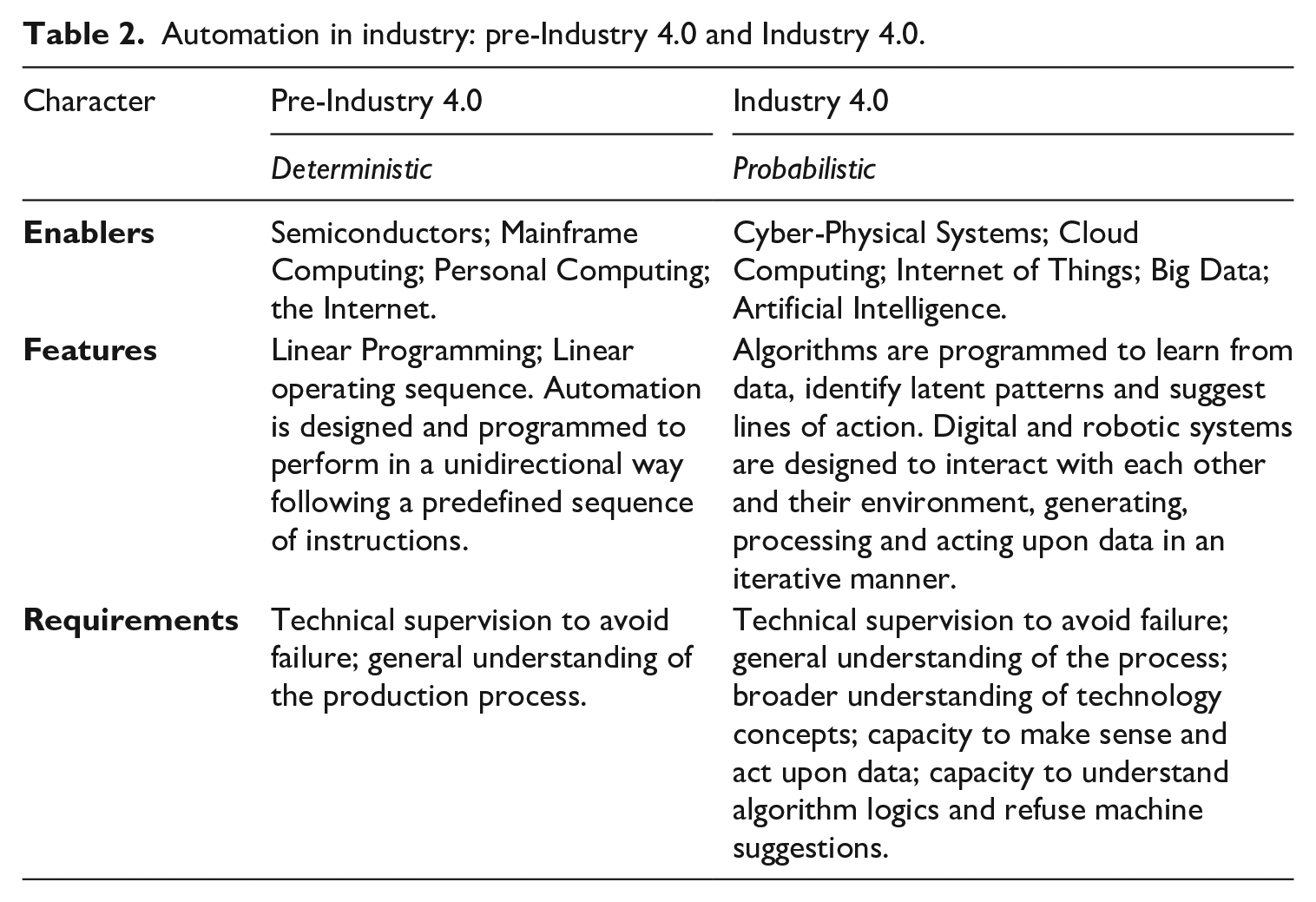
The European steel industry, like other manufacturing industries across Europe, is experiencing a significant degree of technological change. Our contention in this article is that anticipated levels of technological unemployment, particularly in relation to so-called routine work within the industry are unlikely to transpire because of the ‘probabilistic’ features of technology advancements. Indeed, as Stroud and Weinel (2020: 311) have commented on the steel industry specifically, ‘upskilling’ is an anticipated benefit and the ‘issue is not job loss . . . [which] seems unlikely of these understaffed factories . . . In contrast . . . the scope is for increased recruitment as the anticipated “effect”, even for routine manual work.’
In the light of the considerations outlined above on the different character of deterministic and probabilistic technologies, and of our empirical findings within the European steel industry, we argue that scholarly debates need to move beyond a dichotomic categorisation of tasks. Our investigation of Industry 4.0 applications in the steel industry shows that only in a limited number of cases did automation of (presumed) routine tasks deterministically lead to workers’ substitution. More often, we found that what would be considered routine and non-routine tasks are tightly coupled and that human–technology complementation is a frequent approach to improving production processes.
Hence, we argue that a potentially more effective approach to addressing the impact of technology on jobs would be to conceptualise tasks as a continuum, rather than a dichotomic categorisation. One way to comprehend this is by considering a range of tasks, starting from those that are strictly based on logical computation, codified sequences and identifiable patterns, and gradually progressing towards tasks that encompass various types of non-linear behaviour (see Figure 1). As we move along this continuum, tasks are expected to increasingly deviate from standardised sequences, and to require interpretation, judgement, contextual and technical knowledge, and a broad array of transversal skills. For analytical purposes, the tasks continuum can be divided into four segments: (a) tasks that are entirely automatable and can lead to workers’ substitution; (b) tasks that are mainly characterised by monitoring automatised process; (c) tasks that increasingly require systematic human intervention to support automatised processes; and (d) tasks that are led by human operators with the aid of technology.
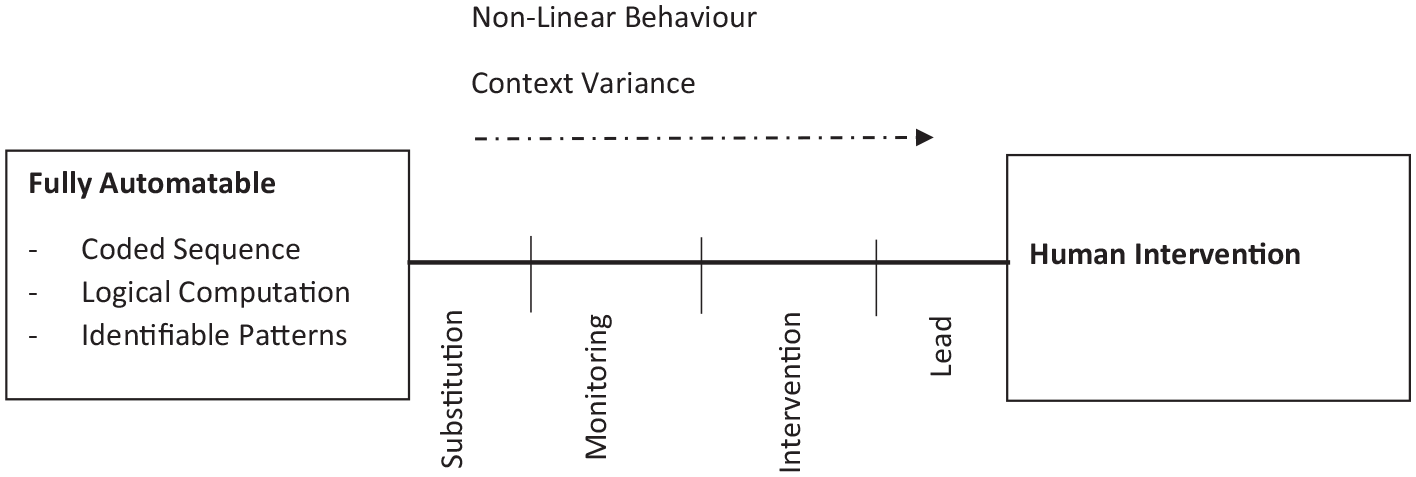
Task continuum.
In the reality of many workplaces, as our steel industry cases showed, many tasks and jobs seem to hardly fit in their entirety the routine/non-routine categories, and instead seem to sit somewhere along this continuum. Overcoming a dichotomic approach in favour of a continuum can help to investigate more nuanced transformations of current jobs and workplaces by assessing how tasks gradually open up to non-linear behaviours and human intervention as we move along the continuum.
The more the digitalised, interconnected, multi-layered systems derived from the Industry 4.0 paradigm are integrated in the different areas of steel production, the greater the need for human understanding, evaluation and supervision. In such a context, we argue, transversal skills play a crucial role as these are properly those skills that allow human beings to perform all those non-routine/unroutinisable/polimorphic actions that require a great deal of interpretation, critical thinking, problem-solving, communication, negotiation and so on. While, as Susskind has noted, new technologies make a higher number of tasks routinisable thanks to their capacity to compute, to recognise patterns and to generate their own rules, it should not be overlooked that such technologies, often powered by algorithms and AI, still cannot effectively manage complexity and unpredictability, and would fail where interpretation and judgement are needed (Pettersen, 2019).
Hence, while the definition of routine tasks, as tasks that can be completely broken down into a sequence of ordered actions that lead to a certain result (Autor et al., 2003), helps to understand the process through which automatisation can be achieved, in accordance with Pfeiffer we maintain that it can lead to distorted results when it comes to forecasting exercises. Such results are often used uncritically to generate quantitative labour market projections and gloomy claims about the ‘end of work’ that overlook the emerging material realities of work and employment, as we and others find. It is evident that susceptibility to automation does not mean that automation is going to be the immediate choice of companies in the short run, since this is also based on economic calculations that are highly context dependent (Lloyd and Payne, 2019). Further, as qualitative research shows, while automation might at some level impact on the number of workers needed for each particular role, the automation of specific tasks or full processes does not rule out the need for human workers and, indeed, workers skilled in different and more complex ways when compared to past technological eras. Indeed, our data suggest that unions and employers hold a shared perspective on the general direction of such developments – what this article does not address is where conflicts will likely emerge between the different stakeholders on how to appropriately address and manage the technology effects discussed (see Edwards and Ramirez, 2016).
Footnotes
Declaration of conflicting interests
The authors declared no potential conflicts of interest with respect to the research, authorship, and/or publication of this article.
Funding
The data for the article derives from the European Steel Skills Agenda project, which is funded as part of the Erasmus+ Programme of the European Union (Key Action 2-Cooperation for innovation and the exchange of good practices) Agreement Number: 2018-3059/001-001, Project Number: 600886-EPP-1-2018-1-DE-EPPKA2-SSA-B. Access to project data is available through the project website: 