




Abstract
Incorporation of information literacy into the Science, Technology, Engineering, and Mathematics (STEM) curriculum can be a challenge for academic librarians, in part due to different terminology than used by disciplinary faculty colleagues. Aligning terminology used in information literacy frameworks with the scientific method can provide a means of demonstrating the role of information literacy in STEM research. This paper maps the knowledge practices of the Association of College and Research Libraries Framework for Information Literacy in Higher Education with an example of the scientific method. The resulting map provides an alignment of the different terminologies being used and visualizes the role of research skills throughout the process of conducting scientific research.
Introduction
Librarians on college campuses often struggle to incorporate information literacy into the science and engineering curriculum. Most information literacy instruction takes place in classes aligned to the humanities and social sciences. However, student and faculty researchers in Science, Technology, Engineering, and Mathematics (STEM) disciplines also need to develop and use effective research habits and skills. Inconsistent terminology between librarians and STEM faculty makes communicating the value of information literacy a significant challenge. Aligning the language used by library science professionals to that of STEM faculty can bridge this gap and help explain the value of information literacy instruction.
This paper maps the Association of College and Research Library’s (ACRL) Framework for Information Literacy in Higher Education to an example of the scientific method. The map produced can be adopted by science and engineering libraries for use in instruction development and communication about information literacy. The exercise of mapping information literacy terminology to a commonly accepted scientific framework will help librarians align their language to that of faculty and students on campus. It will also demonstrate the role that research skills and habits play throughout the process of scientific work. This study seeks to address the following research question – Can information literacy standards be mapped to the scientific method to align terminology used by librarians with that of professional scientists and engineers? This paper proposes a method of combining information literacy language and scientific method language to explore the implications of this alignment in academic libraries.
Literature review
This project lies at the intersections of science literacy and information literacy. According to the American Association for the Advancement of Science, a “science-literate person is one who is aware that science, mathematics, and technology are interdependent human enterprises with strengths and limitations; understands key concepts and principles of science; is familiar with the natural world and recognizes both its diversity and unity; and uses scientific knowledge and scientific ways of thinking for individual and social purposes” (Rutherford & Ahlgren, 1990, p. introduction). Information literacy, as defined by ACRL is “the set of integrated abilities encompassing the reflective discovery of information, the understanding of how information is produced and valued, and the use of information in creating new knowledge and participating ethically in communities of learning” (Association of College & Research Libraries, 2016). Aspects of information literacy are connected to science literacy as researchers use existing scientific knowledge as a foundation to build upon in their own work.
There has been some discussion in the literature regarding the intersections of information literacy and science literacy (Klucevsek, 2017). Many researchers explore the ways that both skillsets can enhance student learning, especially early in the undergraduate curriculum (Knight et al., 2021; Pan et al., 2021; Podgornik et al., 2017; Porter et al., 2010). In their study at the University of Ljubljana, Slovenia, Podgornik et al. explored the impact that previous science literacy (SL) instruction would have on a student’s information literacy (IL) skills and found, “The positive correlation between the students’ achievements in IL and SL confirms the existence of parallels between the ACRL IL standards, performance indicators and outcomes, and the SL competencies specified in PISA 2006” (2017, p. 3888). Of note, some of the literature explores science literacy and the scientific literature from a disciplinary perspective (Jurecki & Wander, 2012; Krontiris-Litowitz, 2013; Sloane, 2021). Librarians will recognize the concepts explored, even without an explicit focus on information literacy terminology. In their study, Krontiris-Kitowitz of Youngstown State University in Ohio, USA, found “the student, acting as an independent learner, practiced literacy skills to read an article, interpret data, write a conclusion, and gain knowledge from the scientific literature” (2013, p. 76). This perspective is important for librarians to consider because it can provide insight into the experiences of disciplinary faculty who incorporate research skills into their teaching.
Information literacy standards or frameworks are often used to guide the design and assessment of individual information literacy lessons. They can also be used on a programmatic level to scaffold and assess a cohesive instruction program. Mapping can be used on a large scale to align an entire curriculum to a framework or institutional goals (Archambault & Masunaga, 2015; Witek, 2016). It can also be used on a smaller scale to focus on engagement with a particular department or discipline (Franzen & Bannon, 2016; Webb, 2020; Ziegler, 2019). In addition to self-assessment and curriculum planning, curriculum mapping and alignment to information literacy frameworks is a valuable communication tool for librarians. In their study, Buchanan et al. used multiple approaches to curriculum mapping at various institutions in North Carolina, USA. They found, “Ideally, curriculum maps will inspire conversations and collaborations with colleagues, teaching faculty, and administrators to strategically integrate information literacy instruction into the academic curriculum” (2015, p. 110). In another study, Charles at Rutgers University in New Jersey, USA, found that the development of maps and alignment of curriculum increased communication with stakeholders and intentionality in the work completed by librarians (2015). While mapping has received increased attention in the library literature in recent years, mapping information literacy frameworks to tools or models prominent in specific disciplines, such as the scientific method, has not been widely studied.
The application of the ACRL Framework in a variety of contexts has been explored widely in the literature (Hsieh et al., 2021; Latham et al., 2019). In recent years, the focus of the literature and academic librarians has shifted to application of the Framework in specific disciplines. Companion documents have been drafted for a variety of disciplines including journalism, social work, and sociology (Association of College and Research Libraries, 2018). In July 2021, the ACRL Science and Technology Section released a companion document for the Framework focused on research in STEM (ACRL/STS Information Literacy Framework Task Force, 2021). It was crafted to complement the Framework and provide STEM-focused language in the knowledge practices and dispositions.
There has been increasing exploration in the literature regarding methods for communicating the value of information literacy and the concept of information literacy frameworks to STEM faculty in higher education (Cope & Sanabria, 2014; Guth et al., 2018). A significant portion of the literature utilizes case studies to explore integration of information literacy into the STEM curriculum (Bohémier, 2019; Carroll et al., 2017; Rutledge & LeMire, 2017). Course integration is an important first step that depends on communication and finding common ground with disciplinary faculty and can, over time, be expanded to include discussion of information literacy frameworks. Some researchers have taken the next step to engage with faculty on information literacy standards and their role in the classroom (Cope & Sanabria, 2014; Ford-Baxter et al., 2022; Guth et al., 2018; Kuglitsch, 2015; Manuel, 2004). At California State University, Los Angeles, USA, Ford-Baxter et al., found that “The phrase “information literacy” continues to be relatively uncommon in national [disciplinary] standards and PLOs [program learning outcomes] even when IL concepts are relatively abundant in national standards” (2022, p. 7). While the underlying concepts may be familiar to disciplinary faculty, academic librarians will need to reconcile differences in terminology to effectively engage with faculty about the role that information literacy standards can play in disciplinary studies. Additionally, using scientific methodology to find common ground with faculty has not been widely explored.
This paper will begin to fill gaps in the literature by proposing a method for aligning information literacy concepts with scientific terminology. This theoretical work can ultimately provide a point from which STEM librarians can engage with faculty and assess the overall composition of their information literacy program. It also can provide a prototype for applying lessons learned to other information literacy or science literacy standards.
Methodology
Examples used in mapping
The scientific method used in this study is a basic example of the method as a cycle (Fig. 1). The cyclical depiction was selected, as opposed to a linear depiction, because it most closely relates to the research lifecycle commonly used in information literacy instruction (Network of the National Library of Medicine, n.d.). The scientific method is itself a form of the research lifecycle that helps scientists and engineers navigate the process of obtaining new information. Both are iterative processes in which different steps are revisited as needed throughout the duration of the project. This particular diagram of the scientific method is a combination of two examples from the US Department of Health and Human Services and Wikimedia Commons (ArchonMagnus, 2015; Office of Research Integrity, US Department of Health and Human Services, n.d.). The two examples were combined for this project because both had elements that merited inclusion. The example from Health and Human Services included two steps of particular interest to librarians, Share Results and Search Literature. The Wikimedia Commons example contains a feedback loop that helps researchers to reflect after initial data collection. Reflection is a key aspect of academic research and the concept of meta-literacy lies at the core of the ACRL Framework. The combined scientific method used the Wikimedia Commons example with the feedback loop as the base with three additional steps, Search Literature, Share Results and Ask New Questions from the Health and Human Services example.
Scientific method cyclical diagram used in the mapping project.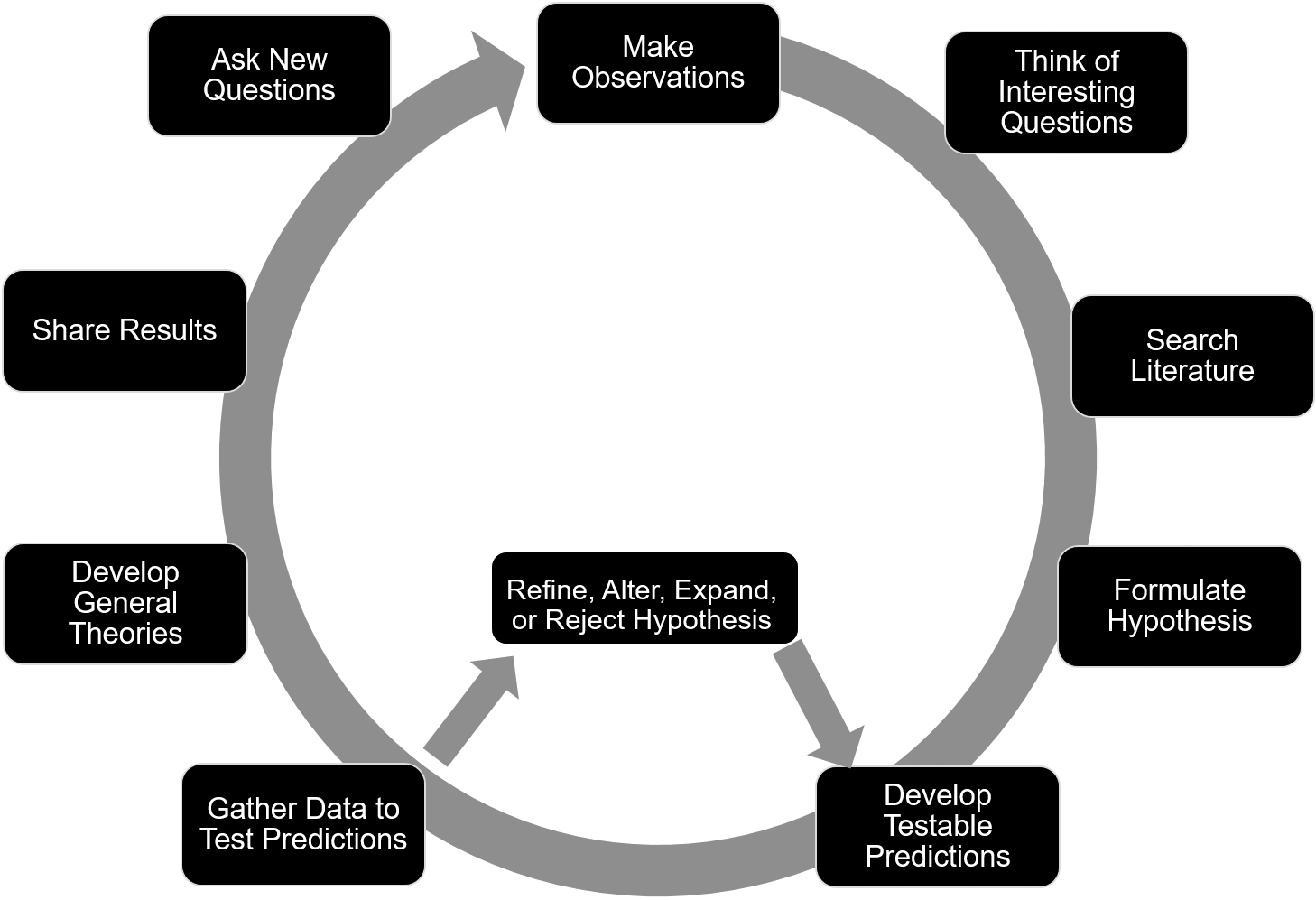
This paper uses ACRL’s Framework for Information Literacy in Higher Education adopted in 2016 as its example information literacy framework in the mapping exercise (Association of College & Research Libraries, 2016). The ACRL Framework was chosen because it is widely applied in academic libraries in the United States and beyond. It has officially been translated into multiple languages, including Chinese, French, German, and Spanish.
The Framework is designed to be broadly applied by focusing on the learner’s trajectory from novice to expert by drawing on the theories of threshold concepts and meta-literacy. Threshold concepts are “those ideas in any discipline that are passageways or portals to enlarged understanding or ways of thinking and practicing within that discipline” (Association of College & Research Libraries, 2016). Meta-literacy helps the learner reflect on their learning and build connections between concepts. The Framework is comprised of six frames that represent the breadth of information literacy. Each frame contains an introduction, knowledge practices (KP), and dispositions. The KPs, or skills practiced by the learner, are the focus on this study. They are written in the format of learning objectives, beginning with active verbs that can be directly used to design lessons and instructional content. The active voice in the KPs allow them to be mapped to the practical steps of the scientific method. The complete text of KPs by frame can be found in Appendix A.
The mapping process consisted of two steps. Initially, the knowledge practices of the ACRL Framework were mapped to the scientific method diagram independently by each author. This step resulted in three maps. The first step was done individually to capture nuanced understanding of the Framework based on the authors’ STEM and library experience. Each author brings a different academic and professional background to their information literacy instruction. They have varying levels of experience with the scientific method and its application in STEM disciplines. Two authors have an educational background in STEM, while the third is a humanities major trained in STEM librarianship after graduate school. Their experience in STEM librarianship range from one year to 30
The independent maps were completed manually using a print copy of the scientific method diagram. Each author was given stickers with code names corresponding to each of the 45 Framework knowledge practices (KP) and a spreadsheet with the language of the knowledge practices. For example, “transfer knowledge of capabilities and constraints to new types of information products” is the seventh KP under Information Creation as a Process, so it was given the code name ICP 7. As authors completed the independent maps, they noted any questions and reflections that arose. They were not required to use every KP if there were any that did not appear to fit the scientific method. They were also allowed to align a single KP to more than one step of the scientific method if appropriate. Ultimately, all three authors mapped all 45 KPs to at least one step of the scientific method resulting in 135 data points for analysis.
Then, the three individual maps were combined into a single map. Analysis was conducted to determine the level of agreement among the authors for each knowledge practice. Each KP was given an author agreement score depending on the number of authors who agreed on the placement of that KP. As Table 1 depicts, all three authors agreed on the placement of 11 KPs and had no agreement on 13 KPs. Partial agreement between two authors (where one author placed a KP between steps) merited a score of 1.5 and partial agreement between all three authors merited a score of 2.5. One example of a 2.5 score was “determine an appropriate scope of investigation” under Research as Inquiry (RAI 2). One author placed it on Formulate Hypothesis, another on Develop Testable Predictions and the third split it between both steps.
Author agreement scores
Author agreement scores
The 13 KPs that received an author agreement score of zero were discussed individually and consensus was reached among the authors as to placement on the scientific method. Discussion included reasons for selecting the chosen method step, the intention of that particular KP and its relation to the scientific research process. Once consensus was reached on the 13 KPs that had an author agreement score of zero, a complete map was created. Of the 45 KPs, 44 were placed on the scientific method and every step of the method had at least one assigned KP. The consensus steps were mapped to the image of the scientific method to create a cohesive map. Significant points of discussion and disagreements between individual maps were also noted for further exploration as a team.
The two scientific method steps with the most KPs are, perhaps unsurprisingly, Search Literature, and Share Results. The authors were unable to reach consensus on one KP, “make informed choices regarding their online actions in full awareness of issues related to privacy and the commodification of personal information”, under Information has Value (IHV 8). The resulting map (Fig. 2) demonstrates the feasibility of mapping an information literacy framework to the scientific method. See Appendix A for the complete text of KPs assigned to each step of the scientific method. The level of agreement on placement of the KPs varied considerably from frame to frame of the ACRL Framework. As Table 2 depicts, some frames had significantly more agreement among the authors than others.
Level of author agreement by frame of the ACRL Framework
Level of author agreement by frame of the ACRL Framework
Combined map of ACRL Framework knowledge practices and the scientific method.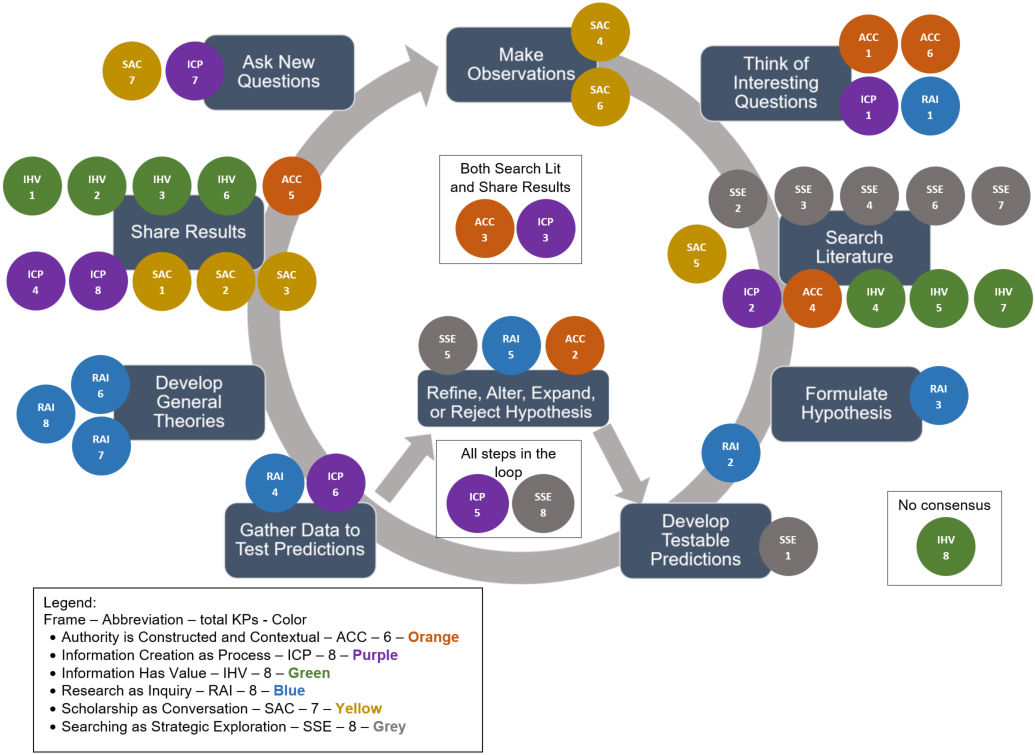
The authors had a high level of agreement on the KPs from three of the six ACRL frames. The three were Information has Value (IHV), Research as Inquiry (RAI) and Scholarship as Conversation (SAC). The frame with the greatest level of author agreement was Information Has Value at 77%. The authors were unanimous on the placement of five of the eight KPs for Information has Value and had only one with no level of author agreement. These frames contain many of the scholarly communications aspects of research, such as citation (IHV 1 and SAC 1), intellectual property (IHV 2) and literature review or source synthesis (RAI 7). They are significant knowledge practices for academic librarians working closely with STEM faculty and graduate students in research intensive institutions like the authors’ home institution. The KPs with the highest level of author agreement can be used to start conversations with research-active faculty about the role that information literacy standards align with the scientific method.
The authors were in less agreement about placement of KPs from the other three frames, Authority is Constructed and Contextual (ACC), Information Creation as a Process (ICP) and Searching as Strategic Exploration (SSE). The frame with the least level of author agreement was Authority is Constructed and Contextual with only 19%. Four KPs had no consensus, one received an author agreement score of 1.5 and one had two authors in agreement. These results raise the question – when should a researcher first consider authority? Further examination of the individual maps found each author favored a different step of the scientific method. One author placed most ACC KPs on Make Observations because authority should be considered at the beginning of the research process. Another author placed most ACC KPs on Search Literature. This could be considered a typical instruction librarian response, considering authority as sources are located and evaluated for use. The final author placed most of the ACC KPs on Gather Data to Test Predictions, emphasizing that authority should be considered when data and sources are being evaluated in relation to the hypothesis. Ultimately, in reaching consensus, four of the six ACC KPs were placed in the first three steps of the method. “Authority” should be revisited at each step in the process, because it is so highly contextual; after it has been established early in the scientific method.
Author agreement by step of the scientific method
The level of agreement on which KPs to place on each step of the scientific method also varied considerably. As Table 3 depicts, many KPs were placed by one author on a given step but few steps had a high level of author agreement. An author agreement score of 0.5 was used for KPs that authors split between steps. For example, one author split RAI 1, “Formulate questions for research based on information gaps or on reexamination of existing, possibly conflicting, information” between the Make Observations and Think of Interesting Questions steps. Each step received a score of 1 in the 0.5 column. Half of the steps had zero KPs with complete agreement from all three authors and only the Search Literature and Share Results steps had more than one KP with an author agreement score of 3.
Level of author agreement by step of the scientific method
Level of author agreement by step of the scientific method
Authors had the highest levels of agreement for three steps, Formulate Hypothesis, Develop General Theories, and Share Results; Share Results had the highest percentage of agreement (80%). Formulate Hypothesis and Develop General Theories both had few KPs placed on them, 6 and 9.5 respectively. They were among the steps with the fewest assigned KPs. Share Results, however, received a lot of attention from the authors both individually and collectively. It had 30 KPs assigned individually with 6 in complete agreement. The attention paid to that step aligns with the importance placed on publication at research intensive institutions. That step was ultimately the consensus location for 4 Information has Value KPs and 10 total KPs. This step could be the easiest point to begin discussions with faculty about the intersections of the ACRL Framework and the scientific method.
Author placement of KPs per scientific method step.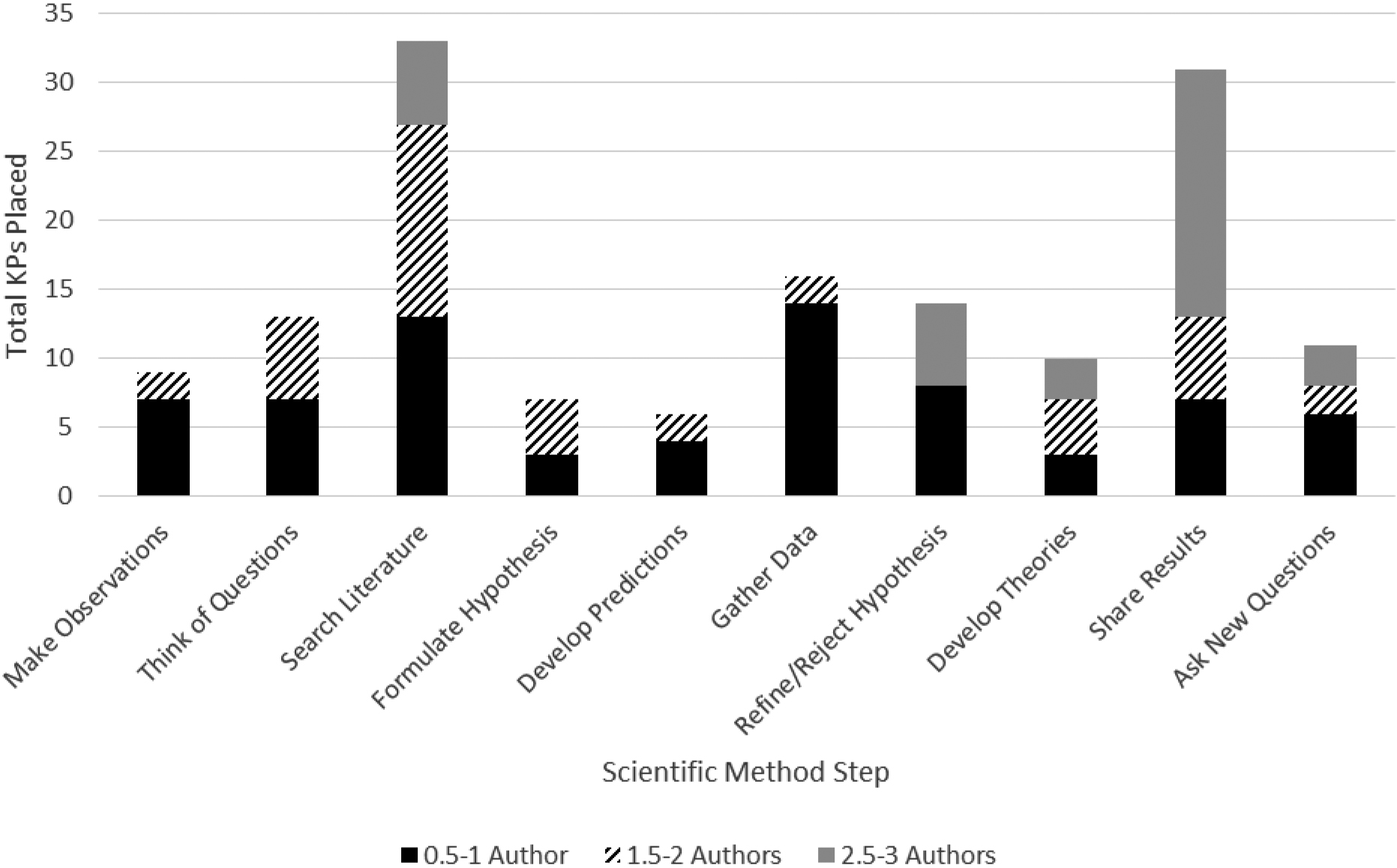
The step Gather Data to Test Predictions also received a lot of attention from authors, but little consensus on the KPs placed there. In whole or part, the authors placed 15 KPs on this step, yet all but one of those placements was not repeated by another author (Fig. 3). Only one KP, “Use various research methods, based on need, circumstance, and type of inquiry” (RAI 4) had the agreement of two authors. Ultimately, two KPs were assigned to this step, RAI 4 and ICP 6 “Monitor the value that is placed upon different types of information products in varying contexts.” The authors with a STEM educational background placed more KPs on this step, 5 and 7 KPs respectively. The author trained in STEM librarianship, but without a formal STEM background, assigned 2 KPs to this step. This disparity could be due to familiarity with the scientific method. It is a very important step in the process for researchers, and learning about both needs and barriers in that process could help librarians to find common ground with faculty.
This project developed after one of the authors used the scientific method to explain the research lifecycle to graduate students in a literature review workshop, demonstrating research as an example of the scientific method. The individual mapping steps pushed the authors to go beyond the scientific method as an example to the scientific method as a companion to information literacy concepts and standards. This leap proved difficult at times as the authors placed KPs along the scientific method steps. Both approaches to bridging information literacy terminology with scientific concepts can be useful for connecting with faculty and early career researchers like graduate students. Both can also demonstrate that information literacy skills and practices have a role in the scientific process without forcing disciplinary researchers to adopt the specific terminology of instruction librarians.
The 13 KPs that had no author consensus from individual mapping deserve attention and provide opportunities for engaging faculty in discussion about the alignment of the terminologies. They represent five of the six ACRL frames, with the exception of Research as Inquiry. More than half of the Authority is Constructed and Contextual (4 of 6 KPs) and Information Creation as a Process (5 of 8 KPs) received an author agreement score of zero in the individual mapping. These two frames, and their use in scientific research bear further exploration.
Placement of KPs with no initial author agreement
Seven of the KPs with a score of zero were ultimately aligned to a step identified by one of the authors. Elaboration of that author’s choice was sufficient to sway at least one other author to agreement. Only one KP was tagged to a scientific method step not identified in the initial mapping step. Initially, authors placed “Define different types of authority, such as subject expertise (e.g., scholarship), societal position (e.g., public office or title), or special experience (e.g., participating in a historic event)” (ACC 1) on three very different steps: Make Observations, Search Literature and Gather Data to Test Predictions. After discussion, this KP was aligned to the second step, Think of Interesting Questions. The authors decided that the definition of authority belongs between making initial observations and searching the literature, so it was placed on the step in between.
Only one of the 45 KPs was not placed in the map because authors were unable to reach any consensus on placement. Despite lengthy discussion, “make informed choices regarding their online actions in full awareness of issues related to privacy and the commodification of personal information” (IHV 8) could not be confidently assigned to any specific portion of the scientific method. Depending on perspective, and the type of researcher in question, this KP could be assigned to different steps. One author placed the KP early in the method, Search Literature. Their justification was that this step becomes the home for many library-focused concepts that do not really fit elsewhere; it was the best of several bad locations for that particular KP. Another author viewed the KP through the lens of confirmation bias and placed it on the Gather Data to Test Predictions step. Researchers need to be especially careful to not view their data in ways that confirm pre-established predictions. They need to critically evaluate found information online to avoid the trap of targeted search results and confirmation bias. The final author placed the KP late in the method, on the Share Results step, because they viewed it through the lens of a researcher publishing their own work. The commodification of information and privacy could relate to the protection of intellectual property and avoidance of predatory publishers.
KPs placed between multiple steps of the scientific method
The first two KPs, ACC 3 and ICP 3, were split between the Search Literature and Share Results steps. They were “understand that many disciplines have acknowledged authorities in the sense of well-known scholars and publications that are widely considered ‘standard,’ and yet, even in those situations, some scholars would challenge the authority of those sources” (ACC 3) and “Articulate the traditional and emerging processes of information creation and dissemination in a particular discipline” (ICP 3). Both KPs received an author agreement score of zero in the initial mapping. Their placement could be debated depending on the objective of the product examined. When examining authorities and creation processes used by other authors in a field, both would be placed in Search Literature as part of the search activity. When examined introspectively as establishment of one’s own authority and or publication choices, both would be placed in Share Results as part of the publication activity.
The placement of KPs like the two above on either Search Literature or Share Results is heavily influenced by the librarian’s goals for their program, and the needs of their institutional community. More specifically, librarians need to consider how that KP is being used, or could be used, in their program. For example, are you helping a novice researcher understand that disciplines have acknowledged authorities? Or, are you helping a more advanced researcher to establish their own authority in their discipline by placing their work in well-respected journals? These goals provide two different starting points for conversation with faculty depending on the needs of the researcher.
Two KPs were placed in the middle of the scientific method’s feedback loop encompassing Develop Testable Predictions, Gather Data to Test Predictions, and Refine, Alter, Expand or Reject Hypothesis. They were “recognize the implications of information formats that contain static or dynamic information” (ICP 5) and “Manage searching processes and results effectively” (SSE 8). Both received an author agreement score of zero in the initial mapping. Both KPs are aligned closely to concepts of research data management, a process that is established and used in all three steps of the feedback loop. These two KPs can be revisited at each step of the loop as researchers develop testing methods, gather data and review that data.
One KP was placed along the continuum between the Formulate Hypothesis and Develop Testable Predictions steps. RAI 2, “determine an appropriate scope of investigation” was used in the methodology section as an example of a 2.5 author agreement score. There was a high level of author agreement that determination of project scope is developed and solidified in both these scientific method steps. It can also be discussed in conjunction with the KPs placed on each of the steps to communicate with disciplinary researchers about the hypothesis and experiment set up stages of the scientific method. The KP on Formulate Hypothesis, “Deal with complex research by breaking complex questions into simple ones, limiting the scope of investigations” (RAI 3) helps researchers to consider the scale of their inquiry. Then, RAI 2 can be used to help determine the scope of the experiment that will be used. Finally, “Determine the initial scope of the task required to meet their information needs” (SSE 1), placed on Develop Testable Predictions, helps researchers to formulate an experiment that will test their refined, specified research hypothesis. Explaining these three KPs in terms of science literacy and experimental design can help to reconcile information literacy terminology with that of disciplinary faculty.
Conclusions and future research
Returning to the original research question, it is possible to create alignment between the knowledge practices of the ACRL Framework and concepts used in the scientific method to bridge terminology used in information literacy instruction with that of STEM researchers. The resulting map provides a basis for further discussion both in the library profession and with faculty. The Search Literature and Share Results steps can be a starting point for those discussions. These steps had both the greatest number of assigned KPs and the highest levels of author agreement on KP placement. The inability to confidently place IHV 8 within the scientific method illustrates the need to consider different levels of understanding or researchers and institutional contexts when using this map to foster discussions on campus. However, use of the combined framework to foster discussion beyond the library will require some interpretation of KPs in relation to local contexts and needs.
The complete mapping between the ACRL Framework and the scientific method example can be used to engage with faculty and students across disciplines to communicate the value of information literacy instruction. The methodology can also be used to map other national and international standards to various depictions of the scientific method. The mapped framework will need to be validated by librarians and ultimately by STEM disciplinary faculty to ensure it can adequately serve as a bridge between the differing terminologies.
This study provides a proof-of-concept for aligning terminology from STEM disciplines with that of information literacy. It focuses on just one information literacy framework used in higher education. To more broadly encompass science literacy and information literacy, it should be expanded to include additional frameworks. First, the methodology should be used to map the scientific method to other significant international information literacy standards, such as UNESCO’s Global Standards for Media and Information Literacy Curricula. While the UNESCO standards are not specific to higher education, they are widely used at institutions around the world.
Another future focus of the research should be to consider the role that science literacy frameworks can play in the bridging of terminology and discussions with faculty. Science literacy frameworks, such as the PISA 2015 Assessment and Analytical Framework, are largely focused on primary and secondary education settings (Organisation for Economic Co-operation and Development, 2017) as opposed to higher education and more advanced research. This different focus could make aligning them to standards like the ACRL Framework more difficult. However, to connect with faculty working at lower undergraduate levels, applying our methodology to significant science literacy frameworks will be a necessary step in future stages of research. It can also be used in discussions related to the transfer of skills from secondary education to higher education settings.
Footnotes
Appendix
Appendix A: Framework knowledge practice codes
Frame
Code
Knowledge practice
Authors in agreement
SM step
Authority is Constructed
ACC 1
Define different types of authority, such as subject expertise (e.g., scholarship), societal position (e.g., public office or title), or special experience (e.g., participating in a historic event)
0
Think of Questions
and Contextual
ACC 2
Use research tools and indicators of authority to determine the credibility of sources, understanding the elements that might temper this credibility
0
Refine/Reject Hypothesis
ACC 3
Understand that many disciplines have acknowledged authorities in the sense of well-known scholars and publications that are widely considered “standard,” and yet, even in those situations, some scholars would challenge the authority of those sources
0
Search Literature and Share Results
ACC 4
Recognize that authoritative content may be packaged formally or informally and may include sources of all media types
0
Search Literature
ACC 5
Acknowledge they are developing their own authoritative voices in a particular area and recognize the responsibilities this entails, including seeking accuracy and reliability, respecting intellectual property, and participating in communities of practice
2
Share Results
ACC 6
Understand the increasingly social nature of the information ecosystem where authorities actively connect with one another and sources develop over time
1.5
Think of Questions
Information Creation as a
ICP 1
Articulate the capabilities and constraints of information developed through various creation processes
2
Think of Questions
Process
ICP 2
Assess the fit between an information product’s creation process and a particular information need
0
Search Literature
ICP 3
Articulate the traditional and emerging processes of information creation and dissemination in a particular discipline
0
Search Literature and Share Results
ICP 4
Recognize that information may be perceived differently based on the format in which it is packaged
2
Share Results
ICP 5
Recognize the implications of information formats that contain static or dynamic information
0
Feedback Loop Steps
ICP 6
Monitor the value that is placed upon different types of information products in varying contexts
0
Gather Data
ICP 7
Transfer knowledge of capabilities and constraints to new types of information products
3
Ask New Questions
ICP 8
Develop, in their own creation processes, an understanding that their choices impact the purposes for which the information product will be used and the message it conveys
0
Share Results
Continued
Frame
Code
Knowledge practice
Authors in agreement
SM step
Information
IHV 1
Give credit to the original ideas of others through proper attribution and citation
2
Share Results
has Value
IHV 2
Understand that intellectual property is a legal and social construct that varies by culture
3
Search Literature
IHV 3
Articulate the purpose and distinguishing characteristics of copyright, fair use, open access, and the public domain
3
Share Results
IHV 4
Understand how and why some individuals or groups of individuals may be underrepresented or systematically marginalized within the systems that produce and disseminate information
3
Search Literature
IHV 5
Recognize issues of access or lack of access to information sources
3
Search Literature
IHV 6
Decide where and how their information is published
3
Share Results
IHV 7
Understand how the commodification of their personal information and online interactions affects the information they receive and the information they produce or disseminate online
1.5
Search Literature
IHV 8
Make informed choices regarding their online actions in full awareness of issues related to privacy and the commodification of personal information
0
No consensus
Research as Inquiry
RAI 1
Formulate questions for research based on information gaps or on reexamination of existing, possibly conflicting, information
2
Think of Questions
RAI 2
Determine an appropriate scope of investigation
2
Formulate Hypothesis and Develop Predictions
RAI 3
Deal with complex research by breaking complex questions into simple ones, limiting the scope of investigations
3
Formulate Hypothesis
RAI 4
Use various research methods, based on need, circumstance, and type of inquiry
2
Gather Data
RAI 5
Monitor gathered information and assess for gaps or weaknesses
2
Refine/Reject Hypothesis
RAI 6
Organize information in meaningful ways
3
Develop Theories
RAI 7
Synthesize ideas gathered from multiple sources
3
Develop Theories
RAI 8
Draw reasonable conclusions based on the analysis and interpretation of information
3
Develop Theories
Continued
Frame
Code
Knowledge practice
Authors in agreement
SM step
Scholarship as
SAC 1
Cite the contributing work of others in their own information production
3
Share Results
Conversation
SAC 2
Contribute to scholarly conversation at an appropriate level, such as local online community, guided discussion, undergraduate research journal, conference presentation/poster session
0
Share Results
SAC 3
Identify barriers to entering scholarly conversation via various venues
2
Share Results
SAC 4
Critically evaluate contributions made by others in participatory information environments
2
Make Observations
SAC 5
Identify the contribution that particular articles, books, and other scholarly pieces make to disciplinary knowledge
2
Search Literature
SAC 6
Summarize the changes in scholarly perspective over time on a particular topic within a specific discipline
0
Make Observations
SAC 7
Recognize that a given scholarly work may not represent the only or even the majority perspective on the issue
2
Ask New Questions
Searching as
SSE 1
Determine the initial scope of the task required to meet their information needs
1.5
Develop Predictions
Strategic Exploration
SSE 2
Identify interested parties, such as scholars, organizations, governments, and industries, who might produce information about a topic and then determine how to access that information
1.5
Search Literature
SSE 3
Utilize divergent (e.g., brainstorming) and convergent (e.g., selecting the best source) thinking when searching
2.5
Search Literature
SSE 4
Match information needs and search strategies to appropriate search tools
2
Search Literature
SSE 5
Design and refine needs and search strategies as necessary, based on search results
2
Refine/Reject Hypothesis
SSE 6
Understand how information systems (i.e., collections of recorded information) are organized in order to access relevant information
0
Search Literature
SSE 7
Use different types of searching language (e.g., controlled vocabulary, keywords, natural language) appropriately
3
Search Literature
SSE 8
Manage searching processes and results effectively
5, 6 and 7
Feedback Loop Steps