




Abstract
This study used scoping review as an approach to examine and determine the extent of studies undertaken in civic engagement roles of libraries and librarians in times of rapid growth of information disorders in the social media environment. The research identified concepts, and methods by providing a systematic examination of academic and scientific literature published in the field. The scoping review was prepared based on Joanna Briggs Institute Manual for Evidence Synthesis. After careful synthesis, a total of 22 documents were analyzed, and found that most research done in this area apply qualitative methods. The main concepts captured revolve around democracy, public sphere, civic engagement, and critical literacy. It is hoped that this scoping review provides a background understanding of the related concepts that appeared in this study. This study helps Library and Information Science (LIS) educators and librarians to discuss and collaborate in strengthening the practice of critical and information literacy.
Keywords
Introduction
The library’s role in civil society is constantly growing to become a public space for members of its community (Coward et al., 2018). Libraries are social places where one can fully express their civic participation (Kranich, 2012). Libraries are built to ensure equal and free access to media and information (McCook, 2001). We know libraries as storehouses of knowledge, centers of education, and as shelters of learning yet it is also strongly becoming a pivot of collaboration, transformation, and social change. Providing such a welcoming and inclusive environment develops a fully engaged populace. Access to media and information falls within the core of libraries’ response to exercise human rights and support the ideals of a democratic society, thus allowing people to get involved and ensure that civic engagement is achieved. Libraries and librarians have an emerging role in relation to its civic engagement practices at a time where false information spreads rapidly online. This study examines this phenomenon by providing a scoping review of scientific literature published in this area.
Civic engagement starts when libraries pose themselves as democratic institutions where education is used as a weapon to inform those who remain ignorant (Stielow, 2001). The definition of civic engagement depends on the definer as there is no consensus of the term (Adler & Goggin, 2005). In this research, civic engagement is defined as an action taken collectively to improve society. This collective action influences the larger civil society (Adler & Goggin, 2005; Van Benshoten, 2001). An adopted definition from Adler and Goggin (2005, p. 241) of civic engagement “describes how an active citizen participates in the life of a community in order to improve conditions for others or to help shape the community’s future.” Scholars would argue that it is the citizens themselves who started to revolutionize why libraries should be established because of much-needed social services (Ditzion, 1947). Even in the past, the presence of prejudice among individuals created divisiveness but Ditzion believes that for a society to overcome these differences, there is a need for citizens to be informed and enlightened to progress. Thus, libraries are formed in response to a civic democratic movement.
Community movement is what defines civic engagement and favors democracy. Libraries are cultural institutions that represent the public sphere. Providing information access to citizens gives them a chance to thoroughly participate involving the economic, political, and social aspects of their daily lives (McCabe, 2001a).
Civic engagement
Civic engagement can be practiced in many forms by any free individual. Those who participate in civic activities believe that society will function better if there is collective action (Kang, 2000). Civic engagement may also be called civic participation and is directly linked with social capital. Civic participation refers to the involvement of citizens in the political and public sphere through civic action (Karamagioli et al., 2022). Conceptual origins of social capital as emphasized by Robert Putnam states that it is collective property which integrate networks, norms, and trust among citizens to act together in achieving shared objectives (Mohan & Mohan, 2002). Social capital promotes social interaction and cooperation.
Civic participation activities may include charity service, project service, or social change (Bringle et al., 2011). In fighting for social change, libraries are at the forefront for equal access to all kinds of users without prejudice to their race, gender, religious and political belief, disability, and economic status. Library and democracy advocate Nancy Kranich (2001) expressed that social capital is provided by civil society to achieve the full sovereignty of all people.
In libraries, civic engagement happens when there is support for a free flow of information both online and offline. The value of democracy is recognized when every individual can access and communicate information through the presence and assistance of the library. The inequities and conflicts that jeopardize citizens’ civic participation make it more relevant for libraries and librarians to advocate for government policies that deal with reliable, open, and free information access to all.
While we work with huge public problems, libraries have now the opportunity to collect the voice of the people and conduct educational activities that provide solutions concerning public interest. A public forum is one way to integrate civic literacy (Kranich et al., 2004). Civic literacy is the understanding of the basic processes and functions of government. Libraries equip citizens the knowledge to keep them active within their communities (Hylton, 2018).
Social media
Consuming information in social media is fast and easy. It was reported that most adults get their information and news in social media (Shu et al., 2017). Social media has transformed from connecting people to strengthen personal relationships into using it as a powerful tool to influence the public views of a community (Chambers, 2013). Social media is an avenue where exchange of information happens (Di Domenico et al., 2021). Social media already outperformed television as a news source and has been a source of fake news information (Shu et al., 2017). In this context, we refer to social media as a tool to share and disseminate news and information that could influence a person’s actions and behavior based on how they consumed its content.
One of the emerging concerns for libraries is the rapid spread of information disorders such as misinformation, disinformation, and malinformation in social media. Definitions of these concepts as defined by Wardle (2018) are as follow: misinformation: information that is false, but not distributed with intent to cause harm; disinformation: false information that is deliberately created or disseminated with the express purpose to cause harm; and malinformation: genuine information that is shared to cause harm. Information disorders are complex messages that are created to deceive the receiver of information or manipulate the legitimacy of any information that affects democratic societies (Tandoc et al., 2018; Wardle & Derakshan, 2018). How do libraries respond to today’s rapid social media influence which contains unverified and unreliable information that attacks the reputation of others? Libraries are threatened to activate their civic engagement social authority to combat information disorders. The civic duty of a library is to ensure that communities are fully informed with reliable information and educate them about source evaluation and introduce fact-checking sites. These practices are already in place for some libraries. Are these enough measures for a library to assert their civic duties? To strengthen a well-informed citizenry, encourage citizens to practice civic participation, and avoid the side effects of false information, libraries must recognize the big challenge on how people will support the government if they are not exposed to credible and authentic information (Hummel, 2022). The lack of education and weak introduction of media and information literacy are seen as problems in an individual level (Sullivan, 2019b).
How do librarians make use of their media and information literacy skills and in parallel advocate for its practice to convert it into reasonable civic engagement? These new roles are now expected from libraries and librarians. News and media being produced, disseminated, absorbed, and consumed each day are at their most challenging times as we seek facts and trustworthy information. Recipients of information may contain all sorts of false information.
Research question and statement of the problem
Librarians must fully participate and defend trustworthy research results (scientific evidence) from pseudoscience, fake news, and alternative facts. They should continue promoting and preserving reliable and factual sources as part of their civic duties. There should be an open discussion on what criteria to apply making every step inclusive and fair (Anderson, 2017). Librarians can find and appraise factual evidence and trustworthy information, and this is the information that they must share and tell together with educators and media practitioners. Being credible and not lying will set us free. Democratic societies advocate for freedom of speech and information and libraries are expected to intelligently train the citizens to decipher real from the opposite. To understand what has been done in this area of library civic engagement in today’s social media life, a scoping review is undertaken.
This scoping review determines the extent of studies undertaken in civic engagement roles of libraries and librarians in times of rapid growth of information disorders in the social media environment. To identify concepts and methods around study, the main aim of the research seeks to provide a systematic examination of academic and scientific literature published. Specifically, it will address the following questions:
What are the publication features of the eligible studies including the author’s professional and country backgrounds?; What methodologies and research methods are applied in the eligible studies?; and What are the characteristics, trends, or main themes about library civic engagement existing in the social media environment?
This scoping review provides a systematic examination on available scientific literature on the role of libraries and librarians in relation to its civic engagement practices at a time where false information spreads rapidly online. To date, there is no available review on the topic expressing the civic roles of libraries in social media misinformation or disinformation. The closest systematic review study, not a scoping review, is written by Revez and Corujo (2021). It is a literature review of library practices against fake news. This scoping review looks broader into the different methodologies selected and included in the study. It also provides a detailed review of study designs.
Scoping reviews are gaining popularity as an approach to examining specific primary research topics of published or unpublished literature that were not yet systematically reviewed (Pham et al., 2014; Mays et al., 2001). Scoping reviews are conducted to examine the extent and nature of research activity, identify the relevance of undertaking the review, provide a summary of research findings, and point out the gaps in the existing literature. Scoping studies undergo various stages: identify the research questions, identify relevant studies, study selection, chart data, and collate, summarize, and report the results (Martzoukou & Abdi, 2017; Arksey & O’Malley, 2005).
Preparation of this scoping review is based on Joanna Briggs Institute Manual for Evidence Synthesis (Peters et al., 2020). To identify, clarify, and examine what has already been explored in the field, this review method is a systematic approach to synthesizing the knowledge already produced. The scoping review starts with an a priori protocol that contains inclusion and exclusion criteria that relates to the review questions. All research methodologies found in the review will be reported and presented to bring together a multitude of evidence. The PRISMA extension for scoping reviews (PRISMA-ScR) checklist will be utilized to report scoping review items. The protocol is published here:
Eligibility criteria
Inclusion criteria
Concept
There are three main concepts being explored. These are civic engagement, information disorder and social media. The concept of interest is to gather sources on the civic roles, duties, and responsibilities of libraries and librarians surrounding issues and threats of spreading information disorders on social media. Librarians cultivate the practice of identifying and evaluating accurate and credible information. Information literacy, media literacy, and media and information literacy will also be considered as associated concepts as they are important in the teaching, learning, and understanding of information disorders. This scoping review maps the outcomes of various strategies or programs of libraries and librarians in combating information disorders.
Context
Selected studies are within the context that describes themes or programs on libraries and librarians’ role in combating information disorders in social media. Libraries included may come from any type of library. Sources that talk about or involve all types of librarians and their role in society are included in the concept and context of this scoping review.
Types of evidence sources
Peer-reviewed journal articles, conference papers, book chapters, academic reports, theses, and dissertations are included as source types with full-text access. Research studies that are quantitative, qualitative, or mixed methods were included.
Exclusion criteria
Civic engagement activities of professionals working in museums and archives were excluded. Civic engagement activities outside the domain of social media platforms were excluded.
Non-peer-reviewed documents, citations that are editorial or perspective in nature, and citations with low-level reference to the research topic were excluded. Low-level reference refers to those citations where the context is out of scope.
Full text documents were excluded if they are identified as irrelevant to the study, did not fit the inclusion criteria or the context is out of scope.
Non-English articles are excluded.
Search strategy
Initial searches were made using the Education Resources Information Center (ERIC) database accessible from EBSCOHost to identify relevant sources of information indicated in the types of evidence sources pointed out in this review. Five academic library databases were chosen based on their relevance and quality: Academic Search Premier via EBSCO, Library, Information Science & Technology Abstracts (LISTA) via EBSCO, Library and Information Science Collection (LISA) via Proquest, Scopus, and Web of Science.
Using the following initial keywords to identify related terms: civic engagement, information disorders, fake news, social media, and libraries. These terms were used to gather and identify records and documents.
Sources of evidence selection
Documents identified were imported and stored using Mendeley and all duplicates were removed.
Procedure and document selection process
The review used the following major concepts in conducting the initial search: civic engagement, information disorders, fake news, social media, and libraries or librarians.
To identify similar terms and synonyms, ERIC’s thesaurus was used.
Example: Civic engagement
The term civic engagement can use civic participation as its synonym. It is the same as civic involvement.
A search string was developed to retrieve target articles to be included in the study. In the initial search, Morris et al. (2016) recommended applying iterative searching to expand a flexible search strategy.
As broad as possible, include important articles that researchers feel should be part of the review but were not captured by the search results keeping in mind the identified major concepts. As a result, the developed search string is presented below.
Search string:
((“civic engagement*” OR “civic participation” OR “citizen participation” OR “civic involvement*” OR “civic action*”) AND (“information disorder*” OR “fake news” OR “misinformation” OR “disinformation” OR “social media”) AND (“librar*” OR “librarian*”))
To increase the potential list of articles and apply iterative search, a fourth concept was added or replaced in the search string: information literacy. Similar terms such as digital literacy, civic literacy, critical literacy, media literacy, and media and information literacy may also be used. Thus, it would appear as
((“civic engagement*” OR “civic participation” OR “citizen participation” OR “civic involvement*” OR “civic action*”) AND (“information disorder*” OR “fake news” OR “misinformation” OR “disinformation” OR “social media”) AND (“librar*” OR “librarian*”) AND (“information literacy”))
The document selection process happened in a span of five months from March–July 2022.
Data extraction
Three researchers agreed to independently review and screen records for inclusion. In case of disagreements, a consensus among them needs to be resolved. A data extraction tool is prepared to record data (Table 1). One author is involved in the final selection of records after identifying eligible records.
Data extraction tool
Data extraction tool
The following data were extracted:
Data with available full text were organized and coded using Taguette 1.3.0-2-g3421f7f released under a BSD-3-Clause license. Taguette is a free online open-source text tagging tool for qualitative data analysis and qualitative research (Taguette, n.d.). Taguette was used to identify the themes by importing the documents into the system, reading the document, highlighting statements, and tagging quotes in every article. Concepts are verified from the list of assigned keywords and themes repeatedly discussed in the article.
Studies included in the scoping review
Studies included in the scoping review
Applying the search syntax to the search strategy, a total of 421 citations were identified through six databases (Fig. 1). During the screening process, 35 duplicates were removed while adding 40 records identified from other sources. The screening process includes peer-reviewed journal articles, book chapters, academic reports, conference papers, theses, and dissertations as source types. Only those with full-text access remain after the screening process. Eligible full-text documents were assessed, and 37 documents were gathered. Exclusion criteria were used to remove irrelevant studies and those that do not fit the inclusion criteria. After careful examination, 22 studies were included in the scoping review (Table 2). The research data revealed that the oldest study in this area was published in 2012 with the most recent published in 2021. All documents have unique authors with no author doing the same study at another time or year.
PRISMA flow diagram.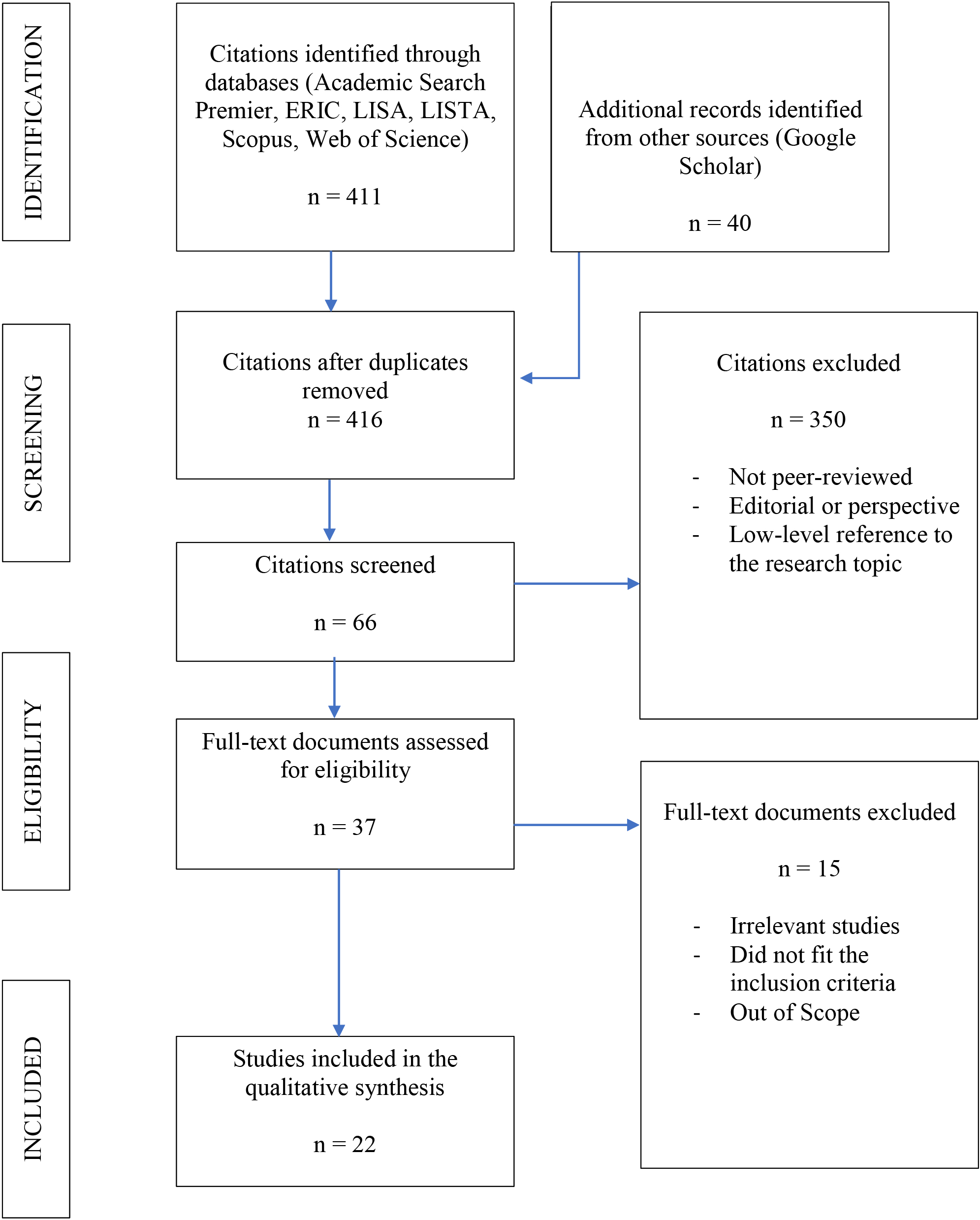
From the list of included studies (Table 3), 16 papers come from scholarly journals, three book chapters, two conference papers, and one from other sources (academic report). All were written in English. The dominant characteristic of studies published in this area is written by single authors. A total of 14 authors wrote their research independently. Six papers have two co-authorships, and two studies have three co-authored papers. Two high-ranking journals have two publications each. Titles of publications are enumerated with the corresponding document number for reference. Studies were published in the following journals: Journal of Academic Librarianship (8, 17), Reference Services Review (1, 4), Information, Communication & Society (11), Journal of Documentation (5), Journal of the Australian Library and Information Association (19), Library & Information Science Research (20), Library Management (13), Library Review (2), Library Trends (18), Media Studies (14), portal: Libraries
Overview of included studies
and the Academy (10), School Libraries Worldwide (9), Singapore Journal of Library and Information Management (16), and The Reference Librarian (3). The book chapters came from one source entitled, Informed societies: Why information literacy matters for citizenship, participation, and democracy (12, 15, 22). One conference paper came from the European Conference on Information Literacy 2018: Information Literacy in Everyday Life (21), and the conference paper was published in proceedings of iConference ’12 (6). It is also interesting to note the publishers where these titles belong. The following publishers were identified: Emerald Group Publishing (
Half of the studies (
Most of the studies are qualitative in nature (20 documents or 90.91%). A more detailed description of the study design is discussed below (Table 5).
Number of authors by country.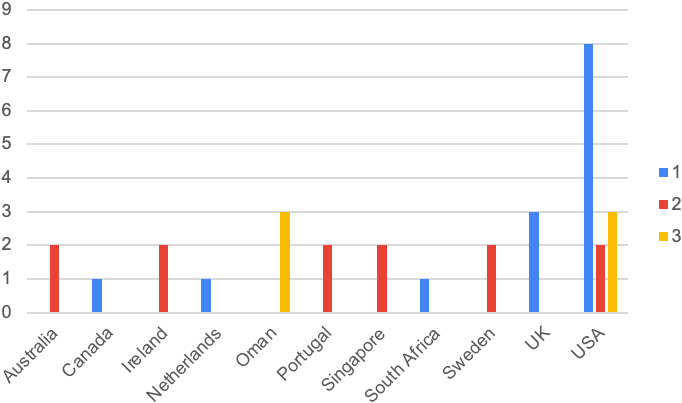
Research data shows that the USA topped among countries with the most authors published in the study (Fig. 2). A total of 32 researchers from 11 countries were identified. The number of researchers per country are as follows: USA (
Out of 32 researchers, 13 came from the USA and were represented by 12 academic and research organizations. These are Arapahoe Community College, Coastal Carolina University, Harvard University, Georgia College and State University, Indian River State College, Louisiana State University and Agricultural and Mechanical College, Montana State University, Seton Hall University, Simmons University, St. John’s University, University of Southern California, and the University of Washington. Top ranking universities from other countries include the list of author affiliations. In Asia, one of the best universities is the National University of Singapore where authors Dahri and Richard came from.
Studies by year of publication and country.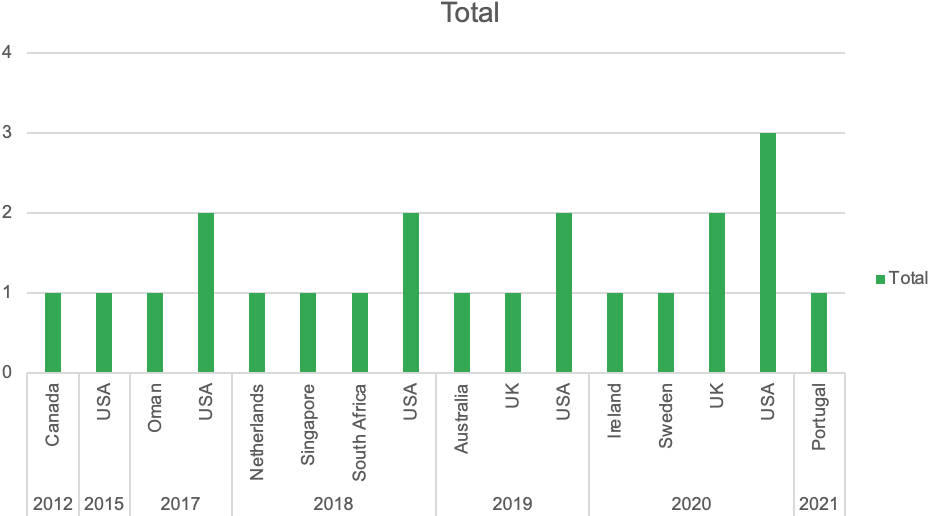
To trace the early beginnings of the study area, Fig. 3 provides a timeline of the year and country as revealed by the research data. The roots of this research started in Canada in 2012 through the efforts of Terry Constantino when she presented her dissertation on public library support for democracy at an iConference. A few years later, this area progressed in the USA in 2015, Oman and USA in 2017, and so on. The recent publication was published in Portugal in 2021.
Number of studies per country
In terms of the number of studies, the USA produced 10 documents from 2015–2020 (Table 4). The UK had three documents, and the rest had one document each. Only one article was published in 2021 which is closest to what the authors are doing. It is a systematic review of librarians in the fake news era. In 2020, seven documents were published in four countries: USA (
Methodologies and research methods
Methodologies and research methods
Research methods used by scholars vary in different study designs and categories (Table 5). One study focused on a mixed method approach using skills assessment and reasoning assessment. Twenty documents used qualitative methods with different approaches. Categories include conceptual framework (
The research methods identified encompass concepts that are aligned in the research. This includes the democratic roles of libraries, their civic engagement practices, the concept of the public sphere, and the rise of critical media and information literacy. Aside from the theories discussed, other main concepts emerge (Table 6).
Main concepts established in the study
Libraries are symbols of democracy and places to advance intellectual knowledge that should be available to all citizens regardless of social class or status (Stielow, 2001). Sharing information to the public and creating new knowledge in support of education and analytical discussion reflects a democratic society (Agosto, 2018). The ideals of democracy and its relationship to libraries have been challenged by Wiegand (2015). He cited that an attempt to develop libraries by increased funding will in no way increase an informed citizenry. His statements target the role played by democracy to fulfill the logical idea that when a democratic society exists, a well-supported institution prevails but will not necessarily automatically fulfill its function. However, a deeper context is suggested by Buschman (2019). Buschman (2007) has been studying the link between democratic theory and its absence in LIS literature and theoretical formation. He mentioned distinguished philosophers like J. Habermas on discourse democracy in the public sphere and individual rights, S. Wolin on undertheorization of democracy, and democratic education’s use of the school as public spaces. As we study democratic theory, we shall also see its interconnection to the concept of politics and political thoughts and understand that in this context we are living in a political world that dictates how democracy is established and achieved.
As an example of exploring democratic theory in LIS, Al-Suqri et al. (2017) explored the potential of Omani libraries as part of a young democratic nation in examining how libraries can be involved in their democratic process. They are looking into strategies on how libraries can promote political literacy. A democratic nation ensures that information is accessible and available to all in helping them arrive at informed decisions. This democratic process helps every citizen to gather information and gives them the freedom to participate in social discussions. One very important aspect of being a democratic society as applied in libraries is its mission to educate people (McCabe, 2001a). Thus, Al-Suqri et al. (2017) inject information literacy as an important ingredient in achieving democratic education. The responsibility rests in the hands of libraries to educate and inform citizens on how to evaluate information critically.
Democracy and Internet use are also areas to consider. As we shift to online discussions, more opportunities are available that would translate to more information that can be harvested. As citizens practice their democratic rights to avail of such products, we now face more responsibilities as to how we promote civic and political participation (Polizzi, 2020). Ultimately, libraries shall continue educating citizens with democratic values and provide access to information.
Civic engagement
Civic engagement is defined as the idea by which a set of knowledge, skills, values, motivation, and actions are developed to create change and make a better society (Singh, 2020; Coward et al., 2018; Ehrlich, 2000). Public libraries fully utilize their civic role by strengthening democratic movements by providing access and information freely available to all to develop a mature civil society (Kranich, 2012).
Kranich (2012) along with LIS theorists, advocates for civic librarianship. Civic librarianship’s one important characteristic is that it protects written knowledge and faithfully upholds its mission to ensure that the knowledge preserved will be used by the next generation (Schull, 2015). Libraries have also provided numerous programs that openly discuss social issues that invite their communities to be involved (Coward et al., 2018). This civic role strengthens community engagement and democracy as being led by civic libraries. Several reforms are also suggested by McCabe(2001b).
Restore the confidence of the public librarians in exercising social authority. Renew the public library’s historical mission of education for a democratic society. Develop the public library as a center of the community. Develop strategies to build communities through public library service. Use services and collections to meet social as well as individual needs. Strengthen political efforts of public librarians.
In social media information, civic librarians should continue developing consumers of digital information, citizens, and students, to be critical thinkers by updating their information literacy programs. Building a strongly informed citizenry fulfills the mission of libraries to establish a powerful democratic culture (Addy, 2020).
Aside from the library’s educational mission where it has a moral responsibility of improving democracy by providing education to its community, libraries also act as civic spaces to encourage community building and community movement (McCabe, 2001b).
The concept of the public sphere appears to be relevant and important as discussed by various researchers like Singh (2020), McDougall (2019), Buschman (2018). Nancy Kranich (2001) published a book on Libraries and Democracy: The Cornerstones of Liberty and stressed that public libraries are safe spaces for public concerns. The theory of the public sphere as discussed by Habermas is associated closely with the public library as a civic space (Widdersheim, 2017). Libraries offer a place for open discussions about public affairs and an area of knowledge production (Kranich, 2020) and are a precondition of a democratic society to enlighten its citizens (Audunson et al., 2019) and further participate through deliberation with rational arguments (Rapeli, 2014; Held, 2006). The public spaces offered by libraries for “free speech and open intellectual discourse” enhance democracy (Kranich, 2012). Buschman (2021) relates achieving equality once libraries fulfill the actually-existing democracy. The question of equality may be different in social media, as access to information is a form of power. The public sphere translated into the digital environment can happen and platforms are provided by libraries. Identifying who among the members of the community have devices is a different challenge. Thus, libraries must rethink how to cater to all kinds of space needs whether physical or virtual.
Critical theory
Developing trustworthy and responsible civic citizens. Addy (2020), Auberry (2018), Batchelor (2017), De Paor and Heravi (2020), Haider and Sundin (2020), Lewandowsky (2020), Lor (2018), and Polizzi (2020) all discussed the advantage of educating people to be critical evaluators of media and information. Critical theory’s influence on critical information literacy is an important professional discourse although very few are exposed to this theory (Schroeder & Hollister, 2014 in Tewell, 2015). Sociocultural complexities are addressed by critical theory, and this has been shown in the evolution of the ACRL Framework for Information Literacy for Higher Education (Tewell, 2015). The use of such a framework allows educators to understand the complex flow of information. The progressive framework encourages us to approach critical information literacy with diverse perspectives. In practice, there are several examples of how libraries have used critical information literacy based on gathered literature. Studies consider that critical information literacy improves the students’ skills to identify credible sources as well as evaluate controversial information (Addy, 2020). There is evidence that shows an increase in civic engagement among students after taking part in media literacy education (Auberry, 2018). As we move along with the growth of the post-truth era in social media and see a lot of information challenges, libraries must put more effort into educating users to be critical in evaluating information sources and regain the role of libraries as a trusted community resource (Lor, 2018).
Main concepts
This area of study focused on the civic roles and responsibilities of librarians in combating information disorders specifically in social media (Table 6). It would also address how information literacy as a concept and skill be applied in this area. Research data showed the main concepts or themes found in each study. The most talked about concepts are democratic theory (
Data source
Data sources explored in the study
Data sources explored in the study
Studies included in this scoping review proved to inspect primary data or made use of original research to prove a study (Table 7). Primary data came from students (
Results of the scoping review revealed that libraries are important in combatting information disorders in social media. The main concepts discussed by researchers revolve around democracy, the public sphere, civic engagement, and critical literacy. These concepts were explored to see the connections with how libraries become important sources in controlling the rapid spread of information disorders. The reliability of information is almost always in question and people with a less critical eyes are vulnerable to false information. Having a skeptical mindset is important for the citizens to arrive at a decision, thus it is one of the roles of libraries to help us become informed citizens. The introduction and development of the ACRL framework answer how libraries perform their instructional role in developing various approaches beyond a fact-checking curriculum (Addy, 2020).
Incorrect information accompanied by many forms of information disorders is a huge challenge for librarians and information professionals as these sorts of information undermine the common good, particularly those that are easily spread on social media and other similar platforms. Librarians’ role is to educate citizens from all walks of life to think critically about information and how to evaluate information. They are vital in providing numerous resources that value and examine trustworthy information. These are essential skills for lifelong learning and civic engagement (Addy, 2020).
Libraries, democracy and civic engagement
Looking into the main concepts that emerge in this study, when researchers discuss civic engagement, one can see the relationship to democracy. Dahlgren (2003) accounts that civic and political participation is our response to democratic participation. But, as Polizzi (2020) confirms, citizens express what they feel like doing without thinking if that participation may influence a political perspective for as long as these things matter to them. The democratic response of libraries is always to offer a space to the people, whether physical or digital, to address civic engagement and resist any threat to democracy (Coward et al., 2018). We must keep in mind that libraries as democratic and civic spaces profess distinct values where we promote access and freedom of information and social responsibility (Johnson, 2017).
Civic programs in the public sphere challenge how libraries can support democracy for citizens to become fully informed individuals. Public libraries become places for information to foster and develop information. Various programs can be created such as a space for current events (Johnson, 2017), conversations that bring people together (Singh, 2020), and activities that entice the community to increase not only the resources of the library but to give an opportunity to be socially aware and rethink about the fake news phenomena (Batchelor, 2017). These events work to address equity, diversity, and inclusion and are hoped to eliminate all sorts of prejudice regardless of race, religion, or socio-cultural background. However, these activities are questioned as to how they can combat the rapid spread of fake news (Sullivan, 2019a).
Libraries and information literacy
While librarians and information researchers continue to strengthen the value of libraries in democracy and critical thinking, most research makes use of documents to explore theory rather than practice. These studies are more on theoretical, literature, historical, or systematic reviews. Research that measures critical thinking or information literacy focuses more on students or other professionals rather than librarians whom we think has adequate knowledge. Pedagogical training is important for librarians and LIS educators to nurture specially in the application of critical theory or critical information literacy. They must improve their critical awareness in various aspects including their political knowledge. Smith (2013) stressed that information literacy assumes the ideologies of critical literacy in achieving the “democratic goals of library and information science”. Thus, LIS educators and practitioners proposed strategies to strengthen the critical minds of students including information shared online that can be attributed to information disorders. Faix and Fyn (2020), Auberry (2018), and Dahri and Richard (2018) believed that classroom activities, hands-on exercises, and tutorials will help students become wise, ethical, and critical users of media and information.
Libraries and information disorders
Facebook and Twitter revealed to be the most studied social media platforms concerning information disorders. Half of the studies did not specify the social media type they are investigating, thus, it is one of the limitations of the study. Complex issues surround our use of social media and each day grows an abundance of misleading and inaccurate information. Auberry (2018) suggests that information literacy is a way of thinking about how to solve this complexity. There must be a commitment among libraries and librarians to keep on fighting fake news with the help of other experts and professionals. It is the librarians’ “professional responsibility to promote critical thinking skills among patrons” (Batchelor, 2017). Although a difficult task to conquer, we are just at the beginning of this battle as Buschman thinks. Librarians should prepare for enormous issues concerning fake news and other information disorders. Librarians should not stop advocating for factual evidence and trustworthy information. Libraries’ strength lies not only in librarians but in the people who realize their value of credibility and authority.
In this scoping review, the civic roles of librarians to combat information disorders can be explored in various types of social media, however, only Facebook and Twitter were the most studied since they are said to be the most popular social media sites being used today. The complicated issues concerning information disorders in social media and its specific types requires more time for libraries to be given attention.
Also observed in this study is Nancy Kranich’s passion for civic librarianship. She is a former American Library Association president who advocates for civic engagement and democracy in public libraries. Kranich’s works (2001; 2004; 2005; 2012; 2017) are influential as cited numerous times by many authors such as Addy (2020); Al Suqri et al. (2017); Constantino (2012); Coward et al. (2018); Singh (2020); and Yerburry and Henninger (2019). The only factor that her works were not part of the qualitative synthesis is that she did not discuss false information and social media in her academic writings. Although it is much appreciated that her works are considered important in establishing the role of democracy in libraries.
Conclusion
After careful examination of the 22 papers included in this study, the authors believed that sources of information related to the role of libraries in civic engagement at the time of social media information disorder are gaining attraction. Over the last five years, this research area has become an interesting topic. This very specific study is crucial in today’s era, as no one is excused to fall for social media misinformation. Since most studies concentrate on qualitative research, a balance of having mixed methods research may be carried out and explored later. The role of libraries has expanded to offer not only their physical spaces for conversations and dialogues but also to open-up virtual platforms that offer safe spaces free from false narratives. Having critical information literacy as part of its civic programs will prepare the librarians and LIS educators to sharpen their existing pedagogies. It will also benefit all citizens under their care to practice not only their civic duties but also enhance their critical analysis.