




Abstract
Individuals need digital health literacy in order to locate, comprehend and evaluate the credibility of online health information. Users of the social media platform TikTok may commonly encounter health information whether they seek it or not. The interplay between TikTok and digital health literacy is not well understood, and thus 170 million US-based users are approaching a nation-wide ban on TikTok without a solid research-informed understanding of what this means for those using this platform to source health information and to engage with an online health community relevant to their health needs. This systematic review captures the small pool of relevant peer-reviewed research, using an additional layer of quality control through journal checking as a novel addition. The key preoccupations and findings in this literature are related to implications for US users in the event of a TikTok ban, as well as the needs of library-based educators globally.
Introduction
Health literacy relates to a person's ability to locate, comprehend and evaluate the credibility of health information (World Health Organization (WHO), 2024). Being able to access and understand health information has been pivotal to enabling individuals to protect themselves and others during the COVID-19 pandemic (Lund and Maurya, 2022). Those with higher levels of health literacy experience the advantages of positive health outcomes through better self-management of health conditions as well as participation and influence on their own health-related decision-making and quality of life (López et al., 2023). In addition to these individual benefits, improving health literacy in populations can offer social benefits, such as ‘by mobilizing communities to address the social, economic and environmental determinants of health’ (WHO, 2024: para. 2).
Within the broader concept of health literacy, a person's level of digital health literacy (DHL) relates to their health literacy skills and knowledge as applied in online environments to digital texts (König et al., 2022). Globally, internet use is burgeoning, with many young users purposefully seeking information through this affordance (DataReportal, 2024), and even social media users who are not actively seeking health information online may be exposed to information about health-related issues (Freeman et al., 2023). While widely available health information online allows users to freely access information, ‘that wealth of information can be questionable, inaccurate, and overwhelming, particularly for those with low health literacy’ (Ottosen et al., 2019: 208). When not accurate, online health information can be harmful. False health information is common online and often categorised as misinformation or disinformation. Misinformation refers to unintentionally incorrect information, whereas disinformation is deliberately false information often circulated to achieve a commercial or ideological agenda (Das and Tripathi, 2023; United Nations High Commissioner for Refugees (UNHCR), 2022). Combined, these forms of false content are viewed as a serious global risk (World Economic Forum, 2024). Health misinformation can have serious negative consequences, such as an ‘increase of misleading or incorrect interpretations of available evidence’ and an ‘impact on mental health, misallocation of health resources and an increase in vaccination hesitancy’, with unreliable health content also delaying care provision (Do Nascimento et al., 2022: 544).
As such, all users of social media may need high levels of DHL to determine the reliability of online health information, though basic digital literacy skills needed to support DHL are lacking in many populations and sub-groups (Gann, 2019). Library professionals play a key role in supporting digital inclusion and the development of digital health skills (Gann, 2019), and as such, they need to be knowledgeable about how health information may be encountered and deciphered across social media platforms such as TikTok. Fostering DHL has become a school and community education priority (Merga, 2023). Library professionals are experts in information literacy who draw upon this skill set to support their library patrons’ judicious use of online information, fostering development of DHL and health literacy in diverse library environments (Merga, 2023).
Globally, TikTok has 1.092 billion adult users, likely to be far below actual whole population figures given many avid users are under the age of 18 (Datareportal, 2023). While many social media platforms have faced vocal criticism in recent times, TikTok faces a likely US ban, triggered by fears about data-sharing relating to its 170 million US-based users (McMahon, 2024). While the ban is not certain, and set to be introduced in early 2025 at the soonest (Walker, 2024), what this loss will mean in terms of reducing exposure of TikTok users to a health information resource has not yet been quantified, as research in this field is new and, thus, far from consolidation. Furthermore, to date, research has captured both benefits and significant concerns in relation to user engagement with health information on social media platforms (e.g. Alter et al., 2024), so it is important to consider if the loss of this resource is likely to yield positive or negative outcomes for current users, particularly those using TikTok to manage chronic illness.
There are many reasons that individuals may seek health information on TikTok and other online environments, such as constrained access to primary care physicians, insufficient health insurance or other affordability issues and a need for social support from others experiencing the same health issues (Willis et al., 2023). Furthermore, individuals with low literacy and DHL may look for easily accessible content, given the relationship between consumer comprehension and ability to understand and use health information (Ferguson et al., 2021; Morse et al., 2024). The short and multimodal messages presented in TikTok videos may be appealing for those with limited reading comprehension or attentional issues, as they have the potential to break down otherwise impenetrable health information. However, the accessibility of health information on TikTok should not be conflated with reliability. Positioning itself as an educational platform (Merga, 2023), TikTok has introduced some safeguards to reduce the proliferation of misinformation on its platform, adding ‘a “misleading information” category in the app where users can report videos that may violate its misinformation policies’ (Southwick et al., 2021: 419–420) and making changes to its guidelines (TikTok, 2014a), but this does not mean that all information provided in this space is accurate.
While health information on TikTok may be encountered by algorithm-directed chance, in other instances, users may purposefully come to TikTok to be either lurking or active members of online health communities (OHCs) that flourish within that space. OHCs are spaces where users offer and solicit advice on health information, publicise their health journeys, engage in a community of shared experience and build self-efficacy in dealing with health issues (Jafri et al., 2023; Willis et al., 2023).
In the absence of research-informed understandings of the possibilities and issues of TikTok in relation to DHL, the true potential and limitations of this affordance may be poorly realised, and distorted anecdotal perceptions of the platform may dominate discourse referring to it. A systematic literature review that explores how TikTok interacts with DHL can help identify possible implications of removing US user access to TikTok. Beyond the US, library-based educators need a current understanding of research in this space informed by such a review to guide their support of their clients' intentional or inadvertent exposure to health information on TikTok. To respond to these real-world needs, the present systematic review concentrates on the following research questions.
How has TikTok been related to DHL in the extant research? What might US users lose in the event of a TikTok ban? What do library-based educators need to know about TikTok and DHL?
Methods
Systematic reviews are useful sources of current information for librarians seeking to inform their decision-making with high-quality current research, as these reviews involve the gathering, synthesis and reporting of relevant data on a key topic of focus (Xu et al., 2015). Adopting a cross-disciplinary scope to capture relevant content, this article draws on Zhang and Liu's (2023) four step process for conducting systematic reviews to underpin the method, with some variations as detailed herein.
Systematic reviews can draw on multiple databases/web search engines or concentrate on a single source. Rather than collecting publications across a breadth of sources, a decision was made to confine the search to the Google Scholar web search engine to facilitate capture of research across fields and disciplines, rather than field-specific literature as collected in some databases. However, this necessitated the introduction of an additional quality control mechanism to minimise the known issues that could emerge from dependence on this source alone (see Merga et al., 2020). While ‘comparisons of citation indexes generally rate Google Scholar as the most comprehensive’ (Gusenbauer and Haddaway, 2020: 209), grey literature and other text types outside the inclusion criteria must be identified and excluded as applicable.
All publications that fell within the search terms were collected from Google Scholar between 29 April 2024 and 2 May 2024. Inclusion criteria were as follows.
Associated with the search terms: ‘digital health literacy social media TikTok’, including the exact phrase ‘digital health literacy’. Publication was post 2020 to ensure current relevance. Publication was a peer-reviewed journal article.
Post 2020 publication was selected as a criterion given that norms in a dynamic, trend-driven platform such as TikTok are very rapidly evolving, so no literature older than 2020 was included, to minimise content focussing on very outdated TikTok content.
As shown in Figure 1, to ensure findings were subject to peer review (the third inclusion criterion), once literature was identified, the next phase involved exclusion of books, book chapters, conference proceedings and other non-journal article text types, including grey literature.
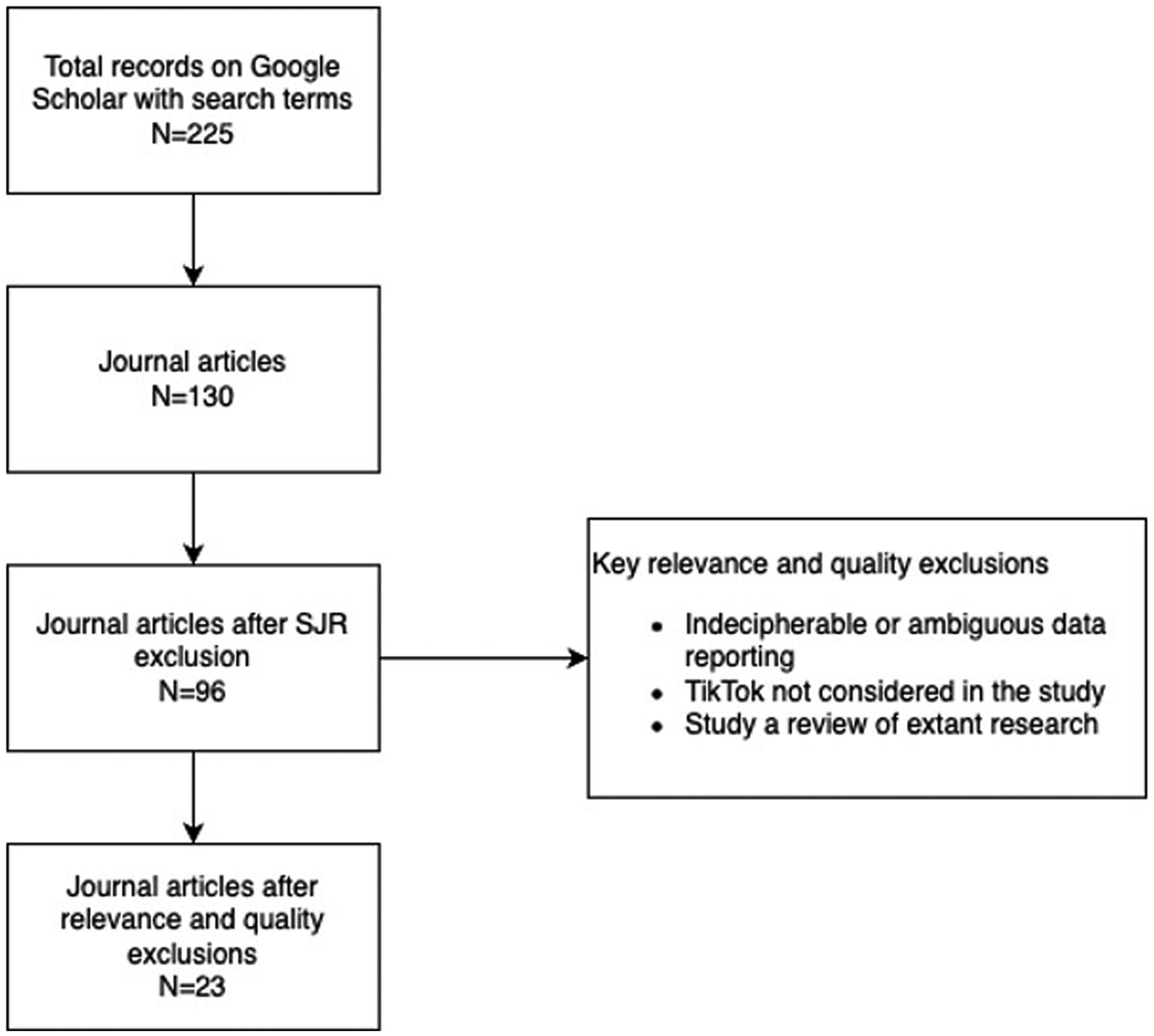
Systematic review process.
Next, each individual journal title was entered into Scopus-powered Scimago (SJR) to confirm its inclusion in this database. This was done as a quality control measure to prevent the inclusion of journals whose content may not be subject to acceptable standards of peer-review. Google Scholar results include journals whose features are considered predatory.
Predatory journals can be conceptualised as journals that do not prioritise research quality given their absent or marginal peer-reviewing process for fee-paying authors, and are sometimes also associated with misleading information, including fake affiliations and editorial boards (Perlin et al., 2018) as well as a lack of rigorous methodological standards and ethical approval (Grudniewicz et al., 2019). Solicitation coupled with high fees is also a common part of this model (Merga, 2024: 2).
While systematic reviews do not typically control for inclusion of potentially questionable research sources, the rise in predatory journals and related content should necessitate that authors of systematic reviews begin to critically reconsider their approach to inclusion and exclusion criteria. The system of exclusion used in this article is not perfect given that a journal may not yet appear on SJR for multiple reasons (as explored in Merga, 2024), peer review itself has limitations and the Scopus database has a history of significant issues (e.g. Franceschini et al., 2016). For the purposes of quality assurance, this mechanism was adopted in the absence of a uniform process routinely employed by others to ensure that the papers that were included are of the highest quality, and that there was not an assumption that just because an item was included in search results and it appeared to be a peer-reviewed journal article, that this was in fact the case. Finally, journal articles from SJR journals were also excluded as per relevance and quality exclusion criteria (see Figure 1).
It should also be noted that there is some debate about the extent to which DHL and eHealth literacy are interchangeable. Studies with an eHealth literacy focus were only included if eHealth literacy was explicitly conceptualised in a way that could be clearly conflated with DHL without ambiguity.
Journal articles in the final sample were subject to thematic coding through an iterative process of categorisation and refinement (Clarke and Braun, 2013), which led to the formation of four key themes: DHL levels, information seeking and exposure to health information on TikTok; use of TikTok to manage illness and medication; evaluation of quality health information on TikTok and the role of health professionals; and engagement and educators fostering DHL for safe use of TikTok. These themes are considered in the ‘Findings and discussion’ section in relation to research questions.
Limitations
Some of the limitations were as follows. A more expansive set of search terms may have yielded a larger volume of relevant research articles; however, the search terms were kept constrained to ensure that TikTok was specifically considered in relation to DHL, and that the scope of the study was purposefully constrained to be sufficiently specific and refined for findings to be reported on in a single article. All databases/web search engines have limitations on the scope and quality of inclusions, and Google Scholar has a number of limitations as a web search engine explored in greater length elsewhere (e.g. see Merga et al., 2020) – that were purposefully mitigated to some extent as previously noted. While only journal articles meeting recency criteria were used, this is an area where even relatively recent papers are speedily dated due to rapidly changing societal conditions (e.g. the COVID-19 pandemic) and an ever-expanding TikTok user base. It should also be noted that using a greater breadth of web search engines and/or databases could have resulted in a more expansive set of literature. Furthermore, ‘variable retrieval of content (due to regular updating of Google algorithms and the individual's search history and location) means that search results are not necessarily reproducible’ (Atkinson and Cipriani, 2018: 80). It could also be argued that privileging peer-reviewed journal articles as a quality control criterion can limit the inclusion of literature from marginalised viewpoints, given that ‘academic publishing is not an equal opportunity space’ (Merga, 2024: 5), and journals’ article acceptance may be influenced by ‘certain biases such as institutional affiliation bias, ideological bias, gender bias, nationality bias, publication bias, newcomer bias, and new idea bias’ (Tutuncu et al., 2022: 2547–2548).
Findings and discussion
This section addresses the research questions, with implications for future research also interwoven herein.
How has TikTok been related to DHL in the extant research?
DHL levels, information seeking and exposure to health information on TikTok
Research captured in this review has begun to explore relationships between TikTok use and DHL levels; however, far more research is needed in this area before meaningful conclusions that hold cross-contextual relevance can be drawn. A study on the DHL of Hong Kong-based migrant domestic workers during the COVID-19 pandemic found that while 28.5% of respondents used TikTok as a source of online information (Milanti et al., 2024: 16), ‘there was no statistically significant relationship between the use of Facebook, Twitter, TikTok, website, and eHealth literacy’. As such, it did not find a current positive or negative relationship between TikTok use and DHL. Patil et al. (2021) explored DHL in the context of COVID-19 pandemic attitudes and behaviours in US college students. They found that TikTok was used by over a quarter of their study sample, and that students with low health literacy were twice as likely to seek pandemic health information on TikTok compared with students with adequate health literacy, suggesting that TikTok may be an attractive source of information for those with lower health literacy. However, this study did not comment on DHL in relation to TikTok, which was also measured. As such, these two studies cannot be meaningfully compared. Research with Chinese university students found that students with both high and low levels of eHealth literacy ‘preferred search engines such as Baidu and TikTok app software’ among numerous other sources (Tian and Chen, 2023: 10699). While TikTok is used to source health information, there is a paucity of research at this time exploring how DHL levels may interact with the decision to source information from this platform as well as a lack of methodological consistency across studies that would enable comparison.
Research has touched on information seeking and exposure to health information on TikTok without explicitly relating this to DHL. A study of Hawaiian young adults’ health information exchange and pandemic perceptions found that nearly all of the sample participants used social media to source information about COVID-19, with 30.6% seeking this information on TikTok (Phillips et al., 2022). An even higher percentage (44.2%) of senior high school students in Indonesia used social media for this purpose (Hasanatuludhhiyah et al., 2023: 525). The notable differences across contexts suggest that findings from one context cannot be extrapolated to another without significant qualification, highlighting the importance of international, cross-contextual research on this topic. Exposure to health information on TikTok may be unsolicited and yet common, with research exploring adolescents’ self-efficacy and DHL finding that participants were exposed to ‘health information on social media simply by virtue of being users of platforms like Instagram, Snapchat and TikTok’ and that ‘even if they were not intentionally searching for health information, it appeared on their feeds because they followed other users who interacted with or created the content’ (Taba et al., 2022: 4). This highlights why DHL education needs to feature in school curricula across contexts, given that adolescents are heavy users of these platforms.
Other recent research has found that young people can be critical information explorers, with results of a small study finding that while young adults seek health information from social media influencers, viewing them as a source of health education, they considered ‘sponsorship, lack of credibility, and perceived normative pressure to critically analyze influencer content from peers and family’ (Pfender and Bleakley, 2024: 205), demonstrating understanding that ‘health information on social media is not always credible’ (2024: 213), with respondents sometimes specifically referencing TikTok. This research is valuable as there may be a tendency to characterise all young people as struggling with information literacy and related source credibility assessment due to some widely publicised studies with highly negative findings (e.g. Breakstone et al., 2021); however, this research acts as a reminder that there may be heterogeneity in young people’s relevant skills within and across contexts.
TikTok can also play a key role in the spread of public health messages, with extant research suggesting that not all social media platforms are equal in this regard. An Australian study exploring specific targeting of young people by health authorities during the COVID-19 pandemic found that while all eight Australian health departments shared Facebook posts, only one sought to reach users through TikTok (Taba et al., 2023). However, the researchers also found that posts on TikTok gained far ‘higher median likes (1086 likes) than posts on Facebook (111.5 likes) and Instagram (566 likes)’ (Taba et al., 2023: 7), suggesting that government health authorities may be underutilising a high-appeal platform, particularly as young people migrate away from platforms such as Facebook. While primarily focussed on Instagram, other research found that ‘e-cigarette use status was significantly associated with the use of two specific social media platforms: TikTok and Twitter’, and that therefore TikTok could be an ideal platform for anti-vaping messaging (Liu et al., 2023).
Research has also begun to capture how social media platforms, including TikTok, may expose information seekers to false health information content. For example, a recent study exploring health disinformation in Spain found TikTok (among other social media platforms) to be a conduit of false health content (Costa-Sánchez et al., 2023); however, the reporting on these data was unclear. Interviews with international migrants in the US found that TikTok was one of a number of platforms where respondents encountered misinformation (Seo et al., 2022), and research with 2050 unvaccinated Australian adults found that a very small portion of respondents mentioned TikTok in a free text field as a source of content discouraging vaccination (Pickles et al., 2022). There is a lack of international, generalisable quantitative research addressing this topic.
However, TikTok content may also challenge misinformation. Italian research provides insight into the role of TikTok in spreading both useful health information and vaccine sceptics’ content in the context of the COVID-19 pandemic, finding that the ‘vaccine sceptic community has limited presence and vocality on TikTok in Italy’ (Parisi et al., 2023: 11), and that sceptics may have adjusted their communication mechanisms to avoid bans due to the spreading of false content. They also found that ‘in the Italian context, the typical polarisation of the vaccine debate seen on other social media might be disrupted on TikTok, mainly by the large presence of ironic videos making fun of common fears around vaccines’ (Parisi et al., 2023: 11), weaponising TikTok-specific elements to fight misinformation. Only a small portion (9.7%) of ‘top’ relevant videos on TikTok discouraged vaccination (Parisi et al., 2023: 5), and it was also found that ‘90% of the videos with a discouraging stance, for which the creator's gender was identifiable, were created by males’ (Parisi et al., 2023: 10), which has implications for educators seeking to counter the production and circulation of misinformation on this platform, though more research is needed to determine cross-contextual generalisability. This research also provided a useful breakdown on tone of voice, topic, source of information, video format and stance profiles.
Using TikTok to manage illness and medication
Research has captured how TikTok is used as a source of information by those managing an illness. For example, a qualitative study of adolescents in Germany living with Type 1 diabetes found that TikTok was one of the social media platforms used to seek additional information or to better understand their condition (Naef et al., 2024). While these videos were felt to be in an optimal form for easy consumption, “sometimes, this information is not subject to expert scrutiny; in other cases, adolescents may express criticisms regarding this information but still use it, and in yet other instances, the information is discussed during subsequent consultations with healthcare experts” (5). Another study of 12 Canadian nurses found that few participants used TikTok for information about their health condition (migraine) (Dione et al., 2024), perhaps unsurprising given that the respondents were health professionals with a knowledge base to draw upon. Further quantitative research could be conducted to determine the generalisability of these findings, as well as to expand the range of health conditions investigated.
TikTok enables peer-to-peer health information exchange; and a qualitative study of 26 patient influencers sought to explore how health literacy is communicated on TikTok and other social media platforms in relation to the consumption of prescription medications (Willis et al., 2023). The article notes that patient influencers seek to ‘share their knowledge and experience in efforts to help other patients learn about disease self-management and improve their quality of life’ (Willis et al., 2023: 1), ‘using hashtags on Instagram and TikTok so others might find and locate their content’ (Willis et al., 2023: 7). However, while this article briefly acknowledges relevant complex ethical issues and the existence of pharmaceutical sponsorships, there is a problematic lack of scrutiny of the conflict of interest arising from patient influencers’ remuneration from their pharmaceutical funders (where applicable). While the article notes that ‘patient influencers on social media may communicate complex information that average consumers have difficulty understanding’ (Willis et al., 2023: 2), it skirts around consideration that if these patient influencers are not qualified health professionals themselves, there is no guarantee that the complex information they are communicating has been accurately interpreted, posing a risk of misinformation spread. There is a need for further research that looks at the remuneration structures for influencers that operate in these instances, so that there is a better understanding of the commercial drivers and motivations that may operate in this space. Patient influencers may have no existing sponsorships, but once a commercial arrangement is in effect, a potential significant conflict of interest follows. The most egregious examples of this, as covered in the media, involve influencers with no medical qualifications giving young people advice about the consumption of prescription medications (e.g. Chan, 2023). More recently, TikTok has taken further steps to restrict young people's exposure to some harmful content (e.g. TikTok, 2024b), though the effectiveness of any such changes has not been externally evaluated.
Not everyone in this space is motivated by a commercial imperative. Researchers captured how young people use TikTok to discuss living with chronic pain, and more than 75% of these videos ‘did not mention, discuss, recommend, or sell treatments, medications, or other solutions’ (Yalamanchili et al., 2023: 180) and ‘the creators appeared to be sharing their own personal health journeys (both positive and negative) and providing education or advocating for specific condition(s)’ (Yalamanchili et al., 2023: 180). Patient influencers may not be the dominant voices in all OHCs concerned with health conditions on TikTok; ‘these videos were primarily ways for young adults to share personal stories of chronic pain, they are not misinforming other young adults on chronic pain, or attempting to sell particular remedies’ (Yalamanchili et al., 2023: 181). It would be useful for future research to attempt to quantify the prevalent voices in OHCs to understand the impact of the presence of patient influencers and the kinds of health issues that remunerated patient influencers are most attracted to. It would also be important to track how these phenomena evolve over time, to raise awareness when patient influencers become the dominant voices about certain health conditions on a platform, as well as capturing who sponsors them (if applicable).
Evaluation of quality health information on TikTok and the role of health professionals
Research has also begun to systematically analyse and evaluate the credibility of health information on TikTok, though this has been recently flagged by researchers as a neglected research area (Alter et al., 2024). For example, research assessed ‘the quality, reliability and accuracy of vocal health content on TikTok’ (Alter et al., 2024:1), finding that the majority of content was low in quality and reliability, with only moderate accuracy and, perhaps most concerningly, that users had higher engagement with lower-quality content. In this vein, Jafri et al. (2023) investigated the quality of irritable bowel syndrome (IBS) content on TikTok, finding that nearly half of the 100 videos analysed in the study were posted by influencers and had low-quality educational content. The researchers concluded that ‘the low proportion of educational videos with factual information raises concerns about the quality of information available to IBS patients and the potential for misinformation’ (Jafri et al., 2023: 4–5). In light of this research, it would be useful to know exactly how TikTok moderates content in this space, given the following text that appears in their updated community guidelines (please note the boldfaced text was present in the original): In a global community, it is natural for people to have different opinions, but we seek to operate on a shared set of facts and reality. Content is ineligible for the for you feed (FYF) if it contains misinformation that may cause moderate harm, such as certain health content, conspiracy theories, repurposed media, or misrepresented authoritative sources. To be cautious, unverified information about emergencies and content temporarily under review by fact-checkers is also ineligible for the FYF. To help you manage your TikTok experience, we may apply warning labels to content that has been assessed by our fact-checking partners and cannot be verified as accurate. We may also send prompts to reconsider sharing such content. (TikTok, 2024a: para. 2–4)
A greater TikTok presence of qualified health professionals who are effective at creating entertaining and engaging content would be desirable to ensure that reliable information is available, accessible and appealing. For example, in the context of vocal health, ‘although an extremely small proportion of videos are uploaded by, or feature content from, health professionals, content created by health professionals has significantly improved reliability and accuracy, with a trend toward higher quality as well’ (Alter et al., 2024: 4). Similarly, research on content on depression and anxiety on TikTok found that the volume of videos of creators sharing personal experiences ‘far exceeded videos created by health professionals’ (Samuel et al., 2024: 5). Jafri et al. (2023) found that videos created by influencers were more likely to be shared than those created by medical professionals, and non-expert content reached far higher engagement metrics than content produced by health experts. In a somewhat contrasting finding, a small Australian study found that young people may be ‘more likely to engage with COVID-19 research when it was communicated by trusted medical professionals, contained a clear message, and used audio-visual formats’ (Douglass et al., 2023: 13).
When these studies are viewed together, it could be inferred that there may be a need for health professionals seeking to become TikTok active to not rely purely on their qualifications and knowledge base, but to also consider how to optimise their capacity to be engaging and accessible to enable their content to effectively compete for viewership and crowd out misinformation. While questions remain about the overall desirability of health professionals on the platform (Jafri et al., 2023), if they are producing appealing content, their participation may be viewed more favourably, although this needs to be studied. Indeed, in the context of COVID-19-related health content in Italy, Parisi et al. (2023: 11) ‘recorded an interesting presence of creators working in healthcare, who seem to be at ease with the platform's popular trends and characteristics’, though it is important to note that, in their sample, representation of Italian healthcare professionals was not high (13.4%) (2023: 11). As such, there is a need for further research that explores how health professionals can optimally engage with young viewers, perhaps with carefully audience-tailored and/or culture-responsive content (Parisi et al., 2023).
Comparative research across social media platforms suggests that TikTok content may be less likely to be produced by health professionals, though further research is needed. In relation to quality evaluation of health information on TikTok, researchers recently considered accessibility and readability in relation to social media content on otolaryngologic diagnoses on TikTok, Facebook, Twitter and Instagram (Morse et al., 2024). Posts on TikTok were more likely to be produced by a layperson (46%) than on any of the other platforms. While a third of posts on Facebook and Twitter, and 28% on Instagram, were made by an otolaryngologist, only 8% of posts on TikTok were. The study also found that ‘for image-associated text, those presented on TikTok were more readable than image-associated text presented on other platforms, which is likely due to the rapid method of information delivery on TikTok and the simple style that the platform supports’ (Morse et al., 2024: 1055), suggesting that, at least in the case of image-associated text, TikTok content is the most accessible to a broad audience while at the same time being the least likely to be produced by a specialist in the relevant medical field.
Researchers also captured the role of TikTok in health professional advocacy and well-being. For example, researchers have explored how nurses have used TikTok ‘as an outlet for expression, entertainment, and communication’ during the COVID-19 pandemic (Yalamanchili et al., 2022: 1), with relevant videos exploring the health and wellbeing challenges of the role, and encouraging resilience among other messages in a time of great professional challenge.
Engagement and educator fostering DHL for safe use of TikTok
While there is limited research that looks at how DHL should be fostered in relation to TikTok specifically, proposing or evaluating the success of such interventions, educator researchers have begun to experiment with innovative learning approaches that invite young people to become active agents in the creation of health-promoting content for social media platforms, including TikTok. In one of the first studies of this kind, Malloy et al. (2024) co-created a lifestyle intervention ‘targeting eating, physical activity, and social wellbeing that is evidence-based, acceptable, and engaging for young women aged 18–24 years’ using a participatory design approach (2024: 1). TikTok videos were ‘created and posted as reels to Instagram’ so that ‘TikTok-style videos’ could ‘be evaluated without requiring participants to check content on multiple apps’ (2024: 9).
Underpinning any educator-led intervention to encourage critical and safe use of TikTok as a source of health information should be an understanding of how content is purposefully created. In this vein, Davies and Mann (2023) investigated factors shaping women's perceptions of health ‘that lead them to accept diet and exercise messages on social media such as Facebook, Instagram and TikTok’ (2023: 416). Their qualitative study including TikTok explored ‘how healthism discourse on social media’ may explicitly ‘underpin the adoption of diet and exercise practices by enhancing experiences of digital intimacy, repeat messages and personal testimonials from other women, and supporting new routines during COVID-19 lockdowns’ (2023: 415). This kind of work can help educators foster awareness of exactly how content creators inadvertently or intentionally seek to influence and/or manipulate viewers to increase engagement, enabling their students to identify how they are being positioned as consumers when engaging with health information content on TikTok.
What might US users lose in the event of a TikTok ban?
This systematic review seeks to draw attention to the research gaps that must be addressed for accurate understanding of the potential impact of a TikTok ban on US users’ access to health information. With US government focus on risk mitigation in relation to the TikTok ban strongly centred on data sharing risk among other moral debates, little attention has been given to what this loss may mean for parts of the US population who may use this platform for health information. While ‘nearly 60% of adult Americans have at least one chronic disease’ (Hoffman, 2022), their consumption of health-related content and participation in OHCs on TikTok have not been broadly captured or quantified in large scale studies, so it is not known what will be lost when these users become excluded from this resource, how many users will be affected and whether the exclusion will have an overall negative or positive impact on them.
Possible findings that cannot be confirmed without further research include the following:
TikTok can be an accessible, appealing and supportive source of health information and public health messaging for young people (e.g. Hasanatuludhhiyah et al., 2023; Liu et al., 2023; Naef et al., 2024; Phillips et al., 2022; Taba et al., 2023; Yalamanchili et al., 2023). TikTok may be a source of false and low-quality health information, but also of high-quality information produced by health professionals (Alter et al., 2024; Costa-Sánchez et al., 2023; Jafri et al., 2023; Parisi et al., 2023; Pickles et al., 2022; Samuel et al., 2024; Seo et al., 2022).
Health information is often shared in a form too complex for population groups with low literacy (Ferguson et al., 2021), which means that the loss of an accessible source of health information could have significant health impacts. However, if the information lost is misinformation or disinformation, this exclusion could be considered as an advantageous outcome. The risk is not known, as research has not been able to keep pace with the surge in TikTok's popularity, or with the controversies in recent times. Given the limited amount of time available before the ban, if the potential risks and benefits of excluding US consumers from health information on TikTok cannot be identified prior to the ban, at the very least, research must capture the post-ban impact for those with chronic illnesses, with a view to mitigating any negative effects.
What do library-based educators need to know about TikTok and DHL?
First, the extant research indicates that TikTok users encounter health information on the platform whether they deliberately seek it or not, and sometimes this information can be helpful and even government sanctioned, while in other instances, it can be harmful. TikTok itself has even been harnessed by content creators to actively address misinformation campaigns using humour and other TikTok features (Parisi et al., 2023). As such, library-based educators clearly can play a valuable role in supporting patrons’ critical and well-informed engagement with health content found on the platform. Furthermore, library-based educators in the US may need to connect patrons who use TikTok for health information with credible alternative sources of this type of information, testing the readability of these materials where applicable, to ensure accessibility (Ferguson et al., 2021).
Library-based educators worldwide will need strong data literacy and careful discernment in interpreting findings in this research area for translation into messaging for library patrons. As found in the review, research on information seeking and exposure to health information on TikTok is often qualitative and with very small samples. When research is quantitative and thus usually with larger samples, it often includes only tangential consideration of TikTok, sometimes not disaggregating data so that TikTok-relevant data is revealed within overarching social media data. There is also a need for studies that specifically quantify the percentages of content that feature misinformation or disinformation so that the prevalence of this material can be better understood; and until these studies are conducted, library-based educators may be unable to draw sweeping conclusions about the strengths and limitations of TikTok while still having to advise patrons, many of whom may be young people.
Providing training and resources to support source credibility skills specifically applied to TikTok will remain a priority for public and school library professionals in contexts where no TikTok ban is in place, and where there is a high volume of local users. Practical ways of doing this that may hold relevance for these libraries include the following:
Delivering training seminars that show how to interpret and fact-check TikTok content with questionable health messaging, directly demonstrating how to apply these skills while engaging with current, authentic content. Providing links to qualified, registered, reputable and credible TikTok health content creators, such as Dr Idz (Berry, 2023). Remaining abreast of source credibility and DHL skills development research in order to be responsive to evolving models of best practice.
It may be particularly pertinent to instruct patrons in understanding how health information may be manipulated, and how they may become a target as potential consumers of pharmaceutical products or health-related programmes, perhaps by patient or social media influencers. Providing library-based learning that invites patrons to become active agents in the creation of sound health-promoting content for TikTok can help them to think like content creators, improving their awareness of the carefully constructed pseudo-realities that viewers on the platform can be exposed to and perhaps encouraging more critical consumption.
In addition to engaging with the extant research, given the emerging research around the role of health professionals on TikTok, library-based educators seeking to provide engaging, accessible but also reliable health information for their clients may need to become active on TikTok if their library patrons are heavy users of this app. They may wish to identify qualified health professionals who provide accessible and engaging information about health-related issues. Vetting content creators’ qualifications is important, as there have been high profile cases of fraudulent individuals claiming to be medical professionals on TikTok (e.g. Schmidt, 2023). This emerging curation role may not be applicable for all library contexts, but school library professionals may be particularly interested in considering it given that a substantial number of their patrons are likely to be active users of TikTok.
Conclusion
This systematic review draws attention to an urgent need for further research in this area of enquiry. Particularly given the imminent US ban, timely but comprehensive research on the complex interplay between TikTok, DHL and health information accessibility and quality is crucial so that there can be a fulsome understanding of what may be lost and gained through such a ban. While the extant research in this review identifies a range of possible consequences, these often need to be extrapolated from foreign contexts, extracted as tangents from larger studies that are not TikTok focussed, or surmised from work concentrating on small sample sizes, making generalisability impossible. While this article begins to touch on some implications of findings for library-based educators both within and beyond the US, this is an area that warrants constant and ongoing scrutiny as further research emerges, particularly given the sizable body of the global population who are active on TikTok, and exposed to health information in this space. Of particular value would be research that identifies US users who are currently heavily reliant on TikTok as a source of health information and/or as a valued OHC, and then tracks potential positive and/or negative health impacts once this affordance is removed from their lives.
Footnotes
Declaration of conflicting interests
The author declared no potential conflicts of interest with respect to the research, authorship, and/or publication of this article.
Funding
The author received no financial support for the research, authorship, and/or publication of this article.
