




Abstract
The paper introduces the UK Open Textbook project and discusses its success factors with regards to promoting open practice and open pedagogy. Textbooks remain a core part of educational provision in science. Open Textbooks are openly licensed academic textbooks, wherein the digital version is available freely, and the print version at reduced cost. They are a form of Open Educational Resource (OER). In recent years a number of openly-licensed textbooks have demonstrated high impact in countries including the USA, Canada and South Africa. The UK Open Textbooks project piloted several established approaches to the use and promotion open textbooks (focusing on STEM subjects) in a UK context between 2017 and 2018. The project had two main aims: to promote the adoption of open textbooks in the UK; and to investigate the transferability of the successful models of adoption that have emerged in North America. Through a number of workshops at a range of higher education institutions and targeted promotion at specific education conferences, the project successfully raised the profile of open textbooks within the UK. Several case studies report existing examples of open textbook use in UK science were recorded. There was considerable interest and appetite for open textbooks amongst UK academics. This was partly related to cost savings for students, but more significant factors were the freedom to adapt and develop textbooks and OER. This is consistent with a range of research that has taken place in other countries and suggests the potential for impact on UK science education is high.
Keywords
Introduction
This paper reports the results of the UK Open Textbooks project, which assessed the viability of the UK for “open textbooks” between 2017 and 2018 through a series of engagement actions. Open textbooks are a form of open educational resource (OER). OER have been described in various ways. According to the UNESCO definition they may be understood as “teaching, learning and research materials in any medium, digital or otherwise, that reside in the public domain or have been released under an open license that permits no-cost access, use, adaptation and redistribution by others with no or limited restrictions” (Creative Commons, 2016). Open textbooks are funded by universities, foundations, governments and other institutions to disrupt the traditional model of educational textbook publishing. Authors (typically academics or other experts) are paid for their work, which is then released under an open licence (e.g. Creative Commons, n.d.). This typically allows content to be freely copied, shared, edited, remixed and used in new ways without further permissions required from the copyright holder.
We proceed with a brief discussion of open science which highlights the potential role of open textbooks in pedagogy 2 before going on to describe the potential for such innovation in the UK market 3. Section 4 describes the UK Open Textbooks project and its activities. Sections 5 and 6 describe the results of the evaluation method for the two engagement approaches explored. Section 7 presents case studies of open textbook use in the UK. Section 8 discusses the results of the project as a whole. Section 9 makes recommendations for further research in this area. The conclusion 10 frames the relevance of the results for open science pedagogy.
Open science and open textbooks
“Open science” does not have a fixed meaning, and refers instead to a set of aspirations and actions designed to make research accessible to all levels of society. This can include open access publication; open data; open source software; collaboration platforms; citizen science; infrastructure; sharing lab notes; specifying protocols for metadata; and outreach from knowledge producer to the general public through social media. Tennant et al. (2019) describe the ongoing transition from open access to open science and open research, finding there are many persistent myths and misunderstandings about openness in science. There are also many longtanding debates about the proper role of openness within scientific research (see Willinsky, 2005; Whyte & Pryor, 2011; Friesike et al., 2015; Concannon et al., 2019; Teixeira da Silva, 2019). Fecher and Friesike (2013) accordingly describe open science as “an umbrella term encompassing a multitude of assumptions about the future of knowledge creation and dissemination”.
Open science is still broadly understood as research-oriented, with the “open” element provided by the outputs (research data, lab notes, methods, instruments, etc.) being made available in accessible formats on open licences to facilitate reuse and validation. The role of openness in science has been explored in a research context quite thoroughly through open data, open access publishing, open source software, and open protocols and practices that enable collaboration, research reproducibility and data validation. Citizenship science is increasingly encouraged. However, the implications of openness for scientific pedagogy are rarely discussed.
For instance, the FOSTER project provides a comprehensive taxonomy of open science which contains no reference to teaching, learning or pedagogy (see Fig. 1).
A recent innovation that challenges the established model of scientific pedagogy
Taxonomy of open science (FOSTER, n.d.; Pontika et al., 2015) CC-BY. Hi-res at 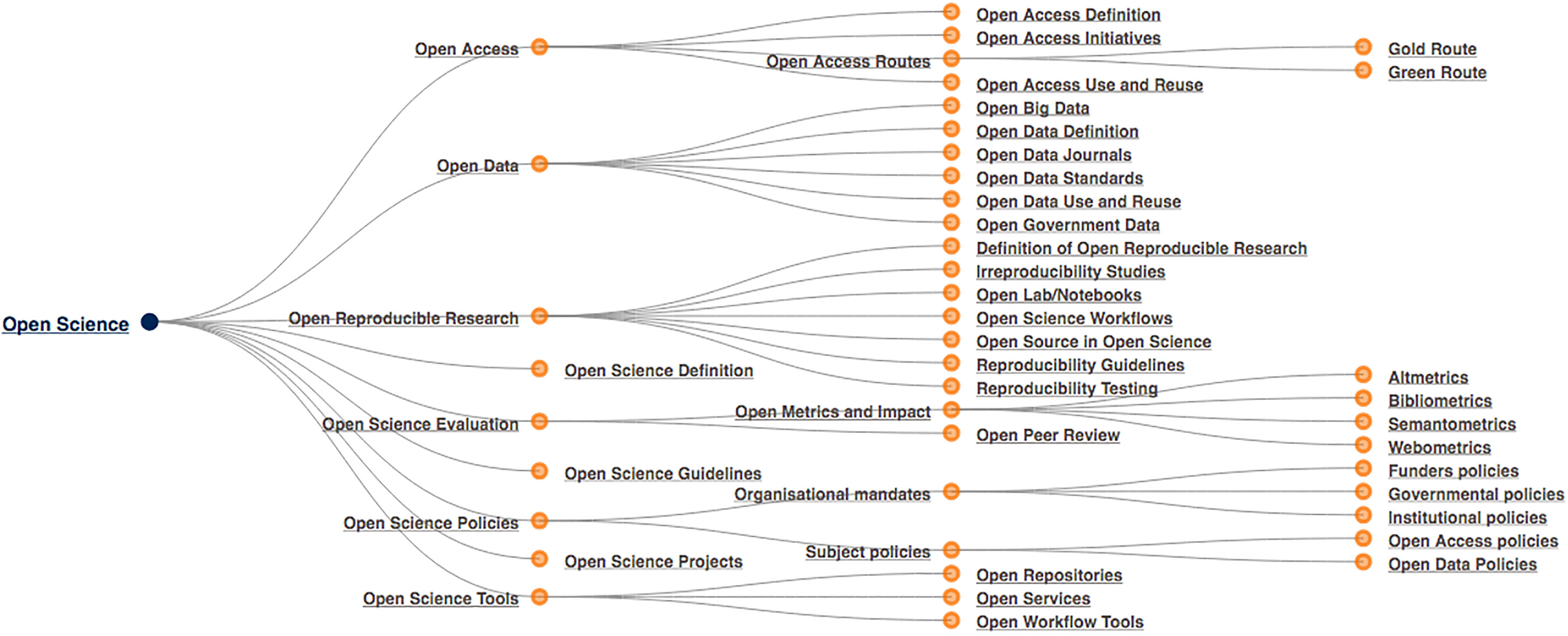
are “open” textbooks. Textbooks are a ubiquitous educational tool, used internationally, that often form the centrepiece of a course presentation. They offer the possibility of a balanced curriculum that is refined over time and standardised to uphold quality standards. Textbooks can be written for a range of purposes and levels of education. The market for educational textbooks in science is enormous, but a handful of publishers dominate this space, making huge profits. Textbook costs in the USA, for instance, have risen by more than 1,000% since the 1970s (NBC, 2015).
There are two main advantages associated with open textbooks. The first are efficiency savings which can be substantial and make a significant difference to low-income students who benefit from having ready access from the time a course begins. The second is the potential for open textbooks to support educational innovation through the use of a wider range of content which can support experimentation and reflection on practice (OER Research Hub, 2014: 21–22).
There is a significant body of research demonstrating the quality and efficaciousness of open textbooks and OER more generally. In one of the largest studies into the efficacy of open textbooks Fischer et al. (2015) analysed whether the adoption of (digital) open textbooks significantly predicted students’ completion of courses, class achievement, and enrollment intensity during and after semesters in which OER were used. The study employed a sample group of almost 5000 post-secondary students using open textbooks and over 11,000 control students using traditional commercial alternatives, distributed among ten institutions across the United States, enrolled in 15 different undergraduate courses. Focusing on five measures of student success – course completion, final grade, final grade of C- or higher, enrollment intensity, and enrollment intensity in the following semester – finding that the OER group had more favourable outcomes.
Delimont et al. (2016) surveyed more than 2,000 students across 13 courses on their use of alternative educational materials on the subject of agriculture, finding that learners rated the quality highly and would prefer to use more open resources. They also interviewed a faculty member from each course, and it was reported that student learning improved while the use of open content both improved workflow and resulted in significant savings.
Similar patterns have been observed in a range of studies. Hilton (2016) synthesized studies into OER, selecting cases according to a quality threshold (comparison of OER cohort with a control group using traditional materials; peer-reviewed & published; focused on OER quality or educational outcomes; having at least 50 participants). Sixteen studies were selected (representing a sample of 46,149 students).
Only one of the nine studies on OER efficacy showed that the use of OER was connected with lower learning outcomes in more instances than it was with positive outcomes, and even this study showed that the majority of the classes were non-significant differences. Three had results that significantly favored OER, three showed no significant difference and two did not discuss the statistical significance of their results. In synthesizing these nine OER efficacy studies, an emerging finding is that utilizing OER does not appear to decrease student learning (Hilton, 2016).
With respect to science education Jared Robinson et al. (2014) found that “students who used open textbooks scored 0.65 points higher on end-of-year state standardized science tests than students using traditional textbooks when controlling for the effects of 10 student and teacher covariates”. While studies such as these don’t establish that open textbooks are pedagogically superior, they have established that an equal level of quality is typically attained.
Watson et al. (2017) studied the student and faculty experiences of adopting and using an open textbook on a biology course. Students (
Faculty adopters in this study noted concern from colleagues who were unfamiliar with notions of open education resources generally…those faculty sometimes found themselves defending their choices in these contexts; however, their ability to describe their firsthand experiences with the quality of traditional and online textbooks, coupled with cost comparisons, made those concerns and discussions easier to navigate (Watson et al., 2017).
Cost savings from switching to open textbooks can be considerable. Recording the adoption of open textbooks has made it possible to calculate the financial value of “going open”. More than $1 billion has been saved by students, their families, institutions and governments (Allen, 2018) as shown in Table 1.
Documented financial savings achieved through OER
Source: Allen, 2018.
The strategic advantage of open textbooks as a route to OER adoption is that a textbook is a familiar artefact which can be substituted for the textbook currently being used to deliver a particular course. Open textbook publishers have consequently aligned their content to widely used curriculum standards used in the USA and Canada. This makes the initial proposition less daunting since an open textbook is simply substituted for one already being used. Open textbooks have spread to other countries both in their original forms as open content and through dedicated initiatives, particularly in the Global South where efficiency savings can be particularly attractive (e.g. Siyavula, n.d.; Pitt, 2015; Goodier, 2017). The UK has many similarities with the American and Canadian markets, but also some factors which make it quite unique.
The high impact of open textbooks in North America reflects the nature of their educational markets, with a high pressure on costs to students as a result of price inflation (Martin et al., 2017; Jhangiani R & Jhangiani S, 2017; Senack, 2015). This is a significant difference compared with the UK, where tuition fees and living costs are perceived as more pressing financial concerns by students. Students currently studying in England will graduate with an average of £50,800 debt with poorer students incurring even more (IFS, 2017).
According to the Student Income and Expenditure Survey for the 2014/15 cohort, students spent a mean of £572 on books and equipment in their first year, falling to £465 in year 2 and £490 in year three (Dept. for Education, 2018:314). Data from the National Union of Students indicates an average spend of more than £1,000 per undergraduate student year on books and study materials (Malcolm, 2010).
There are also some differences in the role of the textbook in formal education. Textbooks are an essential component of post-secondary education. In the UK, it is generally accepted that students will not purchase the entirety of a reading list (Stokes & Martin, 2008). Rather, students may choose one resource to purchase and others to access via the library. On occasion, academic staff may steer students towards a small number of recommended textbooks, with the expectation that only one would be purchased.
Preliminary research for UK Open Textbooks, Rolfe (2018) explored student attitudes toward purchasing textbooks in the biosciences in two university departments. It was revealed that little is known about how students select and utilise textbooks with the exception of one study of psychology undergraduates (Derryberry & Wininger, 2008) which indicated that instructional texts would generally benefit from being better adapted to the requirements and preferences of individual learners.
Commercial production is not necessarily an indicator of textbook quality in the UK. King (2009) found in a survey of 51 UK science textbooks that 29 “showed poor coverage of National Curriculum earth science and contained a mean level of one earth science error/misconception per page”. This resulted in a negative feedback loop where misconceptions found in college teaching materials reinforced these errors among teachers.
The UK Open Textbooks project
The UK Open Textbooks project project was managed by the Open Education Research Hub (OER Hub, 2019) in the Institute of Educational Technology at The Open University (UK). The project ran from May 2017 to December 2018. The USA was represented in the project by the Open Textbook Network (2019) and OpenStax (2019). The Open Textbook Network are a membership organisation facilitating a network of American higher education institutions who have an interest in open textbook adoption. Members are entitled to open textbook workshops as part of their membership and faculty from member organisations invited to conduct a review of a textbook in their subject expertise area following participation. These textbooks are part of a library of open textbook resources hosted by Open Textbook Network and accessible to non-member and member organisations alike. Of the 460 different textbooks available on the platform, 60% of all Open Textbook Network textbooks have at least one review (Open Textbook Network, n.d.). Open textbooks publishers were represented on the Dani Nicholson and Daniel Williamson for OpenStax and David Ernst of the Open Textbook Network.
The OpenStax approach involves presenting textbooks at exhibitions, trade fairs and conferences, encouraging practitioners and decision makers to engage with the high quality of the books and offering a complete digital collection of open textbooks on a USB while encouraging subscription to their distribution list, which is used selectively to keep practitioners advised of updated or specialized versions of textbooks.
The Open Textbook Network approach instead involves running subject specific workshops in universities with educators and librarians and inviting them to contribute a (paid) review of an open textbook to their database. The comparative evaluation of their respective approaches to marketing and outreach was the central thread of the project.
These two different methods of promoting open textbook adoption provided the framework for project activity. The project did not seek to create new OER, nor to remix or adapt existing content for a UK market. Rather, the goal was to assess the viability of marketing and adoption approaches that had been proven successful in other contexts to evaluate and refine the offer in a UK context.
The alternative metrics used to identify impact therefore reflects these strategies. For workshops the Open Textbook Network approach measures the percentage of participants who went on to complete a textbook review. For OpenStax exhibitions the primary metrics were the number of subscriptions gathered and the feedthrough to adoption (see Fig. 1). Events were selected according to subject coverage and the type of attendee that has, or is anticipated, to participate. There was an explicit focus on STEM for these events since the Open Stax range concentrates on STEM and the transferability of – and demand for – these textbooks to the UK was thought to be high.
Once such an event has taken place, a review of the number of sign-ups and cost to exhibit is made to establish the known/estimated impact of participating. OpenStax currently run 12–15 of this type of event across the USA each year. The UK team were provided with a full exhibition stand set-up from OpenStax which included a large banner, table display, branded cloth, bookstands, and promotional literature. Figures for the UK engagements are provided below in Tables 2 and 3.
UK Open Textbook workshops
UK Open Textbook workshops
UK Open Textbook exhibitions
Demand for workshops was high, with seven other UK higher education institutions requesting a workshop. Workshops tended to take place earlier in the project because they were easier to arrange with a campus contact; while there was a longer lead-in time for exhibitions which needed to be booked in advance.
These events provided the opportunity to engage with a wide range of stakeholders with a potential interest in open science textbooks. Other outreach activities included a range of conference presentations, webinars and social media engagements (see
During the course of the project and its presentation at conferences connections were made to other UK open textbook initiatives, such as UCL Press which was the first open access university press (UCL, 2019); the eTextbook Publisher project which brought several universities together to support institutions in producing their own textbooks (Jisc, 2019); Open Book Publishers, a not-for-profit open access publisher for social science and the humanities (Open Book Publishers, 2019); and E-International Relations a publisher of open access resources for international politics (E-IR, 2019). These outreach activities helped to raise awareness of the potential of open textbooks to positively impact on STEM education but also helped to connect together silos of activity and advocacy for open approaches.
The evaluation process followed in the project was ongoing, iterative and guided by key desirable outcomes identified through preliminary research. The evaluation included survey data; web analytics; social media analysis; and regular reviews with work package leaders Key performance indicators were identified for the number of open textbooks adopted/adapted in the UK, and raising awareness of open textbooks. However, these were intended to be broad and overall goals which would sit alongside the exploratory nature of the project. Progress against these targets is reported in the following two sections.
The workshops followed the Open Textbook Network model closely, acting as a catalyst for discussion and institutional action. Fourteen workshops were held at 8 institutions with 116 participants from UK and Irish Universities. Forty-three held full- or part-time academic positions and 29 were library staff, while the remainder were a mix of graduate students; and representatives of various administrative and support services. Many of the academics and librarians were identified as potential advocates for open textbooks in the UK. In the USA and Canada such advocates are an important part of open textbook adoption (Woodward, 2016; Pitt, 2015).
The Open Textbook Network invites concise reviews by educators, organized along the following areas: comprehensiveness; content accuracy; relevance longevity; clarity; consistency; modularity; organization structure flow; interface; grammatical errors; and cultural relevance/appropriacy. Of participants interested in reviewing a textbook, 33.3% of participants completed a review (35 out of 105). A post-workshop survey was shared with all those who took part, and responses were collected throughout the life of the project. The format was the same as the one used by Open Textbook Network in the USA. Twenty out of 49 participants intended to adopt an open textbook with a further 18 advising they would consider adopting. All those who said they would not be adopting a textbook were in non-teaching roles.
Other key outcomes from the workshops:
Senior level support for use of more open textbooks was considerable; Many expressed an interest in involvement in future phases of the project; There was enthusiasm for co-creation of content as a route to innovation; Several participants planned promotion of open textbooks to staff and students on library websites; Open textbooks are increasing being added as part of recommended module reading lists; Increased collaboration with libraries to investigate the potential cost saving on course production/rights clearance through OER; Expressed intention to share and discuss open textbooks with departmental colleagues and to strategize their use in new or existing modules; Participants have used the CC-BY workshop slidedeck to raise the profile of OER locally.
High level of demand for workshops resulted in a waiting list of institutions interested in hosting and taking part in the workshops during a possible future phase.
Results: Subject adoption (OpenStax)
Prior to UK Open Textbook activity, and through reviewing existing data on UK interest and adoption, OpenStax were aware of a range of ad hoc uptake of the textbooks in the UK. Known UK adoptions as at July 2017 (prior to project activity) revealed 16 adoptions of OpenStax materials comprising of 11 public universities, 1 K-12 private school based in the UK, 2 secondary schools, 1 independent school, 1 NGO/non-profit.
The focus of the OpenStax approach is adoption of open textbooks for use as primary teaching materials. Their strategy involves inviting exhibition delegates to share contact information so that they can be informed of updated editions or new volumes. Eighty-five verifiable OpenStax contact response cards were completed by participants at outreach events. Nine UK adoptions of OpenStax materials as core curriculum or teaching materials were reported as resulting in whole or part from the project’s activities. Figure 1 uses data from the OpenStax marketing survey and reveals that the period 2016–2017 saw the number of persons with a “high interest in adopting” more than double.
Web analytics also indicated an upsurge of UK interest in OpenStax materials. Between May 1, 2015 and May 20, 2017, unique visitors from the UK were 1% of overall OpenStax.org traffic. Figure 1 shows that there was already an increasing interest in their materials from UK audiences, with a surge in “confirmed interest” in 2015 followed by “high interest in adopting” in 2016.
In discussions at exhibitions, UK science educators typically exhibited low levels of awareness of open textbooks and OpenStax, but high levels of enthusiasm and positive feedback about the quality of the textbooks. Although OpenStax textbooks are not directly aligned to the UK curricula, there was a very encouraging response to the basic proposition of OER adoption through textbooks. Several teachers commented that the localisation of weights and measures could present a challenge in a STEM context. Many secondary school teachers remarked that they would share OpenStax materials with students who had advanced beyond the textbook being used by their peers.
OpenStax UK opportunity by year, 2013–2019.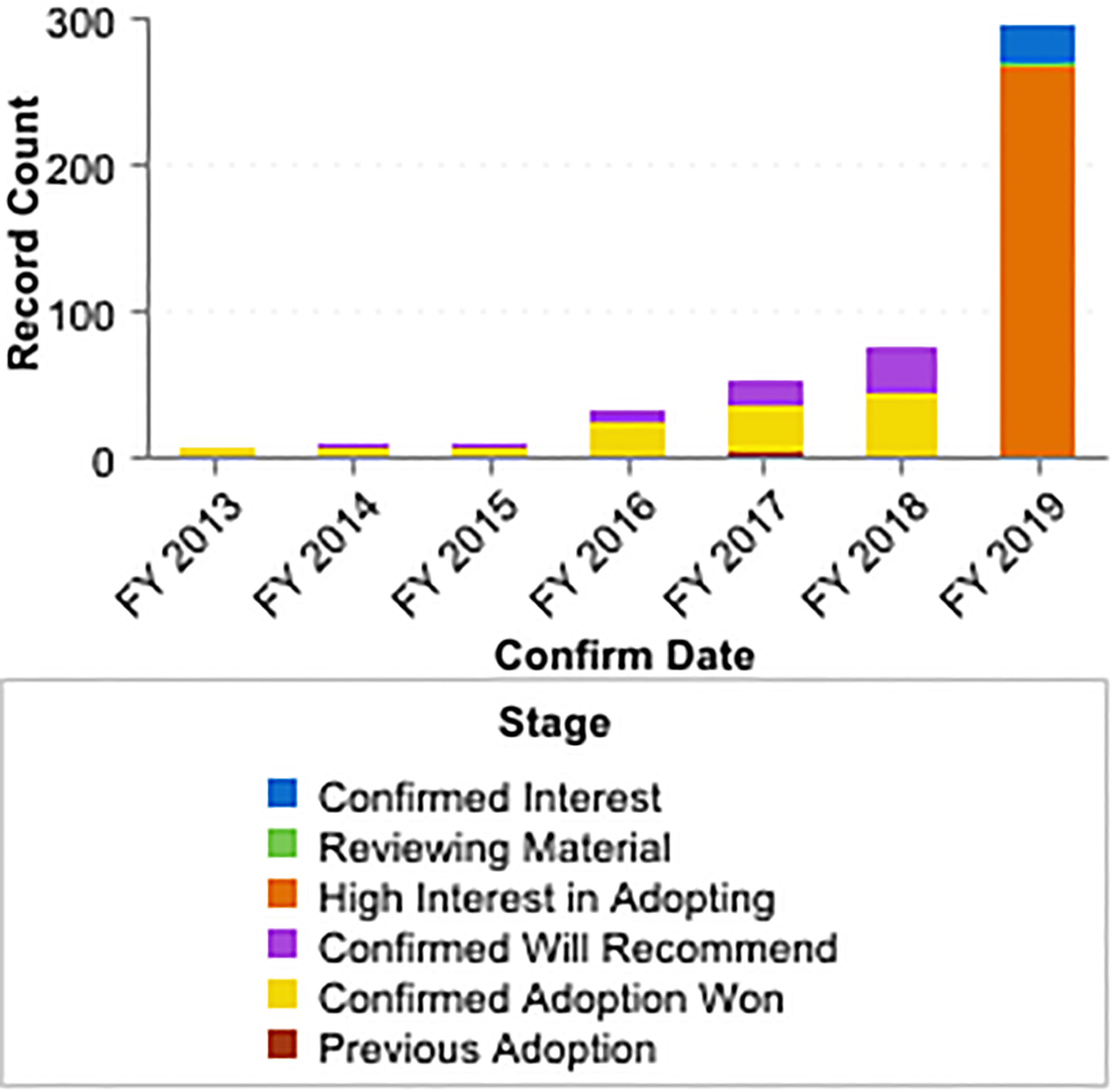
OpenStax UK science textbook adoptions (by subject).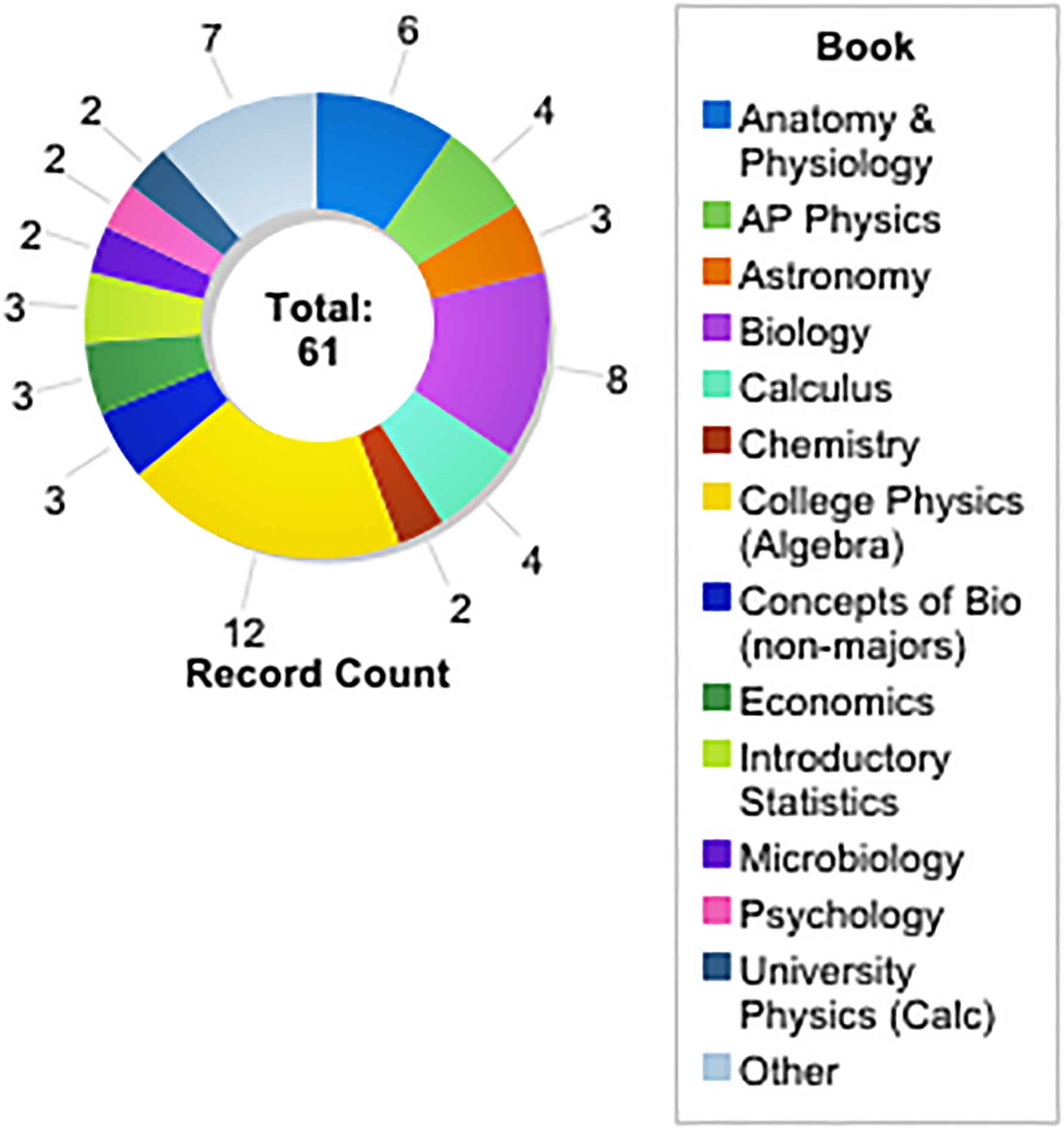
From 20 May 2017 and 22 March 2018 there were 11,467 UK web views of OpenStax textbooks and 9,994 PDF downloads of materials. This represents an increase of 263% (views) and 120% (downloads) respectively on the same period one year earlier. OpenStax reported a 19 month average time between early adopter UK educators being added to the database and confirming adoption of a textbook, suggesting that adoption impact can only be measured over a longer time period than was possible during UK Open Textbooks. The data we observed is consistent with initial patterns of textbooks adoption observed in the USA. It could be possible that it takes over a year to fully transition and this might fall across two academic years – but more data is needed to understand this.
A selection of existing uses of Open Textbooks in the UK
Source: Project Interviews.
Figure 2 shows how the higher level of interest in adopting was amplified by project activity through to 2019.
Figure 3 provides a breakdown of OpenStax textbook adoptions by subject area. These are cases where an open textbook is already being used as the main science education textbook for a course in a UK institution.
A number of interesting cases of open textbooks already being used were uncovered through project activity and then captured through semi-structured interviews. Interviews were informal discussions and organized around the following talking points:
A ‘5W’ (Who, What, When, Where and Why) query to understand how the open materials were being used Description of impact on learners/educators/faculty Challenges faced Advice for UK educators and managers
These brief case studies – four of which are summarized in Table 4 – provide concrete examples of ways in which open textbooks are already being used to support science education in the UK.
Discussion
The UK Open Textbook project sought to implement two models of open textbook adoption that had achieved success in North America, represented by OpenStax and the Open Textbook Network. These were implemented into a higher education context with a growing awareness of the burden of textbook costs, but one where relatively little research existed on the use of standard textbooks. The UK model differed from the North American context in a number of key aspects: a single textbook does not form a central, mandated component in most courses; more academic freedom exists in the selection of texts; textbooks tend to form part of a broader reading list which may include articles and other resources. As a result, the cost of textbooks is not as strong a motivational factor in the adoption of open textbooks in the UK. This is likely to be the case in other countries also, particularly when student fees are lower, or non-existent (as in much of continental Europe), so the cost of textbooks is not such a contributing factor in overall student debt.
The rationale for introducing open textbooks is different in the UK and USA. There is less of a focus on cost in the UK and the freedoms associated with an open licence (ease of access, ability to remix and adapt content) were often of greater interest. UK markets are also much smaller and characterised by smaller audiences who are not always of interest to commercial publishers (e.g. for a specific specialization in science).
The awareness of OER and open textbooks was on the whole very low in the UK HE sector. However, awareness of open access publications is high (Creaser et al., 2010; Nicholas et al., 2012; Finch, 2012). This provides an existing conceptual model and set of practices on which to build, but also indicates a potential policy route to supporting the uptake of open content. Open Textbook Network, for instance, builds capacity by training staff at the local institutions to run the workshops and self-fund the stipends. This requires institutions to own the process of running and promoting workshops.
The UK Open Textbooks project managed to significantly increase awareness by targeting major disciplinary conferences and conducting an intensive programme of workshops. This suggests that a larger, more ambitious project could rapidly achieve significant awareness across the UK HE sector (which is considerably smaller than the USA and has a number of identified points of entry such as reading lists, libraries, course managers, etc.). Although existing knowledge of open textbooks was low, once educators were made aware of them, they typically expressed significant interest in their adoption.
We found that there was a small, distributed set of individual practitioners already working with open textbooks in the UK. Their primary motivations for doing so were the immediacy, and ease of access to free digital resources, the ability to experiment and adapt such resources and the opportunity to innovate on pedagogic models with openly licensed content. They typically prefer OER content that is digital and modular, making it easier to remix and adapt for their own use. These advocates often act as local drivers for using OER in their institutions. Where open textbooks are given to staff they showed high levels of interest in the concept, and a willingness to explore further. Seeing the quality of the physical product was a significant factor for some, while others were comfortable assessing quality of purely digital resources.
In the USA, expectations around data privacy and the security of personal data differ from the European area. Towards the end of the project the General Data Protection Regulation (GDPR) came into effect. Since completed response cards were sent to OpenStax for inclusion in marketing analytics they were sent outside the EU. This kind of international consideration is essential to consider If working with a major open textbook or OER publisher, and data collection tools must clearly set out policies in a way that is GDPR compliant (Tankard, 2016; Chassang, 2017).
Another key difference with the USA is that the wider use of the reading list makes it is relatively straightforward to make one item on a reading list an open textbook without requiring a complete course to be overhauled. This provides a lower threshold for staff to engage with open textbooks because they don’t have to adopt a new textbook for an entire course. Librarians are often more aware of open alternatives than faculty and so constitute a key stakeholder in open textbook adoption. Because institutional structures vary quite a lot between HEIs it’s important to modify the offer of open textbooks according to the local context, involving stakeholders like educators, students, librarians, regional funders, societies and wider communities who may benefit from the open model.
Recommendations for further research
UK Open Textbooks was an exploratory project which indicated several avenues for future research:
Significant multi-method primary research is required to understand the actual use of textbooks in science education in more detail, and needs to be a central component of any future work in this area A more granular approach to understanding the needs of specific sectors could help tailor open textbook offering for school, Further Education and Higher Education in contrast to the open textbooks intended for overseas audiences Efficacy studies (modelled on those which have been influential in a USA context) could be used to assess the educational impact of moving to open textbooks in the UK. This would require identifying a suitable sample and control group, but methods are already established in a number of studies employing the COUP (cost, outcomes, usage, perceptions) framework (Open Education Group, n.d., Hilton, 2017; Bliss et al., 2013).
Conclusion
Open science has been mostly understood in terms of research and public access to that research. The impact of openness on teaching and learning science through open textbooks was explored in the paper. Listening to participants who shared their experiences and science teaching needs has enabled the UK Open Textbooks project to better understand the needs of higher education institutions and practitioners. It is suggested that further actions focused on helping institutions develop their own networks of open textbook advocacy presents a validated way forward.
With respect to the two different outreach approaches used by Open Textbook Network and OpenStax, it was found that both are effective in a UK context but essentially complementary because they serve different audiences (internal and externally facing respectively). Building networks of open textbook practitioners within HEIs is complemented by reaching out to new audiences through carefully targeted exhibitions, trade fairs and other events. The deeper interactions of the workshops determine more specific follow-up actions while the lighter touch of a conference exhibition acts as a marketing lead for someone who might become an open textbook advocate at some point in the future.
The challenge for the future is to coordinate and integrate these approaches at scale. There is no consistent approach to open textbooks in the UK, with a range of isolated practices. Synchronizing these activities into a network could be done through a national programme of workshops and targeted exhibitions. The introduction of Open Access as a widespread approach, supported by Research Council (RCUK, 2013) and government policy provides a model for how this could be pursued.
For instance, the Finch Report called for improving the flow of knowledge and information for open access. A series of recommendations for moving towards open are made (here adapted slightly from Finch, 2012: 7–8) which are also relevant to open textbooks:
Setting a clear policy direction towards openness Research Councils should establish more flexible models Minimise restrictions on rights of use and re-use Finding funds to extend and rationalize existing licenses for institutional use Working ambitiously with libraries Stakeholder collaboration (including central and local government, voluntary organisations, businesses, publishers, learned societies, libraries and others) Future planning to take account of the economics of the shift to open resources Universities, funders, publishers, and learned societies should continue to work together to promote further experimentation Developing the infrastructure of subject and institutional repositories to complement open alternatives
The Research Excellence Framework (REF, 2019) and The Teaching Excellence and Student Outcomes Framework (TEF, n.d.) are latest versions of national audits of research and teaching excellence in the UK. At present, they do not consider activity like sourcing or adapting an open textbook, but they could provide another route to the recognition that could act as a driver.
The role of adapting and customizing open textbooks (rather than just adopting a standard edition) seems to be more significant for UK audiences than those in the USA, where the focus is often on cost savings. This could indicate a high degree of potential for innovation of scientific pedagogy through OER.
Footnotes
Acknowledgments
The UK Open Textbooks project was funded by the William and Flora Hewlett Foundation. The lead for the overall project was Martin Weller. The researchers on the project were Rebecca Pitt, Rob Farrow and Bea de los Arcos with additional research provided by Katy Jordan. Viv Rolfe and David Kernohan acted as UK consultants for the project, conducting additional research, running workshops and raising awareness through social media and email distribution lists. The authors and those involved in the project wish to gratefully acknowledge the support of the foundation and their programme leaders. The views expressed here are the views of the authors. The entire project team contributed to the activities reported here. Analytics were provided by the OpenStax team.