




Abstract
BACKGROUND:
Long noncoding RNA have been indicated to be involved in tumor development. However, the role of LINC00460 in gastric cancer (GC) still remains large unknown. The current study is designed aiming at determining the effects of LINC00460 on GC progression.
PATIENTS AND METHODS:
The expression of LINC00460 in GC tissues and cells were detected by quantitative Real-Time Polymerase Chain Reaction (qRT-PCR). The cell proliferation, cell cycle distribution and cell invasion were evaluated by MTT (3-(4,5-dimethylthiazol-2-yl)-2,5-diphenyl tetrazolium bromide), flow cytometry analysis and transwell cell invasion assays. Western blot analysis was used to detect the WNT signaling related protein expression. Tumor xenograft assay was used to detect the effects of LINC00460 in vivo.
RESULTS:
In the study, we demonstrated that LINC00460 expression was higher in gastric cancer tissues compared to adjacent normal tissues. Higher LINC00460 expression associated with lymph node metastasis and advanced TNM stage. Furthermore, we showed that higher LINC00460 expression predicted a poor disease-free survival (DFS) and overall survival (OS) time of gastric cancer. Multivariate analysis showed that LINC00460 expression was an independent risk factor of GC prognosis. Furthermore, in vitro, we demonstrated that inhibition of LINC00460 expression suppressed cell proliferation, S phase cell number and cell invasion of gastric cancer cells compared to the control groups. In addition, we showed that downregulation of LINC00460 inhibited the Wnt/
CONCLUSIONS:
LINC00460 is a new type of molecule involved in the development of GC, which may become a potential target for the treatment of GC.
Introduction
Gastric cancer (GC) is a frequently diagnosed cancer among males and females and is one of the most common causes of mortality worldwide. More than 50% of cases occur in Eastern Asia and mainly in China [1]. The overall survival outcome has improved for GC due to diagnosis at early stage, surgical resection, chemotherapy or radiation therapy. However, due to tumor progression and metastasis, the prognosis of patients with advanced GC remains a five-year survival rate with about 20% [2, 3]. Thus, to explore novel biomarkers and therapeutic targets for GC is urgent.
Association of LINC00460 expression with clinicopathologic factors in 90 cases of GC patients
Association of LINC00460 expression with clinicopathologic factors in 90 cases of GC patients
Long non-coding RNA (LncRNAs) are endogenous RNA molecules that more than 200 nucleotides [4]. It has been reported that lncRNAs are able to participate in the regulation of cell proliferation, migration, invasion, differentiation, metabolism and apoptosis in gastric cancer [5, 6]. Studies indicated that lncRNAs are identified as tumor suppressors or oncogenes that involved in the regulation of metastasis and invasion of GC. Such as, enhanced expression of lncRNA TP73-AS1 predicts unfavorable prognosis for gastric cancer and promotes cell migration and invasion by induction of EMT [7]. Long non-coding RNA AFAP1-antisense RNA 1 promotes the proliferation, migration and invasion of gastric cancer cells and is associated with poor patient survival [8]. The long non-coding RNA LINC01606 contributes to the metastasis and invasion of human gastric cancer and is associated with Wnt/
In the study, we demonstrated that LINC00460 expression was high in gastric cancer tissues and cell lines. High LINC00460 expression associated with lymph node metastasis, TNM stage and poor prognosis of GC. Furthermore, we demonstrated that inhibition of LINC00460 expression suppressed cell proliferation, cell invasion and Wnt/
Patients and tissues
A total of 90 GC tissues and corresponding adjacent normal tissues were obtained from patients with GC who underwent surgery at the Wuhan Third hospital, Tongren hospital of Wuhan university from March 2011 to December 2015. The histopathological diagnoses of GC were confirmed by two senior pathologists. Patients averaged age 53.6 years and age ranged from 32 to 76 years old. The clinical data of patients was shown Table 1. The present study was approved by the ethics committee of Wuhan Third hospital, Tongren hospital of Wuhan university and written informed consent was obtained from all patients.
Cell culture
Four Human GC cell lines BGC-823, SGC-7901, MKN-28, MKN-45 and the human normal gastric mucosa epithelial cell line GES-1were purchased from the Cell Bank of the Chinese Academy of Sciences (Shanghai, China). Cells were cultured in RPMI 1640 medium (Invitrogen, Carlsbad, CA, USA) containing 10% fetal bovine serum (FBS). All of the cells were cultured in a 37
Cell transfection
Two siRNAs oligonucleotides against LINC00460 and negative controls were purchased from Dharmacon, Inc. (Chicago, IL, USA). The sequences for si-LINC00460-1 or si-LINC00460-2 was as follow: si-LINC00460-1: 5’-AAGTCAAGAATCTGCCTGAAC CAGT-3’, si-LINC00460-2: 5’-CCGTCTCCTTACAT GAAAGTGAAGA-3’. Cells were seeded at 1
RNA extraction and quantitative Real-Time PCR (qRT-PCR)
Total RNA was isolated from tissues and cells using TRIzol (Invitrogen, Carlsbad, CA, USA). The cDNA was generated from RNA isolated from the tissues using Super Script III (Invitrogen, Carlsbad, CA, USA). The reaction was carried out on an ABI 7500 sequence detection system (Applied Biosystems, Foster City, CA, USA) using SYBR Green Master Mix (Applied Biosystems, Foster City, CA, USA). All the reaction mixtures were incubated in a 96-well plate at 95
MTT assay
The MKN-45 and SGC-7901 cells transfected with either si-NC or si-LINC00460 for 48 hours were suspended and then were seeded into 96-well plates (cell density of 3
Transwell invasion assay
Cell invasion assay were performed using transwell chambers with inserts of 8-
Flow cytometry
Transfected cells were harvested and fixed in 80% ethanol and then were lysed at 4
LINC00460 is highly expressed in GC tissues and cells, and indicates poor prognosis of GC patients. (A) QRT-PCR analysis results revealed the expression of LINC00460 in 90 cases of GC tissue samples and adjacent normal tissue samples. (B) QRT-PCR analysis results revealed LINC00460 expression in GC cell lines (BGC-823, MKN-45, SGC-7901, MKN-28) compared with normal gastric mucosa cell line (GES-1). (C) and (D) According to median value of LINC00460 expression, the whole patients were divided into high LINC00460 expression group (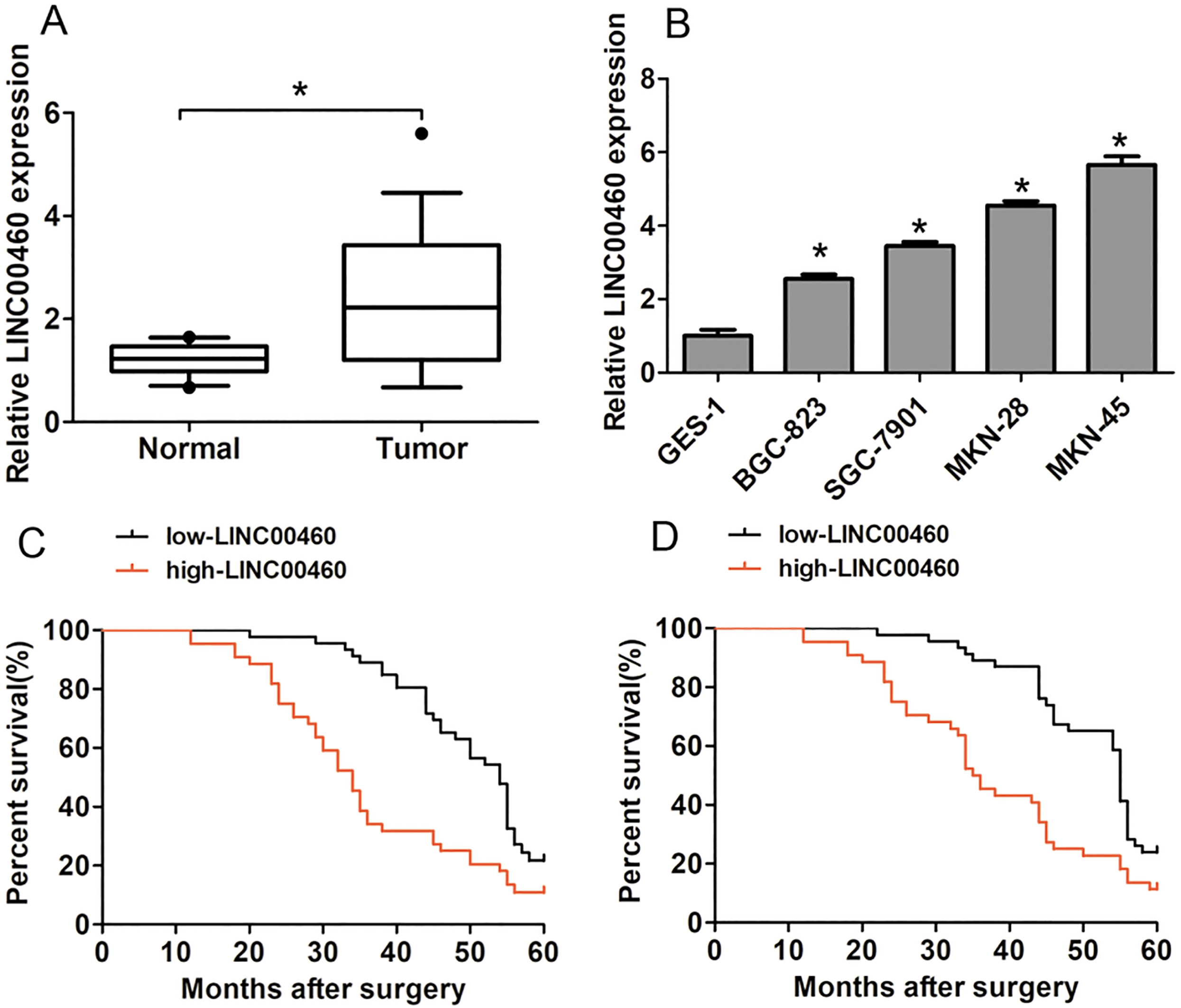
Cells were lysed using ice-cold RIPA buffer (Beyotime, Shanghai, China) and protein concentration was analyzed by the BCA protein assay kit (Beyotime, Shanghai, China). Equal amounts of protein (40
Tumor xenograft assay
All animal experiments were approved by the Animal Care and Use Committee of Tongren hospital of Wuhan university. LINC00460-knockdown (Lv-LINCC460) MKN-45 cells and control cells (Lv-control) were injected subcutaneously into the flank region of nude mice (four-week-old male) using tuberculin syringe. Tumor size was measured every 7 days with a caliper, and tumor volume was calculated using the following equation: tumor volume (mm
Statistical analysis
Statistical analysis was performed using SPSS 20.0 software (SPSS, Inc., Chicago, IL, USA). The difference between two groups was analyzed using a two-tailed Student’s
Results
LINC00460 expression is upregulated in GC and associates with prognosis of GC patients
To explore the role of LINC00460 expression in gastric cancer, we detected the LINC00460 expression in 90 cases of GC tissues and adjacent normal tissues by performing qRT-PCR analysis. The results showed that the expression of LINC00460 in GC tissues was significantly higher than that in adjacent normal tissues (
LINC00460 knockdown inhibits cell proliferation and cell colony formation ability. (A) and (B) RT-PCR analysis results revealed the expression of LINC00460 after MKN-45 or SGC-7901 cells were transfected with si-LINC00460-1, si-LINC00460-2 or si-NC. (C) and (D) MTT assay results revealed the cell proliferation ability after MKN-45 or SGC-7901 cells were transfected with si-LINC00460 or si-NC. (E) and (F) Cell colony formation assays results revealed the cell colony formed number after MKN-45 or SGC-7901 cells were transfected with si-LINC00460 or si-NC. 
Moreover, according to median value of LINC00460 expression, the whole patients were divided into high LINC00460 expression group and low LINC00460 expression group. We found that higher LINC00460 expression was closely associated with lymphatic metastasis (
Multivariate Cox analysis of DFS in 90 cases of GC patients
Multivariate Cox analysis of DFS in 90 cases of GC patients
Multivariate Cox analysis of OS in 90 cases of GC patients
LINC00460 knockdown inhibits cell cycle progression and cell invasion ability. (A) and (B) Cell cycle distribution was shown after MKN-45 or SGC-7901 cells were transfected with si-LINC00460 or si-NC. (C) and (D) Transwell invasion assay and cell invasive number were shown after MKN-45 or SGC-7901 cells were transfected with si-LINC00460 or si-NC. 
To verify the effects of LINC00460 knockdown on GC progression, two LINC00460-specific siRNAs were transfected into two GC cell lines MKN-45 and SGC-7901, followed by monitoring cell proliferation, cell cycle progression and cell invasion. The design of LINC00460-specific siRNAs was shown in Fig. 2A. The siRNA-2 was primarily used in the present study due to its higher knockdown efficiency. We found that knockdown of LINC00460 in MKN-45 and SGC-7901 cells resulted in a dramatically reduced cell proliferation compared the control groups by MTT cell proliferation assays (Fig. 2B and C). Furthermore, knockdown of LINC00460 in MKN-45 and SGC-7901 cells resulted in a dramatic reduction in the number of colonies formed compared to control groups, suggesting dampened cell proliferation ability (Fig. 2D and E). Moreover, we performed the flow cytometry analysis to detect whether LINC00460 expression affected cell cycle progression in GC cells. The results showed that LINC00460 knockdown significantly inhibited S phase cell
LINC00460 knockdown inhibits Wnt/
number cell compared the control groups in MKN-45 and SGC-7901 cells (Fig. 3A and B). In addition, the transwell invasion assay also showed that LINC00460 knockdown significantly inhibited cell invasion number compared the control groups in MKN-45 and SGC-7901 cells (Fig. 3C and D). These results indicated that LINC00460 knockdown can effectively inhibit tumor proliferation, cell cycle and cell invasion ability in vitro.
Then we attempted to explore whether LINC00460 expression affects Wnt/
Expression of LINC00460 affects GC tumorigenicity in vivo
To evaluate the role of LINC00460 in vivo, we performed the nude mouse xenograft assay for further study. The results demonstrated that tumor volume of LINC00460 knockdown xenografts were significantly decreased compared with the control group (Fig. 5A). The average tumor growth of xenografts from LINC00460-knockdown cell-injected mice was smaller than that of the control group (Fig. 5B). Moreover, we showed that Ki67 protein levels in LINC00460-knockdown xenografts were significantly decreased compared with the control group (Fig. 5C). These data suggested LINC00460 promotes GC tumorigenesis in vivo.
LINC00460 knockdown significantly suppressed cell proliferation in vivo. (A) Tumor volume of LINC00460 knockdown xenografts were significantly decreased compared with the control group. (B) The average tumor growth of xenografts from LINC00460-knockdown cell-injected mice was smaller than that of the control group. (C) Ki67 protein levels in LINC00460-knockdown xenografts were significantly decreased compared with the control group by western blot analysis. 
Increasing evidences have confirmed that long non-coding RNAs have considerable potential value for improving diagnostic and therapeutic methods for GC. Recently, many researchers have identified some lncRNAs were involved in GC proliferation and invasion. Such as, enhanced expression of lncRNA TP73-AS1 predicts unfavorable prognosis for gastric cancer and promotes cell migration and invasion by induction of EMT [7]. Long non-coding RNA NNT-AS1 sponges miR-424/E2F1 to promote the tumorigenesis and cell cycle progression of gastric cancer [12]. Knockdown of long noncoding RNA CCAT1 inhibits cell growth, invasion and peritoneal metastasis via downregulation of Bmi-1 in gastric cancer [13]. Elevated TFAP4 regulates lncRNA TRERNA1 to promote cell migration and invasion in gastric cancer [14]. LINC00460 was found to affect cell proliferation and apoptosis by regulating KLF2 and CUL4A expression in colorectal cancer [15]. In GC, Wang et al. showed that LINC00460 modulates KDM2A to promote cell proliferation and migration by targeting miR-342-3p in gastric cancer [16]. However, the role of LINC00460 in gastric cancer still needed to be explored.
In the study, our results showed that LINC00460 expression was higher in gastric cancer tissues compared to adjacent normal tissues. Higher LINC00460 expression associated with lymph node metastasis and TNM stage. Furthermore, we demonstrated that higher LINC00460 predicted a poor DFS and OS rate of gastric cancer. Multivariate analysis showed that LINC00460 was an independent risk factor of gastric cancer prognosis. These results indicated that LINC00460 expression could act as predictor of GC prognosis.
Moreover, functional assays showed that reduced LINC00460 expression suppressed cell proliferation, cell cycle and cell invasion of gastric cancer cells. Wnt/
Conclusions
In conclusion, our results showed LINC00460 expression was higher in GC. Higher LINC00460 predicted a poor prognosis of gastric cancer patients. LINC00460 was also identified an independent risk factor of gastric cancer prognosis. Moreover, reduced LINC00460 expression suppressed cell proliferation, cell invasion and Wnt/