




Abstract
BACKGROUND AND AIM:
Gastric cancer (GC) is a common and fatal malignancy with a worldwide occurrence. There still lacks effective biomarkers for precisely evaluating GC. Saliva is a biological fluid with enormous diagnostic potentials which emerged many advantages. We aimed to discover the novel biomarkers for accurately distinguishing early GC based on saliva glycopatterns.
METHODS:
We used Aleuria Aurantia Lectin (AAL)-magnetic particle conjugates to isolate fucosylated glycoproteins in the pooled saliva of healthy volunteers (HV,
RESULTS:
A total of 9/9, 8/11, and 9/9 fucosylated
CONCLUSIONS:
This study could provide pivotal information to distinguish among HV, AG, and GC, and facilitate the discovery of biomarkers for GC diagnosis based on precise alterations of
Introduction
Although the incidence and mortality have declined in recent years, gastric cancer (GC) is still a major public health problem, particularly in the eastern countries [1]. Helicobacter pylori (H. pylori) infection is known as the major trigger of atrophic gastritis (AG), and AG is the precursor of gastric cancer [2, 3]. The existing biomarkers such as CEA, CA125, CA19-9 and CA72-4 are not sensitive or specific enough to characterize the early GC [4, 5]. These reasons result in that about 80% patients are not diagnosed until advanced stages, and inducing the high mortality [4, 5]. Thus, identification of the difference among HV, AG, and GC to discover the novel biomarkers is an urgent demand for accurately distinguishing early GC.
As the two major types of protein glycosylation,
Saliva is a kind of mixed fluid secreted by parotid, submandibular, sublingual and minor glands, which contains several molecular profiles that could reflect the condition of body [10, 11]. Using saliva in diagnosis has many advantages such as noninvasive and convenient, which might facilitate early detection of many diseases [11]. Recent studies have elucidated that many diseases could be detected by saliva, such as familial juvenile systemic lupus erythematosus [12], type II diabetes [13], laryngeal cancer [14], oral cancer [15], breast cancer [16], lung cancer [17], pancreatic cancer [18], and GC [19]. Salivary glycopatterns could also be used for detecting of disease and cancer [20, 21]. Our previous study revealed that salivary glycopatterns recognized by Aleuria Aurantia Lectin (AAL) exhibited significantly decreased expression levels in GC compared with HV and AG (all
In this study, we further investigated the alterations of fucosylated
Clinical characteristics of healthy volunteers and patients with atrophic gastritis and gastric cancer
Clinical characteristics of healthy volunteers and patients with atrophic gastritis and gastric cancer
The overall strategy applied in this study.
Study approval and population
The collection and use of human whole saliva for research presented here were approved by the Ethical Committee of Northwest University (Xi’an, China), First People’s Hospital of Chenzhou (Chenzhou, China). Written informed consent was received from participants for the collection of their whole saliva. This study was conducted in accordance with the ethical guidelines of the Declaration of Helsinki. In total, 51 patients of AG, 51 patients of GC and 51 age- and sex-matched HV were enrolled for this study. All the patients were histopathologically confirmed in the First People’s Hospital of Chenzhou and who received preoperative radiotherapy, chemotherapy, chemoradiotherapy or curative were excluded from the study. The clinical characteristics of HV, AG, and GC were summarized in Table 1.
Whole saliva collection and preparation
The collection of all the saliva samples were according to the protocol [20, 21]. Saliva was collected without stimulation between 9 a.m. and 10 a.m. at least 2 h after intake of food. Before collecting, the mouth was rinsed with physiological saline immediately. Whole saliva (about 1 mL) was collected and placed on ice. Protease Inhibitor Cocktail (1
Preparation of AAL-magnetic particle conjugates
AAL was purchased from Vector Laboratories (Burlingame, CA, USA). The epoxy-coated magnetic particles (2 mg) were rinsed three times with ethanol and then rinsed three times with coupling buffer (5 mM NaB
Selective isolation of glycoprotein from human saliva by AAL-magnetic particle conjugates
The prepared AAL-magnetic particle conjugates were blocked by 600
Trypsin digestion of the AAL-isolated glycoproteins and PNGase F release of the N-linked glycans
The AAL-isolated glycoproteins (200
NaClO release of the O-linked glycans
The protocol of
Purification of
-/
-linked glycans
Purification of glycans was performed as described previously [23, 25]. The C
Characterization of the
- and
-linked glycans by MALDI-TOF/TOF-MS
The purified glycans were characterized by MALDI-TOF/TOF-MS (UltrafleXtreme, Bruker Daltonics). Glycans were resuspended in 10
Results
The
-linked glycan profiles of the isolated salivary glycoprotein
The identified
MALDI-TOF/TOF-MS spectra of the purified 
MALDI-TOF/TOF MS/MS analyzing the
The proposed fucosylated structures for 11
*Monosaccharides are represented according to MS-tools from the GlycoWorkbench software (GlcNAc, blue square; Man, green circle; Gal, yellow circle; Fuc, red triangle; NeuAc, purple diamond; ND, not detected in the sample. The Relative Ratios of each peak from HV, AG, and GC groups are compared with each other based upon fold change in pairs. –, the denominator of the fold-change is zero.
MALDI-TOF/TOF-MS spectra of purified 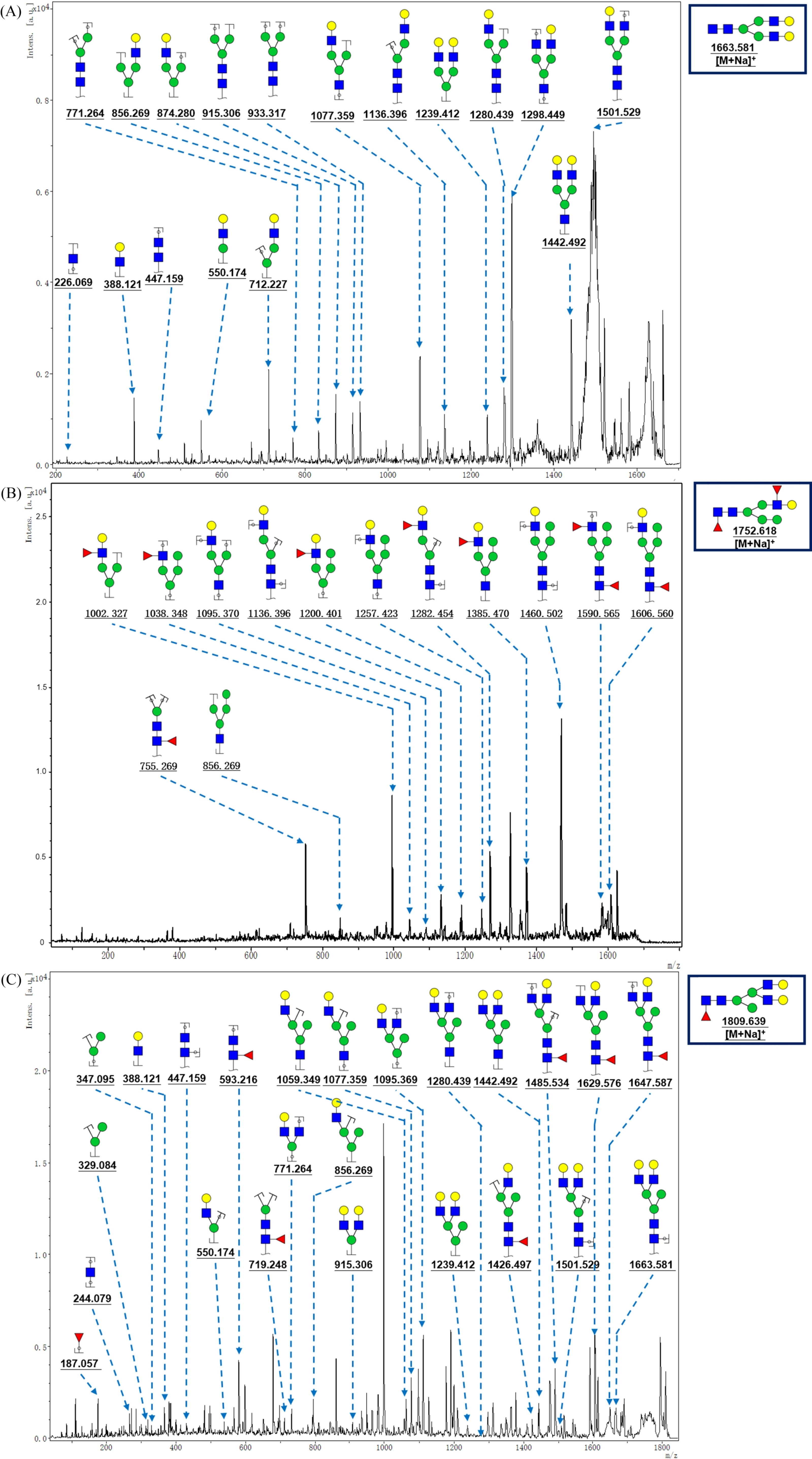
The proposed fucosylated structures for 19
*Monosaccharides are represented according to MS-tools from the GlycoWorkbench software (GlcNAc, blue square; Man, green circle; Gal, yellow circle; Fuc, red triangle; NeuAc, purple diamond; ND, not detected in the sample. The Relative Ratios of each peak from HV, AG, and GC groups are compared with each other based upon fold change in pairs. –, the denominator of the fold-change is zero.
The proportion of the fucosylated
The
-linked glycan profiles of the isolated salivary glycoprotein
The
Alterations of fucosylated O-linked glycan profiles among healthy volunteers, gastric cancer, and atrophic gastritis patients
It is also noticeable that there were 9, 11, and 9 fucosylated
The proportion of the fucosylated
Discussion
There are many studies indicated that the alteration of glycans affects the function of glycoproteins as well as depicted that the association between glycosylation and cancer. E-cadherin aberrant
A total of 14/14, 13/16, and 13/14
In conclusion, the present study investigated the correlation of the fucosylated glycans from the salivary proteins isolated by the AAL-magnetic particle conjugates, and systematically compared their alterations of the fucosylated
Footnotes
Acknowledgments
This work is supported by the National Natural Science Foundation (Grant No. 81372365) and the training Fund of Northwest University (Grant No. YYB17018).
Conflict of interest
The authors declare no competing financial interests.