




Abstract
Bladder cancer is derived from bladder mucosa and is the most common malignant tumor in urinary system. Long non-coding RNA (lnc-RNA) has high tissue specificity and can participate in cell proliferation and differentiation at various levels, and plays critical roles in occurrence of malignant tumors. This study aims to investigate the suppression of E-cadherin expression by lnc-RNA H19 to enhance bladder cancer metastasis.
qRT-PCR was applied to analyze differential expression of lnc-RNA H19 in different bladder cancer tissues and tumor adjacent tissues. Patients clinical data were collected to analyze the correlation between H19 expression level and patient’s clinical stage, tumor metastasis. RNA interference was employed to examine the effect of H19 on E-cadherin expression. The regulation of cancer metastasis was investigated on an animal model. H19 expression level was significantly higher in bladder cancer tissue compared to adjacent tissues (
Introduction
Bladder cancer mainly refers to a group of malignant tumors occur on bladder mucosa. It is one popular cancer in urinary system, and is the most frequent tumor in urine-reproductive system. In Western world, bladder is the second popular urinary cancer next to prostate cancer [1]. In year 2012, incidence of bladder cancer in China is 6.6 per 100 000 people, and is the ninth frequent cancer. The incidence is rapidly increasing with aged population, and is most frequent among 50–70 years group, with about 3–4 fold more male patients over females [2]. Currently electrocision has been widely applied on those bladder limited on superficial layer, and has obtained more than 80% 5-year survival. However, for those patients with lymph- or blood-borne metastasis, the treatment difficulty is largely increased [3].
Recent studies about tumor molecular biology has revealed the present of abnormal expression of long non-coding RNA (lncRNA) in malignant tumor cells [4]. As one group of RNA molecules with transcript length
E-cadherin is one group of calcium-dependent transmembrane protein mediating homogenous cell adhesion. Developmental studies showed that E-cadherin played critical roles in cell differentiation, embryonic development and organogenesis [8]. Recent studies found the correlation between E-cadherin and metastasis of human cancer [9]. This is mainly due to the critical roles of E-cadherin in maintaining normal structure of epithelial cells, and can suppression tumor cell invasion [10]. Loss-of-function mutation of E-cadherin can disrupt adhesion between tumor cells and peripheral cells, leading to tumor invasion or metastasis [11]. Therefore, the study of E-cadherin related regulatory mechanism and its correlation with cancer metastasis is of critical importance for human suppression of cancer invasion and improvement of patient survival rate. This study aimed to investigate the role of lnc-RNA H19 in E-cadherin expression, in addition to its effects of bladder cell metastasis.
Primer sequences used in RT-PCR
Primer sequences used in RT-PCR
Recruitment of research objects
A total of 48 bladder cancer patients admitted in The People’s Hospital of Jiangxi Province from January 2014 to March 2016 were recruited as the research objects. All patients aged between 46 and 64 years (average age
qRT-PCR assay
Based on gene sequence of lnc-RNA H19 (Gene-bank access ID: NR_002578), specific primers were designed as shown in Table 1. One-step total RNA extraction kit TRIZOL (Invitrogen) was used to extract total RNA from tissues. Using total RNA extracted from control tissues as the control group, qRT-PCR was performed based on test kit (TianGen). Firstly reverse transcription was performed at 37
Design of RNA interference sequence
Based on lnc-RNA H19 sequence, RNA interference sequence was designed. Firstly those sequences with 29 bp length containing about 50% GC were selected from mRNA database. Those sequences were then aligned with mRNA from other genes in human genomic database to exclude sequences with homology. Those H19-RNAi sequences fitting criteria were randomized for sequence. After ruling out homology with other genes, those sequences fitting criteria were recruited as negative controlled scramble-RNAi. Sequences were shown in Table 2 and were synthesized by Sangon (China).
Nucleotide sequence used for RNA interferences
Nucleotide sequence used for RNA interferences
Bladder cancer cell line HTB-9 and J82 was purchased from Cell Bank, CAS. Cells were resuscitated and incubated until log-growth phase. Trypsin was used to digest cells, which were counted and diluted in freshly prepared medium, and were inoculated into 96-well plate. After 24 h incubation, transfection assay was performed using liposome INTERFERin
Cell adhesion assay
Matrigel was added into the 96-well plate and incubated at 37
Transwell assay for cell invasion and migration
60
Western blot
Cell after culture were collected and mixed with 100
Bladder cancer cell mouse model and analysis of tumor metastasis
Using cancer cell xenograft assay, we measured the effect of lnc-RNA H19 on tumorigenesis potency of bladder cancer cells. In brief, cancer cells were incubated at 37
Statistical methods
SPSS 19.0 software package was used to analyze all data. Measurement data were presented as mean
H19 expression in bladder cancer tissues. Bladder cancer tissues were collected for total RNA extraction which was used for measuring the mRNA expression of H19 by RT-PCR. **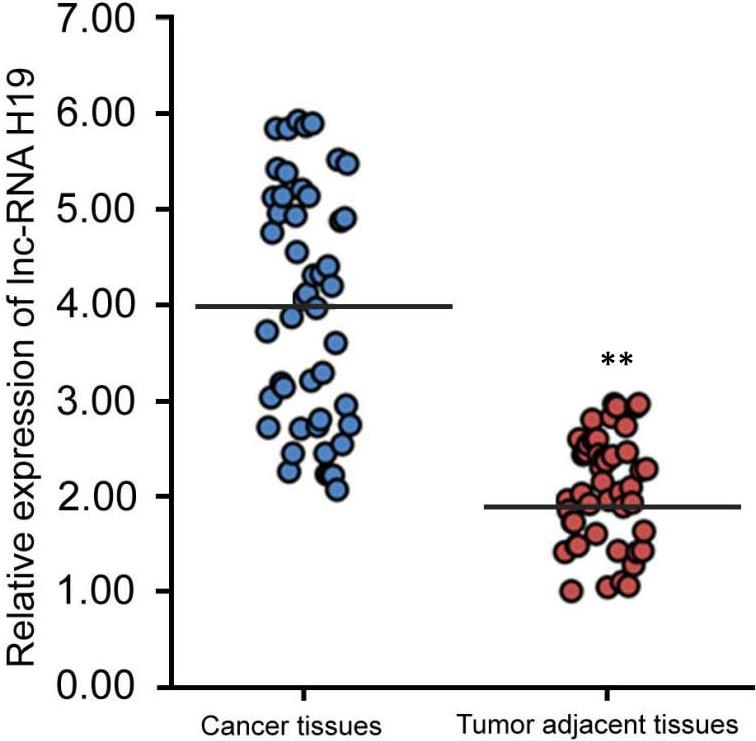
H19 expression across different stages of bladder cancer. Bladder cancer tissues and tumor adjacent tissues were collected and total RNA was extracted for analysis of H19 expression by RT-PCR. *, 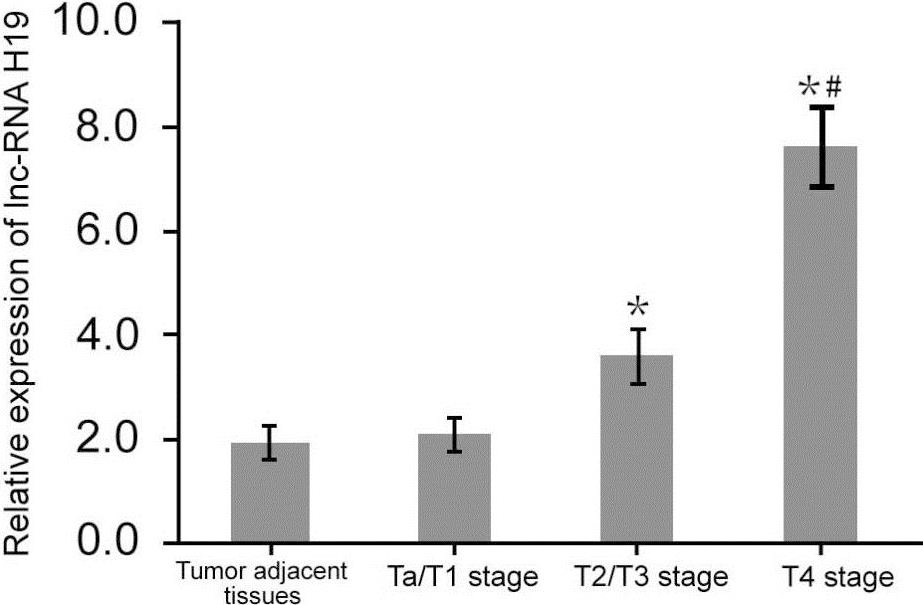
Lnc-RNA H19 expression in bladder cancer tissues
By using qRT-PCR, we measured the expressional profile of lnc-RNA H19 in cancer tissues and adjacent tissues across different bladder cancer patients. As show in Fig. 1, we found that compared to cancer adjacent tissues, cancer tissues had about 1.1 fold increase of H19 expression (
Correlation between lnc-RNA H19 expression and metastasis of bladder cancer
Based on qRT-PCR results, we divided all prostate cancer patients into H19 high-expression (relative expression
H19 expression in bladder cancer with or without metastasis. Total RNA was extracted from tissues of bladder cancer patients with or without metastasis followed by measuring H19 expression by RT-PCR. ***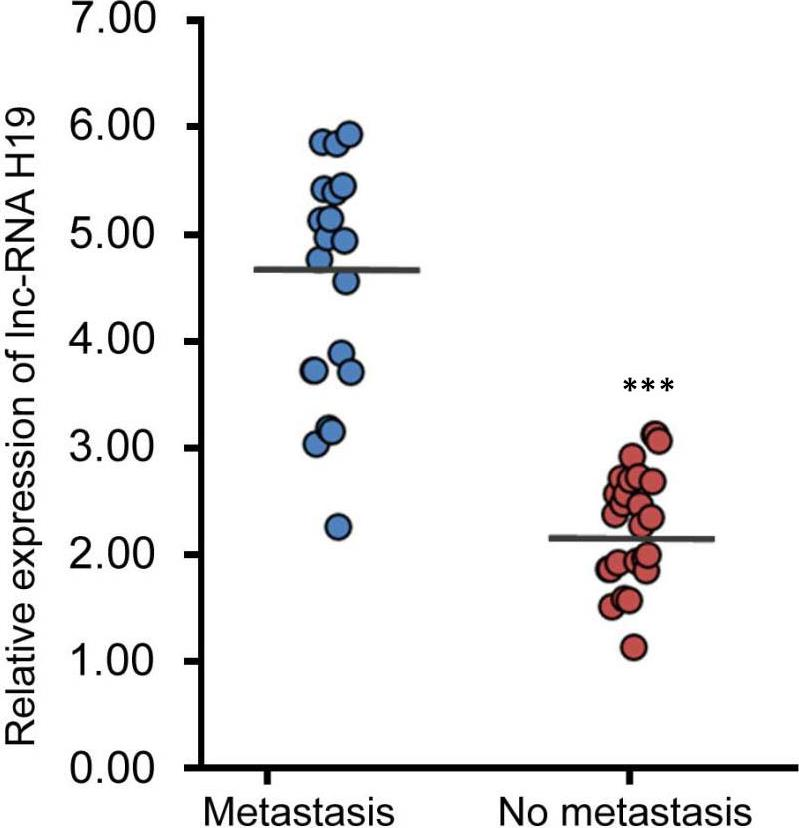
Relationship between H19 expression and clinical or pathological parameters of bladder cancer
Using in vitro synthesized oligonucleotide sequen-ces H19-RNAi and Scramble-RNAi, human bladder cancer cell line HTB-9 or J82 was transfected, with un-transfected cells as blank control. qRT-PCR results were shown in Fig. 4. In those cells transfected with H19-RNAi, H19 expression level was significantly decreased, demonstrating successful transfection of H19-RNAi oligonucleotide sequence and further RNA interference. Western Blot assay was further applied to measure relative expression level of E-cadherin protein after RNA interference. Figure 5 showed significantly up-regulated E-cadherin expression after RNA interference cells (
Relative expression of H19 in transfected cells. Total RNA was extracted from HTB-9 or J82 cells after transfection of RNAi for analysis of H19 expression by RT-PCR.*, 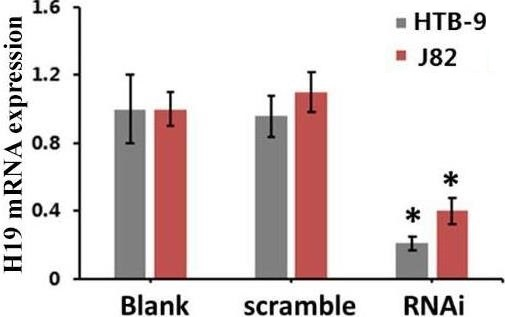
Effects of H19 expression on E-cadherin. Total RNA and protein were extracted from transfected cells and E-cadherin protein and mRNA was measured by western blot and RT-PCR respectively. *, 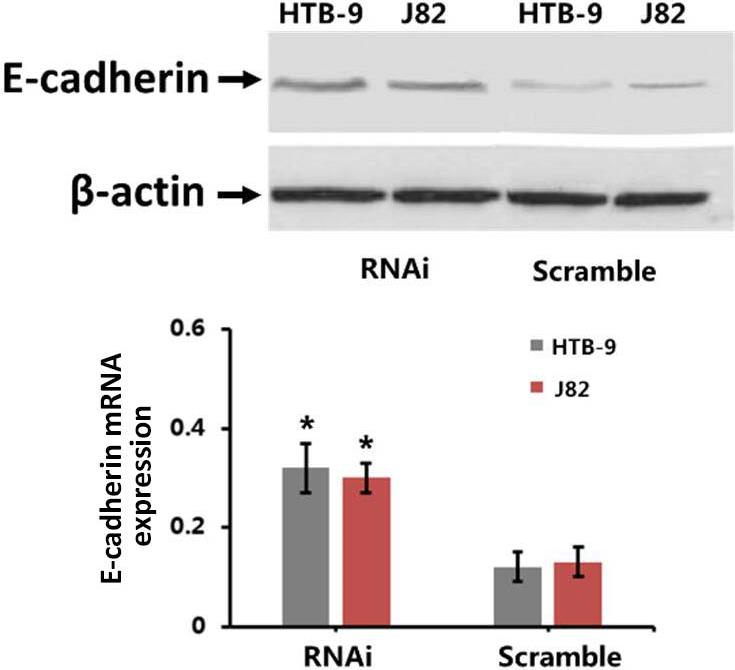
Effects of H19 expression on cell adhesion and invasion. (A): Cell adhesion analysis in HTB-9 or J82 cells after RNAi transfection. (B): Cell invasion and migration analysis. *, 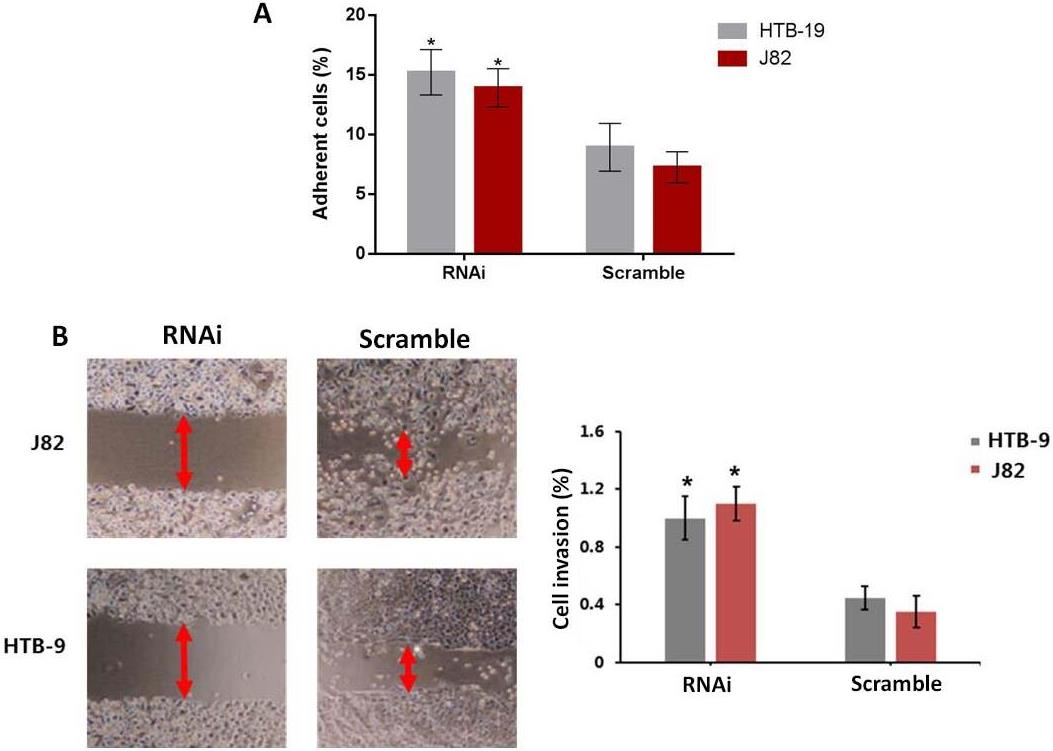
To evaluate whether H19 affects cell adhesion and invasion, relevant assays were performed. As shown in Fig. 6A, cell adhesion was significantly increased in cells transfected with RNAi compared with control (
Effects of H19 expression on tumor metastasis
Those bladder cancer cells with successful transfection of RNA interference were used in a xenograft transplantation study to analyze the effect of H19 gene expression on metastatic potency of bladder cancer cells. The efficiency of RNAi-H19 has been verified by RT-PCR prior to implantation of the transfected cells in mice. The condition of in vivo tumor metastasis inside mouse was shown in Fig. 7. We found that in those mice injected with RNA-interference cells, the number of metastatic lesions was significantly lower than control group (red arrows) on day 21 post implantation, indicating that RNA interference against H19 expression effectively suppressed metastatic potency of bladder cancer cells.
Effects of H19 expression on metastasis of bladder cancer. (A) Images of xenograft cell transplantation, with metastatic lesions indicated by arrows; (B) The effect of H19 expression on metastasis of bladder cancer. *, 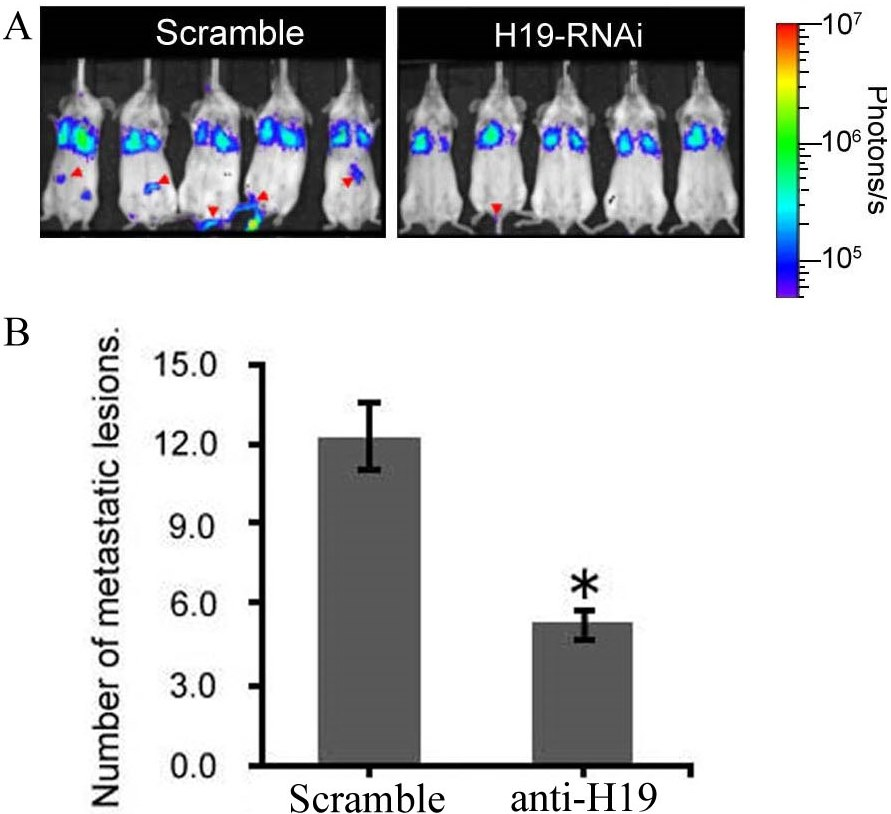
Recent studies showed that lnc-RNA played important roles in mediating expression of cellular transcription factor, interaction with nuclear chromatin, and expressional modification of cellular genes [4, 12]. Expression of lnc-RNA thus exerts critical roles for maintaining normal cellular homeostasis, and abnormal expression of lnc-RNA is closely correlated with pathogenesis and progression of malignant tumors [5, 13]. In this study we investigated the expressional profile of H19 inside human bladder cancer tissues, and found the correlation between H19 expression and clinical stage or cancer metastasis. Lastly, we employed cell transfection and RNA interference approach to analyze the effect of H19 expression on cell proliferation and invasion.
By RT-PCR assay, we found significant up-regula-tion of H19 inside bladder cancer cells, and is positively correlated with clinical stages. Meanwhile we also found that the expression of H19 was correlated with lymph node metastasis and distal metastasis. In recent years, multiple studies found significant up-regulation of H19 in various human malignant tumor cells including liver cancer, gastric carcinoma, lung cancer and bladder cancer cells [14, 15, 16]. Meanwhile we also found that those patients with H19 high-expression showed more advanced pathological grades, and higher risk and malignancy [17]. Luo et al. also reported that those bladder cancer patients with H19 high expression presented higher incidence of distal metastasis compared to those with H19 low expression [14], as consistent with this study.
By in vitro cell culture, we found significantly enhanced proliferation and invasion potency of bladder cancer cells when H19 expression was suppressed. We thus speculated that H19 down-regulation might enhance proliferation and invasion potency of cancer cells, and eventually potentiated malignancy of cancer and possibly of invasion or metastasis. In studies on other malignant tumors, similar phenomena can be observed. Li et al. performed a gene over-expression assay, and found similar results showing that H19 over-expression facilitated metastasis of gastric cancer cells [17], as consistent with our results.
During the regulation of cancer cells, Jiang and Zhang found that most malignant tumor cells displayed over-expression of TGF-
Currently lnc-RNA has become a new focus on molecular biology study of tumors, as it may become a potential drug target in future. Major weakness of this study includes insufficient sample size, and absence of further exploration of molecular mechanism of H19 expressional regulation. Future study will focus on the effect of H19 expression on cancer driving gene expression, and its interaction with E-cadherin for intracellular signaling pathway. These studies may provide grounds for clinical diagnosis and treatment of prostate cancer.
Conclusion
Up-regulation of H19 in bladder cancer tissues is correlated with clinical stage or metastasis of cancer. By cell transfection to suppress H19 expression in bladder cancer cells, E-cadherin expression is up-regulated, thus weakening metastatic potency of cancer cells.
Footnotes
Acknowledgments
This work was supported by the Key R&D Project of Jiangxi Province (No. 20171BBG70070) and the Social Development Project of Jiangxi Provincial Science and Technology Department (No. 20141BBG70046).
Conflict of interest
None.