




Abstract
BACKGROUND:
It has been demonstrated that microRNAs (miRNAs) play an important role in the carcinogenesis of osteosarcoma.
OBJECTIVE:
The aim of the present study was to determine the diagnostic and prognostic value of serum miR-124 in osteosarcoma.
METHODS:
The serum miR-124 expression levels in 114 osteosarcoma patients, 40 periostitis patients and 50 normal controls were detected using real-time quantitative polymerase chain reaction (RT-qPCR).
RESULTS:
The level of serum miR-124 was remarkably decreased in osteosarcoma patients when compared to periostitis patients and healthy controls (both
CONCLUSIONS:
These findings suggested that serum miR-124 might be a promising biomarker with diagnostic and prognostic value for osteosarcoma.
Introduction
Osteosarcoma is the most prevalent type of primary bone tumor with high morbidity in young adults and children [1, 2]. The tumor predominantly occurs in the long bones while approximately 10% of osteosarcoma occurs in the axial skeleton [3]. Although great progress has been achieved in the treatments in the past decades, the 5-year overall and disease-free survival rates of osteosarcoma patients still remained dismal [4, 5]. Therefore, it is crucial to identify novel diagnostic and prognostic biomarkers to improve clinical prognosis in osteosarcoma patients.
MicroRNAs (miRNAs) are a class of highly conserved non-coding RNA molecules with approximately 19–25 nucleotides in length. MiRNAs regulate gene expression by binding to the 3’-untranslated region (UTR) of target mRNAs [6, 7]. Previous studies have shown that miRNAs were aberrantly expressed in human cancers and involved in many biological processes, such as cell growth, differentiation, migration and apoptosis [8]. For example, a decrease in miR-203 expression was observed in osteosarcoma cell lines and tissues. Moreover, inhibition of miR-203 significantly stimulated osteosarcoma cell proliferation in vitro and promoted carcinogenesis in vivo by negatively regulating TANK binding kinase 1 [9]. In contrast, Lu and colleagues revealed that miR-374a was remarkably enhanced in both osteosarcoma tissues and cell lines. Furthermore, deletion of miR-374a greatly inhibited cell proliferation of osteosarcoma via directly targeting Axin2 [10]. Also serum miRNAs have also been reported to be deregulated in patients with osteosarcoma. For instance, serum miR-497 expression was down-regulated in osteosarcoma patients and low serum miR-497 levels were associated with worse prognosis of osteosarcoma [11].
MiR-124 was significantly downregulated in osteosarcoma tissues and cell lines. Overexpression of miR-124 suppressed cell proliferation, migration, and invasion and induced apoptosis by regulating Rac1, indicating miR-124 played a tumor suppressive role in osteosarcoma [12]. It has been demonstrated to function as a tumor suppressor in various cancer types, such as hepatocellular carcinoma [13], glioblastomamultiforme [14], ovarian cancer [15], gastric cancer [16], breast cancer [17, 18, 19, 20], non-small cell lung cancer [21], and colorectal cancer [22]. However, little is known about the association between the prognosis of osteosarcoma and serum miR-124 expression. This study was to explore the potential diagnostic and prognostic value of serum miR-124 levels in osteosarcoma.
Materials and methods
Patients and serum collection
Our study was approved by the Ethics Committee of the First Affiliated Hospital of Harbin Medical University and written consent was collected from all the participants. In this study, a total of 114 patients diagnosed with osteosarcoma, 40 patients with periostitis and 50 healthy volunteers as controls were recruited. Tumor stage was evaluated according to the 2002 UICC TNM classification. All osteosarcoma patients received routine follow-up. The duration of follow-up for overall survival (OS) was calculated from the date of diagnosis to the date of death or the last follow-up, and the duration of follow-up for disease-free survival (DFS) was calculated from the date of diagnosis to the date of the first sign of progression. The clinicopathological parameters of patients were retrospectively reviewed and listed in Table 1.
Association of serum miR-124 expression with clinicopathological characteristics of osteosarcoma
Association of serum miR-124 expression with clinicopathological characteristics of osteosarcoma
A combination of doxorubicin, cisplatin, and methotrexate were used for the chemotherapy. The pre-treatment and post-treatment (3 months after surgery) blood samples were collected based on the following protocol. All the samples were processed within 30 min after collection and centrifuged at 1500 g for 20 min. Then the separated supernatant was stored in 1.5 mL RNase free tubes at
Total RNA was extracted from fresh serum samples by using miRcute miRNA isolation kit (Tiangen Biotech, Beijing, China) according to the manufacture’s instruction. RNA purity and concentration were measured using a NanoDrop ND-1000 spectrophotometer (Thermo Fisher Scientific, San Jose, CA, USA). Reverse transcription was performed with a total of 10 ng of total RNA using the TaqMan MicroRNA Reverse Transcription Kit (Applied Biosystems, Foster City, CA, USA). Real-time PCR was carried out on a MyiQ Real-Time PCR Detection System (Bio-Rad, Richmond, CA, USA). Each sample was operated in triplicate. The relative expression level of miR-124 was normalized with respect to RNU6 using the 2
Statistical analysis
The statistical analyses were conducted using MedCalc 15.6.1 (MedCalc, Mariakerke, Belgium) and GraphPad Prism 6 (GraphPad Software, Inc., San Diego, CA). The one-way ANOVA assay was used to evaluate the differences in the serum miR-124 levels among different groups. The diagnostic value of serum miR-124 was assessed using the receiver operating characteristic (ROC) curve. The Chi-squared test was used to examine the association between the miR-124 expression and the clinical features. The Kaplan-Meier method was used to determine survival rate and Log-rank test was used to assess the association between serum miR-124 levels and OS as well as DFS. Multivariate Cox regression analyses were carried out to determine the independent prognostic factors for osteosarcoma. A
Relative expression levels of miR-124 in 114 osteosarcoma patients, 40 periostitis patients and 50 healthy volunteers (
Serum miR-124 expression and its diagnostic value in osteosarcoma
The expression level of serum miR-124 was detected in all the participants (including 114 osteosarcoma patients, 40 periostitis patients and 50 healthy controls) by using qRT-PCR. As shown in Fig. 1, serum miR-124 expression was remarkably decreased in osteosarcoma patients when compared to periostitis patients and healthy controls (both
Serum miR-124 expression are sensitive to therapeutic response (
Receiver Operating Characteristic (ROC) was established to analyze the diagnostic value of miR-124. The AUC was 0.846 with a sensitivity of 79.8% and specificity of 86.0%.
Multivariate survival analysis of OS and DFS in 114 patients with osteosarcoma
The correlation between serum miR-124 levels and clinical variables (A for clinical stage; B for distant metastasis) (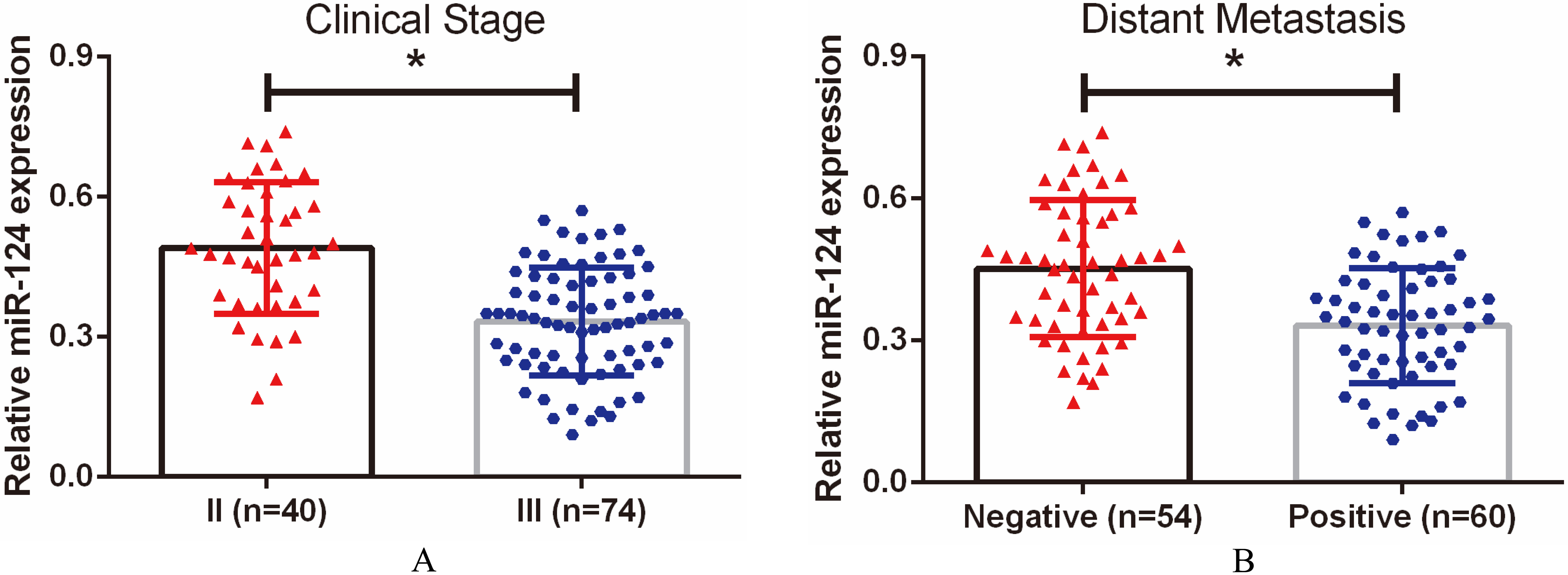
The correlation between serum miR-124 levels and survival rates (A for overall survival; B for disease free survival).
The serum miR-124 levels in osteosarcoma subjects were measured after treatment, and we found that serum miR-124 levels were greatly up-regulated after treatment (
The osteosarcoma patients were divided into two groups using the median value of serum miR-124 expression levels (0.37 fold). On this basis, 59 patients belonged to the low expression group while 55 patients belonged to the high expression group. As shown Table 1, serum miR-124 expression level was closely associated with clinical stage (
In addition, serum miR-124 levels in III stage patients were dramatically lower than those in II stage patients (
Decreased expression of serum miR-124 associates with worse prognosis in osteosarcoma patients
The Kaplan-Meier method and log-rank test were used to evaluate the correlation between serum miR-124 expression level and OS as well as DFS. The results demonstrated that the survival time of osteosarcoma patients in high serum miR-124 expression group was dramatically longer in comparison with those in low serum miR-124 expression group (
Serum miR-124 was an independent prognostic marker in osteosarcoma patients
Multivariate Cox proportional hazards model analysis confirmed that clinical stage (OS: HR, 3.87; 95%CI, 1.47–6.22;
Discussion
Osteosarcoma is the most common type of bone tumor with high rate of metastasis. In the present study, we revealed that the expression level of serum miR-124 was greatly reduced in osteosarcoma patients in comparison with periostitis patients and normal controls. The reasons we used periostitis patients as controls were that serum miR-124 downregulation was only observed in patients with osteosarcoma, but not in healthy people and patients with inflammatory bone diseases. Therefore, serum miR-124 is relatively specifically downregulated in osteosarcoma. In addition, the results of ROC curve showed that serum miR-124 could serve as a promising biomarker for early diagnosis of osteosarcoma. Furthermore, a positive correlation was found between decreased serum miR-124 expression and unfavorable clinical outcome of osteosarcoma patients. The osteosarcoma patients with low serum miR-124 expression suffered worse overall survival and disease free survival. Moreover, serum miR-124 level was verified to be independent prognostic factor for osteosarcoma. Our findings suggested that miR-124 might work as an anti-oncogenic miRNA in osteosarcoma. In accordance with our findings, a significant reduction in miR-124 expression was observed in osteosarcoma cell lines. Enforced miR-124 expression strongly inhibited the migration and invasion by regulating ROR2 [23]. Lower miR-124 levels were associated with worse clinical parameters and poorer survival in patients with osteosarcoma. B7-H3 was demonstrated to be a direct target of miR-124 [24]. miR-124 levels were significantly reduced in the serum exosomes from osteosarcoma patients with poor chemotherapeutic response, suggesting that exosome miR-124 might be used for the diagnosis and assessment of osteosarcoma chemotherapy [25].
To the best of our knowledge, miR-124 was reported to exert a tumor suppressive function in various cancer types by all the current studies. Lang and colleagues provided in vitro evidence to show that loss of miR-124 dramatically promoted cell proliferation of hepatocellular carcinoma by inducing G1-phase cell-cycle arrest [13]. Lv and Yang showed that ectopic expression of miR-124 suppressed the proliferation of glioblastoma multiforme cancer cells in vitro through down-regulating son of sevenless 1 [14]. It was also reported that miR-124 expression was greatly decreased in metastatic ovarian cancer tissues and cells. Moreover, up-regulation of miR-124 significantly attenuated cell migration and invasion of ovarian cancer through targeting Sphingosine kinase 1 [15]. Xie and colleagues revealed that reduced miR-124 expression promoted the tumorigenicity of gastric cancer cell by regulating enhancer of zeste homolog 2 [16]. In breast cancer, overexpression of miR-124 markedly inhibited cell proliferation, migration and invasion through directly targeting E26 transformation specific-1 [17], cyclin-dependent kinase 4 [18], CBL [19], or snail family zinc finger 2 [20]. Lin et al. confirmed that forced expression of miR-124 suppressed cell proliferation, migration, colony formation and induced cell apoptosis of non-small cell lung cancer via targeting signaling pathway of CD164 [21]. Similarly, it was also validated that deletion of miR-124 strongly promoted colorectal cancer cell proliferation, metastasis and invasion by upgrading Rho-associated protein kinase 1 [22]. However, it should be noted that the number of participants in our study was relatively small. Thus, a larger cohort of patients with osteosarcoma should be studied to verify the clinical value of serum miR-124. Recently a patient-derived orthotopic xenograft (PDOX) mouse model has been used for the evaluating the therapeutic effects on osteosarcoma [26, 27]. Using this model might contribute to elucidate the role of miR-124 in tumorigenesis of osteosarcoma in the future.
Taken together, this study showed that serum miR-124 expression was significantly under-expressed in patients with osteosarcoma. Moreover, a remarkable increase in serum miR-124 levels was observed in osteosarcoma patients receiving surgery. Besides, decreased serum miR-124 expression was positively correlated with unfavorable clinical outcome and worse survival of osteosarcoma patients. Overall, the current study provided convincing evidence to demonstrate that serum miR-124 might serve as a diagnostic and prognostic indicator for osteosarcoma patients.