




Abstract
BACKGROUND:
Squamous cell cervical carcinoma is the most common gynecological malignant disorder worldwide. Early detection of squamous cell cervical carcinoma is needed for proper clinical management. Squamous cell carcinoma antigen (SCCA) is commonly used as a tumor marker for squamous cell cervical carcinoma. Platelet distribution width (PDW) is an indicator of platelet activation. Prealbumin is a negative acute-phase protein.
OBJECTIVE:
The aim of this study was to investigate the ability of SCCA, PDW, and prealbumin individually or in combination, to distinguish between cervical carcinoma and control subjects.
MEHTODS:
Two hundred and twenty patients with squamous cell cervical carcinoma and 211 control subjects were included in the study. Patients’ characteristics and hematologic tests data at initial diagnosis were collected.
RESULTS:
Our results showed that SCCA and PDW were higher, and prealbumin was lower in cervical carcinoma patients than in control subjects. Single biomarker had AUC value ranging from 0.753 for SCCA to 0.845 for PDW. The combination of SCCA and PDW increased the AUC to 0.900 (
CONCLUSIONS:
The combined use of SCCA, PDW and prealbumin can accurately distinguish squamous cell cervical carcinoma from control subjects. This promising approach could be helpful in early detection of squamous cell cervical carcinoma.
Introduction
Cervical carcinoma is the third most common gynecological malignant disorder and represents the fourth leading cause of cancer-related death in females worldwide [1]. Squamous cell cervical carcinoma comprises 80–90% of cervical cancers. Since the occurrence of cervical carcinoma is a multigenic disease, there are no good serum biomarkers that can be used to screen cervical carcinoma. Although cytology (papanicolaou test) screening has been very successful in lowering cervical carcinoma incidence and mortality, false-positives are common [2]. Therefore, identification of novel markers to find cervical carcinoma in early stage is warranted.
Squamous cell carcinoma antigen (SCCA) is commonly used as a tumor marker for squamous cell cervical carcinoma. SCCA is a 45-kDa glycoprotein with two types: SCCA-1 and SCCA-2. Increased SCCA levels were observed not only in squamous cell carcinoma of the esophagus, lungs, head and neck, and cervix, but also in benign diseases such as skin disorders, cystitis, and pelvic inflammatory disease [3, 4].
Activated platelets play a key role in cancer progression and metastases [5, 6]. A meta-analysis showed that pretreatment thrombocytosis is an independent prognosis predictor in cervical cancer patients [7]. Mean platelet volume (MPV) is an indicator of activated platelets and is associated with gastric cancer, ovarian cancer, lung cancer, colon cancer, and breast cancer [8, 9, 10, 11, 12]. Platelet distribution width (PDW), another platelet parameter, indicates variation in platelet size and differentially diagnoses thrombocytopenia [13]. Previous studies showed that PDW is associated with poor prognosis in gastric cancer, laryngeal cancer, non-small cell lung cancer, and melanoma [14, 15, 16, 17].
Serum prealbumin is a 55-kDa negative acute-phase reactive protein and is synthesized mainly in the liver. It is generally used to determine nutritional status. Recent studies revealed that reduced serum prealbumin came from decreased synthesis following reprioritization of the synthesis of acute-phase proteins and was tightly related to inflammation [18, 19, 20]. Emerging evidence showed that decreased prealbumin is associated with impaired functional status, malignancies, poor outcome, and mortality [21, 22, 23].
Combination of several biomarkers for early detection of cancer may result in enhanced sensitivities and specificities. The aim of the present study was to investigate the ability of SCCA, PDW, and prealbumin, individually or in combination, to distinguish squamous cell cervical carcinoma from normal cervix.
Methods
Study population
The present study included 220 patients with stage Ia-Ib squamous cell cervical carcinoma (mean age 46.9
The characteristics of the participants according to cervical carcinoma status
The characteristics of the participants according to cervical carcinoma status
Values are shown as mean (standard deviation). BMI, body mass index; WBC, white blood cell; MPV, mean platelet volume; PDW, platelet distribution width; SCCA, squamous cell carcinoma antigen.
The study protocol was approved by the Ethics Committee of Harbin Medical University Cancer Hospital of Harbin Medical University. Written informed consents were obtained from all participants.
Correlations between clinicopathological features and pre-operative SCCA, prealbumin and PDW in cervical carcinoma
Receiver operating characteristic curve analyses showing the utility of alone or combined markers for differentiating of control subjects and cervical carcinoma
SCCA, squamous cell carcinoma antigen; PDW, platelet distribution width; PPV, positive predictive value; NPV, negative predictive value; AUC, area under curve.
All the subjects underwent physical examination. BMI was calculated as weight (kg) divided by height squared (m
Statistical analyses
All data were expressed as means
Receiver-operator characteristics (ROC) curve for serum SCCA, PDW, and prealbumin combined showing sensitivity and 1-specificity of differential diagnosis of cervical carcinoma versus normal cervix.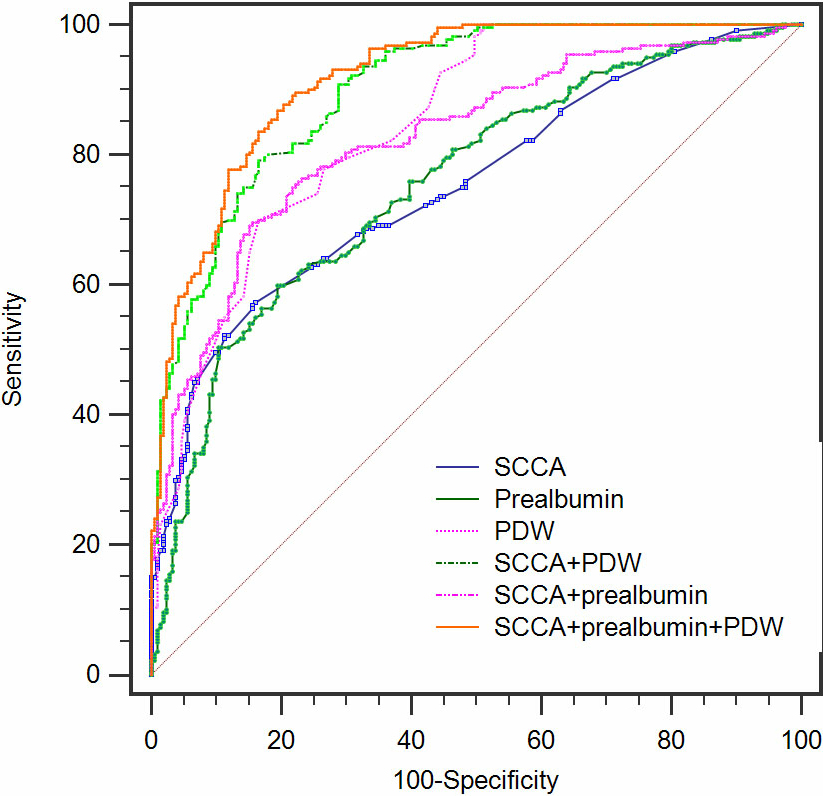
The characteristics of cervical carcinoma patients and control subjects are shown in Table 1. The mean age of cervical carcinoma patients and control subjects was 46.9 (8.3) years and 47.4 (4.8) years, respectively. Prealbumin, MPV and haemoglobin levels were significantly reduced, and PDW and SCCA were significantly increased in cervical carcinoma patients compared with the control subjects (
Correlations between clinicopathological features and pre-operative SCCA, PDW and prealbumin in cervical carcinoma are demonstrated in Table 2. There were no significant differences in SCCA, prealbumin and PDW between the differentiation stage and the FIGO stage. SCCA showed a markedly difference in different tumor size group (
To determine the predictive accuracy of each of the independent biomarkers based on the optimal cutoff value, we used ROC analysis to assess the AUC for single biomarker and the combination of three (Table 3). When used to analyze control subjects versus cervical carcinoma, prealbumin, SCCA, and PDW alone had the high specificity (80.6%–84.4%), but at the cost of unsatisfactory low sensitivity (56.8%–70.0%). The sensitivity increased and specificity did not changed when the combination of SCCA, PDW and prealbumin was applied. Single biomarker had AUC value ranging from 0.753 for SCCA to 0.845 for PDW; the combination of SCCA and PDW increased the AUC to 0.900 (
Discussion
Cervical carcinoma ranks as the fourth most common cause of death in women. Good tumor markers in early screening of cervical carcinoma are lacking. In this study, we provided evidence that the combined use of SCCA, PDW and prealbumin could accurately distinguish squamous cell cervical carcinoma from control subjects.
Activated platelet is a paramount mediator in tumor development, tumor cell growth, angiogenesis, and metastasis. MPV and PDW are commonly used indicators of activated platelet. Reduced MPV is regarded as an enhanced consumption of large platelets in inflammatory states [24]. At present, the mechanism of increased PDW in cervical carcinoma has not been determined. Bone marrow cells (including megakaryocytes) dys-regulation may contribute to changed MPV and PDW.
Prealbumin was generally used to assess the nutritional status in various types of cancers, including head and neck cancer, and ovarian cancer [25, 26]. Recent studies showed that prealbumin was associated with response to treatment and outcomes in patients with non-small cell lung cancer and epithelial ovarian carcinoma [21, 27]. Moreover, hypoalbuminemia was a poor prognostic indicator in esophageal cancer and advanced colorectal cancer [28, 29]. Several studies have confirmed that inflammation is associated with reduced prealbumin [20, 30, 31, 32]. However, the association between prealbumin and cervical carcinoma has not been investigated in previous research. Our results showed that prealbumin was lower in cervical carcinoma patients than in control subjects. In addition, prealbumin plays a complementary role along with SCCA and PDW in cervical carcinoma evaluation.
Increased SCCA levels are commonly found in squamous cell carcinoma of the esophagus, lung, head and neck, and cervix. Furthermore, SCCA at initial diagnosis is correlated with the tumor stage, size, depth of invasion, and lymph node metastasis [33]. However, SCCA may also increase in benign diseases such as pelvic inflammatory disease and cystitis, suggesting the need for other promising biomarkers in the primary screen to detect early disease and renal failure [3, 4].
For the diagnosis of squamous cell cervical cancer, few tumor markers are highly sensitive or specific. SCCA has low specificity and sensitivity. Our study demonstrated that the AUC value for discriminating cervical carcinoma patients from healthy controls using this three biomarkers was 0.917, significantly higher than any single index. In addition, SCCA, PDW, and prealbumin levels are routinely recorded in the clinical setting and can be easily estimated prior to treatment. Thus, a combination of three serum markers is a more comprehensive indicator for cervical detection than single biomarker.
This study has limitations: (1) the study was carried out in a single center; (2) because prealbumin levels are affected by changes in transcapillary escape, further study is needed to evaluate transcapillary escape rate of prealbumin; (3) the results cannot be generalized because our study includes only Chinese participants.
In conclusion, the study showed that the combined use of SCCA, PDW and prealbumin might be useful in the distinction of squamous cell cervical carcinoma and control subjects. Further studies are needed to validate these results before using these markers in routine practice.
Footnotes
Acknowledgments
This work was supported by the Scientific Research Foundation for Post-Doctoral Scholars settled in Heilongjiang (RC2016XK004068).
Conflict of interest
The authors declare no conflict of interest.