




Abstract
Ovarian cancer has the highest mortality rate among gynecological malignancies, presenting a major threat to women’s life and health. It is essential to study the mechanisms of drug resistance to chemotherapy to identify ways to enhance drug-sensitivity. In recent years, many studies have shown that Smac/DIABLO is closely related to tumor drug resistance. Smac/DIABLO expression is markedly different between drug-resistant and chemo sensitive tumor cells. Up-regulation of Smac/DIABLO has been shown to increase tumor cell chemotherapy sensitivity. We found that Smac, combined with DDP greatly inhibited proliferation of subcutaneous xenografts of ovarian cancer cell line SKOV3/DDP without side effects. Mechanistic studies showed that Smac can inhibit the expression of Survivin, promote cell apoptosis of drug-resistant ovarian cancer cells and reverse the drug resistance.
Introduction
Ovarian cancer is one of the most common gynecological malignancies. The high mortality rates. make it a threat to women’s life and health. In recent years, the main treatment of ovarian cancer is surgery, combined with chemotherapy. However, chemotherapy resistance is one of the major causes of ovarian cancer recurrence and treatment failure [1]. Understanding mechanisms of chemotherapy resistance may help identify new treatments to prevent or reverse chemotherapy-induced drug resistance.
Abnormal regulation of cell apoptosis is one of the mechanisms affected by chemotherapy in ovarian cancer treatment. Ovarian cancer resistance cell apoptosis is a complex physiological process. Chemotherapeutic drugs have an anti-tumor effect by inducing apoptosis of cancer cells, but they may also induce changes in the apoptosis regulatory pathway, leading to chemotherapy-induced cell resistance [2]. The most studied apoptosis-related factors are p53, Bcl-2, Bax, Smac, Survivin, and Caspase [3]. Survivin is the smallest member of the inhibitor of apoptosis (IAP) family but it is described as the most potent inhibitor of apoptosis [4]. It is highly expressed in embryonic tissues and various tumor tissues but not expressed in normal healthy tissues. Survivin is also specifically expressed in the G2/M phase of the cell cycle participating in the regulation of celluar division. Furthermore, it can promote tumor neovascularization by specifically binding to tubulin [4]. In recent years, more studies have found that the anti-apoptotic effect of Survivin is related to tumor cell resistance. Studies on ovarian cancer, stomach cancer, lung cancer, liver cancer, pancreatic cancer, leukemia have suggested that Survivin plays an irreplaceable role in chemotherapy resistance [5, 6, 7, 8, 9]. Its anti-apoptotic role, regulation of cell mitosis, and the protective effect of vascular endothelium are possible mechanism of how Survivin may induce drug resistance.
Smac/DIABLO is a protein present in mitochondria and regulates apoptosis [10]. Under various stimulations like anticancer drugs, chemical or physical apoptotic signals, Smac/DIABLO is released from mitochondria into the cytoplasm. In the cytoplasm, it interacts with apoptosis-suppressing protein (IAP), by blocking the inhibitory effects of IAPs on caspases, thereby promoting apoptosis [10]. In recent years, many studies have shown that, Smac/DIABLO protein is associated with tumor resistance. Smac/DIABLO expression was markedly different between drug-resistant tumor cells and chemo sensitive cells [11]. Upregulation of Smac/DIABLO or its analogues can increase the sensitivity of tumor cells to chemotherapy [12, 13]. Smac/DIABLO maybe a new target for reversing tumor resistance.
Materials and methods
Cell lines and culture
Human ovarian serous papillary cystadenocarcinoma cell line SKOV3/DDP were supplied by the Institute of Endocrinology, Tianjin Medical University. Cells were maintained in RPMI-1640 complete medium supplemented with 2 mM glutamine and 10% fetal bovine serum (FBS) at 37
Cell culture reagents and antibodies
RPMI-1640, FBS were purchased from Invitrogen Life Technologies (Carlsbad, CA, USA). Cisplatinwas obtained from QiLu Pharmaceutical Co., Ltd. (Jinan, China).
(pcDNA3.1(
Xenograft preparation and transplantation
SPF nude mice, female, 4 weeks old, weighing 18
Recipient group assignment and analysis procedure
Subcutaneous transplanted tumors with a 150 mm
Transplanted tumor formation comparison in different groups. A and B. Tumor volume was collected and analyzed 18 days after treatment (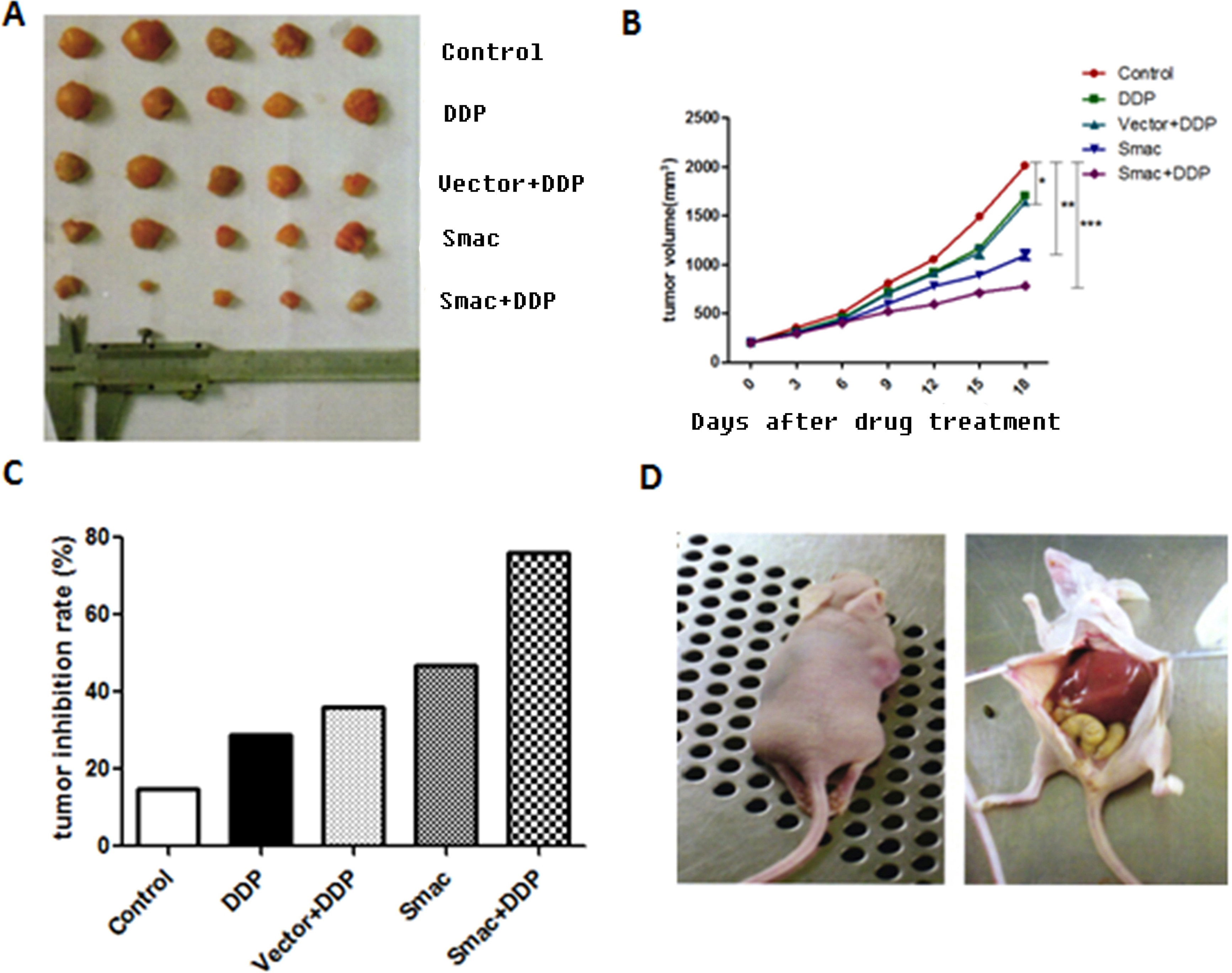
One week after stopping treatment, recipient mice were sacrificed. The tumor tissue was removed and tumor inhibition rate was calculated. Tumor growth inhibition rate was calculated: (%)
Slides were deparaffinized in xylene. endogenous peroxidase activity was blocked with 3% hydrogen peroxide in 50% methanol for 10 min at room temperature. Sections were rehydrated in alcohol, washed with phosphate-buffered saline (PBS) and then pretreated with citrate buffer (0.01 M citric acid, pH 6.0) for 20 min at 95
C-caspase3 expression in transplanted tumor. Protein lysates from transplanted tumors were extracted and c-caspase3 levels were detected by western blot analysis.
Smac can inhibit the expression of Survivin. Smac (A) and Survivin (B) expression were detected through immunohistochemistry, bar: 50 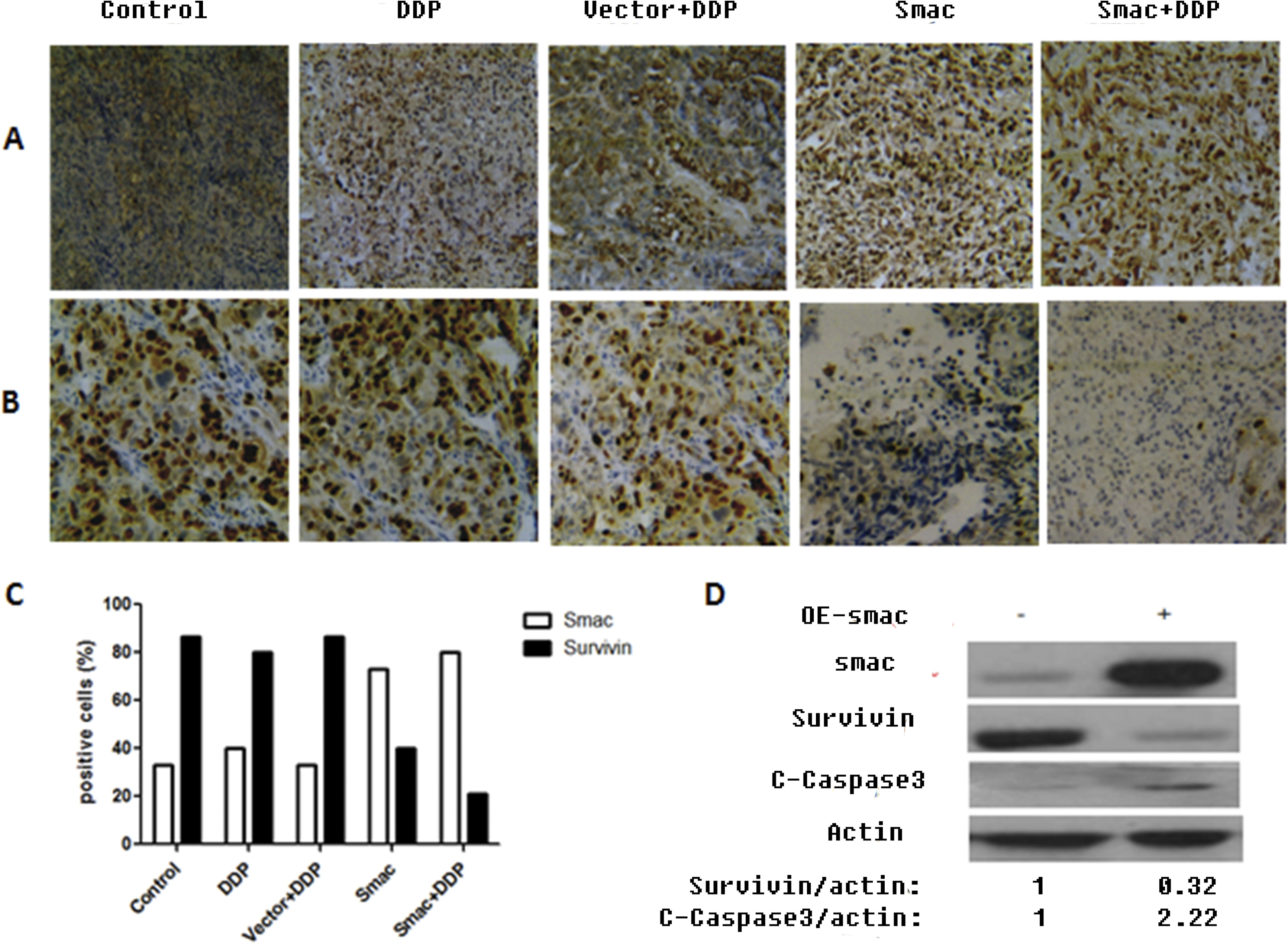
Tumor cell samples were lysed in ice-cold radio immunoprecipitation assay lysis buffer containing a protease inhibitor cocktail. A total of 60
Statistical analysis
SPSSl8.0 software was used to statistically analyze the data. quantitative analysis were obtained by variance, Wilcoxon rank sum test for multiple sets of ordered categorical variables. Smac and Survivin correlation analysis were performed using Spearman rank correlation, with a bilateral test level.
Result
Smac combined with DDP can significantly inhibit the growth of transplanted tumor
The ovarian cancer cells were subcutaneously transplanted into nude mice. After treatment with different drugs, it was found that Smac and DDP treatment could significantly inhibit the growth of transplanted tumors, and the combination of Smac and DDP treatments had the greatest effect.
Phenotype showed a significantly smaller tumor volume (Fig. 1A and B), tumor inhibition rate was significantly stronger as observed in (Fig. 1C). No significant drug side effects were observed in each group, including tail subcutaneous oozing, local swelling, skin scaling, and diarrhea. There were no metastatic lesions and obvious ascites in the abdominal organs (Fig. 1D).
Smac can promote cell apoptosis in transplanted tumors
Previous observations have shown that Smac expression promotes apoptosis. We speculated that the inhibitory effect of Smac on transplanted tumor may be related to apoptosis. By detecting the expression of apoptotic factor c-caspase3, we observed that Smac significantly promoted apoptosis of transplanted tumor. The effect was even more effective when Smac inhibition was combined with DDP treatment (Fig. 2). These results suggest that, Smac may inhibit the growth of transplanted tumors by increasing cell apoptosis sensitivity.
Smac can inhibit the expression of survivin in transplanted tumors and ovarian cancer resistant cells
Previous studies have shown that the anti-apoptotic effect of Survivin is closely related with tumor cell resistance. In our study, we found that the expression of both Smac and Survivin was negatively correlated in transplanted tumors (Fig. 3A–C). Furthermore, overexpression of Smac in ovarian cancer resistant cells showed that Survivin expression was significantly down-regulated (Fig. 3D). The expression of c-caspase3 was also increased accordingly (Fig. 3D). These findings suggest that Smac may promote apoptosis in ovarian cancer resistant tumor transplanted cells by regulating the expression of Survivin.
Discussion
Apoptosis regulation is an important mechanism of ovarian cancer chemotherapy resistance. Chemotherapeutic drugs exhibit an anti-tumor effect by inducing apoptosis of cancer cells, but may also induce a series of changes in the apoptosis regulatory pathway to promote chemotherapy-induced cell resistance.
Previous studies have shown that Smac is closely associated to reversal of tumor resistance. Studies of prostate cancer, gastric cancer, colon cancer and other cancers have shown that up-regulation of Smac expression can promote cell apoptosis and increase the sensitivity of chemotherapy drugs [13, 14, 15]. Yang et al. found that Smac expression was significantly higher in drug-resistant squamous cell carcinoma cells than in sensitive cells. Deletion of Smac can significantly inhibit cisplatin-induced apoptosis and caspase activity. Furthermore, Smac analogue LBW242 significantly enhanced cisplatin-induced apoptosis. Also, throat cancer, pancreatic cancer, breast cancer, leukemia and other cancer studies have found that Smac increases sensitivity to chemotherapy, and even reverses drug-induced resistance [16, 17].
In this study, we found that Smac expression was very low in ovarian cancer drug resistant cell line SKOV3/DDP in subcutaneous transplanted tumor tissue. The up-regulation of Smac expression can promote apoptosis of ovarian cancer cell-resistant tumor. However, high expression of Smac can enhance the sensitivity of subcutaneous transplanted tumor to DDP treatment. DDP can cause DNA damage by binding to DNA, which ultimately leads to cell apoptosis [18]. In the platinum-resistant ovarian cancer, DNA damage repair ability increases, apoptosis decreases, which greatly weakens the effect of DDP. Our studies showed that Smac inhibition, combined with DDP treatment could significantly inhibit the growth of transplanted tumors, and the tumor inhibition rate was significantly higher. These findings indicate that Smac may promote growth inhibition of SKOV3/DDP in subcutaneously transplanted tumor, and effectively reverse the drug resistance of SKOV3/DDP. Furthermore, during the course of the experiment, Smac or Smac combined with DDP showed no side effects in recipient mice.
Many studies have found that Survivin regulation in apoptosis is an important mechanism of ovarian cancer resistance. The Survivin anti-apoptotic effect is mainly through the interaction with Smac [19], by binding directly to Survivin. The above study showed that the N-terminus of Smac is necessary for binding to Survivin. If 18 amino acids (AVPIAQKSEPHSLSSEAL) are removed or substituted with an amino acid (Met) at the N-terminus of Smac, Smac loses its ability to bind to Survivin [11]. In this study, we found that Smac can inhibit the expression of Survivin in an ovarian cancer resistant cell transplantation model. We can speculate that reduction of Survivin expression via Smac inhibition may be one of the mechanisms of reversing chemotherapy-induced resistance.
In conclusion, the results of this study suggest that Smac combined with DDP can effectively inhibit the growth of transplanted tumor, andreverse ovarian cancer resistance, with no major side effects. Up-regulation of Smac resulted in down-regulation of Survivin expression, suggesting a possible mechanism of Smac to restore sensitivity of drug-resistant cells SKOV3/DDP to cisplatin. We can speculate that by targeting Smac or Survivin, in combination with chemotherapy can improve the clinical outcome in drug-resistant patients.
Footnotes
Acknowledgments
The study was supported by Tianjin Municipal Health and Family Planning Commission Scientific and Technological Project [No. 16KG113] (The study of the expression of Smac in ovarian cancer and the sensiting effect of Smac mimics in chemotherapy) and Science and Technology Fund of Tianjin Health Bureau [2015KZ078] (The value of serum Smac in early diagnosis of ovarian cancer and the relationship between serum Smac and chemotherapy resistance).