




Abstract
BACKGROUND:
Cancer is a type of disease caused by the uncontrolled growth of abnormal cells that can destroy body tissues. The use of traditional medicine naturally uses plants from ginger with the maceration method. The ginger plant is a herbaceous flowering plant with the Zingiberaceacea group.
METHODS:
This study uses the literature review method by reviewing 50 articles from journals and databases.
RESULTS:
A review of several articles, namely ginger has bioactive components such as gingerol. Ginger is used as a treatment in complementary therapies using plants. Ginger is a strategy with many benefits and functions as a nutritional complement to the body. This benefit has shown the effect of anti-inflammatory, antioxidant, and anticancer against nausea and vomiting due to chemotherapy in breast cancer.
CONCLUSION:
Anticancer in ginger is shown by polyphenols associated with anti-metastatic, anti-proliferative, antiangiogenic, anti-inflammatory, cell cycle arrest, apoptosis, and autophagy. Therefore, consuming ginger regularly affects natural herbal therapy with the prevention and treatment of breast cancer and serves as a prevention against the effects of chemotherapy.
Introduction
Cancer is a health problem that is the main cause of death in Indonesia. According to the World Health Organization (WHO), based on 2018 data from the Global Cancer Observatory, cancer in Indonesia ranged from 58,256 (16.7%) cases out of a total of 348,809 cancer cases [1,2].
Cancer is a disease caused by the uncontrolled growth of abnormal cells, which can destroy body tissues. Breast cancer is a global problem that ranks second in the world. In 2018 cancer cases were around 18.1 million, and cancer deaths were around 9.6 million. This data shows the number of cases of breast cancer in women in 2018 [3].
Breast cancer often occurs in women, with numbers reaching 2.4 million cases. It is the leading cause of death and disability in women [4]. Cancer treatment has side effects from chemotherapy and surgery, namely thinning hair, nausea, vomiting, dizziness, depression, and blurred vision [5].
Patients with cancer often experience several symptoms or physical and psychological problems simultaneously, both related to the disease and with treatment; pain, depression, sleep disturbances, and fatigue are the most common symptoms in patients with breast cancer [6].
The use of traditional medicine naturally uses plants from ginger with the maceration method. The ginger plant is a herbaceous flowering plant belonging to the Zingiberaceacea group. This plant consists of pseudo stems, yellow flowers, and tuberous rhizomes. The rhizome of turmeric is useful as a medicine in preventing and healing wounds, diarrhea, nausea, and vomiting and as an anti-inflammatory, antipyretic, and antibacterial. Turmeric rhizome has nutrients, protein, carbohydrates, water, lipids, fiber, and essential oils [7].
Ginger (Zingiber officinale) is a traditional medicine the community uses. The ginger extract showed that the anti-breast cancer effect could inhibit the proliferation and metastasis of breast cancer cells. 10-Gingerol can inhibit cell proliferation through protein downregulation by regulating the cell cycle as anti-proliferative activity in MCF-7 and MDA-MB 231 ER-positive breast cancer cells, with a mechanism of action that can stop the cell cycle through inhibition of transition in G1 phase and there is a stop in the cell cycle. In addition, the compounds contained in ginger can inhibit cell invasion and migration through the degradation of its extracellular matrix components and intracellular connectors, such as Akt and p38 MAPK, which are activated, thereby inhibiting expression by tumor genes in MDA-MB-231 [8]. Zingiberaceae species such as Etlingera elatior have antioxidant, anticancer, antibacterial, antifungal, cytotoxic, tyrosinase inhibitory, and immunomodulatory activities [9].
Cancer Related Fatigue (CRF) is one of the symptoms that often appear in cancer patients starting from treatment and even after treatment—according to Zheng (2016), stating that the prevention and treatment of cancer from several spices such as Curcuma longa (turmeric), black cumin (Nigella sativa), ginger (Zingiber officinale), cayenne pepper (Capsicum annum) contain bioactive compounds, namely curcumin, thymoquinone, piperine. And capsaicin [10].
Breast cancer has side effects of chemotherapy, namely nausea and vomiting. Research conducted by Arslan (2015), namely ginger has an antiemetic effect on nausea and vomiting due to chemotherapy, and ginger can reduce the frequency of nausea and vomiting in patients diagnosed with breast cancer [11]. In line with research by Lua (2015), the effect of ginger aromatherapy can reduce nausea and vomiting due to chemotherapy in breast cancer patients [12].
Bioactive ginger
Ginger rhizome contains two kinds of compounds: volatile compounds, essential oils, and nonvolatile compounds, including oleoresin (source of spiciness) and other organic and inorganic compounds commonly found in food. Gingerol is the main ingredient in fresh ginger. A research study by Bakht (2014), by extracting ginger using organic solvents, performed the separation and purification of materials based on column chromatography and thin layer chromatography and determined various chemical compounds contained in ginger using HPLC. With the advancement of technology, several studies have obtained suitable good-quality extracts, the results of which can be explored using a simple method that is fast, precise, and solvent-free in the headspace solid-phase micro-extraction method and microwave extraction, which can detect volatile and active compounds [13]. The gingerol in ginger was purified by high-speed reverse-flow chromatography. The result of this method is that the solvent using a two-phase system can be easily separated for purification of 5–8 and 10-gingerol solvents from the ginger rhizome, and the efficiency for purification is higher than 99.9% and 99.2% in each solvent [14]. The microwave extraction method (MAE) resulted in a lower content of 6 gingerols in the steamed ginger sample, whereas in the 6-shogaol, it was higher [15].
The microwave extraction method (MAE) resulted in a lower content of 6-gingerol in the steamed ginger sample, whereas in the 6-shogaol, it was higher [16].
Biological activity
Antioxidative ability in the antioxidant defense mechanism mostly produces excessive reactive oxygen species (ROS), causing oxidative stress [16]. Free radicals are one or more unpaired electrons in atomic or molecular orbitals, namely ROS (Reactive oxygen species) and RNS (reactive nitrogen species). Oxygen free radicals are produced in living systems and as a regular product of cellular metabolism. Effects of ROS at low concentrations on several infectious factors or for mitogenic advancement. It is in the formation of oxygen radicals higher than the level of accumulation of oxygen free radicals, which causes several effects, causing potential biological damage, which is responsible for inducing a series of pathological reactions of disease in the body. ROS levels can be restored by using antioxidants, which can provide electrons or hydrogen atoms to free radicals to cover some of the pathways associated with ROS formation. This level can convert free radicals into ginger products which are lipid complex antioxidants or thermodynamically.
Biological effects on ginger
See Table 1.
Ginger activity against breast cancer
Ginger activity against breast cancer
Description: Ginger activity in breast cancer prevention and treatment.
The review of several articles shows that ginger has bioactive components such as gingerol. Ginger is used as a treatment in complementary therapies using plants. Ginger is a strategy that has many benefits and functions as a nutritional complement to the body. This benefit has shown the effect of anti-inflammatory, antioxidant, and anticancer against nausea and vomiting due to chemotherapy in breast cancer.
Monoterpenes are a terpene group consisting of two isoprene units with the molecular formula C10H16 and one or two cycloalkane units such as cyclopropane, cyclobutane, and cyclohexane. Monoterpenes can be linear (acyclic) or ring-containing. Cinole (1,8-cineol or eucalyptol) is a cyclic ether found in the preparation of the essential oil of Eucalyptus globulus and is known to have anti-inflammatory, antimicrobial, antihypertensive, spasmolytic, analgesic and antianxiety effects [43,44].
Sesquiterpenes are hydrocarbon compounds belonging to trepenes with a combination of three isoprene groups (skeleton C15). The chemical structure is classified as a sesquiterpene with an anticancer effect [24,25].
Phenolic compounds have one or more hydroxyl groups attached to an aromatic group. These compounds are included in polyphenols which act as natural bioactive compounds [44].
Diariheptanoids consist of two aromatic rings linked by a seven-carbon chain and s various substituents. Two aryl groups are related connected by a heptane chain and are classified into linear (curcuminoid) and cyclic groups. Curcumin is a member of the curcuminoids. This means that turmeric belongs to a Zingiberaceacea (ginger) member and is a principal significant constituent [46].
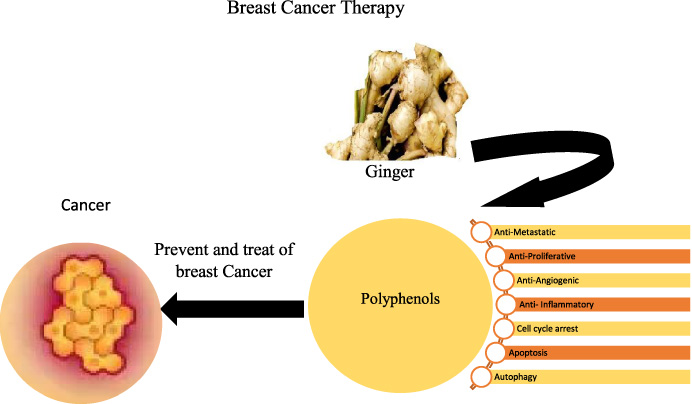
Schematic diagram showing the molecular pathways in ginger that play a role in complementary therapeutic activity in breast cancer.
Treatment using ginger can suppress the proliferation and colony formation in breast cancer cells, MCF-7 and MDA-MB-231 [47]. Research conducted by Rahman (2011) showed that the thick extract of the Zinger officinale variety (fulbaria and Syedpuri) contained flavonoids with a concentration of 400–800 mol/mol at high CO2 conditions. Fulbaria and Syedpuri could produce anticancer effects on MCF-7 cancer cells with values ranging from IC50 to 34.8 g/ml and 25.7 g/ml, while MDA-MB-231 cancer cells produced IC50 values of 32.52 g/ml and 30.20 g/ml [48]. In line with the research conducted by Ekowati (2012), it showed that ginger, Javanese chili, and the combination of ginger and Javanese chili had cytotoxic activity on myeloma cells with IC50 (Inhibitory Concentration 50%) of 28, 36, and 55 mg/ml, respectively. And cell line WiDr IC50 74, 158, and 64 mg/ml, respectively. The results of this study proved that ginger (Zingiber officinale), Javanese chili (Piper retrofractum), and the combination showed cytotoxic activity, apoptosis induction, and p53 expression from HeLa cells, T47D (47 Ductal Tumors), and MCF-7 cells (Michigan Cancer Foundation-7) [49].
Ginger Zingiberaceae is effective against breast cancer and can reduce clonogenicity and cell migration in breast cancer cell lines (MDA-MB-231 and AT1) by decreasing matrix metalloproteinase (MMP-9). Terpenoid compounds in the Zingiberaceae group can inhibit tumor development by stopping the cell cycle in apoptosis. Chemical compounds such as furanoidiene, germacron, 13-hydroxygermacron, and sesquiterpenes are derived from essential oils in the ginger Zingiberaceae group [50].
See Fig. 1.
Conclusion
Anticancer in ginger is shown by polyphenols associated with anti-metastatic, anti-proliferative, antiangiogenic, anti-inflammatory, cell cycle arrest, apoptosis, and autophagy. Therefore, consuming ginger regularly affects natural herbal therapy with the prevention and treatment of breast cancer and serves as a prevention against the effects of chemotherapy.
Footnotes
Acknowledgements
This literature review is a part of research that has received grant funding from the research and community service institute at Hasanuddin University from the Collaborative Fundamental Research scheme for the 2023 Fiscal Year by contract number 00323/UN4.22/PT.01.03/2023.