




Abstract
OBJECTIVE:
Molecular markers for the detection of breast cancer and its different types, grades, and stages lack enough sensitivity and specificity. This study evaluates the expression of miRNAs 9 and 342 in sera of different types, grades, and stages of BC. Moreover, the assessment of their sensitivity, specificity, diagnostic, and prognostic role in detecting different types of BC.
METHODS:
Blood was collected from 200 females outpatients, divided into five groups each 40 subjects: control, benign breast tumor, estrogen receptor (ER+)/progesterone receptor (PR+) BC, human epidermal growth factor receptor (HER+) BC, and triple-negative BC. BC subjects were further subdivided according to grade and stage. Expressions of miRNAs 9 and 342 were measured for all subjects by real-time polymerase chain reaction (RT-PCR).
RESULTS:
Results showed that serum expression of both miRNAs 9 and 342 can be used for the diagnosis of different types of BC. Their expression can be used to significantly differentiate between different grades and stages of BC. MiRNAs 9 and 342 showed high sensitivity of 92.5% and specificity of (81.2 and 88.7%), respectively, for triple-negative BC.
CONCLUSION:
The expressions of miRNAs 9 and 342 provide potential roles as serological biomarkers for the diagnosis and prognosis of different types, grades, and stages of BC.
Introduction
Breast cancer (BC) is considered the most occurring women with cancer. In the United States, one in three women were diagnosed with BC [1]. There were about 266,120 new cases of invasive and 63,960 of noninvasive BC among women in the United States in 2018 [2]. In Egypt, BC is a challenging clinical malignant problem among Egyptian females accounting for 37.7% of all female cancers with 29% mortality with a high rate of reoccurrence after treatment up to 4 folds [3]. The complexity of breast cancer is attributed to different factors, where the genetic factor is due to heterogeneous genetic alterations. There are different types of BC depending on the specific cells in the breast that are affected, including ductal carcinoma in situ, invasive ductal carcinoma, inflammatory breast cancer, and metastatic breast cancer [4]. There are three major subgroups in BC; estrogen receptor (ER) and/or progesterone receptor (PR) positive, human epidermal growth factor receptor (HER) positive, and triple-negative (ER, PR, and HER negative). However, using the microarray method for determining miRNAs profile, this subgrouping is extended to a more precise one, including luminal A (ER-positive with low grade), luminal B (ER-positive with high grade), HER positive, and basal-like (is almost equal to triple-negative status) [5]. Triple-negative BC has a higher disease incidence rate and a higher risk of death as compared with other BC subtypes which lead to death through metastasis [6].
Despite all progressions in cancer research, the molecular basis of malignancy has remained unknown as one of the most challenging aspects of the disease. Although the early diagnosis of BC has caused a decrease in death rates, prevention and treatment are still considered a general concern [7]. Recent studies have shown a promising role of molecular markers in the prognosis and diagnosis of different types of diseases. These studies focused on the expression of new microRNA and their protruding role in the development and metastasis of different types of cancer [2].
MicroRNAs (miRNAs) have been identified for their critical involvement in different physiological/pathological states in the development, proliferation, and carcinogenesis [8]. The up- or down-regulation of tissue-specific miRNAs has been studied for regulating signal transduction pathways, involving the main cellular process [7].
MiRNA 9 expression was found to be related to metastasis of several types of cancer. Its expression is signicantly higher in tumors with high T stage, high histologic grade, p53 overexpression, and a high proliferation index [9]. It has been suggested that miRNA 9, an important miRNA which participates in cancer progression, can downregulate E-cadherin expression in breast cancer and thereby increase the risk of cancer metastasis in patients by reducing the ability of malignant cells to adhere to the cancer microenvironment [10]. MiRNA 342 regulates the carcinogenesis of various types of cancers such as liver, cervical, lung, and BC [11]. Previous studies have shown critical interactions between ERα and miRNAs and suggested that several miRNAs regulate ERα expression directly or indirectly. It has been shown that the downregulation of miR-342 is associated with ERα-negative breast cancer [12].
This study aims to evaluate the expression of miRNAs 9 and 342 in sera of different types, grades, and stages of BC and determine their role in early detection of BC. Moreover, the assessment of their sensitivity, specificity, diagnostic, and prognostic role in detecting different types of BC.
Subjects and methods
Patient database and blood sampling
Blood samples (10 MLS) were collected from 200 age-matched female volunteers from the National Cancer Institute in Egypt. All analyses were performed within 6 months of collection. Blood was then centrifuged for serum separation for the expression of miRNAs 9 and 342. Samples were stored at −80 °C till the time of assay.
All patients signed a written informed consent after a full explanation of the study. The study was approved by the Committee of Medical ethics of Future University in Egypt following the regulations and recommendations of the Declaration of Helsinki. The study groups were classified into five groups, each group comprising 40 subjects: group I: non-cancer healthy controls; group II: patients with benign breast tumor; group III: patients with ER and/or PR positive BC; group IV: patients with HER 2 positive BC; group V: patients with triple-negative BC.
Patients with chronic liver diseases, acute or chronic renal disease, hyperthyroidism, pituitary disorders, autoimmune disease, and any acute or chronic inflammatory diseases were excluded. They were not suffering from any disorders and were not taking any medications. Tumor staging and grading were determined according to tumor necrosis and metastasis (TNM) and World Health Organization classification (Edge and Compton, 2010) [4].
Laboratory assessment
Total RNA was reverse transcribed using miScript II RT kit (Qiagen, Germany) in 4 μL miscript Hispec Buffer, 2 μL miscript nucleic mix, RNase free water, 2 μL miscript reverse transcriptase mix, and 12 μL RNA template (Qiagen, Germany). For the synthesis of cDNA, the RT reaction was incubated at 37 °C for 60 min, and at 95 °C for 5 min. The cDNA product was stored at −20 °C until analysis.
Measurements of miRNAs 9, 342, and (Hs_Snord 68_11) were obtained for each sample on a 96-well plate. Data were analyzed with Rotor Gene Q software (Qiagen, Germany), with the automatic Ct setting for assigning baseline and threshold for Ct determination. The relative expression level of each miRNA after normalization to (Hs_Snord 68_11) was calculated using the 2−ΔΔCt method.
Statistical analysis
Results were expressed as mean ± standard error of the mean (M ± SEM). Both parametric and nonparametric methods were used in this study. Different groups were compared by analysis of variance (ANOVA), and post hoc Tukey was applied to compare individual groups. Nonparametric receiver operating characteristic (ROC) curves were generated in which the value of sensitivity is plotted against (1-specificity). We defined a diagnostic test (positive vs. negative) for BC using a cutoff threshold for each molecular marker. The positivity rates were compared by the chi-square test. The overall accuracy of a molecular marker to predict different types of BC is defined as the average of the sensitivity and the specificity. Spearman’s correlation coefficients were used. Moreover, prognostic binary logistic regression analysis was applied between ER+/PR+/HER+ BC patients and triple-negative BC patients using the assessed anthropometric, clinical, and biochemical to determine their probable role as prognostic biomarkers in a univariate and multivariate fashion. The odds ratio (OR) and 95% confidence interval (CI) were also calculated. All statistical analyses were performed by using SPSS 20 software (SPSS Inc, Chicago, USA). P values of <0.05 were considered statistically significant.
Results
The clinical parameters have been recorded for the subjects of the different studied groups before measuring the expression levels of miRNAs 9 and 342, as shown in Table 1. The clinical parameters satisfied different variables including age, menopausal status, frequency of pregnancy, duration of contraception, obesity, previous family history, diabetes mellitus, grade/stage of breast cancer, and lymph vascular invasion.
Clinical characteristics of the studied groups
Clinical characteristics of the studied groups
Number of subjects in each group = 40. Values are expressed in terms of (Mean ± SEM). BMI: body mass index, ER: estrogen receptor, PR: progesterone receptor, HER: human epidermal growth factor receptor. aSignificantly different from control group at p < 0.01. bSignificantly different from group I at p < 0.01. cSignificantly different from group II at p < 0.01. dSignificantly different from group III at p < 0.01.
Expression of miRNA 9 was significantly lower in all of the studied groups in comparison to the control group at p < 0.01. MiRNA 9 expression was significantly higher in the triple-negative BC, HER+ BC, and ER+/PR+ BC groups in comparison to the benign group at p < 0.01. Moreover, its expression was significantly upregulated in the triple-negative BC and HER+ BC groups in comparison to the ER+/PR+ BC group, and in the triple-negative BC group in comparison to HER+ BC group at p < 0.01 Table 1, Fig. 1a.
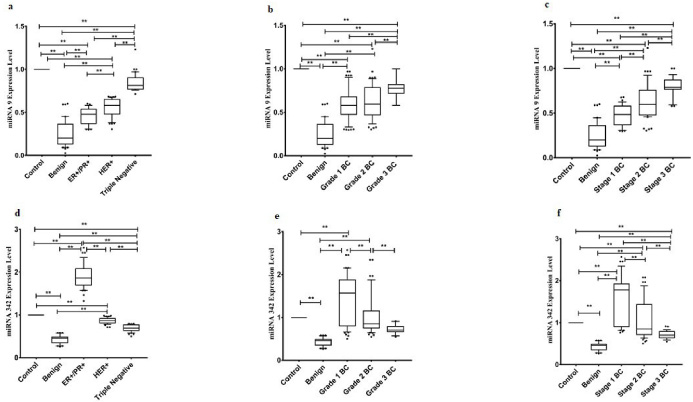
Expression of miRNAs 9 and 342 amongst the studied groups. 1a: Expression of miRNA 9 amongst control, benign breast tumor,
Regarding miRNA 342 expression in all investigated BC groups was significantly higher in comparison to the benign group at p < 0.01. Furthermore, its expression was downregulated significantly in the triple-negative and HER+ BC groups in comparison to ER+/PR+ BC group, additionally in triple-negative BC in comparison to
Expression of miRNAs 9 and 342 was determined in different grades and stages of BC in comparison to control and benign groups as shown in Table 2 and Figs 1b, c, e, and f.
Expression of miRNA 9 and 342 in different grades and stages of breast cancer
Values are expressed in terms of (Mean ± SEM). BC: breast cancer. aSignificantly different from control group at p < 0.01. bSignificantly different from benign at p < 0.01. cSignificantly different from grade 1 BC at p < 0.01. dSignificantly different from grade 2 BC at p < 0.01. eSignificantly different from stage 1 BC at p < 0.01. fSignificantly different from stage 2 BC at p < 0.01.
ROC curve analysis was conducted to investigate the role of miRNAs 9 and 342 as diagnostic markers in serum for differentiation between triple-negative BC patients and
Positivity rate of miRNA 9 and 342 between ER+/PR+/HER+ breast cancer group and triple negative breast cancer group
ER: estrogen receptor, PR: progesterone receptor, HER: human epidermal growth factor receptor.
Sensitivity, specificity, PPV, NPV, and accuracy of miRNA 9 and 342
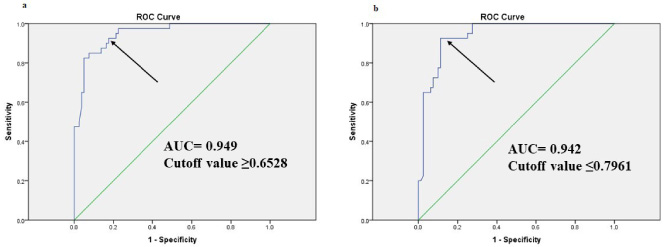
Receiver operating characteristic (ROC) curve for miRNAs 9 and 342. The arrow denotes a best cutoff point. 2a: Receiver operating characteristic (ROC) curve for miRNA 9. 2b: Receiver operating characteristic (ROC) curve for miRNA 342.
By performing the Spearmen correlation coefficient, both investigated miRNAs were correlated with each other. By using miRNAs 9 and 342 as the dependent variables, they were significantly correlated with the grade, stage of BC, and lymph vascular invasion at p < 0.01, while with previous family history of BC and DM at p < 0.05 only miRNA 342 was significantly correlated with obesity at p < 0.05 Table 5.
Spearmen correlation coefficient of miRNA 9 and 342 as dependent variables
NS: non-significant correlation.
Binary logistic regression was applied to assess the potential role of the studied miRNAs in the prediction of triple-negative BC. MiRNAs 9 and 342 can be used as prognostic markers for the prediction of triple-negative BC with p < 0.01. Univariate analysis of clinical characteristics of the studied groups such as taking contraceptive hormones, previous family history, obesity, diabetes mellitus, grades, and stage of BC can be used for prediction of triple-negative BC at p < 0.05 Table 6.
Binary logistic regression between ER+/PR+/HER+ breast cancer group and triple negative breast cancer group
Previously, several studies investigated the expression levels of miRNAs 9 and 342 in BC tissue, where the studied groups were limited in number and individual variations [13].
This is the first comprehensive study to our knowledge to investigate the expression of miRNAs 9 and 342 in the human serum to satisfy different variations including different types, stages, and grades of BC, compared to benign breast tumor and healthy control subjects.
Generally, the expression of miRNA 9 in this study was significantly downregulated in all BC types, grades, and stages as well as the benign tumor group, compared to the healthy control group at p < 0.01. The downregulation of miRNA 9 in breast cancer patients could be explained due to aberrant hypermethylation of any of the miR-9-1, miR-9-2, and miR-9-3 precursor regions which have been reported in independent studies in different cancer types [14]. Downregulation of miRNA 9 leads to activation of many targeted genes including CCNG1 (cyclin-G1) which is a p53 target that increases cell growth rate and invasion [15], LARP1 which regulate cell migration, division, and invasion [16], SRPK1 has anti-apoptotic and proliferative activity [17]. The increase in mRNA and protein levels of these oncogenic targets due to the downregulation of miRNA 9 leads to tumorigenesis.
Based on that, we decided to investigate the expression levels of downregulation for mir-RNA9 within the collected BC samples. Our results showed that miRNA 9 expression was significantly increased in the triple-negative and HER+BC groups, compared to the ER+/PR+BC group. Furthermore, mir-RNA9 was highly expressed in the triple-negative BC group, compared to the HER+ BC group at p < 0.01. This could be helpful for the early detection of the different BC types.
Grade 3 BC subjects had higher significant miRNA 9 expression, compared to grade 1 and 2 BC subjects at p < 0.01. Oppositely, previous studies showed that miRNA 9 expression decreased in high-grade BC [18], while others presented that there are no significant differences in the expression of miRNA 9 and histological grades of BC [19].
Our results showed that high stage BC has higher significant miRNA 9 expression than lower stage BC at p < 0.01. This could be attributed to the aggressive features accompanied by the progression of BC and its metastasis profile [20]. Ma et al. have suggested a regulatory pathway of miRNA 9 as a metastasis-promoting miRNA. They demonstrated that miRNA 9 directly targets CDH1, resulting in the expression of E-cadherin and a surge in motility and invasiveness of cancer cells [21]. Results showed the correlation between miRNA 9 expression and tumor angiogenesis. These correlations were because of stimulation of the beta-catenin signaling pathway induced by E-cadherin downregulation [21]. Additionally, miRNA 9 can act as a metastasis-promoting miRNA even in E-cadherin-negative breast cancer cells through downregulation of leukemia inhibitory factor receptors [22]. The expression of miRNA 9 is regulated by different genetic and epigenetic factors, thus leading to controversial results about its role as a tumor promoter or suppressor [23].
When ROC curve analysis was conducted between the triple-negative BC group and
The prognostic role of miRNA 9 in triple-negative BC was previously elucidated based on different mechanisms; (1) The relation to EMT [24], in which epithelial cells gain mesenchymal properties, resulting in increased motility [25] and (2) the relation to angiogenesis, where vascular sprouting in triple-negative BC cell lines was detected upon ligand-dependent stimulation of Platelet-Derived Growth Factor Receptor Beta (PDGFRβ) signaling [26].
Regarding miRNA 342 expression, our study showed an upregulation of its expression in ER+/PR+ compared to the control group, benign group, HER+ BC group, and triple-negative BC at p < 0.01. MiRNA 342 expressions was downregulated in
Increased expression of miRNA 342 in ER+/PR+ BC group while its downregulation in the triple-negative BC group could be explained as miRNA 342 targets ID4 gene (inhibitor of DNA binding 4). ID4 is one of the negative regulators of basic helix-loop-helix transcription factors. Its expression is upregulated in different types of cancer including breast cancer [28]. The expression ID4 has been contrariwise with ER status [29]. Overexpression of ID4 protein has been correlated with loss of differentiation, enhanced malignancy, angiogenesis, and aggressive clinical behavior [30]. Moreover, ID4 is a negative regulator of the tumor suppressor gene BRCA1 (breast cancer gene 1). MiRNA 342 was found to activate the expression of BRCA1 while inhibiting the expression of ID4 in breast cancer cell lines and tissues [31].
In this study, the expression of miRNA 342 was upregulated in the stage 1 BC group in comparison to other stages of BC group, benign and healthy control groups at p < 0.01. Its expression was significantly downregulated in the stage 3 BC group in comparison to other stages of BC group, benign and healthy control groups at p < 0.01. Applying the ROC curve, miRNA 342 showed sensitivity and specificity of 92.5 and 88.7%, respectively. Using binary logistic regression, decreased expression of miRNA 342 can be used for the prediction of triple-negative BC (odds ratio: 86.333, CI: 22.374–333.127) at p < 0.001. These results confirm previously reported results that decreased expression of miRNA 342 is associated with less prognosis and more metastasis of breast cancer [32].
Another interesting finding of this study is that when the ROC curve was applied for both miRNA 9 and 342 in combination, the sensitivity increased to 100% while specificity decreased to 73.8% with accuracy 86.9%. To our knowledge, it is the first study to investigate the sensitivity and specificity of miRNA 9 and 342 alone or in combination in serum for triple-negative BC in comparison to ER+/PR+/HER+BC.
Several previous studies have demonstrated the value of circulating miRNAs in breast cancer diagnosis. A number of new breast cancer related miRNAs have been identified [33]. Compared to previous studies, Shimomura et al., verified the accuracy of using a combination of miR-1246, miR-1307-3p, miR-4634, miR-6861-5p and miR-6875-5p measured from serum for early diagnosis of breast cancer. That combination had a sensitivity of 97.3%, a specificity of 82.9% and an accuracy of 89.7% for breast cancer in the test cohort [34]. Ali et al., found that sensitivity of miRNA-182 and miRNA-375 were 91.1% and 91.8%, respectively. While miRNA-182 and miRNA-375 showed 44.1% and 36.7% specificity, respectively. On combining both miRNAs the sensitivity and specificity for detecting breast cancer increased reaching 92.9% [35].
Remarkably, both miRNA 9 and 342 expression were positively correlated to each other using Spearmen correlation. Moreover, their expressions were positively correlated with the grade, stage, and lymph vascular invasion of BC at p < 0.01 and with previous family history at p < 0.05.
On conducting binary logistic regression to determine the potential role of miRNAs 9 and 342 for the prediction of triple-negative BC compared to ER+/PR+/HER+ BC, results showed that several anthropometric such as duration of taking contraceptive hormones, previous family history of BC, obesity, diabetes mellitus, grade, and stage together with investigated miRNAs could significantly predict triple-negative BC.
In conclusion, the evaluation and screening of the investigated miRNAs 9 and 342 in serum can be used for the diagnosis and prognosis of BC. Both miRNAs 9 and 342 can be used to significantly differentiate between different types, grades, and stages of BC. Moreover, both showed high sensitivity and specificity for triple-negative BC when used alone or in combination. MiRNAs 9 and 342 can be used as potential biomarkers for the prediction of triple-negative BC over ER+/PR+/HER+ BC. Finally, these miRNAs can be used in combination with other clinicopathological factors to give a complete picture of the diagnosis and prognosis of different types, grades, and stages of BC.
Our recommendations are to conduct more studies with a high number of populations. Our study recommends the investigation of miRNA 9 and 342 in patients with a family history of breast cancer before its occurrence.
Footnotes
Acknowledgments
The authors acknowledge the work and support provided by each member in this research. This study did not receive any grant from funding agencies in the public, commercial, or not-for-profit sectors. Ass. Prof Dr. Marwa Shabayek, Dr. Mae Seleem, Dr. Heba Ewida; all participated in sample collection, preparation, and RT-PCR analyses. Statistical analysis, paper writing, and revision were done by Dr. Heba Ewida. The paper was read, revised, and approved by the contributing members.
Consent for publication
Each author involved in this paper declares that they have no competing interests.
Ethical approval
All patients were informed about the purposes of the study and consequently have signed their “consent of the patient”. All investigations conformed to the principles outlined in the Declaration of Helsinki and were performed with permission by the responsible Ethics Committee of Faculty of Pharmaceutical Sciences and Pharmaceutical Industries, Future University in Egypt.
Conflict of interest
All authors confirm that there is no conflict of interest.