




Abstract
Designing an ontology that meets the needs of end-users, e.g., a medical team, is critical to support the reasoning with data. Therefore, an ontology design should be driven by the constant and efficient validation of end-users needs. However, there is not an existing standard process in knowledge engineering that guides the ontology design with the required quality. There are several ontology design processes, which range from iterative to sequential, but they fail to ensure the practical application of an ontology and to quantitatively validate end-user requirements through the evolution of an ontology. In this paper, an ontology design process is proposed, which is driven by end-user requirements, defined as Competency Questions (CQs). The process is called CQ-Driven Ontology DEsign Process (CODEP) and it includes activities that validate and verify the incremental design of an ontology through metrics based on defined CQs. CODEP has also been applied in the design and development of an ontology in the context of a Mexican Hospital for supporting Neurologist specialists. The specialists were involved, during the application of CODEP, in collecting quality measurements and validating the ontology increments. This application can demonstrate the feasibility of CODEP to deliver ontologies with similar requirements in other contexts.
Keywords
Introduction
Ontologies have been used to support the representation and management of data in several domains. For example, FIRO (Espinoza, Abi-Lahoud, & Butler, 2014) is an ontology used for reasoning over data in the financial domain to support anti-money laundering. Also, ontologies exist in the medical domain such as OpenGalen (OpenGalen Foundation, 2012) or SNOMED-CT (SNOMED International, 2015); OpenGalen is expressive enough and SNOMED-CT represents taxonomies, which standardizes medical concepts. One of the most powerful applications for ontologies is to build a knowledge base that can be populated and queried. For instance, in medicine, a knowledge base can be used to support the medical diagnostic record identification and medical dissections, and surgical procedures (Napel, Rogers, & Zanstra, 1999). Also, an ontology-based knowledge base can be queried by users as well as information systems, which can be used for inferencing or most commonly known as reasoning over data. This feature makes ontologies a powerful means to support intelligence and automation in information systems, which is often called a marriage (Pisanelli, Gangemi, & Steve, 2003). Ontologies that are application-oriented need to answer queries representing functional requirements and they also need to satisfy several quality attributes (e.g., accuracy, efficiency, availability, etc.). This means that these ontologies should have a balance between expressiveness (the type of axioms it implements, such as inheritance, symmetry, or functional relationships among others) and the ability to answer the queries according to end-user requirements. To build application-oriented ontologies is the main motivation for our work and we suggest that this kind of ontologies will need a unique process that includes activities, which constantly evaluate the satisfaction of end-user requirements, as well as the verification of the ontology quality.
Creating an ontology is usually time-consuming, error-prone, and requires extensive training and experience (Pazienza & Armando, 2012). In addition, creating a very expressive ontology cannot guarantee its implementation in a knowledge base, to be effectively queried. End users and/or other software systems need to perform queries to support practical tasks. In this support stems the importance of continuously validating and verifying the ontology design, for evaluating whether the ontology is truly delivering the required support. This checking should not be postponed after the completion of the ontology.
In the process of designing an ontology, end-user requirements are captured through Competency Questions (CQs; Grüninger & Fox, 1995, p. 3). CQs are natural language questions that need to be answered by querying an ontology, for solving practical tasks of end-users. Several methodologies and processes do not use CQs to drive the ontology design and therefore, knowledge bases do not support CQs. Those that do use CQs barely use the results of the CQs’ responses (by querying), for driving improvements in the ontology design. Some examples are NeOn by Suárez-Figueroa M. C. (2010), which uses the Ontology Requirements Specification Document (including a list of CQs) to guide the development, and METHODOLOGY that defines CQs in the Specification Phase (Fernández, Gómez-Pérez, & Juristo, 1997). If CQs are not used to drive the design process, then it is difficult to validate whether an ontology truly supports the end-user needs. Therefore, in this paper, we propose an approach that considers CQs as drivers for an ontology design, through translating them into queries to be executed in an implemented Knowledge Base (KB), and by including the CQs in the Validation & Verification activities (through the metrics definition and application).
Also, we have found that there are many knowledge engineering processes and methodologies for creating ontologies (as reviewed in the Section Related Work), but the Validation and Verification (V&V) activities that ensure the satisfaction of users and their requirements, are barely included as a backbone for driving the improvements in ontology iterations. In addition, none of the existing approaches propose well-structured processes to be followed, with clear activities and roles. In this paper, we tackle these gaps by proposing an approach called CQ-Driven Ontology DEsign Process (CODEP), an iterative and incremental process for designing ontologies and developing knowledge bases that truly satisfy end-user needs, defined as CQs. The contributions of CODEP are as follows: 1) It defines a well-structured process to be followed, with clear activities and roles; 2) it includes Validation & Verification (V&V) activities based on quantitative metrics. These metrics are helpful because they (a) support KEs in improving the ontology (b) allow users to quantitatively indicate their satisfaction towards an increment of an ontology and its KB from different perspectives; 3) it supports an incremental and iterative life cycle where ontology versions are produced until users are satisfied and an applied KB is produced. The process produces an ontology that is validated against the expected end-users quality metrics, which ensure effective support for practical purposes, such as the ontology implementation in a KB which can also be mined by information systems.
Additionally, this paper presents how CODEP has been applied in every activity. The application has been performed in collaboration with a medical team at a Mexican Hospital, to create a medical ontology that supports the identification of patients with diagnostic features after suffering traumatic head injuries, to enroll them in a rehabilitation program. Through the application of CODEP, it is shown, how the ontology and its respective implemented KB responds to the CQs, and how several metrics are used to validate the satisfaction of the medical team’s requirements. This validation is used to improve the ontology iteratively and incrementally by obtaining feedback from the medical team. The medical team evaluates the accuracy and comprehensibility of queries’ responses and knowledge rules, the coverage and completeness of the CQs, and the responses’ comprehensibility.
The paper is organized as follows: Section 2 presents an overview of CODEP. Section 3 illustrates in detail how CODEP has been applied to create a medical ontology and develop a knowledge base. Section 4 presents the protocol conducted to validate that the medical ontology satisfies the CQs. Section 5 analyses related work, and finally Section 6 presents the conclusions.
The CQ-driven ontology design process
This section presents the CQ-Driven Ontology DEsign Process (CODEP), which is driven by end-users CQs. CODEP has been inspired by taking proved practices from ontology designing experiences in three previous projects (Espinoza, Abi-Lahoud, & Butler, 2014; Nieves, Espinoza, Penya, Ortega De Mues, & Peña, 2013; Espinoza et al., 2013). This process is defined for creating ontologies that will be implemented in Knowledge Bases (KBs) that can be mined. Therefore, this is an application-oriented ontology design process.
CODEP is divided into three main phases: Phase I CQ Domain Acquisition, Phase II Ontology Building, and Phase III Ontology Verification and Validation. Fig. 1 summarizes the life cycle. Table 1 shows the activities for each phase with their respective milestones, which produce practical outcomes: Milestone I: Ontology Vision and Scope, Milestone II: Ontology Beta, and Milestone III: Ontology and Knowledge Base Release.
CODEP is a process that stems from V&V activities, for obtaining feedback from Subject Matter Experts (SME) to drive the ontology design process to produce an ontology that is aligned with end-users needs. That is, to validate whether the CQs (stated by the end-users and that are answered with the ontology) are satisfactorily responding to the user’s expectations. From the early phase of CQ elicitation, the end-users define their validation criteria. Thus, in the Ontology Building phase, the ontology design is driven by the end-users requirements. The actors involved in CODEP are: 1) the SME, which has the expertise in the domain knowledge, e.g., a physician specialist in medicine; an SME can also be one of the end-users of an ontology (e.g., a general physician); and 2) The Knowledge Engineer (
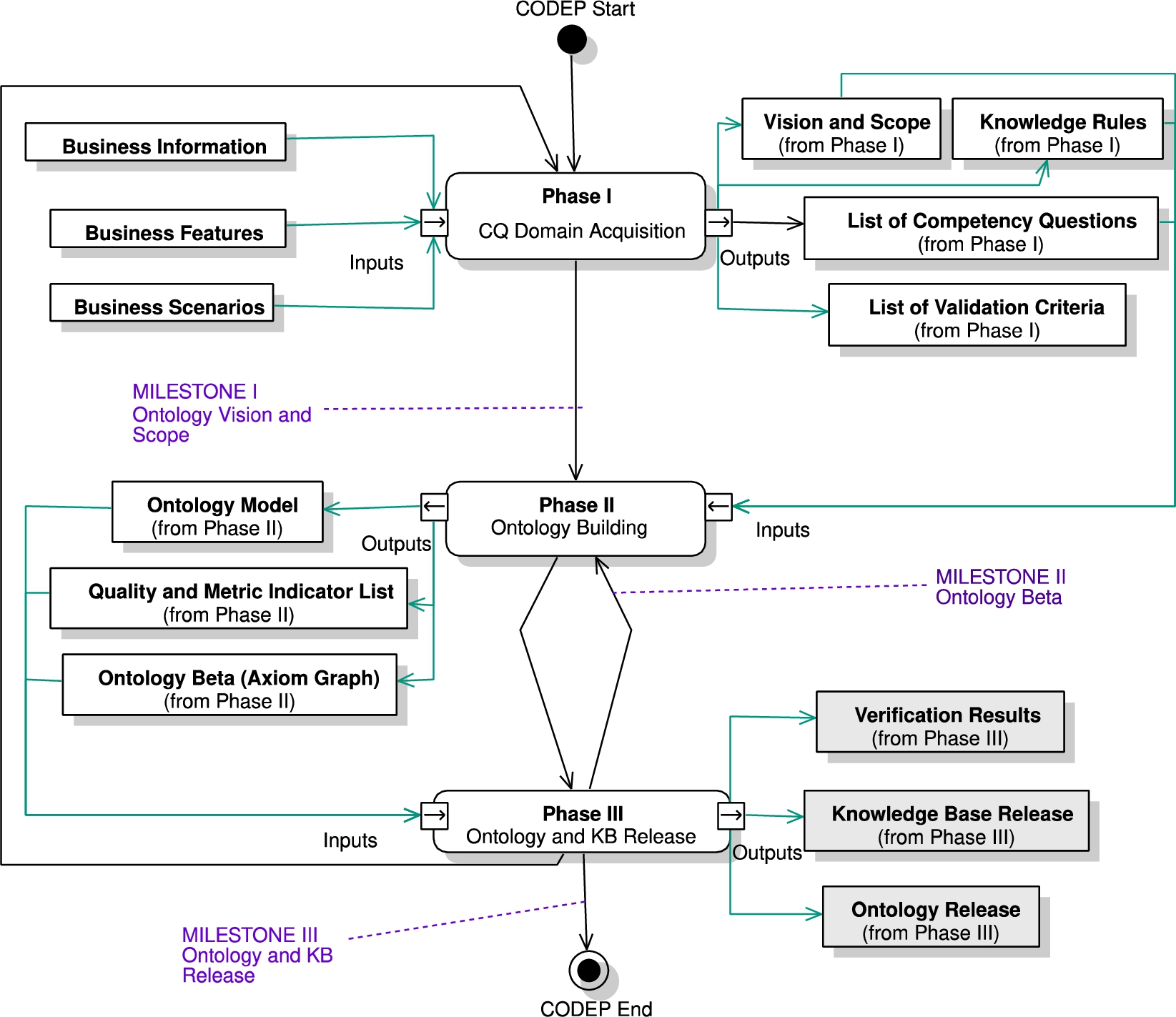
Life cycle of CODEP.
CODEP activities
CODEP defines a life cycle model based on the Incremental-Build Model (IEEE-SWEBOK, 2014), which includes from modeling to V&V. It can be observed from Fig. 1 that CODEP defines an
In the following CODEP specification, the activities description is done along with the case study application, to facilitate the CODEP understanding. The activities’ description is stated for a general application, while the case study describes how the process can be performed in a practical setting.
Case study description
The ontology supports a medical team composed of neurologists, who are specialized in rehabilitating patients with head injuries, in the context of the National Rehabilitation Institute (Instituto Nacional de Rehabilitación – INR, http://www.inr.gob.mx/r08.html), a Mexican hospital and leader in attending patients in rehabilitation services. INR also promotes research projects in several medical areas about rehabilitation. The medical team conduct one of the INR’s research protocols called the Cerebrolysin Research Protocol (CRP; INR, 2013). CRP focuses on investigating the functional, cognitive, psychological, and physical effects of the Cerebrolysin® drug, as adjuvant treatment for several sequelae of Traumatic Brain Injury (TBI). The CRP team is constantly seeking patients with specific diagnosis conditions, who meet the CRP’s requirements and analyses whether they are candidates for neurological rehabilitation in an in-hospital program that lasts for a year. The medical team, who is specialized in neurology at INR and manages the CRP, needs to perform a specialized evaluation of the patients, who are sent from other hospitals with a preliminary diagnosis of TBI. However, these hospitals are the first-contact medical place after the patient has suffered an accident, and commonly the general physicians in charge are not specialized in making such specific diagnoses for the criteria evaluation. Currently, two situations can happen: 1) INR’s medical staff need to travel to the first-contact hospitals to perform the diagnostic analysis and considering the high number of hospitals with A&E services in Mexico City and the time it takes to get there, this becomes an unpractical activity; 2) The first-contact hospitals’ general physicians perform a preliminary diagnosis to send potential patients to the INR for the Cerebrolysin treatment. However, as they are not specialists in medical rehabilitation, such preliminary diagnostic, could be incomplete or wrong. Both situations cause the loss of candidate patients to be enrolled in the CRP, which affects the medical research and the rehabilitation of current and future patients.
Thus, in the Case Study, it is important to analyze whether the patient fulfills a set of criteria, which is followed by the INR’s medical team, to determine if the patient can be treated under the CRP (INR, 2013). Table 2 shows these criteria as a list of Inclusion Criteria and a set of Exclusion Criteria. The application of the inclusion/exclusion criteria follows an order which is determined by the INR’s medical team. In this Case Study, some of these criteria might be business policies (e.g., that the patient must be at least 18 years old), others might be business constraints (e.g., that the TBI is considered “severe” if the lesion time is between 1–6 months. Thus, the CRP (including the inclusion/exclusion criteria) along with the INR organization, will be taken as Business Information, which is used to identify the Business Policies (BP) and Business Constraints (BC; Fig. 2, Activity 2).
The Inclusion/Exclusion Criteria, as Business Policies (BP) and Business Constraints (BC)
The Inclusion/Exclusion Criteria, as Business Policies (BP) and Business Constraints (BC)
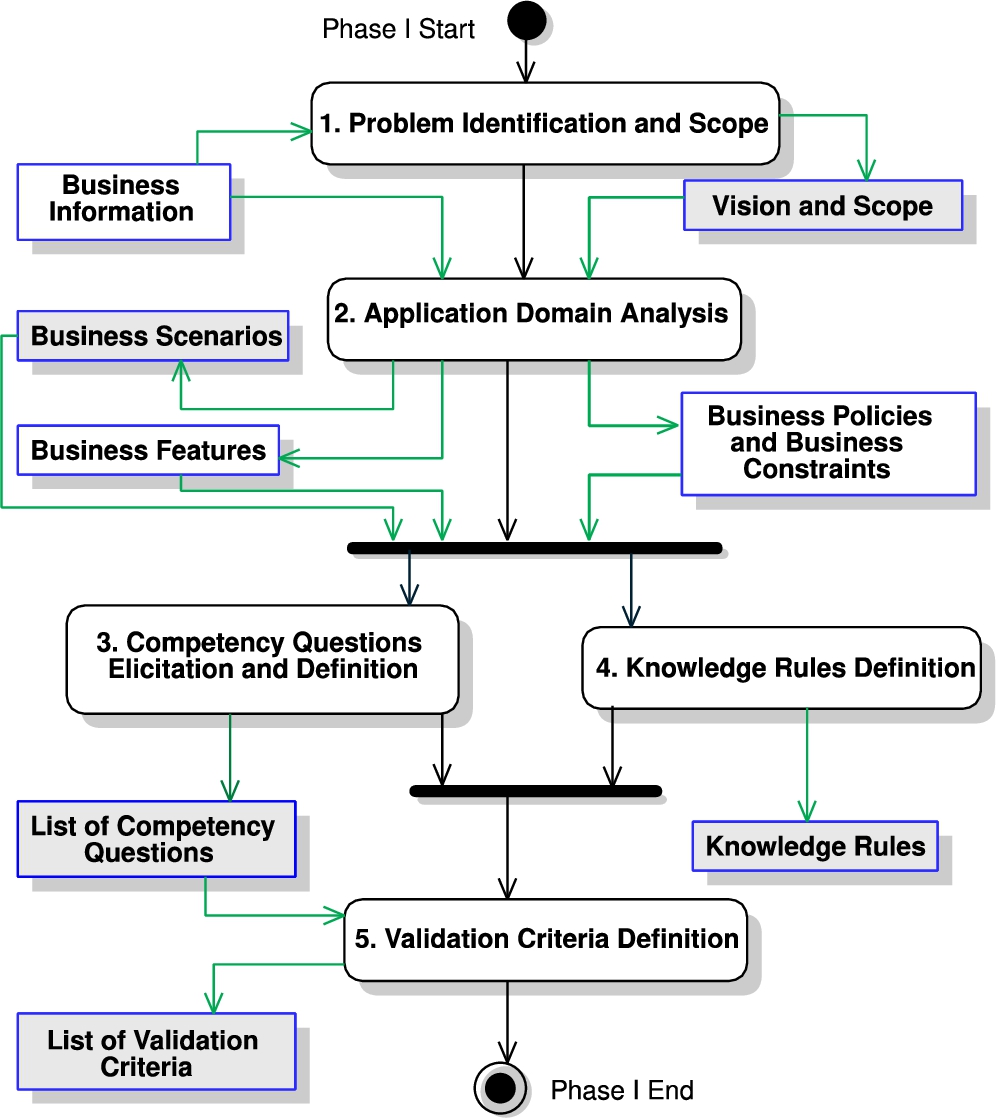
Phase I flow.
In this scenario, the ontology will be the means to organize and model the medical rationale required to process patients to be treated under the CRP. The KB (based on the ontology) will support the first-contact GPs at the hospital to perform the specialized diagnostic analysis, through the implementation of the medical criteria as knowledge rules. It is worth mentioning that before starting the ontology design, research was performed to identify processes that are oriented to developing application-oriented ontologies. As commented in Sections Introduction and Related Work, even there are several well-known processes, we were not able to find one which focused on developing ontologies to be used in an application setting, with frequent activities to perform quantitative validation (for measuring if the ontology and KB are truly answering the CQs, from the SMEs’ perspective), with a guide to applying the process, and that the resulting ontology can be used to set up a knowledge base, able to execute queries from a software application. Therefore, CODEP is inspired by many of these processes but fills the gap by proposing a new process that is structured, includes V&V, and can be driven by the CQs to create an application-oriented KB.
In the following Section 3.2, the description and application of CODEP in every phase are explained.
The objective of Phase I is to understand the domain to obtain the list of Competency Questions and Knowledge Rules that will be used to drive the ontology (see Fig. 2).
The problem identification of an ontology is key for avoiding the modeling of irrelevant aspects of the domain application, and the scope states the expectations that the ontology must be compliant. The problem identification and scope are defined by conducting several meetings between the knowledge engineer and the SME to identify what are the needs for the ontology. The SMEs are the experts of the domain and they can be end-users of the ontology. From this step, the KE identifies the actors, end-users, and stakeholders of the ontology. The Input is the Business Information related to the domain and context that describes problem elements. The Output is a Vision and Scope that clearly describes the subject, the problem boundaries, and the roles involved.
The objective is that the KE gets deep knowledge about the concepts that need to be included in the ontology and the level of expressiveness. Specifically, 1) the application domain context (the institution features, the company’s business policies and constraints from relevant standards, and a glossary of terms) is studied; the doubts should be solved with the involved people in the domain (staff, customers, or technicians); 2) the set of scenarios (including the tasks that are performed by the scenario’s actors) where the ontology is applied are identified; here each actor can have a set of scenarios or many actors can share them. The Input is the Vision and Scope, from Activity 1. The Output is three elements: 1) the Business Features that describes the institution description and a list of significant domain terms; 2) the Business Scenarios, which includes the scenario set per role; and 3) the Business Policies and Constraints.
Scenarios for ontology usage
Scenarios for ontology usage
This activity focuses on capturing the set of CQs. The CQs are the questions that SMEs need to answer to support their daily work. They are usually the queries that need to be supported with the ontology, and they are defined as focusing on obtaining knowledge (explicitly or implicitly) from the KB. Usually, CQs are in the mind (tacit) of SMEs, and the KE works with SMEs to make them explicit. To be able to explicitly define the CQs, the KE analyses as Inputs: The Business Features, Business Scenarios, and the Business Policies and Constraints from Activity 2. The Output of this Activity is the List of Competency Questions (this includes the refined CQs in iterations).
(Excerpt) Competency Questions (CQs)
This activity aims to identify constraints or restrictions in the knowledge domain, such as regulations, the vision, and scope document (from Activity 1), and relevant domain documentation provided by the SMEs. Constraints are defined as Knowledge Rules to implement the business logic in the ontology domain, and they are defined as axioms in the ontology, which can be verified by a reasoner (an intelligent software application). In CODEP, the Knowledge Rules are extracted from the Input: Business Scenarios, Business Features, and Business Policies and Constraints (from Activity 2); but it is recommended that the KE refines them along with the SME. The Output is the Knowledge Rules, which are implemented in the KB in Activity 12, to apply the ontology quality metrics (e.g., for testing accuracy of the CQs responses). The knowledge rules identification can be done by defining use cases, identifying the flows in such use cases, and complementing them with activity or business process modeling diagrams (e.g., with UML or Business Process Modeling Notation).
Before the creation of the ontology, we recommend defining the ontology validation criteria. The validation criteria aim is to check whether the CQs respond to the SMEs’ expectations, once an ontology is set up in a knowledge base. For this purpose, the KE will get the CQs’ responses through querying the KB, and the SME will indicate if they believe whether the validation criteria are met or not after evaluating such CQs’ responses. Thus, the KE and SMEs work together to set these criteria, and they should reflect the functional achievement (e.g., completeness and accuracy of the CQs) but also the non-functional one (e.g., comprehensibility and efficiency). During the validation criteria definition, the communication between the KE and the SME must be very active. Depending on the ontology objective and the SME expectations, different validation criteria can be defined as a set of metrics. In the literature, there are already metrics that can be reused for quality assessment, such as the external quality and quality in use from the SQuaRE model in the series ISO/IEC 2502n (ISO-25023, 2016; ISO-25022, 2016). However, the KE must adapt them to reflect that the requirements specification for CODEP is represented as CQs. The input for this activity is the List of Competency Questions (from Activity 3); and the Output is the List of Validation Criteria, which will be used for the ontology validation (Activity 15).
The List of Validation Criteria for CERPRO included: CQ completeness (since the medical team is interested in implementing the whole CQs set), CQ response accuracy (since the medical team expects accuracy in the responses when identifying diagnostics), and CQ response comprehensibility (since the medical team needs to comprehend the responses from the knowledge base with no complication in the technical argot). Each metric has a definition, a metric to collect values to prove whether the ontology expectations are fulfilled, the range of meaningful values (e.g., 0 the worst value and 1 the best value), the number of CQs needed to calculate the metric and the medical teams’ expected value.
aCQ: Zero the worst accuracy, one the best. If
i: Number of the CQ being measured.
n: Number of the evaluated CQs (14 for this case study) in a given iteration.
TCQs: The total number of CQs, which were provided by the medical team.
cCQ: If cCQ is near zero then the CQ implementation is poor, on the contrary, if it is near 1, it is the best.
i: Number of the CQ being measured.
n: Number of the evaluated CQs (14 for this case study in the last iteration) in a given iteration.
TCQs: The total number of CQs, which were provided by the medical team.
rCQ: If rCQ is near zero then the CQs’ responses’ comprehensibility is poor, if it is near to 1 it is high.
i: Number of the CQ being measured.
n: Number of the evaluated CQs (14 for this case study in the last iteration) in a given iteration.
Thus, in Activity 15, these metrics are applied to obtain feedback about CERPRO’s quality from the SME’s perspective, to identify deviations and to correct them, till
The objective of this phase is to build an ontology model and its axioms (see Fig. 3). The activities for this phase are as follows:
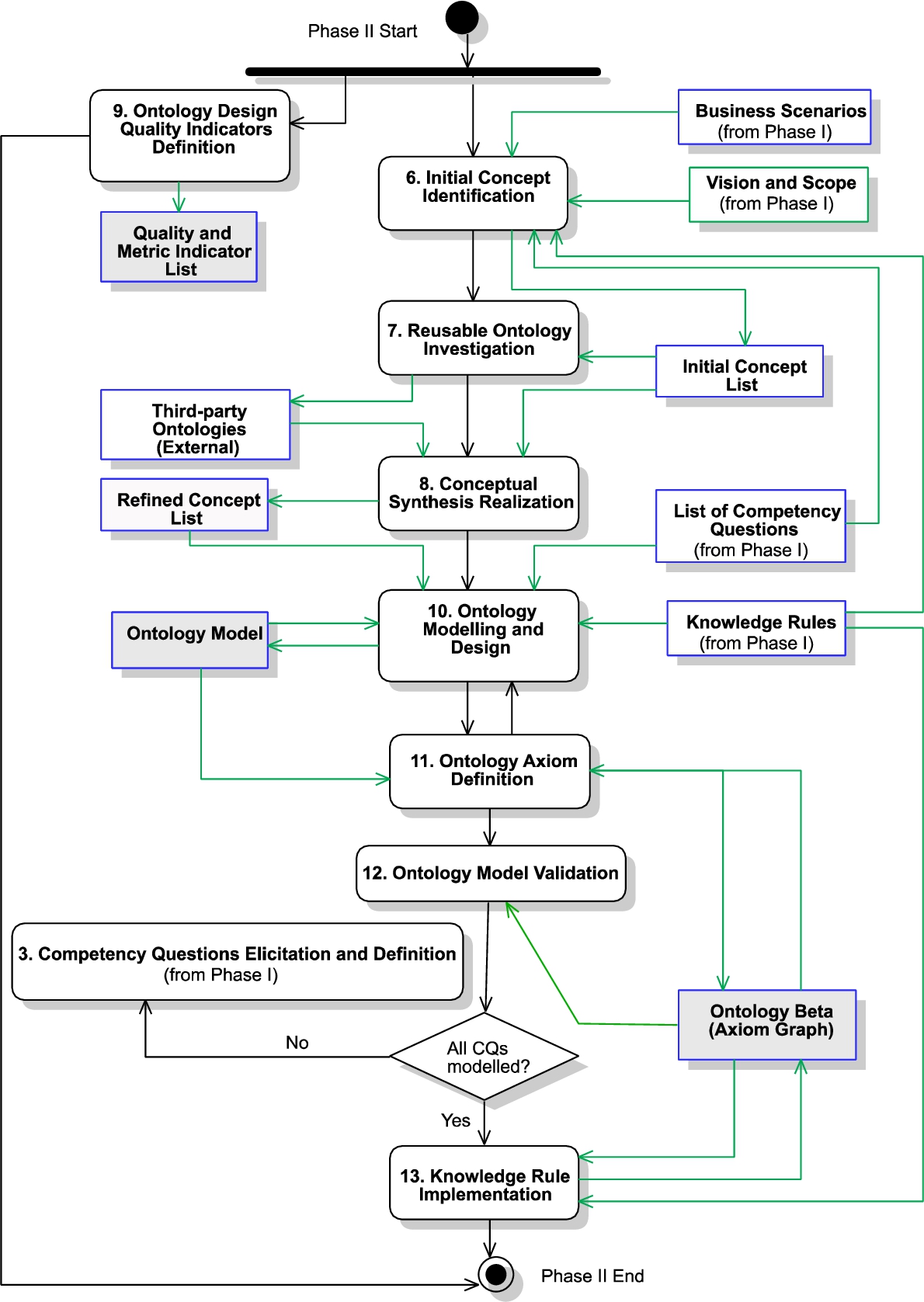
Phase II flow.
This activity aims to extract the relevant domain nouns and business actions from the outputs of previous activities. The Input to this activity is the Business Scenarios, the Vision and Scope document, the list of Competency Questions, and the Knowledge Rules. Nouns in these inputs will be the initial list of the ontology concepts and the verbs will be relationships among the concepts. This is a highly creative task and can involve interviewing further the SME and additional information could be provided to the KE related to the identified concepts. The Output of this activity is the Initial Concept List.
“Patients with a sequela diagnostic caused by the TBI.”
From this statement, the following nouns can be identified as concepts: Patient, Diagnostic, Sequela, and TBI. Then, more information can be discovered about the features which describe Patient, Diagnostic, and TBI through interviewing physicians. For the Sequela concept, the SP has further required to detail the classification of a series of illnesses produced as a consequence of the TBI. Relevant concepts were also identified for the application domain analysis of the target ontology. For example, the Glasgow Outcome Score (SNOMED International, 2015 ) which is a scale for measuring the damage caused by brain injuries (e.g., cerebral traumas), divides patients into 5 groups: Death, Persistent vegetative state, Severe, Moderate and Low disability. Thus, the Initial Concept List is produced to be included in the ontology.
As a result, new relationships and concepts not identified in Activity 6 can be discovered and added to the Initial Conceptual List. In this activity, the KE can identify several potential third-party ontologies. In this case, the KE needs to evaluate which one is more appropriate based on the initial concepts identified and the scope. The KE maps the third-party ontologies’ concepts with the initial concepts. The SME needs to work with the KE to ensure that the semantics of the concepts. Therefore, the Input is the Initial Concept List and the Output is the reusable Third-party Ontology/ies, which are selected.
This activity aims to synthesize the concepts obtained from the Third-Party Ontologies (Activity 7), with the concepts that have been identified in Activity 6 to eliminate duplicate concepts from the re-used modules. Therefore, the Input of this activity is the Initial Concept List and the reusable Third-Party Ontologies. This activity must be carefully done since third-party ontologies could be exhaustive, and it is necessary to double-check if each of the concepts from the CQs is already included in the Third-Party ontologies selected. We, therefore, recommend mapping the concepts of the reusable ontology to the ones in Initial Concept List. The output is a Refined Concept List which will be used to model the ontology in Activity 10.
(Excerpt) refined concept list
This activity aims to allow the KE to set quality indicators about the ontology design to be verified in later activities. The KE sets quality indicators related to the design of the ontology. In this way, the design of the ontology is driven by these quality indicators and checked after the modeling stage. Quality indicators are set to assure that the ontology follows quality standards. It allows the KE to verify that the ontology has been designed and implemented according to the quality indicators and if not, the KE can refine the ontology. Quality indicators are different from validation metrics defined in Activity 5. Validation metrics are end-user-oriented and are checked with users to achieve end-user expectations. Quality Indicator Metrics can be adopted from already defined ones available in the literature such as by Gangemi, Catenacci, Ciaramita, & Lehmann (2005) and by Tartir, Budak Arpinar, Moore, Sheth, & Aleman-Meza (2005). However, these could need to be adapted to be defined in terms of CQs. The Output of this activity is the Quality and Metric Indicator List, including the metrics per indicator, to be used for measuring the quality of the ontology.
comCQ: The average of total concepts in the ontology from the n evaluated CQs, <1 the worst, ⩾1 the best.
i: Number of the CQ being measured.
n: Total number of CQs.
SemCM: 1 the best (none of the concepts are modelled in more than one ontology),
2 the worst (concepts are modelled in both ontologies).
i: Number of the CQ being measured.
n: Total Number of CQs.
i: Number of the CQ being measured.
n: Total Number of CQs.
The metrics will be used in Activity 13 to measure the CERPRO’s quality, to improve the quality design through the iterations, till the 3 metrics are near 1. For example, if
As this activity is part of an iterative process, the KE selects a set of CQs that will create an increment of the ontology model. Therefore, the input of this activity is the List of Competency Questions, the Knowledge Rules and the Refined Concept List, and the Ontology Model from previous iterations. Each time an increment of the model is generated that satisfies a set of CQs, another set of CQs are selected from the Refined Concept List in the next iteration and the previous increment is extended to support a new set of CQs. In the first iteration, this activity includes selecting the language for the ontology modeling and design, and a tool for an ontology graphical representation. A graphical representation is advisable as it allows the KE to discuss the model with SMEs. An example of an ontology design language is OWL-DL (W3C-OWL 2, 2012), and examples of ontology modeling tools are yED (yWorks Software, 2020), which has a plug-in to model OWL-DL ontologies, and Enterprise Architect (SparxSystems, 2013), which uses UML to depict the OWL-DL axioms. Each iteration generates an increment, which is called the Ontology Model (Output), and the last iteration will generate the increment that satisfies all the CQs.
During the activity, concepts and their relationships are represented in a graphical model, before designing the ontology, to create a consensus among the participants about the ontology axioms, knowledge rules, and expressiveness level. Also, the graphical ontology model is a means to visually verify if all the concepts and their relationships from the Refined Concept List (Activity 8) are being considered in the model.
Due to the iterative nature of CODEP, Activity 10 can be iteratively be updated with Activity 11–12, for modeling, and designing the ontology, and defining the knowledge rules.
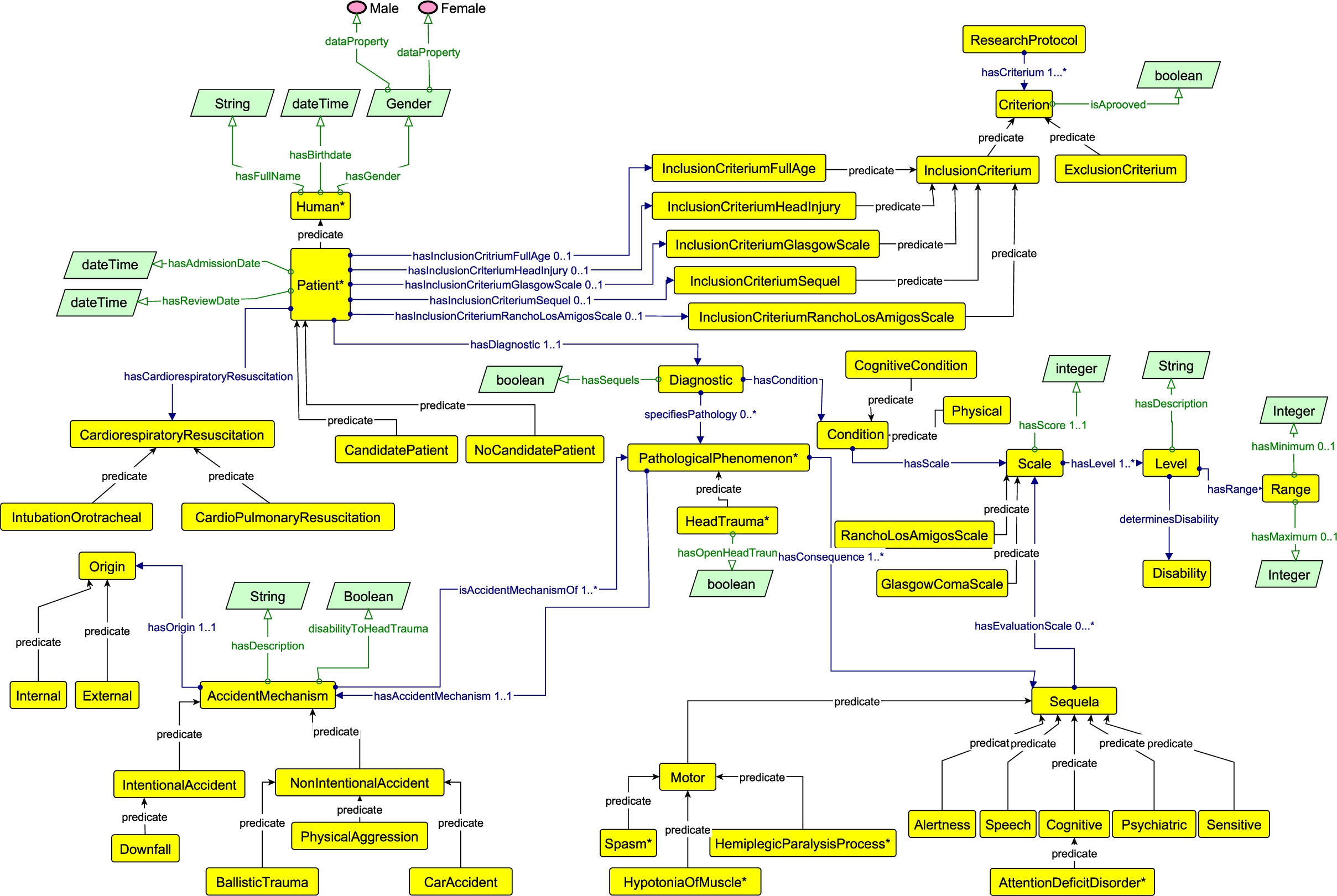
CERPRO model in yED, showing the INR Inclusion Criteria.
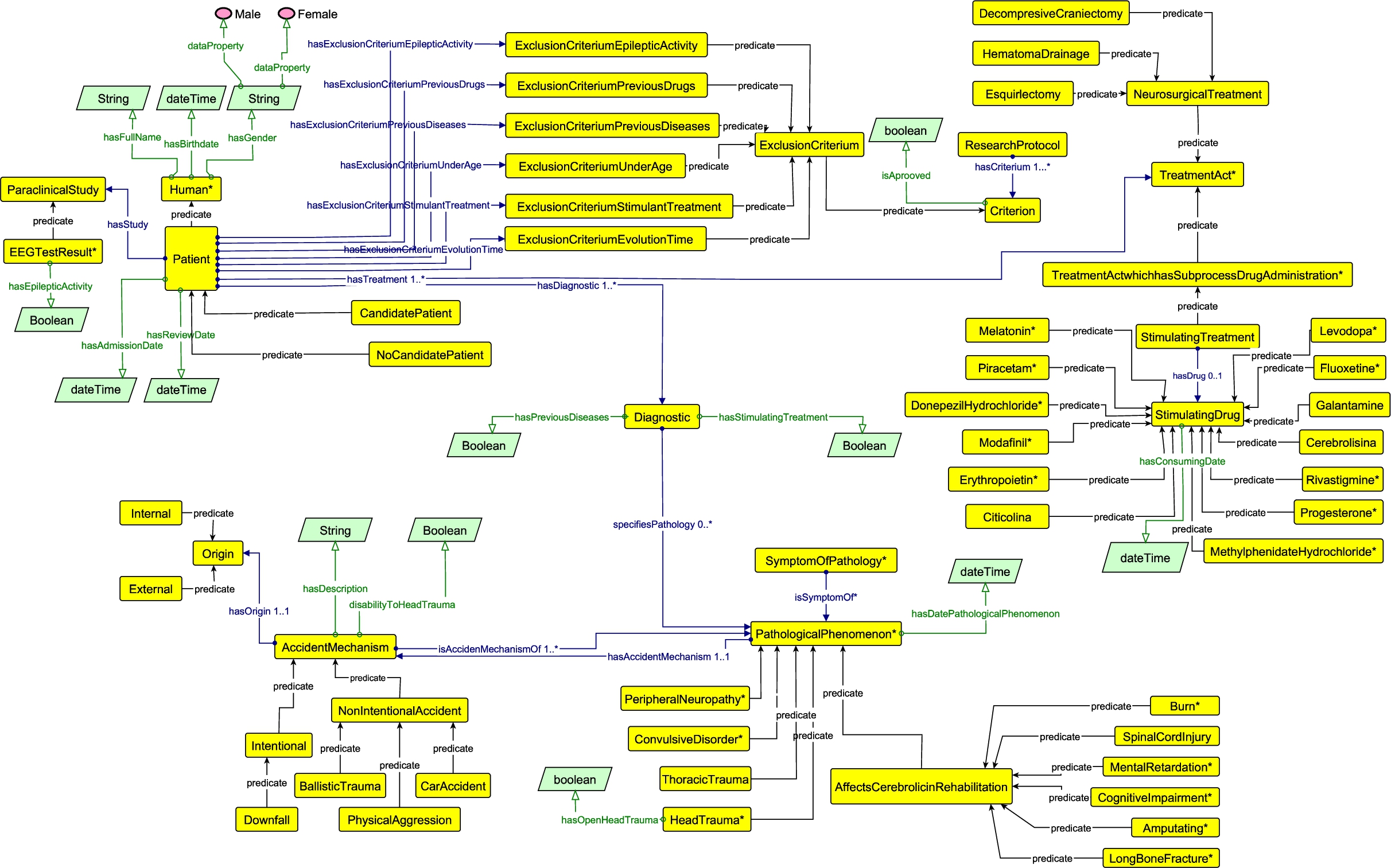
CERPRO model in yED, showing the INR Exclusion Criteria.
In this activity, the axioms already specified in the model from Activity 10 are implemented. The Input for this activity is the Ontology Model and the Ontology Beta (from iteration 2, which includes the axioms in a formal ontology language, implemented through an ontology editor). The objective is to constantly verify that the designed ontology contains all the model expressiveness (inheritance, equivalence, disjoining, etc.), stated in the model. Several graphical modeling tools used in Activity 10 can automatically generate the ontology axioms; however, the KE must manually check that the generated axioms contain all the required expressiveness. This manual check must be done each time the model or ontology is edited. This expressiveness could consist of iteratively defining a set of axioms (the TBox in the ontology OWL language), the domain concepts and the properties (relationships) between them, cardinalities, equivalences, functions, and inheritance. It is possible to use some already known Ontology Design Patterns (ODP; Gangemi & Presutti, 2009).
In this step of this Activity, the ontology consistency checking must be done as many times as the reasoner reports inconsistencies in the ontology until there are no more reported errors. The Output of this activity will be an Ontology Beta version.
Due to the iterative nature of CODEP, Activity 11 can be iteratively be updated with Activity 10 and 12, for modeling, and designing the ontology, and defining the knowledge rules.
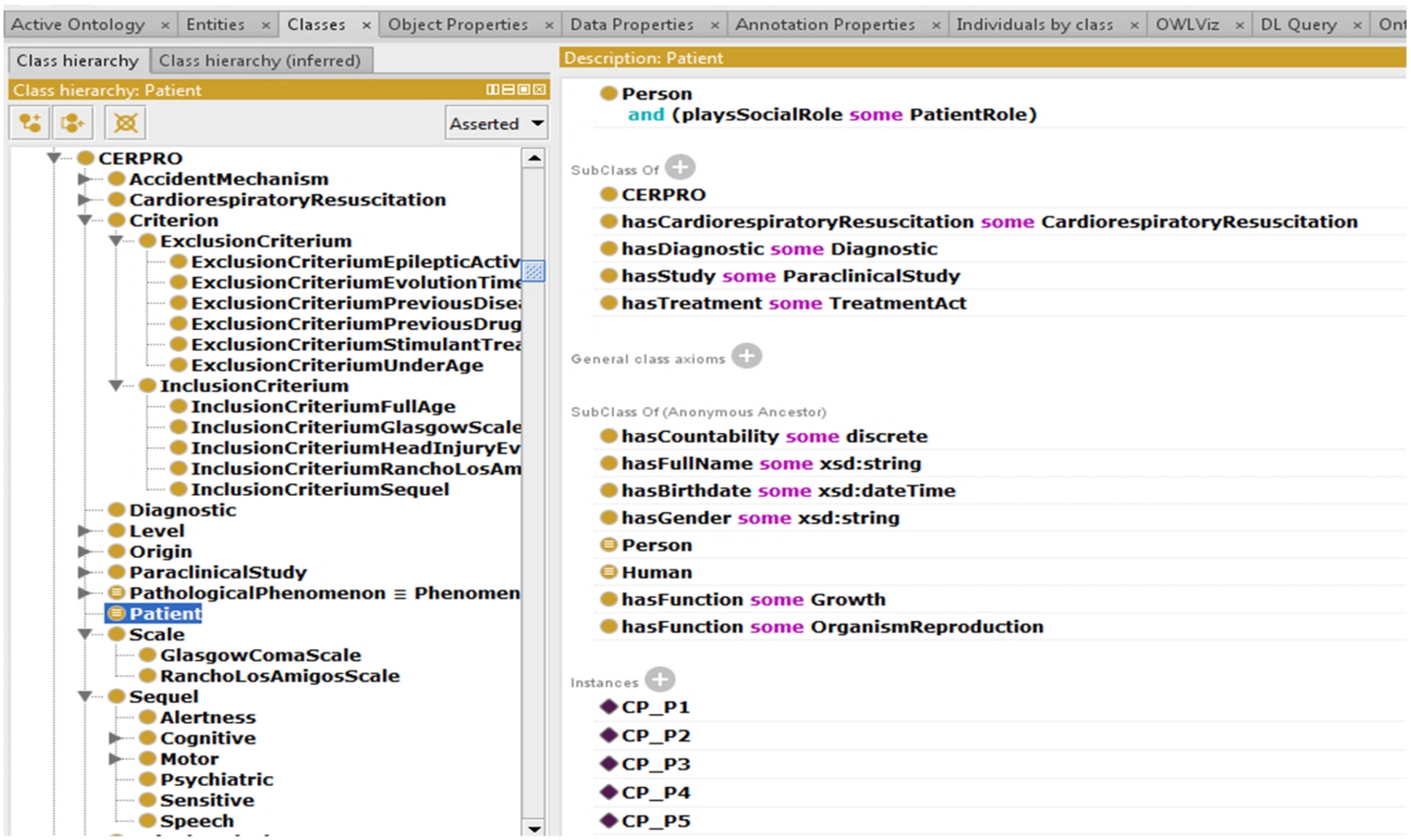
CERPRO in Protégé, displaying the OWL axioms for the patient class, and patients as instances (CP_P1, CP_P2, etc.).
This activity aims to receive feedback on the ontology design as it is easier and less costly to make any changes/updates at this stage than in later activities in the process. In this activity, the KE shows the ontology model and axioms to the SME. For this purpose, it is recommended to use a graphical ontology representation to facilitate the comprehension of the SME. Thus, this is a qualitative validation – as it captures the SME’s comprehension about missing or misrepresented concepts, attributes, and relationships.
After performing this activity, a decision can be made either, to perform more iterations to other activities in this phase, specifically activities 6, 10, and 11; or not. The input of this activity is the Ontology Beta and the output is the decision about performing more iterations (when some concepts are still missing in the ontology) or going forward to Activity 13 to implement the knowledge rules.
Fig. 7 shows how the ontology was changed after this validation. The trauma accident concept was not detected by the KE from the CQs and domain analysis. This situation can happen because SMEs are not aware that they need this in the model early on, until the KE walks them through the model.
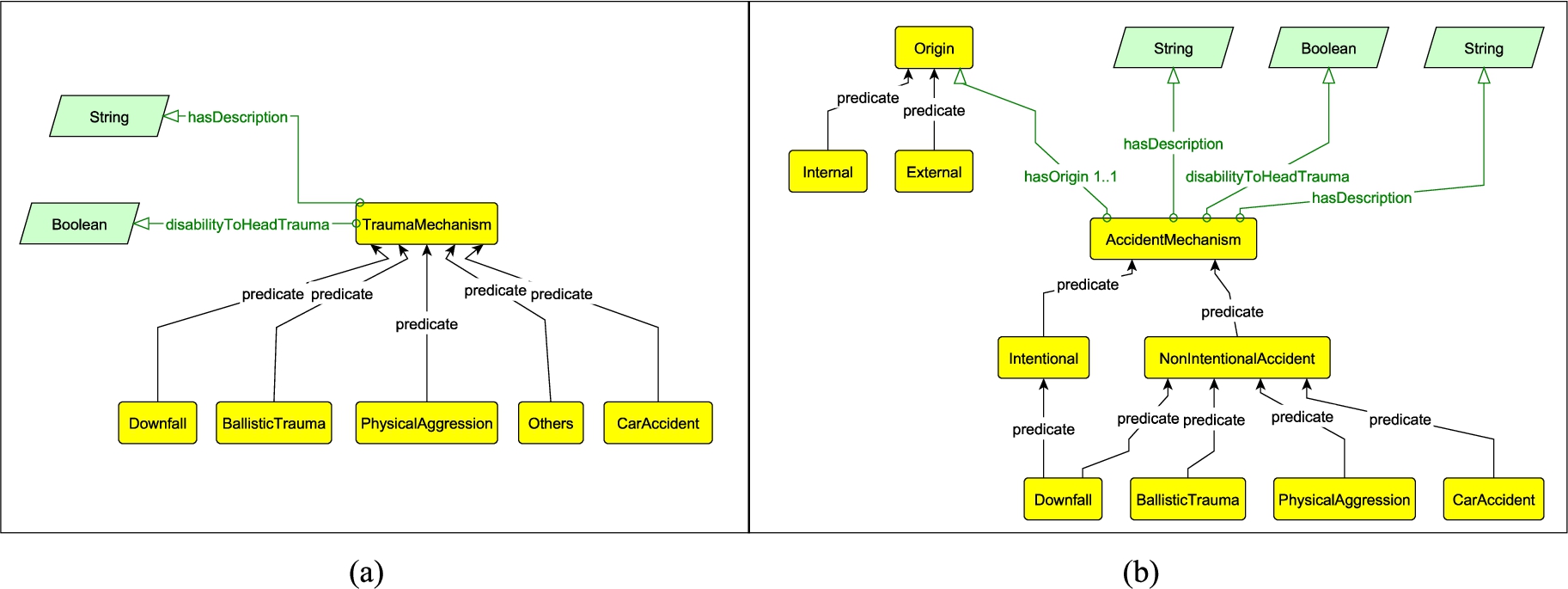
The (a) shows the previous version of the TraumaMechanism class; (b) shows the same class but it was renamed as AccidentMechanism, with additional classes for modeling whether the trauma was an accident that might be intentional (e.g. a third-person pushed the patient) or NonIntentionalAccident (e.g., a person falls due to a sickness).
In this Activity, the KE implements the Knowledge Rules (from Activity 4) in a rule language (e.g., for OWL ontologies), by selecting the best strategy according to the objective of the ontology (e.g., to be used for inferencing knowledge, or querying). Three strategy options are proposed to implement KRs:
Due to the iterative nature of CODEP, Activity 13 can be iteratively be updated with Activity 10–12, for modeling, and designing the ontology, and defining the knowledge rules.
(Excerpt) Inclusion and Exclusion Criteria (IC and EC respectively) in combination, comprises the Knowledge Rules (KR). In each KR, the IC/EC must be simultaneously executed according to the rows below in this table. For example, KR1 requires to simultaneously execute IC-1 and EC-1. Inclusion and Exclusion Criteria must be simultaneously executed in each KR
Rule R-3 implementation in SPARQL
The objective of Phase III is to implement a Knowledge Base from the ontology that is verified and validated (see Fig. 8). The activities for this phase are as follows:
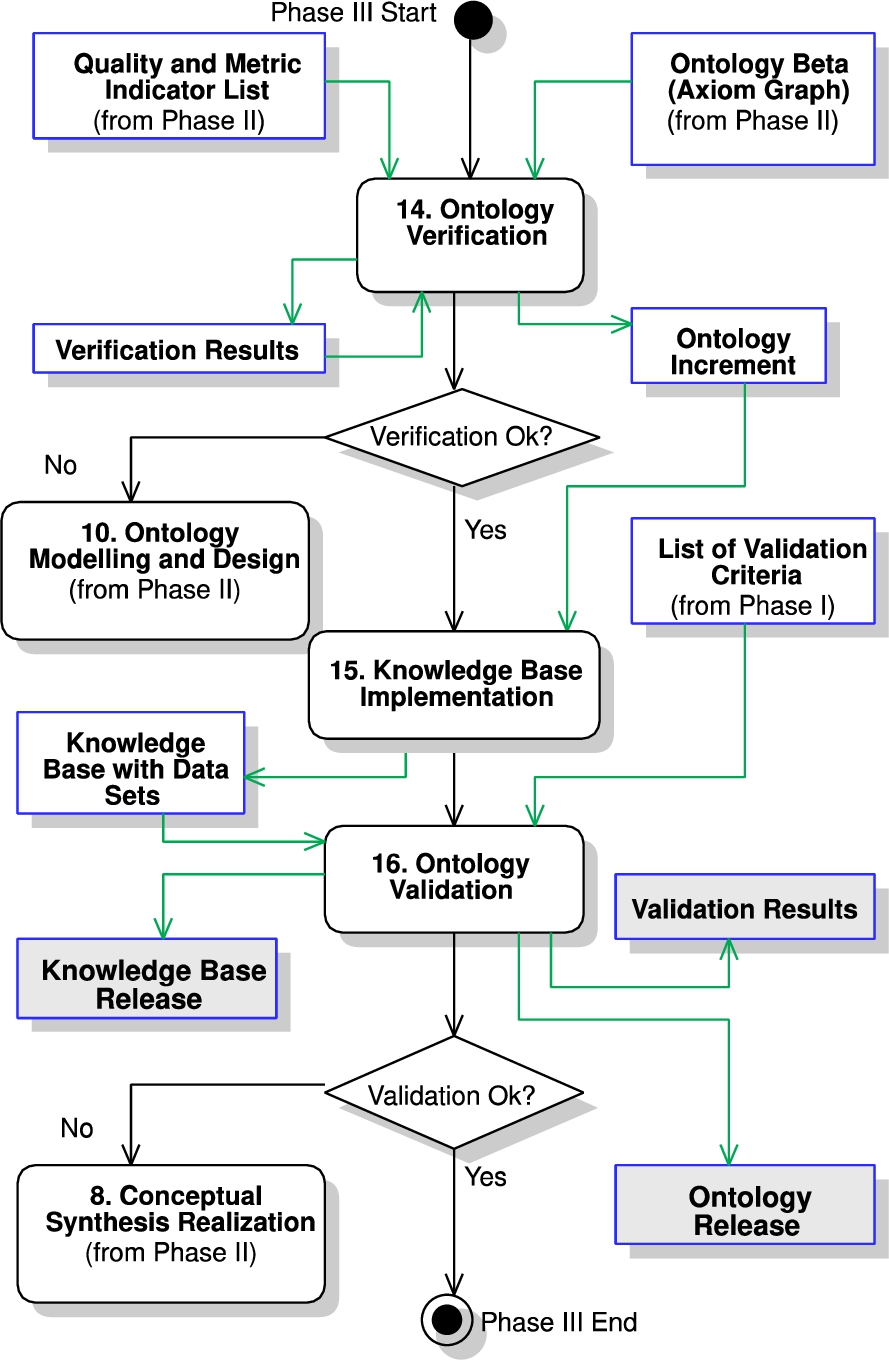
Phase III flowchart.
This activity aims at verifying the ontology design by measuring its quality, according to the defined Quality and Metric Indicator List (Input from Activity 9). The Verification definition in CODEP is based on the one provided in SWEBOK (IEEE-SWEBOK, 2014), as follows: “Verification is an attempt to ensure that the product is built correctly, in the sense that the output products of an activity meet the specifications imposed on them in previous activities”. In this context, this activity verifies the ontology design in terms of the quality indicators that were defined in Activity 9.
The verification is run by applying the metrics included in the indicators to obtain measurements, which will give insights about the ontology design, and then to correct deviations if the results are under the expectations. This will guide the KE to review and improve the design of the ontology and conduct further iterations if needed. Examples of improvements that can be performed are the addition of missing concepts, axioms, and properties and changes in the hierarchies. Metrics that can be measured are model expressiveness, completeness, and semantic consistency between the target ontology and reused ontologies. The Output will be either: The Verification Results and the verified Ontology Increment; or the decision to go back to Activity 10 for a new iteration. Otherwise, if the ontology design quality is reached, then the next Activity 15 is performed.
Short iterations from Activity 10–14 might be done, to adjust the ontology modeling and design, until reaching the expected quality as stated in Activity 9.
(Excerpt) metrics application for measuring the model completeness indicator
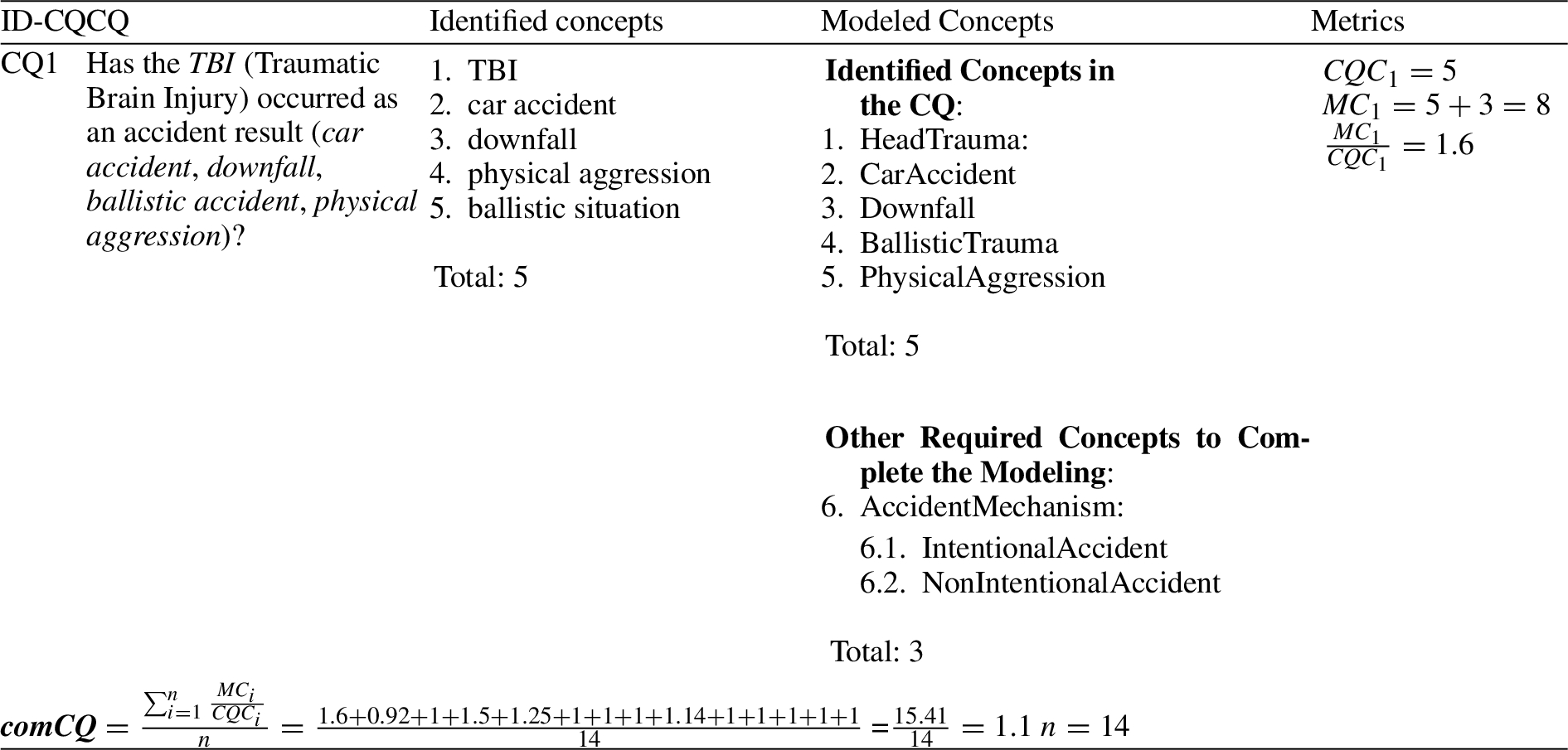
The advantages of using the Model Completeness metric in an iteration for driving improvements are as follows:
Check the traceability of the concepts from the CQs to the ontology model. As it can be noticed from Table 8, the calculation of the Model Completeness indicator has allowed us to document and keep track of the traceability of the Ontology Model concepts: the ones that are identified directly from the CQ and the ones that are not.
Add missing concepts and axioms in the Ontology. For example, in iteration 1 the Model Completeness metric for
Update hierarchies. For example, in iteration 1,
(Excerpt) previous model completeness metric calculation, where CQ2 and CQ13 metrics had lower figures
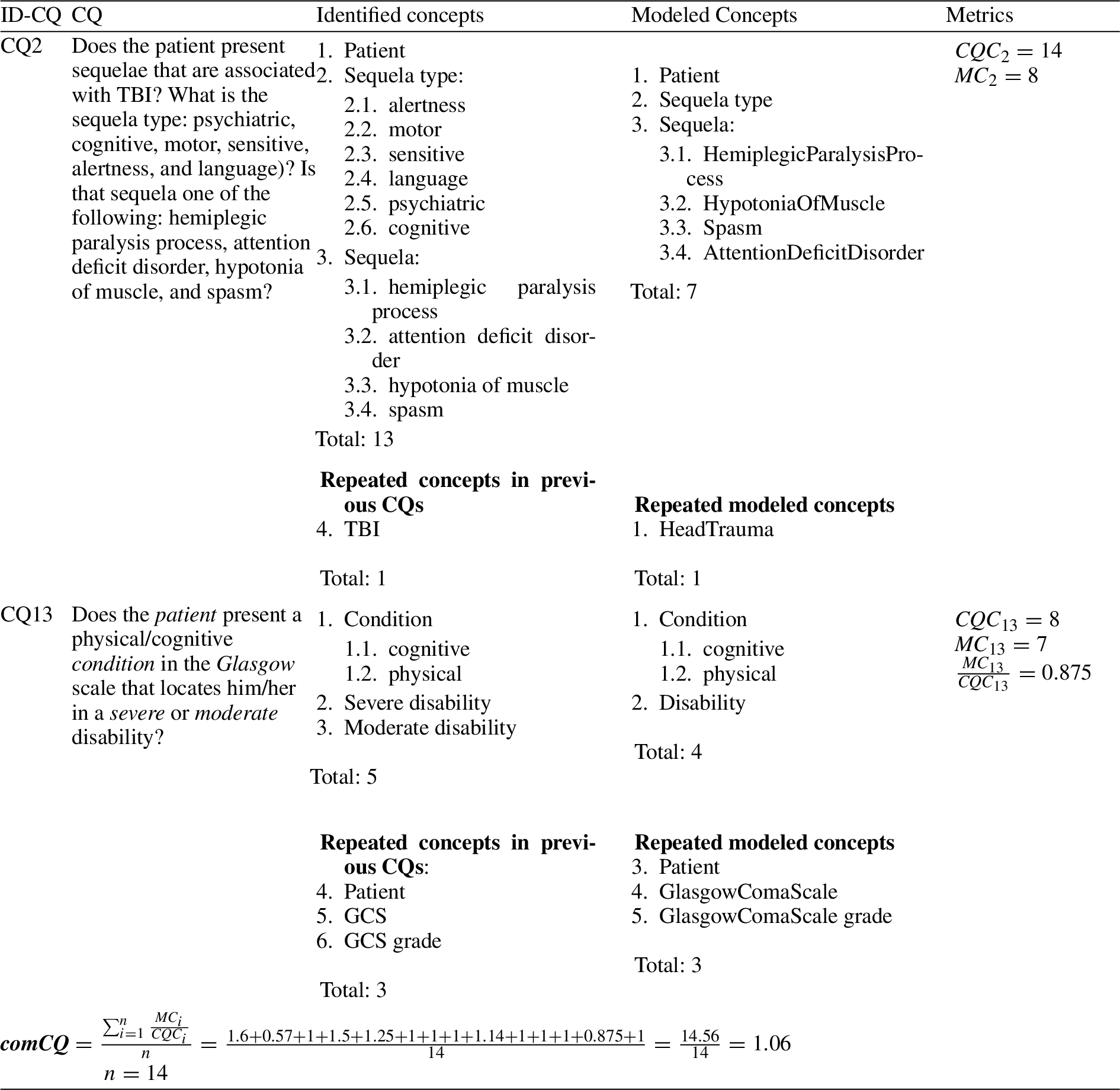
Table 10 presents the results for Semantic Consistency between Models indicator measurements. In this table we have defined columns for: the CQ description, the Identified Concepts in the CQ (to document the relevant concepts from the CQ text, Modelled Axioms in Open Galen, (to document the axioms that already exist in OpenGalen, which model the concepts from the CQ), Modelled Axioms in CERPRO (to document the axioms that model the concepts from the CQ in CERPRO), and the Metrics (for each of the 14 CQs to calculate
(Excerpt) metrics application for measuring the indicator: semantic consistency between models
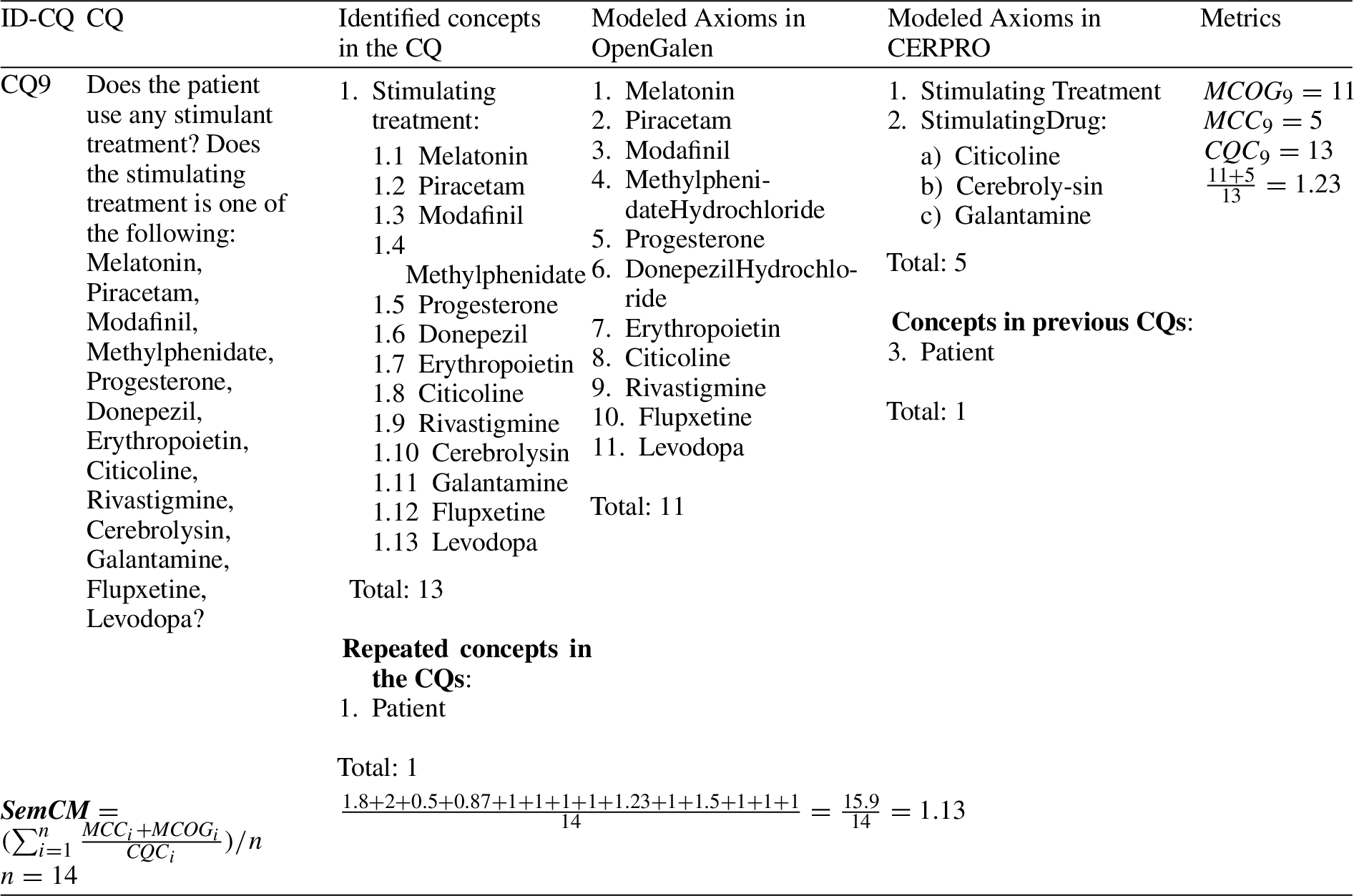
To check and remove repeated concepts between OpenGalen and CERPRO. For example, 5 concepts are identified from
(Excerpt) previous semantic consistency between models metrics calculation, where CQ12 has repeated axioms
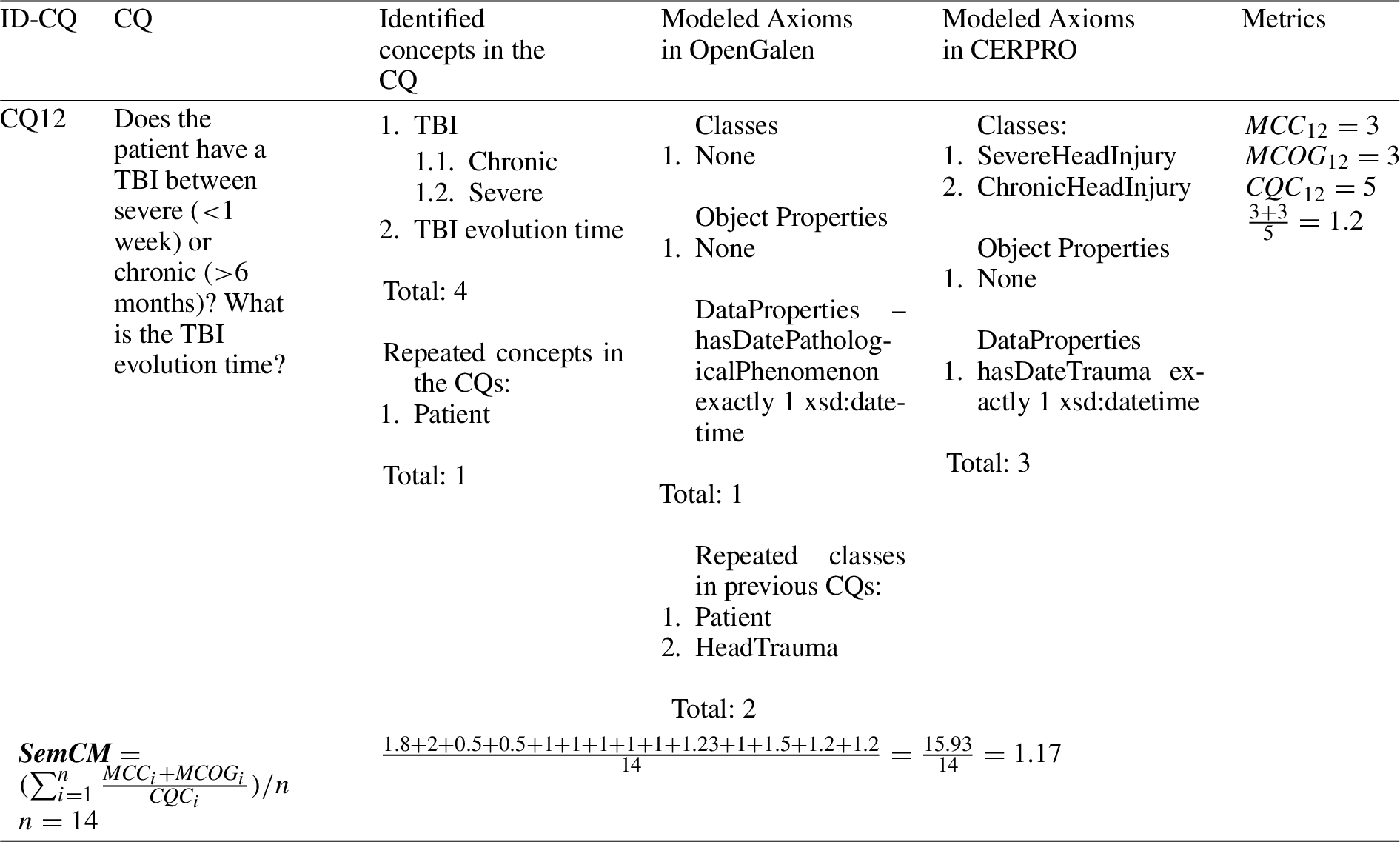
The advantages of using the Semantic Consistency between Models metric in an iteration for driving the improvements are as follows:
To trace the concepts between an ontology and a third-party one. The SemCM metric was used in the creation of all the CERPRO classes when reusing the ones from OpenGalen since the objective was to always keep the metric slightly over 1. In each iteration, this metric is calculated to record which concepts were created in CERPRO and which were already modeled in OpenGalen. The method is as follows, for each
Table 12 presents the results for the Model Expressiveness indicator measurement. The
(Excerpt) metrics application for measuring the model expressiveness indicator
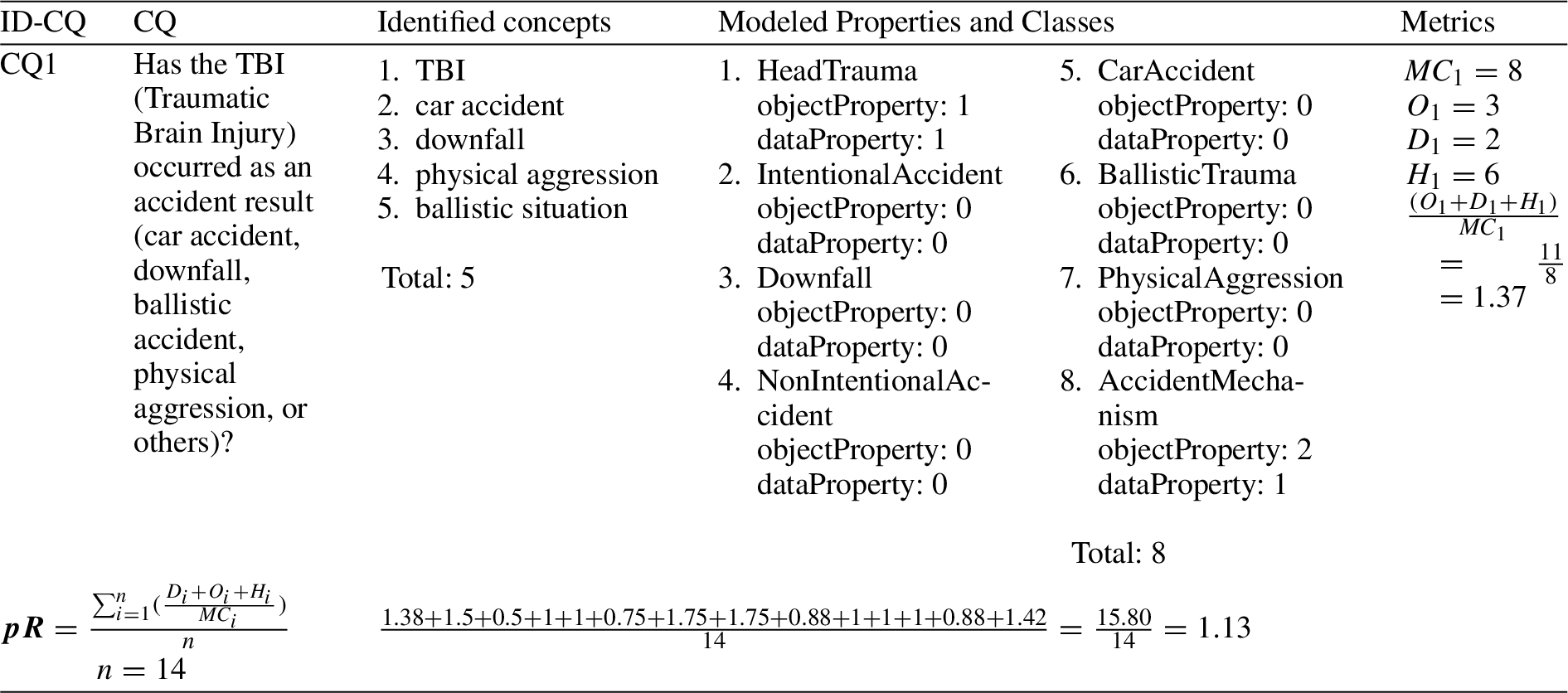
The advantage of using the Model Expressiveness metric in an iteration for driving the improvements is to identify vertical ontologies (mostly hierarchies). This metric was very helpful in identifying whether a
(Excerpt) previous model expressiveness calculation, where CQ1 has a low ratio
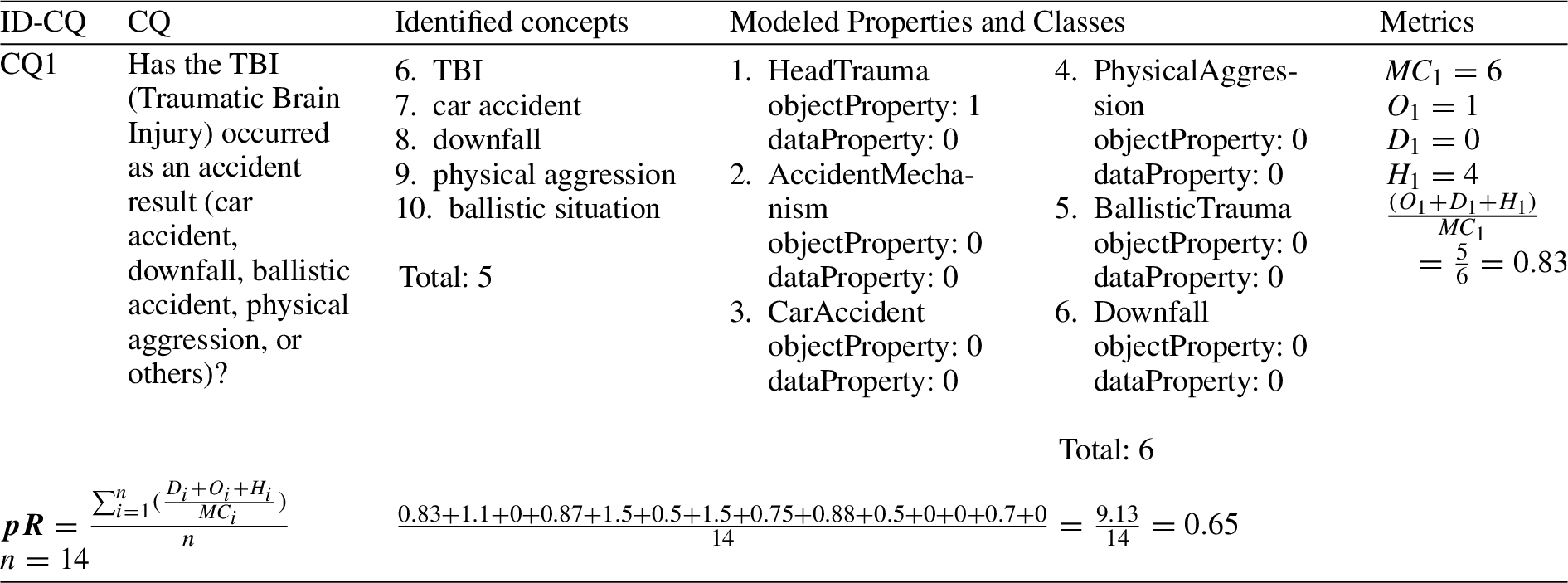
Therefore, after iteration 11, CERPRO achieved the verification expectations in terms of these 3 metrics.
The aim is to create a KB to test if the ontology is properly answering the CQs. This is entirely a software installation task. Thus, the Ontology Increment is used (Input from Activity 13) to set up the KB platform in servers, for creating a dataset to be populated with selected trial data for creating triplets (ABox for OWL ontologies). This allows the execution of the knowledge rules (from Activity 12) and the queries (created from the CQs) for validation. The Output of this Activity is the Knowledge Base with a dataset.
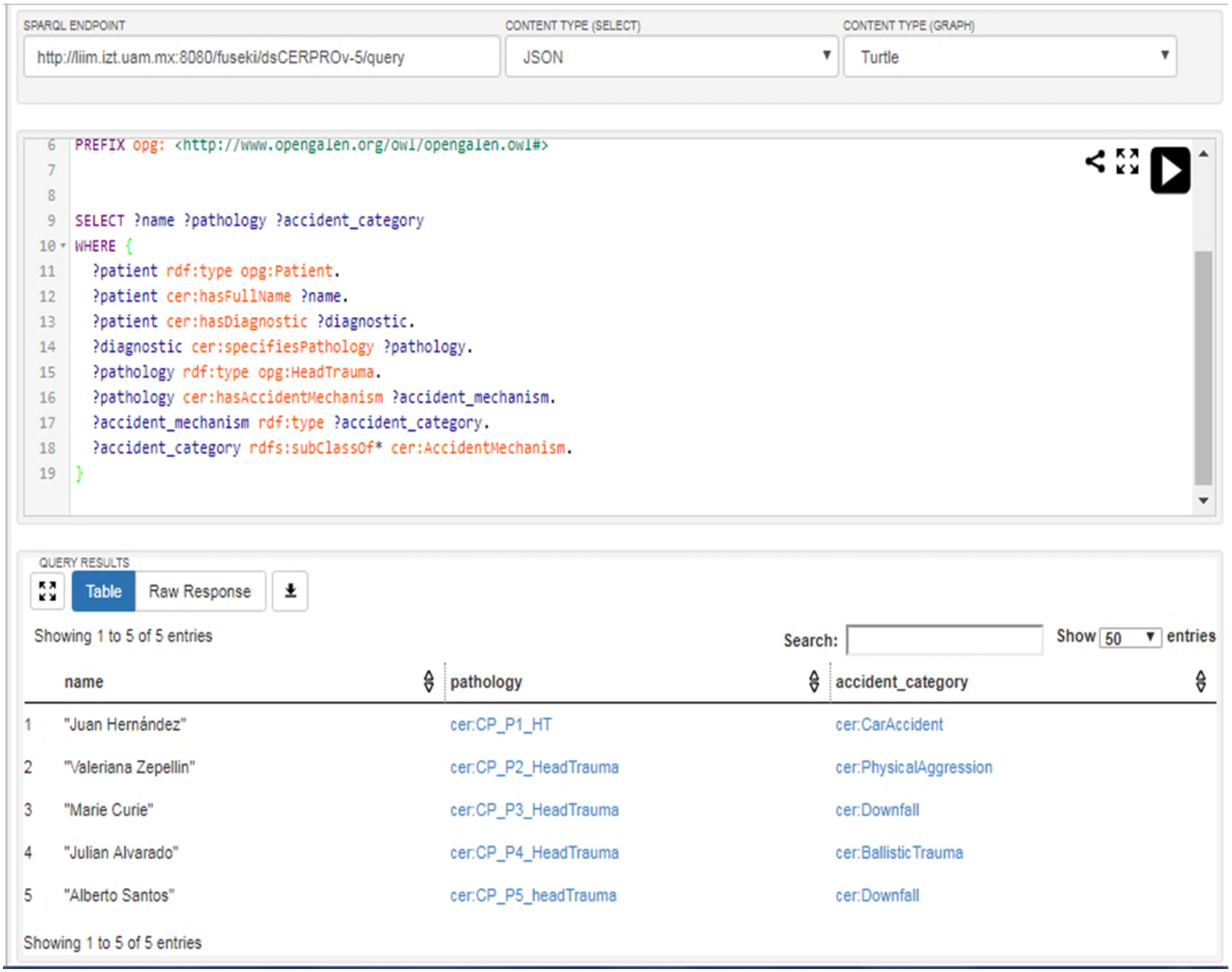
The SPARQL implementation of CQ-1 and the CERPRO response.
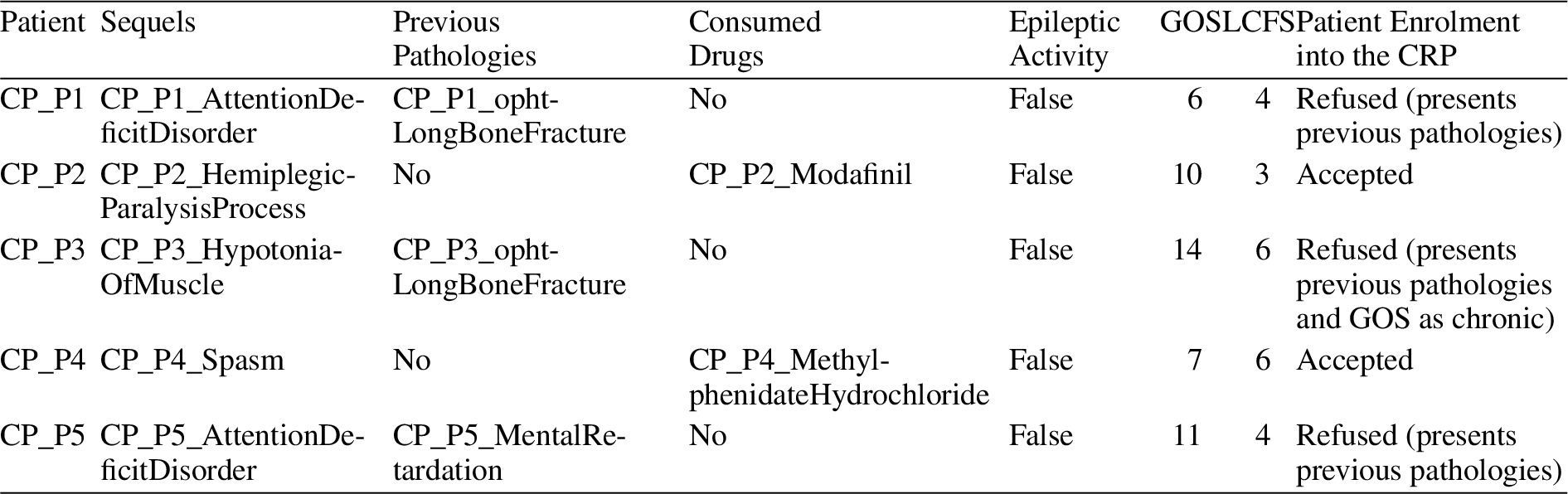
(Excerpt) trial data with patients data
This activity aims to validate whether the Ontology Increment is answering properly the CQs from the SME’s perspective in a quantitative perspective. The Validation definition in CODEP is based on the one provided SWEBOK by (IEEE-SWEBOK, 2014), as follows: “Validation is an attempt to ensure that the right product is built – that is, the product fulfills its specific intended purpose”. In this context, this activity validates whether the ontology fulfills the CQs that were defined in Phase 1, in terms of querying the KB and evaluating the results according to the ontology validation criteria, through the metrics that were defined in Activity 5.
The Input is the
The Output of this activity is either: 1) the Validation Results, the Ontology Release version and the Knowledge Base Release, then, ending the CODEP process; or 2) the decision to perform another short iteration from Activity 10–15, to update the ontology according to the validation results if the ontology does not fulfill the criteria. Due to the iterative nature of the process, it must be ensured that any changes performed to the ontology during an iteration do not affect the obtained satisfaction when answering the CQs in the previous iteration. Therefore, the final iteration must include all the CQs, already validated.
Short iterations from Activity 10–15 might be done, to adjust the ontology modeling and design, to respond to the CQs as the SME expects.
This Validation Protocol was followed in Activity 16 of CODEP to validate whether the CERPRO-KB truly responds to the medical team’s needs (stated in the CQs in Activity 3).
The validation research question pursued is as follows: Does the CERPRO ontology meet the expectations of the medical team, which are stated as CQs? To be able to answer this question, the used criteria are:
CQ accuracy
CQ completeness
CQ comprehension
These 3-validation criteria follow the definition from Activity 5 (defined according to the medical team’s needs), thereafter they are measured through Equations 1–3, respectively.
Validation of CERPRO: response accuracy calculation, completeness, and comprehensibility results

Validation of CERPRO: response accuracy calculation, completeness, and comprehensibility results
Another example for new iterations based on validation metrics is regarding the CQs Completeness. This metric was used to measure whether each CQ queried is returning complete results. For example, in iteration 1 (CERPRO 1.0), when the result of the query for
There have been approaches in the literature to support the design and development of ontologies. In this section, we review them and compare them to CODEP.
On-To-Knowledge (Staab, Studer, Schnurr, & Sure-Vetter, 2001) proposes to design an ontology with four main sub-processes: Feasibility, Kick-off, Refinement (which includes Knowledge elicitation process with domain experts and ontology Formalization), and Evaluation. This is the nearest approach to CODEP, since it is the only approach that is application-oriented ontology methodology, considers validation of the CQs/requirements, and tests the KB by obtaining answers for the CQs. However, it does not include metrics (verification or validation) are applied to formally guide the ontology increments, this means, it does not consider Evaluation’s feedback loops to systematically improve the ontology design; and neither provides a formal definition of the phases, i.e., no roles and work products are specified to reproduce the process successfully in ontology design projects.
DILIGENT (Pinto, Staab, & Tempich, 2004) is one of the former ontology development methods, and it focuses on managing the ontology design with geographical-distributed teams; its activities are Build, Local Adaptation, Analysis, Revision, and Local update. It is mainly oriented to elicit, capture and manage the ontology concepts directly from the end-users. This approach has two main limitations: Axioms are only hierarchical which reduces the expressivity of ontologies and metrics are not formally used to perform V&V on the ontology. The process itself stems from whole-process cycles to release a new ontology version. NeOn (Suárez-Figueroa et al., 2007) provides a collection of scenario-based life cycle models for ontology development, in a similar way to how models are used in the software development lifecycle. This approach can be mainly used to guide ontology creation when other resources need to be integrated, such as reused ontologies, ontology patterns, and non-ontological resources (e.g., thesaurus, taxonomies, etc.). The life-cycle includes activities for the ontology formalization and implementation, and activities for V&V; however, it does not include guidance about how to manage the ontology improvements in further increments, based on the results of the V&V. Both DILIGENT and NeOn do not support a CQ-driven ontology development very systematically (for example, through metrics based on CQs), which means they are not processes to produce end-user oriented KBs.
Methontology (Fernández, Gómez-Pérez, & Juristo, 1997) considers CQs in the initial Specification phase, but there are never used in the next phases of the life cycle to validate the ontology release. Methontology supports verification in the Implementation phase, but verification results are not used to formally improve the ontology (for example through metrics). It is neither an iterative nor an incremental approach.
In the approach by Katsumi & Grüninger (2010), a life cycle is proposed for ontology development, which is strongly centered on integrating the use of theorem provers to ensure that ontology models are semantically correct. CQs are used, but end-users or SMEs are not involved since there is not a specific validation activity, which would be necessary to determine that the ontology truly meets end-user needs. The cycle is not iterative or incremental. In the approach by Garcia Castro et al. (2006) an ontology development process is proposed, which is iterative between the modeling and evaluation activities, and with the involvement of end-users in the early stages. The approach stems from defining and eliciting CQs by using Conceptual Maps (CMs), which are considered as an informal ontology model. The CMs are used to get users’ feedback and to improve the CMs. It proposes an iterative evaluation phase to formalize the ontology; however, the approach does not apply metrics and/or measurements to do this evaluation, which means that the ontology improvements are not quantitatively guided and no formal increments can be produced.
In the approach by Lasierra, Alesanco, Guillén, & García, (2013), a three-stage solution is presented: ontology development, ontology deployment in the application domain, and software implementation with the ontology incorporation for the KB. A waterfall lifecycle is proposed, and users are not involved in the process. It is not formally structured (does not describe the involved roles, the inputs/outputs, metrics usage, etc.) and does not include V&V activities.
There are additional approaches that stem from using CQs as the backbone for building the ontology design. In the approach by Malheiros & Freitas (2013), the authors present a system based on an algorithm to iteratively build the ontology based on CQs. It is a promising approach as it attempts to automatically generate the ontology, however, the system does not consider a deep analysis of the domain and does not consider using metrics to quantitatively validate whether the iterative ontology fulfills the CQs. In the approach by Ren et al. (2014), the authors present an approach for testing the ontology with the CQs formulated by stakeholders to automatically find out whether the ontology can answer such CQs, in terms of analyzing the Description Logic (DL) axioms. In the approach by Sousa, Soares, Pereira, & Moniz (2014), the authors suggest a template for writing CQs for building lightweight ontologies (defined as: with poor computational processing and no inferable constructs) that are mainly used by domain experts with no knowledge of OWL-DL. They propose a structure to specify the CQ’s approach which can later represent in conceptual maps for ontology building.
In the approach by Grüninger & Fox (1995) and Uschold & Grüninger (1996), a methodology for the ontology design is proposed, which focuses on defining informal CQs as the means to capture the ontology requirements, which will be used to test whether the ontology is answering to the CQs. The formal CQs are used as the driver to implement the ontology expressiveness (axioms in a description logic), and as the means to formally evaluate whether the CQs have been answered by the ontology and its instances. This is an approach in line with ours in the sense that it is also grounding the CQs as a driver for ontology design, and the formal CQs concept is an approach to explore a more automatic evaluation. However, the methodology does not include an activity to consider metrics to evaluate quantitatively the ontology, nor there is guidance about how to proceed with the CQs when iterating the ontology. Since the process is not well-defined as it does not indicate inputs/outputs, roles for its activities it would be difficult to follow.
In the approach by Blomqvist & Öhgren (2006), the authors propose a methodology for manually constructing an ontology, with phases: requirements analysis, building, implementation, evaluation, and maintenance. The evaluation phase is used to compare the consistency between a manually created ontology against a semi-automatic created one. However, the methodology does not evaluate whether an ontology satisfies the goals and its applicability in answering queries and CQs, and the evaluation feedback (ontology verification) is not used for re-designing the ontology in further increments. In the approach by Noy & Mcguinness (2001) authors present a guide to developing ontologies based on the waterfall model (no-iterations). The guide considers a deep domain knowledge analysis. However, it does not consider V&V, nor the configuration of the KB platform; and the ontology development is not driven by CQs.
Some approaches provide verification and validation techniques, such as OntoQA (Tartir, Budak Arpinar, Moore, Sheth, & Aleman-Meza, 2005) and OOPS! (Poveda-Villalón, Suárez-Figueroa, García-Delgado, & Gómez-Pérez, 2009). OntoQA proposes a method to measure the ontology’s quality in 3 different perspectives: 1) the schema ontology quality, 2) the populated ontology, and 3) the KB compliance to the ontology schema. Particularly, the third perspective could be incorporated into CODEP in Activities 14 in further work, to enhance the CODEP evaluation for the ontology schema (Activity 14) and the populated ontology (Activity 16); and, the first and second approaches could be additional sources for defining metrics, as required in Activities 14 and 16. OOPS! (Poveda-Villalón, Suárez-Figueroa, García-Delgado, & Gómez-Pérez, 2009) provides a method (and online tool) for evaluating the ontology quality from the verification perspective, by providing a catalog of 40 good practices for ontology development and metrics to evaluate the ontology. However, OntoQA does not provide guidance or a process for applying the method in the ontology quality evaluation, but it can be complemented by CODEP to formally update the ontology, based on the suggested validation metrics, as part of CODEP’s Activity 16.
This shows that CODEP provides a framework for building ontologies, which can be enriched and tailored with third-party approaches/techniques in specific activities. In fact, as future work, the verification method with (Ren et al., 2014) and the CQs structure proposed by Sousa, Soares, Pereira, & Moniz (2014) could be used to support the automatization of the CODEP process.
CODEP evaluation and further discussion
Comparing CODEP’s features to other ontology development processes
This section discusses the CODEP’s features in comparison to other available approaches in the literature for ontology design. To compare these approaches, we have used the features described in Table 16.
Features used for the comparison
Features used for the comparison
Ontology process models benchmarking
From Table 17, it can be observed that many approaches do not mention involving the user or domain experts in the process. Those that do, involve users in activities acquiring knowledge about the domain. Two approaches in addition to CODEP do involve the user invalidating the ontology or knowledge base to ensure that the user is satisfied and collect/update the ontology and define new CQs. On-To-Knowledge and Diligent allow the user to propose changes to the ontology, therefore they can be viewed as the user to participate in the Ontology Building/validation.
In terms of approaches supporting validation and verification activities, only 3 approaches include both, the rest include one or the other. CODEP is the only process that includes validating the ontology quantitatively using metrics. The validation in CODEP is performed in two phases: one where the ontology model is validated and then where the knowledge base is validated with the users/domain experts.
It can be noticed that there are few approaches where the ontology is driven by CQs (3 approaches and CODEP). From the 3, only 2 support the development of a knowledge base. But it can also be observed that only approaches that are CQ-driven can develop knowledge bases. This demonstrates the importance of these criteria when suggesting processes for creating ontologies that can be applied.
From the evaluation in Table 17, it can also be observed that none of the approaches propose well-structured processes to be followed, with clear activities and roles. This is one of the factors that motivated us to define the CODEP process, as we could not identify any approach from the literature which can be followed.
CODEP includes 3 main phases, each with several activities. The phases cover the life cycle of ontology development. In addition, the end-user is highly involved in most of the activities. This has been appropriate for developing the CEPRO ontology where the usage of the results of the ontology are critical to the health of humans and ensure that medical doctors (users) trust the quality of the diagnosis produced by the ontology. The effort of following the CODEP activities can be high from the perspective of the knowledge engineer and the users (domain experts). In certain kinds of projects, a trade-off should be considered between applying all CODEP activities and the effort required without influencing the quality of the produced artifacts (ontology, knowledge base, etc.). In some cases, not all activities have to be applied. In our further work, to provide better guidance on the application and adaptation of CODEP, we can design experiments to evaluate which activities can be skipped and which activities must be kept for certain domains or characteristics of end-users.
We also plan on conducting further studies to evaluate other aspects of the performance of the CODEP process and the quality of the ontologies it produces. One of the aspects that would be of interest to study is bottlenecks. Identifying possible bottlenecks, analyze them, and suggest improvements to CODEP activities to handle such issues. One approach we can follow is the process improvement concept (CMMI Institute, 2020), where we can design measurements and adjust CODEP’s activities to solve identified process issues. The process improvement can be performed based on quality attributes of the process such as process comprehension (if the process is well-defined from the knowledge engineer’s perspective), visibility (if the activities produce clear results), acceptance (if the process is understood by the end-users, knowledge engineers, etc.), support (which activities are performed with tool support), reliability (if the process allows identifying failures which can affect the resulting ontology), maintainability (if the process can easily evolve) and velocity (in the speed of performing activities to complete the knowledge base).
Further studies comparing CODEP to existing ontology development approaches would be of interest. For this objective, we would have to define metrics where we can measure aspects of CODEP and compare them with the results of the other approaches. There are challenges we can encounter in performing this kind of study to make these comparisons meaningful. We have to apply the same metrics used and published by other approaches and develop ontologies of similar domains and complexities.
Conclusions
CODEP focuses on driving the ontology design through competency questions, aiming in producing an accurate ontology in terms of compliance with end-user requirements. Metrics are used to validate quantitatively the compliance of the CQs in the ontology. An innovative aspect of CODEP is that it implements incremental and iterative cycles for designing the ontology, in which the V&V tasks are the backbone to indicate if more increments and iterations are needed or not. Specifically, the significance of designing an ontology by adhering to CODEP is as follows:
Some limitations are:
The CODEP application in the case study shows an example of exhaustive metrics definition and collection since elements are counted from the ontology (for verification measurements), and the KB responses (for validation measurements). However, it distinguishes our work from others as it guides the KE in verifying and validating whether the ontology fulfills the quality standards stated at the beginning of the process. This also supports the delivery of a high-quality ontology from the end-user’s perspective, since their feedback determines whether to stop the modeling and design or not based on meeting their expectations. Thus, it can be argued that this consumed time is valuable against the benefits gained.
If CODEP is used for designing ontologies with a non-practical purpose, some activities do not have to be followed. For example, Activities 13–16, are oriented to validate the ontology for practical usage. Also, Activities 1–5 must be also revised, since the CQs must be adjusted to a more general scope instead of supporting specific purposes of specific end-users. An example of this situation is related to ontologies which are developed for standardizing concepts in an application domain such as FIBO (EDM Council, 2020) for finance, SNOMED (SNOMED International, 2015) for medicine, and FRO-Solvency Ontology (Jayzed Data Models Inc., 2019). These ontologies commonly define the body of knowledge in their domain intending to avoid ambiguities of concepts and they provide a baseline for further operational ontologies (specific to case studies in organizations). However, even in this case, CQs are still the driver for defining the ontology’s objectives and goals, and for the ontology development and verification.
Footnotes
Acknowledgements
The authors thank Sc. Dr. Paul Carrillo-Mora and his team from Instituto Nacional de Rehabilitación, México, for the support in the case study and advising about the medical background for designing CERPRO. This work was partially funded by Enterprise Ireland (project MF20180009) through the Career FIT program, which has received funding from the European Union’s Horizon 2020 research and innovation program under the Marie Skłodowska-Curie grant agreement No. 713654; The Royal Academy of Engineering (NRCP1516/1/39) and The Royal Society (NI150203) through the Newton Fund scheme.